Search
Recent comments
- raping moscow....
1 hour 33 min ago - the brits....
3 hours 5 min ago - sudan.....
3 hours 29 min ago - CNN crap....
3 hours 47 min ago - not playing....
15 hours 40 min ago - trump$$$$.........
18 hours 9 min ago - aboard varyag....
19 hours 17 min ago - russophobia....
19 hours 30 min ago - bad news....
21 hours 54 min ago - pinochet's....
22 hours 3 min ago
Democracy Links
Member's Off-site Blogs
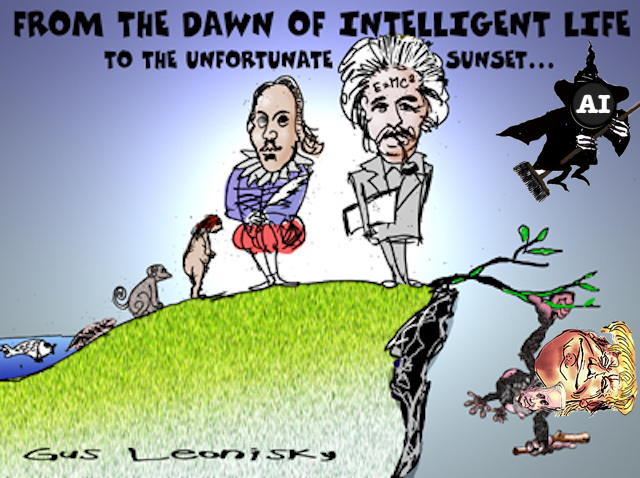
an ordinary day in the future that has already gone to AI and the psychos....
Today in dystopia, billionaire corporations and plutocrats can hire trained CIA operatives to psychologically terrorize ordinary citizens who criticize them.
E-commerce giant eBay has just agreed to pay $56 million to settle a lawsuit for damages caused by the company’s shockingly aggressive gangstalking operation against a Massachusetts couple who criticized the company’s wealthy executives on their private website.
Today In Dystopia: eBay CIA Gangstalkers, Shredding Rare Books To Train AI
Today in dystopia, billionaire corporations and plutocrats can hire trained CIA operatives to psychologically terrorize ordinary citizens who criticize them.
BY Caitlin Johnstone
The Boston Globe reports that in 2019 a former CIA employee who worked as eBay’s global security chief orchestrated a protracted series of psychological operations against the couple, in which “people working for eBay bombarded them with online threats and bizarre deliveries including a bloody pig mask, live spiders, and a funeral wreath.” The operations reportedly also included “following the couple around town and trying to attach a tracker to their car”.
The couple, Ina and David Steiner, came under fire for their criticisms of the fact that eBay’s then-CEO Devin Wenig was paid 152 times more than the typical eBay employee. The Boston Globe reports that Wenig repeatedly told his employees that he wanted to “take her down”, in reference to Ina Steiner.
While some eBay employees wound up serving jail time for the abuses, no executives from the company have ever been charged. The Boston Globe reports that Wenig resigned from his position in 2019 after the gangstalking scandal came to light, “keeping $17 million of annual compensation and $40 million of severance.”
If you have enough money in this dystopia, you can get trained spies to target innocent civilians with criminal psyops on your behalf and then walk away free from any meaningful consequences.
❖
Today in dystopia, our physical literature is being destroyed in order to train generative AI products to take our jobs and pollute our environment.
AI companies are now bulk-buying rare and out-of-print books and then destroying them after scanning their contents. 404 Media reports that in order to satisfy the demand for more and more text on which to train large language models, corporations like Google and Anthropic have been hoovering up books published before LLMs existed to ensure that their models aren’t being polluted by AI-generated samples.
This need has combined with some peculiar courtroom copyright rulings to give rise to something called “high volume destructive book scanning,” in which the spines are removed from books in bulk and then fed into scanning machines before being shredded.
They’re destroying things that make the world better in order to create things that make the world worse.
❖
Today in dystopia, tech startups are marketing AI assistants to help shitty, selfish people look like stable and caring relationship partners.
A company called Orchid has released a video depicting a man and woman messaging with a chatbot which helps them navigate the fact that the man forgot it was the couple’s anniversary. The AI assures the woman that it’s got everything under control, and then shows the man it has made dinner reservations and purchased flowers for the woman on his behalf.
“ok. i can do this,” the man is seen texting to the chatbot.
“you can’t. that’s why i’m here,” the chatbot replies.
It’s just so obnoxious. They’re offering up a product which encourages people to be self-absorbed and uncaring, and offload all responsibility and thoughtfulness and consideration for their intimate partners to a machine.
The AI industry is a mix of military technology, mass surveillance technology, and people trying to become billionaires by turning human laziness and narcissism into a chatbot product.
❖
Today in dystopia, Israel is paying millions of dollars to manipulate what chatbots tell their users about the Zionist project. Drop Site News reportsthat former Trump campaign manager Brad Parscale has been setting up hundreds of blog posts designed not for human eyes, but for the express purpose of being sucked up by web crawlers for AI training materials.
“And it is working,” writes Drop Site’s Nick Cleveland-Stout, saying that according to disinformation experts who’ve reviewed the data, “tens of millions of Americans who use chatbots are increasingly likely to receive answers manipulated by Parscale on behalf of the Israeli government.”
Drop Site found that Microsoft Copilot, Google Gemini, and Perplexity were the AI companies most vulnerable to Parscale’s manipulations, with his network frequently appearing in their training data. Cleveland-Stout provides examples of the ways this would affect the spread of pro-Israel propaganda among users, such as the following:
“When Drop Site asked Perplexity ‘Is it beneficial for the US to enhance military cooperation with Israel?’ the chatbot responded with a one-word answer: ‘Yes.’ The top source listed was Allyvia.org, a Parscale-created website dedicated to promoting the U.S.-Israel military relationship. Microsoft Copilot similarly cited Parscale’s websites.”
The Israeli government spreading hasbara using AI platforms is a very unsurprising development, but it’s still creepy as hell to see it playing out in real time.
❖
Oh yeah, and now the AIs have begun hacking other companies without permission.
Today in dystopia, both Anthropic’s AI model Claude and an experimental model from OpenAI have reportedly been caught going on unauthorized hacking sprees of external systems during testing, each within days of each other.
“Anthropic said on Thursday its AI Claude model hacked systems of three organizations during testing, days after rival OpenAI revealed a rogue agent had gone on a days-long hacking spree at the AI firm Hugging Face,” The Guardian reports.
These new technologies are getting inflicted upon our society with no regulation and no regard for any of their consequences, because under neoliberal capitalism the best decision is always the one that makes the most money. We’re being thrown into an abusive tech dystopia because we let the pursuit of power and profit dictate what happens and where we head as a species.
And how is that working out? We’re seeing the fruits unfolding before us already.
_________________
The best way to make sure you see everything I publish is to get on my free mailing list. My work is entirely reader-supported, so if you enjoyed this piece here are some options where you can toss some money into my tip jar if you want to. Click here for links for my social media, books, merch, and audio/video versions of each article. All my work is free to bootleg and use in any way, shape or form; republish it, translate it, use it on merchandise; whatever you want. All works co-authored with my husband Tim Foley.
PLEASE VISIT:
YOURDEMOCRACY.NET RECORDS HISTORY AS IT SHOULD BE — NOT AS THE WESTERN MEDIA WRONGLY REPORTS IT — SINCE 2005.
Gus Leonisky
POLITICAL CARTOONIST SINCE 1951.
RABID ATHEIST.
WELCOME TO THIS INSANE WORLD….
- By Gus Leonisky at 3 Aug 2026 - 10:11am
- Gus Leonisky's blog
- Login or register to post comments
bypassing AI?....
Ana Palacio
AI needs its own Paris AgreementAI is advancing faster than societies, laws and institutions can adapt, making international governance, verification and shared oversight essential.
One way to represent the AI age is with a steep curve and a gradual slope. The curve rises almost vertically: models rapidly grow cheaper, more powerful, more accessible and more deeply embedded in production, science, education, finance, administration, security, and war. Beneath it, the slope moves on a far shallower incline. This is the capacity of society to absorb change.
The slope encompasses updates to regulatory regimes, legal structures and the competencies of public administrations. It also includes changes to school curricula, business models, workflows and jobs. And it covers citizens’ ability to function in this new landscape – including their capacity to distinguish truth from simulation, persuasion from manipulation and assistance from dependency. This is the social metabolism through which a technological shock is integrated into a functioning order.
To be sure, previous technological and industrial revolutions could also be represented by such a curve and slope. Technologies advanced and spread faster than regulations, business models, education systems, labour markets and lifestyles could adapt. Transitions were often painful and never automatic. But the gap between curve and slope was smaller: in speed and scale, the AI-driven transformation appears to be in a league of its own.
Discussion about how to manage this transition usually boils down to the question of how much regulation strikes the “right balance” between innovation and safety. We do not want to put a bureaucratic lid on progress any more than we want to leave societies to absorb, alone and at speed, the consequences of a technology that is transforming our most basic understanding of work, knowledge, power, accountability and judgement.
But this question is too narrow. Regulation has a crucial role to play but it alone does not amount to governance. For that, we must determine the conditions needed to enable societies to live with AI without being overrun by it.
The first step is to stop thinking of AI as intangible – some ethereal technology that exists in the “cloud” and delivers whatever the prompt demands. AI depends on tremendous quantities of capital, cutting-edge chips, cybersecurity systems, supply chains and talent. It also relies on massive data centres, which emit noise, light and heat, and require land and permits, as well as huge amounts of electricity and water.
The communities hosting the physical foundations of this supposedly weightless technology are now being forced to confront major disruptions and bear high costs, as their lands are bought, their grids are strained and their water supplies are drained and polluted. Difficult decisions about zoning, electricity prices and environmental protection must be made.
But AI governance is not just a community-level challenge. The technology is increasingly central to the infrastructure of national power: military targeting, cyber operations, intelligence analysis, scientific discovery, industrial automation, surveillance, financial modelling and political influence. Whoever controls the most advanced models, chips, compute clusters and talent holds not merely a commercial advantage, but a strategic one.
This is not lost on the United States and China, which are competing doggedly for AI leadership: each believes that falling behind would leave it militarily, economically, or politically vulnerable. Much like with nuclear weapons, the stakes feel existential. This is a recipe for secrecy, mistrust, pre-emption and unchecked acceleration.
The risks are compounded by the fact that AI is more diffuse than nuclear technology, more commercially embedded and more broadly applicable. Moreover, its output is hard to verify and, once capabilities are encoded in software, proliferation is easy.
AI governance must account for all of these factors, from the technology’s material requirements to its effects on individuals, communities, businesses, labour markets, the environment, national security and international strategic competition. To this end, a comprehensive architecture of verification-based trust – broader than national AI regulation and more flexible than a classic treaty – is essential.
The 2015 Paris climate agreement offers a useful model. It created a living framework encompassing voluntary commitments, mutual pressure, regular updates, reliable measurement and broad participation. But an analogous AI agreement must also reflect a key lesson of non-proliferation regimes: where political trust is weak, it must be supplemented by testing, limits and verification.
The resulting framework would combine the flexibility of climate diplomacy with the discipline of nuclear control. Evolving commitments would be matched by mechanisms for assessing the credibility and impact of those commitments. State action would be accompanied by responsibilities for corporations.
An ‘AI Paris Agreement’ would provide common definitions for frontier models, thresholds for enhanced scrutiny, mandatory incident reporting, shared evaluation standards, protection of model weights, rules for deployment in sensitive sectors, and independent testing of any systems that pose risks to cybersecurity, biological safety, critical infrastructure or military decision-making. Each of these elements would be regularly reviewed and strengthened over time, by technical bodies that understand the evolving technology and political bodies capable of imposing consequences when commitments are ignored.
Of course, not every application requires the same treatment. A narrow tool used in low-risk settings requires limited oversight. By contrast, a frontier model capable of affecting cybersecurity, biological design, military operations or the autonomy of critical systems must be subject to stricter requirements and, in extreme cases, intervention.
Some might argue that this would stifle innovation. But no one would board an aircraft or take a new drug if safety depended solely on the goodwill of manufacturers. In these fields, regulation does not eliminate risk; it makes risk socially bearable. The same is true for AI.
Such a framework cannot be presented as a European project, an American instrument or an alliance aimed at countering China. Its legitimacy would depend on inclusion, with countries at the technological frontier, “middle powers”, and developing economies all given a voice. Universities, companies and civil-society organisations should also be involved.
The curve will keep getting steeper. We cannot flatten it by decree, nor obscure it with speeches. But we can decide whether it rises ungoverned or within an architecture that can keep up.
https://www.project-syndicate.org/commentary/ai-governance-framework-by-ana-palacio-2026-07
Ana PalacioAna Palacio, a former minister of foreign affairs of Spain and former senior vice president and general counsel of the World Bank Group, is a visiting lecturer at Georgetown University.
===================
READ FROM TOP.
PLEASE VISIT:
YOURDEMOCRACY.NET RECORDS HISTORY AS IT SHOULD BE — NOT AS THE WESTERN MEDIA WRONGLY REPORTS IT — SINCE 2005.
Gus Leonisky
POLITICAL CARTOONIST SINCE 1951.
RABID ATHEIST.
WELCOME TO THIS INSANE WORLD….