Search
Recent comments
- of genocides....
41 min 41 sec ago - give it up....
4 hours 25 min ago - drugs.....
15 hours 21 min ago - critics....
21 hours 44 min ago - davis cup 1959.....
21 hours 53 min ago - invasion....
2 days 55 min ago - we lost....
2 days 1 hour ago - liberating....
2 days 4 hours ago - no patriots...
2 days 11 hours ago - in between....
2 days 18 hours ago
Democracy Links
Member's Off-site Blogs
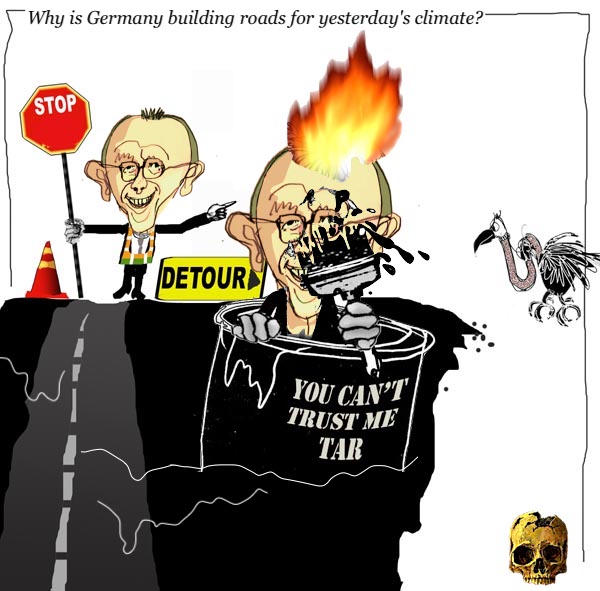
buckling concrete slabs, deforming asphalt and forcing temporary speed limits.....
Multi-day European heat waves with temperatures topping 104 degrees Fahrenheit (40 degrees Celsius) are increasingly leaving their mark on Germany's famed Autobahn — buckling concrete slabs, deforming asphalt and forcing temporary speed limits.
In early July alone, seven stretches of the country's highways had to be shut down completely for a time.
Why is Germany building roads for yesterday's climate?
Tim Schauenberg
As the Autobahn buckles under heat waves, Germany is still paving roads for a past climate. Engineers know how to fix that — so what's the holdup?
"The cause often lies in the bitumen — the petroleum-derived binder in asphalt. It's elastic and can soften at high temperatures, from around 60 degrees Celsius," a spokesperson from Autobahn GmbH, the company that manages Germany's highways, told DW.
Bitumen is a component in most of the country's roads.
When outdoor temperatures climb above 30 degrees Celsius, the surface of dark asphalt can quickly heat to double that or more in the sun and then deform. Using modern, bitumen-free asphalt mixes lowers the risk of such damage, according to Autobahn GmbH.
So, as heat waves intensify and traffic volumes rise, are Germany's roads built to last?
Autobahn need to be prepared for the heatGerman roads are "not designed for these stresses at all," said Nina Stelzenmüller. The engineer heads the road construction technology division at the Karlsruhe Institute of Technology (KIT) in southwestern Germany.
"The composition of the road surface is based on experience from the last 30 or 50 years," and not on the increasingly noticeable shifts in the climate, explained Stelzenmüller.
At present, road surfaces have to be designed for a temperature range of minus 30 degrees Celsius to plus 45 degrees Celsius, according to Autobahn GmbH. They are built, the company said, to withstand "the climatic stresses from heat and cold to be expected in Germany."
Yet in some regions of eastern Germany, temperatures could exceed that 45C maximum on certain days by the year 2040. That's according to climate models from Germany's National Meteorological Service (DWD), which assume emissions will remain high in the coming years and that global warming will continue to intensify.
A studyinvolving the research institute of Germany's federal transport ministry (BASt) likewise concludes that climate change is already pushing existing road materials to their limits, and that action is needed. But these findings have not yet translated into binding requirements for updating street surfaces.
Resurfacing as an opportunity: climate-ready asphalt for the futureEvery road resurfaced today needs to withstand temperatures that may only become reality decades from now. But there are plenty of ways to make Germany's vital road infrastructure heat-resistant for the medium to long-term.
A 2019 study, also involving BASt, found that dark asphalt heated up by 7C less when light-colored quartzite was mixed in. The researchers recommended applying reflective surface layers to roads and building in other cooling materials as quickly as possible. The study did not examine the cost or durability of such heat adaptations.
According to Autobahn GmbH, lighter-colored stone is already being used in construction in some cases. The regional availability and cost of such stone also play a role in its use, said the company.
Individual states and cities are also testing and planning light-colored road surfaces, including in the western German cities of Oberhausen and Stuttgart, as well as the eastern state of Brandenburg.
Just scattering light-colored quartzite over the asphalt surface could also help, according to Stelzenmüller, and would be a short-term, feasible approach.
Global models: water in the asphalt and reflective coatingsGermany isn't alone in facing increasingly hot roads. Infrastructure needs to be adapted worldwide.
Tokyo, for example, already uses reflective, water-retaining road surfaces as standard when resurfacing streets. These can lower the surface temperature by 8 to 10 degrees Celsius. By 2030, some 152 miles (245 kilometers) of roads in the Japanese capital are to be fitted with them.
In Phoenix, in the US state of Arizona, light-colored coatings have also already been applied to numerous streets. They reflect more sunlight, so absorb less heat. During the day, they were around 6.7 degrees Celsius cooler than conventional surfaces. But at the same time, this noticeably warmed the ambient air for passersby.
But Germany, like many other countries, is still a long way from the systematic use of suitable road surfaces to combat heat damage. And even as average temperatures keep rising, the challenge remains that the road surface also has to stay stable in freezing winter conditions.
As an alternative to bitumen, high-performance binders that can survive both extremes — frost and heat — are currently being developed, said Stelzenmüller.
"For one thing, they're especially elastic, so that at low temperatures they can still bear the stresses caused by the cold. But at the same time they also have a very high strength, which allows them to withstand deformation at high temperatures," explained the engineer.
Policy lags behind the researchA great deal of research on climate-adapted road construction already exists, according to Stelzenmüller.
"But by the time these findings are actually written into regulation and roads are routinely built with them — that's a process that will take years if not decades. I don't expect it can be implemented in the next two or three years," she added.
The heat-ready overhaul of the infrastructure could happen faster if the transport ministry and the road-construction authorities pushed the issue. That's what happened with the tightening of pollutant limits in the development of asphalt mixes.
In 2025, Germany's transport ministry ordered that less-toxic surfaces be adopted "as quickly as possible," even before a new directive on the issue officially took effect.
"There was a real sense of urgency to meet those limits. And here it worked out [quickly], establishing new regulations within a few years," she said.
For road construction that is adapted to climate change and fit for the future, authorities need to take a similar approach, said Stelzenmüller.
"If you put a stronger focus on it, you could certainly have new types of asphalt within a few years," Stelzenmüller added.
By the time of publication, Germany's transport ministry had not responded to DW's request for comment.
This article was translated from German by Josh Axelrod.
https://www.dw.com/en/why-is-germany-building-roads-for-yesterdays-climate/a-78130975
PLEASE VISIT:
YOURDEMOCRACY.NET RECORDS HISTORY AS IT SHOULD BE — NOT AS THE WESTERN MEDIA WRONGLY REPORTS IT — SINCE 2005.
Gus Leonisky
POLITICAL CARTOONIST SINCE 1951.
RABID ATHEIST.
WELCOME TO THIS INSANE WORLD….
- By Gus Leonisky at 29 Jul 2026 - 7:22am
- Gus Leonisky's blog
- Login or register to post comments
firewave....
Europe’s “firewave” and global capitalism’s climate crisis
Thomas Scripps
French authorities are actively considering the evacuation of Bordeaux, with a population of over 250,000 and a metropolitan area inhabited by 850,000 people. Home to some of the most prestigious vineyards in the world, it has stood for more than 2,000 years and over a third of the city is a designated UNESCO World Heritage Site.
All of which is now covered in thick smoke, produced by a wildfire which has already burned through a record area of land and forced the evacuation of 200,000 people in its path—bringing the total number of people displaced by fires across Europe to 400,000. The heat and haze are now generating their own thunderstorms, bringing lightning strikes which can worsen the blaze.
That this can be happening in one of the 10 richest countries in the world, in the continent with the highest levels of per capita social spending, is an unanswerable indictment of capitalism.
Government negligence and underfunding have allowed the fires to grow in poorly managed forests and undermined attempts to contain them. A spokesperson for the National Firefighters Federation of France, whose members are risking their lives daily to contain the inferno, told reporters bluntly, “It’s a David-versus-Goliath scenario.” Personnel and equipment are so scarce that European officials have warned fires may be burning into November.
Workers must demand and fight for the resources needed to mount an urgent and massive response to the crisis and improve the continent’s readiness for the future. But to carry out such measures without also tackling the social system producing these disasters is like firefighting on the slopes of a volcano.
Economic and social life is so mismanaged, so dominated by the profit interests of an obscenely rich few, that a damaged climate is endangering millions even in the most technologically developed parts of the globe. More fires are burning in Spain, Italy, Greece and the UK, as well as other areas of France, threatening areas close to Madrid, Valencia and Paris. Only weeks ago, North America was blanketed in toxic wildfire smoke.
Scientists at Imperial College London have been moved to coin the term “firewave,” described by Professor of Fire Science Guillermo Rein as “the wildfire equivalent of a heatwave: a period of exceptionally high wildfire activity that overwhelms the emergency response of a city, region or nation.”
These events have been made far more likely and severe by the raising of the Earth’s average temperature through fossil fuel emissions. They are the product of prolonged and record heat waves—Britain is now entering its fourth this year—and worsening drought.
Besides contributing to the wildfires, these conditions have already killed well over 10,000 people across the continent—as many as 25,000 according to an estimate from Indiana University—and injured an estimated 277,000 workers. They have caused billions of euros of economic damage, especially to agriculture.
Scientists have warned for decades about Europe’s exposure to these dangers. But a ruling class which already proved its indifference to human suffering during the Covid pandemic did nothing to prevent them.
As far as the oligarchy is concerned, this is simply the cost of doing business—paid by other people through their lives, health and taxes. What are a few tens of thousands of deaths in June, possibly the city of Bordeaux in July, and who knows what else in August, against the billions to be made disregarding the costs of climate change?
For the world working class, this is a grave warning and must be a spur to action. Today’s environmental disasters are taking place with the Earth only on the threshold of breaching 1.5 degrees Celsius global heating above the pre-industrial average. Most authoritative forecasts warn of the world’s capitalist governments taking the planet to close to double this (2.8C) by 2100.
The consequences—not only extreme heat and drought but flooding and storms—worsen exponentially with each tenth of a degree.
As the authors of these studies warn, the impact will fall hardest on exposed poorer countries in Africa and South Asia. Imperialism denied these countries any opportunity to lay the foundations of a modern, sustainable economy and now lumbers them with the worst outcomes of fossil fuels’ rampant overuse by the super-rich.
Just this week, Uganda began emergency food handouts after 19 people were reported dead by starvation, amid a prolonged drought which has placed 1.5 million people at risk.
Extreme weather connected with the El Niño weather pattern is predicted by Goldman Sachs analysts to produce a nearly 16 percent surge in global commodity food prices into 2028. An investment bank provides this information because, under capitalism, those with influence are more concerned about the impact on their stock trades than on human lives.
Meanwhile, the United Nations’ World Food Programme and Food and Agriculture Organization are reduced to begging governments for $202 million for minimal measures to protect 8.8 million people across 22 high-risk countries. Less than a fifth has been received.
The consequences of climate change are bound up with all the morbid symptoms of capitalism in its death agony.
Environmental disasters produced by climate change are fuelled by emissions from economies churning out armaments and storing up the energies of the next financial explosion. The consequences—poverty and war—leave vast swathes of humanity especially vulnerable to droughts, heat waves, floods, storms and the wider spread of viruses.
At the same time, environmental crises intensify the military scramble for resources and slash workers’ incomes. A recent report on 6-10 percent annual wage losses for India’s agricultural, construction and transport workers due to 2024’s extreme heat described it as a “poverty multiplier.”
The current epicentre of these mutually reinforcing disasters is the Horn of Africa, home to 140 million people—a figure expected to double by 2050. It is impacted by drought and other forms of extreme weather, the fertiliser crisis caused by the US war on Iran, and the destruction and displacement brought by major local conflicts. Close to 40 million people are threatened with acute food insecurity, including nearly 5 million children with acute malnutrition.
Never before has a social system been so destructive as to put the most basic condition of civilisation, the global natural environment itself, at risk—not only from the acute catastrophe of nuclear war, but the chronic disaster of global warming and environmental collapse.
Like war, the climate crisis is one of the defining issues of our time, which the international working class must either suffer or solve. It is not, as right-wing politicians and their many media sounding chambers claim, a “lifestyle” question of interest only to the affluent middle class, but a life-or-death question for every worker. It is not, as the green movement claims, a question of personal responsibility, but of collective class struggle.
And it is an unavoidably revolutionary question.
In June, the World Inequality Lab released a “Global Justice Report.” Based on a large collection of natural scientific, economic and social studies, it demonstrates the material possibility of providing a vastly higher standard of life for the overwhelming majority of the population while limiting global heating to 2C by 2100 and investing in adaptation measures to deal with the consequences.
However, the authors propose to do so with global wealth taxes up to 20 percent and global income taxes up to 90 percent. This only serves to prove the uselessness of all such reformist pipe dreams.
The oligarchy to which these taxes would apply will not relinquish a single cent. Its multi-millionaire and billionaire members are proving in America and beyond that they would rather see a dictatorship than a depreciation of their assets. Donald Trump, trampling on democracy and encouraging an orgy of fossil fuel extraction, is the foul individual embodiment of this class reality.
The social wealth monopolised by the super-rich, and with it the power to direct the fate of humanity, must be expropriated through the struggle of the working class. Only through democratic, scientifically informed planning can a situation in which society has enough productive power to drastically alter the climate of the planet, but apparently not to feed and protect all its citizens, be ended.
This is the perspective of world socialist revolution which must be taken up by the workers of Europe now being burned out of their homes and of the whole world threatened with the results of capitalism’s climate crisis.
https://www.wsws.org/en/articles/2026/07/28/sxok-j28.html
READ FROM TOP.
PLEASE VISIT:
YOURDEMOCRACY.NET RECORDS HISTORY AS IT SHOULD BE — NOT AS THE WESTERN MEDIA WRONGLY REPORTS IT — SINCE 2005.
Gus Leonisky
POLITICAL CARTOONIST SINCE 1951.
RABID ATHEIST.
WELCOME TO THIS INSANE WORLD….