Search
Recent comments
- more heads.....
52 sec ago - blackcore....
2 hours 43 min ago - removed.....
15 hours 12 min ago - explosion.....
16 hours 42 min ago - crowded....
22 hours 50 min ago - overboard.....
23 hours 51 min ago - low risk...
1 day 1 hour ago - new nato....
1 day 1 hour ago - non-citizen?....
1 day 3 hours ago - free....
1 day 3 hours ago
Democracy Links
Member's Off-site Blogs
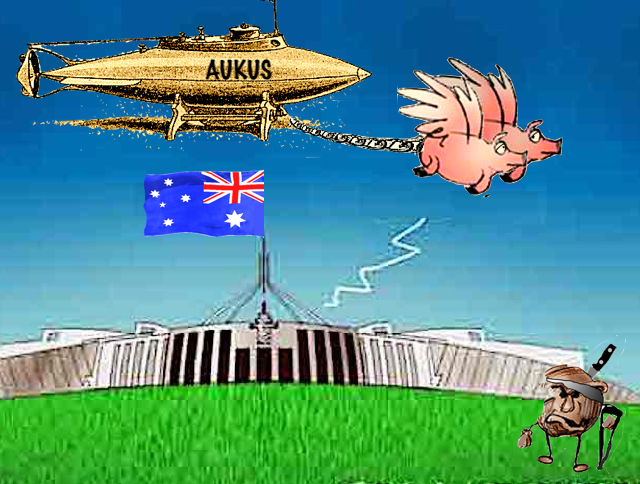
no subs yet? barking dogs and flying pigs could do the same job....
With more than a third of the US fast-attack submarine fleet sidelined by maintenance delays, the assumptions behind AUKUS Pillar 1 are looking less credible by the year.
The US shipyard crisis sinking AUKUS
More than 18 of the US Navy’s 48 in-service nuclear attack submarines (SSNs) are alongside, idle awaiting docking. This is a clear indicator of a structural crisis threatening the core of American undersea power. While official communiqués refer to these setbacks as “cyclical maintenance bottlenecks,” primary-source data from the US Government Accountability Office (GAO) paint a more difficult and worsening picture.
The limited public data indicates the problem is deteriorating. In 2018, the GAO reported that nearly 30 per cent of the attack submarine fleet was out of service and awaiting or undergoing maintenance, against a target of less than 20 per cent. The July 2026 GAO report, Navy Readiness: Attack Submarine Fleet Readiness, confirms that this has worsened: at least 37 per cent of the US Navy’s fast-attack submarine fleet is non-operational while awaiting maintenance.
For Australia, this poses a pressing challenge. The planned sale of three Virginia-class submarines to the Royal Australian Navy (RAN) starting in 2032 is tied directly to the health of the US submarine capability and its related industrial base. The latest metrics indicate that the probability of this sale occurring, already minimal, continues to decline based on primary source data.
The root causes: strategic contraction and planning failure
Today’s US shipbuilding crisis is not merely a transient operational failure; it is a self-inflicted, multi-decade structural legacy of decisions made in the early 1990s. Following the end of the Cold War, US defence leadership sacrificed shipbuilding capacity and long-term industrial reconstitution planning in pursuit of a post-Cold War “peace dividend.”
During World War II, as early as 1943, US planners systematically evaluated how to transition industrial capacity and workforce skills to a peacetime economy and back. Conversely, during the post-Cold War drawdown of the 1990s, public oversight personnel and shipyard infrastructure were slashed without planning for how the enterprise would reconstitute shipbuilding capacity when required. The primary focus became personnel reductions and short-term efficiency rather than cradle-to-grave industrial management. Lacking elasticity, the current industrial base cannot support concurrent major construction and fleet maintenance.
Shipyard limits and the backlog
The maintenance backlog is driven by the capacity limits of the four US public shipyards: Norfolk, Portsmouth, Puget Sound, and Pearl Harbor. Compounding this is the strict control of technical data rights by the two private companies building Virginias, which introduces administrative delays when public shipyards attempt to source components or access software. Furthermore, the US Navy cannot easily shift this overflow to private yards, as those facilities are fully committed to constructing new Virginia-class hulls (at a baseline delivery rate of 1.1–1.2 boats per year) and the next-generation Columbia-class ballistic missile submarines – the Pentagon’s highest strategic priority.
Workforce shortages and systemic attrition
The primary bottleneck within the repair pipeline is a severe shortage of civilian industrial labour, which has created deep operational hurdles and high attrition within the public shipyard workforce:
- Workforce Deficits: Public shipyards face an 18 per cent workforce shortage relative to the volume of repair tasks assigned to them. The US Navy’s target for stable operations is a maximum 3 per cent labour deficit.
- Overtime Reliance: To bridge this capacity gap, shipyards rely heavily on overtime. Shipyard personnel face sustained overtime rates between 25 per cent and 32 per cent, periodically spiking to 45 per cent.
- Resignations and Attrition: This sustained workload has caused civilian resignations to double, pushing yearly attrition toward 14 per cent to 16 per cent in critical technical shops.
Compounding this is a distinct loss of senior corporate knowledge, driven by recent top-down personnel reductions across the Department of Defense (DOD) that cut the broader civilian workforce by 9.9 per cent (78,375 employees). As a result, shipyards processed thousands of early retirements under the Voluntary Early Retirement Authority (VERA), accelerating the departure of senior master tradespeople and certified nuclear inspectors. Concurrently, first-to-fourth-year apprentice attrition routinely exceeds 20 per cent due to burnout, leaving shipyards with a less experienced workforce that takes longer to execute complex tasks.
The human cost to crews: lessons from allied failures
While civilian shipyard workers face production pressure, the resulting maintenance delays create distinct human costs and severe retention challenges for the active-duty naval crews assigned to the idle vessels:
- Skills Degradation: When a submarine is stuck at a pier for three to five years, crew skills degrade because the vessel is not at sea, preventing junior personnel from completing their certifications.
- Wider “Skills-Fade”: As Rear Admiral Phil Mathias observes, “skills-fade” is not confined to individuals or a single crew, but spreads across the entire submarine force—resulting in fewer and less well-prepared prospective commanding officers and, ultimately, fewer command-qualified officers.
The British parallel: a deeper structural failure
This human and industrial crisis is not unique to the US – the United Kingdom’s submarine enterprise suffers from the exact same post-Cold War structural causes, but is deeper and further advanced. Decades of underinvestment, public shipyard rationalisation, and industrial fragmentation have left the Royal Navy with a severe maintenance queue and acute operational availability deficits as documented by the UK House of Commons Defence Committee.
The UK is much further down this slippery slope and may be irrecoverable; it has qualified less than half the number of commanding officers it needs over the past 10 years and today has no command-qualified submariners in the naval hierarchy or leading its submarine capability.
To compensate for personnel shortfalls on active missions, the US Navy – like the Royal Navy – frequently relies on short-notice postings, moving sailors and officers off their assigned, idle submarines to deploying vessels at the last minute. This disrupts crew cohesion and family stability, impacting morale. This environment disproportionately impacts highly skilled technical personnel, such as nuclear, sonar, and fire control technicians, who increasingly choose to leave the military for commercial technology and energy sectors.
Implications for AUKUS Pillar 1
These personnel and industrial deficits directly impact the viability of the AUKUS plan for Virginias to be sold to Australia to avoid a capability gap as the Collins class retires and we await the arrival of the UK-designed SSN-AUKUS – a program that remains highly vulnerable to delays.
The US submarine industrial base currently produces Virginia-class hulls at a rate of 1.1–1.2 vessels per year. To meet domestic commitments and supply Australia with three submarines, production must reach 2.33 boats per year. However, the US Navy recently informed Congress that the timeline to achieve a production rate of even 2.0 hulls per year has slipped to 2032.
Under the US National Defense Authorization Act (NDAA), the US President cannot legally sell a nuclear-powered submarine to a foreign partner unless they certify to Congress that the transaction will not degrade domestic US undersea capabilities. With more than 37 per cent of the operational fleet sidelined and crews facing growing readiness strain, providing this certification faces significant political and legal obstacles.
The data indicates that the industrial assumptions underlying AUKUS Pillar 1 are fundamentally misaligned with the reality of shipyard output. The US in service SSN force is facing an availability crisis that threatens both its hulls and the retention of its most vital technical personnel. The delivery of new SSNs is not keeping pace with the retirements of the ageing Los Angeles class, causing the number of in service submarines to remain under severe strain.
The maintenance queue for submarines in service is almost double the 20 per cent norm and deteriorating, impacting individual and crew readiness and morale. Personnel numbers and experience levels in the shipyards and submarine crews remain understrength and heading in the wrong direction. Its impact will be felt across the US submarine capability for years to come, precisely while the US is attempting to scale up construction for twelve new Columbia-class SSBNs and thirteen larger Block V/VI Virginia-class SSNs.
The sale of three second-hand Virginias starting in 2032 from the US Navy’s straitened in-service force, in date for maintenance and with 15 years of reactor life remaining is becoming ever more unlikely.
For Australia, the US and UK industrial crises offer a stark lesson: establishing and sustaining a sovereign submarine capability requires whole-of-economy planning across a multi-decade lifecycle. It demands a cradle-to-grave strategy that integrates civilian skill pipelines, defence management and civil-military career transition pathways over 20 – 30 year horizons.
Australia cannot afford to wait for a capacity turnaround that current data shows is heading the wrong way; Canberra, Washington and London must evaluate alternate maritime strategies before Australia finds itself without an undersea deterrent capability.
https://johnmenadue.com/post/2026/07/the-us-shipyard-crisis-sinking-aukus-2/
PLEASE VISIT:
YOURDEMOCRACY.NET RECORDS HISTORY AS IT SHOULD BE — NOT AS THE WESTERN MEDIA WRONGLY REPORTS IT — SINCE 2005.
Gus Leonisky
POLITICAL CARTOONIST SINCE 1951.
RABID ATHEIST.
WELCOME TO THIS INSANE WORLD….
- By Gus Leonisky at 24 Jul 2026 - 6:44am
- Gus Leonisky's blog
- Login or register to post comments
a con job....
https://www.youtube.com/watch?v=cv1ZuG5lJ9o
AUKUS Was Never About Defending Australia
AUKUS was a dud deal from day one. Not only is it costing the Australian people nearly $400B, it also all but guarantees our involvement in future US wars and military action.
Australia's foreign policy should be independent, with the goal of actually defending Australia -- not furthering US interests. It's time to end AUKUS.
Join the calls to end AUKUS: https://greens.org.au/campaigns/get-o...
---
JOIN THE GREENS: https://greens.org.au/join
READ FROM TOP.
PLEASE VISIT:
YOURDEMOCRACY.NET RECORDS HISTORY AS IT SHOULD BE — NOT AS THE WESTERN MEDIA WRONGLY REPORTS IT — SINCE 2005.
Gus Leonisky
POLITICAL CARTOONIST SINCE 1951.
RABID ATHEIST.
WELCOME TO THIS INSANE WORLD….
yesterday...
POSTED ON 6 Jun 2015
READ FROM TOP.
PLEASE VISIT:
YOURDEMOCRACY.NET RECORDS HISTORY AS IT SHOULD BE — NOT AS THE WESTERN MEDIA WRONGLY REPORTS IT — SINCE 2005.
Gus Leonisky
POLITICAL CARTOONIST SINCE 1951.
RABID ATHEIST.
WELCOME TO THIS INSANE WORLD….
bottleneck....
Peter Briggs
AUKUS Infrastructure, part 2: The Henderson bottleneckIn the second of a six-part series on AUKUS infrastructure, the focus shifts to Henderson, where fragmented land tenure, commercial disruption and regulatory delays could block the facilities needed to sustain nuclear-powered submarines.
While Part 1 of this series outlined the technical constraints and the missing graving dock required for heavy nuclear submarine sustainment, the physical space to build that infrastructure remains locked in an administrative logjam.
To execute AUKUS Pillar 1, the Commonwealth and Western Australian Governments announced the creation of a consolidated Defence Precinct at Henderson, south of Perth. This precinct is designed to house both heavy surface ship construction and the heavy depot maintenance facilities for Australia’s future fleet of nuclear-powered attack submarines. However, translating a high-level master plan into certified waterfront infrastructure reveals an on-the-ground reality defined by fragmented land tenure, displaced commercial operations, severe physical encroachment, and competing naval priorities.
The land-tenure patchwork and commercial disruption
The primary obstacle at Henderson is not an absence of physical land, but who owns and occupies it. Unlike greenfield developments, the Henderson waterfront is a densely developed commercial maritime hub. Realising the Defence Precinct requires the Commonwealth and WA Governments to amalgamate dozens of separate land titles, negotiate complex lease buyouts, and relocate active commercial shipbuilders, offshore supply bases, and civil engineering firms.
Relocating established commercial tenancies is not a simple administrative transfer. To maintain regional maritime capacity and avoid disrupting the Western Australian economy, state authorities must construct alternative facilities elsewhere along the Western Trade Coast before existing tenants can be displaced. Designing, funding, and building replacement commercial quays and laydown areas will take years, pushing the start of heavy nuclear-certified civil works well into the late 2020s or early 2030s.
Physical constraints and co-location congestion
Even if land titles are successfully consolidated, the Henderson precinct faces severe physical and spatial limits. Bounded by existing road network corridors, residential buffers, and shallow water approaches, the site lacks the an easily expandable footprint.
The new nuclear sustainment facilities must share this constrained waterfront with high-priority surface vessel programs:
Governance transparency and the statutory clock
A stark contrast exists in how capital works are governed across Australia’s two primary submarine hubs. While infrastructure spending at Osborne is channelled through a Government Business Enterprise that bypasses traditional public works scrutiny, capital outlays at Henderson fall under standard Federal Parliamentary Standing Committee on Public Works oversight. Every major expenditure must undergo formal business-case development, environmental impact assessments, and public parliamentary hearings. While this guarantees transparency, it also adds strict statutory timeframes that cannot be shortcut.
This administrative reality collides directly with the US legislative framework. Under US Code (10 U.S.C. § 10431 / NDAA Section 10431), the US President cannot legally transfer a Virginia-class submarine unless it is formally certified that the transfer will not degrade US undersea capabilities and that Australia possesses certified, secure infrastructure to maintain the vessels.
If Henderson’s land tenure, environmental approvals, and civil construction slip past 2032, Australia will face a multi-year capability vacuum. Washington will retain both the legal duty and the political justification to defer or cancel Virginia-class transfers altogether, leaving Australia’s strategic posture stranded.
https://johnmenadue.com/post/2026/07/aukus-infrastructure-part-2-the-henderson-bottleneck/
READ FROM TOP.
PLEASE VISIT:
YOURDEMOCRACY.NET RECORDS HISTORY AS IT SHOULD BE — NOT AS THE WESTERN MEDIA WRONGLY REPORTS IT — SINCE 2005.
Gus Leonisky
POLITICAL CARTOONIST SINCE 1951.
RABID ATHEIST.
WELCOME TO THIS INSANE WORLD….