Search
Recent comments
- and god said....
9 hours 36 min ago - walking east....
10 hours 13 min ago - part 1 and 2.....
10 hours 23 min ago - bastard pig....
10 hours 33 min ago - accidental....
21 hours 47 min ago - momentum...
1 day 6 hours ago - the greatest....
1 day 6 hours ago - cold place, warm people.....
1 day 9 hours ago - profitering....
1 day 9 hours ago - tobogganning....
1 day 9 hours ago
Democracy Links
Member's Off-site Blogs
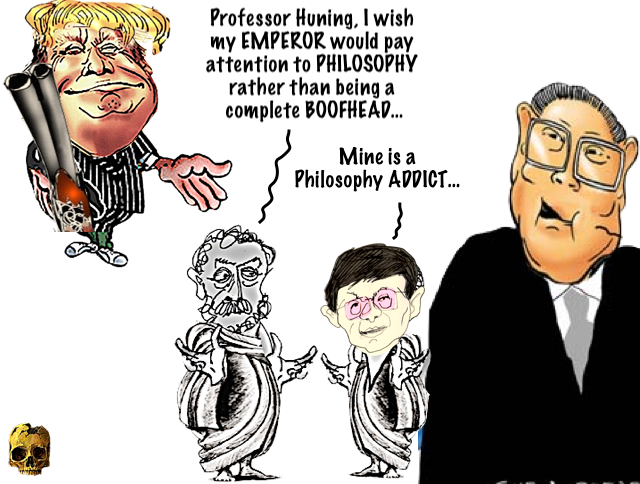
of ruthless empire and enlightened philosophy....
Search the official photographs of Chinese state occasions across three decades and you will find him. A few steps back, slightly to the side, watching. A lean man in a dark suit whose face, in image after image, carries the same expression. No performance of confidence. No display of authority. Something quieter and harder to name: total attention. The attention of a man who has decided that his job is to see clearly and that being seen interferes with seeing.
The Architect of the Long Why
BY FLAVIO M.
His name is Wang Huning. He is seventy years old. He has served at the innermost center of Chinese Communist Party power under Jiang Zemin, Hu Jintao, and Xi Jinping — three men of different temperaments, different priorities. Each transition in Chinese politics is, by the standards of any other major power, a transformation. New direction, new language, new faces ascending and descending. Wang ascended through all three. He is currently the fourth-ranking member of the Politburo Standing Committee, the seven-person body that governs China, and chairman of the Chinese People's Political Consultative Conference. He got there without ever having governed a province, a city, or a ministry. Every other member of the Standing Committee climbed through executive responsibility. Wang climbed through thought.
In China he is called guóshī — a term from imperial history, reserved for the senior advisers who stood behind the throne and shaped what the throne believed about itself and its mandate. The title is informal. The role is real.
In the West, we do not have a name for what he does. The nearest approximation is court philosopher — but court philosophers write for posterity and Wang writes for the institution. The nearest political approximation is chief ideologue — but ideologues are usually prisoners of the movement that produced them, and Wang has survived three movements.
What Wang does is fundamental: he provides the language in which power explains itself to itself. Not the slogans — the architecture beneath the slogans. The reason why obedience is deserved.
II. Shanghai, Iowa, and a diagnosis
Wang Huning was born in 1955 in Shanghai, the son of Red Army parents who had fought in the Shanghai Campaign of the Civil War and stayed. His father, a military official, was caught in the anti-Peng Dehuai campaign launched by Mao and persecuted during the Cultural Revolution. His mother was repeatedly hospitalized.
Wang and his two older brothers were left largely to their father's chosen remedy for the chaos outside: the door was locked, and the boys were required to copy the Selected Works of Mao or read whatever books were available. The Cultural Revolution, which destroyed so much, produced in Wang a calm that former colleagues would later describe as almost unnerving — and a reading habit that never left.
He came to political science through Fudan University, where he completed a master's thesis on Western sovereignty theory from Bodin to Maritain that his committee called a serious attempt to systematically engage with bourgeois political thought. By twenty-nine he was an associate professor — the youngest in China at the time. Students wrote to him for guidance. Senior officials asked him to speak. He found the attention exhausting and said so in an interview: what he wanted was quiet, time to write, time to think.
In 1988, Fudan sent him to the United States for six months — the University of Iowa, three weeks at Berkeley, visits to more than thirty cities and nearly twenty universities. He arrived as a specialist in Western political theory. He left as something harder to categorize: a man who had seen the system he had studied from the inside, and found it less than its admirers claimed and more than its critics acknowledged.
The book he published three years later, America Against America, is written, Wang said, to show that America contains contradictions that cannot be dismissed with a single sentence. He had no interest in the old Maoist caricature of American society as pure exploitation. He was equally uninterested in the new Chinese fantasy of America as a paradise without flaw. What he saw was a society in genuine tension with itself: individual freedom so expansive that common purpose had become nearly impossible to sustain; political competition so institutionalized that unity, when the country needed it, was structurally difficult to achieve; a prosperity that was real and a social cohesion that was quietly fraying beneath it.
The conclusion he brought home was not triumphalist. It was cautionary. Modernization without cultural continuity produces disintegration. The West had made its choice and was living with the consequences. China could not afford the same trajectory.
That analysis sounds, in 2026, less like a political position and more like a description of observable reality. Which is either a vindication of Wang's diagnosis or a reflection of how thoroughly his framing has shaped the lens through which China watches the West. Probably both.
III. The Soviet lesson and the summons
In December 1991, the Soviet Union ceased to exist. For the Chinese Communist Party this required an autopsy of a system that had looked, from the outside, like theirs.
The Party studied the collapse with the attention of people who understood that what had happened in Moscow could happen in Beijing. The conclusion: the Soviet leadership had not been defeated. It had been hollowed out.
In the end the apparatus no longer knew what it stood for. The ideology had become ritual, then embarrassment, then silence. When the system came under pressure it had nothing to say about why it deserved to survive. The language of legitimacy had atrophied, and without it the structure dissolved faster than anyone had imagined possible.
Wang had been writing about exactly this problem — the relationship between political culture, ideological coherence, and state stability — since the mid-1980s. He had argued that China's reform process was producing a dangerous vacuum: the old Maoist framework discredited, the new market economy generating values the Party had not yet found language to absorb, a society in rapid transformation with no coherent story about what it was becoming or why the Party should lead it there.
In 1995, Jiang Zemin summoned him to Beijing.
Wang closed his academic career, severed most contact with former colleagues, stopped publishing, stopped giving interviews. The scholar who had wanted quiet and time to think went somewhere quieter still — into the machinery of the Party's Central Policy Research Office, where his job was to think for the institution rather than for the record. He would remain there for twenty-five years, the longest tenure in the office's history. He rose through the Central Committee, the Secretariat, the Politburo, and finally to the Standing Committee in 2017 — the only member of that body who had never run anything larger than a research office.
What Jiang understood, and what Wang's subsequent career confirmed, is that there are two distinct skills in political life that are usually conflated. One is the ability to exercise power — to make decisions, manage institutions, allocate resources, enforce compliance. The other is the ability to explain power — to provide the framework within which decisions make sense, within which the institution understands its own purpose, within which citizens find reasons to accept authority that do not reduce to fear. The first skill produces officials. The second produces something rarer: the man who makes the officials' work legible to themselves.
Party functionaries know how power operates. Wang knows why power deserves to operate. In a moment when the Party needed to restate its reason for existing, the second knowledge mattered more than the first.
IV. Three rulers, one architecture
Wang's output across three decades is one argument restated in the idiom each moment required.
The problem he inherited in 1995 was acute. The Party had spent the Deng years presiding over an economic transformation that had produced capitalists, entrepreneurs, and a new professional class — none of whom fit the original Marxist description of who the Party represented. The ideological framework said: party of the working class. The economic reality said: party of whoever is generating growth. The gap between the two was not merely embarrassing. It was a structural vulnerability. An institution that cannot explain what it is cannot sustain loyalty across generations.
Wang's solution under Jiang Zemin was the Three Represents: the Party represents China's most advanced productive forces, its most advanced culture, and the interests of the overwhelming majority. Four words replaced four decades of class analysis. Capitalists could join the Party — because the Party's principles, properly understood, had always been about national development rather than class struggle. It was reinterpretation so smooth it barely announced itself as such. The framework did not break with the past. It absorbed the present into a past that had been quietly rewritten to accommodate it.
Under Hu Jintao, the problem shifted. Rapid growth had produced inequality, corruption, and social tension that threatened the stability Party legitimacy depended upon. The Harmonious Society was Wang's response: not a promise of equality — China's growth model could not sustain that promise — but an invocation of cohesion. Differences could exist. They could even be large. What they could not do was tear the fabric. The concept drew on Confucian ideas of social order that predated the Party by millennia, which was precisely its strength: it grounded the Party's authority in a civilizational tradition deeper than any particular ideology, one that Chinese people recognized in their bones as the alternative to chaos.
Under Xi Jinping, Wang's architecture has reached its most ambitious expression. The Chinese Dream — collective rebirth after a century of humiliation, China's restoration to the civilizational position it has occupied for most of recorded history — borrowed the American Dream's grammar and inverted its meaning. Where the American version promises individual ascent, the Chinese version promises civilizational return. The individual recedes. The nation advances. Xi Jinping Thought, quite probably distilled and curated by Wang..
What makes Wang different from an ordinary ideologue is his relationship to time. Ordinary ideologues write for the current leadership. Wang writes for the institution across generations. His frameworks are designed to remain usable for the next half-century — adaptable enough to absorb changing circumstances, durable enough to provide continuity across leadership transitions. That is precisely the distinction between propaganda and ideology. Propaganda tells you what is true today. Ideology tells you why it was always going to be true.
V. What Dörner found, and Wang already knew
Dietrich Dörner, a German psychologist working in Bamberg in the 1970s and 80s, ran experiments that Wang Huning never read and would not have needed to. Dörner gave intelligent, well-intentioned people control of simulated complex systems — a development region in Africa, a small German town, a nuclear reactor — and watched them fail. The failures were consistent enough to become a taxonomy.
In Tanaland, a community of shepherds, they drilled wells and the water table dropped. They improved healthcare and the population outgrew the food supply. They killed pests and predators starved. Each solution generated the next crisis, invisible until it screamed. They fixed what screamed. They ignored the field. Repair-service behavior: the substitution of the immediately visible problem for the underlying system that keeps producing problems.
In Lohhausen, in a clock factory, they cut costs, fired workers, launched products. Each decision seemed rational. Together they accelerated the collapse of what they were trying to save. They applied what had worked before to a situation that had fundamentally changed. Methodism: the conversion of past success into present dogma.
At Chernobyl, the operators overrode safety systems because overriding safety systems had always been fine before. The positive reinforcement of a thousand small violations taught them that the rules were for other people — until the reactor proved otherwise.
Dörner's taxonomy: short-term focus, side-effect neglect, exponential blindness, methodism, ballistic decisions — shoot, forget, move to the next problem, never ask what the intervention created downstream. Not the failures of bad people. The default settings of minds built for a simpler world than the one they were trying to manage.
Dörner worked with individuals. The question his work implies but never quite asks is: what happens when an institution amplifies these traps rather than dampens them? What happens to a civilization whose Why — whose account of what it is for, across generations — is too short, too narrow, too blind to consequence to catch the error before the error becomes catastrophic?
VI. September 2008
On September 15, 2008, Lehman Brothers filed for bankruptcy. Within weeks, credit markets had seized across the Western world, stock markets had shed a third of their value, and governments were discovering that the financial system they had spent thirty years deregulating had been, at its operating core, a machine for moving risk from those who understood it to those who did not — until the morning when everyone held it simultaneously.
Every trap in Dörner's taxonomy, at civilizational scale. Short-term focus: traders rewarded for packaging debt whose risk they did not model because the quarter's bonus did not require them to. Side-effect neglect: the assumption that risk dispersed through the system was risk eliminated from the system. Exponential blindness: housing prices, the models all agreed, did not fall nationally. Methodism: it had worked before. Ballistic decisions: regulators who had looked away looked away again, because looking away had always been fine before.
The West's financial system broke. The response was emergency intervention, then a slow return to the same patterns — because the Why had not changed. The Why was still the quarterly return. The Why was still the optimization of an instrument that had just demonstrated, at the cost of a decade of austerity and a generation's worth of institutional trust, that it could not model the systems it operated inside.
China did not panic. It entered the crisis with foreign reserves, state control of the financial system, and a five-year plan in execution. It deployed a four-trillion-yuan stimulus aimed at infrastructure, manufacturing, and the industrial capacity the West had spent thirty years shedding. It emerged with its industrial strategy intact. Not because its system is without flaw — it is not, it generated huge local debt at the time. Arguably because its Why extended far enough beyond the quarter to absorb a shock that a shorter Why could not survive.
Here is what the West learned from 2008: nothing. Private capital, rescued from the abyss it had created, spent the following fifteen years attempting to pull China inside the same perimeter — the same financial instruments, the same consumption logic, the same optimization for quarterly return. The reasoning was Dörner's methodism in its purest form: the game had nearly destroyed everything, so the response was to expand the game.
China declined.
VII. What attenuation looks like — and what it costs
China's system is not immune to Dörner's traps. The Great Leap Forward was repair-service behavior at civilizational scale — grain statistics falsified upward by officials too frightened of the center to report failure, the feedback loop so corrupted that Beijing could not see the famine it had generated until tens of millions were dead. The Cultural Revolution was methodism in its most catastrophic form — a revolutionary instrument applied, long past its usefulness, to a society it sought to redeem by destroying. China knows what Dörner's laboratory reveals, at full scale. It has lived it.
What the system has since constructed — imperfectly, incompletely, deliberately — are mechanisms designed to catch errors before they become catastrophes. Cadres rotate across regions and sectors, so that diverse experience accumulates. Planning cycles run long enough to force the modeling of second-order consequences before the decision, not after. Supervisory structures track outcomes across multiple dimensions simultaneously — because a system optimizing a single metric will always find a way to maximize that metric while destroying the reality the metric was meant to measure.
These are feedback loops. And feedback loops — the mechanism by which a system detects the gap between what it intended and what it produced — are precisely what Dörner's failed subjects universally lacked.
In Europe, Northvolt was supposed to be the continent's battery champion: fifteen billion dollars from Goldman Sachs, Volkswagen, and the Swedish state, a factory in Skellefteå built to produce 16 gigawatt-hours of cells annually. It filed for bankruptcy in November 2024 — the largest in Swedish industrial history — having produced less than half a percent of its target in its first year of operation. It could not fill the factory with people who knew how to run it. The embodied knowledge had left the continent across forty years of deindustrialization, and fifteen billion dollars could not buy it back. The EU's response was to announce a one-billion-euro emergency facility for the next battery champion, administered through existing instruments, measured by key performance indicators that Northvolt had already demonstrated meant nothing.
Meanwhile, the EU's Battery Alliance Academy — established to train eight hundred thousand skilled battery workers — was found in a 2024 investigation to be issuing certificates to people who had not watched a single second of the training content. A journalist took four courses, clicked through without reading, scored zero on the final tests, and received four certificates of completion. The Commission, informed of the findings, awarded the same organization nine million euros more to build a solar academy on the same model.
No one lost power. There was no address for the failure. The system had optimized its metrics. The metrics bore no relation to the reality the metrics were supposed to measure. Dörner would have recognized it without being told the details. So, from his different vantage point, would Wang Huning.
Wang's answer to the problem of civilizational coherence comes at a price that is not abstract. It is paid by the person whose published argument disappears from the internet without explanation. By the lawyer who takes the wrong case. By the journalist who asks the question the system has decided not to answer.
VIII. Two questions
Wang Huning has been watching from the edge of the frame for thirty years. He watched the Soviet Union discover, too late, that an institution which forgets its own language of legitimacy dissolves faster than anyone imagines possible. He watched the West's financial system break under the weight of a Why too short to model what it was creating. He watched Europe announce targets, commission frameworks, issue certificates, and call the result industrial policy.
He has not commented publicly on any of this. He does not comment publicly on anything. He thinks, and the thinking becomes the language in which Chinese power explains itself to itself, and that language outlasts the leader who speaks it.
Dörner's subjects failed not because they lacked intelligence. They failed because they had no stable reference point against which to measure the distance between what they intended and what they produced. Without that reference point, every intervention is defensible. Every solution is reasonable. The crisis always arrives as a surprise.
Two questions, then, for anyone who has read this far.
When did your civilization last ask itself why — not as a slogan, not as a campaign promise, but as a genuine reckoning with what it is for, across generations, beyond the next election cycle and the next quarterly report?
And if the next wicked problem arrives tomorrow — an AI that outpaces the institutions designed to govern it, an energy transition that requires thirty-year planning, a pandemic that cannot be managed on a four-year horizon — will the feedback loops your civilization has built, the planning horizons it can hold, the shared language it has preserved, be adequate to what is coming?
Wang Huning, quiet at the edge of the frame, has had his answer prepared for thirty years. Whether you find it acceptable or not, the question he never stopped asking is one the West has largely stopped asking at all.
That silence [OF THE WEST] is ... the most dangerous thing in the room.
https://www.linkedin.com/pulse/architect-long-why-flavio-marin-%E9%A9%AC%E5%87%8C%E9%A3%8E--ji9nc
PLEASE VISIT:
YOURDEMOCRACY.NET RECORDS HISTORY AS IT SHOULD BE — NOT AS THE WESTERN MEDIA WRONGLY REPORTS IT — SINCE 2005.
Gus Leonisky
POLITICAL CARTOONIST SINCE 1951.
RABID ATHEIST.
WELCOME TO THIS INSANE WORLD….
- By Gus Leonisky at 18 Jul 2026 - 9:09am
- Gus Leonisky's blog
- Login or register to post comments
AI diplomacy...
Head-of-state diplomacy shines at WAIC, fostering ties and advancing global governance consensus
By Wang Qi
Chinese President Xi Jinping on Friday held a series of high-level meetings on the sidelines of the 2026 World Artificial Intelligence Conference (WAIC) and High-Level Meeting on Global AI Governance in Shanghai, sitting down successively with Thai Prime Minister Anutin Charnvirakul, Cambodian Prime Minister Hun Manet, and UN Secretary-General António Guterres. The bustling diplomatic activity transformed the WAIC from a premier showcase of AI technologies and industrial breakthroughs into a vibrant platform for head-of-state diplomacy and global governance coordination.
Analysts said hosting intensive head-of-state diplomatic events in Shanghai, a core hub of reform, opening-up and technological innovation, carries profound meaning. In addition, Friday's high-level meetings embody the innovative model of "technology builds the stage while diplomacy takes the leading role." It not only deepens China's bilateral relations with ASEAN members, but also helps advance inclusive global AI governance centered on the UN mechanism.
Strategic guidance
According to the two separate official releases by Xinhua, during his meetings with the prime ministers of Thailand and Cambodia, President Xi spoke of the long-standing friendship China shares with both nations. He called on China and Thailand, as well as China and Cambodia, to join hands to advance the development of their respective communities with a shared future.
Furthermore, the Chinese leader stressed the need for China to expand pragmatic cooperation with Thailand and Cambodia respectively across traditional and emerging sectors, and work with each country to jointly crack down on cross-border crimes such as online gambling and telecom fraud, according to Xinhua.
He called for the proper handling of border frictions between Thailand and Cambodia and called on the two sides to resolve disputes through dialogue and consultation, with China standing ready to continue playing a constructive role in this regard, per Xinhua.
During their respective meetings with the Chinese leader, the prime ministers of Thailand and Cambodia both expressed willingness to deepen multi-field cooperation with China and spoke highly of China's positive efforts to facilitate the peaceful settlement of the Thailand-Cambodia border conflicts.
Xu Liping, Director of the Center for Southeast Asian Studies at the Chinese Academy of Social Sciences, told the Global Times that head-of-state diplomacy has charted the fundamental course for the advancement of China's ties with both Cambodia and Thailand.
WAIC exemplifies the innovative model of "technology builds the platform, while diplomacy takes the leading role," said Xu, "In addition, AI cooperation is also expected to serve as a vital entry point to further deepen and substantiate China's ties with Thailand and Cambodia going forward."
Furthermore, addressing the sensitive and thorny Thailand-Cambodia border dispute amid the relatively relaxed atmosphere of a tech summit enables all relevant parties to handle differences in a rational and pragmatic manner, which embodies Eastern wisdom and an Asian approach to resolving issues, said Xu.
The year 2026 marks the fifth anniversary of the establishment of the China-ASEAN comprehensive strategic partnership, witnessing the official rollout of the new Plan of Action on the China-ASEAN Comprehensive Strategic Partnership (2026-2030). It also kicks off the implementation of China's 15th Five-Year Plan.
The critical juncture offers a perfect window to align China's development plans closely with the national development strategies of Global South countries and ASEAN members, said Xu. "Thailand and Cambodia's willingness to ramp up cooperation with China mirrors the aspiration of the majority of ASEAN members to leverage China's development dividends and pursue win-win outcomes and common prosperity in the region."
Firm support for UN
In his meeting with UN Secretary-General Antonio Guterres on Friday, Xi reiterated China's firm support for the UN.
Noting that this year marks the 55th anniversary of the restoration of the lawful seat of the People's Republic of China at the UN, the Chinese leader said China has since been committed to building world peace, contributing to global development, defending international order, and firmly supporting the UN, Xinhua reported.
Xi added that he proposed the vision of building a community with a shared future for humanity and the four global initiatives with one important consideration in mind - to uphold the status and authority of the UN.
Currently, the international landscape is marked by more pronounced changes and turbulence, making it all the more necessary to practice true multilateralism and reinvigorate the status and role of the UN, he said.
Guterres commended China for its steadfast support for multilateralism, the cause of the UN, and international cooperation, saying that China has set an example for the world.
Guterres said the UN will continue to strengthen cooperation with China, oppose unilateralism, protectionism, and hegemonic bullying, safeguard the UN Charter and international law, as well as advance the process toward a multipolar world.
At this pivotal juncture where talks on AI development and UN multilateral governance converge, China, leveraging head-of-state diplomacy as a top-tier platform, has elaborated in a systematic manner its vision for global governance in the AI era, Wang Yiwei, a professor at the School of International Studies, Renmin University of China, told the Global Times.
He added that China's emphasis on the UN-centered global governance architecture will further strengthen the UN's authority and operational capacity.
Before the official opening of the WAIC, on Thursday, representatives from 29 countries, including Kazakhstan, Laos, Pakistan, Russia and Indonesia, signed an agreement on establishing the World Artificial Intelligence Cooperation Organization (WAICO) in Shanghai. UN chief Guterres was among representatives from countries and international organizations present at the signing ceremony.
According to the agreement, WAICO will be an independent intergovernmental international organization, which aims to promote international cooperation and global governance on AI, ensuring that AI is beneficial, safe and fair, thereby promoting its healthy and orderly development to benefit all humanity.
President Xi on Friday also announced that in the next five years, China will provide developing countries with 5,000 opportunities in AI training and seminar programs. China will also develop international AI application cooperation centers with the ASEAN, the League of Arab States, the African Union, the Community of Latin American and Caribbean States, the Shanghai Cooperation Organization, and BRICS.
However, some international media, including Reuters and Nikkei, used the term "AI diplomacy" describing the grand gathering in Shanghai, claiming that Beijing seeks a new global AI order, challenging US dominance.
In rebuttal, Wang pointed out that China advocates open, inclusive technology that lets AI benefit all humanity under the vision of "AI for All". In contrast, the US adheres to a mindset of "All for AI", weaponizing AI for geopolitical rivalry and aiming to outpace China in technological competition. Driven by the "America First" doctrine and capital-centric priorities, Washington's approach forms a sharp contrast with China's.
Meanwhile, China's resolute commitment to upholding the UN system underscores that for China and a wide array of Global South countries, the sensible path lies in reforming and improving the existing global governance architecture rather than discarding it to build parallel institutions from scratch, the expert added.
https://www.globaltimes.cn/page/202607/1366232.shtml
READ FROM TOP.
PLEASE VISIT:
YOURDEMOCRACY.NET RECORDS HISTORY AS IT SHOULD BE — NOT AS THE WESTERN MEDIA WRONGLY REPORTS IT — SINCE 2005.
Gus Leonisky
POLITICAL CARTOONIST SINCE 1951.
RABID ATHEIST.
WELCOME TO THIS INSANE WORLD….
SEE ALSO: https://www.globaltimes.cn/page/202607/1366235.shtml
eager...
America Against America
Wang Huning
January 1, 1991
美国反对美国
INTRODUCTION
Long before he climbed his way into the Politburo Standing Committee, years before newspapers called him the “crown theorist” and “éminence grise” of China’s central leadership, Wang Huning was a young political scientist eager to learn everything he possibly could about the world outside of China.1
At age 30 he was handed an associate professorship at Fudan University, becoming the youngest professor in the university’s history. As a specialist in Western political philosophy at a time when Chinese political leaders were reevaluating China’s Maoist heritage, the young academic seemed to represent the future of Chinese political science. It was on these terms the American Political Science Association invited Wang on a six-month visit to the United States.2
While given a formal position as a visiting scholar at the University of Iowa, Wang spent half of his 1988 trip traveling across the Uniting States. Wang would travel to over 30 cities and 20 universities during his stay. Wang’s curiosity was omnivorous. With equal interest he visited both MIT and the Iowa City public library, interviewed both congressmen and farmhands, and toured both blue-chip corporate headquarters and remote Amish townships. Wherever he journeyed, Wang talked with the Americans he met about the topics that animated them most. Thus Wang learned a great deal about both the 1988 presidential race and the 1988 University of Iowa football season (“in the United States,” Wang recalls, “one who does not know how to converse about football will rarely be conversing naturally at all”).3
Wang titled his account of his sojourn in the United States America Against America. Part travelogue, part philosophical meditation, America Against America was published before Wang entered the world of Chinese high politics. It thus provides a refreshingly honest look at the ideas and ideals of one of the most influential men in China.
Though Wang does not shy from criticizing his host country, he is no polemicist. Wang visited America when China was still poor, its history of mass violence was still fresh, and its future deeply uncertain. He deeply admires the widespread prosperity and political stability he found in the United States. He hopes China may gain from America’s example. This concern ties together the colorful anecdotes and meditative asides that fill America Against America’s pages. Wang constantly asks which aspects of American life are accidental byproducts of America’s unique history and geography, and which illustrate more general political or social principles which might hold true outside of an American context.
America Against America poses many questions but provides few conclusive answers. Three overarching questions seemed to haunt Wang on his journey across the United States, each resurfacing at multiple points in his narrative:
First, how do the Americans maintain order over such a large and diverse society without relying on violence or falling victim to over-centralized control?
Second, is it possible for individuals, sub-cultures, or entire countries to join the capitalist world order without having their culture subsumed by the homogenizing forces of the marketplace?
Finally, what is the source of America’s technological might?
Of all the nations on this earth, why is it always Americans who are dragging mankind on to new technological frontiers?
This last theme is the subject of the excerpts of America Against America translated by the Center for Strategic Translation. Each of these passages investigates the unparalleled technological dynamism of the American people and considers what lessons might be drawn from the American experience. In the translations published below you will find Wang’s first encounters with American technology, his argument that scientific progress defines the American character, his observations on the technological foundations of national power, and his reflections on what developing nations must learn from the education of American scientists and engineers:
From Chapter I: “Uncertainty Created By America.”
From Chapter III: “Departure From Convention” and “The World of the Future.”
From Chapter III & XI: “The Space Shuttle Misdirection” and “Technology Governs Men.”
From Chapter IX: “The Furnace of Technology.”
https://chinaopensourceobservatory.org/publications/america-against-america/america-against-america
READ FROM TOP.
PLEASE VISIT:
YOURDEMOCRACY.NET RECORDS HISTORY AS IT SHOULD BE — NOT AS THE WESTERN MEDIA WRONGLY REPORTS IT — SINCE 2005.
Gus Leonisky
POLITICAL CARTOONIST SINCE 1951.
RABID ATHEIST.
WELCOME TO THIS INSANE WORLD….