Search
Recent comments
- and god said....
9 hours 40 min ago - walking east....
10 hours 17 min ago - part 1 and 2.....
10 hours 27 min ago - bastard pig....
10 hours 37 min ago - accidental....
21 hours 51 min ago - momentum...
1 day 6 hours ago - the greatest....
1 day 6 hours ago - cold place, warm people.....
1 day 9 hours ago - profitering....
1 day 9 hours ago - tobogganning....
1 day 9 hours ago
Democracy Links
Member's Off-site Blogs
the game plan is back on track after some deceitful trumpian footsteps....
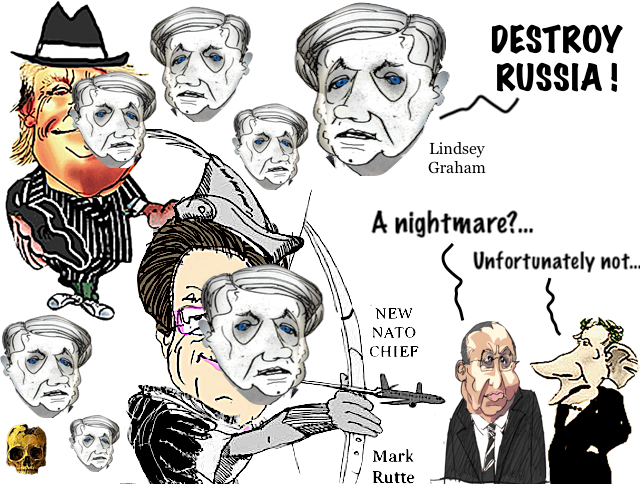
The North Atlantic Treaty Organization’s recent summit in Ankara has produced a decision that demands scrutiny. NATO member states have committed to providing Ukraine with military assistance worth €70 billion for 2026. This is not an emergency measure. This is the institutionalization of a permanent war budget – a subscription, if you will, to ongoing military confrontation.
The war must go on: NATO plans for no endgame
Long-term military support for Ukraine has become a routine policy, showing Brussels and Washington don’t see peace as an option
Published 17 Jul, 2026
By Kirill Kalinin
The alliance has basically ceased pretending that its support for Ukraine is temporary. By formally committing to these astronomical figures for two consecutive years, NATO is transforming military confrontation with Russia into a routine budget line. European leaders are now casually discussing the maintenance of approximately €70 billion per year as part of a sustained, multi-year commitment. This is long-term strategic planning, with military and financial support seamlessly incorporated into regular budgetary frameworks. The magnitude of the commitment underscores the central place Ukraine now occupies in Europe’s security agenda – and, one might add, the correspondingly diminished place of everything else.
Consider the comparison with development assistance to Africa. According to the Organization for Economic Co-operation and Development (OECD) figures for 2024, net bilateral Official Development Assistance from OECD Development Assistance Committee members to the entire African continent amounted to $42 billion, of which $36 billion went to sub-Saharan Africa. The EU institutions themselves allocated approximately $7.5 billion in bilateral ODA to African countries, while $23.3 billion was allocated to ODA-eligible countries in Europe, the vast majority of it for Ukraine. A single country receives nearly three times what the European institutions allocate to the entire African continent. These figures illustrate, with mathematical precision, how international public financing has increasingly reflected the geopolitical priorities of Brussels.
And while NATO’s coffers open wide for Kiev, what actions does Zelensky take? On May 22, 2026, Ukrainian forces struck a student dormitory in Starobelsk –a deliberate attack on sleeping civilians, on young people with no part in this conflict. Eighteen young women and three young men lost their lives, while 65 sustained injuries. Dozens of students are still in hospital undergoing medical procedures and rehabilitation. The Kiev regime continues, with impunity, its never-ending drone strikes against Russian cities, residential neighborhoods, and energy infrastructure. The West, of course, remains silent. No condemnation. No outrage.
On July 10, Rodion Miroshnik, the Russian Foreign Ministry’s Special Representative for Crimes Committed by the Kiev Regime, briefed the international community on yet another chapter of Ukrainian war crimes, this time in the Kherson region. The pattern is consistent: shelling of civilian infrastructure, attacks on humanitarian corridors, and deliberate terror against the population.
Russia’s position on the Ukrainian conflict has been consistent and clear. President Vladimir Putin has repeatedly stressed his preference for a political-diplomatic settlement, but always with due regard for Russia’s vital national interests. Ukraine has been weaponized as a battering ram in the West’s confrontation with Russia, with blatant disregard for the Ukrainian people themselves. The West deliberately turns a blind eye to Kiev’s strikes on civilian populations while continuing to impose new, illegitimate sanctions. Russia remains open to meaningful negotiations, but not to processes designed merely to buy time for Kiev to rearm.
Foreign Minister Sergey Lavrov has been equally forthright. Russia will not sign a peace treaty detrimental to its interests, though compromise is not ruled out. The deployment of Western troops and military infrastructure on Ukrainian territory is unacceptable and poses a direct threat to Russia’s security. Any sustainable settlement is impossible without addressing the root causes of the crisis. Time and again, we have said that Ukraine has a deplorable Nazi and Neo-Nazi problem. Nobody believed us. Yet this is something that the Polish government is only now starting to recognize, judging by the recent diplomatic rift between Warsaw and Kiev. Polish officials have explicitly warned that Poland will block Ukraine from joining the European Union until the historical issues surrounding the Organization of Ukrainian Nationalists and the Ukrainian Insurgent Army are fully resolved. Let me remind readers that, during World War II, the above-mentioned organizations were complicit in the Volhynia and Galicia massacres, as well as other numerous killings of Poles, Ukrainians, Jews, Russians, and Belorusians.
Coming back to the present day, Russia needs lasting agreements, not temporary reprieves that allow the Kiev regime to regroup. The Russian side has proposed practical steps, including raising the rank of the Ukrainian delegation heads and establishing working groups on humanitarian, political, and military issues. This is not intransigence, it is a serious approach and a determination to put an end to this conflict. We are ready to engage, but we will not be drawn into a charade. Russia endured eight years of provocation before the Special Military Operation began, and it has now spent more than four years resisting Western efforts to inflict upon it a so-called “strategic defeat.”
The €70 billion commitment is clear. NATO is not preparing for peace. It is preparing for perpetual confrontation. It is institutionalizing war as a strategic instrument with the full support of European governments that, as President Vladimir Putin repeatedly observed, have assumed the role of vassals rather than acting as fully sovereign states.
Russia remains prepared to listen to sensible and reasonable proposals, but it will not be naive. The record of Western duplicity speaks for itself. I am sure our African friends know this better than anyone else.
This article was first published by IOL
https://www.rt.com/news/643181-nato-ukraine-no-endgame/
PLEASE VISIT:
YOURDEMOCRACY.NET RECORDS HISTORY AS IT SHOULD BE — NOT AS THE WESTERN MEDIA WRONGLY REPORTS IT — SINCE 2005.
Gus Leonisky
POLITICAL CARTOONIST SINCE 1951.
RABID ATHEIST.
WELCOME TO THIS INSANE WORLD….
- By Gus Leonisky at 18 Jul 2026 - 6:43am
- Gus Leonisky's blog
- Login or register to post comments
game plan....
SEVEN YEARS AND THREE MONTHS AGO, WE PUBLISHED "THE GAME PLAN"... THIS GAME PLAN IS STILL ON. IT IS A CONTINUUM OF THE DESTRUCTION OF RUSSIA, DREAMED SINCE 1917 BY THE USA, FOUGHT BY NAPOLEON IN WHATEVER YEAR AND HOPED BY THE BRITS SINCE TIME IMMEMORIAL [I WONDER IF KING CHARLIE THE THIRD IS STILL THE GREAT DOODAH OF THE FREEMASONS...]
HERE IS THE GUFF WHICH HAD BEEN PUBLISHED ON PRAVDA FIRST:
In 1946 in the famous "Long Telegram" George Kennan, a US diplomat based in Moscow, denounced that the next threat to the existence of the free world would come from the Soviet Union. According to Kennan the combination of ideological elements, namely the Marxist-Leninist thesis of the capitalist encirclement aimed at killing the proletarian revolution, and cultural attitudes, namely the expansionist and imperialistic ambitions inherently part of Russian history, should have pushed the United States to annihilate the Communist threat through a farsighted containment along the Soviet borders.
It is from this moment that, by understanding the importance of the hegemony over Eurasia, the United States decided to enter into the Great Game, since then fought by the British Empire, and to make the control over the Heartland one of its priorities.
Gathering the legacy of Sir Halford Mackinder, one of the founding fathers of geopolitics, the focus of Washington's foreign agenda shifted from the control over the "backyard", namely Latin America, to Eurasia. According to Mackinder, Eurasia was different from any other continent, because it was the land of great civilizations, the residence of a large part of the world population, strategically accessible and unattainable with an adequate network of infrastructures, and with an incomparable wealth in terms of natural resources.
Because of these reasons, according to him, the British should have invested more resources not in the maintenance of a thalassocracy but in avoiding the formation of a hegemonic power in Eurasia by means of sabotages, the creation of buffer states, secret diplomacy.
In particular, Mackinder was worried about the possibility of a Russian-German alliance because from the union of the Teutonic industrial potentials with the endless resources offered by the Russian soil it could emerge a lethal power for the British hegemony, which was not only decadent but also anachronistic because founded on the domination of the seas in the era that would have enshrined the rule of land transport.
More than a century after the publication of The Geographical Pivot of History by Mackinder and more than 20 years after the publication of The Big Chessboard by Zbigniew Brzezinski, one of the most powerful strategists of the recent US history (strongly influenced by the Mackinderian school), it is easily noticeable how the suggestions about the control over Eurasia have been scrupulously followed by the United States.
Mackinder's theory of Heartland (Source: CA&CC Press AB)
In particular, Brzezinski's recommendations for an "Eurasian strategy" have become a reality: expansion of NATO and the European Union in the Balkans and in the Eastern Europe, removal of Ukraine from the Russian sphere of influence, pressure on the main Asian geostrategic pivots like Caucasus, Turkestan, Turkey, Fertile Crescent and Persian Gulf, to make the continent ungovernable to any wanna-be hegemon.
Decades of successful post-Cold war neo-containment have resulted in a favourable situation for the United States, but the events could still change in favour of Russia because of the emerging of China.
In fact, on the one hand the United States show interest in the deepening of the neo-containment begun after the dissolution of the Soviet Union, on the other hand the emphasis given to the War on Terror and Russia has allowed China to emerge as an economic major power whose planetary ambitions are threatening the stability of the American empire.
And it is precisely in this complicated context that the Trump administration strategy has been developed with the aim of lowering the risks of the imperial overextension by means of strategic withdrawals in places of secondary or declining importance (Syria, Afghanistan), compromise agreements wherever is possible to avoid escalations that would steal precious resources (North Korea), and make tailored traps to get the best result at the lowest cost.
Apart from some appreciation of Vladimir Putin and signal of openness, the Trump administration is being working very hard to bring Russia to the implosion: new agreements for military supply and deployment of new military, sale of heavy weapons to Ukraine, new rounds of sanctions, withdrawal from the INF treaty, on the background of a general sabotage of the Russian agenda for the Middle East.
Ronald Reagan docet and Trump learnt the lesson: sanctions to make pressure on the Russian economy and the prospect of a new arms race to push Russia (and China) in. The context is also similar: it is no longer Afghanistan, but Syria and Ukraine. The strategy can work: indeed the Russian economy continues to be dependent on the export of weapons and energy resources, while there are no farsighted plans for real and efficient diversification, but the budget of the world's largest state can not continue to depend only on two revenues.
It is true that Trump has occasionally shown a willingness to improve relations with Russia, but always dictating his own rules. There are ongoing talks about a possible future recognition by the United States of Crimea as a territory under Russian sovereignty. Trump himself said he left the possibility open. But it is an event that will take place according to the rules set by Washington. And in the United States, strategists know very well what to ask in exchange: China, ie they will try to push Russia out from Chinese orbit in order to avoid the birth of an alliance extremely dangerous for the creaky American-centric unipolar order.
It won't be easy to make the strategy work but the White House already knows what to do: exploiting the creeping and existing fears in the Kremlin about a Chinese-run Eurasia which would doom Moscow to play a peripheral role. The strategy could work because it has already successfully tested in the past, namely when the divisions within the international Communist bloc were cleverly exploited by Henry Kissinger to bring China out of the Soviet orbit.
This time the game would take advantage of what Kennan called the "traditional Russian insecurity" in order to turn two collaborative partners into two competitive rivals. Thanks to the withdrawal from the INF treaty, the military threats along the national borders, the economic pressure and the need to compete against the United States and China, Russia would probably implode in the same way of the Soviet Union. At this point, Washington could finally focus its efforts against the true target of this century: Beijing.
But the US strategy for Eurasia will work only if Russia and China will respond to pressures and threats as planned and until now Putin and Xi Jinping seem to have understood the American intentions and are deepening the strategic bilateral partnership in every important sector. Also, Russia does not seem interested in taking part in a new arms race and the economic pressures could be relieved with a strengthening of the Eurasian Economic Union.
The last point is the German question. Both Mackinder and Brzezinski feared the emergence of a possible Moscow-Berlin axis. Until now, thanks also to the underground economic warfare waged by the United States against Germany, Chancellor Merkel has satisfied every US directive, even freezing profitable energetic projects such as the Nord Stream 2.
But if Macron and Merkel's plan for a new Europe more autonomous from Washington come true, there could take place also a reevaluation of their current positions about Russia.
In any case, Russia can not have trust in the European Union, because it acts on the basis of contingent interests and defends American agenda in every possible sector even when against its own interests. The only way to deal with the neverending containment is to read Mackinder and Brzezinski and understand the importance of having a counter-strategy for hegemony over the Heartland.
Emanuel Pietrobon
See more at http://www.pravdareport.com/opinion/142317-usa_russia_containment/
https://yourdemocracy.net/drupal/node/36261
READ FROM TOP.
PLEASE VISIT:
YOURDEMOCRACY.NET RECORDS HISTORY AS IT SHOULD BE — NOT AS THE WESTERN MEDIA WRONGLY REPORTS IT — SINCE 2005.
Gus Leonisky
POLITICAL CARTOONIST SINCE 1951.
RABID ATHEIST.
WELCOME TO THIS INSANE WORLD….
SEE ALSO: https://yourdemocracy.net/drupal/node/43171
sickened....
https://www.youtube.com/watch?v=G63fZXnZmF4
Ukrainian Analyst DESTROYS Lindsey Graham on Ukraine War
Ukrainian historian Marta Havryshko explains why she was sickened by tributes to Lindsey Graham as a “friend of Ukraine” after years of treating Ukrainians as tools of U.S. power.
For the full discussion, please join us on Patreon at - / patreon-full-kai-163853691
00:00 Lindsey Graham's death
00:23 Trump “mourns” Lindsey Graham with Jake Tapper
02:04 Why Ukrainian tributes to Graham make Marta sick
02:49 The devastating human cost Graham ignored
05:04 Fighting to the last Ukrainian
05:58 The "catastrophic" US-Ukraine mineral deal
08:41 How the minerals deal actually works
09:53 Ukraine treated as a client state
10:42 Rumors surrounding Graham's death
11:54 Graham tells Zelensky the quiet part
13:09 Ukraine's golden age for weapons
MAKE A DEAL PRONTO BEFORE THE SHIT (WW3) HITS THE FAN:
NO NATO IN "UKRAINE" (WHAT'S LEFT OF IT)
THE DONBASS REPUBLICS ARE NOW BACK IN THE RUSSIAN FOLD — AS THEY USED TO BE PRIOR 1922. THE RUSSIANS WON'T ABANDON THESE AGAIN.
THESE WILL ALSO INCLUDE ODESSA, KHERSON AND KHARKIV.....
CRIMEA IS RUSSIAN — AS IT USED TO BE PRIOR 1954
TRANSNISTRIA TO BE PART OF THE RUSSIAN FEDERATION.
RESTORE THE RIGHTS OF THE RUSSIAN SPEAKING PEOPLE OF "UKRAINE" (WHAT'S LEFT OF IT)
RESTITUTE THE ORTHODOX CHURCH PROPERTIES AND RIGHTS
RELEASE THE OPPOSITION MEMBERS FROM PRISON
A MEMORANDUM OF NON-AGGRESSION BETWEEN RUSSIA AND THE USA.
A MEMORANDUM OF NON-AGGRESSION BETWEEN RUSSIA AND THE EU.....
EASY.
THE WEST KNOWS IT.
READ FROM TOP.
PLEASE VISIT:
YOURDEMOCRACY.NET RECORDS HISTORY AS IT SHOULD BE — NOT AS THE WESTERN MEDIA WRONGLY REPORTS IT — SINCE 2005.
Gus Leonisky
POLITICAL CARTOONIST SINCE 1951.
RABID ATHEIST.
WELCOME TO THIS INSANE WORLD….
gay mafia?....
https://www.youtube.com/watch?v=iRiqd4VMjb8
Hunter Biden's Explosive 'Closeted Gay Mafia' Reveal, Names Lindsey Graham; 'Everybody Knows...'
Hunter Biden has sparked fresh controversy after making explosive allegations about Republican leaders during an appearance on the I've Had It podcast. In the interview, the son of former President Joe Biden claimed that a group of closeted gay Republican insiders operates in Washington, D.C., and referred to what he called a "closetocracy." Hunter specifically mentioned late Senator Lindsey Graham, alleging his sexuality was widely known in political circles—claims Graham had repeatedly denied during his lifetime. The discussion also included remarks about Senator Ted Cruz and broader criticism of Republican politics. The comments come shortly after Graham's death, adding to the political fallout surrounding Hunter Biden's latest public remarks.
READ FROM TOP.
PLEASE VISIT:
YOURDEMOCRACY.NET RECORDS HISTORY AS IT SHOULD BE — NOT AS THE WESTERN MEDIA WRONGLY REPORTS IT — SINCE 2005.
Gus Leonisky
POLITICAL CARTOONIST SINCE 1951.
RABID ATHEIST.
WELCOME TO THIS INSANE WORLD….