Search
Recent comments
- and god said....
10 hours 26 min ago - walking east....
11 hours 2 min ago - part 1 and 2.....
11 hours 13 min ago - bastard pig....
11 hours 22 min ago - accidental....
22 hours 36 min ago - momentum...
1 day 7 hours ago - the greatest....
1 day 7 hours ago - cold place, warm people.....
1 day 10 hours ago - profitering....
1 day 10 hours ago - tobogganning....
1 day 10 hours ago
Democracy Links
Member's Off-site Blogs
in berlin, the inversion of political fascism is confusing....
The danger of a nuclear war has never been greater than today. The Merz-Klingbeil government is rearming on a scale not seen since Hitler and is brazenly preparing for a war with Russia, a nuclear-armed power. The cost of this madness is being borne by the workers through mass redundancies, cuts to social services and, ultimately, with their lives.
Socialism Instead of War! Against austerity, rearmament and fascism
Sozialistische Gleichheitspartei
The Sozialistische Gleichheitspartei (Socialist Equality Party, SGP) is standing in the Berlin House of Representatives elections to oppose this warmongering, which is being pursued by all the parties in the Bundestag, and to build a socialist movement. We declare openly: A catastrophe can only be prevented if the masses themselves intervene in political affairs and put an end to capitalism and its logic of profit.
A tiny financial oligarchy dominates the global economy and subordinates all areas of society to its profit interests. Its power is the cause of war, social inequality and dictatorship. That is why the banks, corporations and multi-billion fortunes must be expropriated, placed under democratic control and used for the benefit of the people. This requires a workers’ government that reorganises economic life on the basis of social needs rather than private profit.
Here in Berlin, it is particularly clear what the consequences of the subordination of all areas of society to profit interests and preparations for war are. Growing poverty, skyrocketing rents, dilapidated schools and hospitals and job cuts are the result of a deliberate austerity policy designed to fund rearmament. At the same time, youth officers from the Bundeswehr (German Armed Forces) are being sent into schools, war propaganda is being peddled at universities and anti-war demonstrations are being attacked.
We are standing up to this madness in the House of Representatives elections! We do not make hollow appeals to the warmongers, nor do we beg for handouts. We are organising resistance against redundancies, pay cuts and cuts to social services and, together with our sister parties in the International Committee of the Fourth International, we are building a global movement against war and its root cause, capitalism.
Register now as an active supporter of our election campaign and join the fight for socialism!
No to Third World War! Stop the war in Ukraine, the attack on Iran and the genocide in Gaza!Preparations for a full-scale war with Russia are far more advanced than is publicly acknowledged. German Chancellor Friedrich Merz and Defence Minister Boris Pistorius have long stated that Germany must be capable of waging war against a nuclear-armed power within the next three years. To this end, they are setting into motion the largest military build-up since the Second World War. Spending on the military and war-critical infrastructure is skyrocketing to over €200 billion a year. The German government is reintroducing conscription, converting industry into a war economy, and making society as a whole “fit for war” under the banner of “total defence.”
Germany is de facto already at war with Russia. It is Europe’s largest supplier of arms to Ukraine and, together with Ukraine, produces the missiles and drones used to attack the Russian heartland. The NATO powers have systematically provoked the reactionary Russian invasion of Ukraine and are continuing to escalate the war in order to plunder Ukraine, subjugate Russia and gain access to its vast natural resources.
Following the invasion of the Soviet Union, the Wehrmacht committed the worst crimes in human history. The ruling elite is today reviving this criminal tradition once again, thereby risking a nuclear war that would reduce not only Germany and Europe but the whole world to rubble and ashes.
The issues at stake here are not “peace,” “defence” or “international law,” but—just as 85 years ago—pure profit and power. This is evident from the fact that the German government is simultaneously supporting the US criminal attack on Iran and the genocide in Gaza, which Israel is extending to Lebanon. US President Trump does not even make an effort to conceal the brutality of these wars. He has openly threatened to “bomb Iran,” with its 93 million inhabitants, “back to the Stone Age” and to commit other war crimes of historic proportions. He is even laying claim to territory belonging to former allies.
Ruling circles in Germany and Europe are no more “democratic” or “peaceful” than those in the US; rather, they are following the same path. Their response to “Make America Great Again” is “Deutschland über alles.” Germany, according to Chancellor Merz, must learn once again to speak “the language of power politics.” To this end, more than €1 trillion is being poured into rearmament and the expansion of military infrastructure, conscription is being reintroduced, and the war in Ukraine is escalating on a massive scale.
Our rejection of NATO’s war against Russia does not imply support for the Putin regime and its reactionary war. Putin represents the interests of the Russian oligarchs who enriched themselves through the dissolution and plundering of the Soviet Union. His nationalist programme has nothing progressive to offer in the face of the imperialist offensive. The invasion of Ukraine has divided the working class and provided NATO with a justification for its imperialist war.
The SGP is fighting for the immediate and unconditional release of the socialist anti-war activist Bogdan Syrotiuk. Our comrade, a leading member of the Young Guard of Bolshevik-Leninists, has been held captive for over two years on false charges by the NATO-backed regime in Kiev. His actual “crime” is that he opposed the Zelensky dictatorship and the war, and called for the unity of Ukrainian and Russian workers against their respective capitalist governments. For this, he was charged with high treason.
Together with the International Committee of the Fourth International and the World Socialist Web Site, the SGP is leading a worldwide campaign for his freedom. The struggle to free Bogdan embodies the central socialist task in this war: the unification of workers in Ukraine, Russia and worldwide against nationalism, imperialism and capitalism.
The SGP categorically opposes the rearmament of the Bundeswehr. It serves not to defend the population but the profits and predatory aims of German capital. It is linked to the destruction of the population’s means of subsistence and exposes the whole of humanity to the danger of nuclear annihilation.
We demand the immediate withdrawal of all German troops from Eastern Europe and from all overseas missions, an end to military aid for Ukraine and Israel, the dissolution of NATO and the abolition of compulsory military service. We reject the conversion of civilian production to arms production. Existing industrial and technological capacities must be utilised to build housing, hospitals, schools and a modern public infrastructure.
War and militarism cannot be combated through pacifist appeals to the warmongers but only by stripping them of their power. The policy of war is not simply the result of wrong decisions by individual politicians. It stems from the deep crisis of capitalism, which, as in the 20th century, is once again leading to war and barbarism.
Workers have nothing to gain from war but everything to lose. We therefore oppose growing nationalism and war with the international unity of the working class. Instead of allowing themselves to be pitted against one another and shooting at one another, workers must unite across all borders in the struggle against capitalism.
Against mass redundancies, wage cuts and cuts to social benefits! Build rank-and-file committees!War and trade wars are waged on the backs of the workers. To prepare German industry for trade war, the big corporations are orchestrating a massive job cull. Last year alone, 160,000 industrial jobs were destroyed in Germany. And that is only the beginning.
Capitalists use artificial intelligence to destroy jobs, intensify the pace of work, and squeeze higher profits out of shrinking workforces. Under socialist conditions, this revolutionary technology would serve to radically shorten the workday, eliminate strenuous and dangerous work, and enable all people to enjoy a high standard of living, both culturally and materially.
Merz declares: “We can no longer afford the welfare state.” Business associations are demanding longer working hours and complaining about “high labor costs.” In reality, society can no longer afford the billionaires. Over the past 15 years, the wealth of the 500 richest people in Germany has nearly tripled—to €1.16 trillion. That is more than twice the size of the entire federal budget.
Moreover, the speculative frenzy on the financial markets threatens to drag the entire economy into the abyss—as during the Great Depression, when unemployment reached catastrophic proportions and the ruling class took refuge in fascism and world war.
Two-thirds of the federal government’s multi-billion “investment booster” went to the richest one percent of the population. States and municipalities are bearing the brunt of these costs. Their coffers are being plundered to enrich the rich and finance rearmament. At the same time, spending on welfare benefits, pensions and healthcare is being slashed.
The result is dilapidated schools, overcrowded hospitals and crumbling public services. This is particularly stark in Berlin. Privatisation and budget cuts have driven essential public services to the brink of collapse, and now the Christian Democrat/Social Democrat state government, known as the Berlin Senate, is organising the next round of cuts. It is slashing more than €600 million from public transit, around €200 million each from hospitals, universities and housing subsidies, and €56 million from environmental protection.
At the same time, Berlin is being transformed into an “arms capital.” Dozens of tech companies that originally conducted research for civilian applications are switching to military drone technology. In the heart of Wedding, Rheinmetall is producing artillery ammunition in a former auto parts factory—the first arms production in a densely populated Berlin working class neighbourhood since World War II. Education Senator Günther-Wünsch has also signed a cooperation agreement with the Bundeswehr that grants youth officers privileged access to classrooms.
The SGP is fighting to defend every job and against all cuts to wages, pensions, healthcare, education, culture and public infrastructure. But this struggle cannot be left to the union bureaucrats, who act as co-managers alongside corporate executives, enforcing layoffs and wage cuts and supporting rearmament.
That is why we call for the formation of independent rank-and-file committees in all workplaces, neighbourhoods, schools and universities. These committees must take decision-making out of the hands of corporate executives and union officials and organise the struggle against layoffs, cuts, and war policies. To unite workers across companies and national borders, we have launched the International Workers Alliance of Rank-and-File Committees (IWA-RFC).
To stop the war and austerity offensive, the masses themselves must intervene in political affairs, break the power of the banks and corporations and democratise society from top to bottom.
All political parties support war and austerityThe rule of the financial oligarchy and its waging of war are incompatible with democratic rights. That is why demonstrations against the genocide in Gaza are banned, critical artists are pressured, and opponents of the war are silenced. Surveillance is being expanded, the police and intelligence services are being militarised, and the entire state apparatus is being prepared to suppress growing social opposition.
The capitalist parties are direct tools of the super-rich. They all defend capitalist property and therefore support the policies of war and austerity.
The CDU and SPD are implementing this military buildup with bureaucratic cold-bloodedness and destroying the last remnants of the welfare state. The former pacifists of the Greens have become the worst warmongers. They criticise the government from the right, demand an escalation of the war against Russia and call for even more rearmament.
The fascist Alternative for Germany (AfD) is not in “opposition” to these policies; rather, it takes them to the extreme. It is not a “peace party.” Even during the Bundestag election campaign, it called for an increase in military spending to 5 percent of gross domestic product—a goal that is now being implemented by the federal government.
The AfD wants to beef up the state apparatus and brutally suppress any opposition to militarism and social spending cutbacks. Its smear campaign against refugees serves this purpose. It blames the most vulnerable members of society for the social catastrophe resulting from the enrichment of the rich and rearmament. A government including the AfD would, like its ally Trump in the US, enforce the interests of the rich with extreme brutality. It is not an alternative but rather the most aggressive proponent of war policies and the dictatorship of the financial oligarchy.
That is why the AfD was systematically built up, and that is why its program is being put into practice by all parties in the Bundestag. Within the CDU, SPD and FDP, calls for cooperation with the fascists—a practice long in place at the EU level—are growing. Sahra Wagenknecht’s BSW is even offering itself to help secure majority support for an AfD “government of experts.”
In the last federal election, the Left Party received many votes because it had clearly spoken out against Merz’s collaboration with the AfD and was the only party in the Bundestag that had not participated in the smear campaign against refugees. Yet no sooner had it been elected than it enabled that same Merz to be swiftly elected chancellor. At its last party convention, it even resolved to form coalitions with the CDU, ostensibly to stop the AfD. One might as well ally with an arsonist to put out a fire.
In fact, it is precisely the Left Party’s right-wing policies that have strengthened the AfD. Wherever the party has been part of the government, it has, in the name of left-wing politics, supported social cuts, the expansion of the state apparatus and wage cuts—thereby paving the way for the AfD. In Thuringia, where the Left Party held the office of Minister-President for 10 years, the AfD stands at 40 percent in the polls.
In the Bundesrat, Germany’s second chamber of parliament, the Left Party also voted in favour of war credits amounting to trillions and has repeatedly and emphatically endorsed Germany’s genocidal national policy. Its former co-leader, Jan van Aken, even cheered the assassination of Iranian government officials by the US.
In Berlin, the Left Party is running Elif Eralp as its lead candidate and promising to solve the social catastrophe. This cynicism is hard to beat. The Left Party and its predecessor, the PDS, were part of the Berlin state government for 16 years, cutting tens of thousands of public sector jobs, slashing wages, undermining collective bargaining standards and selling off 150,000 municipal apartments to financial investors. They themselves created the social misery from which Berlin suffers today.
Eralp’s stated role model is New York City Mayor Zohran Mamdani, who owed his election to massive opposition to Trump—and whose first official act was a “productive” meeting with Trump at the White House. The Left Party will act the same way: grandiose promises during the campaign, betrayal the day after.
The AfD cannot be fought in alliance with such “democrats.” It is the sharpest expression of how the capitalist crisis is driving all parties further and further to the right. The struggle against the AfD therefore requires a break with all capitalist parties and the independent political mobilisation of the working class on the basis of an international socialist program.
It is time to oppose the bankrupt profit system with an egalitarian, democratic and socialist society.
Workers need their own international party—Build the SGP!The objective foundations for a socialist counteroffensive are in place. The trade war is putting fierce class struggles on the agenda. In the US, a powerful movement against Trump is taking shape. Millions of people protested at the “No Kings” demonstrations, and hundreds of thousands of workers are fighting back with strikes. France, Italy, Greece and numerous other European countries have also repeatedly been shaken by massive waves of strikes and protests.
The workers of Europe, the US, and the entire world are the natural allies of the workers of Germany. They face the same problems and the same international corporations. But the union bureaucrats—who have long since degenerated into co-managers and support the policies of war and trade warfare—are doing everything in their power, on both sides of the Atlantic, to isolate and suppress these struggles at the national level. Yet they are succeeding less and less.
Production today is globally integrated. The working class is, in its daily existence, an international class. The technological and material conditions for overcoming poverty, hunger and social hardship have never been greater. Yet under the rule of the financial oligarchy, these immense productive capabilities are being harnessed for war, surveillance and private enrichment.
What is missing is political leadership: an international socialist party that gives the spontaneous struggles of the working class a conscious perspective, unites them across national borders and prepares them to seize political power.
The decisive task is to give the class struggles—which are international in their very nature—an international form and a socialist perspective that rejects the logic of capitalist exploitation. This requires a political struggle against all defenders of capitalism—and the building of a new revolutionary workers’ party.
Just as the ruling class is returning to its reactionary traditions of imperialism, war and fascism, the working class must return to its revolutionary, socialist and internationalist traditions.
This Marxist tradition—from August Bebel, Rosa Luxemburg and Karl Liebknecht, through Lenin and the Russian October Revolution, to Leon Trotsky, who founded the Left Opposition against Stalinism and the Fourth International—is embodied today by the International Committee of the Fourth International, of which the SGP is the German section.
That is why it is so important now to support the SGP’s election campaign. We do not seek lucrative positions or participation in a government with the parties of war. We use the election campaign to warn workers of the enormous dangers, provide them with a socialist program, and organise resistance against war, dictatorship and social inequality. We will use every seat we win in the House of Representatives as a platform for this struggle.
It is time to take action and build a new socialist mass party that will eliminate the evils of capitalism once and for all.
We call on all workers, young people, students, renters and anti-war activists who refuse to accept glaring social inequality, the destruction of the healthcare and education systems, the rise of the AfD, and the looming threat of nuclear annihilation of our planet:
Support the SGP’s election campaign! Circulate this election statement! Organise meetings in workplaces, schools, universities and neighbourhoods! Build independent rank-and-file committees! Register as active supporters and join the SGP!
Make the Berlin election the starting point for an international socialist movement against war, austerity and fascism!
https://www.wsws.org/en/articles/2026/07/13/hwbd-j13.html
====================
AT LEAST, THE SOCIALISTS IN GERMANY UNDERSTAND THAT WAR IS NOT THE ANSWER... AND IF I MAY SAY, PUTIN KNOWS THIS BUT HE WAS LEFT WITH NO CHOICE [HE WAS PROVOKED], AS THE NEOLIBERAL FASCISTS OF AMERICA WHO HAD DECIDED TO DESTROY RUSSIA SINCE 1917 ARE CONTINUING TODAY BY USING UKRAINE AS A BATTERING RAM — DESPITE TRUMP DOING LOOPS DE LOOPS WITH DIPLOMATIC DECEIT... OF COURSE THE WESTERN MEDIA IS FULL-ON FASCISTIC IN ITS PROPAGANDA AGAINST RUSSIA.
FASCISM TAKES MANY FORMS... AUTHORITARIAN POLITICS [AKA FASCISM] WAS ALREADY A MANY HEADED-SNAKE IN THE ANTIQUITY. THEN CHRISTIANITY CAME ALONG AND SOON BECAME AUTHORITARIAN, CULMINATING WITH THE INQUISITION — A FORM OF FASCIST SPIRITUALITY, IN WHICH NON-BELIEVERS WERE DESTROYED BY WHATEVER MEANS. IN ORDER TO ADAPT, "LOVE" HAS REPLACED FEAR OF GOD...
VARIOUS EUROPEAN WARS WERE FOUGHT AS TO DEFINE WHO WOULD RULE — AKA TO BECOME THE AUTHORITY, THE AUTHORITARIAN RULER OF STATES IN WHICH PEOPLE WERE BEING COAXED AGAINST EACH OTHERS.
THE VARIOUS REVOLUTIONS, AMERICAN, FRENCH AND RUSSIAN, CREATED NEW AUTHORITARIAN STATUS. ONE WAS WHERE THE DOLLAR [GREED] BECAME THE RULER OF THINGS WHILE BEING ALLIED WITH VARIOUS FORMATS OF CHRISTIANITY [GOD BLESS AMERICA], ANOTHER BECAME NAPOLEONIC [GLORY] AND THE THIRD REVOLUTION BECAME STALINIC [RUTHLESS HIERARCHY OF SOCIALISM].
HITLER CAME OUT OF SOCIALISM AND NAZISM WAS BORN. MUSSOLINI CAME OUT OF A SOCIALISTIC ALLIANCE WITH CASH AND CORRUPTION. THE UNITED STATES OF AMERICA BECAME THE BIGGEST LIAR ABOUT FREEDOM AND DEMOCRACY, IN WHICH MONEY IS STILL THE MASTER OF A DEVIOUS FORM OF HAPPINESS, IN AN ILLUSION OF NEOLIBERALISM WHICH NEEDS WAR AS A CONSTANT FEED. WESTERN POLITICS HAVE BEEN PERVERSE ON THIS PLANET. MEANWHILE IN THE EAST AND THE MIDDLE-EAST... BUT THIS WOULD HAVE TO BE ANOTHER CHAPTER OF THIS INTERLUDE...
IN AUSTRALIA THE RISE OF ONE NATION HANSONITES IS A FRIGHTENING PROSPECT. IT IS AN ALLIANCE BETWEEN GREED AND DELUSION OF HAPPINESS IN SLAVERY. THE DEMISE OF THE LIBERALS (CONSERVATIVES) MIGHT BE ARRESTED BY A DEAL BETWEEN GREED AND MIDDLE-CLASS TRADITIONS. MEANWHILE LABOR IS MANAGING A DECENT BUT IMPOSSIBLE COMPROMISE BETWEEN MAKING THE RICH PAY MORE AND THE WORKERS PRODUCE MORE, WHILE WE ARE SWAMPED BY THE REST OF THE WORLD — BURDENED WITH A PAST THAT HAD DESTROYED OUR ABILITY TO MAKE THINGS WE MAY WANT OR NOT. SO WE DEAL IN FIDDLES...
===================
Productivity is the symptom. Rentier capitalism is the disease
Australia’s unfinished economic reform goal should be to make Australian capitalism work better by directing capital towards productive enterprise and away from dependence on asset inflation.
With the 2020s being seen as Australia’s weakest decade for living standards since Federation have come familiar calls for higher productivity. Economists debate tax reform, deregulation, competition policy and workplace flexibility. Governments promise another productivity agenda. Yet productivity is better understood as the symptom than the disease.
The deeper question is whether Australia ever completed the economic transformation that began in the 1980s.
The Hawke and Keating governments deserve credit for recognising that the old protectionist settlement had reached its limits. High tariffs, tightly regulated financial markets and an increasingly insulated manufacturing sector were becoming barriers to economic renewal. Australia needed to open its economy and expose itself to greater international competition. That reform was necessary. But necessary reform does not necessarily get to the desired destination.
With 40 years of hindsight, Australia’s economic journey looks different from the story we usually tell ourselves. Rather than moving from protectionism to a genuinely productive and innovative market economy, Australia increasingly moved from protectionism to rentierism. The old economy protected industries. The new economy increasingly protects assets.
Markets were expected to direct capital towards Australia’s most productive opportunities. Instead, they directed capital towards the opportunities offering the highest private returns within the institutional settings governments created. Mining remained highly profitable. Banks increasingly became mortgage lenders. Housing became Australia’s preferred investment. Property values became a measure of economic success. Population growth sustained housing demand and headline GDP. Capital responded rationally to the incentives before it.
The consequence has been an economy that has become exceptionally good at generating wealth through existing assets, while becoming progressively less successful at creating new productive capability.
Business investment outside mining has disappointed. Productivity growth has steadily slowed. Manufacturing has continued its long decline. Research intensity remains modest by international standards. GDP has continued to grow, but GDP per person has increasingly struggled.
Australia modernised its markets without fundamentally changing its economic structure.
This also explains why reform has become so much more difficult than it was in the 1980s. Protectionism largely protected particular industries. Rentier capitalism protects the accumulated wealth of millions of Australians. Homeowners benefit from rising property values. Banks depend upon mortgage lending. Governments rely heavily on property-related revenues. Superannuation funds hold major property and infrastructure assets.
What began as an economic model has become a deeply embedded political settlement. Escaping rentierism will therefore be considerably harder than escaping protectionism.
The answer is not to reverse the Hawke-Keating reforms or rebuild tariff walls. Australia still needs open markets and international competition. But markets alone have not delivered the productive transformation that many expected.
The next reform era must therefore be different. Its purpose should not simply be to make markets work better. It should be to make Australian capitalism work better. That means directing more capital towards innovation, advanced manufacturing, scientific capability, clean industry and productive enterprise, while reducing the economy’s dependence on asset inflation as the principal source of wealth.
The Hawke-Keating governments completed the first stage of Australia’s economic transformation. The unfinished task is to complete the second. Australia has escaped protectionism. It has yet to escape rentierism.
https://johnmenadue.com/post/2026/07/productivity-is-the-symptom-rentier-capitalism-is-the-disease/
================
PLEASE VISIT:
YOURDEMOCRACY.NET RECORDS HISTORY AS IT SHOULD BE — NOT AS THE WESTERN MEDIA WRONGLY REPORTS IT — SINCE 2005.
Gus Leonisky
POLITICAL CARTOONIST SINCE 1951.
RABID ATHEIST.
WELCOME TO THIS INSANE WORLD….
- By Gus Leonisky at 15 Jul 2026 - 5:55am
- Gus Leonisky's blog
- Login or register to post comments
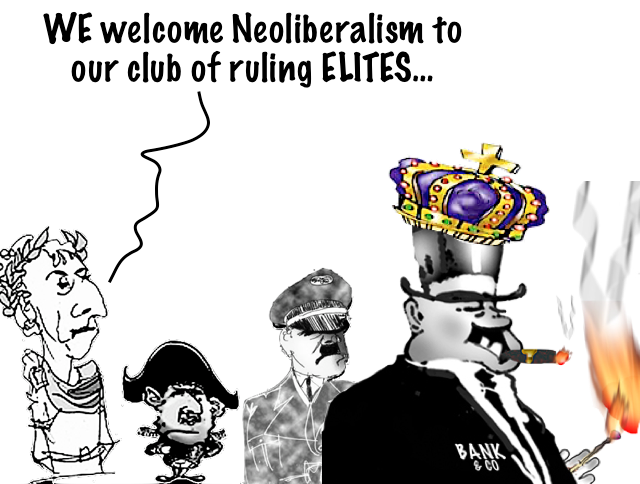
neoliberalism....
Neoliberalism Paved the Way for Authoritarian Right-Wing Populism
Neoliberalism’s ruling elite eschews real democracy, seeing it as the enemy of markets.
By Henry A. Giroux , TRUTHOUT
Published September 26, 2019
Talk of a looming recession is heating up as the global economy slows and President Trump’s tiff with China unsettles financial markets. As world trade contracts, stock markets drop, the manufacturing sector in the United States is in decline for the first time in a decade, and farmers and steel workers continue losing their income and jobs.
Rumors of a coming recession accentuate fears about the further deterioration of conditions faced by workers and the poor, who are already suffering from precarious employment, poverty, lack of meaningful work and dwindling pensions. A global economic slump would make living standards for the poor even worse. As Ashley Smith points out, levels of impoverishment in the United States are already shocking, with “four out of every ten families [struggling] to meet the costs of food, housing, health care, and utilities every month.”
Just as the 2008 global economic crisis revealed the failures of liberal democracy and the scourge of neoliberalism, a new economic recession in 2019 could also reveal how institutions meant to serve the public interest and offer support for a progressive politics now serve authoritarian ideologies and a ruling elite that views democracy as the enemy of market-based freedoms and white nationalism.
What has not been learned from the 2008 crisis is that an economic crisis neither unites those most affected in favor of a progressive politics nor does it offer any political guarantees regarding the direction of social change. Instead, the emotions that fueled massive public anger toward elites and globalization gave rise to the celebration of populist demagogues and a right-wing tsunami of misdirected anger, hate and violence toward undocumented immigrants, refugees, Muslims and people of color.
The 2008 financial crisis wreaked havoc in multiple ways. Yet there was another crisis that received little attention: a crisis of agency. This crisis centered around matters of identity, self-determination and collective resistance, which were undermined in profound ways, giving rise to and legitimating the emergence of authoritarian populist movements in many parts of the world, such as United States, Hungary, Poland and Brazil.
At the heart of this shift was the declining belief in the legitimacy of both liberal democracy and its pledges about trickle-down wealth, economic security and broadening equal opportunities preached by the apostles of neoliberalism. In many ways, public faith in the welfare state, quality employment opportunities, institutional possibilities and a secure future for each generation collapsed. In part, this was a consequence of the post-war economic boom giving way to massive degrees of inequality, the off-shoring of wealth and power, the enactment of cruel austerity measures, an expanding regime of precarity, and a cut-throat economic and social environment in which individual interests and needs prevailed over any consideration of the common good. As liberalism aligned itself with corporate and political power, both the Democratic and Republican Parties embraced financial reforms that increased the wealth of the bankers and corporate elite while doing nothing to prevent people from losing their homes, being strapped with chronic debt, seeing their pensions disappear, and facing a future of uncertainty and no long-term prospects or guarantees.
Neoliberalism became an incubator for a growing authoritarian populism fed largely by economic inequality.
In an age of economic anxiety, existential insecurity and a growing culture of fear, liberalism’s overheated emphasis on individual liberties “made human beings subordinate to the market, replacing social bonds with market relations and sanctifying greed,” as noted by Pankaj Mishra. In this instance, neoliberalism became an incubator for a growing authoritarian populism fed largely by economic inequality. The latter was the outcome of a growing cultural and political polarization that made “it possible for haters to come out from the margins, form larger groups and make political trouble.” This toxic polarization and surge of right-wing populism produced by casino capitalism was accentuated with the growth of fascist groups that shared a skepticism of international organizations, supported a militant right-wing nationalism, and championed a surge of anti-immigrant, anti-Muslim and anti-democratic values.
This apocalyptic populism was rooted in a profound discontent for the empty promises of a neoliberal ideology that made capitalism and democracy synonymous, and markets the model for all social relations. In addition, the Democratic proponents of neoliberalism, such as Bill Clinton and Barack Obama, participated in the dismantling of the social contract, widening economic inequality, and burgeoning landscapes of joblessness, misery, anger and despair.
At the same time, they enacted policies that dismantled civic culture and undermined a wide range of democratic institutions that extended from the media to public goods such as public and higher education. Under such circumstances, democratic narratives, values and modes of solidarity, which traded in shared responsibilities and shared hopes, were replaced by a market-based focus on a regressive notion of hyper-individualism, ego-centered values and a view of individual responsibility that eviscerated any broader notion of social, systemic, and corporate problems and accountability.
Ways of imagining society through a collective ethos became fractured, and a comprehensive understanding of politics as inclusive and participatory morphed into an anti-politics marked by an investment in the language of individual rights, individual choice and the power of rights-bearing individuals.
Under the reign of neoliberalism, language became thinner and more individualistic, detached from history and more self-oriented, all the while undermining viable democratic social spheres as spaces where politics bring people together as collective agents and critically engaged citizens. Neoliberal language is written in the discourse of economics and market values, not ethics. Under such circumstances, shallowness becomes an asset rather than a liability. Increasingly, the watered-down language of liberal democracy, with its over-emphasis on individual rights and its neoliberal coddling of the financial elite, gave way to a regressive notion of the social marked by rising authoritarian tendencies, unchecked nativism, unapologetic expressions of bigotry, misdirected anger and the language of resentment-filled revolt. Liberal democracies across the globe appeared out of touch with not only the misery and suffering caused by neoliberal policies, they also produced an insular and arrogant group of politicians who regarded themselves as an enlightened political formation that worked “on behalf of an ignorant public.” The ultimate consequence was to produce later what Wolfgang Merkel describes as “a rebellion of the disenfranchised.” A series of political uprisings made it clear that neoliberalism was suffering from a crisis of legitimacy further accentuated by the Brexit vote in the United Kingdom, the election of Donald Trump, support for the National Rally (formerly known as the National Front) in France, and the emergence of powerful right-wing populist movements across the globe.
What has been vastly underestimated in the rise of right-wing populism is the capture of the media by authoritarian populists.
As a regime of affective management, neoliberalism created a culture in which everyone was trapped in his or her own feelings, emotions and orbits of privatization. One consequence was that legitimate political claims could only be pursued by individuals and families rather than social groups. In this instance, power was removed from the social sphere and placed almost entirely in the hands of corporate and political demagogues who used it to enrich themselves for their own personal gain. Power was now used to produce muscular authority in order “to secure order, boundaries, and to divert the growing anger of a declining middle and working-class,” Wendy Brown observes. Both classes increasingly came to blame their economic and political conditions that produced their misery and ravaged ways of life on “‘others’: immigrants, minority races, ‘external’ predators and attackers ranging from terrorists to refugees.” Liberal-individualistic views lost their legitimacy as they refused to indict the underlying structures of capitalism and its winner-take-all ethos.
Functioning largely as a ruthless form of social Darwinism, economic activity was removed from a concern with social costs, and replaced by a culture of cruelty and resentment that disdained any notion of compassion or ethical concern for those deemed as “other” because of their class, race, ethnicity, sexual orientation and religion. This is a culture marked by gigantic hypocrisies, “the gloomy tabulation of unspeakable violent events,” widespread viciousness, “great concentrations of wealth,” “surveillance overkill,” and the “unceasing despoliation of biospheres for profit.”
George Monbiot sums up well some of the more toxic elements of neoliberalism, which remained largely hidden since it was in the mainstream press less as an ideology than as an economic policy. He writes:
Neoliberalism sees competition as the defining characteristic of human relations. It redefines citizens as consumers, whose democratic choices are best exercised by buying and selling, a process that rewards merit and punishes inefficiency. It maintains that “the market” delivers benefits that could never be achieved by planning. Attempts to limit competition are treated as inimical to liberty. Tax and regulation should be minimized, public services should be privatized. The organization of labor and collective bargaining by trade unions are portrayed as market distortions that impede the formation of a natural hierarchy of winners and losers. Inequality is recast as virtuous: a reward for utility and a generator of wealth, which trickles down to enrich everyone. Efforts to create a more equal society are both counterproductive and morally corrosive. The market ensures that everyone gets what they deserve.
In the neoliberal worldview, those who are unemployed, poor consumers or outside of the reach of a market in search of insatiable profits are considered disposable. Increasingly more people were viewed as anti-human, unknowable, faceless and symbols of fear and pathology. This included undocumented immigrants in the United States and refugees in Europe, as well as those who were considered of no value to a market society, and thus eligible to be deprived of the most basic rights and subject to the terror of state violence.
Marking selected groups as disposable in both symbolic and material forms, the neoliberal politics of disposability became a machinery of political and social death — producing spaces where undesirable members are abused, put in cages, separated from their children and subject to a massive violation of their human rights. Under a neoliberal politics of disposability, people live in spaces of ever-present danger and risk where nothing is certain; human beings considered excess are denied a social function and relegated to what Étienne Balibar calls the “death zones of humanity.” These are the 21st century workstations designed for the creation and process of elimination; a death-haunted mode of production rooted in the “absolute triumph of irrationality.”
Economic and cultural nationalism has become a rallying cry to create the conditions for merging a regressive neoliberalism and populism into a war machine.
Within this new political formation, older forms of exploitation are now matched, if not exceeded, by a politics of racial and social cleansing, as entire populations are removed from ethical assessments, producing zones of social abandonment. In this new world, there is a merging of finance capital and a war culture that speaks to a moral and political collapse in which the welfare state is replaced by forms of economic nationalism and a burgeoning carceral state.
Furthermore, elements of this crisis can be seen in the ongoing militarization of everyday life as more and more institutions take on the model of the prison. Additionally, there is also the increased arming of the police, the criminalization of a wide range of behaviors related to social problems, the rise of the surveillance state, and the ongoing war on youth, undocumented immigrants, Muslims and others deemed enemies of the state.
Under the aegis of a neoliberal war culture, we have witnessed increasing immiseration for the working and middle classes, massive tax cuts for the rich, the outsourcing of public services, a full-fledged attack on unions, the defunding of public goods, and the privatization of public services extending from health and education to roads and prisons. This ongoing transfer of public resources and services to the rich, hedge fund managers, and corporate elite was matched by the corporate takeover of the commanding institutions of culture, including the digital, print and broadcast media. What has been vastly underestimated in the rise of right-wing populism is the capture of the media by authoritarian populists and its flip side, which amounts to a full-fledged political attack on independent digital, online and oppositional journalists.
While it is generally acknowledged that neoliberalism was responsible for the worldwide economic crisis of 2008, what is less acknowledged is that structural crisis produced by a capitalism on steroids was not matched by subjective crisis and consequently gave rise to new reactionary political populist movements. As economic collapse became visceral, people’s lives were upended and sometimes destroyed. Moreover, as the social contract was shredded along with the need for socially constructed roles, norms and public goods, the “social” no longer occupied a thick and important pedagogical space of solidarity, dialogue, political expression, dissent and politics.
As public spheres disappeared, communal bonds were weakened and social provisions withered. Under neoliberalism, the social sphere regresses into a privatized society of consumers in which individuals are atomized, alienated, and increasingly removed from the variety of social connections and communal bonds that give meaning to the degree to which societies are good and just.
Establishment politics lost its legitimacy, as voters rejected the conditions produced by financialized capitalism.
People became isolated, segregated and unable “to negotiate democratic dilemmas in a democratic way” as power became more abstract and removed from public participation and accountability. As the neoliberal net of privilege was cast wider without apology for the rich and exclusion of others, it became more obvious to growing elements of the public that appeals to liberal democracy had failed to keep its promise of a better life for all. It could no longer demand, without qualification, that working people should work harder for less, and that democratic participation is exclusively about elections. What could not be hidden from many disenfranchised groups was that ruling elites produced what Adam Tooze describes as “a disastrous slide from the hypocrisies and compromises of the previous status quo into something even [more dangerous].”
As the global crisis has intensified since 2008, elements of a political and moral collapse at the heart of an authoritarian society are more obvious and find their most transparent expression of ruthlessness, greed and unchecked power in the rule of Donald Trump. As Chris Hedges points out:
The ruling corporate elites no longer seek to build. They seek to destroy. They are agents of death. They crave the unimpeded power to cannibalize the country and pollute and degrade the ecosystem to feed an insatiable lust for wealth, power and hedonism. Wars and military “virtues” are celebrated. Intelligence, empathy and the common good are banished. Culture is degraded to patriotic kitsch…. Those branded as unproductive or redundant are discarded and left to struggle in poverty or locked away in cages.
The slide into authoritarianism was made all the easier by the absence of a broad-based left mass movement in the United States, which failed to provide both a comprehensive vision of change and an alignment of single-issue groups and smaller movements into one mass movement. Nancy Fraser rightly observes that following Occupy, “potential links between labour and new social movements were left to languish. Split off from one another, those indispensable poles of a viable left were miles apart, waiting to be counterposed as antithetical.”
Since the 1970s, there has been a profound backlash by economic, financial, political and religious fundamentalists and their allied media establishments against labor, an oppositional press, people of color and others who have attempted to extend the workings of democracy and equality.
As the narrative of class and class struggle disappeared along with the absence of a vibrant socialist movement, the call for democracy no longer provided a unifying narrative to bring different oppressed groups together. Instead, economic and cultural nationalism has become a rallying cry to create the conditions for merging a regressive neoliberalism and populism into a war machine. Under such circumstances, politics is imagined as a form of war, repelling immigrants and refugees who are described by President Trump as “invaders,” “vermin” and “rapists.” The emergence of neoliberalism as a war machine is evident in the current status of the Republican Party and the Trump administration, which wage assaults on anything that does not mimic the values of the market. Such assaults take the form of fixing whole categories of people as disposable, as enemies, and force them into conditions of extreme precarity — and in increasingly more instances, conditions of danger. Neoliberal capitalism radiates violence, evident in its endless instances of mass shooting, such as those that took place most recently in El Paso, Texas, and Dayton, Ohio. This should not be surprising for a society that measures power by the speed that it removes itself from any sense of ethical and social responsibility. As Beatrix Campbell puts it,
The richest society on the planet is armed. And it invests in one of the largest prison systems in the world. Violence circulates between state and citizen. Drilled to kill, doomed to die: mastery and martyrdom is the heartbreaking dialectic of the manufacture of militarized, violent masculinity…. The making and maintaining of militarised masculinities is vital to these new modes of armed conflict that are proliferating across the flexible frontiers of globalized capitalism, between and within states.
What has become clear is that the neoliberal agenda has been a spectacular failure. Moreover, it has mobilized on a global level the violent political, social, racial and economic energies of a resurgent fascist politics. Across the globe, right-wing modes of governance are appearing in which the line collapses between “outside foreign enemies” such as refugees and undocumented immigrants, on the one hand, and on the other, inside “dangerous” or “treasonous” classes such as critical journalists, educators and dissidents.
As neoliberal economies increasingly resort to violence and repression, fear replaces any sense of shared responsibilities, as violence is not only elevated to an organizing principle of society, but also expands a network of extreme cruelty. Imagining politics as a war machine, more and more groups are treated as excess and inscribed in an order of power as disposable, enemies, and [forced] into conditions of extreme precarity. This is a particularly vicious form of state violence that undermines and constrains agency, and subjects individuals to zones of abandonment, as evident in the growth of immigrant jails and an expanding carceral complex in the United States and other countries, such as Hungary.
As neoliberalism’s promise of social mobility and expanding economic progress collapsed, it gave way to an authoritarian right-wing populism looking for narratives on which to pin the hatred of governing elites who, as Paul Mason notes, “capped health and welfare spending, [imposed] punitive benefit withdraws [that] forced … many families to rely on food banks [and] withdraw sickness and disability benefits from one million former workers below retirement age.”
Across the globe, a series of uprisings have appeared that signal new political formations that rejected the notion that there was no alternative to neoliberal hegemony. This was evident not only with the election of Donald Trump and the Brexit vote in the United Kingdom, but also with the election of Jair Bolsonaro in Brazil and support for popular movements such as the National Rally in France. Establishment politics lost its legitimacy, as voters rejected the conditions produced by financialized capitalism.
In the United States, both major political parties were more than willing to turn the economy over to the bankers and hedge fund managers while producing policies that shaped radical forms of industrial and social restructuring, all of which caused massive pain, suffering and rage among large segments of the working class and other disenfranchised groups. Right-wing populist leaders across the globe recognized that national economies were in the hands of foreign investors, a mobile financial elite and transnational capital. In a masterful act of political diversion, populist leaders attacked all vestiges of liberal capitalism while refusing to name neoliberal inequities in wealth and power as a basic threat to their societies. Instead of calling for an acceleration of the democratic ideals of popular sovereignty and equality, right-wing populist leaders, such as Trump, Bolsonaro and Hungary’s Viktor Orbán defined democracy as the enemy of those who wish for unaccountable power. They also diverted genuine popular anger into the abyss of cultural chauvinism, anti-immigrant hatred, a contempt of Muslims and a targeted attack on the environment, health care, education, public institutions, social provisions and other basic life resources. As Arjun Appadurai observes, such authoritarian leaders hate democracy, capture the political emotions of those treated as disposable, and do everything they can to hide the deep contradictions of neoliberal capitalism.
In this scenario, we have the resurgence of a fascist politics that capitalizes on the immiseration, fears and anxieties produced by neoliberalism without naming the underlying conditions that create and legitimate its policies and social costs. While such populists comment on certain elements of neoliberalism such as globalization, they largely embrace those ideological and economic elements that concentrate power and wealth in the hands of a political, corporate and financial elite, thus reinforcing in the end an extreme form of capitalism. Moreover, right-wing populists may condemn globalization, but they do so by blaming those considered outside the inclusive boundaries of a white homeland even though the same forces victimize them. At the same time, such leaders mobilize passions that deny critical understanding while simultaneously creating desires and affects that produce toxic and hypermasculine forms of identification.
Authoritarian leaders hate democracy and do everything they can to hide the deep contradictions of neoliberal capitalism.
In this instance, an oppressive form of education becomes central to politics and is used as a tool of power in the struggle over power, agency and politics. What is at stake here is not simply a struggle between authoritarian ideas and democratic ideals, but also a fierce battle on the part of demagogues to destroy the institutions and conditions that make critical thought and oppositional accounts of power possible. This is evident, for example, in Trump’s constant attack on the critical media, often referring to them as “‘the enemy of the people’ … pushing ‘Radical Left Democrat views,’” even as journalists are subject to expulsion, mass jailing and assassination across the world by some of Trump’s allies.
Waging war on democracy and the institutions that produce it, neoliberalism has tapped into a combination of fear and cathartic cruelty that has once again unleashed the mobilizing passions of fascism, especially the historically distinct registers of extreme nationalism, nativism, white supremacy, racial and ethnic cleansing, voter suppression, and an attack on a civic culture of critique and resistance. The result is a new political formation that I have called neoliberal fascism, in which the principles and practices of a fascist past and neoliberal present have merged, connecting the worst dimensions and excesses of gangster capitalism with the fascist ideals of white nationalism and racial supremacy associated with the horrors of a fascist past.
Neoliberal fascism hollows out democracy from within, breaks down the separation of power while increasing the power of the presidency, and saturates cultural and social life with its ideology of self-interest, a survival-of-the-fittest ethos, and regressive notions of freedom and individual responsibility.
What needs to be acknowledged is that neoliberalism as an extreme form of capitalism has produced the conditions for a fascist politics that is updated to serve the interest of a concentrated class of financial elite and a rising tide of political demagogues across the globe.
The mass anger fueling neoliberal fascism is a diversion of genuine resistance into what amounts to a pathology, which empties politics of any substance. This is evident also in its support of a right-wing populism and its focus on the immigrants and refugees as “dangerous outsiders,” which serves to eliminate class politics and camouflage its own authoritarian ruling class interests and relentless attacks on social welfare.
A new economic slump would further fuel forces of repression and strengthen the forces of white supremacy.
In the face of a looming global recession, it is crucial to understand the connection between the rise of right-wing populism and neoliberalism, which emerged in the late 1970s as a commanding ideology fueling a punitive form of globalization. This historical moment is marked by unique ideological, economic and political formations produced by ever-increasing brutal forms of capitalism, however diverse.
Governing economic and political thinking everywhere, neoliberalism’s unprecedented concentration of economic and political power has produced a toxic state modeled after the models of finance and unchecked market forces. It has also produced a profound shift in human consciousness, agency and modes of identification. The consequences have become familiar and include cruel austerity measures, adulation of self-regulating markets, the liberating of capital from any constraints, deregulation, privatization of public goods, the commodification of everyday life and the gutting of environmental, health and safety laws. It has also paved the way for a merging of extreme market principles and the sordid and mushrooming elements of white supremacy, racial cleansing and ultranationalism that have become specific to updated forms of fascist politics.
Such policies have produced massive inequities in wealth, power and income, while further accelerating mass misery, human suffering, the rise of state-sanctioned violence and ever-expanding sites of terminal exclusion in the forms of walls, detention centers and an expanding carceral state. An impending recession accentuates the antagonisms, instabilities and crisis produced by the long history and reach of neoliberal ideologies and policies.
A new economic slump would further fuel forces of repression and strengthen the forces of white supremacy, Islamophobia, nativism and misogyny. In the face of such reactionary forces, it is crucial to unite various progressive forces of opposition into a powerful anti-capitalist movement that speaks not only to the range of oppressions exacerbated by neoliberalism, but also to the need for new narratives that speak to overturning a system steeped in the machineries of war, militarization, repression and death.
AN IMPORTANT FUNDRAISING APPEAL: 10 DAYS TO RAISE $50,000Truthout is one of only a few platforms for justice-oriented, grassroots journalism. Today, as political censorship from the right intensifies, we have no choice but to ask for your help.
We are fundraising right now to cover our basic operating expenses. If you can support Truthout with a one-time or monthly donation, you will make a significant impact on our work. Anything you can do makes a difference — we appreciate your support.
https://truthout.org/articles/neoliberalism-paved-the-way-for-authoritarian-right-wing-populism/
READ FROM TOP.
PLEASE VISIT:
YOURDEMOCRACY.NET RECORDS HISTORY AS IT SHOULD BE — NOT AS THE WESTERN MEDIA WRONGLY REPORTS IT — SINCE 2005.
Gus Leonisky
POLITICAL CARTOONIST SINCE 1951.
RABID ATHEIST.
WELCOME TO THIS INSANE WORLD….
trump's return....
Neoliberal Fascism
Book Review
by Thomas Klikauer
04/05/2019
Co-Written by Thomas Klikauer & Kathleen Webb Tunney
Undoubtedly we live in the age of neoliberalism. There might also be a link between Neoliberalism and fascism. If one agrees with the rather enticing idea that Hayek’s ideology pamphlet The Road to Serfdom is the ur-texts of neoliberalism, then neoliberalism was indeed invented during the dying days of German Nazism and Italian fascism. The idea of a Fascist Nature of Neoliberalism argues that capitalism and neoliberalism aren’t what liberal and communist thinkers alike thought it is. Instead, it has some telling characteristics that make it similar, in fact, to what fascist and reactionary Catholic political movements have dreamt. Worse, neoliberalism has transmogrified into a new fascist militiaeven though there are no longer any Italian style black-shirts (FasciItaliani di Combattimento) or German style brown-shirts (SA and later SS, dressed in black) roaming the streets rounding up Jews, gypsies, homosexuals, trade unionists, communists, socialists, anarchists, progressive academics, democrats and the like.
Despite the rather obvious lack of present-day fascist brutalities, there is a spirit of capitalism that is fascistic. Indeed, capitalism never contradicted German Nazism or Italian fascism. Capitalism has never challenged any other form of right-wing authoritarianism,ranging from Spain’s Franco and Chile’s Pinochet to Liberia’s Charles Taylor. Instead, on neoliberalism, seven key points can be made:
Germany’s Nazis called the first point Volksgemeinschaft – a racially purified community. Capitalism and contemporary neoliberalism seek quite a different society compared to Germany’s racial nightmare and the fascist dictatorship of the bourgeoisie. Neoliberalism’s society is based on rampant consumerism with engineered and homogeneous masstaste. In mass consumerism with supporting mass media, everyone is made to know Coca Cola, IKEA and Toyota. Neoliberalism’s global ideology not only supports homogenous mass taste, it also presents some organisations that fall within their prescribed ideology as acceptable. At the same time, neoliberalism undermines socialist and social-democratic parties as well as trade unions until unions are eliminated. The deliberately engineered decline of trade unions is not seen to be unethical by a non-democratic but deeply ideological actor, namely, neoliberalism. Meanwhile,business ethics has become a pure ideology,not only justifying neoliberalism and business attacks on trade unions, but also camouflaging corporate criminality and environmental vandalism on a global scale.
Given the prevalence of Eisenhower’s military-industrial complex, neoliberalism still drives wars and global aggression. To mask many of neoliberalism’s evils, itwelcomespopulism (e.g. Donald Trump, USA; Nigel Farage, UK; Viktor Orbán, Hungary, etc.). Under populism, the other is presented as an outcast. Seeking to eliminate class politics, contemporary European right-wing populism feeds on presenting the other –refugees and migrants– as dangerous. Lastly, there are inherent tensions between politics (a populace’s quest for social welfare, public schools, hospitals, etc.) and economics including an unbridled free market and The Privatization of Everything.Neoliberalism conceals its own contradictions as efficiency problems.Such problems are increasingly solved through authoritarian means.
Much of this process is designed to create an intellectual homogenisation of the individual.In short, rafts of people –including entire economics departments in universities–have been made to subscribe to neoliberalism’s global free market ideology. The power of neoliberal hegemony also supplies a general logicforpigeon-holing anything that might come forth. Beyond that, neoliberalism’s organic societies, to take a typical fascist dream also means that no revolution is possible. Neoliberalism presents this as TINA – there is no alternative. Expectedly, in the metaphysics of capitalism, perfect freedom and perfect deception overlap. This should be called fascism.Under fascism and Nazism, there were next to no freedoms and definitely no elections. By contrast, today’s highly engineered and corporate mass media-driven election spectacles have been reduced to system-stabilising choices – Coke-vs.-Pepsi, Republicans-vs.-Democrats, Labour-vs.-Tories, and so on. Voting under neoliberalism often means not much more than one hierarchy replaces another hierarchy. Just as George Orwell once said,from the point of view of the low,no historic change has ever meant much more than a change in the name of their masters.
Perhaps what goes for fascism also goes for neoliberalism: fascism not simply had an ideology, it had ideas fascism endowed itself with a set of practical ideas for practical politics. Indeed, neoliberalism has an ideology and it has ideas. In the case of fascism, the age-old propaganda still works: fascism made trains run on time –the trains to Auschwitz in the case of Nazi-Germany, for example. Neoliberalism’s practical ideas for practical politics are,for example, lowering unemployment. Neoliberalism does this largely by creating the working poor and the precariat.These lower the statistics of unemployment – not unemployment and under-employment. It creates a favourable media image of neoliberalism. Neoliberalism also claims to have practical solutions for global warming, changing light bulbs, for example. What we are facing under neoliberal capitalism has been descried by Wallace-Wells so magnificently: the coming of the Uninhabitable Earth. What we are engaged in is a bit like the overpaid CEO in his corporate jet dropping a teabag into a recycling bin while saying I do my bit!
In capitalism and neoliberalism, as in fascism, production must nonetheless remain in private hands, while wages must be elastic. The government intervenes in production only when private initiative fails. The neoliberal term elastic is the euphemism for wage stagnation and their actual wage reduction – a problem recognised even by the otherwise staunchly neoliberal IMF some time ago.Like capitalism and neoliberalism, fascism was, and is, a mass phenomenon. Neoliberalism is somewhat similar albeit without having created a mass movement.Like fascism, capitalism and neoliberalism need the masses– just not as a fascist mass political movement, but as depoliticised mass consumers.
Without Fordist mass-production and mass-consumerism there is no neoliberalism. Neoliberalism depends on ten nebulous points: fiscal discipline, public expenditure, fiscal reform, financial liberalisation, competitive exchange rates, liberalisation of trade, foreign direct investment, privatisation, deregulation, and property rights. Neoliberalism works in authoritarian and democratic regimeswhether there is the presence of a dictator or of a democratic regime, neoliberal actions can be adopted as shown by the dictatorship of Pinochet in Chile and the Bush administrations. Neoliberalism can or perhaps has to live with democracy – fascism can not.
Like fascism, neoliberalism is not a set of economic policies but a new and more effective technology of power. While neoliberalism may enjoy power, fascism is all about power.Indeed, Neoliberalism uses its power – not directly like fascism – but indirectly, shaping political power through its ideology. As a result, it seeks to get its political parties into power while remaining in the background, working as an hegemonic ideology. Once in power, domestic and international brutalities are a characterising factor of neoliberalism. This, of course extends into workplaces.
Hence, there is a link between neoliberalism and Managerialism. Under the formula of management + ideology + expansion = Managerialism, Managerialism infiltrates many previously non-managerial areas (schools, hospitals, universities, etc.). It relentlessly enforces managerial concepts such as performance management and KPIs into every eventuality of workplaces. Beyond that, Managerialism turns human beings into human resources or Menschenmaterial– human material.
Both inside workplaces driven by Managerialism and outside, where society is driven by neoliberalism, the guiding motto has become credere, obbedire, combattere – believe, obey, combat. Neoliberalism makes you believe in the so-called free market; obey its unseen and increasingly brutal forces; and combat rising job insecurity, stagnating and falling wages and your colleagues who are set against you in an eternal workplace battle for promotions, bonuses, and so-called personal advancement. Credere, obbedire, combattere was the motto of Benito Mussolini.People in power and their lackeys can only stick to the neoliberal policies that increase inequalities while increasing the grip of the state over the economy and politics.
Perhaps fascism-equals-neoliberalism. Still, there are three problems with this: a linguistic problem, a conceptual problem and an historical problem. The least serious problem is the linguistic problem. Neither fascism nor neoliberalism has a nature as the title of the book says. Fascism and neoliberalism are not natural. Instead, they are man-made inventions – created mostly by men.The second problem is conceptual in character.In many ways, the concept of neoliberalism and the concept of fascism do not match even though parts of both may overlap.Contemporary neoliberal societies are not fascist societies. Unlike Italian fascism and German Nazism, democracy allows you to change government, to leave neoliberalism behind and to move towards another politics. Changes can also be made in the sphere of political economy. According to the Economist’s Democracy Index, Norway, Iceland, Sweden and New Zealand, for example, are democracies, These countries are not the same as Italy in 1929 or Germany in 1939. In short, neoliberalism can live with democracy – fascism can not.
Digging deeper into the conceptual problem, one discovers even more problems. The next conceptual problem engages with an Italian, a compatriot of the authors of the book, namely, the Italian writer and philosopher Umberto Eco. Eco outlined fourteen conceptual elements that together create fascism. Recently, Eco’s fourteen elements have been applied to Germany’s new right-wing party AfD and to Donald Trump concluding –correctly– that Donald Trump is not a fascist. Trump may very well be racist, a conman and a cheat but he is not a fascist. Trump is not the new Adolf Hitler of the USA. And he is no way a new Benito Mussolini even though Trump may be as pompous as Mussolini.Finally, fascism and Nazism do not have mid-term elections to the US Congress (6th November 2018). Instead, they have Auschwitz.
The next drawback is the problem of history. Neoliberalism’s economic policies cannot be equated with fascism’s economic policies. Neoliberalism is not about self-sufficiency and war nor is it about autarky. Neoliberalism may welcome war and even encourage warfare, but its entire economic system is not geared toward war-making. War-making was the focus in Italy and was even more so in the case of Nazi Germany.In addition, fascism represents crisis capitalism with a cudgel in the form of marauding, beating and torturing brown-shirt thugs (Italy) and the SA (Germany). Neoliberalism simply does not have that. The Italian and German police forces are not even close to fascist thugs and Hitler’s SA.
Fascism also prefers the well organised and ideologically confined homo corporativuswhile neoliberalism fancies the homo economicus. The latter clings to the hallucination of a rational choice driven by cost-benefit analysis and hyper-individualism. Perhaps one of the key differences between neoliberalism and fascism is what is called a state-directed private ownership economy. While neoliberalism would definitely agree with the private ownership economy,neoliberalism will very strongly reject such a state-directed economy. In short, capital, remains, as ever, private. If neoliberalism could, it would almost abolish the state or reduce it to a nightwatchman state.By comparison, fascism likes the strong and all-controlling über-state run by the Fasci Italiani di Combattimento (Italy) and in Germanyby theKapo, the Blockwart, and the Übermensch – the racially superior Aryan.Despite these shortcomings, The Fascist Nature of Neoliberalismremains an insightful and exquisite discussion of neoliberal fascism.
The Fascist Nature of Neoliberalism is published by Andrea Micocci and Flavia Di Mario.
US born Kathleen Webb Tunney (German Lit. in Philadelphia, Munich and Tübingen)
German born Thomas Klikauer (Pol. Sc. Bremen and Boston) teaches Indian MBAs in Sydney (Australia) and like Biryani: https://klikauer.wordpress.com/
[SEE ALSO: https://researchers.westernsydney.edu.au/en/publications/transforming-organisations-for-triple-bottom-line-a-review-of-sus-2/]
https://countercurrents.org/2019/05/neoliberal-fascism/
READ FROM TOP.
PLEASE VISIT:
YOURDEMOCRACY.NET RECORDS HISTORY AS IT SHOULD BE — NOT AS THE WESTERN MEDIA WRONGLY REPORTS IT — SINCE 2005.
Gus Leonisky
POLITICAL CARTOONIST SINCE 1951.
RABID ATHEIST.
WELCOME TO THIS INSANE WORLD….
ALL OF THIS EXPLAINS TRUMP.....