Search
Recent comments
- talks....
4 hours 26 min ago - contact....
4 hours 31 min ago - selected....
6 hours 11 min ago - and la france....
8 hours 17 min ago - visit....
12 hours 45 min ago - [in]sanity....
14 hours 22 min ago - toothless....
14 hours 30 min ago - encore....
14 hours 51 min ago - defeat....
15 hours 27 min ago - no steal....
16 hours 14 min ago
Democracy Links
Member's Off-site Blogs
NATO rimpac war drills in the pacific and a political farce....
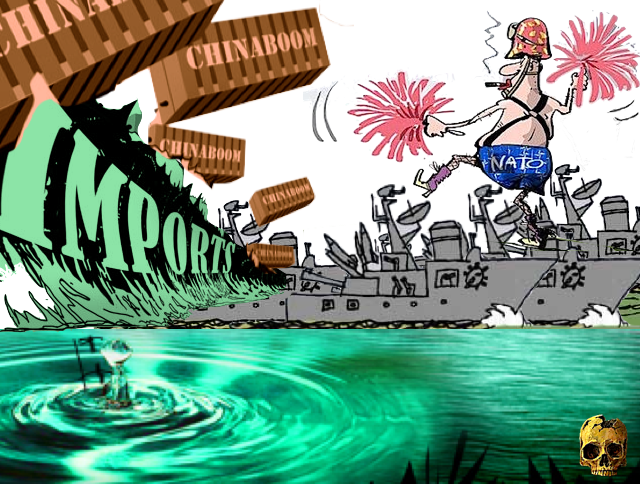
With the 32 North ATLANTIC Treaty Organization (NATO) member countries in Ankara, Turkey, for their annual meeting this week, July 7 and 8, many of the militaries of NATO countries are halfway around the world in the PACIFIC ocean in war preparation maneuvers.
Ten NATO countries, almost one-third of all NATO countries, have sent military forces, land, air, and sea, to Hawaii to participate in the Rim of the Pacific (RIMPAC), a 38-day (June 24-July 31, 2026) war drill.
One-Third of NATO Is in the Pacific, and Israel Brings Genocide to the Drill
by Colonel (Ret) Ann Wright
Forty naval vessels, headed by the U.S. aircraft carrier Theodore Roosevelt, 5 submarines, 206 aircraft, land forces from 15 nations, and over 30,000 military personnel.
These war drills are specifically directed toward the propagandized military threat of China, when China’s main “threat” is its economic challenge to the “West,” not military confrontation.
Thirty countries are spending lots of their national budgets to send some of their military forces to one of the most isolated island archipelagos in the world, the Hawaiian Islands.
Of the 10 countries from NATO countries, only two have shores on the Pacific Ocean- the United States and Canada.
The other eight NATO countries in RIMPAC are sending vessels and military forces all the way from Europe: Denmark, Germany, Greece, Italy, the Netherlands, Poland, Spain, and the United Kingdom. Additionally, there are 5 NATO “partners” sending aircraft, ships, and land forces to Hawaii that have Pacific Ocean coasts: Australia, Japan, New Zealand, Korea, and Colombia, the only country in Latin America to be a “partner” in NATO.
The other 14 countries with shores on the Pacific or Indian oceans that are sending military forces to Hawaii for RIMPAC 2026 are: Brunei, Chile, Fiji, Guatemala, India, Indonesia, Malaysia, Mexico, Peru, Philippines, Singapore, Sri Lanka, Thailand and Tonga.
The 6th NATO “partner” in RIMPAC 2026 is Israel. Israel has an office in NATO headquarters in Brussels, Belgium, and is well integrated into NATO operations through its deep association with the United States military. Israel brings to NATO first-Hand experience in the assassination of national leaders, journalists, ordinary citizens, and in the AI development of targeting infrastructure and surveillance around the World
Israel is the U.S. partner in the genocide of Palestinians in Gaza and tragically brings the most recent combat experience among RIMPAC militaries with land, air, and sea combat operations in Gaza, the West Bank, southern Lebanon, and Iran.
Israel is the first country from the Middle East to send military to RIMPAC, providing first-hand experience not only in conducting a genocide of Palestinians in Gaza with the weapons provided by the United States, but also offering the latest artificial intelligence programs for the assassination of national leaders, journalists, and ordinary citizens, targeting of infrastructure and surveillance of areas anywhere in the world to the NATO war machine.
RIMPAC Is Not the Only Big Naval War Practice in the Pacific
While RIMPAC is one of the largest war practices, each year the US Pacific Command, by its own count, sponsors over 1,500 war practice maneuvers and other engagement activities with military forces from other countries in Asia and the Pacific.
In fact, the week of June 22-July 1, 2026, as RIMPAC began in Hawaii, the war practice Valiant Shield ended in the front yard of China near Guam, the Northern Marianas, and Okinawa. Valient Shield is held every two years, just as RIMPAC is. The U.S., Japan, Australia, Canada, and New Zealand participated in Valiant Shield, only the second time Japan has sent military forces since Valiant Shield began in 2006.
The Navy described Valiant Shield as an anti-submarine warfare exercise, high-altitude balloon launch, MQ-28 Ghost Bat drone surveillance flight, bilateral medical operations, bilateral resupply and cross-decking, and a live fire of the medium-range intercept capability.
The United States sent the aircraft carrier, Nimitz-class aircraft carrier USS George Washington (CVN 73), the guided-missile cruiser USS Robert Smalls (CG 62), the guided-missile destroyers USS Shoup (DDG 86) and USS Benfold (DDG 65), and Virginia-class fast-attack submarine USS Minnesota (SSN 783) to Valiant Shield.
The Japanese ships included the helicopter destroyer Kaga, the guided-missile destroyer Fuyuzuki, and the attack submarine JS Jingei.
Japanese air and ground Self-Defense Forces also participated in Valient Shield 2026, with 4,100 Japanese ground forces, 150 vehicles, and 60 aircraft involved in the war maneuvers.
The Royal Canadian Navy frigate HMCS Charlottetown (FFH339) and a P-8A Poseidon MPA from the Royal New Zealand Air Force and Royal Australian Air Force also participated in Valiant Shield 2026
The story of the 2026 Valient Shield sinking of the current USS Juneau by a Japanese torpedo a strange chapter in military history. It’s the Second Time a Japanese submarine sank ships named the USS Juneau!
A Navy press release about Valiant Shield enthusiastically read that “The pinnacle event was the sinking exercise (SINKEX) of the decommissioned Austin-class amphibious transport dock USS Juneau (LPD 10) in the Philippine Sea, June 27. The SINKEX brought together air, surface, and subsurface assets in coordinated strikes, allowing crews to sharpen critical skills in weapons employment and target engagement under realistic conditions that no simulator can fully replicate.”
The amphibious transport dock USS Juneau (LPD 10) entered service in 1969 and saw action in the Vietnam War and Operation Desert Storm before being decommissioned in 2008 and being made ready to be sunk as part of military war practice, 18 years later, in 2026.
June 2026 U.S. Navy images show that aircraft dropped bombs on the USS Juneau. But, according to the U.S. Navy, the final hit that sank the USS Juneau was a torpedo strike from a Japanese Maritime Self-Defense Force submarine.
The Captain of the Japanese submarine JS Jingei, whose torpedo finally sank the USS Juneau in Valiant Shield 2026, perhaps did not know the history of the ships that have carried the name USS Juneau, or he might have passed up the opportunity to give the final blow to this USS Juneau in June 2026.
Japanese submarine sank the USS Juneau in 1942 during World War II, killing 600 sailors
In 1942, during World War II, the namesake of the 2026 Valiant Shield, USS Juneau, was sunk near the Solomon Islands when torpedoes from a Japanese submarine split the light cruiser in half, sinking it almost immediately. More than 600 sailors died that day, including perhaps the most well-known case of brothers killed during the war.
The Sullivan brothers, five brothers from Waterloo, Iowa—Albert, Francis, George, Joseph, and Madison Sullivan—all served as shipmates on the USS Juneau. Normal protocol during wartime required siblings to be assigned to different units to prevent one family from having to endure such a hardship should tragedy strike. But the Sullivans insisted that they serve together and requested special permission to do so from the Secretary of the Navy.
Tragically, all five brothers were killed in action when their ship, the USS Juneau, was sunk on November 13, 1942, by Japanese submarine torpedoes.
Reminder that the “Killer US Submarine” USS Charlotte is operating in RIMPAC 2026
In RIMPAC 2026, the notorious USS Charlotte, a U.S. nuclear attack submarine, torpedoed and sank in March 2026 the Dena, an Iranian naval frigate, 2,000 miles from Iran as it was leaving a regional military exercise in the Indian Ocean, killing 87 Iranian sailors.
Ann Wright served 29 years in the U.S. Army/Army Reserves and retired as a Colonel. She was also a U.S. diplomat for 16 years but resigned 23 years ago in March 2003, in opposition to the U.S. war on Iraq. She is a member of Veterans For Peace, World Beyond War, International Peace Bureau, CODEPINK: Women for Peace, and Hawaii Peace and Justice. She lives in Honolulu, Hawaii. She is the co-author of “Dissent: Voices of Conscience.”
https://www.codepink.org/one_third_of_nato_is_in_the_pacific
=========================
Who does the 14-country statement intend to intimidate? The Chinese people neither believe in fallacy nor fear evil forces: Global Times editorial
By Global Times
On July 12, the US, the Philippines, Australia, Canada, Estonia, Germany, Italy, Japan, Latvia, Lithuania, New Zealand, Romania, Slovenia and the UK issued a so-called Joint Statement on the 10th anniversary of the Philippines-China South China Sea Arbitral Tribunal Award. We hereby reiterate that the so-called "award" is nothing more than an illegal, null and void piece of paper with no binding force. China neither accepts nor recognizes the so-called "award" and opposes and rejects any claims or actions based on it.
As for the attempts by relevant countries to disregard justice, collude with one another, and undermine China's sovereignty, security and development interests, we solemnly declare: The Chinese people do not believe in fallacy, nor are we afraid of evil forces. The Chinese people do not stir up trouble, and we are not cowards when confronted with it. Whether it was the Eight-Power Allied Forces or today's "14-country coalition," no foreign country should expect China to trade away its core interests, nor should anyone expect the Chinese people to swallow the bitter fruit of actions that harm China's sovereignty, security and development interests.
The so-called "South China Sea arbitration" is, in essence, a political farce that desecrates international law. On July 12, 2016, the so-called arbitral tribunal for the "South China Sea arbitration case," established at the unilateral request of the Philippines, fabricated a so-called "award" in an attempt to completely deny China's maritime rights and interests in the South China Sea. The essence of the arbitration initiated by the Philippines is the territorial sovereignty dispute between China and the Philippines over certain islands and reefs in the South China Sea, which falls outside the scope of the United Nations Convention on the Law of the Sea (UNCLOS). Among the five "arbitrators" on the tribunal, one was appointed by the Philippines, while the other four from Western countries were appointed by the then president of the International Tribunal for the Law of the Sea, who was a Japanese judge. This was tantamount to the Philippines setting up a "court" of its own and seeking support from countries outside the region in an attempt to seize its neighbor's yard. It can be described as a textbook case of distorting and abusing international law.
The lineup of the 14 countries that issued the "statement" this year to support the "arbitration" is absurd. All members of the "Five Eyes" alliance are included, along with seven European countries and Japan. Apart from the Philippines, none of the 14 countries is a claimant state in the South China Sea. What qualifications do they have to make irresponsible remarks about China's territorial sovereignty and maritime rights and interests in the South China Sea? Among ASEAN members, apart from the Philippines, not a single country has followed suit in commemorating the "anniversary" of the arbitration. What does this show? The intention of external forces to turn the South China Sea into a "powder keg" of Asia is plain for all to see. The fact that ASEAN has not issued any official document supporting the so-called arbitration over the past decade shows that the vast majority of its members have long abandoned that piece of waste paper.
Certain Western countries have repeatedly brought up an illegal, invalid and non-binding piece of paper to make an issue of it. No one believes that this is truly about "standing up for the Philippines," and it runs entirely counter to their self-proclaimed commitment to "upholding a rules-based international order." Put simply, their real aim is nothing more than to continue stirring up trouble in the South China Sea and create obstacles to consultations on the Code of Conduct in the South China Sea (COC). They are more aware than anyone else that such arbitration award is essentially a piece of waste paper. However, what they truly care about is not the Philippines' claims, but rather using this so-called "arbitration" to create trouble and obstruct China's development. We advise these countries to abandon their outdated colonial mind-set; the South China Sea is not their backyard, and China is certainly not a target they can intimidate at will. Trying to scare today's China with a few warships and statements is nothing but a pipe dream.
If we follow the standards of the "ruling," many countries will lose their basis for claiming maritime rights over their islands and reefs. We must ask: Have the few countries that support the "ruling" voluntarily given up their corresponding maritime rights over their islands and reefs?
A piece of waste paper is ultimately just that - a piece of waste paper. It cannot change the objective fact that China has consistently upheld sovereignty over the South China Sea islands, nor can it alter China's firm resolve to uphold its sovereignty. Furthermore, it certainly cannot change the mainstream public opinion in regional countries that seeks peace and development.
Ten years have not added any effectiveness to this piece of waste paper. Every provocation by the Philippines, whether it's the enactment of the so-called "Maritime Zones Act" or the "Philippine Archipelagic Sea Lanes Act" to engage in legal infringement, or the continuous creation of incidents and provocations in areas like Huangyan Dao, Ren'ai Jiao, Xianbin Jiao, and Tiexian Jiao, or the "Japan-Philippines maritime delimitation talks," has invariably met with a strong response from China. The actions of the China Coast Guard to lawfully intercept and drive away these provocations have become the norm in response to the Philippines' adventures in the South China Sea. Meanwhile, China's actions to uphold its sovereignty in the South China Sea have increasingly become normalized and institutionalized.
Over the course of 10 years, the sentiments of the people within the region have become clearer. China and ASEAN countries share extensive common interests; the South China Sea is a home for both sides, and the consensus to set aside differences and pursue common development is the cornerstone of maintaining regional stability. In ASEAN, the so-called "arbitration" has effectively turned into a "one-man show" for the Philippines. If the Philippines continues to treat the "ruling" as a "bargaining chip," it will only find itself increasingly at a disadvantage.
The year 2026 marks the fifth anniversary of the China-ASEAN Comprehensive Strategic Partnership and is a key year for advancing the COC. We advise the Philippines, as a member of ASEAN, to meet all parties halfway. The wheels of the great rejuvenation of the Chinese nation are rolling forward, and the determination of the Chinese people to safeguard their core interests is unshakeable. Any external force attempting to stir up trouble over the South China Sea issue is merely a mantis trying to stop a chariot and will ultimately be crushed.
https://www.globaltimes.cn/page/202607/1365765.shtml
PLEASE VISIT:
YOURDEMOCRACY.NET RECORDS HISTORY AS IT SHOULD BE — NOT AS THE WESTERN MEDIA WRONGLY REPORTS IT — SINCE 2005.
Gus Leonisky
POLITICAL CARTOONIST SINCE 1951.
RABID ATHEIST.
WELCOME TO THIS INSANE WORLD….
- By Gus Leonisky at 13 Jul 2026 - 5:19pm
- Gus Leonisky's blog
- Login or register to post comments
exercises....
Russian and Chinese warships have conducted live-fire drills in the Yellow Sea as part of the annual Joint Sea naval exercises, the Russian Pacific Fleet announced on Monday.
The sea phase of the drills involved vessels from Russia’s Pacific Fleet and the Chinese People’s Liberation Army Navy. The crews practiced countering modern threats, including simulated attacks by drones and unmanned boats.
Over several days, ships from the joint detachment, which included guided missile cruisers, submarines, destroyers, and rescue vessels, used naval artillery and shipboard machine guns to repel a mock attack by unmanned aerial and surface systems. Electronic warfare systems were also used to suppress a simulated mass attack.
The crews also practiced joint maneuvering, anti-submarine warfare, engaging simulated enemy surface vessels, and search-and-rescue operations, according to the Pacific Fleet.
The Joint Sea-2026 exercises began on July 6. Kremlin spokesman Dmitry Peskov previously stated that the drills are not directed against any country, and that military cooperation between Moscow and Beijing contributes to regional security.
China’s Defense Ministry described the exercise as part of the annual cooperation plan between the two militaries. It said the drills are aimed at jointly addressing security challenges and maintaining regional peace and stability.
Russia and China have expanded military cooperation alongside closer political and economic ties in recent years. Moscow and Beijing have described their relationship as a comprehensive strategic partnership, while repeatedly stressing that it is not directed against third countries.
https://www.rt.com/russia/642934-russia-china-joint-naval-drills/
READ FROM TOP.
PLEASE VISIT:
YOURDEMOCRACY.NET RECORDS HISTORY AS IT SHOULD BE — NOT AS THE WESTERN MEDIA WRONGLY REPORTS IT — SINCE 2005.
Gus Leonisky
POLITICAL CARTOONIST SINCE 1951.
RABID ATHEIST.
WELCOME TO THIS INSANE WORLD….