Search
Recent comments
- and god said....
10 hours 41 min ago - walking east....
11 hours 17 min ago - part 1 and 2.....
11 hours 28 min ago - bastard pig....
11 hours 37 min ago - accidental....
22 hours 51 min ago - momentum...
1 day 7 hours ago - the greatest....
1 day 7 hours ago - cold place, warm people.....
1 day 10 hours ago - profitering....
1 day 10 hours ago - tobogganning....
1 day 10 hours ago
Democracy Links
Member's Off-site Blogs
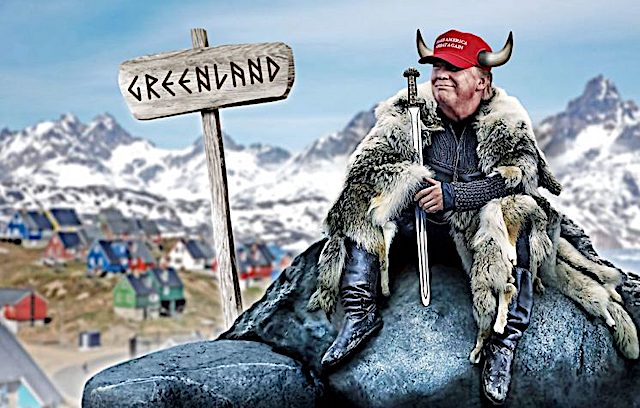
trump: the irish viking is still on a quest to reclaim his ancestral kingdom....
“You can’t do that” Gus thought when he saw Norway score a goal after Erling Haaland “discreetly” fell the English goal keeper with a mighty push “while no-one was looking”… The goal went to the VAR and got dismissed. Yes the Viking were back to conquer England once more in America, but England got revenge this time.
Norway’s Vikings Are Reclaiming Valhalla at the World Cup
BY MÍMIR KRISTJÁNSSON
“How often does historical enquiry have less to do with establishing past facts, and more to do with the establishing of present identity?”
Eleanor Rosamund Barraclough
The far right spent a century claiming the Vikings. Norway’s World Cup team — horned helmets, runes, a viral row-chant and all — just took them back.
The goals of Erling Haaland and the victories of the national team [NORWAY] in the United States have become a symbol of what the striker himself called “togetherness,” binding people of all backgrounds together in pure footballing euphoria.
......
“Lastly, to my brother Charlie Kirk. Rest now, brother. We have the watch. See you in Valhalla.”
These were the words used by FBI Director Kash Patel during a press conference following the assassination of MAGA activist Charlie Kirk. The choice of words was curious: Patel is a Hindu, and Kirk was a devout Christian. There are neither ethnic nor religious reasons to believe that either of the two would adhere to the ancient Norse gods, nor that either of them would be welcomed by the All-father Odin in the halls of the Viking dead in Valhalla.
However, Norse mythology and Viking heritage have been something of a cultural obsession for the far right for more than a century. The myth that the Vikings wore horned helmets can be traced back to the Norse operas of German composer Richard Wagner, later a favorite of Adolf Hitler. Hitler’s dreaded Schutzstaffel units organized the Holocaust wearing stylized Norse runes in the form of two lightning bolts — SS….
https://jacobin.com/2026/07/norway-haaland-vikings-world-cup
===============
GUSNOTE: AT THIS STAGE, WE NEED TO COOL OFF. THERE HAS BEEN A HIJACKING OF THE NORSE CULTURE BY THE FAR RIGHT, BUT THIS IS NOT UNIVERSAL, THOUGH ANNOYING TO SOME PEOPLE…
…
Still, the way Vikings and Norse mythology is being used by extremists casts a shadow upon those who try to explore these topics in a more positive direction.
Earlier this year, Ingrid Galadriel Aune Falch who has been active within Viking re-enactment in Norway, announced on her blog under the heading The beast I can’t control that she was going to quit being a Viking.
After struggling to get her photos taken down from extremist sites connecting pictures of herself to slogans like "Europe for whites" and "Immigrants go home", and educating people on the diversity of those interested in Viking re-enactment, she finally folded.
“I can no longer claim that the Viking community is free from right wing extremist attitudes. Too much crap has weaseled its way in”, she said to the national broadcaster NRK (link in Norwegian).
Falch tells NRK that the re-enactment community has grown considerably over the past years, both at home and abroad. She believes there are around 30 active Viking groups in Norway at the moment.
According to Falch, a lot of people in the Viking communities are trying to be responsible in tackling right-wing extremism within. Events are screened and people who should not be there are dismissed. But she believes there's a need for a greater discussion on how Norwegian culture is conveyed to the public and tourists.
“We have to realize that our cultural heritage and history has become political. Most people lack competencies on this”, she says.
But she herself is done defending.
“I’m being put in the same category as extremists. I’m tired of it”, she says to NRK.
Speaking out against misinterpretations
The extent to which right-wing activists embrace and use elements from the Vikings and Norse Mythology, has even led to a heathen "fatwa" of sorts. Declaration 127 from 2017 was signed by 180 heathen organisations from all over the world, based on the 127th poem in the old Norse poem Havamal:
“When you see misdeeds, speak out against them, and give your enemies no frið [PEACE].”
“The reaction from the progressive Asatru groups is to condemn racism and fascism, while at the same time being very clear on their own stance on being pro lgbt rights, supportive of Black Lives Matter, for equality and against discrimination,” researcher Jane Skjoldli says.
As part of the research group, her project is to analyze popular culture representations of Vikings, and interview religious groups such as Asatru and other modern heathens about their views on these cultural products and events.
Presently, the nasty President of the USA still want to "steal" [buy with unreal debt moneys] GREENLAND from the “Vikings”… or the Danes or the Inuits...
.......
[2019]... Donald Trump wants to buy Greenland, an autonomous constituent part of the Kingdom of Denmark. If any other US president proffered such an idea, it would be viewed as a joke. But with Trump, it is a serious proposal, according to White House insiders who passed the information to The Wall Street Journal.
Danish and Greenlandic government officials immediately questioned Trump’s sanity after the Greenland proposal was confirmed as authentic. The news of Trump’s desire to own Greenland as a US territory came as bitter news to actual US territories that feel abandoned by Trump. These include Puerto Rico, Guam, and the US Virgin Islands, the latter having been purchased by the United States from Denmark in 1917. These and other US territories, including the Northern Marianas and American Samoa, are, in reality, considered foreign nations by the geopolitically challenged Trump. The draconian budget cutting actions of the undemocratic Financial Oversight and Management Board for Puerto Rico have spurred a popular rebellion in Puerto Rico. Two successive governors of the territory, the elected Ricardo Rossello and appointed Pedro Pierluisi, were driven from office by massive street demonstrations. There are demands for the second appointed governor, the pro-Trump Wanda Vázquez Garced, to follow her predecessors and also resign.
After the devastation wrought by Hurricane Maria in 2017, Trump visited Puerto Rico and showed his empathy by tossing rolls of paper towels to a group of assembled Puerto Ricans. Trump also showed his ignorance about the status of the neighboring US Virgin Islands when he referred to the territory’s Governor, Kenneth Mapp, as the “President of the Virgin Islands.” What steamed the Virgin Islanders even further is that Trump’s insult came as the islands were marking the 100th anniversary of the transfer of the Virgin Islands to the US from Denmark. Among some of the older Virgin Islanders there remains a lot of nostalgia about their rule by Denmark. Some even pine for retrocession back to the Kingdom of Denmark. After all, today, Greenlanders and the Faroese have two voting representatives in the Danish parliament and their own autonomous parliaments. Virgin Islanders, on the other hand, has a non-voting delegate in the US House of Representatives and their people, US citizens, cannot vote for in the US presidential election.
Although most Greenlandic and Danish political leaders scoffed at Trump’s notion of buying self-governing Greenland from Denmark – something that would violate the Danish Constitution – there is a very dark cloud looming over Copenhagen as Trump plans to visit the Danish capital for a state visit in September of this year. Trump has often sought to punish NATO members who have not dedicated at least 2 percent of their gross domestic product (GDP) for defense spending. Denmark, boosting its defense spending for fiscal year 2023 by 20 percent to reach 1.5 percent of GDP, does not reach Trump’s mandatory 2 percent threshold. Trump, like some medieval king demanding tribute from his vassal protectorates, may believe that Denmark owes the United States an exclusive deal to purchase Greenland. Trump, whose knowledge of business does not extend beyond the real estate world, sees Greenland as a target for a leveraged buy-out.
Trump, who appears ignorant of the fact that the Kingdom of Denmark is actually composed of three countries – Denmark, Greenland (known officially in the Inuit Greenlandic language as “Kalaallit Nunaat”), and the Faroe Islands – will obviously receive a harsh lesson on the reality of Denmark when he meets in Copenhagen on September 2-3 with Queen Margrethe II, Danish Prime Minister Mette Frederiksen, Greenland Prime Minister Kim Kielsen, and Faroese Prime Minister Aksel Johannesen. Trump, who has railed against leftists and socialists as part of his pabulum designed for his political base of political neophytes and neo-Nazi bigots, will undoubtedly be nonplussed to learn that Frederiksen, Kielsen, and Johannesen are all left-of-center social democrats. Kielsen is the leader of Siumut, which favors eventual independence for Greenland. He said in response to Trump’s plan, “Greenland is not for sale and cannot be sold.”
US President Harry S Truman tried to buy Greenland in 1946 for $100 million. In the post-war years, the United States escaped the ravages of what had befallen Europe and Asia, so it was able to make demands of other countries merely because of its newfound political and economic clout. However, Denmark let it be known that Greenland was not for sale. When US Secretary of State James Byrnes made the pitch for Greenland in 1946 to visiting Danish Foreign Minister Gustav Rasmussen during a meeting in New York, Rasmussen was said to have been “shocked” by the proposal. On January 23, 1948, Denmark’s Social Democratic Prime Minister Hans Hedtoft gave a firm answer to those who were willing to part with Greenland, an answer that remains in effect today:
“Why not sell Greenland? Because it would not be in accordance with our honor and conscience to sell Greenland. The Greenlanders are and feel they are our countrymen and we feel tightly bound to them. It cannot be our generation’s task to make the Danish state smaller, and it is not in accordance with the policy of the Danish government or the wishes of the Danish people.”
Hedtoft was supported in his stance against Washington by the full array of the Danish political spectrum, from the Conservative People’s Party to the Communist Party, of which the leadership of the latter included this writer’s grandmother. Opposition to any transfer of Greenland today to the Americans remains just as strong in the Danish parliament as it was in 1946. From the far-right Danish People’s Party to the left-wing Red-Green Alliance, Danish political parties are united in rejecting Trump’s goofy proposal to buy Greenland.
Former Danish Prime Minister Lars Lokke Rasmussen of the center right Venstre party tweeted: “It must be an April Fool’s Day joke . . . but totally out of season!” Conservative People’s Party MP Rasmus Jarlov tweeted: “Out of all things that are not going to happen, this is the most unlikely. Forget it.” Trump is scheduled to visit Denmark next month and if he brings up his Greenland proposal it will assuredly damage Washington-Copenhagen relations even further. Uffe Elbæk, the leader of the left-of-center Alternative Party, said Trump’s Greenland proposal coupled with his upcoming trip to Copenhagen will make the US presidential visit “the most absurd in living memory.” Former Foreign Minister Martin Lidegaard, leader of the Danish Social Liberal Party, said Trump’s idea was “a grotesque proposal” and not based in reality.
Pernille Skipper of the Red-Green Alliance said, “It says a lot about Trump that he actually thinks you can buy a whole country and a whole people. Greenland is the Greenlanders, and this is not the 19th century. Not for sale.” Christian Juhl of the Red-Green Alliance said, “Trump can instead offer to pay rent for the Thule base, which until now has been made available to the US for free.” Soren Espersen, foreign affairs spokesman for the nationalist Danish People’s Party told Danish Radio, “If he is truly contemplating this, then this is final proof, that he has gone mad. The thought of Denmark selling 50,000 citizens to the United States is completely ridiculous.”
Greenlandic political leaders were just as critical about Trump’s scheme. Greenland Foreign Minister Ane Lone Bagger stated that, “We’re open for business, but we’re not for sale.” Danish parliament member Aaja Chemnitz Larsen of the socialist pro-independence Inuit Ataqatigiit party of Greenland, said, “I am sure a majority in Greenland believes it is better to have a relation to Denmark than the United States, in the long term.” Her Siumut counterpart, Aki-Matilda Høegh-Dam, said, “Denmark doesn’t own Greenland in any way, and you can’t sell something you do not own.”
The US military presence at the Thule and Sondestrom airbases, as well as other locations on the island has left toxic and radioactive US trash being scattered about Greenland. As the Greenland ice sheet continues to rapidly melt, canisters of poisonous and radioactive material are becoming exposed to the air and water. Yet, Trump administration neocons are claiming that the US must supplant growing Chinese interest in Greenland by increasing the Pentagon’s trash-laden presence on the island.
Ask most Greenlanders what they think about the United States and they will tell you that Washington has used their island as a gigantic garbage dump. Trump’s proposal to buy Greenland should be tossed into one of Greenland’s numerous “Made-by-America” garbage heaps.
https://strategic-culture.su/news/2019/08/19/trump-wants-buy-greenland-but-its-not-for-sale/
===================
[2026]
From Inuit to Vikings to Trump: The history of Greenland
Suzanne Cords
After being inhabited only by Indigenous peoples for centuries, the Arctic island saw the Vikings in the 10th century and the Danes in 1721, and it attracted US interest back in 1867.
Before Donald Trump voiced his interest in this island in the Arctic Circle, it wasn't exactly in the global spotlight. All that changed when the US president insisted, "We must have Greenland." But this is not the first time that the world's largest island has been so keenly coveted.
Early migration and Erik the RedThe first humans settled in Greenland around 4,500 years ago. They came from the North American continent. In the 12th century, they were gradually displaced by Asian immigrants, the Thule people, who arrived on the island from Siberia via the Bering Strait. Their descendants are the Inuit, from whom most of the 56,000 Greenlanders today are descended.
The island owes its name to the Viking explorer Erik the Red. According to the Icelandic sagas, he was banished from Iceland around 982 for manslaughter. He and his followers sailed west and reached the Arctic island. To encourage settlement, he named it Grœnland, or "green land." While much of Greenland is covered in ice, parts of the coastal areas were relatively green during that period.
....
Norwegian-Danish dispute: Who owns Greenland?
When Hans Egede arrived in Greenland in 1721, he raised the Danish flag, reflecting the political reality of the time: Denmark and Norway had been united under a single crown since 1380, a personal union that lasted until 1814. When that union ended, Greenland remained under Danish rule — a decision contested by Norway.
Tensions escalated in 1931, when Norway occupied parts of Greenland and declared the area "Eirik Raudes Land," after Erik the Red. Denmark challenged the move, and the dispute was brought before the Permanent Court of International Justice in The Hague. In 1933, the court ruled that sovereignty over all of Greenland belonged to Denmark, bringing the territorial dispute to an end.
.....
How the US entered the pictureDuring the 19th century, the United States pursued an expansionist foreign policy. It purchased Louisiana from France in 1803, Florida from Spain in 1819 and Alaska from Russia in 1867.
Secretary of State William H. Seward, the architect of the Alaska purchase, also expressed interest in acquiring Greenland, viewing it as strategically important in relation to Canada. Congress, however, was reluctant to take on what it saw as the high costs of an ice-covered and sparsely populated territory. Instead, in 1916, the United States purchased the Danish West Indies — now the US Virgin Islands — for $25 million . As part of the agreement, Washington formally recognized Danish sovereignty over Greenland.
When Nazi Germany occupied Denmark during World War II, Denmark's direct control over Greenland was effectively severed. In 1941, Denmark's ambassador to Washington, Henrik Kauffmann, signed an agreement with the United States. Under its terms, the US would supply and defend Greenland while gaining the right to establish weather stations and military bases on the island.
Greenland's Inuit population was not consulted.
In 1946, a year after the war ended, the United States offered Denmark $100 million in gold to purchase Greenland, seeking to secure its strategic position at the outset of the Cold War. President Harry S. Truman's administration viewed the island as geopolitically vital, given its location in North America and its importance for Arctic defense. This reflected the logic of the 19th-century Monroe Doctrine, which asserted US opposition to new European influence in the Western Hemisphere. Greenland's mineral potential also added to its appeal.
Denmark rejected the offer. In 1951, however, the two countries reached an agreement that allowed the United States to establish and operate Thule Air Base, now known as Pituffik Space Base, which the US still uses today.
Colonial injustice – and the desire for independenceIn 1953, Greenland's status changed from a Danish colony to an integrated part of the Kingdom of Denmark. The island was granted two seats in the Danish Parliament, but decision-making power largely remained in Copenhagen.
Danish authorities pursued policies aimed at rapidly "modernizing" Greenland's hunter-fisher society. This included promoting the Danish language, education and social norms. Nomadic ways of life were discouraged, and many Inuit were resettled in larger towns.
One of the most controversial policies took place in the early 1950s, when 22 Inuit children were taken from their families and sent to Denmark. The goal was to raise them "Danish" and have them later assume leading positions in Greenland.
At the same time, Danish officials viewed Greenland's population growth as a financial burden. In the 1960s and 70s, thousands of Inuit women and girls were fitted with contraceptive devices — in some cases without informed consent.
Today, support for full independence from Denmark remains strong in Greenland. What Greenlanders overwhelmingly reject is becoming part of the United States. Recent polls have shown 85% oppose any US takeover. Thus far, that icy reception doesn't seem to be deterring Donald Trump.
This article was originally written in German.
https://www.dw.com/en/from-inuit-to-vikings-to-trump-the-history-of-greenland/a-75604169
PLEASE VISIT:
YOURDEMOCRACY.NET RECORDS HISTORY AS IT SHOULD BE — NOT AS THE WESTERN MEDIA WRONGLY REPORTS IT — SINCE 2005.
Gus Leonisky
POLITICAL CARTOONIST SINCE 1951.
RABID ATHEIST.
WELCOME TO THIS INSANE WORLD….
- By Gus Leonisky at 13 Jul 2026 - 11:31am
- Gus Leonisky's blog
- Login or register to post comments
love....
Eight Contradictions Behind NATO's Summit of "Love"
By Medea Benjamin
“I just want to say there was tremendous love in that room,” President Donald Trump declared as he wrapped up the 2026 NATO summit in Ankara.
But anyone looking beyond the carefully choreographed photo-ops saw an alliance beset by public feuds, competing visions of security, and widening political divisions.
Here are eight contradictions that defined the Ankara summit — and raise fundamental questions about NATO’s future.
1. Military Spending vs. Real Security
NATO leaders had already agreed at the previous summit to move toward spending 5 percent of GDP on military-related expenditures, but Ankara exposed how divisive that commitment remains.
Trump used the meeting to chastise allies for failing to meet even the old 2 percent benchmark, arguing that most allies were not paying what they should.
Spain became the main target because it refused to commit to the full 5 percent goal, prompting Trump to call it “a terrible partner in NATO” and threaten trade retaliation.
The timing made the debate especially striking. As leaders met to discuss pouring hundreds of billions more into weapons and armies, Europe was enduring one of the most severe heat waves in its recorded history, with deadly temperatures, wildfires, strained electricity grids, and mounting pressure on public health systems.
The contrast raised an unavoidable question: at a time when climate change is already killing people and overwhelming governments, why is the overriding political priority dramatically expanding military budgets instead of investing in the threats people are facing today?
2. NATO Countries Reluctant to Support Trump on Iran
The recent U.S.-Israeli war on Iran cast a long shadow over the summit. While most European leaders continued calling for diplomacy and de-escalation, the summit itself began with renewed U.S. bombing of Iranian targets after attacks in the Strait of Hormuz. During the meeting, Trump declared the U.S.-Iran memorandum of understanding “over,” dismissed further negotiations as “a waste of time,” and referred to Iran’s leaders as “scum.”
Trump also complained that European allies had failed to support Washington’s military campaign, saying, “We are there for them, but they are not there for us.”
Spain was among the strongest critics of the war, and Prime Minister Pedro Sánchez refused U.S. requests to allow American bases in Spain to be used for offensive operations against Iran. Before the summit, Trump publicly feuded with Italian Prime Minister Giorgia Meloni after she likewise refused to allow Italian bases to be used for attacks on Iran. Germany and France also declined to participate militarily.
The contradiction was unmistakable: NATO presents itself as a defensive alliance, yet its most powerful member expected allies to support an offensive war against a country thousands of miles from the North Atlantic that had not attacked a single NATO member.
3. Europe Pushes Support for Ukraine as US Pulls Back
Missing from NATO’s final declaration was its previous pledge that Ukraine would eventually become a member of the alliance — a notable concession to Trump’s opposition. [Last year’s summit declaration also made no mention of it.]
Ukraine’s prospective NATO membership, first strongly backed by President George W. Bush at the alliance’s 2008 Bucharest summit, has long been one of Russia’s central stated objections and was repeatedly cited by Putin as a justification for the 2022 invasion. Its omission from the declaration reflects a significant shift in NATO’s position.
The declaration pledged roughly $82 billion in military assistance for Ukraine in both 2026 and 2027, but unlike in previous years, the overwhelming share will come from European allies and Canada rather than the United States. After Washington poured well over $100 billion into Ukraine’s war effort, the United States is now stepping back.
That reflects a growing sentiment among Trump supporters that the U.S. should stop financing what they see as another endless foreign war. Many European governments, however, continue to see Russia as a direct threat and remain committed to arming Ukraine rather than pushing for a diplomatic solution.
4. Europe Wants US Troops, Trump Wants Fewer Overseas Commitments
efore the summit, Trump reportedly floated the idea of reducing the U.S. military presence in Europe by as much as one-third, raising questions about the future of the roughly 80,000–90,000 U.S. troops currently stationed across NATO countries.
While U.S. bases remain deeply controversial among peace movements in NATO countries such as Germany, Italy, Spain and the United Kingdom, their governments continue to regard the U.S. military presence as essential to European security and have resisted calls for their removal.
Trump’s willingness to reduce that presence exposed another growing contradiction: many European governments want Washington’s security guarantee to remain firmly in place, while many Americans increasingly question why tens of thousands of U.S. troops should remain stationed in Europe more than three decades after the Cold War ended.
5. Trump Keeps Questioning Denmark’s Sovereignty Over Greenland
Trump again insisted that the United States should control Greenland. Denmark, backed by the rest of NATO, firmly rejected the idea, insisting that Greenland’s future is for Greenlanders and Denmark — not Washington — to decide. Danish officials also note that the United States already enjoys extensive military access to Greenland under a 1951 defense agreement, making U.S. ownership unnecessary to protect its security interests.
At the NATO summit, Danish Prime Minister Mette Frederiksen reaffirmed that Denmark would “defend every inch” of the Kingdom of Denmark, including Greenland, while reiterating that the island is not for sale and that its future must be decided by Greenlanders.
The episode laid bare one of the summit’s sharpest contradictions: an alliance that claims to defend the territorial integrity of its members was forced to confront its most powerful member that is openly challenging the sovereignty of one of them.
6. Turkey Exposes NATO’s Democracy Dilemma
There was a striking irony in holding NATO’s summit in Turkey. Inside the conference halls, leaders celebrated democracy, freedom and shared values. Outside, Turkish authorities banned anti-NATO demonstrations and arrested hundreds of protesters, journalists, lawyers and activists engaged in peaceful protest.
Trump praised President Recep Tayyip Erdogan as “a very strong leader,” even as Erdogan has spent years systematically suppressing dissent, jailing critics, restricting press freedom, and targeting political opponents.
Trump also used the summit to signal his willingness to restore Turkey’s access to advanced U.S. weapons, including the F-35 fighter jet program, from which it had been suspended after purchasing Russia’s S-400 air defense system.
Turkey, however, is hardly unique. Across NATO countries, governments that proclaim their commitment to democracy and human rights have increasingly cracked down on dissent, particularly pro-Palestinian activism. From police raids and protest restrictions to arrests, prosecutions and efforts to silence critics in the United States, Germany, the United Kingdom, and elsewhere, NATO governments have repeatedly shown that democratic freedoms become conditional when they collide with political and strategic priorities.
7. Europe Is Expected to Defend Itself — but Still Rely on NATO
One question lingered behind the scenes throughout the summit: if Europe is now expected to invest more in its military, pay for the war in Ukraine, and prepare for a reduced U.S. military presence, what exactly is NATO’s future role? European leaders continue to describe the alliance as indispensable, but Washington increasingly expects Europe to stand on its own while remaining available to support U.S.-led military operations elsewhere.
That contradiction is fueling a broader debate across Europe. If Europeans are expected to pay more, defend themselves, and shoulder greater responsibility for their own security, why should they remain dependent on an alliance dominated by Washington?
8. Should NATO Still Exist?
The biggest question hanging over the Ankara summit was not inside the conference halls but in the streets: should NATO still exist?
Created in 1949 to contain the Soviet Union, the alliance steadily expanded its mission long after the Cold War ended, intervening in places from the Balkans to Afghanistan and increasingly projecting military power far beyond its original mandate.
The protests in Ankara were part of a broader international movement represented by the No to NATO Network, which brings together peace organizations across NATO countries calling for the alliance to be replaced with a common security architecture based on diplomacy, disarmament, and cooperation.
Trump’s claim that there was “tremendous love in that room” may have made for a memorable soundbite, but it bore little resemblance to the summit itself. Ankara exposed an alliance divided over military spending, Ukraine, Iran, democracy, sovereignty, and even its own purpose.
For peace activists across NATO countries, those contradictions only reinforce what they have argued for decades: Europe needs a new security architecture based on diplomacy, arms control, common security, and cooperation, while the United States needs a foreign policy that relies on diplomacy rather than militarism. For them, the ultimate lesson is clear: the time has come to dissolve NATO and replace it with a security system that reduces tensions instead of fueling arms races and preparing for endless war.
Medea Benjamin is a cofounder of both CODEPINK and the international human rights organization Global Exchange. She is the author of 11 books, including Drone Warfare: Killing by Remote Control, Kingdom of the Unjust: Behind the U.S.-Saudi Connection, Inside Iran: The Real History and Politics of the Islamic Republic of Iran and War in Ukraine: Making Sense of a Senseless Conflict, coauthored with Nicolas J.S. Davies. Her most recent book, coauthored with David Swanson, is NATO: What You Need to Know.
This article is from Codepink.org.
https://www.codepink.org/nato_summit_of_love
READ FROM TOP.
PLEASE VISIT:
YOURDEMOCRACY.NET RECORDS HISTORY AS IT SHOULD BE — NOT AS THE WESTERN MEDIA WRONGLY REPORTS IT — SINCE 2005.
Gus Leonisky
POLITICAL CARTOONIST SINCE 1951.
RABID ATHEIST.
WELCOME TO THIS INSANE WORLD….