Search
Recent comments
- and god said....
10 hours 43 min ago - walking east....
11 hours 20 min ago - part 1 and 2.....
11 hours 30 min ago - bastard pig....
11 hours 40 min ago - accidental....
22 hours 54 min ago - momentum...
1 day 7 hours ago - the greatest....
1 day 7 hours ago - cold place, warm people.....
1 day 10 hours ago - profitering....
1 day 10 hours ago - tobogganning....
1 day 10 hours ago
Democracy Links
Member's Off-site Blogs
stoking the revolutionary spirit in the fires of dystopia.....
The longer we wait for revolution, the more weapons they’ll have in place to stop us.
GUSNOTE: TOO LATE... THE SYSTEMS ALREADY HAVE ALL THE WEAPONS THEY NEED TO DEFEAT A REVOLUTION... EVEN IN THE DAYS OF THE MOST FAMOUS REVOLUTION — AND I MEAN 1848 — THE STATES WIN. THE BOURGEOIS HAVE HAD THE UPPER HAND... THE REVOLUTION STARTED IN 1917 IN RUSSIA ENDED UP WITH THE COLLAPSE OF THE SOVIET UNION AND THE PSEUDO-CAPITALISATION OF RUSSIA.
YES, THE DYSTOPIA IS CRUSHING. THE MASTERS OF THE WORLD KNOW THE VERNACULAR ON HOW TO KEEP US LIKE SHEEP. IN ORDER TO FIGHT A SUCCESSFUL REVOLUTION WE WOULD NEED BETTER WEAPONS THAN THE STATES. AT THIS LEVEL, WE CANNOT COMPETE: WE WOULD BE FODDER. INGLORIOUS FLESH FOR WORMS.
THOUGH THE CONCEPTS OF WORKING TOGETHER HAD A BRIEF MOMENT OF HOPE, THE POWERS TWISTED THIS HOPE INTO HATE — AS WE SEE PRESENTLY, THE WEST VERSUS RUSSIA — AND CHINA...
LET'S STUDY THE FRUIT OF THE 1848 CAPER, BECAUSE THE 1789 REVOLUTION QUICKLY REINFORCED AUTHORITARIAN RULES: NAPOLEON.
The Revolutions of 1848 Series - Legacy
Miltos Spiratos
Feb 13, 2022
Foreword
The revolutions of 1848 are a separate chapter in the study of modern and contemporary European history. The “Springtime of the Peoples,” as it is called by some historians, played a decisive role in the development of the historical events of the 19th century, the 20th century, and also the present. This is the main reason why this series of articles, dedicated to these revolutions, came into being. Specifically, reference will be made to the cases of many European countries and regions, such as France, the German States, the Italian States, Denmark, the territories of the Habsburg Empire, Sweden, Poland, and so on.
Even though there have been plenty of greater revolutions in the history of the modern world, there has been none which spread more rapidly and widely than the revolutions of 1848, running like a bushfire across frontiers and countries. The year of 1848 was painted with the colors of revolution all across continental Europe. Apart from England and Russia, almost all other states and empires in Europe witnessed a revolution this year (Hobsbawm, 2012). This is why this period was named as “The Springtime of Peoples” or “The Springtime of Nations” by many historians. In terms of events the revolutions of 1848 may have failed, with the exception of France, but in terms of ideas, they triumphed. Since 1815, people have challenged the conservative order established in Europe by Klemens von Metternich at the Congress of Vienna three times. Metternich was a conservative foreign minister of the Austrian Empire and the host and a protagonist figure of the congress. 1848 was the culmination of this dispute. Through this challenge, the ideas of Nationalism, Liberalism, Socialism, and Radicalism were strengthened and magnified. The combination of the development of these ideas with the political reforms that emerged from the revolutions of 1848, even if they were short-lived or were revoked after the defeat of the revolutionaries, constitutes the legacy of these revolutions. First, political reforms will be considered and then emphasis will be given to these ideas.
Political Reforms
Although most governments retained power after the revolutions, their administration changed radically. The Prussian Prime Minister declared that the state could no longer be run like the landed estate of a nobleman and that the constitution of January 1820 was to be retained. The revolutions in the German states and in Prussian-occupied Poland obviously contributed to these changes. Governments after 1848 were forced into managing the public sphere and popular sphere with more effectiveness. Nevertheless, there were a few immediate successes for some revolutionary movements, notably in the Habsburg lands. A great achievement of the revolution within the Austrian empire was the resignation of Metternich on March 13, 1848. Austria and Prussia eliminated feudalism by 1850, improving the lot of the peasants. The European middle classes made political and economic gains over the next 20 years; France adopted universal male suffrage and has had it, almost uninterrupted, ever since. Slaves were freed in the French colonial empire too. Serfdom was abolished where it existed in Central and Eastern Europe. Russia would later free the serfs on February 19, 1861, despite the fact that there was no revolutionary action within its territory. The Habsburgs finally had to give the Hungarians more self-determination and to the other nations under Austrian control more liberties. Moreover, the revolutions inspired lasting reform in Denmark as well as the Netherlands. The absolute monarchy ended in Denmark, while representative democracy was introduced in the Netherlands. In many other countries, peasants and workers enjoyed their first taste of politics, voting in elections, joining political clubs and forming trade unions. Although women were denied formal political rights, they participated in political societies and engaged in journalism (Britannica, 2020).
The Evolution of Ideas
Liberal democrats looked to 1848 as a democratic revolution, which in the long run ensured liberty, equality, and fraternity. For the liberals who led the uprisings and then took power, “freedom” meant civil and personal rights and liberties, freedom of the press and of religion, and the creation of constitutions and parliaments, even though they were not always democratically elected. But above all, it meant national independence and unity. It is characteristic that Metternich called Nationalism and Liberalism “mania for constitutions”.
For nationalists, 1848 was the springtime of hope, when newly emerging nationalities rejected the old multinational empires. Germans and Italians demanded their own independent state, while many different nations within the Habsburg Empire fought for their autonomy and independence. The Hungarians were the most notable example. The Poles, who were provocatively ignored at the Vienna Congress, were also eager for national independence. Liberalism and nationalism stood together in 1848, since most liberals believed that their ideals of individual liberty would find their fullest expression within free nation-states. Liberation from foreign rule and national unification were seen as essential conditions to secure the individual rights and dignity of citizens (Rapport, 2008).
Concerning Socialism, communists denounced 1848 as a betrayal of working-class ideals by a bourgeoisie indifferent to the legitimate demands of the proletariat. The view of the Revolutions of 1848 as a bourgeois revolution is also common in non-Marxist scholarship. Middle-class anxiety and different approaches between bourgeois revolutionaries and radicals led to the failure of revolutions. Karl Marx expressed his disappointment at the bourgeois character of the revolutions, as he and Engels were expecting a different kind of revolution when they published the communist manifesto in February 1848, just days before the revolutions broke out. Marx elaborated in his 1850 Address of the Central Committee to the Communist League a theory of permanent revolution according to which the proletariat should strengthen democratic bourgeois revolutionary forces until the proletariat itself is ready to seize power (Hobsbawm, 1962).
Conclusion
The revolutions of 1848 had a catalytic influence on the modern and contemporary history of Europe. Essentially, the great historical events of the second half of the 19th century emerged from the ideas of 1848, such as the establishment of the unified states of Italy and Germany, the Austro-Hungarian Compromise (Ausgleich), the rise of the nation-states in the Balkans, and the slow but steady rise of the democratic and liberal institutions. It is 1848 that lent true character to Europe. It would even be possible to claim that the rise of Nationalism after 1848 would set Italy and Germany on the path towards authoritarianism. It can also be seen as a major precursor to the two most devastating events of the 20th century; the First World War (1914-1919) and the Second World War (1939-1945) (Narayan, 2016).
The Revolutions of 1848 series consist of nine main articles:
Introduction I, The Congress of Vienna and The Revolutions of 1820
Introduction II, The Revolutions of 1830 and The Ideological Background
Legacy
https://www.byarcadia.org/post/the-revolutions-of-1848-101-legacy
==========================
THE PRESENT DYSTOPIA:
Today in dystopia Americans are becoming increasingly outraged by the ubiquitousness of Flock’s AI-assisted surveillance cameras throughout US cities. Flock officers getting caught in lies and viral video footage of police abusing their access to the technology have contributed to the outcry, with public vandalism of the cameras taking place with increasing frequency in public spaces.
Today in dystopia the German government is moving to ban workers from calling in sick by phone in order to boost the economy by reducing the amount of sick leave being taken by corporate employees. New regulations would require a certified in-person doctor’s visit on the very first day of sick leave. They’re just coming right out and saying that the public exists to serve the corporations now.
Today in dystopia we’re starting to see videos of quadrupedal robots firing guns with accuracy and minimal recoil. I know we’ve been calling these things “robot dogs” this whole time, but it is a bit of a misnomer when we’ve known from the beginning they were only ever intended as an all-terrain carrying system for autonomous weapons to suppress revolutions.
Today in dystopia YouTube is warning British content creators that proposed UK laws will result in decreased visibility of their videos on the platform, as the new rules would require the amplification of authorized narrative managers like the BBC above independent voices who may not regurgitate the official narratives of the empire.
Today in dystopia the entire western power structure is aggressively pushing the agenda to restrict children’s access to online pornography and social media platforms, which sounds fine until you realize that these laws are unenforceable without massive expansions in the government’s ability to track the internet use of everyone regardless of age. A major age verification law recently passed a House vote in the United States, despite resistance from online rights advocates and watchdog groups.
Today in dystopia the EU has authorized the criminal prosecution of anyone who shares videos from RT online due to sanctions placed on Russia following the invasion of Ukraine. European private citizens can now wind up doing actual jail time if they share RT videos on their own personal website under this new development.
Today in dystopia the president of the European Parliament Roberta Metsola is deploying a rarely used procedure in an effort to force through a controversial authoritarian internet surveillance law called Chat Control which has already been voted down by EU lawmakers. Metsola even cut off the microphone of a German MEP who attempted to argue against the move. Critics of Chat Control say the proposed laws, though ostensibly designed to curb distribution of child sexual abuse material online, would lead to the indiscriminate scanning of virtually all types of electronic communications throughout Europe.
Today in dystopia Australian “eSafety commissioner” Julie Inman is saying she wants the authority to prevent favored users from receiving large numbers of angry comments on social media, formally requesting a “notification power” which would enable her to demand that social media platforms suspend accounts who are contributing to “an avalanche of online hate” for an Australian deemed worthy of protection. Australian government officials and other high-profile public figures frequently find themselves “ratioed” by hostile comments from Australians who disagree with them; Inman’s proposal would conveniently bring an end to this type of public square accountability.
Today in dystopia activists have constructed an open-sourced website called Israel Exposed — War Crimes Archive to house video footage of Israeli atrocities in Gaza, because they know there’s going to be an ongoing effort to permanently erase the footage from every corner of the internet.
Today in dystopia top Israeli ministers have been openly and explicitly admitting to the premeditated elimination of entire Shia villages in Lebanon, but the entire western political/media establishment refuses to call it ethnic cleansing. This is because western politicians are empire managers, and western news broadcasters are propagandists.
Today in dystopia the governments are getting more and more secretive while forcing the public to become more and more transparent as our rulers construct a panopticon of surveillance systems all around us and develop robot armies to murder us if we ever try to turn against them. They are doing this while rapidly eroding our freedom of speech and rapidly shrinking our ability to find unauthorized information online, and while continuing their murderous atrocities around the globe to ensure the continuation of their planetary domination.
The longer we wait for revolution, the more weapons they’ll have in place to stop us.
_______________
The best way to make sure you see everything I publish is to get on my free mailing list. My work is entirely reader-supported, so if you enjoyed this piece here are some options where you can toss some money into my tip jar if you want to. Click here for links for my social media, books, merch, and audio/video versions of each article. All my work is free to bootleg and use in any way, shape or form; republish it, translate it, use it on merchandise; whatever you want. All works co-authored with my husband Tim Foley.
https://caitlinjohnstone.com.au/2026/07/07/today-in-dystopia/
==========================
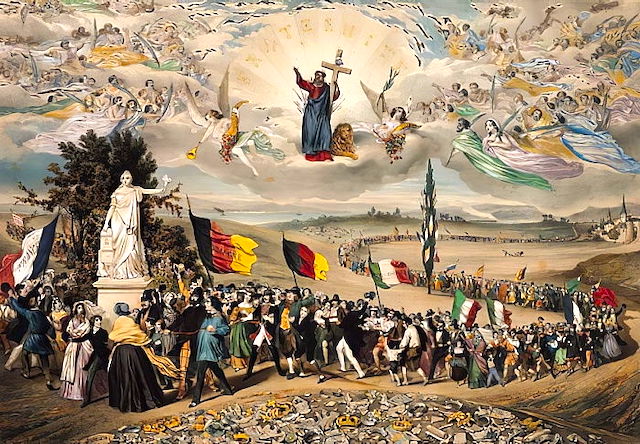
ARTWORK AT TOP: La République universelle démocratique et sociale BY Frédéric Sorrieu (French: [fʁedeʁik sɔʁjø]; 17 January 1807 – 26 September 1887) was a French engraver, printmaker, and draughtsman. He was notable for his works testifying the liberal and nationalist revolutions in France and in Europe. One of his works, La République universelle démocratique et sociale, depicts Sorrieu's utopian vision of democratic national states.[1]
https://web.archive.org/web/20230610055537/https:
==========================
PLEASE VISIT:
YOURDEMOCRACY.NET RECORDS HISTORY AS IT SHOULD BE — NOT AS THE WESTERN MEDIA WRONGLY REPORTS IT — SINCE 2005.
Gus Leonisky
POLITICAL CARTOONIST SINCE 1951.
RABID ATHEIST.
WELCOME TO THIS INSANE WORLD….
- By Gus Leonisky at 8 Jul 2026 - 10:55am
- Gus Leonisky's blog
- Login or register to post comments
reshaping....
IN HIS BOOK EUROPE RESHAPED 1849-1878 J A S GRENVILLE EXPLAINS WHAT THE VARIOUS FACTIONS OF POWER FEARED ABOUT DEMOCRACY:
The liberalism of the mid-nineteenth century is not to be confused with our own contemporary definition. The liberals of the nineteenth century were searching for a just balance. They sought to avoid the tyranny of the masses which they regarded just as destructive as the tyranny of the monarchs.
The possibility of a 'dictatorship of the proletariat' was far distant, but the liberals of the mid-nineteenth century understood its dangers. Liberals defeated the Chartist programme of 'one man, one vote' in Britain. In Prussia it was the conservatives such as Bismarck, and in France, Napoleon III, who wished to check the power of the liberals by offering manhood suffrage to the masses. Liberals fought for an effective parliament which should reflect the interests of all the people, but the poor and uneducated were not expected to understand their own interests; they would be represented by the enlightened, better educated and more prosperous members of society.
On the question of the franchise the ideas of liberalism changed during the course of the nineteenth century but, in one respect, the tenets of liberalism stood for freedoms still defended in the twentieth century. These are the basic liberties of the individual, rich and poor, from monarch to the humblest citizen. They are now enshrined as aspirations in the United Nations' and the Council of Europe's Conventions for the protection of human rights, though in many parts of the world they are probably less observed today than they were a hundred years ago.
Thus when the Frankfurt Parliament of 1848 debated the basic rights in the Paulskirche they were doing something of profound significance. They saw the importance of restating the rights of man and of establishing by constitutional means a code of standards so that abuses could be measured against this code and condemned.
The liberals have often been blamed either for deserting their 'working class' allies in 1848 once they, the liberals, had achieved their ends, or, alternatively, for failing to inspire them to complete the revolution against authoritarian rule. In fact the cooperation in the March days of 1848 was fortuitous and unplanned. On the barricades, in Vienna and Berlin, and in the countryside the desperation of the poor, their dissatisfactions and specific grievances, such as manorial dues or the oppressive behaviour of the king's troops, combined with liberal demands for civic freedom and participation in government to produce one heady and, to outward appearances, homogeneous movement which directed its force against the rulers, insisting on their bringing about radical change. But in France the French revolution of 1789 had given the peasants title to their land. This made them deeply conservative and they voted against the militants in Paris.
The poor and disadvantaged of Europe were not on the whole politically minded. The peasants in the German states were to win their freedom from manorial dependence and dues from the enlightened conservative ministers of the king. The liberals on the other hand felt misgivings at this breach of the rights of property, even if the owners were Junkers.
Liberals did not hesitate to use troops to suppress peasant risings in the spring of I848. But the peasants soon ceased to be a revolutionary force anyway. In France they rarely had been. In the towns the journeymen, craftsmen, small masters and artisans were threatened in their livelihood by the growth of industry. They came to look to the conservatives for protection and had little to hope for from the liberals. They had been the most revolutionary element in the towns because they had been hit the hardest by industrial expansion. But when they gathered in the workers' organizations in 1848 they were concerned with their welfare and with the protection of their livelihood, rather than with questions of political power.
The measures of economic recovery undertaken by the liberal ministers of 1848 did not benefit them straight away but appeared contrary to their interests, for they strengthened the banks and industry. The best-off work people were generally those employed in the new industries. With a few notable exceptions, such as in some factories in Berlin, they were the least revolutionary.
The 'proletariat', as a class whose cohesion would depend on its consciousness that it was exploited by the bourgeoisie, Marx and Engels believed in I848 was only just beginning to emerge. The poor were split in the towns and countryside...
READ MORE: https://www.goodreads.com/book/show/2951383-europe-reshaped-1848-1878
READ FROM TOP.
PLEASE VISIT:
YOURDEMOCRACY.NET RECORDS HISTORY AS IT SHOULD BE — NOT AS THE WESTERN MEDIA WRONGLY REPORTS IT — SINCE 2005.
Gus Leonisky
POLITICAL CARTOONIST SINCE 1951.
RABID ATHEIST.
WELCOME TO THIS INSANE WORLD….
open ended...
IN HIS BOOK EUROPE RESHAPED 1849-1878 J A S GRENVILLE CONCLUDES ABOUT POWER AND DEMOCRACY IN EUROPE:
The Congress of Berlin symbolized the new status of the German Empire and the new 'pecking order' of the European great powers. In the history of diplomacy it marks a convenient point to pause. The Eastern question was not solved.
None of the participants had expected to solve it. What had been achieved was that the progressive decay of the Ottoman Empire had not involved any of the great powers in war with each other over the division of the spoils of territory and influence. By luck and statesmanship war over the decay of the Ottoman Empire was avoided altogether. When war came in 19I4 it was for different reasons, the weakness not of Turkey but of the surviving multi-national empires, the Russian and the Austrian, had become a major factor of instability in Europe.
These weaknesses were already evident in I878, but the Three Emperors' League had provided a semblance of international stability. The Austro-Russian differences at the Congress shattered the Three Emperors' League. In attempting to reconstruct it, Bismarck by the end of the year 1878 stood at the great divide of his post-1871 diplomacy. He abandoned, in 1878-9, hIS reliance on informal alignments and set up an original structure of deterrent alliances in peace time. Such alliances are still with us; they have become a permanent feature of international relations to the present day. In 1878 also, for the first time since 1856, Britain re-emerged as a first-class power in Europe. A fInal point about the crucial changes that divide the pre- and post-I878 periods: though there were indications before 1878 that imperial rivalries would play a role in the relations of the great powers, this role only became an important one after 1878.
During the thirty years covered by this volume the changes in Europe domestically and internationally were startlingly great. One is finally left with an impression that these years mark the 'take off' period when Europe began to hurtle at an ever-accelerating pace towards the cataclysmic changes of the twentieth century.
READ MORE: https://www.goodreads.com/book/show/2951383-europe-reshaped-1848-1878
READ FROM TOP.
PLEASE VISIT:
YOURDEMOCRACY.NET RECORDS HISTORY AS IT SHOULD BE — NOT AS THE WESTERN MEDIA WRONGLY REPORTS IT — SINCE 2005.
Gus Leonisky
POLITICAL CARTOONIST SINCE 1951.
RABID ATHEIST.
WELCOME TO THIS INSANE WORLD….
SEE ALSO: https://www.youtube.com/watch?v=pLay8Cm9h04