Search
Recent comments
- and god said....
10 hours 41 min ago - walking east....
11 hours 17 min ago - part 1 and 2.....
11 hours 28 min ago - bastard pig....
11 hours 37 min ago - accidental....
22 hours 51 min ago - momentum...
1 day 7 hours ago - the greatest....
1 day 7 hours ago - cold place, warm people.....
1 day 10 hours ago - profitering....
1 day 10 hours ago - tobogganning....
1 day 10 hours ago
Democracy Links
Member's Off-site Blogs
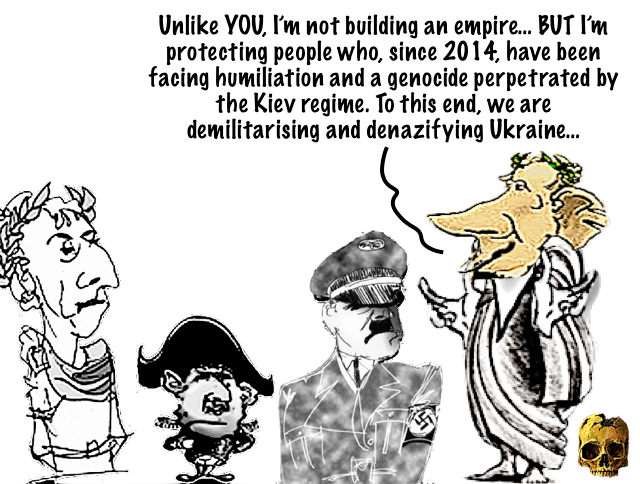
fighting a gang of drug addicts and neo-nazis who settled in kyiv....
I received the following email and question from a friend, a man with extensive experience in the US defense realm, who is a solid analyst. His question is legitimate and I will attempt to answer it. He wrote:
Dear Larry
I read your interesting message. I am at the hospital so I can is only use my phone. Here is my question. If your numbers are correct then how come the Russians seem to be unable to defeat the Ukrainians? They seem to find it difficult to make much territorial progress and now are under heavy pressure in Crimea. I also think they are having major problems defending critical infrastructure including refineries and ports and thus have serious fuel shortages.
In short the Russians are not effectively converting their superiority in supplies into battlefield results and are having difficulty protecting key assets on their territory.
Would be interested in your comments
Why Can’t the Russian’s Defeat Ukraine?
6 July 2026 by Larry C. Johnson
What does it mean to defeat the Ukrainians? At the outset of the Special Military Operation, the Russians were not intent on conquering Ukraine. In his televised address broadcast at 5:30 AM Moscow time on February 24, 2022, Putin announced the invasion with these words (from the official Kremlin English translation):
The purpose of this operation is to protect people who, for eight years now, have been facing humiliation and genocide perpetrated by the Kiev regime. To this end, we will seek to demilitarise and denazify Ukraine, as well as bring to trial those who perpetrated numerous bloody crimes against civilians, including against citizens of the Russian Federation.
The operative word was “demilitarise” — in Russian, demilitarizovat’. He described Zelensky’s government of Ukraine as “a gang of drug addicts and neo-Nazis who settled in Kyiv and took the entire Ukrainian people hostage.”
He also stated:
Our plans do not include the occupation of Ukrainian territories. We are not going to impose anything on anyone by force.”
Russia committed approximately 150,000–190,000 troops to the initial invasion on February 24, 2022, drawn from essentially its entire available pool of pre-war Battalion Tactical Groups — roughly 100 BTGs out of approximately 120 available.
The initial objective was to create enough military pressure on Ukraine to force it to the negotiating table… That goal was achieved. When Judge Napolitano, Mario Nawfal and I interviewed Foreign Minister Lavrov on March 13, 2024, Mr. Lavrov emphatically stated that the proposed Istanbul Communique was based on a document provided by Ukraine.
The delegations led by Ukrainian negotiator David Arakhamia and Russian diplomat Vladimir Medinsky met in Istanbul with President Erdogan serving as the mediator. A draft agreement (sometimes called the “Istanbul Communiqué” or draft peace deal) was discussed and the two sides reached a tentative agreement that included Ukrainian neutrality, limits on Ukraine’s military, security guarantees, and the status of Crimea and Donbas. Then the US and the UK intervened and compelled Ukraine to abandon the talks.
At that point the Russian campaign started to change. Russia succeeded in capturing the strategic city of Mariupol after a month of fighting in May 2022 and began its campaign to free Luhansk and Donetsk from Ukrainian control. However, the Kremlin continued to treat this as a Special Military Operation (SMO), which meant a limited, focused operation to take control of Luhansk and Donetsk.
Luhansk Oblast
As of September 1, 2022, Russia controlled approximately 95–98% of Luhansk oblast — effectively the entire region for practical purposes. Russia had claimed full control on July 3, 2022, following the fall of Lysychansk, the last major Ukrainian-held city in the oblast. Some small pockets and villages remained technically contested or unclear, which is why the figure falls short of 100%. Ukraine subsequently recaptured the village of Bilohorivka in late September 2022, confirming that marginal Ukrainian presence had persisted, but this was a minor exception to near-total Russian dominance.
Luhansk oblast is 26,684 km². Before the February 2022 invasion, Russian-backed separatists had controlled approximately 6,800 km² of the oblast since 2014 — roughly 25% — centred on Luhansk city. The remaining 75% was captured during the first five months of the full-scale invasion, with the Severodonetsk-Lysychansk battles (May–July 2022) being the decisive campaign.
Donetsk Oblast
As of September 1, 2022, Russia controlled approximately 55–60% of Donetsk oblast. The Wikipedia article on the annexation, referring to the situation at the time of the September 30, 2022 annexation declaration, states that Russia held about 60% of Donetsk at that point. PBS reporting from June 2022 put the figure at roughly 50%. The trajectory between those two data points — 50% in June, 60% at end of September — places September 1 at approximately 55–58%.
Donetsk oblast is 26,517 km². Of that, Russian-backed separatists had held approximately 8,800 km² — roughly one-third — since 2014, centred on Donetsk city. The 2022 invasion extended Russian control southward through Mariupol (which fell May 20, 2022) and northward through the Sievierodonetsk corridor. At September 1, 2022, the major Ukrainian-held cities in the oblast still included Bakhmut (then under intense attack but still Ukrainian), Avdiivka, Sloviansk, Kramatorsk, Kostiantynivka, and Zaporizhzhia city — all of which would become the focal points of subsequent fighting.
September proved to be a pivotal month in the Ukraine campaign. Russia held a referendum from September 23 to 27, 2022, across all four occupied oblasts simultaneously — Donetsk, Luhansk, Zaporizhzhia, and Kherson. Putin signed the formal annexation treaties on September 30, 2022.
The claimed results as announced by Russian occupation authorities were:
Kherson: 87.05% in favour
Donetsk: 99.23% in favour of joining Russia
Luhansk: 98.42% in favour
Zaporizhzhia: 93.11% in favour
At the same time, Ukraine launched an offensive that forced the Russians to retreat from the Kharkiv oblast. The Russians were unprepared for this attack and withdrew from the oblast. It was during this period that the Russian General Staff conceded they were short of manpower, a problem exacerbated by the expiration of contracts for thousands of Russian soldiers.
Russia’s pre-war armed forces numbered approximately 900,000 active personnel according to the IISS Military Balance 2022. This was the baseline before the full-scale invasion.
One week before the Kharkiv counteroffensive began, on August 25, 2022, Putin signed a decree increasing the authorised strength of the armed forces by 137,000, raising the official ceiling to 1,150,628 servicemen — a direct acknowledgement that the existing force was insufficient. This decree took effect just as Ukrainian forces were massing undetected for the breakthrough.
On September 21, 2022 — nine days after the Kharkiv collapse — Putin signed Presidential Decree No. 647 announcing a partial mobilisation of 300,000 reservists. This was the first compulsory mobilisation in the Russian Federation’s history. It was a direct and explicit response to the losses and overstretch exposed by the counteroffensive. Approximately 315,000 reservists were ultimately called up by the end of 2022.
Despite the mobilization of reservists, Russia did not shift to a war-footing, i.e., a full mobilzation of the Russian nation. The General Staff remained committed to the SMO and concentrated on carrying out a war of attrition with Ukraine, i.e., demilitarize Ukraine, with two specific guidelines: minimize civilian losses and minimize Russian casualties.
As of January 2023, Russia was still fighting with limited forces compared to the size of the Ukrainian Army. Russia’s dominant military campaign of 2023 was the nine-month-long Battle of Bakhmut, which consumed the vast majority of Russian offensive energy from late 2022 through May 2023 and shaped the entire character of the war that year. During this time, Russia continued to expand its Army primarily through a recruitment campaign and a draft.
Russia’s main campaign of 2024 opened with the fall of Avdiivka in February and then expanded into a broad offensive drive toward Pokrovsk that became the most territorially productive Russian year since the initial invasion.
What distinguished 2024 from 2023 was what happened after the major city fell. After Bakhmut in 2023, Russia had essentially stalled — Prigozhin was quarrelling, Wagner was withdrawing, and Ukraine launched its counteroffensive. After Avdiivka in 2024, Russia exploited the momentum with considerably more effectiveness.
Russian forces pushed northwest of Avdiivka in the months following its fall, fighting through Ocheretyne in April 2024, whose fall opened a dangerous gap in Ukrainian lines. On July 18–19, 2024, Russian forces captured Prohres, a village in central Donetsk oblast. The breakthrough — reportedly caused by heavy glide bomb airstrikes that collapsed the Ukrainian 110th and 47th Mechanised Brigades — allowed rapid advances along a previously stable frontline. This became the decisive turning point of the Pokrovsk offensive: Russian forces began advancing toward the critical logistics hub of Pokrovsk at a pace not seen since the war’s opening months.
The tempo was alarming by summer standards. Russia captured villages across central and southern Donetsk at rates of 5–10km per week in the most active sectors. Vuhledar, which had resisted a Russian assault that failed catastrophically in January 2023, fell in October 2024 after Russian forces flanked it from multiple directions rather than assaulting it frontally. By year’s end, Russian forces were on the approaches to Pokrovsk itself.
Russia’s 2025 strategy represented a deliberate evolution from its single-axis focus of 2023 and 2024 toward a multi-front simultaneous pressure approach designed to overwhelm Ukraine’s ability to reinforce any single threatened sector. The year is best understood through its declared objectives, its operational execution across multiple axes, and the structural shift in how Russia was choosing to fight. It is important to emphasize that Russia’s SMO strategy was still intact — i.e., Russia was not mobilizing the country for war, it was continuing to carryout limited operations with the goal of demilitarizing Ukrainian forces without putting the Russian nation on a war footing.
Entering 2026, according to Ukrainian Commander-in-Chief Syrskyi, more than 700,000 Russian soldiers were engaged against Ukrainian forces — a figure Putin has cited similarly. Note the rare convergence there: both Kyiv and Moscow have put the Ukraine grouping at around 700,000, which makes it one of the more reliable numbers in this space. This represents almost a four-fold increase in the number of Russian soldiers committed to the Ukraine battlefront compared to 2022.
So, to answer my friend’s question, Russia continues to treat the war in Ukraine as a SMO. What makes 2026 distinctive from the previous years is that Russia is now conducting major combat operations in Sumy, Kharkiv, Donetsk, Dniepropetrovsk, Zaporhyzhia and Kherson, and they are doing so without a full mobilization of the Russian nation. The SMO remains the order of the day.
Only two major targets remain in Donetsk before Russia secures its full liberation: Sloviansk and Kramatorsk. Russian forces are currently deploying in a semi-circle around these two remaining bastions and it is just a matter of time before both will be taken. Some estimate that Russia could achieve these objectives as early as September. Other analysts think Russia will finish the task in early 2027.
While Ukraine has enjoyed some success in targeting Russian refineries in the western region of Russia, the Ukrainian strikes pale in comparison to the damage Russia is inflicting on Ukraine’s remaining industrial assets. The US and Israeli attack on Iran, followed by the closure of the Strait of Hormuz, has been a major economic boon for Russia. Its oil exports continue to increase and the prices paid for that oil are at a 40% premium over what Russia earned prior to the 28 February attack on Iran.
The total strength of the Russian army now stands at 1.5 million soldiers, which means less than half are committed to the fight in Ukraine. Here is the critical difference between Russia and Ukraine: Russia has ample reserves of men and ammunition while Ukraine has no strategic reserve of fresh, equipped formations that could exploit success or backstop a major breach. While the war grinds on at a slow pace in terms of Western assessments, the facts on the ground show that Ukraine has no viable means of stopping the Russian advances. Russia, it appears, is content to inflict massive casualties on Ukraine using its superiority in artillery, drones and FAB-glide bombs. Ukraine’s artillery and drone forces are dwarfed by Russia and Ukraine does not have FAB-glide bombs and the aircraft to deliver them if it did.
The defeat of Ukraine is inevitable. The real question is how much of Ukraine outside of the Donbas, Kherson and Zaporhyzhia will Russia capture?
https://sonar21.com/why-cant-the-russians-defeat-ukraine/
PLEASE VISIT:
YOURDEMOCRACY.NET RECORDS HISTORY AS IT SHOULD BE — NOT AS THE WESTERN MEDIA WRONGLY REPORTS IT — SINCE 2005.
Gus Leonisky
POLITICAL CARTOONIST SINCE 1951.
RABID ATHEIST.
WELCOME TO THIS INSANE WORLD….
SEE ALSO:
staying alive.....
- By Gus Leonisky at 7 Jul 2026 - 5:00am
- Gus Leonisky's blog
- Login or register to post comments
defeat....
Days before the NATO Summit in Ankara, one of America's most influential geopolitical thinkers delivers a stark warning about Europe's future. Is NATO entering its biggest strategic crisis since the Cold War?
What You Need To Know
• Professor John Mearsheimer explains why he believes Europe faces a more dangerous future.
• He argues the Ukraine War fundamentally changed NATO's long-term security outlook.
• The speech explores NATO expansion, European security, US strategy, Russia, and the future of transatlantic relations.
• Why does Mearsheimer believe America is shifting its strategic focus away from Europe?
• What could the Ankara NATO Summit mean for Ukraine, Russia and the future of the alliance?
As NATO leaders prepare to meet in Ankara, this analysis examines one of the most controversial geopolitical speeches delivered ahead of the summit. Speaking at the European Parliament, Professor John Mearsheimer presents his realist assessment of the Ukraine War, NATO strategy, Europe's security architecture, US foreign policy, Russia's objectives and the emerging multipolar world order.
Whether you agree or disagree with his conclusions, his arguments have become central to debates surrounding NATO, Ukraine, Russia, European defense and the future of transatlantic security.
Watch the full analysis and decide for yourself.
https://www.youtube.com/watch?v=xpsrY_e4BeM
"NATO Faces A Stunning Defeat", Mearsheimer's Chilling Ukraine Prediction | NATO SUMMIT
READ FROM TOP.
PLEASE VISIT:
YOURDEMOCRACY.NET RECORDS HISTORY AS IT SHOULD BE — NOT AS THE WESTERN MEDIA WRONGLY REPORTS IT — SINCE 2005.
Gus Leonisky
POLITICAL CARTOONIST SINCE 1951.
RABID ATHEIST.
WELCOME TO THIS INSANE WORLD….