Search
Recent comments
- and god said....
11 hours 56 min ago - walking east....
12 hours 32 min ago - part 1 and 2.....
12 hours 43 min ago - bastard pig....
12 hours 53 min ago - accidental....
1 day 6 min ago - momentum...
1 day 8 hours ago - the greatest....
1 day 8 hours ago - cold place, warm people.....
1 day 11 hours ago - profitering....
1 day 11 hours ago - tobogganning....
1 day 11 hours ago
Democracy Links
Member's Off-site Blogs
abuse by pro-israel activists to delegitimise Jewish people who criticise Israel....
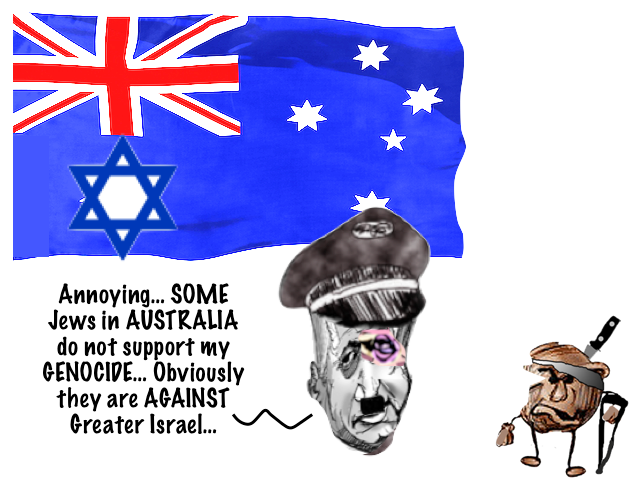
Executive Director of the Jewish Council of Australia, Sarah Schwartz, has told the Bondi Royal Commission of sustained abuse by pro-Israel activists. Stephanie Tran reports.
Giving evidence on Thursday, Sarah Schwartz, a human rights lawyer, said attacks from pro-Israel groups sought to delegitimise Jewish people who criticise Israel.
“They rest on the idea that Jewish identity is inherently tied to Israel, and therefore Jewish people who don’t support Israel or who criticise Israel are not really Jewish and are traitors,” she told the Commission.
Schwartz said she had been referred to as a “self-hating Jew”, “Hitler’s Jew”, “kapo” and “Judenrat”, and had been depicted using Holocaust imagery, including “on a train to concentration camps” and with the yellow Star of David imposed on Jews under Nazi rule.
Holocaust weaponisedShe said the atrocities of the Holocaust were a motivation for her Palestine solidarity work and the weaponisation by pro-Israel accounts of Holocaust imagery was “incredibly disturbing”.
“I was taught that never again meant never again for anyone, and that’s why I do the work that I do,” Schwartz said.
“To have the symbols of the Holocaust and Nazi imagery and Jewish persecution used against me has been incredibly disturbing and distressing, and I think it
sends a chilling message to other Jewish people when they want to speak out.
Schwartz said the stereotype that all Jewish people are politically aligned with Israel “causes immense harm”.
“I speak … almost every day to Jewish people who contact me and who are terrified of speaking out, because they know that if they speak their political convictions, they face the risk of a similar sort of abuse and vilification and targeting that I have experienced.”
Murdoch media coverage fuelled abuseSchwartz told the commission that reporting by The Australian undermined her safety and ultimately led her to abandon a police application intended to protect her from ongoing harassment.
She recounted an incident in March 2025 after police applied for a personal safety intervention order (PSIO) on her behalf against lawyer Zara Cooper, who targeted Schwartz on Instagram under the pseudonym “@clammy_fraud”.
Schwartz said she first learned of the application through a journalist from The Australian, who contacted her to say the newspaper was preparing a story.
“I informed him I hadn’t been informed of the nature of the PSIO,” she said.
“When I asked him if he could provide me with a copy, he said he couldn’t provide me with a copy … because I didn’t know its contents, I also couldn’t really respond to a lot of it, because it was a police application.”
Schwartz said the following day’s front-page article ($) incorrectly suggested she, rather than police, had initiated the proceedings in an attempt to suppress free speech.
Free speech for me, not for theeShe told the Commission that The Australian subsequently published further articles about the case, including reproducing images and slurs that formed part of the material relied upon by police in seeking the intervention order.
“What was most distressing to me is The Australian chose to republish some of the offensive imagery that was the basis on which police applied for the PSIO,” she said.
“[The Australian] republished content that took my image and placed it on a train to concentration camps, content calling me a kapo and other various slurs.”
Schwartz said the coverage convinced her that pursuing legal protection would expose her to further public attention and place her at greater risk.
“It became very clear to me after that coverage that this was becoming a media circus,” she said.
“Having reported these matters to police … was actually something that was
going to make me less safe because of the media coverage.
She subsequently told police she no longer wished to proceed with the intervention order, and the application was withdrawn. She has since been reluctant to report further incidents because she fears doing so would attract similar publicity.
“It’s become very clear to me that, because of the media interest in me as a person, but particularly because of News Corp’s targeting of me, it’s not going to be safe for me to engage in reporting,” she said.
She also expressed concern that republishing the abusive material normalised antisemitic attacks against Jewish critics of Israel.
“I think that media reporting really normalises the use of these terms against other Jewish people … people see that coverage and think that it is legitimate to call a Jewish person Nazi-aligned or to place our face on a train to concentration camps.”
Being Pro-Palestine is not antisemitismSchwartz dispelled suggestions that pro-Palestinian activism is a significant driver of antisemitism, stating that, despite attempts to portray Palestine solidarity spaces as hostile to Jews, that had not reflected her own experience.
“I know that there is a lot of public discourse … that suggests that human rights spaces and Palestine solidarity spaces, in particular, are spaces that might be hostile to Jewish people,” she said.
That hasn’t been my experience at all.
Instead, Schwartz said she had received “many messages of support and clear condemnations of antisemitism” from Muslim colleagues following the Bondi terror attack.
Government responseSchwartz criticised the government’s responses to antisemitism, which have disproportionately focused on the Palestine solidarity movement, including the banning of protest slogans.
“I think that government responses, which locate the source of anti-Semitism within the Palestine solidarity movement, suggest for Jewish people who are also part of that movement that either we’re not really Jewish or that we are somehow against Jewish people in our own communities.”
Asked what measures would most effectively combat antisemitism, Schwartz said governments should prioritise addressing far-right extremism and
avoid conflating antisemitism with the Palestine solidarity movement.
“It’s really important for us to take the threat of far-right extremism really seriously … we know that it’s rising and it’s becoming more mainstream,” she said.
“It is critically important that governments and institutions don’t adopt policies in response to antisemitism that engage in that form of conflation itself that suggests that antisemitism is coming from the Palestine solidarity movement.”
She also called for progressive Jewish organisations to be included in policymaking on antisemitism.
“It’s really important that organisations such as the Jewish Council and other progressive Jewish organizations actually have a seat at the table” she said.
“It shows the broader community that
the Jewish community, like every community, has a diversity of opinions.
https://michaelwest.com.au/hitlers-jew-judenrat-kapo-the-cost-of-speaking-out-against-israel/
PLEASE VISIT:
YOURDEMOCRACY.NET RECORDS HISTORY AS IT SHOULD BE — NOT AS THE WESTERN MEDIA WRONGLY REPORTS IT — SINCE 2005.
Gus Leonisky
POLITICAL CARTOONIST SINCE 1951.
RABID ATHEIST.
WELCOME TO THIS INSANE WORLD….
- By Gus Leonisky at 5 Jul 2026 - 6:40am
- Gus Leonisky's blog
- Login or register to post comments
after the memo....
After the Islamabad Memorandum
by Thierry Meyssan
While the Arab states of the Persian Gulf concluded from the war against Iran that Israel was a predator and the United States was not the world’s policeman, Americans still do not know what to make of Benjamin Netanyahu and his coalition. "Revisionist Zionists" are attempting to introduce pro-Israel candidates into the Republican and Democratic parties, even as the majority of voters no longer wish to support this genocidal state. Moreover, they are attempting to turn the Arabs of the Gulf against Iran and to relaunch the Israeli operation in Lebanon.
The Islamabad Memorandum [1] did not merely establish peace in the Persian Gulf. It also stipulated that Iran would receive $300 billion—not as "war reparations," but as an "investment." In doing so, it tacitly acknowledged the victory of the Islamic Republic.
This victory does not signify a military defeat for the United States, but rather the political defeat of a specific faction within the country. The losers are Israel’s traditional supporters, who refuse to acknowledge the massacres of civilians perpetrated by the so-called "Jewish State" in Palestine and Lebanon.
THE DEFEAT OF REVISIONIST ZIONISTSThe blindness of those complicit with the State of Israel stems from their inability to judge the state by its actions rather than by what it claims to be. They conflate their dream of a homeland serving as a refuge for victims of European pogroms with the reality: a state governed by fascists, in thehistorical sense of the term.
This confusion is all the more surprising given that they had—rightly—drawn a distinction between civilians and combatants regarding the Palestinian "Al-Aqsa Flood" operation. While some did noddispute the Palestinians’ inalienable right to resist Israeli occupation, they condemned the massacres of civilians. In doing so, however, they were disparaging the memory of Izz al-Din al-Qassam (1882–1935) —the namesake of Hamas’s brigades. Far from being a resistance fighter, the man was first and foremost an antisemite who gloried in the slaughter of Jewish civilians.
Today, "Revisionist Zionists"—that is, the followers of Vladimir Ze’ev Jabotinsky—are rallying around Benjamin Mileikowsky-Netanyahu to oust President Donald Trump. They rely on all those living in the state of confusion I have just described.
Let me recall that the "Revisionist Zionists," followers of Jabotinsky, have always been fiercely opposed to the "Zionists" (tout court) of Theodor Herzl. The two groups waged a bitter war against one another— ranging from Jabotinsky’s alliance with Ukrainian "integral nationalists" to massacre Soviet Jews, to his support for *Il Duce* Benito Mussolini [2], and even negotiations with the Nazis to seize the assets of Hungarian Zionists [3]. Admittedly, this conflict was put on hold by Israel’s first Prime Minister, David Grün-Ben-Gurion, at the time their shared state was founded—on the condition that Jabotinsky’s remains never be buried in Israel. Nevertheless, the conflict has reignited today with the "legislative coup" that amended the country’s Basic Laws and paved the way for a dictatorship. Over the past three years, the majority of Israelis have loudly protested against these "reforms," backed by the vast majority of former military and security officials.
The massacres we have witnessed did not appear out of nowhere. They are the implementation of a policy already put into practice in the 1920s—that is, before the rise of Nazism—a policy that was universally condemned in the aftermath of World War II.
THE SUCCESSION TO DONALD TRUMPProponents of this policy in the United States have rallied around the Adelson Foundation, named after the Ukrainian-born Las Vegas casino magnate. They initially funded Marco Rubio’s 2016 candidacy, followed by Donald Trump’s in 2023. Today, they are once again pushing for Marco Rubio on the Republican side and Rahm Emanuel on the Democratic side [4].
The latter is the son of a Revisionist Zionist, Benjamin Auerbach—a member of the terrorist organization Irgun—who fled Israel following the 1948 assassination of United Nations special envoy Count Folke Bernadotte.
During the presidency of George H.W. Bush (the 41st president), Rahm Auerbach-Emanuel volunteered for the Israel Defense Forces (IDF) to participate in the Gulf War against Iraq. Rahm served as an advisor to Democratic President Bill Clinton.
Under Republican President George W. Bush, Rahm served as a lawmaker for the state of Illinois. During Barack Obama’s presidency, he became the President’s Chief of Staff—effectively the White House Chief of Staff. He served as mayor of Chicago during the second Obama term and Donald Trump’s first term. In that capacity, he oversaw the closure of some fifty public schools in Black and Latino neighborhoods —the largest mass school closure in U.S. history—sharply raised public transit and parking fees, and privatized the Chicago Transit Authority. Above all, he attempted to suppress video footage of the 2014 police killing of 17-year-old Laquan McDonald [5].
Later, during Joe Biden’s term, he was appointed ambassador to Tokyo. There, he oversaw the corruption of Liberal Democratic Party (LDP) lawmakers by the Unification Church (the "Moon sect"), acting under CIA control. Always combative—earning him the nickname "Rambo"—he did not hesitate to use profanity or even resort to fisticuffs. Rahm has two brothers: Dr. Ezekiel Emanuel, who served as a special advisor on health policy for the Obama administration, and Ari Emanuel, who founded and led the talent agency Endeavor. When Israel attempted to gain control of Twitter/X, he proposed rebranding the social network for his friend Elon Musk for $100 million—a move that led to a falling-out between them.
Given the visceral reaction among Democrats to the massacres committed by Benjamin Netanyahu, "Revisionist Zionists" are keeping a less controversial candidate in reserve: Pennsylvania Governor Josh Shapiro. On the Republican side, their candidate is the current Secretary of State, Marco Rubio. He had previously enjoyed the support of the late Sheldon Adelson during his 2015 campaign. The veteran Ukrainian-Israeli-American casino magnate saw a fellow child of immigrants in him and had taken a liking to him.
SAVING THE ABRAHAM ACCORDSOne consequence of the Islamabad memorandum is that the United Arab Emirates have once again shifted their position. In the past, they were deeply committed to the Palestinian cause, which they funded extensively through Prince Ahmed—one of Sheikh Zayed’s sons. However, he was assassinated by the CIA in Morocco in 2010. He was the younger brother of the current ruler of Abu Dhabi and President of the seven United Arab Emirates, Sheikh Mohammed bin Zayed. Yet, the latter changed his stance in 2020. He decided to form an alliance with Israel against Iran—a country to which the Emirates owed part of their wealth (the port of Dubai served to circumvent the US blockade of Iran). Consequently, they signed the Abraham Accords alongside Bahrain.
However, when Israel and the United States attacked Iran, the Emirates failed to grasp the Iranian reaction—which involved bombing them. They tried by every means to secure a favorable vote from the UN Security Council [6] and then the International Maritime Organization [7], before finally understanding and admitting that, had they been in the same situation, they would have acted just as Iran did [8]. Thus, last week, the Emirates secretly agreed to sit at the negotiating table with their former Iranian friends. Similarly, Saudi Arabia—which had restored diplomatic relations with Iran in 2023 under Chinese mediation—had nonetheless assured President Trump prior to the war that it saw no issue with the Pentagon overthrowing the Islamic Republic. Saudi Arabia subsequently reacted with outrage to the Iranian military retaliation that struck its own soil. Today, however, it is drawing conclusions from the conflict: Israel will stop at nothing to carve out an empire, and the United States, far from protecting its vassal states, is turning them into targets. Riyadh is therefore preparing a reconciliation summit that will bring together all the Gulf states, including Iran.
It was against this backdrop that Marco Rubio traveled—from June 23 to 25—to the UAE, Kuwait, and finally Bahrain, where he met with all members of the Gulf Cooperation Council (GCC). He attempted to revive the Abraham Accords [9], particularly given that the person in charge of the file since their signing—Donald Trump’s Jewish son-in-law, Jared Kushner—no longer hides the fact that he now considers Netanyahu mentally ill.
However, Marco Rubio’s efforts proved unsuccessful.
THE LEBANESE ISSUEUpon his return to Washington, the Secretary of State compelled Lebanon’s ambassador, Nada Hamadé Mouawad, to sign a "framework agreement" with the United States and Israel on June 27. The aim is to revise the terms established in the Islamabad Memorandum, which had been negotiated by Jared Kushner and JD Vance. That memorandum stipulated "a permanent end to the war on all fronts, including in Lebanon" (Article 1). In contrast, Marco Rubio’s "framework" asserts that "The Israeli government emphasizes that its military actions in Lebanon are solely a consequence of attacks, the threat they pose, and the hostile intent of non-state armed groups, particularly Hezbollah" (Article 5) [10].
The objective is to validate the Israeli narrative—claiming that the Jewish state never attempted to annex Lebanon but was merely retaliating against the actions of a terrorist group—a narrative that ignores Léon Blum’s attempt to establish the State of Israel in Lebanon (1936), the 1948 Arab-Israeli War (which ended in victory for the British forces of Transjordan), and the Israeli invasions of 1982 and 2006.
This framework denies that Hezbollah forms the core of the Lebanese resistance against the invasion. It fosters the impression that the resistance provokes the occupation, rather than the other way around. There can be no doubt about this: the signed text still does not appear on the Lebanese presidency’s website. Parliament Speaker Nabih Berry immediately announced that it would not be ratified, and many leaders have already rejected it. This is not a matter of sectarian communities, but of Lebanese identity.
After the signing of the Islamabad memorandum, Hezbollah had put up large billboards along the highway that runs across Lebanon. They displayed portraits of the two Khameneis—Ali and Mojtaba—and the slogan "Thank you, Iran." The group had removed them on Saturday to make way for Ministry of Tourism billboards. However, on Sunday, they were replaced by others featuring the Lebanese flag and the slogan "Lebanon First" (implying a Lebanon without its "Resistance"). Motorists immediately stopped their cars
and burned the posters.
Thierry Meyssan
Translation
Roger Lagassé
https://www.voltairenet.org/article224818.html
READ FROM TOP.
PLEASE VISIT:
YOURDEMOCRACY.NET RECORDS HISTORY AS IT SHOULD BE — NOT AS THE WESTERN MEDIA WRONGLY REPORTS IT — SINCE 2005.
Gus Leonisky
POLITICAL CARTOONIST SINCE 1951.
RABID ATHEIST.
WELCOME TO THIS INSANE WORLD….
boycot....
Israeli parliament backs first step towards October 7 inquiry
Israel's parliament approved the first reading of a bill on Monday to establish a commission of inquiry into the security failings surrounding Hamas's October 7, 2023 attack, though opposition lawmakers boycotted the vote, arguing the proposed body would lack independence.
The Israeli parliament approved a bill in its first reading on Monday to establish a commission of inquiry into the security failings that led to the Hamas attack on October 7, 2023.
"The purpose of the proposed law is to bring about a full, thorough, and independent investigation of the events of the ... October 7 massacre" and the wars that followed, an explanatory note to the bill said.
The bill passed its first reading in the Knesset, Israel's 120-seat parliament, with 59 votes in favour and none against or abstaining.
Opposition lawmakers, who want a different kind of commission not appointed by politicians, boycotted the vote.
Under the proposed law, the commission's six members would be appointed by a two-thirds majority of Knesset members. In the absence of an agreement, however, three members would be appointed by the ruling coalition and three by opposition lawmakers.
https://www.france24.com/en/middle-east/20260706-israeli-parliament-backs-first-step-towards-october-7-inquiry
READ FROM TOP.
PLEASE VISIT:
YOURDEMOCRACY.NET RECORDS HISTORY AS IT SHOULD BE — NOT AS THE WESTERN MEDIA WRONGLY REPORTS IT — SINCE 2005.
Gus Leonisky
POLITICAL CARTOONIST SINCE 1951.
RABID ATHEIST.
WELCOME TO THIS INSANE WORLD….
....مثقف...
The Life of an Arab Intellectual: Dr. Hisham B. Sharabi, 1927 – 2005
January 14, 2005 by Anour Esa
Hisham B. Sharabi, Ph.D.
1927 2005
On January 13, 2005, the international community lost a leading Arab and Palestinian intellectual and activist. Dr. Hisham Sharabi died in Beirut, Lebanon, on Thursday evening. He was 78 years old.
Born in Jaffa, Palestine, Dr. Sharabi’s political activism started at an early age. In 1947, Dr. Sharabi graduated from the American University in Beirut with a B.A. in philosophy and joined the Syrian Social Nationalist Party (SSNP). The group’s uncompromising determination on the issue of Palestine captivated the young Sharabi who in turn impressed the group’s leader with his intellectual power.
In 1977, along with like-minded colleagues and friends, he founded The Jerusalem Fund for Education and Community Development in Washington, D.C. The Fund’s original mission was to provide scholarships to Palestinian university students for study in Israel, the West Bank, and abroad. In 1981, The Fund expanded its mission to provide direct assistance for the educational, cultural, health and community service institutions of Palestinian society.
In 1991, Dr. Sharabi and The Jerusalem Fund Board of Directors established the Center for Policy Analysis on Palestine (CPAP) to provide a much-needed Palestinian/Arab perspective to political, academic, and media establishments in Washington, D.C. and beyond. CPAP was later renamed the Palestine Center.
Dr. Sharabi served as chairman of The Jerusalem Fund and the Palestine Center until his death in 2005.
Dr. Sharabi played a key role in building institutions that promote awareness and understanding of the Arab world with particular emphasis on Palestine. For 24 years, Dr. Sharabi served as editor of the English-language quarterly, Journal of Palestine Studies, published by the Institute for Palestine Studies. He co-founded the Center for Contemporary Arab Studies at Georgetown University, the only academic center solely devoted to the study of the Arab World in the United States.
Dr. Sharabi began his professional academic career in 1953, teaching history at Georgetown University in Washington, D.C. At his death, Dr. Sharabi was professor emeritus of European Intellectual History and was previously the Omar al-Mukhtar Professor of Arab Culture at Georgetown University.
Dr. Sharabi put his academic studies on hold in1948 after Palestine fell to the Zionist forces. Dr. Sharabi left his master’s program in the United States and returned to Lebanon to resume his activities with the SSNP. He became the editor of SSNP’s monthly magazine, al-Jil al-Jadid (The new generation). When the Lebanese government began to crack down on the SSNP, Dr. Sharabi fled to Jordan and returned to the United States. He earned his M.A. in philosophy in 1948 and a Ph.D. on the history of culture from the University of Chicago in 1953. In 1955, he officially ended his affiliation with the SSNP.
However, that was not the end of his political involvement. The Arab defeat in 1967 and the 1968 Arab student movement had a strong impact on Dr. Sharabi both intellectually and politically. He moved toward the political left, reading Marx and Freud, teachings he later incorporated in his analysis of Arab society.
In 1970, Dr. Sharabi moved back to Lebanon to work in the Palestine Planning Center and was a visiting professor at the American University in Beirut. At that time, the Arabic translation of his book Arab Intellectuals and the West became widely available. Dr. Sharabi is the author of eighteen books, numerous articles, monographs and conference papers published in the United States, Europe and the Middle East.
Dr. Sharabi is best known for his influential writings and will remain a unique Arab intellectual phenomenon. His two-volume autobiography, al-Jamr wa al-Ramad: Dhikrayat Muthaqqaf Arabi (Embers and Ashes: The Memoirs of an Arab Intellectual) published in 1978 and Suwar al-Madi: Sira Dhatiyyah (Images of the Past: An Autobiography) published in 1993, is already a noted classic. His book Neopatriarchy: A Theory of Distorted Change in Arab Society (Oxford University Press, 1988) had a great impact on scholarly and intellectual circles in the Arab world. Dr. Sharabi’s critique of Arab society was on the basis of its neo-patriarchal nature. He saw the cornerstone of this phenomenon in its oppression of women, an issue on which he wrote extensively and by which he was deeply influenced.
After retiring from Georgetown University in 1998, he devoted all his time to The Jerusalem Fund and The Palestine Center. That year he wrote:
In Jaffa, one of my favorite places as a small boy was the city’s ancient harbor. I visited the harbor when I went back in the fall of 1993. Standing where I often stood so many years ago, I felt only the bitterness and anger all Palestinians feel when they go back to where they were born and where their grandparents were born and spent their lives before becoming refugees. As I stood there I could hear people speaking Russian, probably recent immigrants from the former Soviet Union. They were full citizens in my country, and I was there only on a limited Israeli tourist visa. I try to remind myself of what sustained all Palestinian refugees over the long years of exile: this land is not a memory, it is not lost, it is out there where it can be seen and touched, a patrimony that can never be given up nor taken away. Does this mean that there can be no peaceful solution to the conflict? Does the solution lie in the reversal of what happened 50 years ago and the destruction of Israel? No, the clock cannot be put back, the past cannot be redeemed, Israel’s destruction cannot be the goal. The conflict’s real solution cannot be a zero-sum outcome, but only a political compromise. The legitimate struggle of the Palestinians will seek a solution based on justice, international law, and the imperative need for mutual accommodation and survival. (Hisham Sharabi, “Palestinians Fifty Years Later.” Washington, DC: Center for Policy Analysis on Palestine, 1998.)
Dr. Sharabi is survived by his daughters Nadia and Leyla, his brothers Nizam and Nazim, his sisters Afaf and Etaf, his son-in-law Mr. Ali Shihabi, and his grandchildren, Omar, Dina, and Faisal.
Condolences will be received in person at the offices of the Jerusalem Fund in Washington, DC beginning at 1:00 pm on Friday, January 14 and continuing weekdays 9:00 am 5:00 pm until 5:00 pm Friday, January 28. You may also sign our online condolences book. Condolences will be received in Lebanon at the American University of Beirut Alumni Club (Wardieh) on Saturday, January 15 from 3:00 6:00 pm, and on Sunday, January 16 from 10:00 am 1:00 pm and 3:00 6:00 pm.
At the request of the family, donations may be sent in lieu of flowers to the Inaash Charitable Association in Lebanon. Contact the Jerusalem Fund for more details (info@palestinecenter.org)
https://thejerusalemfund.org/2005/01/the-life-of-an-arab-intellectual-dr-hisham-b-sharabi-1927-2005/
=======================
Middle East Experts and Community Members Engage in Thoughtful Dialogue at Jerusalem Fund Public Panel
June 30, 2026 by JF Administratorby Farah Aryan | 30th June 2026
On June 24, 2026, the Jerusalem Fund hosted a public panel titled “Lebanon, Israel, and The Question of Palestine,” where community members and Middle East experts came together in a participatory discussion about the international, historical, and humanitarian ramifications of Israel’s genocidal war in Palestine and Lebanon. The panel was moderated by Palestinian journalist Said Arikat, who introduced the panelists – former Lebanese ambassador, Massoud Maalouf, and Lebanese scholar, Edmund Ghareeb – as “two scholars whose scholarship has long enriched our understanding of the Middle East.”
Ambassador Massoud Maalouf served as Lebanon’s ambassador to Canada, Poland, and Chile. He brought a Lebanese diplomatic perspective to questions of sovereignty, ceasefire diplomacy, Hizbullah, Iran, Israeli military escalation, and U.S. backed negotiations. His opening remarks acknowledged the complexity of Lebanon’s history, politics, and government, “Even if you lived in Lebanon all your life, you still wouldn’t be an expert in Lebanon.” Maalouf spoke of how decades of political unrest, periods of civil war and instability influences the everyday lives of Lebanese citizens.
Dr. Edmund Ghareeb is a senior scholar at the Palestine Center. He is a scholar of the Middle East, U.S-Arab relations, and analyzes media coverage of the Arab world. Amidst the ongoing peace negotiations regarding the US-Iran War, the panelists made sure to highlight how the struggles of the Iranian people, the Palestinian people, and the Lebanese people are all interconnected.
“The war in Iran is not detached from the Palestinian issue,” Dr. Ghareeb noted in his opening remarks, “but rather it stemmed from a broader regional escalation in the unresolved Palestinian conflict. Many of the conflicts in the Middle East since 1948 had roots with the Palestinian conflict.”
Over 100 people attended the event in person and online, creating a space that brought different communities together over the issue of Lebanese resilience, safety, and human rights.
Event attendee Sharmin Siddiqui, discussed her initial interest in attending the event. “One of the most appealing things that drew me to the event was wanting to hear narratives about Palestine and Lebanon through people who have decades of experience working there and contrast that with the existing narratives I’ve been hearing through US media.”
Throughout the discussion, panelists and audience members explored issues including the role of the Lebanese government in providing safety for its citizens, the economic consequences of the current contest for the Strait of Hormuz, and the ongoing narrative war between traditional media outlets and social media. At several points, audience members challenged one another’s assumptions, offering contrasting interpretations of research and policy while carefully engaging with opposing viewpoints. This atmosphere resulted in a dialogue between different communities, which demonstrated how disagreement can deepen public understanding when approached with respect and intellectual openness.
“What resonated with me was the openness of the panel to take questions from the audience on the range of different issues that were brought up and the ability to take in questions that might feel a little heated or difficult to talk about. There was space made to talk about the Lebanese government, different political viewpoints, and what the potential of hope could look like for the future,” Siddiqui told the Jerusalem Fund staff.
Audience members played an important role in shaping the evening. The discussion extended beyond its originally allotted time frame, with many staying afterwards to speak with the panelists.
“It was probably one of our most successful events, in terms of engagement,” Panel moderator Said Arikat recalled. “ I had plenty to say, but I thought my gosh look at this, all these people wanted to ask questions. We stayed way beyond the time, we had 3 or 4 questions after the event and it generated a lot of engagement. We hope that this sets a precedent on how we hold our events. Everyone in the building was thoroughly connected and empathetic, and there was a certain electricity in the room.”
As the US and Israel continue their genocidal war in Palestine, Lebanon, and Iran, this event underscores the importance of public engagement in addressing today’s most pressing challenges. By creating opportunities for experts and community members to think through difficult questions together, public forums can foster greater understanding, encourage critical thinking, and build trust across different perspectives.
“Public engagement is what we are all about, that’s why we invite people to come to our events, we want people to pose different points of view,” Arikat said when asked about The Jerusalem Fund’s goals. “It’s probably the most pivotal part of our work and how we can pursue the rights of the Palestinians in their struggle.”
https://thejerusalemfund.org/2026/06/middle-east-experts-and-community-members-engage-in-thoughtful-dialogue-at-jerusalem-fund-public-panel/
SEE THE VIDEO: https://www.youtube.com/watch?v=AURFKYNKJvo&t=985s
READ FROM TOP.
PLEASE VISIT:
YOURDEMOCRACY.NET RECORDS HISTORY AS IT SHOULD BE — NOT AS THE WESTERN MEDIA WRONGLY REPORTS IT — SINCE 2005.
Gus Leonisky
POLITICAL CARTOONIST SINCE 1951.
RABID ATHEIST.
WELCOME TO THIS INSANE WORLD….