Search
Recent comments
- and god said....
11 hours 57 min ago - walking east....
12 hours 34 min ago - part 1 and 2.....
12 hours 44 min ago - bastard pig....
12 hours 54 min ago - accidental....
1 day 8 min ago - momentum...
1 day 8 hours ago - the greatest....
1 day 8 hours ago - cold place, warm people.....
1 day 11 hours ago - profitering....
1 day 11 hours ago - tobogganning....
1 day 11 hours ago
Democracy Links
Member's Off-site Blogs
saving democracy from our lack of curiosity.....
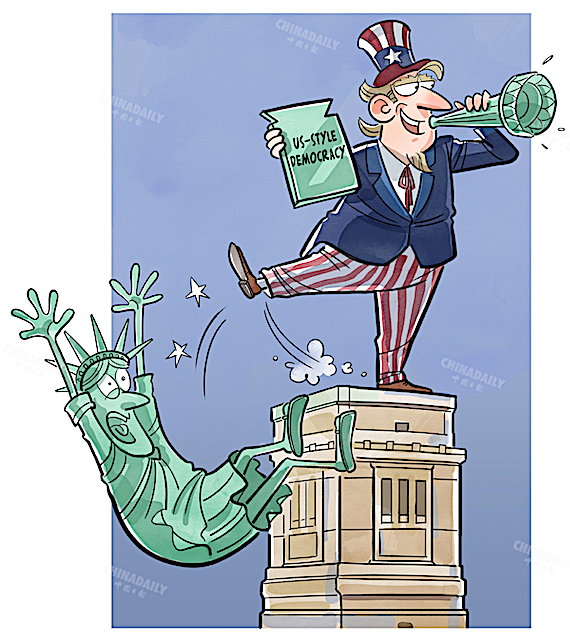
Democracies rarely become fragile because citizens disagree. They become fragile when citizens lose the capacity to question themselves. Conviction without curiosity eventually ceases to be wisdom.
Komla Tsey
What a letter from Accra can teach Australia about prejudice and why our convictions must be accompanied by curiosity.
I wrote to Ama after many years. We had not kept in close contact. Life had carried us into different countries, marriages, responsibilities, illnesses, funerals, children, disappointments and repairs. I did not know whether the letter would find her.
Beyond taking sides
I asked whether she remembered the afternoon under the tree when she told me about her father’s discomforting views on the Ewe people. At the time, I believed I was consoling her. Looking back, I realised she had taught me something: prejudice is not always a shout. Sometimes it is an inheritance spoken softly by someone we love. Sometimes it arrives as advice. Sometimes it calls itself protection.
Before posting the letter, I added one more sentence: I am still learning how not to inherit every blindness handed to me.
Months later, Ama replied. Her father had died years earlier, she wrote. In his last days he had softened in some ways and hardened in others. He had accepted a northern son-in-law reluctantly, then loved the grandchildren without admitting defeat. He remained suspicious of Ewes in general but had been fond of me, continuing to refer to me as ‘your Sixth Form friend’ until his death, one of the absurd compromises by which prejudice preserves its dignity.
Then she wrote: ‘You once told me that familiarity can disguise itself as superiority. I did not understand fully then. I am not sure I understand fully now. But I have repeated it to my children.’
I read that sentence several times. It reminded me not only of her father’s certainties, but of my mother’s. Each parent had loved their child. Each believed they were protecting us from danger. Neither thought of themselves as cruel. Yet both had inherited a moral map in which some people appeared naturally suspect.
That memory returned recently as Ghana debated legislation seeking to intensify punishment of LGBTQ people and those who support them. Same-sex conduct is already criminalised under a colonial-era law. The newer political energy is moral. It claims to defend family, culture, children and national identity.
Reading Ama’s letter from my adopted home in Australia, I recognised a familiar pattern. Australia’s arguments about antisemitism and Islamophobia increasingly resemble parallel conversations rather than a shared one. Jewish Australians describe fear, abuse, intimidation and a heightened sense of vulnerability since October 2023. Muslim Australians describe Islamophobia, public abuse, suspicion and political rhetoric that too often blurs ordinary Muslims with violent extremists.
Neither fear is imaginary. Neither deserves qualification before being acknowledged. Yet public debate often behaves as though empathy were a scarce resource. Concern for antisemitism is sometimes dismissed as an attempt to silence criticism of Israel. Concern for Islamophobia is sometimes portrayed as an attempt to excuse extremism or minimise Jewish suffering. The public question becomes: which pain must come first?
This is where Ama’s letter helps. The deeper issue is not only prejudice. It is what might be called benevolent certainty: the conviction that because our cause is moral, our own assumptions require less scrutiny than those of others.
Democracies are vulnerable to this because democratic politics rewards clarity, loyalty and mobilisation. Social media intensifies the habit. Certainty travels faster than hesitation. Outrage is easier to share than complexity. Political leaders seek slogans, journalists seek conflict, activists seek urgency, and citizens are asked to declare allegiance before they are invited to understand.
Australia knows this pattern from its own history. Indigenous dispossession was defended as civilisation. The White Australia Policy was presented as nation-building. Restrictions on women were justified as protecting family life. Homosexuality was criminalised in the name of public morality. These ideas endured not because everyone argued them daily from first principles, but because institutions made them feel ordinary. Schools repeated them. Newspapers normalised them. Governments translated them into law. Eventually they became common sense.
That is why every generation should be cautious when it feels most certain. The question is not whether we care about justice. Democracies need citizens who care deeply. The question is whether our care still permits self-examination. When conviction no longer allows curiosity, disagreement becomes evidence that others are ignorant, dangerous or morally suspect.
Institutions matter here. Universities should cultivate disciplined curiosity rather than moral performance. Journalism should complicate simplistic narratives rather than amplify outrage. Schools should teach young people how prejudice is inherited, not merely how past prejudice was defeated. Political leaders should enlarge the nation’s moral imagination rather than forcing every issue into contests between virtue and vice. Civic dialogue should make disagreement compatible with mutual recognition.
None of this requires abandoning conviction. It requires remembering that compassion is not a zero-sum resource. Jewish Australians can face real antisemitism. Muslim Australians can face real Islamophobia. LGBTQ Ghanaians can be endangered by laws presented as cultural protection. One truth need not cancel another.
Ama’s sentence travelled farther than either of us expected. Familiarity can disguise itself as superiority. So can religion. So can nationalism. So can progressivism. So can victimhood. The challenge for democracies is not simply to choose the correct side more loudly. It is to build institutions and habits that help citizens ask, especially when they feel righteous, what blindness they may be inheriting.
Democracies rarely become fragile because citizens disagree. They become fragile when citizens lose the capacity to question themselves. Conviction without curiosity eventually ceases to be wisdom.
Komla Tsey is a Ghanaian–Australian writer, retired Professor of Education for Social Sustainability, and part-time Professorial Research Fellow at the Jawun Research Institute, Central Queensland University. His writing explores education, democratic culture, identity, Indigenous empowerment, colonial legacies and the moral certainties that shape public life. His forthcoming memoir, Botoku Child, traces a journey from a small village in Ghana to universities and communities across the world, examining how inherited beliefs, curiosity and lived experience shape both personal lives and democratic societies.
https://johnmenadue.com/post/2026/07/beyond-taking-sides/
PLEASE VISIT:
YOURDEMOCRACY.NET RECORDS HISTORY AS IT SHOULD BE — NOT AS THE WESTERN MEDIA WRONGLY REPORTS IT — SINCE 2005.
Gus Leonisky
POLITICAL CARTOONIST SINCE 1951.
RABID ATHEIST.
WELCOME TO THIS INSANE WORLD….
- By Gus Leonisky at 5 Jul 2026 - 6:20am
- Gus Leonisky's blog
- Login or register to post comments
birthplace....
More than 1,500 Philadelphia Electric Company (PECO) workers went on strike July 4, the first walkout in the utility’s 145-year history, as Philadelphia and the surrounding region marked the Independence Day holiday under a punishing heat wave.
Striking on the 250th anniversary of the Declaration of Independence, in the very city where independence was declared, underscores that the revolutionary conflict of the present is the struggle of the working class against capitalism.
The walkout by members of International Brotherhood of Electrical Workers (IBEW) Local 614, whose contract expired on March 31, has brought linemen, gas workers, mechanics and call-center employees onto the picket lines after months of talks over wages, pensions, retirement medical benefits and the demand for a unified contract.
PECO workers are confronting not only a profitable corporation but the entire political and corporate establishment in southeastern Pennsylvania, where PECO remains parent company Exelon’s dominant electric and gas utility. The walkout began only days after Sheraton Philadelphia Downtown workers, represented by UNITE HERE Local 274, ended a nine-day strike after reaching a tentative agreement timed to restore hotel operations before the July 4 holiday.
The strike revolves around basic questions: pay, pensions and retirement security. The union has stated it wants “fair wages that meet industry standards” along with the restoration of a universal pension plan and retirement benefits. PECO and Exelon eliminated or reduced pensions for workers hired after 2021, creating a tier system that the workers want abolished.
In seeking to justify its opposition to the demands, the company has cited high earnings for some linemen, which is in fact driven by overtime. However, this only reflects the dependence of workers on grueling hours to maintain decent living standards rather than any genuine prosperity.
Utility workers face the same relentless rise in living costs confronting the entire working class. MIT’s 2026 Living Wage Calculator puts a bare-bones living wage for a single adult in Philadelphia County at $23.34 an hour, or roughly $48,500 a year, while a separate analysis of what it takes to “live comfortably” in the city placed the figure at about $92,700 annually, roughly $44.58 an hour.
PECO management brags that it prepared extensive strikebreaking operations to continue service. Company spokesperson Candice Womer said customers should not expect delays or interruptions because “Our customers can be assured that we have comprehensive contingency plans in place to maintain safe and reliable service under any circumstance.”
Other company officials said PECO would “seamlessly pull the trigger” on plans using management personnel and outside resources to maintain operations during the walkout.
Management has tried to abuse and intimidate striking workers on the picket line. IBEW Local 614 says three members were injured in incidents this weekend, including one worker allegedly pushed to the ground by PECO security at a facility and two others reportedly struck in vehicle incidents. PECO has denied the allegations and absurdly claimed that workers fell on their own and were not hit by vehicles.
Despite this, the union leadership has advanced no strategy to broaden the struggle across Philadelphia or appeal directly to other sections of workers, let alone challenge the political establishment that stands behind the company. Public radio WHYY quoted Teamsters Local 107 business agent Shawn Dougherty as declaring, “This chapter of the IBEW has been very, very tolerant. Management’s guns are blazing right away.”
The IBEW apparatus is itself part of the establishment. The career of John “Johnny Doc” Dougherty, the former IBEW Local 98 boss and longtime Democratic Party fixer in Philadelphia, exposes the real social character of the apparatus. Dougherty, widely described as a political “kingmaker” in the city, was convicted in 2023 on charges related to embezzlement and corruption. Reporting at the time showed that Dougherty, in addition to stealing members’ dues, spent union money bribing Democratic Party officials and underwriting the machine politics of the Philadelphia establishment.
In 2022, the IBEW at the national level helped block a national rail strikeand collaborated with the Biden administration and Congress in imposing a contract workers had opposed. The IBEW was exposed as an industrial police force for the corporations and the state rather than an organization defending workers’ rights.
Workers in the city and the country have repeatedly shown their willingness to fight. What has blocked the transformation of this potential power into victory has been the trade union apparatus, which works to contain, isolate and betray struggles.
The strike comes one year after nearly 9,000 municipal workers in AFSCME District Council 33 launched the largest city workers’ strike in almost four decades. That walkout had immense potential and mass support. Trash piled up across the city, municipal operations were disrupted, and July 4 celebrations were deeply affected as workers demonstrated their social power.
Yet after eight days, DC 33 shut the strike down and forced through a tentative agreement with a 9 percent wage increase over three years—only one percentage point better than the city’s prior offer. As the Philadelphia Workers Rank-and-File Strike Committee declared at the time, “Imposing a return to work without membership approval is a blatant violation of workers’ democratic rights and the will of the rank and file.”
The teachers’ struggle followed the same pattern. In 2025, 14,000 Philadelphia educators represented by the Philadelphia Federation of Teachers moved toward a strike, with 95 percent authorizing action. The union staged “strike ready” events and presented itself as preparing a confrontation, only to announce a tentative agreement days before the contract deadline and then ram it through in a sham vote. The union held a one-time Zoom call to discuss the TA while censoring oppositional views and suppressing real debate, forcing a snap vote at the call’s conclusion.
The betrayal resolved none of educators’ fundamental demands and helped clear the way for school closures and restructuring plans imposed by the district.
The essential lesson of all of these struggles is that workers require their own organizations, controlled from below and independent of the union bureaucracy. That perspective was advanced by the Philadelphia Workers Rank-and-File Strike Committee, formed in the wake of DC 33’s sellout.
The committee insisted that last year’s strike “proves that only genuine rank-and-file leadership and organization, independent of both the union bureaucracy and the political establishment, can meet the demands of this crisis and defend the working class in Philadelphia and beyond.”
This perspective and program must be taken up and expanded by workers throughout the region and nationally.
https://www.wsws.org/en/articles/2026/07/06/dmcg-j06.html
READ FROM TOP.
PLEASE VISIT:
YOURDEMOCRACY.NET RECORDS HISTORY AS IT SHOULD BE — NOT AS THE WESTERN MEDIA WRONGLY REPORTS IT — SINCE 2005.
Gus Leonisky
POLITICAL CARTOONIST SINCE 1951.
RABID ATHEIST.
WELCOME TO THIS INSANE WORLD….