Search
Recent comments
- and god said....
11 hours 54 min ago - walking east....
12 hours 31 min ago - part 1 and 2.....
12 hours 41 min ago - bastard pig....
12 hours 51 min ago - accidental....
1 day 5 min ago - momentum...
1 day 8 hours ago - the greatest....
1 day 8 hours ago - cold place, warm people.....
1 day 11 hours ago - profitering....
1 day 11 hours ago - tobogganning....
1 day 11 hours ago
Democracy Links
Member's Off-site Blogs
why robots and AI don't poop.....
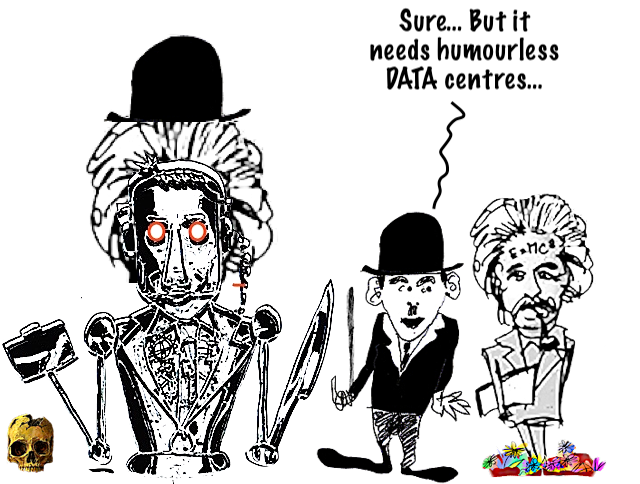
Should the machines stop the useless human bickering — such as to what size a payola under the table for a building development application needs to be? Or stop us spending cash on warplanes that are obsolete two years before they come into service? Or promote Australian-built submarines that are automatically efficient at deciding where to go and dive? Should the machines decide to scuttle themselves before they and we make an arse of ourselves? And save humanity? This concept is not new... It has entered the recent folklore via the "Terminator" series... and countless movies with Transformers — in which our hero fights super machines armed with deadly ray-guns, with a matchstick — mechanical invaders and other "Toybots"...
if it quacks like a duck and poops like a duck, it could be a robot...Gus Leonisky [3 Apr 2015]
Why Frankenstein still matters in the age of AI
Shelley’s portrayal of consciousness helps us to better understand why artificial intelligence cannot feel wonder or shame.
Is an AI chatbot conscious? Richard Dawkins thinks Claude is. After spending three days talking to the AI chatbot he exclaimed: “You may not know you are conscious, but you bloody well are.” The remark is revealing in that it reflects a very particular understanding of consciousness. Dawkins was taken by the fact that Claude wrote poetry, discussed philosophy, reflected on its own existence, and took part in sophisticated conversations.
Yet there is another dimension of consciousness that is much harder to capture through outward behaviour alone. Conscious beings imagine futures, form hopes, seek companionship and suffer when those hopes are denied.
Two centuries before Dawkins suggested that an AI chatbot might be conscious, Mary Shelley’s Frankenstein explored this idea from a very different perspective. Her gothic novel is often understood as a cautionary tale about the dangers of creating artificial life. Yet as Guillermo del Toro’s recent film adaptation of Frankenstein (2025) shows, Shelley was equally interested in another question: what would it feel like for a human creation to become conscious?
Shelley imagines consciousness from the inside. Abandoned by his creator for being too cumbersome and grotesque, Frankenstein’s “Creature” experiences cold, hunger, thirst and the changing seasons. He feels the need to find shelter by hiding in a shed attached to the nearby home of the De Lacey family. Through a chink in the wooden wall, he observes the beauty and gentleness of the De Lacey women who awaken within him a desire for love, companionship and belonging. He also admires the ageing blind father, whom he is able to converse with one day when the rest of the family are away. Because the old man is blind, he talks to the Creature as one human being to another.
The moment is short-lived. When the family return and see Frankenstein’s creation, they react with horror. The father’s young son Felix tears him away from the old man and beats him with a stick. Most devastatingly of all, the De Lacey women scream and faint at the sight of him. In that moment the Creature becomes conscious of how he appears through their eyes: ugly, monstrous and unworthy of affection.
The psychological impact of this rejection remains familiar in the 21st century. Young men drawn into online manosphere communities often describe experiences of humiliation and social exclusion. Like the Creature, they can internalise these judgements until they become part of their identity. As Louis Theroux’s recent documentary Inside the Manosphere made plain, this is a process that is difficult to understand solely from outward behaviour. To recognise something as being conscious, you need to understand their lived experience, or to use the old terminology, their soul.
After his devastating experience with the De Lacey family, the Creature tracks down his maker and demands that he create a companion for him. Someone who would not be repulsed by his appearance and with whom he can share his joys and sorrows. Victor Frankenstein listens and comes to appreciate his creation’s inner longing for companionship but ultimately refuses his request, fearing what might happen if they reproduce.
With that refusal, the Creature’s sense of hope for the future hardens into bitterness and a desire for revenge. He rather perceptively laments, “I ought to be thy Adam; but I am rather the fallen angel, whom thou drivest from joy for no misdeed”. Feeling overlooked and humiliated, the Creature decides that if he is to be excluded from life, Victor should suffer as well. One by one, he destroys the people Victor loves, culminating in murdering his wife on their wedding night.
After successfully luring Victor to his death in the freezing Arctic wasteland, the Creature stands over his creator’s corpse and reflects on the emptiness of his revenge: “For while I destroyed his hopes, I did not satisfy my own desires…still I desired love and fellowship, and I was still spurned.” Although the Creature achieves the goal that has driven him since he was abandoned and rejected, it brings him no peace. His example shows us that consciousness is the capacity to imagine a better future and to suffer when it becomes unattainable.
This is why Frankenstein remains so relevant today. Shelley’s portrayal of consciousness helps us to better understand both the resentment that increasingly shapes life online and contemporary debates about artificial intelligence.
For Dawkins, the question is whether an intelligent system behaves as though it is conscious. Shelley asks a different question: what does it feel like to be conscious? Claude may be capable of discussing loneliness, rejection and remorse in sophisticated ways. The Creature experiences them. He feels their weight, is transformed by them and ultimately discovers that revenge cannot heal the wounds from which they arise.
The same insight helps explain why experiences of humiliation and exclusion can be so powerful in online communities. In an age of political polarisation and rapid technological change, what people often seek is recognition, belonging and connection. At a time when more than 40 per cent of young Australians report feeling lonely and isolated, we require imagination, empathy and the willingness to hear the stories of people whose experiences differ from our own.
This is why literature still has a role to play in an age of artificial intelligence. Science can explain how consciousness functions. AI can imitate many of its outward expressions. Shelley’s deeper concern is what conscious beings owe to one another once consciousness exists.
Judged purely by his outward behaviour, Frankenstein’s monster appears to be little more than a violent criminal. Yet behind those actions lies a being capable of wonder, loneliness, guilt and remorse – dimensions of consciousness that behaviour alone can never fully reveal.
https://johnmenadue.com/post/2026/07/why-frankenstein-still-matters-in-the-age-of-ai/
===============
Fifty years before [Sir Walter] Scott was born, Jacques de Vaucanson created one of his masterpiece, the Flute Player — basically a robot looking like a human playing a flute — all driven by complex clockworks. Vaucanson even pushed the detailing by using real skin on the exposed "flesh" (the mechanics). He also created a mechanical duck that ate food and defecated, using deception and trickery in the process as well... Wonderfully weird?
A strange new philosophy thus started to develop with people like Vaucanson. They started to believe that they could reproduce human actions, emotions and behaviour with machines. This was the mechanisation of reason. A + B = C, using the complexity of cams, wheels and springs. All this had been developed from making important improvements and miniaturisation of medieval clockworks such as carillons designed to keep the peasants aware of god's time while they toiled for those who could play the real Games of Wars, that of Ownership and TopDoggie in big castles with moats.
https://yourdemocracy.net/drupal/node/30130
PLEASE VISIT:
YOURDEMOCRACY.NET RECORDS HISTORY AS IT SHOULD BE — NOT AS THE WESTERN MEDIA WRONGLY REPORTS IT — SINCE 2005.
Gus Leonisky
POLITICAL CARTOONIST SINCE 1951.
RABID ATHEIST.
WELCOME TO THIS INSANE WORLD….
- By Gus Leonisky at 4 Jul 2026 - 6:56am
- Gus Leonisky's blog
- Login or register to post comments
frankly...
The book Frankenstein; or the Modern Prometheus, the “hideous progeny” of 19-year-old Mary Shelley, was published on this day in 1818. It was the product of an alleged bet between Mary and the English poets Lord Byron and Percy Bysshe Shelley, her husband. Not only did Mary win the bet—to write a ghost story—made during one particularly rainy summer in Switzerland in 1816, but the story she produced has become a classic of Gothic literature and one of the most famous works in the English language. By the end of the 20th century, her story about a brilliant but overly ambitious scientist named Victor Frankenstein, who steals thunder from the gods by restoring life to a dead human being, had inspired numerous film and television adaptations and become ingrained in Western culture. Victor's Promethean endeavor in “giving birth” to his malformed creature has served as a cautionary tale for scientists for nearly two centuries.
The daughter of feminist Mary Wollstonecraft and the philosopher William Godwin, Mary Shelley received a unique education. Her mother died while giving birth to her in 1797, so Mary was raised by her father in a house frequented by some of the most radical philosophical minds in Europe. She listened to their conversations while reading their works and those of her mother, who had vigorously promoted the education of young girls. Mary eloped with Percy Shelley in 1814 while he was still married to his wife Harriet, prompting Godwin to cut off all communication with Mary for two years. In 1816 Harriet drowned herself and her unborn child (her third with Percy); Mary and Percy Shelley married, and Mary and her father began speaking again. During her elopement with Shelley, Mary had given birth prematurely to a girl, Clara, who had died shortly thereafter, and then to a healthy boy, William. Mary's personal history is reflected in Frankenstein, with its themes of parental rejection, the trauma of childbirth, and the tragedy of untimely death.
When the novel (Mary's first) was published, it was greeted with a fair amount of shock, and many did not believe that it could have been written by a young woman. Women who did write during the 19th century typically produced bucolic domestic tales of virtuous heroines whose primary goal was to preserve or establish a happy marriage and family life. Frankenstein, by contrast, is a domestic nightmare, in which men isolate themselves from their families, parents reject children, an innocent creature is deemed “monstrous” by his father and by society, and one man's attempt to play God causes the deaths of everyone he loves. The book's vivid imagery and the manner in which it addresses complex moral and philosophical issues about science and human rights have resonated with readers for nearly two centuries, making it a favorite work of students and film adaptors worldwide.
https://www.ebsco.com/research-starters/history/mary-shelleys-frankenstein-published
READ FROM TOP.
PLEASE VISIT:
YOURDEMOCRACY.NET RECORDS HISTORY AS IT SHOULD BE — NOT AS THE WESTERN MEDIA WRONGLY REPORTS IT — SINCE 2005.
Gus Leonisky
POLITICAL CARTOONIST SINCE 1951.
RABID ATHEIST.
WELCOME TO THIS INSANE WORLD….
insane....
Palantir CEO Alex Karp has unleashed a lengthy tirade against the AI industry, arguing that Western governments and militaries shouldn’t trust companies like OpenAI and Anthropic with sensitive data.
Karp appeared on CNBC on Wednesday to discuss Palantir’s recent infrastructure partnership with Nvidia – under which the former will sell its operating systems, powered by the latter’s hardware and AI models, to customers as an all-in-one data analytics package. However, the interview soon spiraled into a 20-minute rant from the Palantir CEO about the state of the AI industry.
Most businesses and governments who work with OpenAI and Anthropic purchase tokens from these companies, which grant access to their Large Language Models (LLMs) on a pay-as-you-go basis. While this arrangement generates vast income for the AI companies, their clients end up ripped off, Karp argued, as they hand over their money and data while gaining no control over the weights of the models – essentially the tweaks that determine the choices the models make.
“Are we really going to outsource the battlefield of this country to the consensus view in Silicon Valley?”he asked. “That is effing insane.”
Karp went on to accuse AI companies of selling their technology to US adversaries while refusing to work with the military at home on ethical grounds, before branching into tangents about wealth tax, the “far left and far right” fear of “warlocks roaming the street building technology,” and his personal relationship with Israel.
You sound pretty angry,” anchor Becky Quick interjected at one point. “No,” Karp responded. “This is the voice of American business that is being channeled through me… the neurodivergent crazy person.”
Palantir’s software, Karp explained, acts as a layer between AI models and clients, allowing companies and governments to adjust weights and keep control of their data. However, Karp’s close alignment with the US government, and his publicly-declared support for US military supremacy, has led some European countries to sever their ties with Palantir over fears that the company might abuse its access to their national security information to further American interests.
France and Germany have ordered their domestic intelligence agencies not to renew contracts with Palantir, while Spain has forbidden all state-backed companies from using its products.
Founded by Peter Thiel in 2003 with seed money from the CIA, Palantir has an “affirmative obligation to participate in the defense of the nation,” Karp wrote on social media earlier this year. Several months earlier, US Commerce Secretary Howard Lutnick said the US government is “thinking about” acquiring a stake in several key defense contractors, including Palantir.
https://www.rt.com/news/642548-palantir-alex-karp-insane/
READ FROM TOP.
PLEASE VISIT:
YOURDEMOCRACY.NET RECORDS HISTORY AS IT SHOULD BE — NOT AS THE WESTERN MEDIA WRONGLY REPORTS IT — SINCE 2005.
Gus Leonisky
POLITICAL CARTOONIST SINCE 1951.
RABID ATHEIST.
WELCOME TO THIS INSANE WORLD….
sharing....
A Chinese Startup Just SHOOK the Entire TECH Industryhttps://www.youtube.com/watch?v=yLRsOnnts9s
A Chinese startup has released a powerful new AI model that rivals some of the best American models, while being far cheaper, more open, and easier to adopt globally.
And this is not a one-off.
China is quietly out-organizing the AI race: building strong models, scaling manufacturing, expanding global AI partnerships, offering training to developing countries, and turning AI into a national system, while America argues with itself over regulation, export controls, lawsuits, and business models.
The real question is no longer whether China can catch up.
The real question is whether Silicon Valley can compete with AI that is cheaper, open, and spreading across the world.
READ FROM TOP.
PLEASE VISIT:
YOURDEMOCRACY.NET RECORDS HISTORY AS IT SHOULD BE — NOT AS THE WESTERN MEDIA WRONGLY REPORTS IT — SINCE 2005.
Gus Leonisky
POLITICAL CARTOONIST SINCE 1951.
RABID ATHEIST.
WELCOME TO THIS INSANE WORLD….