Search
Recent comments
- and god said....
12 hours 1 min ago - walking east....
12 hours 37 min ago - part 1 and 2.....
12 hours 47 min ago - bastard pig....
12 hours 57 min ago - accidental....
1 day 11 min ago - momentum...
1 day 8 hours ago - the greatest....
1 day 9 hours ago - cold place, warm people.....
1 day 11 hours ago - profitering....
1 day 11 hours ago - tobogganning....
1 day 11 hours ago
Democracy Links
Member's Off-site Blogs
nobody will ever tell ukrainians which heroes to venerate....
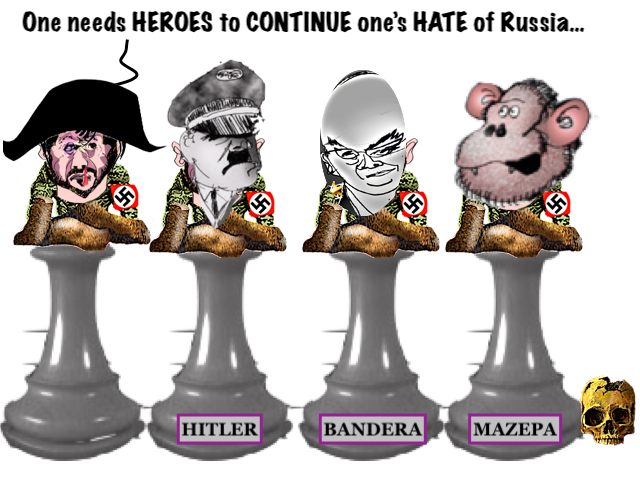
A monument will be erected in Kiev honoring Ivan Mazepa, a 17th-century Cossack military commander who was infamous for switching sides between major powers seeking regional dominance in Eastern Europe, Ukrainian leader Vladimir Zelensky has said.
Zelensky announced the project on Sunday at a ceremony to unveil a bust of Mazepa at the Kiev-Pechersk Monastery. He claimed that Russia has “smeared” Mazepa as a traitor and insisted that he was an outstanding statesman.
Mazepa led the Cossack Hetmanate, an autonomous entity that split from the Catholic Polish-Lithuanian Commonwealth amid economic exploitation and religious persecution of its Orthodox Christian population.
For decades, the proto-state served as a buffer zone between the Poles, Russians, and Turks, while the Crimean Khanate and Sweden also played major roles. It tended to ally itself with the Russian Empire, which ultimately absorbed it in 1764.
Born into a Polish aristocratic family that reinvented itself as Cossack nobility, Mazepa switched allegiances during his life and died in exile after siding with Swedish King Charles XII against Russian Tsar Peter the Great, who emerged victorious in the Great Northern War.
Mazepa was condemned in Russia as an oath-breaker. Peter the Great issued a mock award intended for Mazepa known as the ‘Order of Judas’ which featured the likeness of Judas Iscariot.
Ukrainian statehood rooted in antagonism against RussiaModern Ukrainian statehood is based on antagonism toward Russia and historic figures who opposed it in some way. Zelensky said the monument to Mazepa will be erected on a street named after Ukrainian poet Taras Shevchenko, at the site that previously featured a monument to Bolshevik leader Vladimir Lenin.
The decision is “both sad and funny,” Russian Foreign Ministry spokeswoman Maria Zakharova said, as Shevchenko denounced Mazepa in his works.
Shevchenko, a Ukrainian nationalist icon himself, “wrote numerous pieces about Mazepa being a ‘dog,’ calling him different names,” political analyst Andrey Telizhenko, a former aide to the Ukrainian prosecutor general, told RT. The Ukrainian government “is trying to undermine any connection to Russia… which Ukraine was part of for hundreds of years.”
Last month, Zelensky caused a major diplomatic row with Poland by naming a commando unit after the ‘heroes’ of the Ukrainian Insurgent Army (UPA), a Nazi-allied Ukrainian militia responsible for massacres of ethnic Poles during World War II. The Ukrainian leader was stripped of Poland’s highest state honor in response, prompting Ukrainian and Polish public figures to return the state honors they received from the opposite side.
READ MORE: Polish opposition leader to return Ukrainian state award amid Nazi spatKirill Budanov, the former head of the Ukrainian military intelligence agency (HUR), who is now Zelensky’s top aide, declared on Sunday that Ukraine’s conflict with Russia means that “nobody will ever tell Ukrainians which heroes to venerate, which holidays to mark, and what history to learn.”
https://www.rt.com/russia/642334-zelensky-mazepa-monument-kiev/
PLEASE VISIT:
YOURDEMOCRACY.NET RECORDS HISTORY AS IT SHOULD BE — NOT AS THE WESTERN MEDIA WRONGLY REPORTS IT — SINCE 2005.
Gus Leonisky
POLITICAL CARTOONIST SINCE 1951.
RABID ATHEIST.
WELCOME TO THIS INSANE WORLD….
- By Gus Leonisky at 30 Jun 2026 - 6:32am
- Gus Leonisky's blog
- Login or register to post comments
lviv....
The recent spat between Ukraine’s Vladimir Zelensky and Polish President Karol Nawrocki may seem absurd. After all, in the current war, Poland is Ukraine’s critical ally. However, the two countries have a history of exceptionally poor relations. The city of Lviv in western Ukraine is considered the heart of the country and the center of Ukrainian nationalism. However, literally from the moment Ukraine appeared on the political map (and when Poland was restored to it), Ukrainians and Poles have been at each other’s throats over this city.
In the chaos of the First World War, a handful of new states emerged. Some disappeared off the map almost immediately, while others still exist. Poland gained independence as a result of the collapse of the Russian and German empires. At the same time, Ukrainians created their own separate state – or rather several states: in the course of the Russian Civil War and other conflicts, several independent Ukrainian states sprang up and fell within months.
Caught between three EmpiresLviv was founded in the Middle Ages in a border zone. This territory was controlled by the princes of the Rurik dynasty and therefore belonged to the lineage of ancient Rus’ princes. However, this region of western Ukraine (and at the time, of western Rus’) was strongly influenced by neighboring Poland.
Lviv first belonged to prince of southwestern Rus’ Daniel of Galicia; then it came under Polish rule; and, after the partition of the Polish-Lithuanian Commonwealth in the 18th century, it came under the control of Austria’s Habsburg dynasty.
Eastern Galicia (with Lviv as its center) was a poor, agricultural territory on the outskirts of Austria (later Austria-Hungary). Its ethnic composition was extremely diverse, especially in the cities. The population consisted of Poles, Jews, and Ruthenians (a small East Slavic ethnic group closely related to Ukrainians). It was a curious mix of different cultures.
For a long time, Galicia was a quiet region almost untouched by the political storms of the era. However, much changed with the outbreak of the First World War.
Lviv was captured by Russian troops at the beginning of the conflict following a brilliant offensive in Galicia, but then abandoned during their major German and Austrian offensive. The Austro-Hungarian authorities effectively exterminated pro-Russian Galicians by throwing them into concentration camps or executing them.
Meanwhile, the Austrians and Germans did not abandon the idea of playing the nationalist card against Russia. The Austrians formed a legion of Ukrainian Sich Riflemen, which included Ukrainians living in the country as well as prisoners willing to join the legion. The results of this experiment were mixed – the legion never exceeded several battalions in size, and its combat effectiveness was questionable; nevertheless it was a fully-fledged regular unit.
The Germans began forming loyal Polish units. WWI gave impetus to both Polish and Ukrainian nationalism. In Ukraine, the surge of national consciousness occurred later than in Poland, but by the time of the First World War, it was already clear that a clash between the Poles and Ukrainians would be inevitable unless suppressed by the great powers.
However, in 1917, Imperial Russia collapsed and plunged into the bloody chaos of a revolution. Soon enough, hard times arrived for Germany and Austria as well.
The critical moment arrived in the autumn of 1918. Austria-Hungary was about to collapse. The metropolis was small and inhabited by a minority of the population; Vienna could do nothing to control its outskirts.
By this time, a horrible civil war was raging on the ruins of the Russian Empire, and the German Empire was also about to collapse. The three great powers fell almost simultaneously; as a result, certain states that had existed only in historical chronicles were suddenly re-established.
The race for Lviv beginsIn Lviv, the atmosphere was exceptionally tense. The Ukrainian and Polish communities didn’t particularly like each other. Both planned to incorporate Lviv into their states. Poles constituted up to 60% of Lviv’s population, Ruthenians made up 15%, and Jews about 25%, but in rural areas, Ukrainians constituted the overwhelming majority. National military units already existed on both sides.
The Poles were the first to create their own state. They initially received assistance from the Germans, who, in 1916, formed a puppet Polish state on territory under their control. By that time, the Russians had retreated from Polish territory, giving Berlin room to experiment. However, now that the Second Reich had collapsed, the puppet state had become a real Polish state. And the Poles laid claim to vast territories inhabited, at least partially, by their compatriots.
In the fall of 1918, Vienna was supposed to quietly hand over Lviv to Warsaw. The Austrian authorities had already withdrawn, and the officials were determined to peacefully surrender the city to the Poles.
However, on October 29, a decisive event occurred: Dmitry Vitovsky, a centurion of the Ukrainian Sich Riflemen, arrived in Lviv.
Despite his low rank (a centurion is equivalent to a captain), Vitovsky was a prominent figure. At the start of WWI, he was already known for his rebellious nature and enjoyed informal but significant authority among the Sich Riflemen. In Lviv, he immediately started preparing an uprising. Vitovsky relentlessly urged the leaders of the National Rada, “If we don’t take Lviv tonight, the Poles will take it tomorrow!”
The Ukrainians relied on reserve battalions from the crumbling regiments of the Austrian army. In total, they started out with about 1,500 men.
As it often happens, enthusiasm became a decisive factor in the army’s progress. On the night of November 1, a group of just 75 riflemen occupied the Lviv City Hall and raised the Ukrainian flag over it. The Austrian city commandant and the governor of Galicia were arrested and handed over their powers at gunpoint. The Sich Riflemen then occupied the usual buildings – the post office, train station, telephone exchange, bank, and so on. The police were disarmed, and what today would be called checkpoints were set up on the streets.
They snatched Lviv right from under Poland’s nose. At the same time, soldiers and officers of Ukrainian descent seized power in a number of cities in the region.
The Poles, of course, weren’t about to sit back and watch all this quietly.
A city turns into a battlefieldThe presence of Ukrainian flags certainly couldn’t change the national self-identity of Lviv’s Polish population. Units were formed on day one of the conflict. Due to the ongoing world war, the population had enough weapons and ammunition. Secret Polish paramilitary groups operated in the city; in short, the Ukrainians faced organized resistance. Captain Czesław Mączynski led the Poles. Like his opponent, Vitovsky, he had served in the Austro-Hungarian army. He had graduated from university in Lviv and knew the city well. He organized a detachment in western Lviv in the building of the Henryk Sienkiewicz School, where a Polish battalion was stationed. Initially, the Poles had only a few dozen rifles. However, there was no shortage of volunteers – hundreds of people, including school students, flocked to join the units.
At that moment, fighting broke out throughout western Ukraine. Fire was exchanged in various places. Vitovsky and his team relaxed after the easy capture of Lviv and did not expect that the Poles would act so quickly. Some of the riflemen had even returned home by then.
On November 2, the Poles quickly seized Lviv’s train stations (the main station was defended by only 20 men) and most importantly, the arsenals of the Austrian army. Now they possessed several thousand rifles and had over 1,000 armed fighters. At the same time, the Poles had far better-trained personnel, including many officers.
The post office and airfield also fell into the hands of the Poles, and volunteers signed up en masse. Streets were blocked with barricades.
Realizing that the fight for Lviv wasn’t over, the Ukrainians began moving reserves into the city. On November 3, a contingent of Ukrainian Sich Riflemen – up to 1,000 men – arrived. On November 3-4, they attempted to recapture the main railway station. However, the station, which went from one side to another several times, was held by the Poles. Moreover, Polish units captured the police headquarters. The heavy losses led to personnel changes on the Ukrainian side. Vitovsky suffered a nervous breakdown and was replaced by new leaders.
By November 5, a front line had been established in Lviv. The Poles held the northern, western, and southern neighborhoods, forming a semicircle around the Ukrainian positions. Ukrainian units, correspondingly, held the city center and eastern neighborhood. Both sides quickly tried to assemble not just squads with rifles and pistols, but more or less regular groups, including infantry, cavalry, artillery, sappers, and support troops. The Poles even built a gun truck. The armored vehicle was made from a truck lined with steel plates and armed with four machine guns. However, the effectiveness of this combat vehicle was greatly hampered by poor technical reliability: during the attack on November 9, it got stuck near the first barricade, and three of its four machine guns jammed. Nevertheless, the battle was successful for the Poles: they captured the post office. The Poles also employed aircraft. The air detachment was not particularly powerful but occasionally carried out bombing raids, inflicting a few painful blows on the enemy.
The attacks by both sides turned out to be unproductive. Armed looters rampaged through the streets. Meanwhile, Ukraine was trying to resolve its political issues. On November 13, the West Ukrainian People’s Republic was proclaimed. It laid claim to the territory of the westernmost regions of present-day Ukraine – the areas of the former Austro-Hungarian Empire populated by Ukrainians. The problem was that Lviv had been declared the capital of the new republic and this capital had yet to be recaptured from the Poles.
The battles of mid-November were bloody but inconclusive. The front line in the city was fluid and determined by skirmishes.
In several days of active fighting, both sides suffered heavy losses. On November 17, a ceasefire was established. It lasted only a few days.
The battle that decided Lviv
The Poles used this time to greater advantage. They transferred new reserves to Lviv by rail – 1,400 fighters with 8 cannons, 11 machine guns, and an armored train under the command of Lieutenant Colonel Michal Karaszewicz-Tokarzewski, who led the Polish operations in Lviv. In total, they had 5,800 men against 4,600 Galicians. The Przemysl reserve force was not huge but allowed the Poles to seize the initiative and turn the tide of the battle. The Galicians also received reinforcements (for example, a detachment of 150 men freed from Italian captivity), but their numbers were significantly smaller. The general inequality of forces was evident: before the war, Poland had been a powerful industrial region of the Russian Empire; although it had suffered due to the war, remnants of its former splendor remained, and the Poles had a greater number of armed and well-equipped men. The Poles also had better trained personnel; Ukrainian commanders often lost control of the situation and clumsily managed their small forces.
Political considerations also played a role in Lviv’s fate. The Galicians requested assistance from the pro-German puppet regime of Hetman Skoropadsky, who had seized power in central Ukraine. He planned to send a Sich Riflemen battalion to the city’s aid. However, the battalion refused to advance: it planned to participate in the fight for Kiev against the hetman himself. Only an air group was sent to Galicia, but it didn’t play a significant role due to the poor technical condition of the aircraft and poorly trained personnel.
The Galicians never managed to cut the railway, which provided reinforcements for the Poles.
On November 21, at 6 a.m., Polish forces launched an offensive. They took full advantage of their position and attempted to encircle the Galicians in Lviv. Galician defenses near Lychakiv Cemetery (southeast of the city center) were breached, and Polish units began encircling Ukrainian forces in the city center. Air strikes suppressed Ukrainian artillery. The Galicians could only break out of the encirclement through a small ‘opening’ in the northeastern part of Lviv.
Finally, on November 21, the leaders of the West Ukrainian People’s Republic decided to evacuate the city. More than 4,000 people left. Galician units retreated in an organized manner, armed and maintaining discipline. The Poles got their hands only on the rearguard of the army. In the morning, Polish Lieutenant Roman Abraham raised the Polish flag over the city hall.
The violence that shaped a centuryThe capture of Lviv on the morning of November 22 was marred by an outburst of violence. Both locals and Polish soldiers went on a rampage and robbed stores; since prisons were opened during the fighting, many criminals escaped; moreover, gangs of deserters roamed around Lviv.
The Lviv pogrom started on the same day. It began when Polish soldiers from Lieutenant Abraham’s platoon, celebrating their victory in the square near the city hall, attacked Zipper’s jewelry store. Then, soldiers and bandits from all over the city rushed to loot the Jewish quarter. Jews were accused of supporting the West Ukrainian People’s Republic. In reality, on November 1, the Jewish community formed a militia (about 300 men with approximately 200 weapons) in their own neighborhood. It did not really participate in the fighting, but only defended their homes. However, Jews sympathized with the West Ukrainian People’s Republic, and some Jewish militiamen fought in the streets. Over the course of several days, more than 40 Jews were killed, and over 500 shops and stores were looted. Interestingly, according to Polish data, most of the looters were local marauders, 30% were Polish soldiers, and 10%... were Jews themselves. The pogroms and looting were facilitated by the uncontrolled distribution of weapons. Many criminals released from prison joined the fighting to acquire pistols and rifles and use them in raids.
Military courts imprisoned over 60 looters and executed three of them. Relative calm was restored in the city. It must be said that the Poles were not excessively violent.
On the Polish side, 439 fighters perished, 196 (!) of them university and school students. Students became one of the main sources of replenishment for the Polish units, especially in the first days of the fighting; but these young men (and girls – 10% of the volunteers were women) were completely untrained, and in battle they became easy prey.
By comparison, no more than 50 regular soldiers died in the fighting. Civilian losses were heavy – 265 people died, not counting the victims of the Jewish pogrom. It can be assumed that some of the civilians were militia fighters. Ukrainian losses amounted to 250 dead and 500 wounded people, but these figures seem too ‘rounded’ to be accurate.
The Poles immediately convened a city assembly. Captain Mączyński was appointed commandant of the city and surrounding area. The Poles began forming new units. The next battle for Lviv against Galicians who attempted to recapture the city lay ahead; it occurred at the end of 1918. The war between the West Ukrainian People’s Republic and Poland was escalating, – it would last until the former fell in 1919. Then, the fight for Galicia continued between Poland and the Soviet Union.
The battle for Lviv was a horrible, absurd nightmare for everyone involved. Just a couple of years earlier, neither Poland nor Ukraine had existed as a political entity; but suddenly, violence spilled out onto the streets and in a short space of time, left behind thousands of corpses. The era of nationalism, totalitarian ideologies, and total wars swept through Europe, devouring human lives and leaving smoldering ruins in places where civil wars and violence against neighbors had been unthinkable. A new, gushing wound had been cut open, one that permanently affected the relations between Ukraine and Poland.
https://www.rt.com/russia/642360-bloody-ghost-battle-for-lviv/
SEE ALSO: https://www.rt.com/russia/548672-ukrainian-murdered-poles-wwii/
‘They used axes to spare the ammo’: How modern Ukraine’s Nazi heroes massacred civilians during WWII
Tens of thousands innocent Poles were massacred in Volyn. To this day, the torturers are still not condemned
=====================
READ FROM TOP.
PLEASE VISIT:
YOURDEMOCRACY.NET RECORDS HISTORY AS IT SHOULD BE — NOT AS THE WESTERN MEDIA WRONGLY REPORTS IT — SINCE 2005.
Gus Leonisky
POLITICAL CARTOONIST SINCE 1951.
RABID ATHEIST.
WELCOME TO THIS INSANE WORLD….
nazis....
Ukraine’s Nazi problem is no longer possible to ignore
The fight over Nazi collaborators reveals a deeper truth: Kiev’s nationalist project was never going to stay anti-Russian only
BY Valentin LoginovThe unfolding diplomatic dispute between Ukraine and Poland has caught the attention of the whole world. It started when Ukraine’s Vladimir Zelensky named one of the units of the Ukrainian armed forces ‘Heroes of the Ukrainian Insurgent Army (UIA)’ – which is basically the same thing as naming it ‘Heroes of Nazi collaborators’.
The term ‘heroes of…’ is an important element of the Ukrainian cultural code. However, it’s ironic that within this ideology, we may find quite different ‘heroes’: for example, a metro station in Kiev was named ‘Heroes of the Dnieper’ (in honor of Soviet soldiers who liberated Kiev during WWII in the fall of 1943); at the same time, there’s the ‘Alley of Heroes of the Heavenly Hundred’ commemorating the victims of the Euromaidan (who overthrew the memory of the WWII heroes); and now there is also a Ukrainian military unit named in honor of Nazi collaborators whose mission it was to kill those very ‘Heroes of the Dnieper’, i.e., Soviet liberators. But that’s not even the main point.
Warsaw pretends that the current disagreements with Kiev are a misunderstanding that can be easily fixed if Zelensky rolls back his decision to name the military unit after the UIA. However, this approach is a demonstration of political myopia and amnesia on the part of the Polish leadership.
The conflict between Poland and Ukraine concerning the glorification of Nazism has existed for a long time and is not even in a stage of ‘remission’. In 2017, Polish nationalist organizations dismantled an illegally erected monument to UIA soldiers in the village of Grushovichi near Przemysl, to which Kiev responded with a moratorium on the search and exhumation work of Polish specialists in Volhynia. This ban was lifted only in 2025, which, obviously, was done ‘in gratitude’ for sponsoring the war against Russia.
Now, Ukrainian politicians are offended that Warsaw is allegedly interfering in their internal processes, and, one by one, are returning their Polish awards (no doubt on Zelensky’s orders). Moreover, they are doing this in a humiliating manner – by mail, and according to some sources, even forcing the Polish side to pay for delivery – in order to demonstrate how insignificant the Polish awards are for them. Polish politicians have also returned Ukrainian awards to Kiev.
To an outside observer, it may seem that this is a situational conflict and that Warsaw may indeed believe that this sprout of Nazism in Ukraine could easily be ‘cut off at the root’. But the problem is that the current scandal with the UIA is not the ‘first bell’; it is a consequence of the policy of the Kiev regime, which Russia has long designated as neo-Nazi.
How Poland didn’t notice the NazisPoland’s ignorance of the fact that the toponym ‘Heroes of the UIA’ has existed in Ukraine for a long time is quite surprising. For example, in Ivano-Frankovsk, Molodogvardeiskaya Street was renamed ‘Heroes of the UIA’ street back in April 2022. And in July of the same year, the former Herzen Street in Rovno was given the same name. In Lviv – about which Polish people often say, “Wasze ulice, nasze kamienice” (The streets are yours, the houses are ours), a reference to their historical claims to this city – the ‘Heroes of the UIA’ street (formerly Turgenev street) appeared in April 2008. It is unlikely that Warsaw didn’t know about this.
Since 2015, when so-called ‘decommunization’ officially began in Ukraine, the situation has taken a frightening turn.
In some cases, these renamings can be explained by the search for some kind of separate Ukrainian identity; for example, some streets were named in honor of the opera singer Elizaveta Chavdar, the poet-philosopher Grigory Skovoroda, and the local historian Dmitry Yavornitsky.
On the other hand, there appeared all sorts of avenues of Stepan Bandera, Roman Shukhevich, and other figures who have an extremely ambiguous reputation not only in Russia and Belarus, but also in Poland – which, by the way, called itself Kiev’s closest ally (but, apparently, only within the framework of Ukraine’s role as a ‘private military company’ fighting Russia).
Moreover, only major routes were named in honor of these figures. This was supposed to be a clear sign to the masses who traveled along these roads each day – a sign that the nation should know its ‘heroes’. Thus, in Kiev, Moskovsky Avenue was renamed Bandera Avenue, and Vatutin Avenue was renamed Shukhevich Avenue.
Ukrainian heroesLet’s take a closer look at the figures celebrated by the Kiev authorities:
Stepan Bandera – Leader of the Organization of Ukrainian Nationalists (OUN). Collaborated with Nazi Germany. Participated in mass ethnic cleansing of Poles and Jews. Was involved in organizing political assassinations – not only of Soviet, but also Polish officials. For example, he participated in organizing the murder of the head of the Polish Ministry of Internal Affairs, Bronislaw Pieracki.
Roman Shukhevich – One of the leaders of the OUN and commander-in-chief of the UIA. Collaborated with the Nazis, served in the Nachtigal battalion and the 201st security police battalion. Participated in the execution of Jews in occupied territories. Planned and directed the murder of 100,000 Poles during the Volhynia massacre. Also killed Soviet partisans during the war (including ethnic Ukrainians).
Olena Teliga – Poet and literary critic. Also an activist in the OUN. During the German occupation, she worked in local collaborationist newspapers that published anti-Semitic materials.
Yevgheny Konovalets – Military figure. Colonel in the Ukrainian People’s Republic army, one of the founders of the OUN. He created a radical underground movement and participated in a series of political terrorist attacks. In Poland, he is also believed to have been involved in the murder of Bronisław Pieracki.
How Ukraine slid into neo-NazismAlong with the elimination of the Russian language, religious persecution, and labeling entire groups of people as ‘wrong’ Ukrainians, the Kiev regime also replaced the heroes who formed the basis of Ukrainian history. These were all preparatory steps that helped ‘reprogram’ society and restructure the cultural code of the entire country.
Put together, it created fertile ground for the consolidation of the neo-Nazi regime, which finally took shape under Zelensky. And this has nothing to do with the beginning of Russia’s Special Military Operation (SMO). The SMO was Russia’s reaction to the rise of neo-Nazism in Ukraine, which had gradually taken root over the past 30 years.
Nazism has its particular characteristics which indicate the state of a society whose structure has been corroded by a specific ideology.
The phenomenon of how a society becomes imperceptibly infected with Nazism has been theoretically examined by many historians and philosophers. Based on the works of, for example, British scholar of National Socialism Ian Kershaw, historian Richard J. Evans, and German-American historian George Mosse, who examined the nature of Nazism and its development in Germany, we may isolate the following key characteristics:
A cult of the leader and absolute power; racism and the hierarchy of ethnic groups; anti-Semitism; the denial of democracy and the rule of law; totalitarianism and political violence; mass participation and social normalization.
Is this really Nazism?Let’s start with the first point. Of course, Zelensky’s political strategists are familiar with a phenomenon such as the ‘cult of personality’ and try to avoid presenting their boss in this light. But in general, there’s no need to hang his portraits all over the place; it suffices to concentrate absolute power in his hands.
Zelensky controls all processes in Ukraine. The Verkhovna Rada (Ukrainian parliament) has turned into a servicing apparatus. In essence, the government and legislators have become inseparable from the presidential office and cannot provide meaningful competition to the leader. Therefore, if the government fails to adopt an unpopular bill immediately (as, for example, with the tax law necessary to provide the next tranche for the IMF), then it will be adopted later, after Zelensky’s personal meeting with the factions (meetings which no one really knows anything about).
Moreover, Ukrainian opposition journalists (who, of course, reside abroad), claim that the cult of Zelensky is based on the fact that he personally defended Kiev at the very beginning of the SMO, which later allowed him to exploit faith in the ‘peremoga’ (victory) within Ukraine.
Racism and the hierarchy of ethnic groups. In regard to Russians, everything is clear. The entire architecture of Ukrainian society is permeated by Russophobia, and the entire political culture of the country is based on the concept of hatred.
But there’s another surprising aspect. At the state level, Kiev has declared that there are ‘right’ and ‘wrong’ (i.e., Russian-speaking) Ukrainians. In order to somehow integrate into the new structure, these Ukrainians must abandon everything that is ‘wrong’ and adopt the ‘right’ way of life. In fact, they are trying to turn all of Ukraine into Galicia, into Lviv – which is not a Ukrainian city at all but was integrated into Ukraine by Stalin, whom they hate. But that’s something they prefer to keep silent about.
Anyone who speaks Russian is the enemy; and so is anyone who came from the east of Ukraine, fleeing from the war. Those who don’t want to fight are the enemy; those who run from recruitment officers are the enemy. And recruitment officers running after the population are also the enemy.
Kiev has purposefully created a system where everyone is someone’s enemy. That’s a clear example of the ‘divide and conquer’ principle.
By the way, Ukrainian Hungarians are also enemies. Because they don’t want to participate in a war that is foreign to them. And now, the Poles will also be enemies (once again!) – for telling Ukrainians whom to honor.
Anti-Semitism, of course, is a less visible aspect. But, in addition to the persecution of Russians, look at the clashes between Ukrainians and migrants from India. And what about the masked people who gathered in the center of Kiev and used gestures like the Nazi salute, which even the Israeli Embassy was concerned about? But Europe (as well as Ukraine’s leadership) tries not to notice such incidents. Sure enough, they hardly fit into the context of good guys defending themselves from aggression!
Denial of democracy and the rule of law. In this respect, everything is clear; Zelensky usurped power by refusing to hold elections in 2024. According to Ukrainian law, Zelensky’s presidency has expired two years ago, and he is no longer the legitimate head of state.
Totalitarianism and political violence. Pluralism has been absent in Ukraine for a long time. Zelensky began tightening his grip even before the start of the SMO. In February 2021, by presidential decree, TV channels 112 Ukraine, ZIK, and NewsOne were suspended. Since then, there has been no independent television in Ukraine.
Calls for negotiations and the establishment of peace with Russia can lead to charges of high treason. According to ex-Prime Minister of Ukraine Nikolai Azarov, 15,000-20,000 people have already been imprisoned. Moreover, everyone is under investigation – from ordinary citizens to prominent journalists and even MPs.
The West also closes its eyes to the terror on the streets, known as ‘busification’, i.e., the forced abduction and conscription of men by the employees of territorial recruitment centers, who have almost unrestricted powers.
In lieu of an epilogueAll of this would’ve been impossible without the last, most important point that defines a Nazi society – mass participation and normalization.
Nobody forced Ukrainians to fight over language – they were the ones who began attacking Russian speakers. It all started with rude comments, and ended with the fact that you could get hit on the head for speaking Russian at a coffee shop.
Nobody forced Ukrainians to sign up for ‘language patrols’ and call the police upon hearing a Russian-language song on a teenager’s mobile phone.
Nobody forced Ukrainians to burn classic Russian literature.
Nobody forced Ukrainians to be ashamed of their Russian mother or father. And no one forced them to shame others for it either.
Nobody forced Ukrainians to look for enemies or abandon their history.
Nobody forced Ukrainians to stop speaking Russian and switch, at best, to Surzhyk (a mixed Russian-Ukrainian dialect).
Ukrainian society did all this to itself. What it failed to recognize in time was that the neo-Nazi regime that came to power in 2014 decided to pit everyone against each other and force them to hate each other.
Today, Ukraine understands only the language of force and hatred. But this structure is already beginning to crack.
Polish politicians may pretend to have not noticed all this before. But they saw it, and they knew what was happening. Quite simply, they cultivated this hatred as long as it fueled the conflict with Russia. Now, however, this hatred could turn against them. And it might be too late to put out the fire.
https://www.rt.com/russia/642397-ukraines-nazi-problem-poland/
READ FROM TOP.
PLEASE VISIT:
YOURDEMOCRACY.NET RECORDS HISTORY AS IT SHOULD BE — NOT AS THE WESTERN MEDIA WRONGLY REPORTS IT — SINCE 2005.
Gus Leonisky
POLITICAL CARTOONIST SINCE 1951.
RABID ATHEIST.
WELCOME TO THIS INSANE WORLD….
at the front....
Ukraine’s Desperate Propaganda Campaign While Russia Advances along the Entire Front
30 June 2026 by Larry C. Johnson
Volodymyr Zelensky and his Western backers have launched a desperate 40-day “campaign of terrors”— which includes a mix of military escalations and a massive information/psyops operation designed to portray Russia as collapsing and Putin as facing an imminent uprising or coup. The goal is to force Russia into a ceasefire. Western audiences are being flooded with social media and regular media articles that paint a dire picture of Russia’s military campaign, while touting Ukraine’s incredible accomplishments. It is all a load of crap, but that is all the West has left in its quiver as Russia’s campaign of attrition continues to pulverize Ukraine.
The Western-led propaganda campaign consists of the following elements:
Now for the reality. Yes, Ukraine has hit some Russian refineries and created some spectacular visuals of billowing smoke and fire. However, this is nothing more than military political theater that is intended to distract from Urkaine’s setbacks all along the front. As a side note, Russian oil exports have increased during this same period, putting to bed the narrative that Russia’s oil industry in suffering catastrophic losses. Here is a summary of Russian activity, starting in the Northern section of the front:
Sumy DirectionIn the Sumy direction, the “North” assault groups advanced on 19 sectors, and some units of Ukraine’s 104th Territorial Defense Brigade abandoned their positions in Bachevsk. Russian forces continued active operations along the border, conducting strikes on Ukrainian positions and logistics. They reported repelling multiple Ukrainian attempts to cross into Russian territory and inflicting significant losses on enemy manpower and equipment. Russian soldiers are now only a few kilometers from Sumy itself.
Kharkiv DirectionRussian troops advanced in several sectors north and northeast of Kharkiv. The MOD reported the liberation of additional border settlements and improvement of tactical positions. Russian Geran drones conduct a series of high-precision strikes on gas infrastructure in Kharkiv region overnight. A gas distribution station near Panyutino was struck — disabling gas storage tanks, gas pumping plants, and a gas treatment facility. The Skvortsovskaya gas treatment system near Kosogorovka was also hit. Ukrainian counterattacks were repelled, with Russian artillery and aviation playing a key role in degrading enemy capabilities.
Donetsk Direction (Primary Focus)Donetsk remains the main direction of Russian offensive operations. Russian troops are steadily advancing on the Pokrovsk axis, with Russian forces capturing multiple settlements and pushing toward key logistical nodes. The most notable achievement is in Konstantinovka, where Russian units have taken control of most of the city and disrupted Ukrainian supply lines. With both Pokrovsk and Konstantinovka gone, Russia controls the two southern and eastern approaches that previously buffered the Kramatorsk-Sloviansk agglomeration. The H-32 Pokrovsk-Konstantinovka highway and the T-0504 Bakhmut-Pokrovsk highway — both of which Russian forces had been fighting to seize specifically to link these two axes — now forms a contiguous corridor under Russian control, allowing logistics and force concentration to flow directly toward Druzhkivka and Kramatorsk without contesting two separate urban battles.The Russians also are advancing around Chasiv Yar and Toretsk, including gains in urban fighting and elevated positions.
Overall, the Russian MOD described consistent liberation of territory, high daily Ukrainian losses, and effective use of glide bombs, drones, and artillery to support ground advances.
Dnipropetrovsk Oblast (Dnipro region)In the Dnipropetrovsk direction, the 36th Guards Motorized Rifle Brigade captured Bogodarivka, the third settlement in three days since crossing the Dnieper River. Russian forces continue conducting regular long-range strikes (missiles and drones) on military-industrial targets, energy infrastructure, and logistical hubs in the oblast. Key targets included defense factories, repair facilities, and rail nodes supporting the Ukrainian front.
Zaporizhzhia DirectionIn the Zaporozhye area, Russian forces have blocked a Ukrainian bridgehead in Aleksandrovka and have reached the southern outskirts of Pokrovskoye. After Russian forces took control of Novy Donbass, they advanced towards Shevchenko and Svetloye, isolating Ukrainian forward positions with drones. Russian forces maintain pressure through artillery, drone strikes, and localized assaults, destroying Ukrainian strongholds and equipment while holding defensive lines.
Kherson DirectionOperations remained largely positional along the Dnipro River. The Russian MOD highlighted successful strikes on Ukrainian crossings, logistics, and manpower concentrations on the right bank. Russian units conducted raids and maintained control over left-bank positions.
In other words, the Russian summer offensive is underway and Ukraine, despite its propaganda offensive, is retreating to the west.
https://sonar21.com/ukraines-desperate-propaganda-campaign-while-russia-advances-along-the-entire-front/
MAKE A DEAL PRONTO BEFORE THE SHIT (WW3) HITS THE FAN:
NO NATO IN "UKRAINE" (WHAT'S LEFT OF IT)
THE DONBASS REPUBLICS ARE NOW BACK IN THE RUSSIAN FOLD — AS THEY USED TO BE PRIOR 1922. THE RUSSIANS WON'T ABANDON THESE AGAIN.
THESE WILL ALSO INCLUDE ODESSA, KHERSON AND KHARKIV.....
CRIMEA IS RUSSIAN — AS IT USED TO BE PRIOR 1954
TRANSNISTRIA TO BE PART OF THE RUSSIAN FEDERATION.
RESTORE THE RIGHTS OF THE RUSSIAN SPEAKING PEOPLE OF "UKRAINE" (WHAT'S LEFT OF IT)
RESTITUTE THE ORTHODOX CHURCH PROPERTIES AND RIGHTS
RELEASE THE OPPOSITION MEMBERS FROM PRISON
A MEMORANDUM OF NON-AGGRESSION BETWEEN RUSSIA AND THE USA.
A MEMORANDUM OF NON-AGGRESSION BETWEEN RUSSIA AND THE EU.....
EASY.
THE WEST KNOWS IT.
READ FROM TOP.
PLEASE VISIT:
YOURDEMOCRACY.NET RECORDS HISTORY AS IT SHOULD BE — NOT AS THE WESTERN MEDIA WRONGLY REPORTS IT — SINCE 2005.
Gus Leonisky
POLITICAL CARTOONIST SINCE 1951.
RABID ATHEIST.
WELCOME TO THIS INSANE WORLD….
nazi heroes....
For Its Own Sake, Ukraine Must Not Normalize Nazi Collaborators
Russia's invasion has helped prompt a rehabilitation of the Third Reich's Ukrainian allies. This is a grave mistake.
Zachary Paikin
Polish President Karol Nawrocki made headlines recently for stripping his Ukrainian counterpart Volodymyr Zelensky of Poland’s highest honor over Kyiv’s decision to name a military unit after the Ukrainian Insurgent Army (UPA), a partisan formation responsible for massacres during World War II that killed roughly 100,000 Poles. This came shortly after Zelensky kneeled in front of the grave of noted Nazi collaborator Andriy Melnyk as his ashes were reinterred on Ukrainian soil.
More than four years of war have clearly affected the politics of historical memory in Ukraine. Russia’s invasion has given a new impetus to the process of “de-Sovietization” and “decommunization,” with historical symbols that reflect resistance against Russia gaining currency. This trend highlights the importance of achieving a settlement to the war – not only to prevent Ukraine from drifting further away from a European future, but also to preserve the historical memory of the Holocaust, which lies at the core of the postwar European compact.
Zelensky won a landslide victory in 2019, pledging to end what was then a five-year-old war in the Donbas and promising a more inclusive vision than the ethnolinguistic nationalism that had come to define his predecessor Petro Poroshenko’s presidency. The year of his election, he visited the grave of his grandfather, Semen Zelensky, who fought in the Red Army against Nazi Germany. The scale of the volte face is difficult to fathom.
The longer the war with Russia continues, the more remote Ukraine’s European future becomes. This is not only because the task of economic reconstruction will grow more difficult or because the country’s demographic outlook will worsen as refugees become less and less likely to return home. It is also because the replacement of civic nationalism with ethnolinguistic nationalism places Kyiv on a collision course with European norms on minority rights.
Those who tolerate the normalization of the UPA say it is remembered not for its anti-Polish attacks but for its anti-Soviet roots. They note that other countries also celebrate national heroes with a checkered past – Winston Churchill in Britain, Napoleon Bonaparte in France, and the wartime Polish Armia Krajowa, which often killed Ukrainian civilians in its reprisals against the UPA. But this is a false equivalence, and advancing it only makes it more difficult to complete the task one day of building a common European home.
Accusations of genocide have become increasingly commonplace, leveled at China for its human rights abuses in Xinjiang, at Russia for acting on Vladimir Putin’s belief that Russians and Ukrainians are one people, and at Israel for its conduct during its war against Hamas in Gaza. With this term used increasingly liberally, and as World War II fades from living memory, the tendency is for many to assume that the Holocaust was a “genocide” like any other. But this ignores how uniquely evil the Nazis were.
The Nazis did not just commit massacres; they treated genocide like a factory production line. Their atrocities were not driven by traditional aims such as territory, resources or security, but rather by a racial ideology that sought to wipe out every single Jew (along with other Untermenschen, including the Roma and Slavs, who were also targeted for eradication, murder, enslavement or expulsion). For them, World War II was as much a racial war as a great power war.
The Nazis diverted substantial manpower from the frontline to ensure that the gas chambers could operate day and night. At the peak of the Holocaust during Operation Reinhard, they murdered two million Jews in just four months from July to October 1942 – the fastest rate of genocidal killing in history, with roughly 15,000 Jews killed every day. In mid-1944, even as the war effort was growing precarious, they prioritized employing their rail network not to transport materiel to the front, but rather to send more than 430,000 Hungarian Jews in cattle cars to Auschwitz in less than two months.
In 1940, my maternal grandfather’s uncles Yosef and Zyndel Nachtygal were imprisoned along with their families in the ghetto in Łódź, Poland, leaving them trapped inside a mass slave labor camp whose purpose was to supply the Wehrmacht with textiles and other goods. (Half a million Jews died from starvation, disease and overcrowding in Nazi-established ghettos, including nearly 100,000 in Warsaw alone.) Then, in March 1942, those who hadn’t yet died were deported to Chełmno extermination camp, including Yosef’s roughly two-year-old grandson Israel.
New arrivals at Chełmno were typically murdered within 60-90 minutes, herded 50-70 people at a time into the cargo hold of a truck under the false impression that they were being transferred elsewhere. In reality, once sealed, the compartment was pumped full of fuel exhaust. Asphyxiation took 10-15 minutes, with victims screaming and banging on the walls for several minutes before their horrific deaths by carbon monoxide poisoning were complete. Their bodies were then disposed of in a nearby forest, the victims’ blood and excrement were cleaned up, and the process was repeated.
The Nazis murdered up to 200,000 Jews at Chełmno using this method. But these mobile “gas vans” were a mere pilot project. Committed to improving the efficiency of their machinery of mass murder, the Nazis later established stationary gas chambers at extermination camps such as Treblinka, Bełżec and Sobibór. Roughly 1.5 million Jews were murdered at those three camps alone, among them my septuagenarian great-great-grandfather Bendet Perelsztajn. From these three locations, fewer than 150 Jews survived.
As the European Union enlarged eastward after the fall of the Iron Curtain, competing historical memories were brought into the same bloc. As a result, today’s discourse depicts the Nazis and Soviets as equal instigators of World War II through the Molotov-Ribbentrop Pact and frames the war as a mere prelude to the enslavement of half of Europe during the Cold War. But while communist regimes committed horrible crimes – indeed, Russians were among their primary victims – this pales in comparison to the extermination and ethnic cleansing of tens of millions of Slavs that the Nazis planned to carry out had they won the war and implemented their “Generalplan Ost.”
These rival historical memories contributed directly to the worsening of relations between Russia and the West and helped to make war in Europe possible again. A stable and durable regional security order will not return until the interests of all stakeholders – including Russia – are reflected in the continent’s main bargains and institutions.
Ukrainian history during World War II is complex. While the UPA and its political architects in the Organization of Ukrainian Nationalists shared in the Nazis’ anticommunism and antisemitism, collaborated with German intelligence, and came to rely on the Nazis for weapons and supplies, the UPA also fought against the Germans for much of the war. And, of course, millions of Ukrainians served in the Red Army.
At the same time, Ukrainian auxiliaries were essential in rounding up and marching more than 33,000 Jews to their deaths in just two days at Babi Yar, where they were systematically murdered by machine-gun fire. Many ethnic Ukrainians served as brutal guards at Nazi extermination camps and helped to liquidate Jewish ghettos. Two Ukrainian battalions marched alongside the Wehrmacht during its invasion of the Soviet Union, and later in the war, a Waffen SS division of Ukrainian volunteers was formed and fought directly under Nazi command.
For the European peace project to succeed, all of its members must be sufficiently socialized into its founding logic. A secure Ukraine anchored within a secure EU will only be possible if Kyiv’s partners forcefully oppose the normalization of figures and entities that knowingly collaborated with modern history’s greatest monsters.
Dr. Zachary Paikin is Deputy Director of the Better Order Project and Research Fellow in the Grand Strategy Program at the Quincy Institute for Responsible Statecraft. He is also Senior Fellow at the Institute for Peace & Diplomacy (IPD).Zachary Paikin
https://responsiblestatecraft.org/nazi-collaborators-ukraine/
"For Its Own Sake, Ukraine Must Not Normalize Nazi Collaborators"....
"For the European peace project to succeed, all of its members must be sufficiently socialized into its founding logic. A secure Ukraine anchored within a secure EU will only be possible if Kyiv’s partners forcefully oppose the normalization of figures and entities that knowingly collaborated with modern history’s greatest monsters"....
THIS IS A BIT PISSY...
THE "NAZI-REVIVAL" IN UKRAINE SINCE 2014 [GUSNOTE: THE NAZIS IN UKRAINE NEVER LEFT AFTER WW2 — EXCEPT THOSE WHO MIGRATED TO CANADA, USA AND AUSTRALIA. SINCE WW2, MANY UKRAINIAN NAZIS WERE USED BY THE WEST TO "BOTHER" RUSSIA] HAS BEEN ONE OF THE MANY REASONS WHY RUSSIA LAUNCHED A LIMITED MILITARY OPERATION IN 2022. THE WEST IS STILL TRYING TO HIDE THIS KIEV NAZIS REVIVAL FROM THEIR CORRUPT WISHES TO DESTROY RUSSIA, BUT POLAND HAS LET THE CAT OUT OF THE BAG... THE WESTERN MEDIA THOUGH IS QUITE SLOW ON THE UPTAKE...
MIND YOU BEFORE 2021, THE WESTERN MEDIA WAS QUITE FRANK ABOUT [NEO]NAZIS IN KIEV RUNNING THE PLACE... BY 2022, THIS NARRATIVE CHANGED TO "FREEDOM FIGHTERS" OR SUCH, AND DESPITE HAVING DISMANTLED YUGOSLAVIA, THE WEST STILL TALKS ABOUT THE "SANCTITY OF BORDERS"...
IN UKRAINE, THE DONBASS OBLASTS [FORMER RUSSIAN TERRITORIES] MADE IT CLEAR THEY DID NOT WANT TO HAVE ANYTHING TO DO WITH THE KIEV NAZIS...
READ FROM TOP.
PLEASE VISIT:
YOURDEMOCRACY.NET RECORDS HISTORY AS IT SHOULD BE — NOT AS THE WESTERN MEDIA WRONGLY REPORTS IT — SINCE 2005.
Gus Leonisky
POLITICAL CARTOONIST SINCE 1951.
RABID ATHEIST.
WELCOME TO THIS INSANE WORLD….