Search
Recent comments
- and god said....
12 hours 53 min ago - walking east....
13 hours 29 min ago - part 1 and 2.....
13 hours 40 min ago - bastard pig....
13 hours 49 min ago - accidental....
1 day 1 hour ago - momentum...
1 day 9 hours ago - the greatest....
1 day 9 hours ago - cold place, warm people.....
1 day 12 hours ago - profitering....
1 day 12 hours ago - tobogganning....
1 day 12 hours ago
Democracy Links
Member's Off-site Blogs
a step in the direction of de-escalation.....
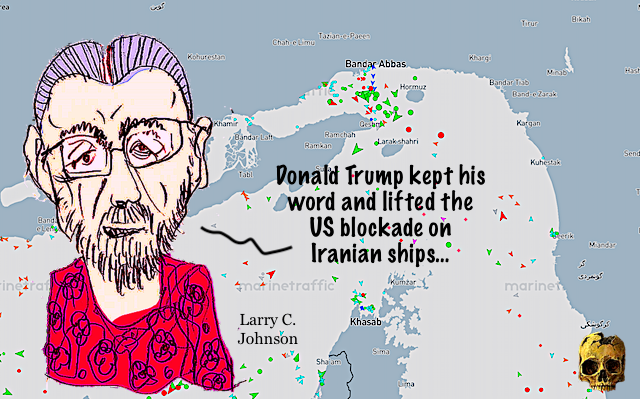
Let’s give Donald Trump credit for one thing… He kept his word and lifted the US blockade on Iranian ships and Iran is going to town with its oil tankers moving in and out of the Persian Gulf through the Strait of Hormuz. The picture above shows ships — marked red and green — moving as of 22:55 hours Eastern time on 15 June 2026.
The Straight of Hormuz is Open for Iranian Business… Oil is Moving and Iran is Getting Paid
by Larry C. Johnson
This does not mean that the MOU with Iran, which is supposed to be signed in Geneva on Friday, will hold, but it is a step in the direction of de-escalation. So the question we ought to ask is why did Donald Trump blink and accept the proposal that Iran proffered way back in April?
I think there are several reasons, but the principal one is that the US is running out of oil, which means Trump will not be able to artificially suppress the price of gasoline. US strategic oil reserves have fallen to their lowest level since 1983, reports CNN. The decline comes amid continued drawdowns to mitigate the impact of the conflict with Iran. Reserves have dropped to 340.3 million barrels, last seen during the Reagan administration, which was still building the stockpile. US daily consumption is 20 to 21 million barrels in 2026, which means the reserve can supply 17 days of gasoline, which falls on July 1st.
Donald Trump may be in mental decline, but he still retains enough smarts to understand that an oil shortage and soaring prices of gasoline in July is politically untenable.
Another factor is that US installations and aircraft in the Persian Gulf took a helluva beating last week. The US attacks on Iranian installations in the Strait of Hormuz on June 9 and 10 provoked a fierce Iranian response that hit targets in Iraq (CIA-bases supporting the Kurds), Kuwait (the Ali Al Salem airbase, Camp Buehring in northeastern Kuwait, as well as a makeshift operations center near the civilian port of Shuaiba), the Prince Saud Airbase adjacent to Riyadh, Saudi Arabia, and the Mowaffaq Al Salti Airbase in Jordan. The attacks were devastating and reportedly employed some new Chinese missiles supplied to Iran.
Then there is the pressure from Gulf Arabs to end the attacks on Iran. Iran, backed by China, Russia and Pakistan, engaged in intense diplomacy with Saudi Arabia, Qatar and the United Arab Emirates (UAE).
The UAE, who has been a thorn in the side of Iran and Saudi Arabia and has been identified as an ally of Israel, sent a delegation to Iran on 9 June. Reuters reported that the UAE had agreed to release billions of dollars for Iran — two regional sources put the figure at $10 billion (including more than $3 billion already delivered), while two other sources put it at $20 billion, with the funds agreed in exchange for Iran halting attacks on the UAE. However, the UAE’s Ministry of Foreign Affairs categorically denied those reports, stating the allegations were “entirely false and unfounded” and that no frozen Iranian funds had been released, transferred, or facilitated through the UAE. What is undisputed is that the UAE sent a high-level delegation to talk to the Iranian government.
A high-level Qatari delegation arrived in Tehran on Wednesday, June 10, to hold talks on bilateral relations, regional developments, and diplomatic efforts to end the conflict between Iran and the United States. The delegation arrived at midday and the visit came after Trump accused Iran of stalling and said Tehran must now “pay the price.” AFP, citing an informed diplomat, reported the Qatari negotiating team had traveled to Tehran following consultations with American officials to help narrow remaining differences between the two sides.
A senior Pakistani source with access to information about Pakistan’s role in mediating the talks between the US and Iran, reported that Pakistan, with the encouragement of China and Russia, was making progress in its talks with the Saudis and the Qataris to stop hosting US military bases in their respective countries. These talks coincided with Saudi Arabia denying the US the use of its airspace to attack Iranian targets during Project Freedom.
Will the deal be signed on Friday? I remain skeptical simply because of the enormous Zionist backlash being visited on Donald Trump by angry Israeli officials and US politicians beholden to AIPAC. However, as I write this Monday night, the deal appears intact.
Why hasn’t Donald Trump released the text of the MOU? Two possible explanations (and I’ll be interested in what you think is the most plausible): 1) There are still areas of disagreement between Iran and the US and they are still trying to work out a compromise, 2) Trump does not want to provide the details beforehand fearing that the Zionist backlash could derail the Friday signing ceremony in Geneva. The diplomatic roller coaster is running full blast… It will be a wild ride until Friday.
PLEASE VISIT:
YOURDEMOCRACY.NET RECORDS HISTORY AS IT SHOULD BE — NOT AS THE WESTERN MEDIA WRONGLY REPORTS IT — SINCE 2005.
Gus Leonisky
POLITICAL CARTOONIST SINCE 1951.
RABID ATHEIST.
WELCOME TO THIS INSANE WORLD…
HAS DONALD J TRUMP REALISED HE HAS BEEN "PLAYED" BY A FEW WARMONGERS IN HIS ENTOURAGE, LIKE A BUNCH OF NERO PLAYING THE "VIOLIN" [TRUMP] WHEN ROME WAS BURNING.... OR HAS HE COME TO BEAR THE REALITY HE'S AS POPULAR AS A CROOKED REAL ESTATE AGENT?
- By Gus Leonisky at 18 Jun 2026 - 5:05am
- Gus Leonisky's blog
- Login or register to post comments
dotted line....
US President Donald Trump has personally signed a memorandum of understanding with Tehran, with a photo of the process sent to the Iranian side and the mediators, according to Axios.
Iran’s Foreign Ministry confirmed on Wednesday that the text of the memorandum had been officially finalized and “signed by both sides.”Trump reportedly signed the document while attending a dinner in France alongside President Emmanuel Macron on the sidelines of the G7 summit, Axios reported.
The White House has yet to publish the final text of the memorandum, but a senior US official read out the 14-point document to journalists earlier on Wednesday, following days of criticism over the secrecy.
The readout largely tracked the leaked text, but included more detailed language on Lebanon’s sovereignty, the phasing out of the US naval blockade, the future administration of the Strait of Hormuz, and the handling of Iran’s enriched uranium stockpile under IAEA supervision.
Foreign Ministry spokesman Esmaeil Baghaei said the end of the war in Lebanon were as important for Tehran as the provisions concerning Iran itself, which is why the first clause mentions the country “three times, including respect for its territorial integrity and sovereignty.”
“We do not separate the United States and the Israeli regime, but their differences in approach and methods are clearly evident,” Baghaei said, according to Press TV. “If the Israeli regime’s attacks on Lebanon continue, it will be considered a violation of the other party’s commitments under the memorandum of understanding.”
Below is the official text in full, as narrated by a senior US official who has not been publicly named. Substantive changes from the previously leaked draft are marked in bold.
The United States of America and the Islamic Republic of Iran have jointly agreed in good faith on [date] on the following:
1. The United States of America and the Islamic Republic of Iran and their allies in the current war are signing this MOU to declare the immediate and permanent termination of military operations on all fronts, including in Lebanon, and undertake from now on not to initiate any war or any military operation against each other, and to refrain from the threat or use of force against each other, and to ensure the territorial integrity and sovereignty of Lebanon. The final deal will confirm the permanent termination of the war on all fronts, including in Lebanon, and other provisions of this paragraph.
2. The United States of America and the Islamic Republic of Iran undertake to respect each other’s sovereignty and territorial integrity and to refrain from interfering in each other’s internal affairs.
3. The United States of America and the Islamic Republic of Iran commit to negotiating and achieving the final deal within a maximum of 60 days, extendable by mutual consent.
4. Immediately upon the signing of this MOU, the United States of America will begin the removal of its naval blockade and any disturbances or impediments against the Islamic Republic of Iran, and will fully end the naval blockade within 30 days. During this period, the traffic of vessels will be in proportion to the prewar traffic levels being restored by the Islamic Republic of Iran. The United States of America further undertakes to remove its forces from the proximity of the Islamic Republic of Iran within 30 days after the final deal.
5. Upon the signing of this MOU, the Islamic Republic of Iran will make arrangements, using its best efforts, for the safe passage of commercial vessels with no charge, for 60 days only, from the Persian Gulf to the Sea of Oman and vice versa. The traffic of commercial vessels will immediately start and, considering the need for removing technical and military obstacles and demining by the Islamic Republic of Iran, will be reinstated within 30 days. The Islamic Republic of Iran will conduct dialogue with the Sultanate of Oman to define the future administration and maritime services in the Strait of Hormuz in discussion with other Persian Gulf littoral states, in line with applicable international law and the sovereign rights of coastal states of the Strait of Hormuz.
6. The United States of America undertakes, with regional partners, to develop a definitive, mutually agreed plan with at least USD 300 billion for the reconstruction and economic development of the Islamic Republic of Iran. The mechanism for the implementation of this plan will be finalized as part of a final deal within 60 days. All required licenses, waivers, and permissions needed for the relevant financial transactions will be granted by the United States of America.
7. The United States of America undertakes to terminate all types of sanctions against the Islamic Republic of Iran, including United Nations Security Council resolutions, IAEA Board of Governors resolutions, and all unilateral US sanctions, primary and secondary, on an agreed-upon schedule as part of the final deal. The Islamic Republic of Iran and the United States of America acknowledge the critical importance of the above-mentioned sanctions termination issue and express their intention to immediately address these issues in the negotiations in order to achieve mutual agreement on them.
8. The Islamic Republic of Iran reaffirms that it shall not procure or develop nuclear weapons. The United States of America and the Islamic Republic of Iran have agreed to resolve the disposition of stockpiled enriched material pursuant to a mechanism that will be mutually agreed upon in accordance with the schedule mentioned in paragraph seven, with the minimum methodology to be down-blending on site under the supervision of the IAEA. The two parties also agreed to discuss the issue of enrichment and other mutually agreed matters related to the Islamic Republic of Iran’s nuclear needs, based on a satisfactory framework to be agreed upon in the final deal. The final deal will confirm the provisions of this paragraph. The United States of America and the Islamic Republic of Iran acknowledge the critical importance of the above-mentioned nuclear issues and express their intention to immediately address these issues in the negotiations in order to achieve mutual agreement on them.
9. Pending the final deal, the United States of America and the Islamic Republic of Iran agree to maintain the status quo. The Islamic Republic of Iran will maintain the current status quo of its nuclear program, and the United States of America will not impose any new sanctions and will not deploy additional forces in the region.
10. The United States of America undertakes that immediately upon the signing of this MOU and until the termination of sanctions, the US Department of the Treasury will issue waivers for the export of Iranian crude oil, petroleum products and derivatives, and all associated services, including banking transactions, insurance, transportation, etc.
11. The United States of America undertakes to make fully available for use the frozen or restricted funds and assets of the Islamic Republic of Iran upon the implementation of this MOU. The United States of America and the Islamic Republic of Iran will mutually agree on the procedures related to the release of these funds during negotiations. Such funds, whether retained in the original account or transferred, shall be made fully usable for payment to any ultimate beneficiary designated by the Central Bank of the Islamic Republic of Iran. The United States of America undertakes to issue all necessary licenses and authorizations accordingly.
12. The United States of America and the Islamic Republic of Iran agree that an executive mechanism will be established to monitor the successful implementation of this MOU and future compliance withthe final deal.
13. After signing this MOU, and subject to the beginning of the implementation of paragraphs 1, 4, 5, 10, and 11 of this MOU, and the continuing implementation of these measures, the United States of America and the Islamic Republic of Iran will start negotiations regarding the final deal exclusively on the other paragraphs.
14. The final deal will be endorsed by a binding UNSC resolution.
https://www.rt.com/news/641756-us-iran-memorandum-signed/
READ FROM TOP.
PLEASE VISIT:
YOURDEMOCRACY.NET RECORDS HISTORY AS IT SHOULD BE — NOT AS THE WESTERN MEDIA WRONGLY REPORTS IT — SINCE 2005.
Gus Leonisky
POLITICAL CARTOONIST SINCE 1951.
RABID ATHEIST.
WELCOME TO THIS INSANE WORLD….