Search
Recent comments
- and god said....
12 hours 54 min ago - walking east....
13 hours 30 min ago - part 1 and 2.....
13 hours 41 min ago - bastard pig....
13 hours 50 min ago - accidental....
1 day 1 hour ago - momentum...
1 day 9 hours ago - the greatest....
1 day 9 hours ago - cold place, warm people.....
1 day 12 hours ago - profitering....
1 day 12 hours ago - tobogganning....
1 day 12 hours ago
Democracy Links
Member's Off-site Blogs
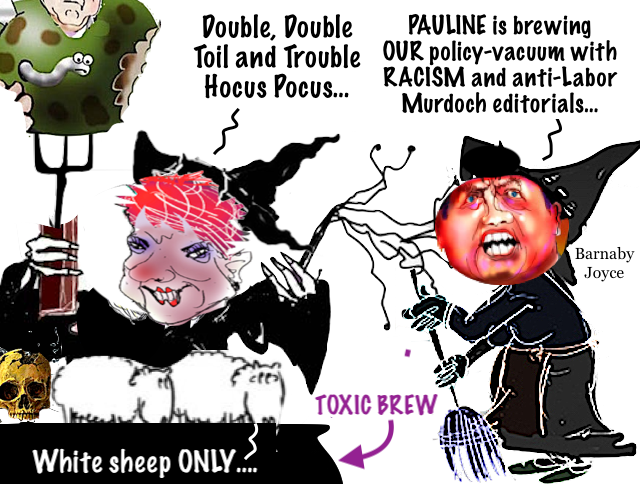
some persons are more witchy than others....
Over recent weeks, the slogan “ditch the witch” has been featured alongside AI-generated photos of Victorian premier Jacinta Allan. She’s depicted in a dusty and distressed witch’s hat, a fake wart on her chin, on billboards and trucks around Melbourne in the lead up to the state election this November.
Instead of critiquing her policies or governance, the campaign attacked her gender. The brothel owner who partly funded the campaign says the slogan is not sexist.
It’s not the first time the phrase has been used that way. In 2011, then-opposition leader Tony Abbott stood before protest placards that read “ditch the witch”, targeted on that occasion toward our first woman prime minister, Julia Gillard.
In fact, there is a long sexist history of labelling women in power as witches.
So, why is it misogynistic to call a powerful woman a “witch”?
Threatening the patriarchyWitchy women weren’t always bad.
In early European medieval stories, for instance, the magical woman Morgan Le Fay is described as a healer and scientist. Then, starting around the 12th century she is recast as a vindictive, evil character. Some scholars have suggested the narrative rules of the French chivalric romance literary genre may have played a role; to work, these stories needed a villain to prevent a knight from being with his lover.
From the early 15th century on, it became a very derisive way to refer to women. Texts like German friar Heinrich Kramer’s misogynistic witch-hunting manual Malleus Maleficarum (1486), among others, were highly influential in shaping the negative image of the witch.
Think also of the fairy tales collected in the 19th century by the Brothers Grimm, told to teach children about moral order. Witches serve a purpose in these stories as villains who lure and eat children. Subtle messages are conveyed about the dangers to the social order posed by women who don’t marry, don’t much like children, and possess power and ambition.
Threatening the patriarchy by displaying ambition or failing to conform to societal gender norms – such as the expectation to be “beautiful”, to bear children and to be a “good wife” – began to be taken as evidence of witchcraft. Think of the infamous Salem witch trials of the 1690s in America, where Bridget Bishop, an elderly, poor and argumentative widow and midwife – all of which were taken as evidence of her being a witch – was the first to be executed.
Many women were violently killed as a result.
A worthless womanWitch-hunts have since shifted from the literal to the metaphorical.
Contemporary witch-hunts demonise women who hold positions of power or possess similar traits to the women deemed witches centuries ago.
Calling a woman a “witch” reinforces the idea that women who seek or have political power are not to be trusted. They are cast as inherently deceitful, dangerous, and diabolical.
It’s also a sledge that targets women’s appearance. Witches are portrayed as ugly, poor, disabled, barren spinsters who fail to live up to feminine beauty standards.
As women’s value in a patriarchy is tied to their appearance and how appealing they are to the male gaze, a witch is therefore seen as worthless.
In a patriarchy, a woman’s value is also linked to producing children and playing the role of a “good wife” – something that witches famously do not do. So when Julia Gillard – once described by a Liberal senator as “deliberately barren” – is called a witch, it is about punishing women who do not perform femininity in a certain, traditionalist way.
There is also a double standard. While women politicians risk being denigrated as witches, this is a term rarely, if ever, used for male politicians.
The male supernatural counterpart to a witch is a wizard or a warlock. A warlock (derived from the Old English “wǣrloga” which meant traitor, scoundrel, monster) and wizard (derived from the Middle English “wysard”, meaning wise) both imply greatness.
The former instils fear; the latter implies skill and excellence.
What actually is misogyny?It’s worth thinking carefully about the difference between sexism and misogyny. And there is a difference. As writer and philosopher Kate Manne puts it:
Overall, sexism and misogyny share a common purpose – to maintain or restore a patriarchal social order. But sexism purports to merely be being reasonable; misogyny gets nasty and tries to force the issue […] Sexism wears a lab coat; misogyny goes on witch hunts.
Sexism is the belief that men are superior to women. It justifiespatriarchy by presenting men as “naturally” dominant and women as subordinate. Sexism can, however, be used to support misogynistic ends.
Misogyny – unlike sexism – distinguishes “good women” and “bad women”, targeting and punishing the latter to coerce all women to adhere to the patriarchal social order.
Feminist scholars note how frequently women who rise in male-dominated institutions are marked as “bad women” who can potentially threaten the patriarchy, making them targets for misogyny.
These bad women are made an example of. The idea is to send a message to all women that this is what they risk if they follow in their footsteps.
In today’s context, the label “witch” loudly communicates to others that they must remain appropriately feminine and, above all, not challenge societal norms.
To be feared and destroyedFrom the 20th century, witches have been embraced and reclaimed by some feminists who deconstructed the negative stereotypes. They have reinterpreted the witch as a feminist icon of women’s resistance.
But when the witch trope is used against women politicians, even as a joke, it reinforces certain beliefs about all women’s essential nature.
By doing this, society is asserting women should not seek power and that those who do so are dangerous; they are to be feared and destroyed.
https://theconversation.com/why-is-it-misogynistic-to-call-a-woman-a-witch-285058
===================
PLEASE VISIT:
YOURDEMOCRACY.NET RECORDS HISTORY AS IT SHOULD BE — NOT AS THE WESTERN MEDIA WRONGLY REPORTS IT — SINCE 2005.
Gus Leonisky
POLITICAL CARTOONIST SINCE 1951.
RABID ATHEIST.
WELCOME TO THIS INSANE WORLD….
SEE ALSO: bravery....
SEE ALSO: southern cross....
- By Gus Leonisky at 15 Jun 2026 - 6:55am
- Gus Leonisky's blog
- Login or register to post comments
small beer....
National Party refugee Barnaby Joyce is an opportunist, which is why he fled to One Nation — and also why he still owes Australia's favourite weatherman, Monte Dwyer, a beer.
SOME YEARS AGO, I attended the victory party of a mate who’d just won a seat in State Parliament. It was a raucous affair, as winners’ bashes tend to be, and fighting one’s way to the bar wasn’t for the faint-hearted.
Consequently, when I returned to my group with a fresh round, I wasn’t impressed when the interloping Barnaby Joyce helped himself to one of the beers – my beer, as it played out — forcing me to line up at the bar again.
Fast forward a decade or so, and I recently had the opportunity to remind Barnaby he still owed me that beer, to which imposition he harrumphed and turned his back on me.
Rude, yes, and had the occasion not been a funeral, I might have pushed the matter further, just to see if I could make his face any redder.
Now he’s hitched his wagon to Pauline Hanson’s One Nation Party to help deliver Australia its very own version of the U.S.’s MAGA or the UK’s Reform, or whatever strain of right-wing politics you care to equate it to. This is not a marriage made in heaven.
Hanson leads with a chip on her shoulder and the bit of grievance between her teeth, and I fully expect her One Nation Party to implode again like so many 1998 QLD State Parliament seats; especially now she’s being courted by the big end of town (beware the gifted planes, Pauline) and started talking crazy about becoming PM.
Barnaby is a different tomato altogether. He’s a career politician who knows an opportunity when he sees one and he’s acutely aware of the prevailing winds of populism sweeping the globe.
He hasn’t been drawn to One Nation for its policies – indeed, some argue it’s still in the pre-policy, stone-throwing stage anyway, and Joyce’s recent housing policy gaffe would support this argument – he’s joined because he’s reading the big room. Worldwide, people are shunning mainstream political parties, looking for quick-fix alternatives and Barnaby’s positioning himself to capitalise on that trend.
To that point, I recently did a road trip through the "Red" states of the U.S., trying to understand why Americans voted Trump in for a second term.
For my money, his questionable behaviour during his first term alone should have disqualified him from another stint in the White House. Yet I was wrong. Among the many causative factors I discovered, so desperate for change were the disenfranchised voters that they fell for an unpredictable shyster with criminal tendencies and self-serving motives and made him their president (again).
And now they’re in such a mess domestically and geopolitically that it’s hard to see any positive outcomes for the American people (excluding the Epstein class, of course).
Lately, we’ve been hearing grumblings about Australia going down the same path. Leaving aside the fact we have a much better parliamentary system and are less likely to end up with a head of state going rogue and making (bad) unilateral decisions, it is true that many people are disillusioned by the status quo and seek the messianic alternative with the simple messaging everyone can latch onto.
Yet there’s a cautionary tale here.
As American journalist and social commentator H. L. Mencken observed about a century ago:
'As democracy is perfected, the office of the President represents, more and more closely, the inner soul of the people. On some great and glorious day, the plain folks of the land will reach their heart’s desire at last, and the White House will be occupied by a downright fool and a complete narcissistic moron.'
Democracy is under threat around the world. As our attention spans shorten, we become less inclined to think deeply and consider alternative points of view. We want our information short, sweet and delivered with confirmation bias.
This makes fertile ground for populist politics, where the clever sound bite becomes more important than the message itself. And it’s all very tempting to believe there really is a simple solution to the complex matter of governance.
But there isn’t. Managing people is complicated. Problems require clear thinking, time and ideally, experience to solve.
Thus far, I’ve not seen a populist movement prepared to apply anything like these qualities to the betterment of humanity.
So, whether Barnaby and Pauline live happily ever after or not, he’d do himself a favour by remembering most Australians still believe in a fair go, and that means shouting when it’s your turn.
Monte Dwyer is an independent journalist/author, best-known in Australia as the travelling weatherman on the Today Show, a role he filled for long enough to require therapy.
https://independentaustralia.net/politics/politics-display/barnaby-joyce-owes-me-a-beer,21165
READ FROM TOP.
PLEASE VISIT:
YOURDEMOCRACY.NET RECORDS HISTORY AS IT SHOULD BE — NOT AS THE WESTERN MEDIA WRONGLY REPORTS IT — SINCE 2005.
Gus Leonisky
POLITICAL CARTOONIST SINCE 1951.
RABID ATHEIST.
WELCOME TO THIS INSANE WORLD….
science bypass....
Kim Carr
One Nation, science and democracy – the trust deficit in AustraliaThe rise of anti-establishment politics reflects a deeper loss of confidence in Australia’s economic model, making investment in science, research and innovation central to rebuilding productivity, opportunity and trust.
The surge in support for One Nation is often explained away as a protest vote, a reaction to migration, cultural anxiety or dissatisfaction with the major parties. But such explanations risk missing the deeper story. If current polling trends are sustained, they point to something more profound: a growing belief among many Australians that the economic and political model which has governed the country for the past four decades is no longer working for them.
The rise of anti-establishment politics should be understood not merely as a political phenomenon but as a symptom of a broader crisis of confidence. Trust in institutions is declining. Trust in governments is declining. Trust in business, media and public authorities is weakening. Increasingly, many Australians doubt that the future will be better than the past.
This matters because democracies ultimately rely on public confidence that the system can deliver opportunity, fairness and security. When that confidence erodes, political fragmentation follows.
The Strategic Examination of Research and Development (SERD), Ambitious Australia, provides an important framework for understanding why this is occurring and what might be done about it.
The report bluntly argues that Australia’s neoliberal economic model is reaching its limits. For decades, economic growth has been driven by population expansion, resource extraction and rising asset values. Australia became accustomed to prosperity generated by what critics have described as a “beach and quarry” economy.
But the conditions that sustained that model are changing.
As the Prime Minister recently observed, the stable and predictable world of ever-expanding free trade has gone. International conflict, strategic competition, technological disruption and declining productivity are creating new economic realities. The assumptions of the post-war economic order no longer apply.
The consequence is a growing sense of insecurity, particularly among younger Australians. The survey evidence suggests Generation Z is leading the decline in trust across institutions. Given the pressures they face – housing affordability, insecure employment, stagnant wages and concerns about future living standards – this should surprise no one.
The trust deficit has a profound economic dimension.
People are more likely to lose faith in political institutions when they believe those institutions are incapable of solving practical problems. They become receptive to anti-establishment movements when they see governments managing decline rather than building opportunity.
This is where science, research and innovation become politically important.
Too often science policy is treated as a niche concern relevant only to universities, researchers and technology companies. In reality, investment in science is fundamentally about national renewal.
Science and research have consistently delivered economic, social and environmental dividends. They improve productivity, create industries, generate jobs and enhance living standards. They provide practical solutions to real-world challenges.
The SERD report highlights a striking reality. Since World War Two, global economic growth has largely derived from technological advances. Since 1990, around 90 per cent of those technological advances have been driven by basic research discoveries.
The implication is clear. Countries that invest in research and development are investing directly in their future prosperity.
Reputable international studies demonstrate that research and development investment delivers deeper and more enduring productivity gains than many other forms of public expenditure.
Yet Australia continues to underperform.
The Commonwealth currently spends around $15 billion on the innovation system, but that investment has been declining as a share of GDP. To merely reach the OECD average, Australia would need to increase research and development investment by approximately 43 per cent.
The problem is not simply one of funding.
The SERD report argues that Australia’s innovation ecosystem has become fragmented, cumbersome and ineffective. Funding is dispersed. Incentives are inconsistent. The system is difficult for businesses to navigate and often fails to support research through to commercialisation. Basic research now is only a third of public funding.
The result is an innovation system that is not merely underfunded but underperforming.
More importantly, Australia has failed to embed research and innovation into its national identity.
Australians celebrate sporting achievement but often fail to recognise scientists, innovators and entrepreneurs with comparable enthusiasm. Research, development and innovation are not widely seen as essential national priorities.
This cultural challenge has political consequences.
A society that undervalues science may struggle to appreciate how innovation can improve everyday lives. It may fail to connect research investment with better jobs, stronger industries and rising living standards. It may become vulnerable to narratives that frame expertise itself as part of a disconnected elite.
That vulnerability is becoming increasingly apparent internationally. Across many democracies, right-wing anti-establishment movements have challenged scientific institutions, particularly around issues such as climate change, public health and technological change.
Australia is not immune from these trends.
Although Australians generally retain higher levels of trust in scientists than many comparable countries, survey evidence suggests trust has declined since 2019. Public attitudes towards science and technology are also becoming more polarised. Support for emerging technologies correlates strongly with education levels, income and broader institutional trust.
This presents a challenge not only for scientists but for democracy itself.
Good science communication is therefore not a luxury. It is a democratic necessity.
Science communication must do more than explain technical findings. It must demonstrate how science provides solutions that improve people’s lives. It must connect innovation to jobs, industries and communities. It must offer practical hope at a time when many Australians are questioning whether progress is still possible.
Science can help rebuild trust because it deals in evidence, problem-solving and tangible outcomes. It shows that collective effort can produce results. It demonstrates that public institutions can still make a positive difference.
The SERD report provides a roadmap for such a project. Its recommendations include a practical focus on research at scale, a world-class basic research scheme, incentives to build business capability, stronger innovation cycles within industry, workforce development and political leadership that places innovation at the centre of national strategy.
Most importantly, the report offers something that contemporary politics often lacks: a long-term vision.
Australia faces a defining decade. The 2002 Intergenerational Report projected that GDP per person would grow by 90 per cent over 40 years. By 2023, that expectation had fallen to just 57 per cent.
Without significant reform, future generations may experience declining living standards and reduced economic opportunity.
That is the real political challenge confronting Australia.
The rise of One Nation and other anti-establishment movements should be understood as a warning signal. It reflects growing frustration with an economic model that many believe no longer delivers for ordinary people. It reflects declining trust in institutions and scepticism about the future.
The answer cannot simply be to condemn those voters or dismiss their concerns.
The answer is to build an economy that once again generates opportunity, productivity and hope. Science, research and innovation are not the entire solution, but they are an indispensable part of it.
The current budget tax changes on property are a step in the right direction. We can anticipate further focused support for start-up businesses in the second tranche of legislation later this year.
The choice before Australia is whether it continues to manage decline through short-term fixes and political caution, or whether it embraces the ambitious reforms necessary to create a more prosperous and equitable future.
Rebuilding trust in democracy ultimately requires demonstrating that democracy can still deliver.
Science can help show the way.
https://johnmenadue.com/post/2026/06/one-nation-science-and-democracy-the-trust-deficit-in-australia/
READ FROM TOP.
PLEASE VISIT:
YOURDEMOCRACY.NET RECORDS HISTORY AS IT SHOULD BE — NOT AS THE WESTERN MEDIA WRONGLY REPORTS IT — SINCE 2005.
Gus Leonisky
POLITICAL CARTOONIST SINCE 1951.
RABID ATHEIST.
WELCOME TO THIS INSANE WORLD….