Search
Recent comments
- and god said....
14 hours 25 min ago - walking east....
15 hours 1 min ago - part 1 and 2.....
15 hours 12 min ago - bastard pig....
15 hours 21 min ago - accidental....
1 day 2 hours ago - momentum...
1 day 11 hours ago - the greatest....
1 day 11 hours ago - cold place, warm people.....
1 day 14 hours ago - profitering....
1 day 14 hours ago - tobogganning....
1 day 14 hours ago
Democracy Links
Member's Off-site Blogs
the psychological warfare of having a punt......
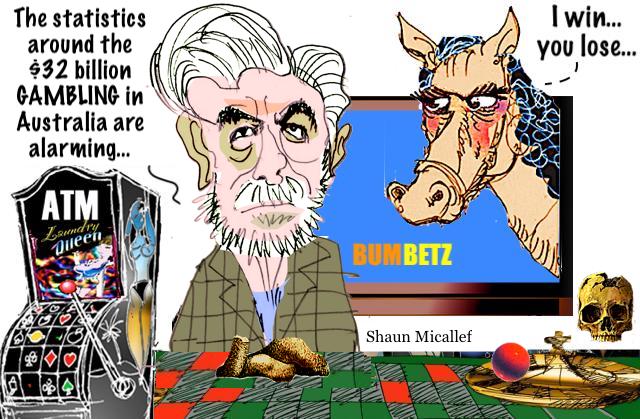
If you’ve watched a footy game on TV, flicked through a newspaper, listened to a radio or glimpsed the games and social channels that contemporary adolescents are glued to, you’ll know how pervasive and inescapable gambling has become in Australia today.
The statistics around the $32 billion industry are alarming. Just for starters, Australians are the biggest gamblers – and losers – in the world per capita; 20 per cent of gamblers account for 80 per cent of losses; and in 2017, Australia had 0.3 per cent of the world’s population, but 2.5 per cent of its gaming machines.
While the fallout from gambling can be easily measured at a grassroots level, the machinations of the industry are complicated. Myths about “having a punt” are threaded into the national psyche. The proceeds of gambling fund elite sport – the Sydney Opera House even – all the way down to local clubs, social hubs and community events. Governments rely on gambling taxes to pay for essential services and are increasingly beholden to lobbyists, an egregious conflict of interest if ever there was one.
The three-part series Shaun Micallef’s Going for Broke does a good job of unravelling many of these complex equations. It identifies with chilling clarity the most pernicious practices in the gambling industry’s playbook and dissects the dark arts that make gambling appealing and addictive. As one participant says, gambling is “psychological warfare”.
It does so by putting a human face on the issues it explores, be that attendees at a seniors’ bingo night or fashionistas glamming up for the Spring Carnival. We meet Dylan DiPierdomenico (son of AFL legend “Dipper”) on the day he is released from a nine-month prison sentence for gambling-related offences, and a mother who has somehow managed to turn her life around from addiction. The humility and frankness of both is truly moving. The head of the much-criticised industry group Responsible Wagering Australia has a turn at explaining the inherent contradictions of his organisation, while researcher and academic Dr Charles Livingstone eloquently dismantles the very idea of “responsible” gambling.
Micallef says at the outset that he has never gambled, played a pokie or willingly sat down to watch a football game. So unlike the actor, writer and comedian’s previous factual shows Stairway to Heaven (about faith) and On the Sauce (alcohol and binge-drinking), he has no skin in the gambling game. Yet, there is no mistaking his genuine interest in how gambling is entrenched in Australian society and history. His curiosity and empathy for the people he meets is palpable. He asks questions and listens without betraying his views, resists funnyman quips (though he does a good John Howard imitation) and the “concerned journalist” furrowed brow, and leaves interviewees to tell their stories. Some of which are shattering.
Going for Broke shares a considerable amount of behind-the-camera DNA with the terrific SBS documentary The People vs Robodebt, both of which are from production company CJZ. As in Robodebt, Going for Broke advocates for those who, pun intended, are being played by a system that is stacked against them.
The late Labor MP Peta Murphy called for a comprehensive ban on all gambling advertising on all media, broadcast and online. Just last month, the federal government finally announced long-awaited reforms that fall well short of a ban, merely limiting the number of gambling ads that can be broadcast between 6am and 8.30pm, ending advertising on jerseys, jumpers and in stadiums and banning online advertising to under 18s.
Micallef signs off the final episode, which was finished well before the reforms were announced, on a tear-worthy note. He didn’t even have to take a punt on how this story would end.
Shaun Micallef’s Going for Broke premieres at 8pm on Tuesday, May 19, on the ABC and streams on ABC iview.
PLEASE VISIT:
YOURDEMOCRACY.NET RECORDS HISTORY AS IT SHOULD BE — NOT AS THE WESTERN MEDIA WRONGLY REPORTS IT — SINCE 2005.
Gus Leonisky
POLITICAL CARTOONIST SINCE 1951.
RABID ATHEIST.
WELCOME TO THIS INSANE WORLD….
SEE ALSO:
Anonymous gamblers have made millions betting on the events of the Middle East war, prompting US politicians to call for a ban on such speculation.
Online bets correctly predicted the US and Israeli strikes on Iran, raising questions about whether the bets were based on insider information and what betting markets should be allowed.
Bets were placed on Polymarket, which describes itself as the world's largest prediction market and allows users to "trade on the outcomes of real-world events", using cryptocurrency.
Iran war live updates: For the latest news on the Middle East crisis, read our blog.
Polymarket is classified as an interactive gambling service by the Australian Communications and Media Authority (ACMA) and is unlicensed in Australia and prohibited from operating here.
One newly created account on Polymarket made more than a quarter of a million US dollars betting on the strikes, the user's profile on the website shows.
Other wagers included a bet Iran's supreme leader, Ali Khamenei, would not be the leader of Iran by February 28, the date of the first US and Israeli strikes. The ayatollah was killed that day.
- By Gus Leonisky at 28 May 2026 - 3:08pm
- Gus Leonisky's blog
- Login or register to post comments
gambles...
PLEASE REVISIT:
problem solved... the spiritual has been replaced by spirits...https://www.yourdemocracy.net.au/drupal/node/21647
the religious follies of the empire...READ FROM TOP.
PLEASE VISIT:
YOURDEMOCRACY.NET RECORDS HISTORY AS IT SHOULD BE — NOT AS THE WESTERN MEDIA WRONGLY REPORTS IT — SINCE 2005.
Gus Leonisky
POLITICAL CARTOONIST SINCE 1951.
RABID ATHEIST.
WELCOME TO THIS INSANE WORLD….
place your bet....
Gambling reform. Government – proud supporters of not having a crack
by Wally The Chartered Accountant
While the Budget purported to take pressure off ordinary Australians, they continue to ignore the need for online gambling reform. Wally the Chartered Accountant has a crack.
On the same day as delivering the Budget – framed to “take the pressure off Australians” – the Government piled the pressure back on with its snail-paced and piss-poor response to the 2023 Inquiry Report – aka The Murphy Report, You win some, you lose more: Online gambling and its impacts on those experiencing gambling harm.
It took the Government 1049 days, or nearly three years, to respond. In November 2024, Minister Anika Wells was questioned about the slow progress of the Government’s Response and responded that reforms to address online gambling harm were ‘important’.
She answered as if the Government was being careful and mindful, and the issues meant a long delay was warranted.
In contrast, the foreword to the Inquiry Report June 2023 highlights that the important thing was the need for urgent reforms because Australians outspent the citizens of every other country on online gambling.
This is wreaking havoc in our communities.
The lengthy response time makes it difficult to believe that the Government believes social harm from online gambling is important.
The first sentence in the introduction to the Government response states: “The Australian Government takes its responsibility to protect Australians from online gambling harm seriously”. If somebody has to publicly state they are taking an issue seriously, it is a red flag. If somebody states they are taking an issue seriously after 1049 days it almost certain that they do not.
An Australian Government serious about social harm from online gambling would have responded to the Inquiry Report within 12 months rather than drag out their response for almost 3 years. An Australian Government that was serious about social harm from online gambling would not drop its reforms on the day of the Federal Budget.
It seems the Australian Government wanted the media and public to be distracted on matters other than online gambling harm. This is the sort of politics that trivialises the social harm of online gambling,
especially the harm caused to children from online gambling advertisements.
Inquiry Report non-responseWhen Minister Wells was questioned by an ABC journalist about the progress of the Government’s Response in November 2024, she said that making online gambling reforms was ‘complex’ as if the Government was confronted by matters of rocket science.
If online gambling reform is complex, then the Government’s Response should be thorough. Alas, the Government’s response does not specifically mention any of the 31 wide-ranging recommendations in the Murphy Report. The best they could come up with is this: “The Government notes the 31 recommendations made by the Committee”.
The extent of the Australian Government’s engagement with the Murphy Report may be little more than to note that 31 recommendations exist. It is not even clear whether the Government has read through the 31 wide-ranging recommendations because the Government Response fails to mention any of them.
Failing to recognise, or ignoring, the details of recommendations made in the Murphy Report is not the same thing as responding to them. Failing to recognise, or ignoring, a recommendation made in the Murphy Report is a non-response. The Australian Government’s non-responses suggest they don’t know how to respond, or what to respond with, to each of the 31 recommendations.
Further, if the Government rejects a recommendation, they ought to explain the basis for rejection based on reason and relevant evidence, including any research. They didn’t.
Ignored Report recommendationsThe first three recommendations of the Murphy Report are glaring examples of the Government ignoring. After a staggering 1049 days and despite the “161 submissions, 26 exhibits and held 13 public hearings”.
The Murphy Report’s first three recommendations appear to be eminently reasonable. A single Australian Government minister. A national strategy with a focus on prevention, early intervention, treatment support and protection of the most vulnerable. A national regulator and requiring the companies that profit from online gambling to pay for harm reduction measures.
Gambling companies and their financial beneficiaries in the media might not like these recommendations, but the Australian Government wasn’t elected to do the bidding of online gambling companies.
If the Government is opposed to these recommendations, they should have explained why rather than display contempt for the Murphy Report by ignoring them.
Government responseThe Government’s Response includes one sentence of breathtaking hypocrisy:
“A number of recommendations made by the committee relate to policy within the responsibility of States and Territories. The Australian Government calls on States and Territories to examine the recommendations of the committee and respond accordingly. Most of the recommendations relate to policy that is the responsibility of the Australian Government. It is the Australian Government that needs to examine the recommendations, or reexamine the recommendations, and respond accordingly and appropriately.”
The Government also ignored the most important recommendation in the Murphy Report
to protect children and prevent gambling harm.
Recommendation 26: “The Committee recommends the Australian Government, with the cooperation of the states and territories, implement a comprehensive ban on all forms of advertising for online gambling, to be introduced in four phases, over three years, commencing immediately.”
According to the Government Response it has formulated a comprehensive package of wagering advertising reforms but none of the reforms are supported by evidence or reason. Most of the proposed reforms seem to have come from a last-minute brainstorming session in the Minister’s or Prime Minister’s Office.
According to the Murphy Report, recent history shows that Australia’s limited approach to protecting children from gambling advertising means that the adoption of restrictions in one place or time results in an increase in advertising elsewhere.
The Government must have overlooked this page in the Murphy Report because its Response continues with the failed approach of adopting restrictions in one place or time so that advertising can increase elsewhere.
School drop offThe Government proposes to ban all wagering advertising on broadcast radio during school drop off (8.00-9.00am) and pick-up (3.00-4.00pm hours).
However, not all children are driven to school in cars with the radio playing and children still have access to broadcast radio at other times and other places.
The Government proposes to ban all wagering advertising during live sporting events on broadcast channels between 6.00am and 8.30pm and additionally to restrict all wagering advertising on broadcast television to no more than 3 wagering advertisements per hour per channel between 6.00am and 8.30pm.
Again, not all live sporting events occur between the hours of 6.00am and 8.30pm. Not all children stop watching television at 8.30pm. There are a lot of television channels and there remains a lot of opportunity to target children with online gambling advertising at times chosen by the advertisers.
Wagering companies continue to have a licence to target children with the content of their advertisements.
The Government proposes to ban all wagering advertising on online platforms EXCEPT where users are logged in, are 18 years or older, and have not opted out of such advertising (triple lock functionality).
Children access content from their devices and are frequently given access to apps using their parent’s login details. The Australian Government’s triple lock is more like a Shoji screen. Parents should not be made responsible for shielding their children from online gambling advertisements.
The Murphy Report makes it clear that shielding children from online gambling advertisements is the Government’s responsibility, and this responsibility can only be discharged with a comprehensive ban on all forms of advertising for online gambling.
Virtue signalling to indigenous communitiesWelcome welcome welcome to the most irrelevant acknowledgment of country statement that has ever been seen. The Government’s Response begins with an acknowledgement of country statement. “The Australian Government acknowledges Aboriginal and Torres Strait Islander peoples throughout Australia and acknowledges their continuing connection to land, water, culture and community, and pay our respects to Elders past and present.”
Aboriginal and Torres Strait Islander peoples have, and feel, a deep and connection to land, water, culture and community. This connection does not extend to online gambling, cyberspace, the worldwide web, or customer logins at Sportsbet!
Story telling by elders is at the heart of Aboriginal and Torres Strait Islander culture; stories of rising seas, country, landscape, animals and morality. The Australian Government seems to think that elders tell stories about first try scorers or points-win-betting with mates and bonus bets.
There is unlikely to be a single person of aboriginal and Torres Strait Islander heritage, who is not in the Australian Government, that would wish to be associated with the Government’s Response to the Murphy Report, but plenty who are offended by being linked with it.
Prime Minister Albanese should engage more with Aboriginal and Torres Strait Islander peoples in his local electorate to gauge their views about acknowledgement to country statements and welcome to country speeches.
When is it appropriate to welcome and acknowledge? When is it not?
The Australian Government should not put itself, and its image or brand, above Aboriginal and Torres Strait Islander peoples by virtue signalling. These peoples deserve genuine Government services to protect them from harm rather than the lip service of an acknowledgement of country statement.
It is telling that the acknowledgement of country statement in the Government’s Response makes no mention of elders emerging only those past and present. The Government does not seem to place much weight into protecting children and future generations from harm, especially from the toxic effects of online gambling advertisements.
Victim blamingThe Australian Government’s philosophy for dealing with online gambling harm is to assist victims to find solutions for self-help rather than prevent the harm from happening in the first place. Victims are to blame. Victims must help themselves.
The Australian Government allows online gambling to wreak havoc in our communities, and the victims can treat themselves, or their loved ones, using some of the helpful pointers that are made publicly available.
The Australian Government shows its cards, and public health credentials for online gambling harm by prominently displaying self-help tips in the Government Response immediately following its ludicrous acknowledgement of country statement.
All good then, go help yourself. As Sportbet says: have a crack.
https://michaelwest.com.au/gambling-reform-government-proud-supporters-of-not-having-a-crack/
READ FROM TOP.
PLEASE VISIT:
YOURDEMOCRACY.NET RECORDS HISTORY AS IT SHOULD BE — NOT AS THE WESTERN MEDIA WRONGLY REPORTS IT — SINCE 2005.
Gus Leonisky
POLITICAL CARTOONIST SINCE 1951.
RABID ATHEIST.
WELCOME TO THIS INSANE WORLD….
THIS ISN'T EXCLUSIVE TO THE LABOR PARTY.... THE LIBS LOVE GAMBLING... THE GREENS DON'T.... AND PHON [PAULINE HANSON ONE NOTION]? I BET YOU 10 TO 10, THEY LOVE TO HAVE A FLUTTER....