Search
Recent comments
- and god said....
15 hours 5 min ago - walking east....
15 hours 41 min ago - part 1 and 2.....
15 hours 52 min ago - bastard pig....
16 hours 1 min ago - accidental....
1 day 3 hours ago - momentum...
1 day 11 hours ago - the greatest....
1 day 12 hours ago - cold place, warm people.....
1 day 14 hours ago - profitering....
1 day 14 hours ago - tobogganning....
1 day 14 hours ago
Democracy Links
Member's Off-site Blogs
the de-dollarisation process is happening slowly....
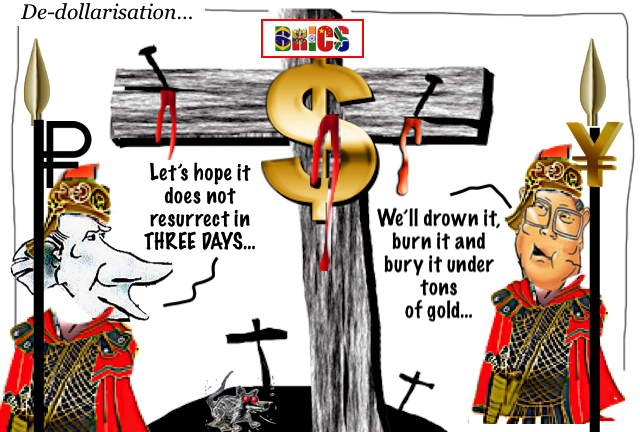
The US dollar emerged as the world’s reserve currency in the aftermath of World War II, becoming the main currency for international goods and coming to account for the majority of the world’s primary reserve currency.
Since Bretton Woods, “King Dollar” has seen off numerous challenges, from the rise of the euro to the suspension of gold convertibility in 1971, only to emerge more powerful than before.
In 1974, agreements between the US and Saudi Arabia led to the creation of the petrodollar system, under which the world’s oil is traded in US dollars in exchange for US protection of producers and their trade routes.
But there are signs that dollar hegemony is under pressure, and that while its reign may not be at an end, its purchase in the international financial system is not what it once was.
Since the turn of the millennium, the share of US dollars in global foreign exchange reserves has fallen from around 71 per cent to around 58 per cent in 2026, as central banks have sought to diversify their holdings.
Amidst this gradual decline, a number of events have conspired to accelerate the trend. Perhaps most notably, was the US response to the Russian invasion of Ukraine.
A harsh sanctions regime revealed the degree to which countries that rely on the dollar make themselves exposed to Washington’s political will. That is to say, if they want to be independent actors, for better or worse, they should ensure they have an independent monetary system.
It is no coincidence that the price of gold has rallied from around $1,800 per troy ounce in February 2022 to its 2026 all-time-high of $5,501.70, after central banks began to diversify away from the greenback.
And far from attempting to shore up the value of the US dollar, Washington is happy to see it fall. A strong dollar has, in part, been responsible for the decline of American manufacturing. A strong currency makes exports less competitive, and imports far cheaper.
As such, the strong dollar policy is seen, in practice, if not always in public, as an obstacle, in the view of the Trump administration, which is working to maximise its military and civilian industrial base, at the expense of the currency.
While the Iran war has proved to be dollar positive, its impact will likely be short-lived. The forces acting upon the dollar, a new multi-polar world, an uncertain security environment, and a breakdown in international norms cannot be put back in their box.
Yet for all the challenges, the US dollar can boast that it remains the world’s premiere reserve currency, and that it still accounts for half of all global trade invoicing.
By way of comparison, the Chinese yuan still only accounts for an estimated 4 per cent of the value of all international payments and just 2.1 per cent of global foreign exchange reserves.
Whatever the drama between the Federal Reserve and the White House, US monetary policy and its currency remains more trusted than its would-be alternatives.
But the trend line looks clear, and while there might not be an heir waiting in the wings, it is likely that we will continue to see the dollar slowly but surely slide in the years and decades to come.
“A Clear Trend of Reducing Dependence on The Dollar”
There is now a “clear trend” away from the dollar, according to Ole Hansen at Saxo Bank, despite the near-term upward pressure on the dollar.
In emailed comments seen by deVere Insights, Saxo’s Head of Commodities said the war was “supporting the dollar and pushing rate-cut expectations further out,” as a result of rising energy prices – a dollar-denominated asset.
But he noted that there remain “growing questions around the long-term dominance of the dollar.” Hansen said that while he does not see a serious challenge to dollar dominance any time soon, he said that central banks and investors are divesting from the greenback:
“While I do not see the dollar’s reserve currency status being fundamentally challenged, there is a clear trend among some central banks and investors to gradually reduce dependence on the greenback through diversification, with gold a natural beneficiary.”
Nigel Green, the CEO of the deVere Group, has characterised de-dollarisation as a “strategic shift” which has only gained pace as a result of “growing discomfort with the idea of the dollar being used as a political instrument.”
Like Hansen, Green does not see King Dollar being dethroned anytime soon, but has told investors that it is now clear its supremacy is creaking at the seams:
“A multipolar currency world is becoming more plausible. Investors already treat the euro, yen, and select emerging market currencies as partial hedges against US policy risk. Digital assets also enter strategic discussions at the margin.
“The dollar will remain central to global finance, but its supremacy has been cracking in recent years, and this has been accelerated in recent days, with markets now seemingly building an escape route.”
“King Dollar” Still Reigns, But Decline is Clear
The evidence is clear that the dollar is in decline, but there is no obvious successor waiting in the wings. As such, while dollar dominance is not what it once was, it remains the world’s premier currency, diminished though it may be.
In the transaction data, the dollar still accounts for roughly half of SWIFT international payments and appeared on one side of about 88 per cent of global foreign-exchange trades in the BIS triennial survey.
A lack of trust in the People’s Bank of China means that the Chinese yuan is not a likely successor; instead, we can see that central banks have moved to diversify into gold, for the most part.
The Federal Reserve estimates gold’s share in official reserves has risen to more than 23%, while the World Gold Council says central banks still added 863 tonnes in 2025.
Despite near-term dollar strength, strategists expect this strength to fade when the Iran war concludes. That’s according to an April poll carried out by Reuters, which found a consensus among 70 fx analysts that the euro would strengthen to $1.20 in a year.
The structural forces look unstoppable, if slow moving. Dollar dominance was a product of American dominance, and China is now jostling to become the world’s biggest economy, Russia is now firmly outside of the liberal international framework, and Europe is increasingly going its own way. The outlook points to long-term decline, despite the recent strength.
https://www.devere-group.com/is-dollar-dominance-coming-to-an-end/
PLEASE VISIT:
YOURDEMOCRACY.NET RECORDS HISTORY AS IT SHOULD BE — NOT AS THE WESTERN MEDIA WRONGLY REPORTS IT — SINCE 2005.
Gus Leonisky
POLITICAL CARTOONIST SINCE 1951.
RABID ATHEIST.
WELCOME TO THIS INSANE WORLD….
- By Gus Leonisky at 28 May 2026 - 6:44am
- Gus Leonisky's blog
- Login or register to post comments
shopping....
https://www.youtube.com/watch?v=d8fQgwbj0M0
https://www.youtube.com/watch?v=15Z1pTg6q-c
https://www.youtube.com/watch?v=9N-AHr5dIIQ
READ FROM TOP.
PLEASE VISIT:
YOURDEMOCRACY.NET RECORDS HISTORY AS IT SHOULD BE — NOT AS THE WESTERN MEDIA WRONGLY REPORTS IT — SINCE 2005.
Gus Leonisky
POLITICAL CARTOONIST SINCE 1951.
RABID ATHEIST.
WELCOME TO THIS INSANE WORLD….