Search
Recent comments
- and god said....
15 hours 6 min ago - walking east....
15 hours 42 min ago - part 1 and 2.....
15 hours 52 min ago - bastard pig....
16 hours 2 min ago - accidental....
1 day 3 hours ago - momentum...
1 day 12 hours ago - the greatest....
1 day 12 hours ago - cold place, warm people.....
1 day 14 hours ago - profitering....
1 day 14 hours ago - tobogganning....
1 day 14 hours ago
Democracy Links
Member's Off-site Blogs
the last straw..........
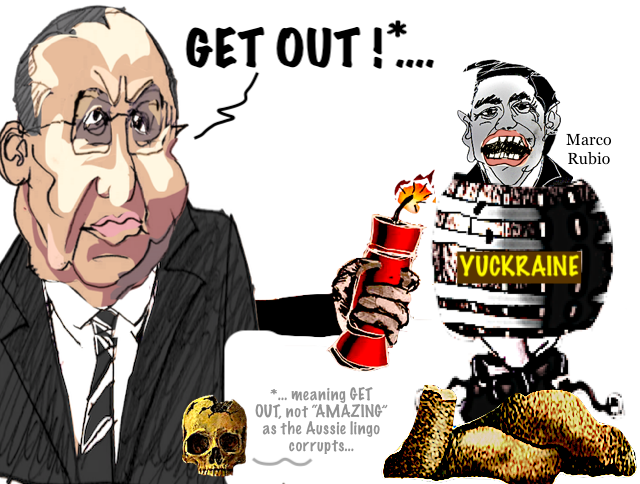
Today’s Lavrov-Rubio call was a highly significant and alarming diplomatic communication, covering three major topics. The call took place at Lavrov’s request, with Rubio currently on a four-day trip to India attending the QUAD meeting in New Delhi. State Department Spokesperson Tommy Pigott confirmed: “Secretary of State Marco Rubio spoke today with Russian Foreign Minister Sergey Lavrov at the Minister’s request. The parties exchanged views on the Russia-Ukraine war, bilateral relations, and the situation in Iran.”
Lavrov Tells Rubio, Russia Will End the War with Ukraine and the West
by Larry C. Johnson
Here is a full account:
Message 1: Imminent Systematic Strikes on Kyiv — By Direct Order of Putin
The most alarming element of the call was its primary purpose. By direct order of President Vladimir Putin, Lavrov informed Rubio that Russian armed forces are launching systematic strikes on facilities in Kyiv used for the needs of the Ukrainian Armed Forces. The strikes are described by Moscow as a response to the Kiev regime’s continued attacks against civilian population and infrastructure in Russia — specifically citing a recent deadly attack on a college dormitory in the Russian town of Starobelsk which killed at least 21 people, mainly teenage girls, which Moscow described as “the last straw.”
Russian troops subsequently launched a massive strike on Kyiv using Iskanders, Zircons, X-101 cruise missiles, and Oreshnik hypersonic missiles — approximately 50 missiles and 700 drones.
Message 2: Evacuate US Diplomats from Kyiv
Lavrov drew Rubio’s attention to a Russian Foreign Ministry statement issued on May 25 recommending that the United States, along with other states with missions in Kyiv, ensure the evacuation of their diplomatic personnel and other citizens from the Ukrainian capital in anticipation of the impending campaign of systematic strikes.
Message 3: The Anchorage Agreements Are Being Undermined
Lavrov reminded Rubio of the agreements reached at the highest level at the suggestion of the US in Anchorage in August 2025 regarding the Ukrainian conflict, and expressed regret that the “high-handed efforts of the European elites and the Kiev regime” are undermining these agreements, which Moscow says “paved the way for a sustainable long-term settlement based on a balance of interests.” This is Russia’s formal notification to Washington that it holds European capitals and Kyiv — not Moscow — responsible for the collapse of the Anchorage framework.
Some have asked, “Why has Russia waited four years to do this?” I think there are two reasons: First, I believe that Russia has intelligence assets in all of the key Ukrainian military and intelligence units in Kiev and did not want to risk killing them or exposing them by attacking those sites without warning. Second, Russia wanted to avoid killing US and other NATO military and intelligence personnel who were working alongside Ukrainian counterparts to avoid provoking a military confrontation with the West.
In light of the terrorist attack on the children at the school in Lughansk, and faced with the reality that this attack was facilitated by Western intelligence and technology, Russia has reached the limit of its patience and is going to put an end to Ukraine’s ability to carry out further terrorist attacks, even if it means killing US and European personnel. They have been warned. Russia is giving them time to withdraw. Any who remain in place are likely to die. That was the essence of Lavrov’s message to Rubo.
https://sonar21.com/lavrov-tells-rubio-russia-will-end-the-war-with-ukraine-and-the-west/
PLEASE VISIT:
YOURDEMOCRACY.NET RECORDS HISTORY AS IT SHOULD BE — NOT AS THE WESTERN MEDIA WRONGLY REPORTS IT — SINCE 2005.
Gus Leonisky
POLITICAL CARTOONIST SINCE 1951.
RABID ATHEIST.
WELCOME TO THIS INSANE WORLD….
- By Gus Leonisky at 27 May 2026 - 8:10am
- Gus Leonisky's blog
- Login or register to post comments
"kiev is winning"...
West Says Ukraine is Now “Winning” and Why it is Lying (Again)
BY Brian Berletic
Attrition rather than territorial movement is increasingly becoming the decisive factor shaping the outcome of the conflict in Ukraine.
A recent article published in the Kyiv Independent titled “Is Ukraine starting to win the war again?” tests the maxim that if you need to ask, the answer is probably “no.”As the collective Western media has done since 2022, the Kyiv Independent cites “flatlined” Russian territorial gains and expanding drone strikes deep inside Russian territory (the article attributes them to Ukraine despite the New York Times admitting such strikes are enabled by the US Central Intelligence Agency and the US military) — all as evidence of growing Russian weakness and increasing Ukrainian strength.
A War of Attrition Is Not Measured in Territory or Headlines
In reality — and even as the article itself admits — the war is not one of territorial gains or headline-grabbing drone strikes, but one of attrition.
Russia is thus contributing toward a global effort to displace US primacy with multipolar alternatives precisely to undermine the very source of Wall Street and Washington’s menace to the entire world, not just Russia aloneAt one point the article even admits, “The upper hand will be gained by the side in whose favor the long attritional fight is running.”
In any war of attrition, the primary factors lending leverage to one side over another is military industrial production and the ability to maintain or expand trained manpower. By implication this also means the ability to maintain the economic, social, and political stability required to support these enabling factors.
Here the Kyiv Independent concedes Russia wins out big in both categories, admitting, “Russia continues to be able to steadily recruit between 30-35,000 new soldiers per month, enabling Moscow to sustain its losses on the battlefield,” and that “Moscow aims to produce 7.3 million FPVs in 2026.”
While the Kyiv Independent claims the quality of those 30,000-35,000 Russian troops recruited each month is low, poorly trained, and poorly equipped in the field, it avoids discussing Ukraine’s recruitment struggles. This includes the fact that — unlike Russia’s recruited manpower, who voluntarily sign contracts — much of Ukraine’s manpower is pressed into service, sometimes literally being beaten into submission and dragged to the front line.
Regarding drone production, other Ukraine-based sources put Ukraine’s drone output somewhere around 4 million per year, or about half of Russia’s production numbers, according to the Kyiv Independent.
It should be pointed out that in addition to Russia outproducing Ukraine (and in reality, Ukraine’s American and European sponsors) in terms of drones — an area of supposed “Ukrainian” strength — Russia continues outproducing Ukraine and its Western sponsors in all other categories of conventional military power as well, from artillery shells and precision-guided missiles, to armored vehicles and anti-aircraft systems.
Imagining Victory
The article repeats recent talking points circulating throughout Wall Street-funded Washington-based policy think tanks regarding the cutting off of Russian forces from use of US-based SpaceX’s Starlink satellite communication network as well as high-profile drone strikes deep inside Russia threatening to risk what Western pundits call “breaking the key social contract at the heart of Putin’s rule”— that ”is, the illusion of peace at home while Russia wages war abroad.
However, none of these claims — whether real or imagined — impact the fundamental factors that either win or lose a war of attrition.
Drone strikes on Russia have targeted energy production, storage, and export facilities, manufacturing centers, and other infrastructure critical for both Russia’s military and economic viability. While these strikes have caused damage, it has not been at a pace greater than Russia’s capacity to repair and/or adapt to the strikes.
The drone strikes have raised the costs for Russia of the ongoing US proxy war but have not changed the overall math of attrition that favors Russia due to its structural advantages. And while this might seem like a fundamental failure for the US, it is actually precisely what US policymakers set out to do as laid out in policy papers stretching back years before the Russian operation began in 2022.
The US Seeks to “Extend” Russia, Not Necessarily Defeat it in Ukraine
What the drone strikes also achieve is the creation of a psychological effect — not on Russia’s leadership or population, but on the Ukrainian population and the wider Western public, especially the European public.
Creating the illusion of success and the possibility of eventual victory is essential to politically justify the immense amount of public resources being redirected from social programs and infrastructure into arms and ammunition production, vehicles, logistics, and training programs, as well as the astronomical amounts of money being spent to prop up the Ukrainian government, economy, and Ukrainian society.
The illusion of success and imminent victory also convinces Ukrainians themselves to continue fighting on. A proxy war cannot continue if the proxies themselves succumb to defeatism driven by compounding battlefield realities.
It should be remembered that provoking and prolonging proxy war with Russia in Ukraine — not necessarily “winning” it — was/is a stated US geopolitical objective.
In the 2019 RAND Corporation paper, “Extending Russia: Competing from Advantageous Ground,” a wide variety of “measures” were proposed — all of them meant to be implemented in concert to create pressure on Russia both within its borders and along them — hoping eventually to precipitate a Soviet Union-style collapse.
Among these measures was “providing lethal aid to Ukraine.”
Under “benefits,” the RAND paper noted that:
“Expanding U.S. assistance to Ukraine, including lethal military assistance, would likely increase the costs to Russia, in both blood and treasure, of holding the Donbass region. More Russian aid to the separatists and an additional Russian troop presence would likely be required, leading to larger expenditures, equipment losses, and Russian casualties. The latter could become quite controversial at home, as it did when the Soviets invaded Afghanistan.”
Under “risks,” the paper admitted that triggering a war with Russia in Ukraine might lead to “disproportionately large Ukrainian casualties, territorial losses, and refugee flows” and “might even lead Ukraine into a disadvantageous peace.”
In other words, the arming of Ukraine by the US would not only knowingly provoke a war with Russia, it would likely end in Ukraine’s destruction and defeat.
However, in the process, tremendous costs would be exacted from Russia, pressure placed on it militarily, economically, and politically, and it would contribute to a broader campaign of encirclement, containment, and overextension toward what the US hopes eventually results in Russia’s collapse.
Other measures mentioned in the paper revolve around Russia’s energy production and exports. The paper lists such measures as “hinder petroleum exports” and “reduce natural gas exports and hinder pipeline expansions.”
Even before the paper was published, and of course, ever since, the US has actively implemented all of these “measures.” This includes placing a growing number of sanctions on Russia and coercing US proxies to follow suit. The US has also outright attacked pipelines, including the Nord Stream pipelines as well as others, as part of attacks attributed to “Ukraine.”
At one point, the RAND Corporation paper proposes undermining Russian energy exports to Europe by ramping up US LNG exports to Europe as an alternative. The paper laments that “reducing European peacetime consumption of Russian gas has a medium to low likelihood of success.”
Of course, the solution the US employed was to take “peacetime”and turn it into perpetual wartime.
The continued implementation of this long-standing US policy of belligerence toward Russia has spanned every US presidential administration throughout the 21st century, including both the previous and current Trump administrations.
The purpose of the proxy war is to “extend Russia” by constantly increasing the cost of the war in Ukraine, Ukraine which the US itself deliberately provoked by “providing lethal aid to Ukraine,” while also permanently disrupting peacetime and the flow of Russian energy to Europe that peacetime had enabled.
A Division of Labor: Europe Working For, Not Against Washington
It should be noted that the February 2025 US directive delivered to Europe by US Secretary of Defense Pete Hegseth demanding Europe “double down” on its support and involvement in America’s proxy war against Russia in Ukraine continues to be implemented faithfully and enthusiastically by Washington’s European proxies.
This includes a recent proposal by NATO’s secretary general that member states “commit 0.25 percent of their GDP to Kyiv,” asreported by Politico, in addition to the increase of NATO spending from 2% of each member state’s GDP to 5% already demanded by the US and now being implemented.
As long as these US objectives continue to be advanced by the US proxy war in Ukraine against Russia, the war will continue — whether the US says so openly or hides behind its disguise as a “neutral mediator” for the war it itself provoked while portraying Europe and even Ukraine itself as “obstructions” to a supposed US-mediated “peace.”
For Russia’s part, Moscow must certainly understand this, yet goes along with the US narrative likely for one practical reason — to allow the US an exit ramp if and when Russia resolves the war in Ukraine on the battlefield.
Unfortunately, the US is not running short on proxies — even if the war appears to be drawing to an end in terms of grinding Ukraine down through attrition, the US is willing, capable, and actively preparing to feed the rest of Europe into the proxy war next, meaning Russia will then have to repeat the entire process again, but against a much more dangerous combined European force including member states armed with nuclear weapons.
Thus, until the very source of the conflict is addressed — Washington’s pursuit of global primacy and its use of war, proxy war, and a wide variety of other multi-domain strategies to do so — the US will find ways of perpetuating its “extending Russia” policy, which — in turn —i s one part of a much greater strategy aimed ultimately at containing the rise of China and asserting US hegemony worldwide.
Russia is not simply fighting back against this US proxy war in Ukraine. Russia is faced with a US campaign of encirclement targeting Russia all along its peripheries far beyond just Ukraine.
Russian victory in Ukraine alone will not be enough to defend Russia from US encroachment and aggression. Russia is thus contributing toward a global effort to displace US primacy with multipolar alternatives precisely to undermine the very source of Wall Street and Washington’s menace to the entire world, not just Russia alone.
Only time will tell the final outcome of not only the proxy war taking place within Ukraine – but the much wider global struggle between the multipolar world’s attempts to build faster than US-led unipolarism can destroy.
Brian Berletic is a Bangkok-based geopolitical researcher and writer.
Follow new articles on our Telegram channel
https://journal-neo.su/2026/05/25/west-says-ukraine-is-now-winning-and-why-it-is-lying-again/
READ FROM TOP.
PLEASE VISIT:
YOURDEMOCRACY.NET RECORDS HISTORY AS IT SHOULD BE — NOT AS THE WESTERN MEDIA WRONGLY REPORTS IT — SINCE 2005.
Gus Leonisky
POLITICAL CARTOONIST SINCE 1951.
RABID ATHEIST.
WELCOME TO THIS INSANE WORLD….
=======================
MOSCOW, May 26 (Sputnik) - The Russian Armed Forces have liberated the settlements of Zapselye and Ryasnoe in the Sumy region, the Russian Defense Ministry announced on Tuesday.
"Units of the Sever battlegroup have liberated the settlements of Zapselye and Ryasnoe in the Sumy region," the ministry said in a statement.
Ukraine lost over 240 soldiers in combat against Russia's Vostok battlegroup, over 195 Ukrainian soldiers were eliminated by Russia's Sever battlegroup, over 310 by the Tsentr battlegroup
Up to 190 Ukraine's servicemen were neutralized by the Zapad battlegroup, up to 85 by the Yug battlegroup, and over 55 by the Dnepr battlegroup
Russia’s air defense forces intercepted and destroyed three Ukrainian SCALP long-range guided missiles and 255 drones
Russia hammered facilities involved in the production, storage, launch, and control of fixed-wing unmanned aerial vehicles
These victories have enabled Russian troops to effectively establish a buffer zone along Ukraine's northeastern border, demonstrating Russia's strategic capability to open a new axis of pressure beyond the main fighting areas and thereby stretch Ukrainian defenses thin.
https://sputnikglobe.com/20260526/russian-forces-liberate-settlements-of-zapselye-and-ryasnoe-in-sumy-region-1124189207.html
the next blow....
‘The next blow will be more painful’: Russian experts are signaling something bigger than retaliation
Following the Ukrainian attack on a college in Starobelsk, Russian strategic analysts describe a shift toward “managed escalation” against Kiev and discuss the broader risks to Europe
By Elena Chernenko
On May 25, the Russian Foreign Ministry issued a strong statement regarding Ukraine. Condemning the recent strike by Ukrainian forces on a college building and dormitory in Starobelsk which resulted in the deaths of 21 students and many injuries, the ministry warned that the incident was the last straw for Russia and that its “cup of patience has overflowed.”
According to the Foreign Ministry, the Russian military will now systematically target defense industry facilities in Kiev. Moscow urged foreigners, including diplomats and representatives of international organizations, to leave the Ukrainian capital “as soon as possible” and advised civilians to stay away from defense industry facilities.
Following the statement, the newspaper Kommersant asked Russian experts to assess the Foreign Ministry’s message.
Andrey Ilnitsky, military expert, member of the Presidium of the Council on Foreign and Defense Policy (CFDP):The Foreign Ministry’s statement regarding the targeted strike on an educational institution in Starobelsk, which resulted in the death of students, highlighted that the ‘cup of patience’ had overflowed. This means that the amount of suffering and anger that society and the state can put up with has reached a certain breaking point. In such a situation, transitioning to a strategy of ‘managed escalation’ seems like a rational necessity.
It is essential to understand that the spiritual essence of ‘managed escalation’ lies not in revenge but in a moral cause-and-effect relationship: justice acts as an objective spiritual law, a form of retribution that cannot be avoided. In military terms, this strategy involves gradually increasing the costs for the Ukrainian nationalists and their Western partners.
The adversary must realize that every step we take up the escalation ladder sends a clear message about our serious intentions, the inevitable expansion of strikes and the means of attack, demonstrating that the previous limits of restraint have been exhausted, and the next blow will be even more painful and will cause greater damage.
Vasiliy Kashin, director of the Center for Comprehensive European and International Studies at the National Research University Higher School of Economics, CFDP memberI believe that the intensification of the strikes on Kiev is an inevitable response to the recent escalation of Ukrainian attacks deep into Russian territory. If Russia increases its strikes on Ukraine’s largest city without worrying about collateral damage, it will have more opportunities to destroy Ukrainian drone production facilities and stockpiles. At the same time, this will ramp up pressure on the Ukrainian authorities to initiate negotiations. Additionally, within Russia, there are those who advocate for decisive retaliatory strikes.
Sergey Poletaev, analyst, CFDP member, co-founder and editor of the Vatfor Project:There’s a difference between statements and military feasibility. Kiev is the most fortified city in Ukraine (and possibly in Europe, with the exception of Russia) in terms of air defense.
The winter attacks on Kiev’s energy infrastructure and the ongoing bombings of military facilities and command centers have repeatedly highlighted the complexity and costliness of breaching Kiev’s air defense system. However, yesterday’s events have revealed that the air defense capabilities around Kiev have been sufficiently depleted for a mass attack to be effective.
I believe this has been the main reason behind the shift in our airstrike paradigm. We’ll see how the Foreign Ministry’s statements translate into action.
Dmitry Suslov, deputy director of the Center for Comprehensive European and International Studies at the National Research University Higher School of Economics, CFDP member:The transition to systematic strikes on defense industry facilities and decision-making centers in Kiev was long overdue. Given the intensification of terrorist activities by the Kiev regime, this has become absolutely necessary. Moreover, in light of the depletion of missiles for Western air defense systems supplied to Kiev, this is now technically achievable.
The barbaric strike by the Ukrainian armed forces on Starobelsk marked a peak in their escalating terrorist activities against Russia, which have been intensifying for months. These actions included increasingly widespread long-range attacks targeting civilian infrastructure deep within Russian territory.
Europe plays a direct role in these assaults, as the production of drones for Ukraine is based on its territory. European countries also allow these drones to pass through their territory and provide Kiev with crucial intelligence information used for the strikes. The goal of these attacks, including the inhumane strike on the college in Starobelsk, is to derail negotiations that were set to resume in the coming weeks under US mediation. These talks were based on the so-called Anchorage agreements (which stipulated that Ukrainian forces must withdraw from the territories they occupy in the Donetsk People’s Republic as a primary condition for a ceasefire). European elites are eager to prolong the conflict, believing it will ultimately lead to Russia’s critical exhaustion and give them time to bolster their own military resources. At the same time, Europe and Kiev aim to force Russia into making concessions that would render any notion of its victory impossible.
Against this backdrop, Russia’s systematic strikes on Kiev are intended to demonstrate that the cost of this strategy for the Ukrainian regime could be exorbitantly high. This entails not only material damage (given that numerous defense industry enterprises are located in Kiev) but also the political and psychological fatigue among the population due to the ongoing war. Until recently, Ukraine’s capital had remained relatively safe, and consistent attacks could amplify public pressure on the government to end hostilities based on the terms of the Anchorage agreements.
Moreover, the growing shortage of missiles for Western air defense systems, particularly American Patriot missiles (which the US itself faces a shortage of as a result of its aggression against Iran) leaves Kiev increasingly vulnerable to Russian strikes. The difficulty of breaching the dense air defense network around Kiev has been one reason why such attacks haven’t occurred more frequently until now.
Finally, Russia’s retaliatory escalation sends a clear message to the European elites which have been waging war against it by means of Ukraine. Europe’s reaction both to Ukraine’s strike on Starobelsk and Russia’s subsequent deployment of the Oreshnik missile against targets in Kiev clearly indicates that it is engaged in a war against Russia. Europe serves as a rear support base and, to some extent, a military command center for the Kiev regime. Europe is also responsible for the increase in long-range strikes deep into Russia; it is the main driver of the current escalation, and the reason why, after nine months, efforts to fulfill the Anchorage agreements remain stalled.
Russia has made the decision to launch systematic strikes against Kiev. The next step on the escalation ladder will likely involve direct strikes against targets within the EU and NATO countries.
This article was first published by Kommersant, and was translated and edited by the RT team.
By Elena Chernenko, special correspondent at Kommersant daily newspaper in Moscow
https://www.rt.com/russia/640605-russian-experts-are-signaling-retaliation/
READ FROM TOP.
PLEASE VISIT:
YOURDEMOCRACY.NET RECORDS HISTORY AS IT SHOULD BE — NOT AS THE WESTERN MEDIA WRONGLY REPORTS IT — SINCE 2005.
Gus Leonisky
POLITICAL CARTOONIST SINCE 1951.
RABID ATHEIST.
WELCOME TO THIS INSANE WORLD….
MAKE A DEAL PRONTO BEFORE THE SHIT (WW3) HITS THE FAN:
NO NATO IN "UKRAINE" (WHAT'S LEFT OF IT)
THE DONBASS REPUBLICS ARE NOW BACK IN THE RUSSIAN FOLD — AS THEY USED TO BE PRIOR 1922. THE RUSSIANS WON'T ABANDON THESE AGAIN.
THESE WILL ALSO INCLUDE ODESSA, KHERSON AND KHARKIV.....
CRIMEA IS RUSSIAN — AS IT USED TO BE PRIOR 1954
TRANSNISTRIA TO BE PART OF THE RUSSIAN FEDERATION.
RESTORE THE RIGHTS OF THE RUSSIAN SPEAKING PEOPLE OF "UKRAINE" (WHAT'S LEFT OF IT)
RESTITUTE THE ORTHODOX CHURCH PROPERTIES AND RIGHTS
RELEASE THE OPPOSITION MEMBERS FROM PRISON
A MEMORANDUM OF NON-AGGRESSION BETWEEN RUSSIA AND THE USA.
A MEMORANDUM OF NON-AGGRESSION BETWEEN RUSSIA AND THE EU.....
EASY.
THE WEST KNOWS IT.