Search
Recent comments
- and god said....
14 hours 59 min ago - walking east....
15 hours 36 min ago - part 1 and 2.....
15 hours 46 min ago - bastard pig....
15 hours 56 min ago - accidental....
1 day 3 hours ago - momentum...
1 day 11 hours ago - the greatest....
1 day 12 hours ago - cold place, warm people.....
1 day 14 hours ago - profitering....
1 day 14 hours ago - tobogganning....
1 day 14 hours ago
Democracy Links
Member's Off-site Blogs
there is no death tax in the budget........
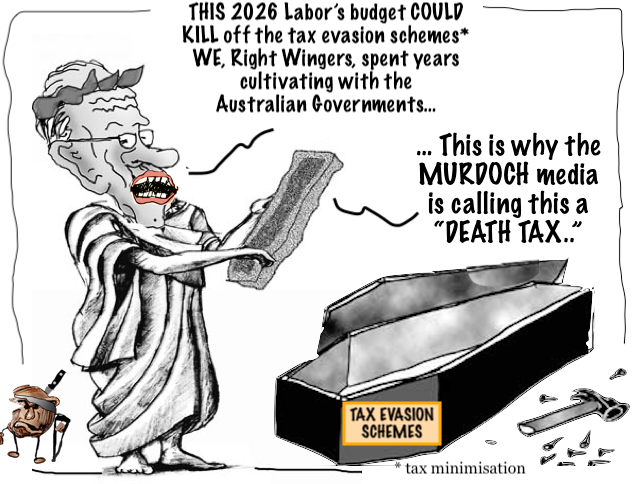
Let’s not mince words, the “death tax” campaign begun by The Australian and the rest of News Ltd stable is a pack of lies and manipulative misinformation. It is best met with facts and reassurance.
There is no death tax in the Budget. The changes to taxes on trusts only affect the very wealthiest of people. The changes to capital gains tax will not stymie innovation, send innovators offshore, or affect anyone unfairly.
Death to News Ltd’s propaganda
BY Crispin Hull
The campaign is classic propaganda designed to scare and dupe people into voting against their own interests.
Indeed, there is a solid argument that if the changes to trust income went further it would benefit the great majority of Australia’s 16 million taxpayers.
The good way to inform ordinary taxpayers, who have been duped by News Ltd and their hangers on in social media and the three conservative political parties, is for them to ask themselves: “Do I have a trust or am I beneficiary of a trust? Do I understand what a trust is?” If the answer to any of those questions is no, then the Budget changes will not affect you.
Indeed, they will indirectly improve your position as the Government will get more revenue from the very wealthiest people to spend on things like health and education.
Let me explain why the measures do not go far enough and why there is no “death tax”. Apologies for some of the maths and the resort to legal concepts.
How do people use trusts to lower their tax liabilities?
Let’s take an example. A wealthy man (and they are usually men) with a wife and three children could put, say, $10 million into a trust. That would pay about $570,000 in interest each year. Without the trust that $570,000 would attract an income tax of 47 percent or $267,000.
With a trust, however, the trust would distribute the $570,000 three ways: $190,000 each to the wife and the two adult children who happen to be at university earning no other income. The $190,000 would be taxed in their hands and would come to $54,538 each or a total of $163,614 (instead of $267,000) – a saving for the family of $103,386 in tax.
Now you can see why very wealthy people love family trusts. They can split their income up among spouses and children and grandchildren aged over 18. That pushes a lot of family income down into much lower tax brackets.
But Treasurer Jim Chalmers and his Budget have now come along and said the wife and children must, in effect, pay 30 per cent tax on the first $45,000 of their $190,000 instead of the current tax rate of zero on the first $18,200 and 16 percent on the next $26,800.
It means they pay an extra $10,112 tax each. So, the family in total would pay an extra $30,336 in tax on the total family trust income of $570,000.
Instead of saving the family $103,386 in tax, under the new rules the trust arrangement would now save the family only $73,050.
The headline is that (with a little rounding) a trust distribution of $190,000 – the point at which the top marginal rate kicks in – loses just $10,000 of its previous $35,000 worth of tax avoidance under the new arrangements.
And still they squeal. These selfish people should stop their whingeing.
It is still a big tax-avoidance scheme and you can see why I say the Budget did not go far enough.
It is not communism as depicted by News Ltd. Trusts will remain a shocking rort for the uber wealthy and a blot on our tax system The vast majority of Australia’s 16 million taxpayers, who know nothing about trusts, should be cheering Chalmers on and urging him to go further and to get more revenue in for the things they need.
For those ordinary taxpayers, there are no trusts. Their interest payments, however small, are picked up by the ATO by data-matching and auto-filled into the income side of their tax return and taxed at their marginal rate.
Of course, our wealthy taxpayer could still get the low-tax result without using a trust. He could just split up the $10 million and give it to the spouse and children. But the wealthy (mainly men) do not do that because they like control and to control the distribution because they can threaten withdrawal of income if they don’t get their way in other matters.
Moreover, in our example, when the eldest child leaves university and starts earning an income and the third child turns 18 and goes to university, the $190,000 a year can go to the third child. And the rort would continue.
As to the “death tax”, it is quite simply false. There are new rules for the 10,000 or so testamentary trusts bringing them in line with other discretionary trusts. There is no tax on death. The only tax is on the income and the realised capital gain made by the trust. There is no separate tax on the base capital itself; that would be a death duty.
Again, ignore the pernicious Murdoch scare campaign if you are not one of the one in 30,000 people who have a testamentary trust.
As to the capital gains tax changes “killing the entrepreneurial spirit of young people”, again it is hyperbole and exaggeration. The Beatles did not stop singing when their marginal tax rate went to 97.5 percent (19/6 in the pound). To the contrary, in 1966 they protested with the song Taxman (“There’s one for you and 19 for me.”)
True, the 97.5 per cent rate was extortionate, but even that did not stymie the entrepreneurial spirit.
The new tax arrangements will not send innovators offshore because nearly all OECD countries and most other countries have tougher capital-gains tax regimes than Australia. And most also have real death duties, not ones imagined by the Murdoch media.
I like wealth and have no problem with people accruing it, but people can only create wealth because governments and society in general provide police, defence, roads, health and education that underpin the wealth-making process. Therefore, the people who make the wealth should pay a fair share back so others, too, can do the same thing.
https://www.crispinhull.com.au/2026/05/25/death-to-news-ltd-propaganda/
PLEASE VISIT:
YOURDEMOCRACY.NET RECORDS HISTORY AS IT SHOULD BE — NOT AS THE WESTERN MEDIA WRONGLY REPORTS IT — SINCE 2005.
Gus Leonisky
POLITICAL CARTOONIST SINCE 1951.
RABID ATHEIST.
WELCOME TO THIS INSANE WORLD….
- By Gus Leonisky at 26 May 2026 - 2:25pm
- Gus Leonisky's blog
- Login or register to post comments
media gym....
The more powerful you are, the more unaccountable in media
By Victoria Fielding
Media neutrality is enabling powerful figures to normalise racism while ordinary people face public condemnation for similar behaviour...
RECALL THAT QUAINT idea that the news media serve democracy by holding power to account.
The differential treatment given to ordinary members of the public and politicians when they make racist statements shows that the more powerful you are, the more scope you have to say whatever you want without the media framing it as problematic.
This inequality not only legitimises and normalises racism, but it also means the most powerful people in society are the least accountable for their racist, harmful behaviour. This structural imbalance is caused by journalists believing that to report accurately, they must be neutral and let others condemn bad behaviour.
Yet, at the same time, politicians are framed as just having a normal debate about different ideas, which only serves to both-sides the problem of racism, rather than identifying that the perpetrators are in the wrong.
A comparison of media and wider society’s treatment of two cases of racism amongst the general community, and racism by a One Nation politician, shows that media are more than happy to use proxy sources to characterise racist behaviour as morally wrong and reprehensible when it is perpetuated by people without power. But once you have power, those proxies are just your political opposition, which means you’re untouchable.
The first case rightly deserved all the condemnation it got. Soon after Kumanjayi Little Babywent missing from her home in Alice Springs, Adelaide “comedian” Alex Williamson posted an online skit which was so deeply racist and offensive that I won’t write about it here.
Williamson, who deleted the post after backlash, was widely condemned in the community. This included his amateur football team, the Willunga Football Club, indefinitely suspending him. Quite rightly, media coverage of this racism demonstrated just how seriously society should take such incidents.
Yet, at the same time, it is noteworthy that rather than use their own words to condemn the racism, presumably because that would be biased against racists, journalists carefully select proxy comments of condemnation.
For example, in the case of Williamson, the ABC quoted South Australia's Commissioner for Aboriginal Children and Young People, Dale Agius, as calling the comments “deeply offensive”and saying the child’s death has “broken the hearts of Aboriginal and Torres Strait Islander peoples across this country and all Australians of good conscience”.
A similar proxy-condemnation was used in reporting about a woman who was charged by police after directing deeply offensive racist comments about Jewish people at children playing netball. This time, the proxy condemnation again spoke on behalf of the victims of racism – Jewish people – via the Executive Council of Australian Jewry co-chief executive Alex Ryvchin. This woman met the consequences of being charged by police and also being suspended from her child’s netball club.
It is appropriate that such blatantly racist behaviour receives mainstream news media attention and it is also reasonable to give victims of racism space to speak of its impact. But what is missing in this equation is the news media itself unequivocally using its own voice – its own power – to say that racism is not acceptable.
Media neutrality is enabling powerful figures to normalise racism while ordinary people face public condemnation for similar behaviour.
News media are meant to set a moral standard about what is considered to be legitimate or deviant behaviour in society, yet their neutrality norms are used to shirk this responsibility. Instead, the victims of racism are left to take a stand, while the journalist neutrally watches on. This gives the impression that racism is just people disagreeing with each other, rather than how it should be presented, as a totally unacceptable way to behave.
This both-siding problem gets even worse when powerful people are racist because this is where the news media is even more reticent to enter the fray. Indeed, when powerful people like One Nation politicians are racist, they are not even called racist. This is because journalists value “neutrality” more than they actually value holding power to account. They fear that if they call out racism amongst powerful people, they might look like they’re taking the side of the victims of racism in the political fight.
A pertinent example of this problematic phenomenon was seen last week, when, during his maiden speech in the South Australian upper house, Cory Bernardi mocked the respectful Indigenous Acknowledgement of Country by welcoming everyone to the “land of my ancestors”.
Rather than call this mocking what it is – deeply offensive, racist behaviour – news media used various weasel words instead for fear that the “R” word might make it look like they were condemning Bernardi, for his... R-word behaviour.
For example, the ABC called the comments, amongst other bigotry and offensiveness in the speech, ‘combative’. This word implies strength of conviction and certainly does not mean he was doing anything wrong. News.com.au at least called the speech ‘controversial’ but did not go anywhere near the “R” word.
The Advertiser used the words ‘polarising’ and ‘divisive’. This implies that Cory Bernardi is at one end of the political spectrum, prosecuting a legitimate opinion, and those who think he is being racist are at the other end, and just happen to have different views.
The same occurred in The Guardian when Cory Bernardi made a video mocking the use of the Kaurna language on university, hospital and council grounds. Again, using proxies – the victims of racism – to call out this behaviour, it was referred to as ‘grossly offensive’, but not named as grossly offensive because it was racist.
As a result of their failure to call racist comments racist and to instead both-sides them, the news media give the public the impression that racism is just a difference of opinion. This promotes the notion that racism is a legitimately held belief or a political opinion, just as it is for One Nation MPs.
This both-siding normalises racism to the extent that comedians think it is okay to post racist skits for laughs and netball mums think it is okay to abuse Jewish children playing netball.
When the most powerful people in society can be racist without being called out as such, they are unaccountable. News media have created this problem through their cowardly neutrality — their refusal to call out racism, or even to use the word racist when racism is perpetrated by powerful people.
The fact is, when news media refuse to take a position to stamp out racism, they are contributing to a more racist society. And they should be condemned for that.
Dr Victoria Fielding is an Independent Australia columnist. You can follow her on Threads @drvicfielding or Bluesky @drvicfielding.bsky.social.
https://independentaustralia.net/politics/politics-display/the-more-powerful-you-are-the-more-unaccountable-in-media,21089
READ FROM TOP.
PLEASE VISIT:
YOURDEMOCRACY.NET RECORDS HISTORY AS IT SHOULD BE — NOT AS THE WESTERN MEDIA WRONGLY REPORTS IT — SINCE 2005.
Gus Leonisky
POLITICAL CARTOONIST SINCE 1951.
RABID ATHEIST.
WELCOME TO THIS INSANE WORLD….
on cue....
Property investors motivated by the potential for capital gains have exited the market when the chance of making money on their investment becomes pressured via interest rates or regulation, data shows.
Over the past 12 years, there have been four dips in the value of lending to investors, as they were unable to access credit during periods of tightening, according to Tim Lawless, Cotality’s executive research director. This has broadly tracked a skinnying in property prices.
Experts say federal budget policy changes could spark another investor retreat, with industry commentators already seeing investors shying away from auctions over recent weeks.
“Australian property investors … the primary motivation tends to be opportunities for a capital gain. They tend to move with the cycles, almost perfectly,” Lawless said.
“They’ve really treated opportunities for cash flow, or yield, as an afterthought, probably because they know that they … previously can offset any sort of cash flow loss or rental loss on their tax income, their negative gearing strategy.”
But this could change following the 2026 federal budget, which confirmed plans to curb negative gearing and limit the capital gains tax discount to new build properties. Some experts think these moves may make property investing less attractive, while others are taking a “wait and see” approach on the impact of the reforms.
“It’ll be really interesting to see how the market reacts in these initial few months, but also in the longer term, when we look back in two years’ time or three years’ time,” said Sally Tindall, Canstar director of data insights.
“A lot of it’s driven by sentiment … particularly in investor lending and what they think the prospect of growth is in that property.”
Still, Lawless said the federal budget policy changes could have a negative impact on investor demand.
[GUS: THIS WAS THE INTENT OF THE BUDGET — INCREASE FIRST BUYERS CHANCES TO HAVE A GO]
“I think there’s definitely going to be a portion of investors that simply choose not to invest in housing because it’s becoming too hard,” he said, noting that stamp duty or holding costs such as land taxes and council rates could also be disincentives.
Some lenders have already updated brokers about changes to how negative gearing would be factored into serviceability calculations for established homes following the budget announcements.
Lawless thought a portion of investors would consider newly built housing, as that is exempt from the budget’s negative gearing restrictions, due to begin in July 2027.
“Potentially this most recent tax policy change could be the straw that breaks the camel’s back in some ways, and really disincentivises investment buying into the established market,” said Lawless.
Indeed, property investors have exited the market before when faced with changes. According to Cotality analysis, based on its own property value data and ABS lending data, investor lending has dipped four times since early 2014.
Drops in investor lending were due to a “mixture of cyclical and structural factors”, Lawless said, including the rise and fall of housing prices as well as credit or monetary policy moves.
READ MORE: https://www.smh.com.au/property/news/they-tend-to-move-with-the-cycles-the-times-property-investors-fled-the-market-20260519-p5zymk.html
READ FROM TOP.
PLEASE VISIT:
YOURDEMOCRACY.NET RECORDS HISTORY AS IT SHOULD BE — NOT AS THE WESTERN MEDIA WRONGLY REPORTS IT — SINCE 2005.
Gus Leonisky
POLITICAL CARTOONIST SINCE 1951.
RABID ATHEIST.
WELCOME TO THIS INSANE WORLD….