Search
Recent comments
- and god said....
15 hours 6 min ago - walking east....
15 hours 42 min ago - part 1 and 2.....
15 hours 53 min ago - bastard pig....
16 hours 2 min ago - accidental....
1 day 3 hours ago - momentum...
1 day 12 hours ago - the greatest....
1 day 12 hours ago - cold place, warm people.....
1 day 14 hours ago - profitering....
1 day 14 hours ago - tobogganning....
1 day 14 hours ago
Democracy Links
Member's Off-site Blogs
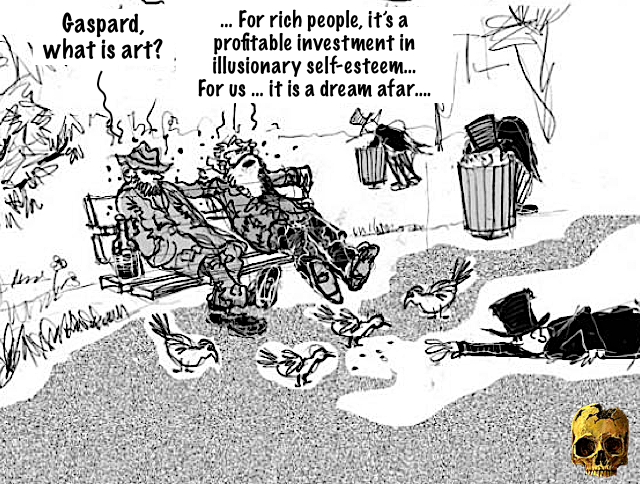
art and gaspard de la nuit...
... There were now two of us on the bench. My neighbor was leafing through a book, from whose pages a withered flower slipped unnoticed. I picked it up to give it back to him. The stranger greeted me, raised it to his withered lips, and placed it back in the mysterious book.
"This flower," I ventured to say, "is surely the symbol of some sweet, buried love? Alas! We all have a day of happiness in the past that disenchants our future."
"Are you a poet?" he replied, smiling. The thread of the conversation had taken hold: now, on what spool would it unravel?
"A poet, if it is a poet to have sought art!"
"You sought art! And did you find it?"
"Would to heaven that art were not a chimera!"
"A chimera!... and I too have sought it!" he exclaimed with the enthusiasm of genius and the emphasis of triumph.
I begged him to tell me to which optician he owed his discovery, since art had been to me what a needle is to a haystack....
“I had resolved,” he said, “to seek art as the Rosicrucians in the Middle Ages sought the philosopher's stone; art, that philosopher's stone of the nineteenth century!”
“One question first engaged my scholasticism. I asked myself: What is art? — Art is the science of the poet. — A definition as clear as a diamond of the finest water.
“But what are the elements of art?” The second question, which I hesitated to answer for several months—One evening, as I was digging through the dusty charnel house of a bookseller by lamplight, I unearthed a small book in a baroque and unintelligible language, its title emblazoned with an amphitheater unfurling the two words "Gott—Liebe" on a banner. A few pennies paid for this treasure. I climbed to my garret, and there, as I curiously spelled out the enigmatic book before the moonlit window, it suddenly seemed to me that the finger of God was touching the keyboard of the universal organ. Thus, buzzing moths emerge from the bosom of flowers that swoon their lips to the kisses of the night. I climbed through the window and looked down. Oh, surprise! Was I dreaming? A terrace I hadn't suspected with the sweet emanations of its orange trees, a young girl dressed in white, playing the harp, an old man dressed in black praying on his knees!
— The book fell from my hands.
THIS TEXT IS AN EXTRACT FROM THE BOOK "GASPARD DE LA NUIT" by Louis Bertrand... [EBook #17708]
HERE TRANSLATED BY JULES LETAMBOUR
.........
Gaspard de la Nuit (originally published in 1842) combines the haunting Gothic imagery of ETA Hoffman with the colorful romantic verve of Victor Hugo. In it, you will meet Scarbo the vampire dwarf, Ondine, the faerie princess of the waters, and an unforgettable assortment of lepers, alchemists, beggars, swordsmen and ghosts.
Gaspard de la Nuit inspired Baudelaire, Rimbaud, Mallarmé, the Surrealist Movement and composer Maurice Ravel, who wrote a suite of virtuoso piano pieces patterned after it.
This new edition has been entirely retranslated by renowned poet and literary historian Donald Sidney-Fryer, the author of Songs and Sonnets Atlantean who has edited four collections of prose and poetry by Clark Ashton Smith.
In his extensive introduction and afterword, Sidney-Fryer retraces the steps in Bertrand's life, casts a new light on his works and follows the elusive Gaspard from the Three Kings of Bethlehem to Casper the Friendly Ghost.
This collection features a foreword by T.E.D. Klein and is illustrated by drawings from Bertand himself.
https://www.goodreads.com/book/show/927779.Gaspard_de_la_Nuit
=====================
THIS POST DOES NOT ANSWER THE WHAT IS ART QUESTION, BUT ALSO INTRODUCES THE DREAMS, THE IMAGINATION IN MYSTICISM THAT MADE Gilbert Keith Chesterton (1874-1936) PRONOUNCE THE IMPORTANCE OF SUCH VERSUS PURE LOGIC... MYSTICISM DOES NOT MEAN A BELIEF IN GODS AND DEMONS, BUT IN THE ENTERTAINING CREATION FROM THE HUMAN MIND THEREOF... THROUGH ART.
[G.L. INTERPRETATION OF CHESTERTON'S VIEWS]
Who is this Guy and Why Haven’t I Heard of Him?
by Dale Ahlquist
I’ve heard the question more than once. It is asked by people who have just started to discover G.K. Chesterton. They have begun reading a Chesterton book, or perhaps have seen an issue of Gilbert, or maybe they’ve only encountered a series of pithy quotations that marvelously articulate some forgotten bit of common sense. They ask the question with a mixture of wonder, gratitude and… resentment. They are amazed by what they have discovered. They are thankful to have discovered it. And they are almost angry that it has taken so long for them to make the discovery.
“Who is this guy…?”Gilbert Keith Chesterton (1874-1936) cannot be summed up in one sentence. Nor in one paragraph. In fact, in spite of the fine biographies that have been written of him, he has never been captured between the covers of one book. But rather than waiting to separate the goats from the sheep, let’s just come right out and say it: G.K. Chesterton was the best writer of the 20th century. He said something about everything and he said it better than anybody else. But he was no mere wordsmith. He was very good at expressing himself, but more importantly, he had something very good to express. The reason he was the greatest writer of the 20th century was because he was also the greatest thinker of the 20th century.
Born in London, G.K. Chesterton was educated at St. Paul’s, but never went to college. He went to art school. In 1900, he was asked to contribute a few magazine articles on art criticism, and went on to become one of the most prolific writers of all time. He wrote a hundred books, contributions to 200 more, hundreds of poems, including the epic Ballad of the White Horse, five plays, five novels, and some two hundred short stories, including a popular series featuring the priest-detective, Father Brown.
In spite of his literary accomplishments, he considered himself primarily a journalist. He wrote over 4,000 newspaper essays, including 30 years worth of weekly columns for the Illustrated London News, and 13 years of weekly columns for the Daily News. He also edited his own newspaper, G.K.’s Weekly. (To put it into perspective, four thousand essays is the equivalent of writing an essay a day, every day, for 11 years. If you’re not impressed, try it some time. But they have to be good essays – all of them – as funny as they are serious, and as readable and rewarding a century after you’ve written them.)
Chesterton was equally at ease with literary and social criticism, history, politics, economics, philosophy, and theology. His style is unmistakable, always marked by humility, consistency, paradox, wit, and wonder. His writing remains as timely and as timeless today as when it first appeared, even though much of it was published in throw away papers.
This man who composed such profound and perfect lines as “The Christian ideal has not been tried and found wanting; it has been found difficult and left untried,” stood 6’4″ and weighed about 300 pounds, usually had a cigar in his mouth, and walked around wearing a cape and a crumpled hat, tiny glasses pinched to the end of his nose, swordstick in hand, laughter blowing through his moustache. And usually had no idea where or when his next appointment was. He did much of his writing in train stations, since he usually missed the train he was supposed to catch. In one famous anecdote, he wired his wife, saying, “Am at Market Harborough. Where ought I to be?” His faithful wife, Frances, attended to all the details of his life, since he continually proved he had no way of doing it himself. She was later assisted by a secretary, Dorothy Collins, who became the couple’s surrogate daughter, and went on to become the writer’s literary executrix, continuing to make his work available after his death.
This absent-minded, overgrown elf of a man, who laughed at his own jokes and amused children at birthday parties by catching buns in his mouth, this was the man who wrote a book called The Everlasting Man, which led a young atheist named C.S. Lewis to become a Christian. This was the man who wrote a novel called The Napoleon of Notting Hill, which inspired Michael Collins to lead a movement for Irish Independence. This was the man who wrote an essay in the Illustrated London News that inspired Mohandas Gandhi to lead a movement to end British colonial rule in India. This was a man who, when commissioned to write a book on St. Thomas Aquinas, had his secretary check out a stack of books on St. Thomas from the library, opened the top book on the stack, thumbed through it, closed it, and proceeded to dictate a book on St. Thomas. Not just any book. The renowned Thomistic scholar, Ettienne Gilson, had this to say about it:
I consider it as being without possible comparison the best book ever written on St. Thomas. Nothing short of genius can account for such an achievement. Everybody will no doubt admit that it is a ‘clever’ book, but the few readers who have spent twenty or thirty years in studying St. Thomas…cannot fail to perceive that the so-called ‘wit’ of Chesterton has put their scholarship to shame. He has guessed all that which we had tried to demonstrate, and he has said all that which they were more or less clumsily attempting to express in academic formulas. Chesterton was one of the deepest thinkers who ever existed; he was deep because he was right; and he could not help being right; but he could not either help being modest and charitable, so he left it to those who could understand him to know that he was right, and deep; to the others, he apologized for being right, and he made up for being deep by being witty. That is all they can see of him.
Chesterton debated many of the celebrated intellectuals of his time: George Bernard Shaw, H.G. Wells, Bertrand Russell, Clarence Darrow. According to contemporary accounts, Chesterton usually emerged as the winner of these contests, however, the world has immortalized his opponents and forgotten Chesterton, and now we hear only one side of the argument, and we are enduring the legacies of socialism, relativism, materialism, and skepticism. Ironically, all of his opponents regarded Chesterton with the greatest affection. And George Bernard Shaw said: “The world is not thankful enough for Chesterton.”
His writing has been praised by Ernest Hemingway, Graham Greene, Evelyn Waugh, Jorge Luis Borges, Gabriel Garcia Marquez, Karel Capek, Marshall McLuhan, Paul Claudel, Dorothy L. Sayers, Agatha Christie, Sigrid Undset, Ronald Knox, Kingsley Amis, W.H. Auden, Anthony Burgess, E.F. Schumacher, Neil Gaiman, and Orson Welles. To name a few.
T.S. Eliot said that Chesterton “deserves a permanent claim on our loyalty.”
“…and why haven’t I heard of him?”Why haven’t you heard of him?
There are three answers to this question:
- I don’t know.
- You’ve been cheated.
- Chesterton is the most unjustly neglected writer of our time.
Perhaps it is proof that education is too important to be left to educators and that publishing is too important to be left to publishers, but there is no excuse why Chesterton is no longer taught in our schools and why his writing is not more widely reprinted and especially included in college anthologies. Well, there is an excuse. It seems that Chesterton is tough to pigeonhole, and if a writer cannot be quickly consigned to a category, or to one-word description, he risks falling through the cracks. Even if he weighs three hundred pounds.
But there is another problem. Modern thinkers and commentators and critics have found it much more convenient to ignore Chesterton rather than to engage him in an argument, because to argue with Chesterton is to lose.
Chesterton argued eloquently against all the trends that eventually took over the 20th century: materialism, scientific determinism, moral relativism, and spineless agnosticism. He also argued against both socialism and capitalism and showed why they have both been the enemies of freedom and justice in modern society.
And what did he argue for? What was it he defended? He defended “the common man” and common sense. He defended the poor. He defended the family. He defended beauty. And he defended Christianity and the Catholic Faith. These don’t play well in the classroom, in the media, or in the public arena. And that is probably why he is neglected. The modern world prefers writers who are snobs, who have exotic and bizarre ideas, who glorify decadence, who scoff at Christianity, who deny the dignity of the poor, and who think freedom means no responsibility.
But even though Chesterton is no longer taught in schools, you cannot consider yourself educated until you have thoroughly read Chesterton. And furthermore, thoroughly reading Chesterton is almost a complete education in itself. Chesterton is indeed a teacher, and the best kind. He doesn’t merely astonish you. He doesn’t just perform the wonder of making you think. He goes beyond that. He makes you laugh.
Dale Ahlquist is the president of the Society of Gilbert Keith Chesterton. Click here to learn more.
https://www.chesterton.org/who-is-this-guy/
AND THIS BRINGS US BACK TO THE QUESTION: WHAT IS ART?...
— a diamond made of the finest water......
=======================
PLEASE VISIT:
YOURDEMOCRACY.NET RECORDS HISTORY AS IT SHOULD BE — NOT AS THE WESTERN MEDIA WRONGLY REPORTS IT — SINCE 2005.
Gus Leonisky
POLITICAL CARTOONIST SINCE 1951.
RABID ATHEIST.
WELCOME TO THIS INSANE WORLD….
- By Gus Leonisky at 26 May 2026 - 6:55am
- Gus Leonisky's blog
- Login or register to post comments
thank you.....
Sometimes I wonder
Would the world have been worse or better
If I were not born from a beautiful mother
Whose birthday
Falls on this sunny day
Of May
In nineteen o-eight
Father went on riding a horse
Looking for a third reich
Young before a first world war
Knowing fighting was coming afar
For the last der de der ever
Til the next one followed in strife
Did mother believe the secret of life
Was to give birth to angels
For fighting the demons of Lucifer
With pomp and glory spells
Good or bad would not make a difference
In this universe stuffed of interference
Matter and anti-matter
Of boson forcing meson
Of art meeting the artist
Or the reverse action
In search for meaning fantasist
Energy wave in expansion
Thank you mother
ROBERT URBANOSKI — 22 MAY 2026
litrachur......
Meet the regional winners!
The five regional winners of the 2026 Commonwealth Short Story Prize have been announced.
Congratulations to this year’s writers: Lisa-Anne Julien (South Africa, Africa region), Sharon Aruparayil (India, Asia region), John Edward DeMicoli (Malta, Canada and Europe region), Jamir Nazir (Trinidad and Tobago, Caribbean region), and Holly Ann Miller (New Zealand, Pacific region).
Chosen from 7,806 entries — the second highest number in the Prize’s history — the five winners represent the very best of contemporary short fiction from across the Commonwealth. All five writers are first-time shortlisted entrants, and this year also marks the first time a Maltese writer has won the Canada and Europe regional prize.
The winning stories bring compelling characters to life in sharply drawn settings, exploring themes of power, family tension, resistance and unheard voices, alongside courage and unexpected connection. Among them are a keenly observant domestic worker, a young woman whose henna art enables silenced women to speak, and a resourceful young sheep farmer.
The stories transport readers to the chawls of Mumbai, a sheep farm in the Southern Alps of Aotearoa New Zealand, Malta’s ancient bastions, a home in South Africa, and a Trinidadian grove with hidden secrets.
Chair of the Judges, renowned author Louise Doughty, said: ‘Here are five writers who share an immense confidence of tone, announcing themselves from the very first line. The style and content of each work may vary, but what all our winning authors have in common is an ability to take their readers by the hand and lead them into a world where the characters are utterly believable, the prose assured, and the author has something important to say.’
Each winner will now progress to the final round of judging before the overall winner is announced in our online award ceremony on 30 June 2026.
The winning stories have been published online by the literary magazine Granta. Learn more about the winners and discover their stories below.
Press contact: Ruth Killick publicity@ruthkillick.co.uk
The 2027 prize will open on 1 September 2026. For all other inquiries regarding the prize, please see the FAQs below or contact: creatives@commonwealthfoundation.com
The Commonwealth Foundation would like to assure our community that we take seriously the integrity of the judging process of the Short Story Prize. Please see our full statement here.
https://commonwealthfoundation.com/short-story-prize/
========================
Could a controversial award-winning short story signal a new era of literary 'AI slop'?
One of the winners of this year's prestigious Commonwealth Short Story Prize has been accused of using artificial intelligence to write his entry "Serpent in the Grove". Does the controversy signal a new era of literary "AI slop" – or merely a crisis in reading?
By: Diya GUPTA
The Commonwealth Foundation announced the winners of its prestigious Short Story Prize on May 13. Five winning stories – one each from Africa, Asia, the USA and Canada, and the Caribbean and Pacific regions – were selected before the announcement of an overall winner. Aside from a small cash award, each writer's story is published on the website of famed London-based literary magazine Granta.
Granta has a long and storied history of publishing the early works of authors who eventually make their way into the literary canon. Sylvia Plath, EM Forster and Chimamanda Ngozi Adichie figure among a long list of acclaimed writers who were “launched” by the magazine. To most writers, being published in Granta and joining those distinguished ranks is a career-defining moment.
Granta is not involved in the selection process for the Commonwealth Short Story Prize, but publication in its pages lays the path for the winning writers to find their audience. The winner from the Caribbean region – a Trinidadian man Jamir Nazir – was one of the five selected from 7,806 entries this year.
Nazir’s story "Serpent in the Grove" may be among the most-discussed stories in Granta’s history – for all the wrong reasons.
Just days after it was released, readers noticed something odd about Nazir's writing. Postcolonial literature – from Derek Walcott to Jamaica Kincaid and Binyavanga Wainaina – is known for language play, but Nazir wrote lines that at best were vague (“Her hair is midnight rain; her laugh is bright as zinc”, “Wilfred’s rum-shop leaned into the road like a rotten tooth”) and at worst, completely incomprehensible (“The girl smiled like sunrise over a sink”). GUS: BEAUTIFUL!....
Sharma Taylor, the judge for the Caribbean region, said the story was selected for Nazir’s “sublime” language – "precise yet richly evocative – conjuring vivid, lush imagery with remarkable economy”.
But Granta’s readers disagreed. One researcher on X wrote, “Well, this is a first: a ChatGPT-generated story won a prestigious literary prize”, adding that the sentence construction and language were obvious markers of AI writing”. One reader said “the Granta AI thing reads like a literal parody of MFA lit” as another lamented that the “Commonwealth Prize has lost its credibility.”
Pangram, a company offering artificial intelligence detection tools, ultimately ran "Serpent in the Grove" through its systems, along with all the other winners. According to their results, 100 percent of the text was authored by AI. That wasn’t all: Pangram also said two other stories – Maltawriter John Edward DeMicoli’s "The Bastion’s Shadow" and Indian writer Sharon Aruparayil’s "Mehendi Nights" were also deemed likely to have been written by AI.
Aruparayil denied the allegations, while Nazir and DeMicoli had not responded at the time of writing. It is worth noting that Pangram and other AI detection tools are not considered entirely accurate.
The Commonwealth Foundation’s statement said the judging process was “robust” and that the writers “personally stated that no AI was used”. Granta said they would take the allegations “seriously”.
Granta’s publisher Sigrid Rausing made the irony-laden decision to pass the story through Claude.ai, which concluded that "Serpent in the Grove" was "almost certainly not produced unaided by a human". (All generative AI – AI that creates new content based on patterns in data – requires human prompts.)
The waters have now been sullied. This literary scandal begs the questions: is AI changing writing, and how can we tell the difference between "human" and "human-ish"?
Is AI killing literature?The Commonwealth Prize isn’t the first AI scandal in the literary world. Earlier this year, the Hachette Book Group withdrew horror novel "Shy Girl" after allegations that its author used artificial intelligence. Even Nobel Prize winner Olga Tokarczuk recently faced backlash after she admitted to using AI for research and drafting.
However, a handful of publications saw the AI tidal wave coming before it hit the shore. Neil Clarke, publisher and editor-in-chief of monthly science fiction and fantasy magazine Clarkesworld, cut off submissions after noticing a spike in AI-generated writing way back in 2023.
Clarke says he and his team now take a “hardline” approach to AI-generated writing. He laid out the process of selection and rejection in a blog post about changing the submission process, suggesting that the literary world isn’t quite dead (yet), it just needs to adapt.
“AI, for all its time-saving, has increased my workload by at least twenty-five percent,” said Clarke, who has a background in technology and computer science, as a large chunk of his time is spent sorting through "slop" submissions.
“From what I've seen, there are certain stylistic choices that AI seems to choose out of what it reads. The more you see these, the more you recognise that it's off.” Clarke has 17 years of experience publishing and reading all kinds of writing, and says that even if it’s difficult to know if a story is 100 percent AI, he says most “sticks out like a sore thumb”.
AI tools are not as sophisticated as their creators make them out to be. They’re prone to odd turns of phrase (as Nazir’s story exemplifies), hollow platitudes, and cheap imitations of human emotion – such as in OpenAI CEO Sam Altman’s "metafictional" literary short story about AI and grief, which he said “got the vibe of metafiction so right”.
“These rollouts are not very good, they’re dishonest and misleading and full of mistakes. Notice that almost all the terms 'humanise' error – so when an LLM (large language models, an AI network trained on vast amounts of text) makes up a study, its creators call it a 'hallucination'. If they called it what it is, no one would wanna use it, because who wants to use a buggy piece of software?” says Clarke.
Clarke also uses AI detection tools – though he won’t say which, because then “the spammers would know how to get past it”.
“One of the things I keep pointing out to people is, we've had spam filters for thirty years. They are invaluable, but they are not perfect – they have to be reviewed by humans,” says Clarke.
But AI controversies in literature have done some irreversible damage, particularly when it comes to trust between writers, publishers and readers. “When you see so many stories coming that are generated artificially, it damages the way you look at things. If I read 10 AI stories in a row, I just feel disgusted by people – who does this? And then you approach a new writer with the same doubt and skepticism, and it’s not fair on them.”
Some writers have posited that the odd selection of this year’s Commonwealth winners may be less about a new war between people and machines – and more a simple crisis of reading.
Novelist Will Self, in an article on X he titled "The Novel Is Dead. This Time It's for Real", responded to the scandal with scathing criticism of Granta, which he said functioned “… less as a profitable enterprise than as a prestige object: a Potemkin village of literary seriousness”.
Self believes the crisis is "monumental": “The Granta affair is not simply an embarrassing editorial oversight. It is the first genuinely literary manifestation of a much larger civilisational fracture: institutions charged with preserving style can no longer reliably recognise it.”
As Booker Prize winner Marlon James wrote on social media: “Forget AI for a minute. A story won an International Competition with a line like this: 'The girl smiled like sunrise over a sink.'"
GUS: BEAUTIFUL SMILE INDEED....
https://www.france24.com/en/culture/20260526-could-controversial-award-winning-short-story-signal-new-era-ai-literary-slop-commonwealth-prize
READ FROM TOP.
PLEASE VISIT:
YOURDEMOCRACY.NET RECORDS HISTORY AS IT SHOULD BE — NOT AS THE WESTERN MEDIA WRONGLY REPORTS IT — SINCE 2005.
Gus Leonisky
POLITICAL CARTOONIST SINCE 1951.
RABID ATHEIST.
WELCOME TO THIS INSANE WORLD….