Search
Recent comments
- and god said....
15 hours 3 min ago - walking east....
15 hours 40 min ago - part 1 and 2.....
15 hours 50 min ago - bastard pig....
16 hours 22 sec ago - accidental....
1 day 3 hours ago - momentum...
1 day 11 hours ago - the greatest....
1 day 12 hours ago - cold place, warm people.....
1 day 14 hours ago - profitering....
1 day 14 hours ago - tobogganning....
1 day 14 hours ago
Democracy Links
Member's Off-site Blogs
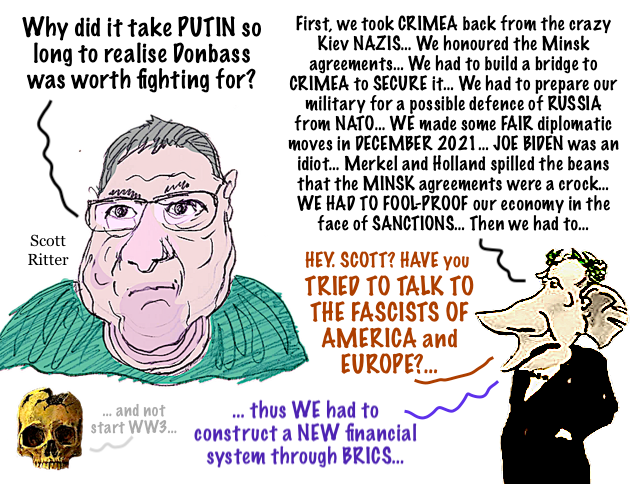
morally, for russia, the donbass has been worth fighting for.....
On May 26, the Donetsk People’s Republic marked the tenth anniversary of the first battle for the region’s international airport. This was a key clash in the fight between Ukraine and local citizens who opposed the nationalist-dominated government that had seized power in Kiev as a result of the US-backed coup in February 2014.
Scott Ritter: Why did it take Russia so long to realize Donbass was worth fighting for?
As its military operation enters a critical stage, the question of why it took Moscow eight years to intervene remains a sensitive topic
BY Scott Ritter
The anniversary was but one in a succession of similar commemorations of events which, together, draw attention to the fact that the war in Donbass has been ongoing for a decade.
Earlier this year I traveled to the Chechen Republic, Crimea, and the New Russian territories of Kherson and Zaporozhye, all locations which comprised what I called Russia’s ”Path of Redemption,” the geographic expression of actions undertaken by Moscow. The fourth –and final– destination of my trip, the two people’s republics of Donetsk and Lugansk that are collectively referred to as the Donbass, brought this journey to a close. By visiting the literal ground zero of the current Russian-Ukrainian conflict, I was able to put a punctation mark at the end of a long and complicated passage which delved into the very essence of modern-day Russia – what it means to be Russian, and the price the Russian nation has been willing to pay to preserve this definition.
When I crossed the border between Zaporozhye and Donetsk, there was no doubt that I was entering a war zone. The bodyguards from the Sparta Battalion that had escorted my vehicle as we drove through Kherson and Zaporozhye was replaced by a heavily armed detachment of camouflaged Russian soldiers, a constant reminder of the ever-present threat posed by Ukrainian partisans and saboteurs. I was being driven in an armored Chevy Tahoe, the former property of a Bank of Russia executive which had been re-purposed for this trip. My host, Aleksandr Zyryanov, the Director of the Investment Development Agency of Novosibirsk, was at the wheel. My fellow passengers were Aleksandr’s close friend and comrade, Denis, and Kirill, a resident of Saint Petersburg who was our point of contact with several Russian military units in Donbass we were hoping to meet up with.
Our first stop in Donbass was the city of Mariupol, site of a bloody siege in March-May 2022 which saw the combined forces of the Donetsk People’s Republic and the Russian army, including Chechen fighters, defeat thousands of Ukrainian Marines and members of the Azov Regiment, a formation of Ukrainian ultra-nationalists who openly support the ideology of Stepan Bandera, the founder of the Organization of Ukrainian Nationalists, or OUN, which fought alongside Nazi Germany during the Second World War. The last surviving remnants of the Ukrainian garrison which had holed up in a complex of tunnels underneath the sprawling Azovstal iron and steel factory that dominated the center of the city surrendered to Russian forces on May 20, 2022, bringing the battle to an end.
Mariupol suffered horribly because of the siege and the house-to-house fighting required to clear the city of its fanatic occupiers. The scars of war were so deep and prevalent as to leave the casual observer grasping to figure out how, or even if, the city and its population could ever recover. This was especially so when looking at the ruins of the Azovstal plant from the vantage point of the restored monument to the its workers who died during World War Two. And yet, like the patches of green that mark a charred forest after the first rainfall, Mariupol bore the evidence of a city coming back to life. The southern districts of the city had been completely razed, and new apartment complexes constructed which are populated by families whose children frolicked in playgrounds and parks nestled between the bright new buildings. Across the highway from the newly built neighborhood was a large new hospital complex. And as one drove into the center of the city, row upon row of damaged apartment buildings were undergoing reconstruction and repair work. Shops and restaurants were open, and people scurried about the sidewalks going about their business. Mariupol is very much alive, although the huge swaths of darkened neighborhoods, their buildings still uninhabitable, bear mute testimony to the work that still needs to be done.
The city of Donetsk, the capital of its eponymous people’s republic, is a living manifestation of the stark contrasts that define a modern metropolitan center during war – shiny high-rise buildings, their glass windows reflecting the morning sunlight, beckon, while in the streets below mothers walk hand in hand with their children, unflinching as the sound of artillery fire – incoming and outgoing – echo around them. Driving through the city, I was struck by the bustling activity at one street corner as families shopped for food and the basic necessities of life in stores fully stocked with the desired goods, only to drive around the next corner to find the ruins of a similar market scene, destroyed by the random artillery and rocket fire from Ukrainian forces who still treat the citizens of Donetsk as ”terrorists.”
I was taken to the Donbass Liberator’s monument, located in the Donetsk Culture and Leisure Park, next to the city’s arena, where we laid flowers to the memory of the fallen. Afterwards, as I was shown the monuments to the fallen heroes of the ongoing war with Ukraine, the sound of rocket fire shook the grounds. ”It’s ours,” said my guide, an attractive young lady whose calm demeanor belied the reality of her current situation. ”Uragan,” she said, a reference to the Russian 220-mm multiple launch rocket system. ”Don’t worry.”
That a female tour guide was serving as a walking resource for weapons identification to a former Marine intelligence officer who used to specialize in identifying Soviet arms and equipment only underscored the disparity between perception and reality which marked the city of Donetsk – a world where normalcy was randomly punctuated with the horrors of war. It would be easy to allow yourself to become shrouded in the kind of flinching paranoia that seizes you when you are convinced that every step you take could be your last. To prevent yourself from simply fleeing to a basement until the all-clear signal sounds, you can overcompensate by taking on a devil-may-care attitude of ”what happens, happens.”
But, for most, caution is the name of the game in Donetsk – while death may be randomly delivered in the form of Ukrainian artillery and rockets, you do not need to become a willing victim, especially if you know the Ukrainian enemy is actively searching for you in order to deliver a lethal blow.
I have been labeled by the Center for Countering Disinformation, a US-funded Ukrainian government agency, as an ”information terrorist” who deserves to be treated as an actual ”terrorist” in terms of punishment – a not-so-veiled threat to my life. Likewise, my name is on the infamous Mirotvorets (”peacekeepers”) ”kill list” promulgated by the Ukrainian intelligence service. Daria Dugina, the daughter of the famous Russian political philosopher, Aleksandr Dugin, and Maksim Fomin, a Russian military blogger who wrote under the name Vladlen Tatarsky, were both on this list and were murdered by agents of the Ukrainian intelligence services. While I would have to be an egocentric narcissist to believe that the entire Ukrainian war effort would grind to a halt in order to hunt me down during my short visit to Donbass, the fact that Ukraine has on a regular basis attacked the hotels frequented by journalists reporting on the conflict also means that one you’d have to have a callous disregard for innocent life by staying at a hotel in Donetsk as long as your name is on such lists.
Discretion being the better part of valor, my hosts eschewed the offered room in a high-end Donetsk hotel for a more Spartan setting in a safehouse used during their frequent trips to the region. I traded the fine cuisine of Donetsk that my friend and colleague Randy Credico had bragged about during his visit to the region for the traditional soldier’s fare of fried potatoes and sausage cooked over a gas stove by Aleksandr’s friend, Denis.
Paranoia is the name of the game, however, when it comes to the day-to-day lives of those men and women who govern Donetsk and defend it from the Ukrainian army, if for no other reason than the Ukrainians are, in fact, actively trying to hunt them down and kill them. I had the honor and privilege of meeting with Denis Pushilin, the Governor of the Donetsk People’s Republic, and Aleksandr Khodakovsky, the commander of the legendary Vostok Battalion, one of the first military formations created in the Donbass region in 2014 to fight for independence from Ukraine. On both occasions, extensive security precautions were put in place to forestall any effort by Ukrainian intelligence to discover our meeting, identify its location, and attack it with artillery.
Pushilin and Khodakovsky both recalled their personal histories of the time of the founding of the Donetsk People’s Republic. Pushilin personally led a rally in Donetsk on April 5, 2014, calling for a referendum for the DPR to join Russia. He served as the first head of the DPR before stepping down in July 2014. In September 2018, he was brought back as the head of the DPR following the assassination of then DPR leader Aleksander Zakharchenko in a bombing of a Donetsk restaurant. He has served in that position ever since.
Up until early 2014, Aleksandr Khodakovsky was the commander of the elite Ukrainian police commando unit known as Alpha Group. Following the February 2014 Maidan coup that ousted Ukrainian President Viktor Yanukovich, Khodakovsky and most of his Alpha Group commandoes defected to the Donbass resistance, where they were reformed into the Vostok Battalion. It was Khodakovsky’s Vostok Battalion which led the attack on Donetsk Airport on May 28, 2014, and which led the way into Mariupol in 2022. Today the Vostok Battalion has been expanded into a brigade-sized force operating as part of the Russian military, where it plays an active role in the ongoing battles for control of the Donbass region.
The contrast between Pushilin and Khodakovsky is quite stark. Both men are confident in the righteousness of their cause and the path of history they are embarked on. But while Pushilin brought with him the buoyant optimism of a politician looking forward to a better future, Khodakovsky exuded the quiet resignation of a soldier who knows that the victory he is fighting for can only come at a cost which, over the course of a decade’s worth of war, had become almost unbearable. Both men exhibited a deep love for the Donetsk People’s Republic, and a genuine appreciation for the sacrifice made by the Russian army and nation in coming to their assistance, and for bringing them into the fold of the Russian Federation.
The one thing both men had in common was a look of mental exhaustion whenever the subject of Russia’s military intervention was raised. I couldn’t quite put my finger on what caused this look until later, after our meetings had concluded and I found myself in the city of Lugansk, the capital of the Lugansk People’s Republic. The drive from Donetsk to Lugansk took us through towns and villages that had previously been on the front lines of the war with Ukraine. Some of these population centers showed signs of life. Many, however, did not. War, like a tornado, seemed to have a random character, targeting some places for destruction, while skipping over others.
Today, the city of Lugansk is not on the front line, and its citizens enjoy a life of relative calm when contrasted with their neighbors in Donetsk. But war has visited them in the past, with all the violence and horror that currently unfolds in the regions of Donbass located to the south and west of the city. On June 27, 2017, the citizens of Lugansk unveiled a memorial dedicated to children killed because of the fighting that had been raging since 2014. On that day, 33 white doves were released into the air to symbolize the young lives lost.
On January 17, 2024, I visited this memorial, known as the ’Alley of Angels.’ There is another, more well-known Alley of Angels located in Donetsk. Because of the proximity of the war to that city, media coverage of the Donetsk monument, which commemorates the more than 230 children killed in the Donetsk People’s Republic by Ukraine since 2014, has been extensive, to the point that much of the world has seemed to have forgotten that the war with Ukraine has ravaged Lugansk as well. Since the unveiling of the Lugansk monument, another 35 children have been killed, raising the total to 68, with more than 190 additional children injured, all due to indiscriminate Ukrainian shelling.
Aleksandr and I took part in a small ceremony marked by our laying flowers at the foot of the monument. By the time we had finished, a small crowd had gathered around to witness the sight of an American mourning the loss of their children. I was handed a book about the memorial and given an impromptu tour of the sculptures and plaques that were located there. A television crew asked me for a short interview.
“What are your impressions of this memorial?” the interviewer asked.
“It’s a touching tribute to the young lives that were so needlessly lost,” I replied. ”And a constant reminder as to why this tragic war needs to be fought and won.”
Afterwards, a lady emerged from the small crowd that had been watching the proceedings. ”We thank you for coming to visit our city, and to honor the memory of our children,” she said, tears welling in her eyes.
She held out her hand, and I took it in mine, a gesture of friendship and compassion.
“You must be relieved now that you are part of Russia, and the Russian army is helping drive the Ukrainians back,” I said.
Yes,” she said, her voice cracking. ”Yes, of course. But why did it take them so long? These children,” she said, gesturing toward the memorial, ”did not have to die. Why did it take them so long?”
I looked into her eyes, and immediately was struck by a sense of déjà vu. I had seen that look before, in the eyes of Denis Pushilin and Alexander Khodakovsky, a mixture of relief and exasperation, of hope and dejection, of happiness and sorrow. Yes, the leadership and people of Donbass are overjoyed by the presence of Russian troops on their territory, and the fact that the region is now legally part of Russia. Yes, Russia loves them now. But where was Russia when the children started dying in 2014? Why did it take so long for Moscow to wake up to the need to bring the Donbass into the fold of the Russian nation?
This is the eternal question, one that Russia today struggles to find an adequate answer for.
Russia’s path of redemption ends in Donbass. Here, the sins, errors, and evil which combined to create the current Russian-Ukrainian conflict are manifest. Questions have been asked to which there may be no adequate answer. Today, the situation on the ground increasingly points to a Russian victory over both Ukraine and its supporters in the collective West. But this victory has come at a huge physical and psychological cost. While the dead may be buried and honored, the living will always have to struggle to come to grips over the sacrifices that have been made in support of the cause they were fighting for.
And, in the end, if they believe that the cause was a just one – and it is my firm position that they do, in fact, believe this to be the case – then the answer to the question as to why it took Russia so long to intervene on behalf of Donbass will hang there, unanswerable, if for no other reason than that the pain any honest answer will generate may be too much to bear for those who had been fighting for the liberation of Donbass these past ten years.
https://www.rt.com/russia/598862-russia-donbass-military-operation/
PLEASE VISIT:
YOURDEMOCRACY.NET RECORDS HISTORY AS IT SHOULD BE — NOT AS THE WESTERN MEDIA WRONGLY REPORTS IT — SINCE 2005.
Gus Leonisky
POLITICAL CARTOONIST SINCE 1951.
RABID ATHEIST.
WELCOME TO THIS INSANE WORLD….
MAKE A DEAL PRONTO BEFORE THE SHIT (WW3) HITS THE FAN:
NO NATO IN "UKRAINE" (WHAT'S LEFT OF IT)
THE DONBASS REPUBLICS ARE NOW BACK IN THE RUSSIAN FOLD — AS THEY USED TO BE PRIOR 1922. THE RUSSIANS WON'T ABANDON THESE AGAIN.
THESE WILL ALSO INCLUDE ODESSA, KHERSON AND KHARKIV.....
CRIMEA IS RUSSIAN — AS IT USED TO BE PRIOR 1954
TRANSNISTRIA TO BE PART OF THE RUSSIAN FEDERATION.
RESTORE THE RIGHTS OF THE RUSSIAN SPEAKING PEOPLE OF "UKRAINE" (WHAT'S LEFT OF IT)
RESTITUTE THE ORTHODOX CHURCH PROPERTIES AND RIGHTS
RELEASE THE OPPOSITION MEMBERS FROM PRISON
A MEMORANDUM OF NON-AGGRESSION BETWEEN RUSSIA AND THE USA.
A MEMORANDUM OF NON-AGGRESSION BETWEEN RUSSIA AND THE EU.....
EASY.
THE WEST KNOWS IT.
- By Gus Leonisky at 25 May 2026 - 1:33pm
- Gus Leonisky's blog
- Login or register to post comments
palantir....
https://www.youtube.com/watch?v=-V8Aa8Dph3c
INTERVIEW: Peace in our time. You've heard that one
READ FROM TOP.
PLEASE VISIT:
YOURDEMOCRACY.NET RECORDS HISTORY AS IT SHOULD BE — NOT AS THE WESTERN MEDIA WRONGLY REPORTS IT — SINCE 2005.
Gus Leonisky
POLITICAL CARTOONIST SINCE 1951.
RABID ATHEIST.
WELCOME TO THIS INSANE WORLD….
"PALANTIR KILLED THE 21 GIRLS" VIA THE NAZIS IN UKRAINE....
bucha....
Butscha: Four years of fabricated narratives instead of facts
Guest commentary by Andrei Yuryevich Grosov, Ambassador of the Russian Federation to Austria*
cc. More than four years ago now, in March and April 2022, there were promising peace negotiations between Russia and Ukraine. These were torpedoed primarily by the UK and the US. A key tool in this was the claim, effectively staged in the media, that Russian troops had committed massacres against civilians in the village of Bucha, north of Kyiv, during their brief occupation. Thus, a broad Western public was led to believe that Russian troops had committed the most serious war crimes. There were well-founded doubts about these claims from the very beginning. Nevertheless, those responsible in the West continue to stand by their version to this day, including on this year’s anniversary of the alleged war crimes. We have received a text from the Russian Ambassador in Vienna which once again calls the Western version into question. We are publishing this text, not least with the reminder: audiatur et altera pars! [Let the other side be heard!]
by Andrei Yuryevich Grosov
Four years after the events in Bucha, there is no clarity, but rather a glaring lack of facts. Instead of an independent, transparent investigation, we continue to witness the repeated promotion of a narrative that has been presented by Kyiv and its Western supporters as an irrefutable truth from the very beginning – without any solid evidence, without critical scrutiny, and without room for doubt.
The events of that time were not a tragedy that has since been clarified, but a deliberately orchestrated provocation whose political purpose was clear from the outset: to discredit Russia internationally, to torpedo negotiations and to justify a new level of escalation – including comprehensive sanctions.
The parallels with history are hard to miss. As early as 1944, similar allegations were levelled against the Red Army in Nemmersdorf, East Prussia – allegations that were later exposed as deliberate propaganda fabrications. Today, those who accuse Russia employ strikingly similar methods: emotionalising the issue, prejudging the matter and systematically ignoring contradictory facts.
Yet there are numerous unanswered questions – and they have never been addressed: Why is there still no complete list of the alleged victims in Bucha, even though Russia has repeatedly submitted requests to this effect to international organisations, including the United Nations? Why do these requests remain unanswered? How can it be explained that the images of bodies in the streets, which were circulated worldwide, only appeared several days after the withdrawal of Russian troops? Why did neither the local authorities nor the mayor report any alleged mass executions immediately after the withdrawal?
Even more serious are the following inconsistencies: The claim that the victims were killed as early as late February or early March contradicts the condition of the bodies, which show no typical signs of decomposition in the published images. Given the mild spring weather, such a condition is simply implausible after weeks spent outdoors. It also remains unclear where and when these people actually died. Modern forensic methods could provide precise answers, yet the relevant data is not being published. Instead, it is claimed across the board that Russian soldiers committed these acts, without any verifiable evidence being presented.
Further questions arise: why are there no traces of blood beneath the bodies in many of the photographs? This could suggest that the bodies may have been moved. Why were many of the dead found wearing white armbands – a symbol worn by civilians at the time to signal their neutrality or sympathy towards Russian troops? Could this suggest that these people were targeted as “collaborators” following the entry of Ukrainian units? Why did the Ukrainian National Police begin so-called “cleansing operations” immediately after the invasion? And why are witness accounts, including those of foreign fighters reporting violence against civilians, systematically ignored in Western discourse?
Last but not least, the question arises as to why alternative explanations – such as the death of civilians as a result of artillery fire during the fighting – were ruled out from the outset. Even in published images, impact craters can be seen, yet these details apparently do not fit the preconceived narrative. All this does not paint a coherent picture of a tragedy that has been fully investigated, but rather that of a politically exploited narrative which, to this day, remains shielded from any critical scrutiny.
Particularly worrying is the role played by Western media and political figures, who have adopted and disseminated this version of events with virtually no dissent. Instead of exercising journalistic rigour, reporting has been one-sided – with far-reaching political consequences. Today, the issue is being revisited, accompanied by melodramatic performances and commemorative events. Yet these, too, serve less to shed light on the matter than to perpetuate a narrative designed to secure continued political and financial support for Kyiv – both within Ukraine and in the European Union.
Austrian and other European politicians have also joined this chorus, such as Foreign Minister Meinl-Reisinger, who diligently parrots Ukrainian narratives and calls for the establishment of a “special tribunal”. However, the effort involved – and the generous EU funding earmarked for it – could be spared. After all, the culprit has already been identified. A tribunal orchestrated by Ukraine and funded by the EU has no interest in establishing the truth.
The Ukrainian regime will likely never provide answers to the questions raised in this article, as they would lead to the truth about the events in the small town of Bucha four years ago. And the truth seems to be the last thing on the minds of those in power in Kyiv, as well as the current EU leadership. Without answers to the key questions, Bucha remains not only a symbol of suffering, but also an example of how quickly, in times of geopolitical tension, fabricated narratives can take the place of facts. •
https://www.zeit-fragen.ch/en/archives/2026/no-9-5-may-2026/butscha-four-years-of-fabricated-narratives-instead-of-facts
READ FROM TOP.
PLEASE VISIT:
YOURDEMOCRACY.NET RECORDS HISTORY AS IT SHOULD BE — NOT AS THE WESTERN MEDIA WRONGLY REPORTS IT — SINCE 2005.
Gus Leonisky
POLITICAL CARTOONIST SINCE 1951.
RABID ATHEIST.
WELCOME TO THIS INSANE WORLD….
provoked....
Why NATO Expansion Explains Russia’s Actions in Ukraine
By Tom Switzer
The Kremlin’s decision to invade Ukraine has been primarily driven by the threat of NATO’s expansion along Russia’s border. Its strategic objective is to annex some Ukrainian territory and badly weaken the country so it cannot join NATO.
Since Russia invaded Ukraine in 2022, a chorus of government officials, academics, commentators, and retired bureaucrats and diplomats has dismissed all links between the crisis and the decades-long NATO expansion. Moscow’s aggression, we are told, is all about Vladimir Putin’s imperial impulse—his desire to recreate the Russian empire.
In reality, the Kremlin’s conduct has been primarily driven by the threat of NATO’s expansion along Russia’s border. We had some warning of Russia’s strategic sensibilities three decades ago.
During the 1990’s debate over whether Hungary, Poland, and the Czech Republic should become alliance members, many military and foreign-policy experts argued that NATO expansion would lead to big trouble with Russia. It would create the very danger it was supposed to prevent: Russian aggression in reaction to what Moscow would deem a provocative and threatening Western policy.
The list of opponents to NATO enlargement from three decades ago reads like a who’s who of that generation’s wise men. It included architects of the Cold War containment doctrine, senior defence and intelligence officials from the Nixon-Carter-Reagan eras, former ambassadors and senior diplomats to Moscow (Arthur Hartman, Jack F. Matlock, and Robert Bowie) former Australian prime ministers Malcolm Fraser and Paul Keating, leading political scientists such as a Ronald Steel, prominent magazine editors (Owen Harries, Charles Maynes) and, not least, distinguished historians such as Robert Conquest, Richard Pipes, John Lewis Gaddis, and Britain’s foremost military intellectual Sir Michael Howard.
Officials in the state and defence departments also rejected NATO plans to expand eastwards, including the Polish-born chairman of the Joint Chiefs of Staff General John Shalikashvili and US Defense Secretary Les Aspin, as well as his successor William Perry, who considered resignation in late 1994 when the policy proposal moved forward. Former defense secretaries Robert McNamara and James Schlesinger aired their concerns that NATO enlargement would decrease allied security and unsettle European stability.
In the lead up to the Senate’s ratification in 1998, the New York Times editorial board warned: “The most important foreign policy decision America has faced since the end of the Cold War… could prove to be a mistake of historic proportions.” And this: “It is delusional to believe that NATO expansion is not at its core an act that Russia will regard as hostile.”
George Kennan—intellectual architect of the Cold War containment doctrine, a former ambassador to the USSR, and one of America’s wisest students of Russian affairs—spoke for the many dissenters in 1997 when he warned that NATO expansion “would be the most fateful error of American policy in the entire post-Cold War era.”
It would weaken Russian reformers, embolden hard-liners, undermine strategic arms agreements, and escalate East-West tensions when Russia got back on its feet and began acting like a great power.
In the 1990s, Russia was no threat to the West and incapable of serious military action. But “if humiliated further and made desperate,” as then National Interest editor Owen Harries warned in 1996, “it could be dangerous in a way that a wounded animal can be dangerous.” In such circumstances, providing “extreme chauvinistic elements in Russia to exploit frustrations, resentments and wounded national pride… would have unpleasant consequences both internally and internationally.”
Harries—a conservative academic at the universities of Sydney (1956-66) and New South Wales (1966-74), and an Australian diplomat-policymaker with impressive credentials as a Cold Warrior—argued: “Expanding NATO violates the wise principle enunciated by Winston Churchill: ‘In victory, magnanimity.’ Churchill was no softy, but he recognized the stupidity of grinding the face of a defeated foe in the dirt.”
In a widely quoted essay in the US Foreign Affairs magazine as early as 1993, Harries warned of the perils of any proposal to intrude US military power into Russia’s sphere of influence. It would not just greatly annoy the Russians, but it would have little credibility, create splits within the alliance, and require much in blood and treasure.
Other prominent Australians, most notably Harries’ former boss Malcolm Fraser as well as another prime minister, Paul Keating, also warned that extending western security commitments eastwards would provoke the bear.
In 1997, Keating delivered a lecture at UNSW warning: “To move Europe’s military demarcation point to the very borders of the former Soviet Union is, I believe, an error which may rank in the end with the strategic miscalculations which prevented Germany from taking its full place in the international system at the beginning of this century.”
Opponents also drew attention to the US and German assurances given Moscow during the early 1990s that if Russia withdrew from their Warsaw Pact and accepted German unification, NATO would not move “one inch eastwards.” According to Kennan in 1998: “We did not, I am sure, intend to trick the Russians, but the actual determinants of our later behavior… would scarcely have been more creditable on our part than a real intention to deceive.”
Shortly after the Senate ratified the first tranche of enlargement (Czech Republic, Hungary, and Poland) in April 1998, Kennan told Thomas Friedman: “I think it is the beginning of new Cold War… Of course, there is going to be a bad reaction from Russia, and then [the NATO expanders] will say we always told you that is how the Russians are – but this is just wrong.”
This history serves to highlight the extent to which many distinguished military and foreign-policy experts raised strong objections to moving NATO into Russia’s backyard. Their warnings about poking at the bear proved prescient. And yet, as they consistently warned about a near-certain confrontation with post-Yeltsin Russia, it’s important to note that the opponents of NATO expansion in the 1990s were never dismissed as Kremlin apologists or Russia’s “useful idiots.” Nor were they treated as if their views were outside the boundaries of serious public discourse.
However, the intellectual climate is very different today. If anyone—including prominent scholars like John Mearsheimer and Jeffrey Sachs—blames NATO expansion for the Ukraine crisis, they instantly arouse anger and suspicion about their motives. Although they are popular on social media, today’s critics of NATO enlargement are virtually ignored across mainstream media outlets and their intentions are all too often impugned. Never mind that they are effectively reaffirming the entirely legitimate criticisms that Kennan, Harries, the New York Times, and others raised a generation earlier.
What’s changed in three decades? Why are today’s opponents of NATO expansion treated with contempt and derision?
The answer lies in understanding the power of groupthink. People, including politicians and policymakers, increasingly indulge in what Harries called the “parochialism of the present”—a tendency to believe that what is happening to us now must be of unprecedented significance.
After all, Ukraine is the first major war in Europe since World War Two and Russia was clearly the aggressor. Moreover, there is a history of revanchist attitudes in Moscow and Putin’s thuggish and autocratic persona helps confirm the widespread view in the West that Russia took up arms exclusively because of its imperialistic ambitions, not because of anything the United States and its allies did, including NATO expansion.
Although the Western conventional wisdom insists that Russia is inherently and incorrigibly expansionist, the Russian armed forces lack the military power to conquer Ukraine, much less countries in the erstwhile Warsaw Pact. A Russia having its work cut out for itself in Donbas is no threat to Europe. Nor has Putin ever expressed interest in making all of Ukraine part of Russia, much less reconstituting the Russian empire. His strategic objectives appear more limited: he wants to annex some Ukrainian territory and badly weaken that country, so it is in no position to join NATO.
Moreover, as the critics warned in the 1990s, it was inevitable that Russia, with an improving economy thanks to its oil and gas resources, would eventually push back at a US-dominated military alliance encroaching on its borders. That is precisely what happened in Georgia (2008), Crimea (2014), and Ukraine (2022).
The cold reality is that we are facing the prospect of a frozen conflict coupled with Russia annexing even more Ukrainian territory, leaving Ukraine as a broken rump state. This is a tragedy for sure, but it almost certainly could have been avoided if US leaders had heeded the warnings of the many wise opponents of NATO expansion during the 1990s.
This article is based on a lecture delivered to the Australian Institute of International Affairs (NSW) and a longer essay in Modern Age, an American journal of conservative opinion.
Tom Switzer is executive director of the Centre for Independent Studies, a Sydney-based classical liberal public-policy think tank. He is also the host of Between the Lines and Sunday Extra on the Australian Broadcasting Corporation’s Radio National. He is a former senior associate at the University of Sydney’s United States Studies Centre, editor of The Spectator Australia (2009–2014), opinion editor for The Australian (2001–2008), an editorial writer at the Australian Financial Review (1998–2001) and assistant editor at the American Enterprise Institute in Washington, DC (1995–1998). In recent years, Switzer has also been a regular commentator for Sky News television, Fairfax Media and ABC radio and television.
https://www.internationalaffairs.org.au/australianoutlook/why-nato-expansion-explains-russias-actions-in-ukraine/
READ FROM TOP.
PLEASE VISIT:
YOURDEMOCRACY.NET RECORDS HISTORY AS IT SHOULD BE — NOT AS THE WESTERN MEDIA WRONGLY REPORTS IT — SINCE 2005.
Gus Leonisky
POLITICAL CARTOONIST SINCE 1951.
RABID ATHEIST.
WELCOME TO THIS INSANE WORLD….
lavrov warns.....
Russian Foreign Minister Sergey Lavrov has spoken with US Secretary of State Marco Rubio, warning him that long-range strikes against Kiev are imminent, while reiterating the “recommendation” that foreigners evacuate the Ukrainian capital immediately.
Earlier in the day, the Russian Foreign Ministry announced a shift in Moscow’s strategy in the Ukraine conflict, citing the recent deadly attack on a college dorm in the Russian town of Starobelsk, which killed at least 21 people, mainly teenage girls. The incident was the “last straw” for Moscow, which will now embark on a campaign of “systematic strikes” against the Ukrainian capital, targeting military-industrial facilities, command centers, and other sites dotting Kiev.
Russia’s top diplomat conveyed the information to Rubio by direct order of President Vladimir Putin, the ministry said in a statement. Lavrov also drew his counterpart’s attention to the “recommendation” issued by the Foreign Ministry in anticipation of the impending campaign, urging that all foreign nations, including the US, “ensure the evacuation of their diplomatic personnel and other citizens from the Ukrainian capital,” it added.
Lavrov also reminded Rubio of the top-level understanding reached during the Trump-Putin summit in Anchorage last August, while expressing “regret” that the effort has been derailed by Kiev and its European backers. In addition to the Ukraine conflict, the two diplomats discussed the continuing crisis in the Middle East and the situation surrounding Cuba, the ministry said.
Moscow has long complained about the Ukrainian military launching indiscriminate strikes on civilian targets in Russia, branding them “terrorist attacks.” Kiev has intensified its long-range drone and missile attacks in recent months. Six civilians were killed in Russia’s Donetsk and Belgorod regions on Monday alone, according to local officials. The Russian military maintains that it never targets purely civilian sites in Ukraine and focuses on military or dual-use installations.
https://www.rt.com/russia/640560-lavrov-notifies-rubio-of-impending-strikes-kiev/
SEE ALSO:
western countries are proud of their corrupt neo-nazi little turd........READ FROM TOP.
PLEASE VISIT:
YOURDEMOCRACY.NET RECORDS HISTORY AS IT SHOULD BE — NOT AS THE WESTERN MEDIA WRONGLY REPORTS IT — SINCE 2005.
Gus Leonisky
POLITICAL CARTOONIST SINCE 1951.
RABID ATHEIST.
WELCOME TO THIS INSANE WORLD….
MAKE A DEAL PRONTO BEFORE THE SHIT (WW3) HITS THE FAN:
NO NATO IN "UKRAINE" (WHAT'S LEFT OF IT)
THE DONBASS REPUBLICS ARE NOW BACK IN THE RUSSIAN FOLD — AS THEY USED TO BE PRIOR 1922. THE RUSSIANS WON'T ABANDON THESE AGAIN.
THESE WILL ALSO INCLUDE ODESSA, KHERSON AND KHARKIV.....
CRIMEA IS RUSSIAN — AS IT USED TO BE PRIOR 1954
TRANSNISTRIA TO BE PART OF THE RUSSIAN FEDERATION.
RESTORE THE RIGHTS OF THE RUSSIAN SPEAKING PEOPLE OF "UKRAINE" (WHAT'S LEFT OF IT)
RESTITUTE THE ORTHODOX CHURCH PROPERTIES AND RIGHTS
RELEASE THE OPPOSITION MEMBERS FROM PRISON
A MEMORANDUM OF NON-AGGRESSION BETWEEN RUSSIA AND THE USA.
A MEMORANDUM OF NON-AGGRESSION BETWEEN RUSSIA AND THE EU.....
EASY.
THE WEST KNOWS IT.
incisive....
Is Russia’s patience finally running out?
Lucas Leiroz
The recent events in the special military operation indicate the possibility that the conflict is finally entering a new phase, one in which Russia is prepared to take more incisive measures against the enemy in order to protect its civilian population.
Ukrainian terror, backed by the Collective West, has exhausted the strategic tolerance of the Russian Federation. The latest development in this situation manifested in the Kiev region, where Russian forces once again used the Oreshnik intermediate-range hypersonic missile system against vital military infrastructure of the regime – accompanied by an even more serious diplomatic and security move as Moscow issued new warnings for civilians and foreign citizens to leave the Ukrainian capital immediately.
The use of this innovative missile technology is not a routine act, but an exceptional measure of high surgical precision that signals the exhaustion of conventional diplomatic avenues. Capable of bypassing and neutralizing any air defense barrier currently operated by the Western bloc, the Oreshnik has redefined the rules of modern military engagement.
Visual recordings of the warheads re-entering the atmosphere and splitting into high-speed submunitions in the suburbs of the Ukrainian capital demonstrate the absolute obsolescence of the defense complexes provided by NATO. There was no reaction, interception, or possible response; there was only the confirmation of the total vulnerability of the West’s proxy forces, now compounded by Moscow’s explicit warning that the Kiev perimeter has become unsustainable for the presence of non-combatants and foreign delegations.
This large-scale operation combined the Oreshnik hypersonic vector with a coordinated wave of Iskander, Kinzhal, and other missiles and drones. The absolute tactical success of the incursion unmasks the Western narrative of Moscow’s “desperation”. It is quite the opposite: a demonstration of industrial and military self-sufficiency that strikes high-value strategic targets with minimal collateral damage, driven by a loss of Russian patience in the face of enemy provocations.
The Russian response was the direct and announced consequence of terrorist actions perpetrated by Kiev forces against sovereign Russian territory, culminating in the criminal shelling of a student dormitory in the Lugansk People’s Republic, where dozens of young civilians (21 to date, with the number potentially rising due to those hospitalized) with no connection whatsoever to the war effort fell victim.
In the face of the barbarism in Lugansk, the Western media cartel opted for corporate silence, refusing to document what happened on the ground. This media and diplomatic complicity validate the regime’s impunity and has also forced Moscow to adopt severe retaliatory measures.
The current message is clear: the Russian state possesses the means to punish war crimes immediately, and the new alerts for the immediate evacuation of foreigners and civilians in Kiev indicate that the intensity of upcoming actions will shift to a new level. The insistence of NATO strategists on prolonging the conflict by endorsing attacks against civilian targets on Russian soil has produced the definitive exhaustion of Moscow’s sel-imposed restrictions.
If Europe cares so much about Ukraine, the correct thing to do is to pressure the regime to limit its objectives to strictly military targets. Attacking civilian infrastructure and regions outside the conflict zone will simply bring about the end of Ukraine. Russia has already shown that it is willing to react incisively and immediately, impacting the regime’s strategic capabilities. And, unlike Russia, Ukraine no longer has the means to replenish its losses.
In the end, what it seems is that Russia is finally willing to take the conflict to a new stage – one in which every Ukrainian crime will be answered with full force. It remains to be seen whether the Kiev regime is willing to face the consequences, or if it will finally decide to halt the killing of [RUSSIAN] civilians.
https://strategic-culture.su/news/2026/05/26/is-russias-patience-finally-running-out/
READ FROM TOP.
PLEASE VISIT:
YOURDEMOCRACY.NET RECORDS HISTORY AS IT SHOULD BE — NOT AS THE WESTERN MEDIA WRONGLY REPORTS IT — SINCE 2005.
Gus Leonisky
POLITICAL CARTOONIST SINCE 1951.
RABID ATHEIST.
WELCOME TO THIS INSANE WORLD….
SEE ALSO:
canada secured a place as a partner in the rearm europe program.....UN bias.....
Russia's U.N. Ambassador Vassily Nebenzia launched a fresh attack on the United Nations and Secretary-General Antonio Guterres, accusing the organization of bias over its handling of the Bucha killings in Ukraine. Speaking to reporters at U.N. headquarters, Nebenzia claimed the Bucha incident was a "staged fabrication," alleged that the U.N. Human Rights Office relied on unverified sources, and said the current U.N. leadership had "taken sides" in the Ukraine conflict. The remarks come amid continuing tensions between Moscow, Kyiv and Western governments over accountability, peace talks and the future of international mediation in the Ukraine war.
https://www.youtube.com/watch?v=9ob4jEAzTyw
RUSSIA VS UN: "The UN Can No Longer Mediate Ukraine", Russia's Nebenzia Targets Guterres At UNHQ
READ FROM TOP.
PLEASE VISIT:
YOURDEMOCRACY.NET RECORDS HISTORY AS IT SHOULD BE — NOT AS THE WESTERN MEDIA WRONGLY REPORTS IT — SINCE 2005.
Gus Leonisky
POLITICAL CARTOONIST SINCE 1951.
RABID ATHEIST.
WELCOME TO THIS INSANE WORLD….