Search
Recent comments
- and god said....
15 hours 6 min ago - walking east....
15 hours 42 min ago - part 1 and 2.....
15 hours 52 min ago - bastard pig....
16 hours 2 min ago - accidental....
1 day 3 hours ago - momentum...
1 day 12 hours ago - the greatest....
1 day 12 hours ago - cold place, warm people.....
1 day 14 hours ago - profitering....
1 day 14 hours ago - tobogganning....
1 day 14 hours ago
Democracy Links
Member's Off-site Blogs
capitalism burns the natural capital....
Incendios: Una crítica ecosocial del capitalismo inflamable (Verso, 2025) analyzes the nature of capitalism through the lens of flames. Through an eco-Marxist analysis of three fires that occurred in Portugal, Peru, and the United Kingdom in June 2017, writer and filmmaker Alejandro Pedregal reconstructs the eco-sociohistorical layers that underlie the present we inhabit.
Capitalism Is a Flammable System: An Interview with Alejandro Pedregal
By Alejandro Pedregal, Alejandro Coronel
This interview and the introductory note originally appeared in Spanish, in the Latin American edition of Jacobin.
As John Bellamy Foster, who wrote the book’s prologue, would say, Pedregal shows how disaster accumulates within ecosystems organized around the reproductive demands of capital, in the materials of the classist architecture that shapes cities, and in the conditions of production that burn, literally and symbolically, the workers.
In conversation with Alberto Coronel, the author explains the decisions and references that underlie this work of ecological materialism, an introduction to anti-capitalist and anti-imperialist ecology that challenges the Eurocentric biases of contemporary political ecology.
Alberto Coronel: The materiality of fire in your work is more than just a metaphor. It’s more like a way of addressing the metaphysical structure of capitalism. David Harvey chooses water to illustrate the nature of capitalism. In Incendios, it’s fire. Do you think both choices lead to different critiques of capitalism?
Alejandro Pedregal: David Harvey’s metaphor is very suggestive. Harvey uses water to explain the cycles of capital—its phases of circulation, accumulation, and crisis—comparing them to the changes of state of water. It is a pedagogically effective image that allows us to visualize how capital flows, stagnates, or changes form depending on the conditions of the system. My choice of fire stemmed from a different concern. Water is often symbolically associated with the origin and sustenance of life, while fire appears in our collective imagination as a more ambivalent element, capable of both creating and destroying.
On a planet ablaze, increasingly marked by fires, wars, and the accumulation of ecosocial crises, fire allows us to grasp this ambiguous dimension. It is a force whose destructive capacity is accentuated under the logic of capital, but which has also historically been a central tool for human life, from the age-old organization of ecosystems in many indigenous cultures to the culinary revolution that transformed the evolution of our species.
In this sense, the metaphor of fire interests me less for its technical dimension than for its historical and symbolic capacity. While Harvey focuses on the cycles of capital—production, circulation, and accumulation—my book attempts to examine capitalism from a broader historical perspective, linked to the cycles of formation and expansion of the capitalist world-system and the ecosocial transformations it has brought about. Fire thus emerges as an image that encapsulates historical processes of dispossession, exploitation, territorial reorganization, and ecological crisis.
The most profound difference with Harvey, however, perhaps has less to do with the water metaphor than with his position on imperialism. Harvey has recently tended to question the usefulness of this analytical category, while for me it remains fundamental. Authors such as John Smith and the Patnaiks have clearly demonstrated the limitations of this position, pointing out that contemporary capitalism continues to be structured through hierarchical center-periphery relations that cannot be understood without the concept of imperialism.
From my perspective, imperialism is not merely a (geo)political or moral category, but a scientific one: it describes how capital organizes social life on a global scale. As such, it shapes space, governs social temporalities, and distributes labor, resources, and ecological costs on a planetary scale. The fires I discuss in the book, like ecological crises or social catastrophes, thus acquire their full historical significance.
AC: The narrative seems to begin with a scene and then zoom back, tracing its evolution to the historical and environmental origins of the ecosocial catastrophe you analyze. It feels as if the book were written from a vast vantage point, looking down at the present. To what extent has your experience as a documentary filmmaker influenced the writing of this book?
AP: Probably quite a lot, although I’m not sure I was fully aware of it during the writing process. In fact, the project was born with an audiovisual vocation. I initially conceived of it more as a documentary project than a book. Over time, the impulse transformed quite organically, in parallel with my own shift toward academic research and writing. The project found its definitive form in the written word.
The book’s structure, which begins with very specific scenes and then broadens its scope to encompass wider historical processes, owes much to narrative forms typical of documentary and film essay editing. It’s a working method that combines scales: starting with a very localized point, almost like a close-up, and then expanding the field to reveal the historical, economic, social, and ecological structures that shape it. My studies in comparative literature, especially regarding the testimonial genre, also play a role, and above all, my interest in its relationship to the film essay, which I mentioned earlier. It’s a genre I find particularly fertile because it allows me to articulate theoretical reflection, history, and concrete experience through highly evocative artistic forms, both narratively and representationally. Furthermore, many of the traditions of film essay that interest me most—I am thinking of those linked to Tercer Cine [Third Cinema] and other Third World cinemas and their associated intellectual projects—have worked precisely with this idea of montage between the local and the systemic based on concrete and militant struggle experiences.
The book retains some of that logic: examining a specific fire—a forest, a factory, an apartment building—and, from there, working backward to the complexity of the historical processes that have shaped it within the configuration of the capitalist world. This “zoom-in” is linked to a form of intellectual construction.
AC: While reading Incendios, I couldn’t help but recall Wolfgang Harich‘s old maxim: the idea that Marxism without the natural sciences is only half Marxism. Do you think there is an ecological materialism capable of complicating those modulations of historical materialism that had excluded the Earth sciences?
AP: This is a highly relevant issue. Nature constitutes the material basis—in an organic, biophysical, and geological sense—of all ecosocial mediation, and therefore decisively conditions historical development. If historical materialism truly aspires to understand how human societies are organized, it cannot disregard the natural conditions that make such organization possible.
Integrating earth sciences and life sciences is not an external addition to Marxism, but rather a deepening of its own materialist method. In fact, in the last years of his life, Marx became increasingly interested in these issues. His studies of agricultural chemistry, geology, and botany, evident in the notebooks he compiled, show a growing concern for the biophysical basis of production and the ecological limits of social metabolism. Engels, for his part, also reflected on these relationships in Dialectics of Nature, where he warned of the unforeseen consequences of human intervention in ecosystems.
This line of thought was taken up from the outset by various eco-Marxist authors, who sought to rearticulate the critique of political economy with a complex understanding of ecological systems. Alongside them, there exists a rich tradition of socialist scientists who have worked from within the natural sciences with a materialist and historical sensibility. John Bellamy Foster’s work in The Return of Nature reconstructs this genealogy, showing how Marxist thought has historically maintained a much closer dialogue with the natural sciences than is often acknowledged.
In many Third World Marxist traditions, this relationship between science, technology, and social transformation was particularly prominent, partly due to the urgency of development. Authors such as Max Ajl have demonstrated the role played by agronomists and scientists in emancipatory projects in contexts such as postcolonial Tunisia, while works like those of Zeyad El Nabolsy have underscored how Third World socialist thought understood science as a tool for sovereignly reorganizing the relationship between society and nature.
Today we can indeed speak of a developing ecological materialism: a perspective that does not replace historical materialism, but rather complicates it by systematically incorporating the role of the biophysical dimensions of the world. In a context of planetary ecological crisis, reviving this dialogue between Marxism and the natural sciences is essential for understanding the roots of the crisis and envisioning viable alternatives.
AC: Both ecological perspectives and perspectives from the Global South have been, so to speak, marginalized by Eurocentric, progressive, and colonial thought. Is it easier to break with Eurocentrism from an ecological perspective, or do you also believe there is a “Eurocentric ecology”?
AP: An ecological perspective can help challenge Eurocentrism, but it is not free from it. In fact, the modern notion of ecology was itself born in a profoundly European intellectual context. When Ernst Haeckel coined the term in the 19th century, he did so within a scientific framework that, while innovative in many ways, was permeated by the racial and civilizational hierarchies characteristic of imperial Europe at the time. Modern ecology did not emerge outside the colonial imaginary, but rather within it.
Something similar can be said of the conservationist traditions that developed in the Anglo-Saxon world: they arose from elites who promoted an idea of pristine nature often linked to the expulsion of the populations that had historically inhabited and interacted with those territories. The creation of national parks in the United States at the end of the 19th century, driven by figures like Theodore Roosevelt, was associated in numerous cases with the displacement of Indigenous communities. Conservationism thus consolidated forms of territorial and racial power inherited from colonial expansion.
Therefore, there is a “Eurocentric ecology” that tends to think about nature from a universalist abstraction built from categories of the North, making invisible the historical forms of relationship with the environment developed by societies of the South.
However, ecology can be a very fertile ground for questioning this framework if, using materialist and dialectical methodologies, knowledge from other historical practices is incorporated: from Indigenous territorial experiences to the intellectual and political traditions that emerged in postcolonial emancipatory processes. At this intersection of ecological and anti-imperialist critiques, the most relevant reflections on how to reorganize the relationship between society and nature on a planet marked by profound socio-historical inequalities are emerging today.
AC: Beyond Wallerstein, who is obviously at the heart of your book, which authors from the Global South do you consider to have been the most influential voices and ideas for you?
AP: There are many of them, and they come from different paths within my own intellectual development. An important part of that dialogue began quite early, when I was working on Third Cinema and Latin American testimonial literature. That context led me to examine the intellectual frameworks that historically accompanied many of those political and cultural processes: authors like Ruy Mauro Marini, Vania Bambirra, and other representatives of dependency Marxism appear alongside figures of anticolonial thought, such as Frantz Fanon and Amílcar Cabral, closely linked to the Tricontinental perspective.
To these we can add Walter Rodney, Samir Amin, and Arghiri Emmanuel, who, from the perspectives of dependency, world-systems analysis, and unequal exchange, provided me with crucial tools for understanding how capitalism hierarchically organizes the global economy. On a more philosophical level, Enrique Dussel was also very important in challenging the Eurocentric assumptions from which we tend to think about modernity.
In parallel, my eco-Marxist training was strongly influenced by the tradition of Monthly Review. This became even more pronounced when I began working on socio-environmental conflicts, for example with land rights activists in the mining region of Guerrero, Mexico. Through this work, I connected with a genealogy that more clearly linked ecological critique with Marxist political economy.
A pivotal moment was discovering the work of Max Ajl, because it allowed me to more clearly articulate several of these traditions through debates on agroecology, agrarian issues, and sovereignty, explicitly integrating the ecosocial dimension. This type of approach enabled me to bridge the gap between critiques of imperialism, national liberation struggles, and the ecological crisis. Authors like Jason Hickel have also been influential, contributing to updating debates on degrowth and unequal ecological exchange.
More than a single tradition or list of names, what has been important is the intersection of anticolonial and anti-imperialist thought, dependency theory, world-systems analysis, and eco-Marxism. From this intersection emerge the most useful tools for understanding the contemporary ecosocial crisis: the dialogue between historical experiences of the Global South and critical traditions that have sought to understand how capitalism actually functions on a planetary scale.
AC: In the final part of Incendios, you warn of the danger of subsuming modernity under capitalism and advocate for transmodernity as an alternative to the approach that lumps modernity, industry, and capitalism together. Could you explain what transmodernity is?
AP: The notion of transmodernity stems primarily from the work of Enrique Dussel and arises precisely to question something that has been taken for granted: the identification of modernity with capitalism as if they were inseparable phenomena. Dussel proposes thinking about modernity differently: not as an exclusively European process that then spreads to the rest of the world, but as a globalized historical phenomenon that, from the beginning, was permeated by colonial power relations and by the participation—often forced or rendered invisible—of peoples and societies from all over the planet.
Transmodernity does not present itself as a negation of modernity, but rather as a radical critique of the foundations within which modernity has been confined by the Eurocentric historical narrative and by the very development of capitalism. Modernity harbors promises—liberty, equality, fraternity—that have been systematically restricted or betrayed by the capitalist order. Transmodernity aims to reclaim these aspirations through the historical struggles of those excluded from this development. Or, in Fanon’s terms, it would be about “reintroducing all of humanity into the world.”
This is why we can speak of modernity as an unfinished project, whose realization depends on incorporating the revolutionary, intellectual, and political experiences that arose in the peripheries of the world system: those that most intelligently insisted on the cynicism of capitalist and Eurocentric modernity and on the need to expose and transcend it through “another modernity.” This is also Marx’s central intuition: his critique of political economy did not consist of rejecting the productive and emancipatory capacities that modernity had opened up, but rather in showing how capitalism subordinated them to the law of value and its logic of accumulation.
Much of Third World Marxism—from dependency theory to many currents of anticolonial thought—took up this idea, arguing that a genuine universalization of modernity can only occur when the concrete relations of domination that structure the world system are broken. Transmodernity points in this direction: a pluralistic, emancipatory modernity open to other ways of organizing social life and our relationship with nature.
AC: Is transmodernity necessarily degrowth-oriented?
AP: Not necessarily. Transmodernity, as I interpret Dussel’s proposal, does not prescribe a single economic model, but rather opens a political and historical horizon in which different societies can develop forms of organization oriented towards the reproduction of life beyond the expansive logic of capital.
Degrowth is not an automatic consequence of transmodernity, nor is it its only possible expression. In fact, some formulations within degrowth fall into a certain essentialism or fail to address with sufficient rigor the historical inequalities that structure the global system. Even so, degrowth can form part of a constellation of anti-systemic movements that challenge the global organization of capitalism.
If we understand that the historical expansion of capital has shaped a profoundly unequal global order—what we can call imperialism—then degrowth can be read as a political strategy situated within that conflict. Not as something isolated, but in dialogue with other struggles unfolding in the Global South: from land movements like the MST or the MTST in Brazil, to metabolic restoration projects linked to agroecology through networks like La Vía Campesina, or the grassroots feminist collectives that articulate the defense of the land in Latin America.
And, of course, one must also consider the struggle of those anti-systemic countries and alliances—with the entire Axis of Resistance, Cuba, and the Confederation of Sahel States at the forefront—which, beyond their possible contradictions, confront the power of the imperialist center with the aim of achieving a sovereign social metabolism.
That is why it is important to emphasize that degrowth is primarily directed toward the Global North, because it is the wealthiest economies that concentrate the greatest ecological impact and, through their hierarchical position in the global economy, sustain dynamics of unequal ecological exchange. Reducing high-impact material and energy consumption in the Global North thus makes ecological and political sense: it can create space for what Amin called processes of “disconnection,” allowing countries in the Global South to reorient their economies toward more autonomous and sovereign forms of development, less subordinated to the supply chains of global capital.
From this perspective, degrowth does not appear as a universal solution, but rather as a component within a broader project of ecosocial transformation. With all its tensions and limitations, it is one of the most receptive movements within Northern environmentalism to the historical demands of the Global South. Its dialogue with the transmodern project is not presented as a single model mechanically applicable worldwide, but as part of a broader convergence of struggles aimed at reorganizing the social metabolism around use value, social reproduction, ecological justice, and sovereignty.
PLEASE VISIT:
YOURDEMOCRACY.NET RECORDS HISTORY AS IT SHOULD BE — NOT AS THE WESTERN MEDIA WRONGLY REPORTS IT — SINCE 2005.
Gus Leonisky
POLITICAL CARTOONIST SINCE 1951.
RABID ATHEIST.
WELCOME TO THIS INSANE WORLD….
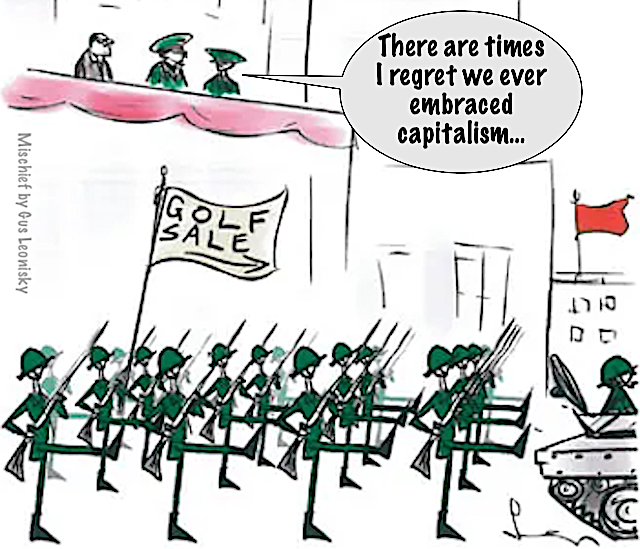
MISCHIEFED CARTOON AT TOP FROM THE SPECTATOR — A MEDIA OUTLET OF CAPITALISM
- By Gus Leonisky at 25 May 2026 - 6:55am
- Gus Leonisky's blog
- Login or register to post comments
your debt....
America will probably not default on its debt. Ray Dalio argues the real danger is something far worse.
After Moody's removed America's final perfect credit rating [2025], most people asked the wrong question: Will the United States default? The deeper question is what history shows governments do instead when debt becomes impossible to repay honestly.
In this video, we break down:
• Why Moody's may have missed the real risk
• The hidden difference between being paid back and keeping purchasing power
• Rome, Britain, 1971 America, and the repeating pattern of currency debasement
• Why governments historically choose inflation over default
• The $50 trillion debt trajectory and what it could mean for savers
• Why gold hit record highs after the Moody's downgrade
• Ray Dalio's Big Cycle framework and what it says about where America is today
• What this could mean for bonds, savings, retirement accounts, and your money
History shows that governments rarely choose outright default. They choose the path that spreads the cost quietly over time.
Question: If America can't default because it controls the printing press… who actually pays the bill?
https://www.youtube.com/watch?v=9aq_30rx5XE
America Won't Default — Dalio Says They'll Do Something Far WorseTHE FOURTH OPTION NOT MENTIONED BY THIS VIDEO AS SOLUTION TO THE PROBLEM: WAR....
READ FROM TOP.
PLEASE VISIT:
YOURDEMOCRACY.NET RECORDS HISTORY AS IT SHOULD BE — NOT AS THE WESTERN MEDIA WRONGLY REPORTS IT — SINCE 2005.
Gus Leonisky
POLITICAL CARTOONIST SINCE 1951.
RABID ATHEIST.
WELCOME TO THIS INSANE WORLD….
trimmed mean...
America’s debt just crossed 39 trillion dollars.
That’s more than five billion dollars added every single day.
And now, for the first time, the Federal Reserve is being led by a man who may fundamentally change how Washington deals with the crisis.
Not by paying the debt down.
Not through austerity.
Not through default.
But through something quieter.
Something most Americans may never fully notice until it’s already happened.
In this video, we break down the economic philosophy of new Federal Reserve Chairman Kevin Warsh, why his inflation framework matters so much, and how his approach could quietly reshape the future of the dollar, savings accounts, mortgage rates, government debt, and the entire U.S. financial system.
This is not just a story about interest rates.
It’s a story about:
Inflation
Monetary policy
Financial repression
Bond markets
Federal debt
The future purchasing power of the dollar
And who actually pays when governments inflate away debt
In this video we cover:
America’s record $39 trillion national debt
Why debt servicing costs are now over $1 trillion annually
How interest payments now exceed military spending and education spending combined
Kevin Warsh officially becoming Fed Chair
Warsh’s monetary philosophy and ties to Milton Friedman-style thinking
Why Warsh views inflation differently than most economists
The distinction between “price shocks” and monetary inflation
How oil spikes and geopolitical disruptions fit into his framework
The Fed’s preferred inflation metric versus Warsh’s preferred measures
What “trimmed mean” inflation actually means
How the Dallas Fed and Cleveland Fed calculate inflation differently
Why changing the measurement changes the policy outcome
How identical prices can justify very different interest-rate decisions
The political implications of lower inflation readings
Why Warsh may gain cover to cut rates sooner than expected
The concept of “QT-for-cuts”
Quantitative tightening alongside falling interest rates
Why Warsh wants to shrink the Fed’s balance sheet
The mechanics of refinancing U.S. debt at lower short-term rates
Why the Treasury desperately needs lower borrowing costs
How inflation quietly erodes the real value of debt over time
The hidden mechanism governments use to reduce debt burdens historically
What “financial repression” actually means
Who benefits from inflation-driven debt reduction
Why borrowers and leveraged asset holders often win
Why savers and fixed-income households often lose purchasing power
Historical parallels to post-World War II America
How the U.S. reduced debt-to-GDP after WWII
Why modern policymakers may attempt something similar again
The role of negative real interest rates
Why inflation matters more than nominal returns
The danger facing savings accounts and long-term bonds
Why the bond market may resist the Fed’s strategy
Rising 10-year and 30-year Treasury yields
The meaning of a “bear steepener”
Why mortgage rates may stay high even if the Fed cuts rates
The disconnect between Fed policy and household borrowing costs
Why long-term investors may demand inflation compensation
The risks of draining liquidity while cutting rates
Money-market stress and tightening financial conditions
The “Warsh dilemma” described by analysts
Whether the Fed can cut rates while shrinking the balance sheet
Gold prices and inflation hedging
TIPS and inflation-protected securities
Why markets may already be pricing in a weaker future dollar
The historical winners and losers during periods of financial repression
The role of AI-driven productivity growth in the optimistic scenario
Whether America can genuinely grow its way out of the debt problem
The broader implications for savers, retirees, homeowners, and investors
Most importantly, this video explains the uncomfortable reality underneath America’s debt debate:
The debt may never actually be “paid off.”
Instead, it may slowly be reduced through inflation, lower real returns, and a gradual decline in the purchasing power of money itself.
And if that’s true, then the question isn’t whether the debt crisis disappears.
The question is who quietly absorbs the cost when it does.
Trump’s New Fed Pick is About to Do Something MASSIVE… America’s $39T Debt Crisis Could VANISH!
https://www.youtube.com/watch?v=eoseLz16PkQ
READ FROM TOP.
PLEASE VISIT:
YOURDEMOCRACY.NET RECORDS HISTORY AS IT SHOULD BE — NOT AS THE WESTERN MEDIA WRONGLY REPORTS IT — SINCE 2005.
Gus Leonisky
POLITICAL CARTOONIST SINCE 1951.
RABID ATHEIST.
WELCOME TO THIS INSANE WORLD….