Search
Recent comments
- and god said....
16 hours 14 min ago - walking east....
16 hours 50 min ago - part 1 and 2.....
17 hours 1 min ago - bastard pig....
17 hours 10 min ago - accidental....
1 day 4 hours ago - momentum...
1 day 13 hours ago - the greatest....
1 day 13 hours ago - cold place, warm people.....
1 day 15 hours ago - profitering....
1 day 15 hours ago - tobogganning....
1 day 16 hours ago
Democracy Links
Member's Off-site Blogs
the ringmaster.....
US President Donald Trump concluded his state visit to China on Friday afternoon and departed Beijing on Air Force One. During this historic and landmark visit, mutual respect, valuing peace, and exploring cooperation were the overarching themes of the summit.
Let 2026 be a historic, landmark year that opens up a new chapter in China-US relations: Global Times editorial
By Global Times
The agreement reached by the two heads of state to build "a constructive China-US relationship of strategic stability" is the most important political consensus and has attracted widespread attention from the outside world. An editorial in the South China Morning Post said this is "a realisation that the China-US relationship is so complex and consequential that they need to keep it stable - not only for the sake of the two peoples, but also for the international community." The article said that the summit in Beijing "heralds the start of constructive, stable relations."
Chinese President Xi Jinping used "four stabilities" to elaborate on the core essence of "a constructive relationship of strategic stability": a positive stability with cooperation as the mainstay, a sound stability with moderate competition, a constant stability with manageable differences, and an enduring stability with promises of peace. Some foreign media said that this is a layered structure of premise, pathway, key, and goal. Many analysts believe that the creative use of the concept of "strategic stability" by both sides has transcended the original meaning of crisis management between major powers during the Cold War, and has provided a new strategic framework for expanding pragmatic cooperation through healthy competition among major powers and managing differences in the new era.
It is not difficult to see that "a constructive relationship of strategic stability" has a rigorous theoretical logic and rich practical implications. The "four stabilities" mean that both sides should continuously enhance the resilience of China-US relations through exchanges and cooperation, avoid a zero-sum game, and ensure that bilateral policies do not fluctuate wildly, let alone lead to conflict, confrontation, or even war. These four stabilities are interconnected and organically unified, setting up a crucial protective net for China-US relations when facing storms and reefs, and providing fundamental impetus for this giant ship to sail in the right direction. Under the strategic guidance of this new positioning, this "most important bilateral relationship in the world today" has become more certain and predictable, which in itself is an important public good provided to the international community. It conforms to the trend of the times, responds to the greatest concerns of all parties, and its widespread welcome is inevitable.
The new positioning of China-US relations represents a recalibration of each side's goals and modes of interaction under new circumstances, addressing the overarching question of whether China and the US are rivals or partners. For some time, certain people in the US have viewed China's development as a "threat," defined China as a "rival," made "competition" the dominant framework of their China strategy, and even attempted to promote "decoupling" and the severing of supply chains. Facts have proven this way of thinking entirely wrong. China's growth is part of the historical trend, and any attempt to contain or suppress China is doomed to fail. "Decoupling" and supply-chain disruption ultimately harm both sides. The concept of "a constructive China-US relationship of strategic stability" transcends the narrow zero-sum mindset of "your loss is my gain" or "your rise means my decline." It restores clarity to the true nature of China-US relations and reflects a sense of responsibility toward history, the people, and the world.
Positive cooperation, healthy competition, managing differences, and enduring peace are fully consistent with China's long-standing principles and propositions. These ideas have been widely welcomed by the international community and continuously tested in practice. This also demonstrates that China and the US are moving beyond a cycle of confrontation and negotiation toward gradually building consensus and clarifying direction, while deepening exploration of a new model for major-country relations. Today, dialogue between the two sides is more equal, communication more pragmatic, and red lines clearer, showing the possibility for China-US relations to open a new chapter through resilience.
The proposal to build a "constructive China-US relationship of strategic stability" underscores China's consistent commitment to head-of-state diplomacy and its active efforts to promote a China-US relationship that is strategic, constructive, and stable, so that positive interaction between the two countries can bring greater stability to an unsettled world.
The US side has agreed to define the building of a "constructive China-US relationship of strategic stability" as the new positioning of bilateral ties. US President Donald Trump said that China-US relations will get "better than ever before." Responding to media questions on Thursday, US Secretary of State Marco Rubio said that bilateral relations are important and constructive, adding that world stability is in everyone's interest.
A "constructive China-US relationship of strategic stability" should not be a slogan, but must become a shared objective upheld by both sides and translated into joint actions. As permanent members of the United Nations Security Council and the world's two largest economies, China and the US should achieve peaceful coexistence and mutually beneficial cooperation on the basis of mutual respect, and find the right way to get along with each other. This is what the peoples of both countries desire and what people around the world hope to see. Expanding the list of cooperation while reducing the list of problems will require concrete actions to realize "constructive strategic stability" in China-US relations.
China hopes the US side will demonstrate the responsibility expected of a major power through practical actions, work with China along the direction charted by the two heads of state, continue enriching the substance of this new positioning, and translate it into concrete policies and practical measures, jointly opening a new chapter in China-US relations. There is reason to believe that 2026 will become a historic, landmark year that opens up a new chapter in China-US relations.
https://www.globaltimes.cn/page/202605/1361091.shtml
PLEASE VISIT:
YOURDEMOCRACY.NET RECORDS HISTORY AS IT SHOULD BE — NOT AS THE WESTERN MEDIA WRONGLY REPORTS IT — SINCE 2005.
Gus Leonisky
POLITICAL CARTOONIST SINCE 1951.
RABID ATHEIST.
WELCOME TO THIS INSANE WORLD….
- By Gus Leonisky at 17 May 2026 - 8:06pm
- Gus Leonisky's blog
- Login or register to post comments
changing the bed sheets....
Trump’s Failed Mission to China
by Larry C. Johnson
The Beijing circus is over and Donald Trump’s talks with Xi Jinping produced nothing more than some pleasing photo ops and some performative diplomacy with no substantive accomplishments.
There was no final communique at the end of Trump’s two days of meetings with Xi Jinping. Instead, we are left to rely on the statements from each government. When you parse the two statements, the two readouts diverge significantly, and the gaps are as informative as the overlaps. When you compare what each side claims was discussed you can see what actually transpired at the summit.
The divergence between the two readouts is stark and strategically deliberate. Here is a precise accounting of what the White House emphasized that China’s Foreign Ministry either omitted entirely or mentioned only in the vaguest terms:
1. The Iran War and Nuclear Weapons — Omitted by China
This is the most consequential gap. The White House readout stated explicitly:
The two sides agreed that the Strait of Hormuz must remain open to support the free flow of energy. President Xi also made clear China’s opposition to the militarization of the Strait and any effort to charge a toll for its use, and he expressed interest in purchasing more American oil to reduce China’s dependence on the Strait in the future. Both countries agreed that Iran can never have a nuclear weapon.” PBS
The Chinese readout, by contrast, merely said that “the two sides discussed the Middle East conflict” without offering any further details — no mention of the Strait, no mention of tolls, no mention of Iran’s nuclear program, and no acknowledgment of any agreed position on any of those issues. YouTube
This gap is enormous. The White House is asserting that China agreed Iran can never have a nuclear weapon and opposed Iran’s toll regime. That White House is spinning this as significant Chinese concessions that Beijing clearly did not want attributed to it publicly. However, according to a reliable source with access, Xi firmly rejected Trump’s request that China apply pressure on Iran and help open the Strait of Hormuz.
2. Fentanyl — Omitted by China
The White House readout specifically noted that the two sides discussed “addressing fentanyl precursor flows into the United States” — a longstanding US demand that China reduce the flow of chemical precursors used to manufacture fentanyl. The Chinese readout made no mention of fentanyl whatsoever, which is consistent with Beijing’s longstanding position that it has already done enough on the issue and resists framing it as a bilateral problem. Komo News
3. Agricultural Purchases — Omitted by China
The White House noted that the two presidents discussed “increasing Chinese purchases of U.S. agricultural products.” China’s readout spoke only in general terms about trade being “mutually beneficial” and made no specific commitment to agricultural purchases. YouTube
4. Market Access for US Businesses — Framed Very Differently
The White House described the meeting as centered on “expanding market access for American businesses into China and increasing Chinese investment into US industries.” China’s readout framed this entirely differently — as China “opening its door wider” on its own terms, not as a response to US demands for market access.
5. The Business Delegation — Treated Asymmetrically
The White House noted that “leaders from many of the United States’ largest companies joined a portion of the meeting,” treating it as a substantive commercial engagement. The Chinese readout mentioned that Trump “asked each of the business leaders who were traveling with him to present themselves to President Xi” — framing it as a courtesy introduction rather than a substantive business discussion. YouTube
6. Taiwan — The Mirror Image Problem
The most telling asymmetry runs in the opposite direction on Taiwan. The White House readout did not mention Taiwan at all, while China centered its entire readout on Xi’s Taiwan warning. Trump declined to answer a reporter’s question about whether he and Xi had even discussed Taiwan. Rubio told NBC News that the US was “not asking for China’s help with Iran” — a comment that implicitly pushes back on what the White House readout seemed to suggest about Chinese cooperation. The National DeskBreitbart
The Bottom Line
Both sides released statements detailing what Trump and Xi discussed, but they only overlap in limited areas. The statements diverge most sharply on Iran — where the US claims specific Chinese commitments that China refused to acknowledge — and on Taiwan, where China made explicit warnings that the US declined to even mention. NPR
The pattern is diplomatically classic: each side published the readout that serves its domestic political needs and advances its negotiating position. China wanted the world to see Xi issuing stern warnings on Taiwan. Washington wanted the world to see China agreeing that Iran can never have a nuclear weapon and opposing Iran’s toll regime. Whether either claimed concession is real — or merely asserted — is precisely what makes the readout divergence so revealing.
The Strategic Framework
Xi opened with a sweeping philosophical framing: “Transformation not seen in a century is accelerating across the globe, and the international situation is fluid and turbulent.” He posed three questions to Trump directly: Can China and the United States overcome the Thucydides Trap and create a new paradigm of major-country relations? Can we meet global challenges together and provide greater stability for the world? Can we build a bright future together for our bilateral relations? Wikipedia
Xi announced the two leaders had “agreed on a new vision of building a constructive China-U.S. relationship of strategic stability,” defining it precisely: “Constructive strategic stability means positive stability with cooperation as the mainstay, healthy stability with competition within proper limits, constant stability with manageable differences, and lasting stability with expectable peace.” He said this framework “will provide strategic guidance for China-U.S. relations over the next three years and beyond” and stressed: “Building a constructive China-U.S. relationship of strategic stability is not a slogan. It means actions in the same direction.” Wikipedia
Trade and Economics
Xi stated that “China-U.S. economic and trade ties are mutually beneficial and win-win in nature. Where disagreements and frictions exist, equal-footed consultation is the only right choice.” He said the economic and trade teams had “produced generally balanced and positive outcomes” at preparatory talks the prior day, and that “China will only open its door wider. U.S. businesses are deeply involved in China’s reform and opening up.” Wikipedia
Military and Diplomatic Channels
Xi called on the two sides to “make better use of communication channels in the political and diplomatic and military-to-military fields” and to “expand exchanges and cooperation in areas such as the economy and trade, health, agriculture, tourism, people-to-people ties and law enforcement.” Wikipedia
Taiwan — The Sharpest Language in the Readout
Xi was unambiguous: “The Taiwan question is the most important issue in China-U.S. relations. If it is handled properly, the bilateral relationship will enjoy overall stability. Otherwise, the two countries will have clashes and even conflicts, putting the entire relationship in great jeopardy. ‘Taiwan independence’ and cross-Strait peace are as irreconcilable as fire and water. Safeguarding peace and stability across the Taiwan Strait is the biggest common denominator between China and the U.S. The U.S. side must exercise extra caution in handling the Taiwan question.” Wikipedia
International Issues
The readout notes that the two presidents “exchanged views on major international and regional issues, such as the Middle East situation, the Ukraine crisis, and the Korean Peninsula” — but offered no further detail on any of those topics in the official Chinese text. Wikipedia
APEC and G20
The two presidents agreed to support each other in hosting a successful APEC Economic Leaders’ Meeting and G20 Summit this year. Wikipedia
Wang Yi’s Closing Assessment — May 15
Foreign Minister Wang Yi told state media: “This was an important meeting in which the two heads of state engaged in in-depth communication and achieved substantial outcomes,” calling it “a historical meeting.” He particularly touted progress on trade and economic issues. China’s Foreign Ministry also confirmed that President Xi Jinping will visit the United States this fall at the request of President Donald Trump.
As far as Iran is concerned, the Chinese and Russians are working behind the scenes — using Pakistan as a frontman — to erect a new security architecture for the Persian Gulf. The current effort is to convince Saudi Arabia and Qatar to effectively cut military ties with the US and enter into a strategic agreement that will be guaranteed by Russia and China. If Saudi Arabia and Qatar persist with prohibiting the US to use their bases and air space for a new set of attacks against Iran, the US may be compelled to call off planned strikes.
https://sonar21.com/22945-2/
==========================
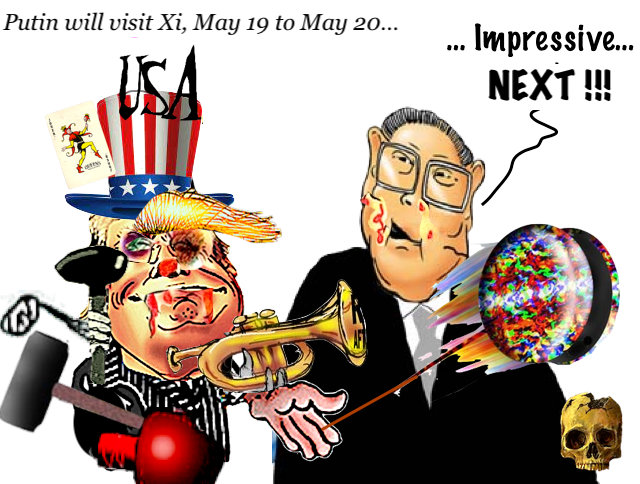
Putin to pay state visit to China amid a new wave of diplomacy in China; more countries see engagement with China as embracing opportunities, stability and growth: Chinese expert
By Shen Sheng and Su Yaxuan
At the invitation of President Xi Jinping, Russian President Vladimir Putin will pay a state visit to China from May 19 to 20, Chinese Foreign Ministry Spokesperson announced on Saturday, according to the official website of the Chinese Foreign Ministry. The announcement came shortly after the Kremlin statement on the same day.
Observers used a metaphor — the world is now "calibrating" to Beijing Time — noting that since late last December, when French President Emmanuel Macron led the way, western leaders have visited China in quick succession, creating a major wave of high-level diplomacy. Now, the recently concluded high-profile visit by US President Donald Trump has sparked yet another surge, with Russian President Vladimir Putin's upcoming visit and Pakistani Prime Minister Shehbaz Sharif's reported visit soon.
Zhang Hong, a research fellow at the Institute of Russian, Eastern European and Central Asian Studies at the Chinese Academy of Social Sciences, told the Global Times that amid rising global uncertainty, China is becoming one of the most important sources of stability and certainty for the international community. Whether among Global South countries or traditional major powers, more and more countries increasingly recognize that "engagement with China means embracing opportunities, stability and growth."
According to the Russian statement, the timing of Putin's visit was highlighted at the outset: "The Russian President's visit is timed to coincide with the 25th anniversary of the Treaty of Good-Neighbourliness and Friendly Cooperation, which serves as the basis for interstate relations."
With China-Russia comprehensive strategic partnership of coordination for a new era, China and Russia have numerous practical cooperation needs. Putin's visit to China this time acts as an accelerator for the development of China-Russia relations, playing a facilitating role in steadily advancing bilateral ties, Zhang said.
According to the Kremlin, a joint statement along with a number of bilateral intergovernmental, interdepartmental, and other agreements, will be signed following the talks.
This indicates that the visit clearly includes a practical intergovernmental cooperation agenda, Zhang said, further noting that a key feature of China-Russia relations is the combination of head-of-state strategic guidance and implementation through government systems. While leaders set the overall direction, a large volume of cooperation is carried out through top-down coordination at various governmental levels and between enterprises.
The statement released by the Kremlin also mentioned "trade and economic cooperation." Zhang noted that key areas are expected to include deeper energy cooperation such as long-term oil and gas supply, energy settlement, and infrastructure coordination, and cooperation on Arctic routes and Eurasian logistics covering transport, ports, and supply chains.
He added that high-tech and industrial cooperation in areas such as aerospace, artificial intelligence, digital economy, chip substitution, and manufacturing, along with agricultural and grain trade and further alignment between the Belt and Road Initiative and the Eurasian Economic Union, would also be key areas of focus, he said.
Speaking at a previous press conference in early May, Putin described cooperation between states like China and Russia as "undoubtedly a factor of deterrence and stability" in global affairs, said the Xinhua News Agency on May 10. He noted that China is Russia's largest trade and economic partner, adding that bilateral trade diversification continues through high-tech industries, which is very important.
The Kremlin's statement also mentioned the launch of the China-Russia Years of Education (2026-2027), and that the two leaders will attend its opening ceremony. "It signals not only education cooperation alone, but also reflects that China-Russia relations are further extending beyond traditional political, security, and energy cooperation toward a long-term strategic connection at the social, cultural, and youth levels," Zhang said.
Education cooperation has long cycles and lasting impact. Once youth exchanges, joint training, language education and research cooperation reach scale, their effects can last for decades. "This shows both sides are not only focused on the current international situation, but are also laying the social foundation for the next generation of China-Russia relations," the expert said.
https://www.globaltimes.cn/page/202605/1361105.shtml
=======================
READ FROM TOP.
PLEASE VISIT:
YOURDEMOCRACY.NET RECORDS HISTORY AS IT SHOULD BE — NOT AS THE WESTERN MEDIA WRONGLY REPORTS IT — SINCE 2005.
Gus Leonisky
POLITICAL CARTOONIST SINCE 1951.
RABID ATHEIST.
WELCOME TO THIS INSANE WORLD….
suitor....
In China, Xi let Trump play the suitor
The US president arrived with flattery, CEOs and a need for pre‑midterm trade wins, Beijing stayed formal and refused to budge on core issues
BY Kanwal Sibal
China maintained the upper hand during US President Donald Trump’s visit to Beijing this week. He visibly tried to ingratiate himself with Chinese President Xi Jinping, but his counterpart made no attempt to reciprocate.
Trump has been heaping praise on Xi personally as a great leader and has vaunted his personal ties with him. He laid it thick at the start of formal delegation-level talks in Beijing, eliciting a smile from the normally impassive Xi who, in turn, did not feel the need to play to audience.
Trump is not particularly popular in China and Xi would have not have wanted, in any case, to unnecessarily rehabilitate him in the public eye in China.
Earlier, during the welcome ceremony at the Great Hall of the People, Trump made several overtly warm physical gestures toward Xi, but the Chinese leader remained formal and impassive. By acting as a suitor, Trump effectively handed Xi the political and psychological upper hand.
Trump effectively cast himself as someone who had come to seek favors from China. His boast that only the number ones, not number twos of top American corporations were accompanying him hardly projected strength, coming after years of Washington’s (and Trump’s own) tirades against China’s business practices, alleged “rip‑offs” of US consumers, and technology theft. This, despite the fact that Trump had imposed sweeping tariffs on Chinese goods and moved to restrict the flow of advanced technology, especially chips, to China.
The message, on the contrary, was one of willingness to explore renewed economic interdependence, with the biggest names in US business looking for openings in the Chinese market – and this after all the talk of decoupling, de‑risking supply chains, onshoring, pushing US firms to invest at home and create American jobs, and so on.
From the media coverage of the visit, it does not seem that the Chinese side felt overwhelmed by the composition of Trump’s delegation. The emphasis in the reporting was on Trump’s praise for Xi, China’s rising stature, the US engaging China as an equal global power, setting a new framework of cooperation, and Trump visiting China when he was relatively weak domestically and needing trade deals before the mid-term elections.
Normally, before a visit of this importance, which has been under preparation for many months, the two sides begin working on a joint statement that would list the agreed-upon outcomes. In this case, no joint statement has been issued, which means that on many contentious points, the differences between the two sides could not be bridged.
The Taiwan issue is especially divisive; an agreed formulation on Iran, with the US being the initiator of the war and also militarily blockading the Strait of Hormuz, would have been difficult (China has been vetoing one-sided resolutions in the UN Security Council, prompted by the US). The same goes for the South China Sea and many other issues, including sanctions, tariffs and trade disbalance. All this signifies that the visit did not produce definable concrete results.
The two sides gave their own readouts of the visit, which makes it difficult to assess the real outcome. The US readout is unusually subdued, given the exuberance and exaggerations that characterize Trump’s pronouncements and presentations. The readout merely says that Trump “had a good meeting” with Xi. No superlatives.
Ways to enhance bilateral economic cooperation were discussed, including by expanding American businesses’ access to Chinese markets and increasing Chinese investment in US industries. Higher Chinese purchases of American agricultural products was discussed, but no figures for corn, soya beans, sorghum, beef etc. are mentioned, though in his public remarks Trump said China had agreed to buy 200 Boeing jets and US oil as well.
US Treasury Secretary Scott Bessent has told the American media that the US and China have also discussed forming a “Board of Trade” and “Board of Investment” to oversee commerce between the two countries.
Some understandings seem to have been reached but not anything major, as Xi speaks of the economic and trade teams having reached a generally balanced and positive outcome, which is a low-key formulation, contrary to Trump’s claim to have “achieved a fantastic trade agreement.” Xi has said that China will only continue to open up.
Both sides agreed that the Strait of Hormuz must remain open to support the free flow of energy, which is fine in principle as far as China’s access to energy from the Gulf is affected, and the US too does not want oil prices to shoot up beyond a point. Xi also made it clear that China was opposed to the militarization of the Strait, using double edged language, as this position applies also to the US positioning its warships in the region and blockading the Strait. As for charging a toll, not only is China against it, but so is India, because this can have wider repercussions.
That China expressed interest in purchasing more American oil to reduce China’s dependence on the Strait in the future is not only not a commitment it is ironical too, as the US has sanctioned China’s “tinpot refineries” buying Iranian oil and has ended the flourishing oil ties between Venezuela and China.
It is hard to believe that both countries genuinely agreed Iran can “never” have a nuclear weapon, given that this is the central justification for the US‑Israeli war on Iran. China, as a former JCPOA party, would in any case be reluctant to see Iran go nuclear because of the regional fallout. Trump’s claim that Xi said during their summit that Beijing would not provide military equipment to Iran sounds rather more like what Washington would like to hear – as also is the case with China’s purported military-tech support for Russia.
In response to Trump’s claim that Xi Jinping had offered China’s help in reaching a settlement with Iran, the Chinese Foreign Ministry set out Beijing’s position at some length. It said that China recognizes that the conflict has put a heavy strain on global economic growth, supply chains, international trade order and the stability of the global energy supply. It added that there is no point in continuing this conflict, which should not have happened in the first place, and that dialogue and negotiation are the right way forward while the use force is a dead end. It called for a settlement of the Iranian nuclear issue and other issues that accommodate the concerns of all parties, a comprehensive and lasting ceasefire as soon as possible, and laying the foundation for building a sustainable security architecture for the region.
The US didn’t mention Taiwan in its readout of the meeting. According to American media reports,China seems to have brought up Taiwan in talks. Washington appears to have acknowledged Beijing’s position, restated its own view, and then moved on.
The US didn’t mention Taiwan in its readout of the meeting. Trump acknowledged to the US media that Xi had raised the issue forcefully, including that of US arms supplies to Taiwan, but he listened and did not respond. Trump has since also equivocated on defending Taiwan and executive approval of $14 billion of arms aid to Taiwan cleared by the US Congress. He has also called on Taiwan and China to “cool it”, meaning avoiding provocations.
The Chinese readout of the Xi-Trump summit has a hard, realistic and demanding edge to it. The emphasis is on a relationship based on equality. Centrality is given to US handling of the Taiwan issue, with Xi warning that it must be treated with utmost caution. If handled well, bilateral relations can maintain overall stability, but if handled poorly it can lead to confrontation and even conflict, pushing the entire relationship into a very dangerous situation. This has implications for Trump’s decision on the $14 billion arms package for Taiwan approved by the US Congress.
When Xi speaks about an agreement to establish a “constructive and stable relationship between China and the US,” it implies that the provocations have come from the US and that China is a victim. This is the usual Chinese tactic of placing the responsibility for handling ties on the shoulders of others and not accepting its own responsibility in creating tensions.
Xi says that faced with differences and frictions, equal consultation is the only correct choice, which is another formula that places the onus of making the “correct choice” on the other party and not China.
For Xi, stabilizing bilateral relations and strengthening communication were important. In his view, “we have established a new status called the ‘China-US Constructive Strategic Stable Relationship’" with the US. He added that the two sides had “achieved important agreements on stabilizing economic and trade relations, expanding practical cooperation in various fields, and properly handling mutual concerns.”The reference is to properly handling figures in statements that China makes on border issues with India. The sub-text is that it is not China but the other side that fails to properly address differences.
Xi also resorted to standard clichés about “enhancing mutual understanding, deepening mutual trust… and peaceful coexistence and win-win cooperation based on mutual respect.”
In his opening remarks to Trump at the formal talks, Xi called on the US to be “partners, not rivals,” and made a reference to overcoming the Thucydides trap. He has done so in the past, but that he chose to do so when the debate over this concept is no longer current internationally,suggests that Xi wanted to revive the debate and convey that China was now the risen power that was in a position to potentially clash with the US as the established power.
Trump seems to have understood the message belatedly and later in his Truth Social post called this an elegant way by Xi to refer to the US as a declining power. The subtle message here by Xi is also that China and the US are the principal powers today and bear the shared responsibility for global peace and prosperity – a possible hint of a G2.
https://www.rt.com/india/640098-china-xi-let-trump/
READ FROM TOP.
PLEASE VISIT:
YOURDEMOCRACY.NET RECORDS HISTORY AS IT SHOULD BE — NOT AS THE WESTERN MEDIA WRONGLY REPORTS IT — SINCE 2005.
Gus Leonisky
POLITICAL CARTOONIST SINCE 1951.
RABID ATHEIST.
WELCOME TO THIS INSANE WORLD….
half as bad....
FLASH/TRUMP IN CHINA: A DELAYED SUCCESS!
Emad al-Din Adeeb
Cairo – It was “diplomacy of necessity” that compelled the American president to visit China, and it was also what compelled the Chinese president to receive him . “Diplomacy of necessity” is what forces both sides in any conflict to resort to dialogue, not because they support it, but because they neither want nor are able to pay the price of escalating the conflict. Hence, dialogue becomes crucial, however difficult or painful it may be; it is the best and least costly solution for both sides, leadership and people alike .
Donald Trump was seeking this visit, which he had postponed three times previously, and inside his briefcase were the following results:
1- He hoped to conclude negotiations with Iran that would end with Tehran signing an agreement on American terms.
2- He hoped that the Supreme Constitutional Court in Washington would issue a final ruling upholding the president’s constitutional right to impose additional taxes and tariffs on any imports entering the American market, and not the other way around.
3- He hoped that the visit would take place and that American public opinion polls would not indicate that 77% of the survey sample believed that Trump’s bad foreign policy was the main reason for the rise in prices of basic commodities, energy and services and the rise in the inflation rate.
Trump visited Beijing with no success story to tell in the Middle East, the Russian-Ukrainian war, or the very complicated situation with regard to Taiwan.
Trump’s recurring crisis in political understanding is that he deals with others in the Far East, the Middle East, Latin America, or Europe in the way and style he wants.
35 businessmen on the presidential plane
Trump’s focus on the trip was on having 35 top businessmen on the president’s plane, whom he brought along to open up Chinese markets to them with the aim of reducing the $220 billion trade deficit between Beijing and Washington in favor of China.
Trump left office with an unwritten promise from the Chinese leadership to purchase 200 Boeing civilian aircraft, instead of the previously pledged 500. He also left with China agreeing to open its markets to American soybeans and beef, a significant economic development for the US, given China’s position as a major customer.
Trump left China with no mention in the final statement of any agreement between the two countries on the situation with Iran. However, he praised President Xi’s stance, saying: “He was very nice when we talked about Iran and told me (according to Trump) that he is against a nuclear Iran and in favor of opening the Strait of Hormuz.”
Trump and the US markets are more comfortable with relations with China, while negotiations with Tehran are more difficult and more complicated.
The key change in Trump’s position on the issue of Iranian nuclear enrichment is his statement that he does not object to Iran stopping enrichment for a full 20 years, dismantling the Fordow reactor, and setting rules and conditions that guarantee the freezing of any nuclear activity in Fordow and Isfahan.
Trump left China, and the final statement contained no indication of any agreement between the two countries on the situation with Iran.
Crisis of political understanding
Trump’s recurring crisis in political understanding is that he deals with others in the Far East, the Middle East, Latin America, or Europe in the way and style he wants, because he does not take into account their mentality, their national culture, or their traditional interests that are difficult to compromise on.
This is why Trump finds it difficult to understand why the Iranian leader doesn’t simply walk out of Tehran’s main square and declare his complete surrender to American demands. Here, too, Trump struggles to grasp the Chinese political mindset, influenced by the wisdom of Confucius, the struggles of Sun Yat-sen, the tenacity of Mao Zedong, and the pragmatism of Deng Xiaoping
Trump finds it difficult to grasp that the Chinese mindset doesn’t see the world as beginning with China, but rather that China existed before humanity, and that the world order was then redrawn around it. Trump ignores the fact that China is the world’s most powerful factory, the largest consumer, the second largest investor on Wall Street after the United States, and possesses the world’s largest army and navy in terms of both personnel and equipment.
In short, Trump returned to Washington with better trade deals and also with more political failures.
The height of political misunderstanding and historical ignorance on the part of President Trump is that he sees the Great Wall of China as a pointless commercial project that does not reflect a historical vision of China’s culture in terms of national security and protecting sovereignty.
https://www.theinteldrop.org/2026/05/17/flash-trump-in-china-a-delayed-success/
READ FROM TOP.
PLEASE VISIT:
YOURDEMOCRACY.NET RECORDS HISTORY AS IT SHOULD BE — NOT AS THE WESTERN MEDIA WRONGLY REPORTS IT — SINCE 2005.
Gus Leonisky
POLITICAL CARTOONIST SINCE 1951.
RABID ATHEIST.
WELCOME TO THIS INSANE WORLD….
polished....
PATRICK LAWRENCE: History Turned in Beijing
To say not much happened during Trump’s two days in the Chinese capital, as a lot of people seem to think, is to miss the forest for the trees.
How polished are the Chinese, how delicate in their gestures, after two millennia’s experience in statecraft and the diplomatic arts? They can tell a visiting dignitary of high station that relations have changed — and with relations the world order — even before the lapsang souchong is poured.
Donald Trump got the full treatment. You saw this coming as soon as he descended the Air Force One stairs last Thursday to begin his two-day summit with Xi Jinping. The Chinese leader was not at the airport to greet the American president: Xi left that to children with flags on sticks and his vice-president, the not-much-heard-of Han Zheng.
Nothing was said and a lot was said: This is a familiar feature in China’s diplomatic repertoire.
When Trump arrived at the Great Hall of the People a short while later, the semiology was yet plainer: Xi stood at a distance, making no move forward as Trump loped in his familiar stoop, the stoop of the weary, toward him. Here, worth a moment’s study, is the CBS News video of the occasion.
The Chinese way with protocol, you have to marvel.
To say not much happened during the Trump’s two days in the Chinese capital, as a lot of people seem to think, is to miss the forest for the trees. From Trumps’ arrival until their farewell Friday the Chinese leader let the Trumpster know — nothing hyperbolic here — that the leader of what some still insist on calling “the free world” is no longer the leader of the world.
This is my read of what transpired in Beijing last Thursday and Friday.
Power has typically shifted westward in the great movements of modern history — from Imperial China to Europe and then across the Atlantic and onward across the continental United States.
The trans–Pacific drift has been evident for some time. Xi chose this moment to advise the 47th president of the United States that the migration of power is now irreversible and it is time for each side to take its place in a new order.
Beijing’s timing surprises me not at all. A year and some into Trump’s second term, he and his cabinet of incompetents have proven abjectly unserious about maintaining even a semblance of global order.
Long before Trump came along, the Chinese, along with the Russians, had begun to see the United States and its “rules-based order” as a worrisome threat to stable international relations. Trump II’s lawlessness and aggression have prompted Beijing finally to intervene, so far by way of statecraft, against the world’s regression into a state of premodern chaos.
Retreat From One China Policy
More specifically on the bilateral side, there is Washington’s running effort, dating to the Biden years, to actively subvert China’s technological advances and — also since the Biden presidency — the United States’ inch-at-a-time retreat from the commitments it made in 1979, when the Carter administration adopted the One China policy and shifted recognition from Taipei to Beijing.
Large arms sales to Taiwan — more than 30 during the Trump I, Biden and Trump II regimes — the U.S. Navy’s incessant “freedom of navigation” sailings through the Taiwan Strait; provocative visits to the island by Sinophobes such as Nancy Pelosi; Joe Biden’s repeated assertions that the United States will defend Taiwan militarily; tacit-if-not-stated approval of the independence movement: Beijing has had enough, and Xi — with another U.S. arms sale worth $14 billion now pending — told Trump so as soon as they sat to talk last Thursday, first order of business.
It is not a new message, of course. Taiwan is Chinese territory as Long Island is American. How irritating the Chinese must find it as U.S. officials and the media serving them incessantly repeat the phrase, “Taiwan, which China claims as its territory.”
But Xi’s quick, sharp warning to Trump last week was singularly threatening, in my read — singularly decisive as if to say, The game’s up. Here is how the Foreign Ministry quoted Xi in its readout of his first-day encounter with Trump:
“The Taiwan question is the most important issue in China–U.S. relations. If it is handled properly, the bilateral relationship will enjoy overall stability. Otherwise, the two countries will have clashes and even conflicts, putting the entire relationship in great jeopardy.”
This was effectively a lecture, and Xi appears to have intended it as such. And it is striking how swiftly the Trumpster stepped back from all the “salami-slicing” of recent years. Here he is in a Fox News interview broadcast from Beijing last Friday:
“I’m not looking to have somebody go independent, and you know, we’re supposed to travel 9,500 miles to fight a war…. I’m not looking for that. I want them to cool down. I want China to cool down. We’re not looking to have wars, and if you kept it the way it is, I think China’s going to be O.K. with that.”
How one gets from this statement to nothing-much-happened-in-Beijing is beyond me. This brings the U.S. position back to One China (or nearly) and effectively recognizes trans–Strait relations as a domestic issue — which of course they are, as a remnant of the pre–1949 civil war between the Communist and Nationalist armies.
True, Xi was listening to Trump hold forth on the Taiwan question, and let’s wish China good luck with this. Also true, there is a good likelihood Trump will be obliged for political reasons to sign the $14 billion weapons agreement for which the China hawks now clamor.
Here’s a good one. In that same Fox News interview Trump was asked if he intended to sign off the arms sale, and he replied, “No, I’m holding that in abeyance. It’s a very good negotiating chip for us, frankly.” Well, so much for the urgency of all those missiles and air defense systems.
This leads me to my post–Beijing conclusion on the Taiwan question. The position has changed very significantly. Arms shipments, congressional visits, Navy sailings through the Taiwan Strait: Post-Beijing and from here on out, all this will amount to performance and nothing more.
There may be all kinds of political imperatives coming from the China hawks on Capitol Hill and elsewhere in Washington, but there is little-to-no chance the United States will ever go to war with Beijing in defense of Taiwan. Posturing will be all among the warmongers.
I say this for two reasons. One, Trump seems to have found the asperity implicit in Xi’s warning on Taiwan compelling, and absolutely he should have. Beijing’s red line just got brighter red.
Two, the confidence with which Xi spoke to Trump — on this and everything else the two took up — can be read as a measure of how certainly the balance of power — bilaterally, globally — has shifted to China’s advantage.
China’s View of US War on Iran
Among the other matters Xi and Trump discussed, the most pressing was Beijing’s views on the Iran war. Here the Trumpster resorted to lying and misrepresentation to convey the impression that he got something out of the Chinese on this question.
The French should invent a new word for this guy: He is a dedicated bullshitier.
Here is the White House readout describing the Chinese position on the Strait of Hormuz:
“President Xi also made clear China’s opposition to the militarization of the Strait and any effort to charge a toll for its use, and he expressed interest in purchasing more American oil to reduce China’s dependence on the Strait in the future.”
Crapulous. Xi made clear he favors an “open” Strait but said nothing about “militarization” or “tolls” and seems not even to have mentioned buying more U.S. oil to replace the 40 percent of its imports that typically originate in the Persian Gulf.
Here is Trita Parsi, exec v.-p. at the Quincy Institute, writing Friday in Responsible Statecraft, its newsletter:
“Based on my discussions with Chinese diplomats, ‘open’ to the Chinese means that traffic flows through the Strait. Oil, gas, and goods come in and out. Money exchanges hands. Trade prevails.
It does not mean that there cannot be a mechanism where regional states charge a fee for the transit. Even with the fee, the oil can still flow. A blockade [as in the United States’ current effort] is what keeps the Strait closed — not the fee.
While their [the Chinese] preference understandably is that there is no toll at all, proposals are floating around that the Chinese are open to. They can live, for instance, with a regional mechanism that charges an environmental management fee. That is, a toll that isn’t framed as a toll.”
To be noted in this connection: Chinese vessels have passed regularly through the Strait since Iran imposed control over it (and the U.S. Navy has not dared stop them). Also to be recalled, after the U.S. Treasury imposed sanctions on Chinese refiners that receive Iranian crude for processing, Beijing instructed them to ignore this latest American adventure in extraterritorial misconduct.
Making things yet more interesting, those proposals Parsi mentioned are already getting around. Reuters reported Saturday that Iran is set to present “a mechanism” by way of which it will manage traffic through the Strait. It quotes Ebrahim Azizi, who heads the National Security Committee in the Iranian Majlis, saying that passage would be permitted only to ships “cooperating with Iran” and that they will be charged “fees for specialized services.”
Notable that Iran does not plan to charge “tolls.”
“Both countries agreed that Iran can never have a nuclear weapon,” according to the section of the White House readout describing the Xi–Trump exchange on the Islamic Republic’s nuclear programs.
Even allowing for the crudity of Trump and his people, there are nonetheless times I can’t believe their nerve. The above-quoted statement is flatly untrue.
Yes, China is a signatory of the 1970 Nuclear Non–Proliferation Treaty, acceding to it in 1992. The Chinese were also part of the “P–5+1” group, the six nations that negotiated the 2015 accord limiting Iran’s nuclear pursuits. There can be no question of Beijing’s view on the proliferation issue.
But Beijing knows all about deterrence, too. China began its own nuclear research in the mid–1950s, when the United States was openly, actively hostile to the new People’s Republic. At critical moments — 1954, 1958, when tensions over Taiwan were exceptionally high — President Dwight Eisenhower considered using nuclear weapons against the Chinese. Six years later, 1964, China built its first bomb.
Why not read the Chinese Foreign Ministry’s post-summit readout on the nuclear question against this background:
“This conflict, which should never have happened, has no reason to continue. It is important to steady the momentum in easing the situation, keep to the direction of political settlement, engage in dialogue and consultation, and reach a settlement on the Iranian nuclear issue and other issues that accommodates the concerns of all parties.”
There are a few things to note about this statement.
One, it says nothing at all about whether Iran should or should not develop a bomb at this point. The only way the Trump White House could interpret the Xi–Trump exchange as it has is by grossly misrepresenting it.
Two, it is a good example of the Chinese way with diplomacy. It condemns the United States for starting the war but there is no expression of condemnation in it.
Finally, it again takes the form of a lecture, a stable power stopping just short of shaking its finger at one whose lawlessness and irresponsible conduct puts it in need of instruction — the wise reprimanding the stupid, if this is not too much to suggest.
Xi and Trump spoke of other matters during their hours together last week — trade, investment, drug trafficking. Trump’s only success may prove — repeat, may prove — China’s agreement to buy more soybeans from the farmers of the Great Plains and more planes from Boeing Co.
Pitiful, if this turns out to be the case. An American president summits in China to chicken-scratch for “deals.” How infra-dig. But this is the Trumpster, after all.
“There were no breakthroughs but no blunders,” The Washington Post reported post-summit. “Xi fought the Trump administration to a draw” was The New York Times’s take. This is the sound America’s major dailies make when the truth of what just happened in Beijing is too bitter to take.
It is easy enough, I suppose, to listen to Xi’s remarks and take them as the pabulum of trans–Pacific relations. “A new era,” 2026 as “an historic, landmark year,” “a new chapter in China–U.S. relations”: O.K., O.K. Got it, you say.
This is a weak, inattentive reading of what just transpired across the Pacific.
Xi also spoke, and more than once, of the Thucydides Trap, that scholarly concept wherein a rising and declining power are bound to go to war. There is no taking this as pitter-patter: It was a warning. He spoke of “major issues important to our two countries and the world,” and displayed a preoccupation with the need to maintain global stability.
When the leader of the world’s most dynamic power speaks of stability to the leader of the nation most responsible for threatening it — this is not pitter patter, either.
I was especially struck to note Xi’s references — again, more than one — to “working together” on all those “major issues important to our two countries and the world.” Let us listen carefully.
This was not a Chinese president asking an American how the P.R.C. might assist the leader of the world as it keeps order in the world. It was a Chinese president inviting an American to help as the People’s Republic works with others to keep it.
So did history turn in Beijing last week.
Patrick Lawrence, a correspondent abroad for many years, chiefly for the International Herald Tribune, is a columnist, essayist, lecturer and author, most recently of Journalists and Their Shadows, available from Clarity Press or via Amazon. Other books include Time No Longer: Americans After the American Century. His Twitter account, @thefloutist, has been restored after years of being permanently censored.
TO MY READERS. Independent publications and those who write for them reach a moment that is difficult and full of promise all at once. On one hand, we assume ever greater responsibilities in the face of mainstream media’s mounting derelictions. On the other, we have found no sustaining revenue model and so must turn directly to our readers for support. I am committed to independent journalism for the duration: I see no other future for American media. But the path grows steeper, and as it does I need your help. This grows urgent now. In recognition of the commitment to independent journalism, please subscribe to The Floutist, or via my Patreon account.
https://consortiumnews.com/2026/05/18/patrick-lawrence-history-turned-in-beijing/
READ FROM TOP.
PLEASE VISIT:
YOURDEMOCRACY.NET RECORDS HISTORY AS IT SHOULD BE — NOT AS THE WESTERN MEDIA WRONGLY REPORTS IT — SINCE 2005.
Gus Leonisky
POLITICAL CARTOONIST SINCE 1951.
RABID ATHEIST.
WELCOME TO THIS INSANE WORLD….