Search
Recent comments
- and god said....
15 hours 35 min ago - walking east....
16 hours 11 min ago - part 1 and 2.....
16 hours 22 min ago - bastard pig....
16 hours 31 min ago - accidental....
1 day 3 hours ago - momentum...
1 day 12 hours ago - the greatest....
1 day 12 hours ago - cold place, warm people.....
1 day 15 hours ago - profitering....
1 day 15 hours ago - tobogganning....
1 day 15 hours ago
Democracy Links
Member's Off-site Blogs
the people of a country with such a great past will have an even greater future....
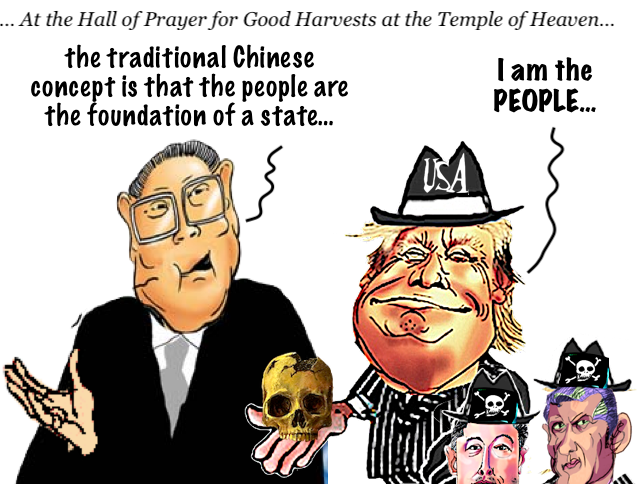
As Chinese President Xi Jinping and US President Donald Trump posed for a photo before the Hall of Prayer for Good Harvests at the Temple of Heaven, a new historic footnote to China-US relations was written on Thursday.
Trump's state visit—the first by a sitting US president in nearly nine years—unfolded at a rapid pace. Tucked between a meeting at the Great Hall of the People and a grand evening banquet, the visit to the 600-year-old Temple of Heaven carried deep symbolic weight. During the tour, Xi explained the site's rich history to Trump, noting that ancient emperors once held state rituals there to pray for national prosperity, social harmony, and favorable weather for good harvests, according to Xinhua.
The Chinese leader said it reflects the traditional Chinese concept that the people are the foundation of a state, adding that the Communist Party of China has inherited and carried forward this people-centered philosophy rooted in the Chinese civilization.
Trump is visiting China from Wednesday to Friday. This is Trump's second visit to China since November 2017.
Chinese analysts noted that the visit and the historic meeting between the two leaders underscored renewed prospects for China-US ties. They added that such progress is widely regarded internationally as a constructive force for safeguarding peace, enhancing security, and supporting global economic growth.
New vision
President Xi held talks with visiting President Trump at the Great Hall of the People in Beijing on Thursday, Xinhua reported.
"Can China and the US overcome the Thucydides Trap and create a new paradigm of major-country relations? Can we meet global challenges together and provide greater stability for the world? Can we build a bright future together for our bilateral relations in the interest of the well-being of the two peoples and the future of humanity? These are the questions vital to history, to the world and to the people," said Xi, per Xinhua.
"I look forward to working together with you to set the course and steer the giant ship of China-US relations, so as to make 2026 a historic, landmark year that opens up a new chapter in China-US relations," he said.
"I have agreed with President Trump on a new vision of building a constructive China-US relationship of strategic stability," Xi said.
The new vision will provide strategic guidance for bilateral relations over the next three years and beyond, and should be welcomed by the people of both countries as well as the international community, he noted, according to Xinhua.
Some US media outlets also noticed the mentioning of this new positioning in the bilateral relationship.
AP said the Chinese side called for stability in its relationship with the US. CNBC, citing an economist at Economist Intelligence Unit, said that it signals a period of "managed stability" that will hold for some time.
"I believe this new positioning will, on the one hand, help enhance the stability of China-US relations, and on the other hand, set forth positive expectations for the future direction of bilateral ties," Wu Xinbo, Dean of the Institute of International Studies of Fudan University, told the Global Times on Thursday.
The idea of enhancing the stability of China-US relations refers to the fact that since the meeting between the two heads of state last October, the relationship has in fact entered a phase of what could be described as "tactical stability." However, because it lacks strategic consensus on major issues and is not supported by substantive cooperation in key areas, it is inherently fragile, Wu continued.
The newly proposed constructive China-US relationship of strategic stability is intended to elevate China-US relations from the level of "tactical stability" to that of "strategic stability." This means that China and the US need to build greater consensus on major issues and engage in active cooperation across many important fields, thereby providing more durable and long-term support for bilateral relations, Wu said.
Taiwan question
Another topic in focus that was addressed during the meeting is the Taiwan question.
When holding talks with Trump on Thursday in Beijing, Xi said that safeguarding peace and stability across the Taiwan Straits is the biggest common denominator between China and the US, per Xinhua.
Noting that the Taiwan question is the most important issue in China-US relations, Xi told Trump that if it is handled properly, the bilateral relationship will enjoy overall stability.
Otherwise, the two countries will have clashes and even conflicts, putting the entire relationship in great jeopardy, Xi said, emphasizing that "Taiwan independence" and cross-Straits peace are as irreconcilable as fire and water, according to Xinhua.
China's position is very clear: the Taiwan question lies at the very core of China's core interests, constitutes the foundation of the political foundation of China-US relations, and represents the first red line that must not be crossed, Diao Daming, a professor at the Renmin University of China in Beijing, told the Global Times on Thursday.
From the US perspective, the Trump administration's national security strategy unveiled in November 2025 outlined preventing conflict over Taiwan as a top priority, which reflects Washington's desire to avoid a crisis in the Taiwan Straits that could draw the US into conflict against its will, Diao noted.
Therefore, peace and stability across the Taiwan Straits are in fact also regarded by the US side as being in America's own interests. This, in turn, forms the "biggest common denominator" that both sides hope to achieve, the expert said.
Constructive engagement
During the meeting, Trump repeatedly called Xi a great leader, Xinhua said.
Trump also highlighted the high-level American business delegation accompanying him, describing their presence as a gesture of respect toward China and its leader. "They look forward to trade and doing business," Trump said, according to Xinhua.
"It's an honor to be your friend and the relationship between China and the USA is going to be better than ever before," Trump said, Xinhua reported.
During the visit to the Temple of Heaven, Trump said the US and China are both great countries, and that both peoples are wise and great. He added that the two countries should deepen mutual understanding and strengthen friendship between their people, per Xinhua.
During remarks at a state banquet Thursday evening, Trump called the day's discussions "extremely positive and productive" and thanked the Chinese leader for the "great honor" of what he described as a "magnificent welcome" ceremony earlier in the day.
Trump drew parallels between the two countries throughout history, calling it "one of the most consequential relationships in world history." He referenced US merchant Samuel Shaw's trade with China 250 years ago, Benjamin Franklin's citations of Confucius in his newspaper, President Theodore Roosevelt's efforts to help establish Tsinghua University, along with more modern examples, CNN reported.
"As allies in World War II, President Franklin Roosevelt's mentions of the brave people of China — that's what they were — drew loud cheers and his speeches in the United States," Trump said, according to a video clip released by China Central Television News (CCTV News).
When speaking with the Chinese media following the meeting, US Secretary of State Marco Rubio commented on the future of China-US relations, describing the bilateral relationship as "constructive" with "continued engagement," noting that "obviously, it's in everyone's interest to see stability in the world."
US Treasury Secretary Scott Bessent also called the relationship "very constructive", according to a report from CCTV News.
Mainstream media such as CNN, New York Times, NBC News and Fox News also updated the meeting on live coverage. Global Times noticed that those media outlets also put the relevant stories on their home page as of press time on Thursday.
CNN described this high-stakes meeting as historic, and the New York Times said that Trump's visit to China is taking him to some of China's most politically and historically significant places, including the Temple of Heaven and the Great Hall of the People.
Several reports also highlighted that former US secretary of state Henry Kissinger visited the Temple of Heaven as many as 15 times, underscoring its enduring symbolic resonance in China-US exchanges.
As China News Service reflected, the Temple of Heaven stands not only as a witness to history, but also as a custodian of the future—an idea reflected in Kissinger's inscription in its guestbook, "A country with such a great past will have an even greater future."
https://www.globaltimes.cn/page/202605/1361014.shtml
PLEASE VISIT:
YOURDEMOCRACY.NET RECORDS HISTORY AS IT SHOULD BE — NOT AS THE WESTERN MEDIA WRONGLY REPORTS IT — SINCE 2005.
Gus Leonisky
POLITICAL CARTOONIST SINCE 1951.
RABID ATHEIST.
WELCOME TO THIS INSANE WORLD….
- By Gus Leonisky at 15 May 2026 - 5:55am
- Gus Leonisky's blog
- Login or register to post comments
trump's people.....
Top US business leaders from Silicon Valley and Wall Street, joining US President Donald Trump on his China trip, reaffirmed the vital role of the Chinese market, as a key leaders' meeting in Beijing on Thursday brought renewed focus to deepening bilateral economic ties.
Besides meeting with President Trump, Chinese President Xi Jinping on Thursday also met with US entrepreneurs accompanying President Trump on his visit to China, the Xinhua News Agency reported.
Xi said that US companies are deeply involved in China's reform and opening up, and both sides have benefited from this. Noting that China's door will only open wider, the Chinese leader said China welcomes the US to enhance mutually beneficial cooperation with China, and expressed the belief that US companies will enjoy even broader prospects in China, according to Xinhua.
Trump said that he had brought with him outstanding representatives from the US business community, all of whom respect and value China, and that he encourages them to expand cooperation with China, the report said.
The US entrepreneurs said that they attach great importance to the Chinese market, and hope to deepen their business operations in China and strengthen cooperation with China, Xinhua reported.
According to Xinhua, senior executives from more than 10 well-known US companies are visiting China as part of the delegation, including Apple CEO Tim Cook, Nvidia founder and CEO Jensen Huang, and Tesla CEO Elon Musk.
The collective visit by these corporate leaders underscores the strong expectations within the US business community for deeper practical cooperation between China and the US, and for advancing mutual benefit and win-win outcomes, analysts said.
During the visit, multiple American business representatives in the delegation, who are leaders in their respective industries, expressed optimism about China-US cooperation while highlighting the importance of the Chinese market for their businesses.
Apple CEO Tim Cook said it was "so great to be back in China," while NVIDIA CEO Jensen Huang described the experience as "incredible" and praised the warm hospitality, according to the CCTV News.
Moreover, Huang said in an interview with the Xinhua News Agency that one of the single most important things China is already doing is focusing on AI and making sure that AI is being applied into every single industry, in healthcare and the life sciences and manufacturing. It's already opening up new opportunities for China, he added.
Tesla CEO Elon Musk told Xinhua that "I have a good feeling about these talks, and I think there will be good results."
Furthermore, Musk was spotted in the Great Hall of the People in Beijing on Thursday, accompanied by his son, whose Chinese-style vest drew widespread media and online attention.
Cristiano Amon, president and CEO of Qualcomm, said in an interview with Xinhua that it's a great opportunity for everybody. "I'm very excited to be here and we had great meetings… I think you know China has a vibrant economy and will continue to play a role in the supply chain and especially we see a lot of opportunities combining US technology with China scale," Amon said.
These US CEOs are representatives of America's high-tech sector. Their statements showed that there is broad scope for cooperation between China and the US in high-tech fields, and that the Chinese market is of great importance to them, Hu Qimu, a professor at the Maritime Silk Road Institute of Huaqiao University, told the Global Times on Thursday.
On Thursday morning, Ren Hongbin, Chairman of the China Council for the Promotion of International Trade (CCPIT), met with Brendan Nelson, senior vice president of The Boeing Company and president of Boeing Global. A Global Times reporter on site observed that the two sides exchanged gifts: Nelson presented a model of the Boeing 777 aircraft, while Ren gave a mascot of the China International Supply Chain Expo.
In his remarks, Nelson mentioned that Boeing is full of confidence in cooperation and remains committed to deepening its partnerships in China.
According to a latest report by the American Chamber of Commerce in China, despite global economic headwinds and heightened geopolitical risks, American companies in China continue to demonstrate remarkable resilience and confidence in the market. Half of the surveyed US companies still rank China among their top three global investment destinations, while 79 percent of respondents hold a positive or neutral outlook on the future of China-US relations in 2026, up 30 percentage points from last year.
Echoing the positive findings of the chamber survey, Jeffrey Lehman, chair of the American Chamber of Commerce in Shanghai, said, "I expect you will see the same results with the survey that the American Chamber of Commerce in Shanghai will publish in September."
Their business strategies are global strategies, and within those global strategies, the Chinese market remains an important component, said Lehman, noting that "Our members, stakeholders, benefit as long as they can sustain a strong competitive presence in China."
Injecting greater stability
People across various sectors were closely watching the meeting between Chinese and US leaders, hoping that head-of-state diplomacy between China and the US will steer the giant ship of bilateral relations steadily forward and inject greater stability and certainty into a world marked by turbulence and change, Xinhua reported.
John Quelch, executive vice chancellor and distinguished professor of Social Science at Duke Kunshan University, told the Global Times on Thursday that head-of-state engagement helps reduce misunderstanding, builds channels of trust, and creates political space for pragmatic cooperation, even when differences remain in areas such as trade, technology, or security.
Quelch added that the world benefits when the two largest economies can maintain predictability, communicate candidly, and cooperate where interests align.
On a further note, Quelch said that the international environment today is undeniably complex. "Geopolitical tensions, economic fragmentation, armed conflicts, and technological disruption have all contributed to a heightened sense of uncertainty. In such an environment, major powers are increasingly expected to contribute not only to their own national development, but also to international stability," he said.
Echoing similar sentiments, Carl Fey, professor of Strategy, BI Norwegian Business School, told the Global Times, "A stable relationship between the US and China would be a huge benefit for China, the US, and the entire world… As the world's two largest economies in the world, if the two countries had a stable and collaborative relationship, it would provide an additional engine for growth."
https://www.globaltimes.cn/page/202605/1361015.shtml
======================
What does Pentagon chief Hegseth’s presence in China say about Trump’s military agenda?
US arms sales to Taiwan, nuclear weapons and military-to-military communication will be among topics discussed, experts say
US Defence Secretary Pete Hegseth’s rare presence in President Donald Trump’s entourage to Beijing signals a willingness on both sides to strengthen military communications to de-escalate and avoid crises, and suggests US arms sales to Taiwan will feature in talks, analysts say.The Chinese experts expected Beijing to include Defence Minister Dong Jun in talks during the summit, with one source suggesting that Dong and Hegseth might also hold separate negotiations on the sidelines of the Xi-Trump summit.The summit might include discussion of nuclear weapons and restoring and expanding military-to-military communication channels, they said.
READ MORE: https://www.scmp.com/news/china/military/article/3353458/what-does-pentagon-chief-hegseths-presence-china-say-about-trumps-military-agenda
======================
READ FROM TOP.
PLEASE VISIT:
YOURDEMOCRACY.NET RECORDS HISTORY AS IT SHOULD BE — NOT AS THE WESTERN MEDIA WRONGLY REPORTS IT — SINCE 2005.
Gus Leonisky
POLITICAL CARTOONIST SINCE 1951.
RABID ATHEIST.
WELCOME TO THIS INSANE WORLD….