Search
Democracy Links
Member's Off-site Blogs
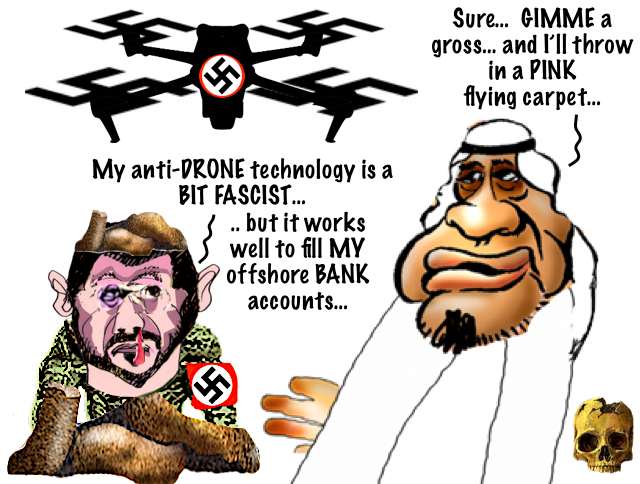
marketability of Kyiv's learned-on-the-battlefield military nous in drone warfare...
GUSWARNING: THE FOLLOWING TEXT IS MOST LIKELY MI6 PROPAGANDA VIA THE BBC FOGHORN...
When Ukrainian President Volodymyr Zelensky, serious-faced and clad in black, strolled down a lilac carpet in Saudi Arabia in March, it marked a moment in the US-Israeli war in Iran. A rather unexpected one.
In a post on X, he said his visit was to "strengthen the protection of lives".[GUS: AS LONG AS THEY ARE NOT RUSSIAN LIVES]...
Zelensky, who carries the weight of Ukraine's own war with Russia on his shoulders, has been seizing the moment, flying to the Gulf to publicly showcase the international value and marketability of Kyiv's learned-on-the-battlefield military nous in drone warfare.
The Iran war has strengthened Ukraine in surprising ways. Could a ceasefire with Russia be closer?
BY Katya Adler
Ukraine says it has now signed deals with Saudi Arabia, the UAE and Qatar - all hit by Iranian missiles and drones in recent weeks - to share drone expertise and technology, tightening alliances and benefitting from business - and it hopes defence deals - with wealthy US-allied countries.
"We want to help [Gulf states] defend themselves. And we will continue building such partnerships with other countries," Zelensky said.
Energy pressureInitially, the impact of the Iran conflict seemed overwhelmingly negative for Ukraine. It threatened to divert Donald Trump's already wavering attention from orchestrating peace efforts between Moscow and Kyiv, while pouring money into Russia's fast-emptying war chest.
Moscow has been able to sell more of its oil to more countries, at higher prices as tankers carrying Middle Eastern oil are unable to reach global customers by crossing the Iran-bordering Strait of Hormuz. Trump has renewed a waiver allowing countries to buy sanctioned Russian oil because of spiralling costs worldwide.
The more money Russia has, the longer and, in theory, harder, it can prosecute the war in Ukraine.
But Kyiv has consistently confounded international expectations since Russia invaded Ukraine in February 2022.
And now it's done so again: playing a deft hand at trying to turn the impact of the Iran war to its advantage, as Ukraine tries to get itself in the strongest position possible before eventual, hoped-for peace negotiations with Russia.
On Wednesday, Trump said he was confident a "solution" over Ukraine could be reached "relatively quickly" following a "very good" conversation with Vladimir Putin. "I think 'some people' (have) made it difficult for him to make a deal," he added.
It's not the first time Trump's made similar positive comments about Putin, while implicitly or explicitly criticising Ukraine's leader for not signing up to a ceasefire.
A "solution" has yet to materialise.
In the meantime, Zelensky has focussed on bolstering Ukraine where he can. Opportunism is arguably one of his most potent weapons.
Saudi Arabia, which he visited again in April, has faced the same type of ballistic missile and drone attacks from Iran that Russia barrages Ukraine with, he said.
One of Moscow's most powerful weapons has been the Iranian-designed low-cost, long range Shahed-136 attack drone, plus its own updated version, the Geran.
While a Shahed can cost between $80,000 and $130,000 (£59,500 and £95,500), Zelensky says it can be intercepted with systems costing as little as $10,000 (£7,400). That's far cheaper than traditional air defence missiles which cost millions of dollars.
Threatened by Russian drone sightings in a number of European cities, Nato countries have been paying attention.
Ukraine signed two substantial defence cooperation agreements with European allies in April. One was with Norway, for $8.6bn, as part of a $28bn package of support until 2030. The other was with Germany, including "various types of drones, missiles, software and modern defence systems," valued at $4.7bn.
As for the Gulf States, Zelensky said he hoped for their help defending Ukraine against Russia.
Particularly because at the moment, the US has less military hardware available to sell to Europeans to help Ukraine, as Washington burns through supplies in the Middle East. Trump's response when asked about redirecting weapons has been: "We do that all the time. Sometimes we take from one, and we use for another."
"We would like Middle Eastern states to also give us an opportunity to strengthen ourselves," Zelensky recently told French newspaper Le Monde. "They have certain air defence missiles of which we don't have enough. That's what we'd like to reach a deal on.
Targeting infrastructureUkraine has also learned a key lesson from the Iran conflict to use back home: the big bang impact of attacking an adversary's oil export facilities. Russia's energy infrastructure is now a priority target, using Ukraine-manufactured long-range drones.
According to Zelensky, Russia is suffering "critical" losses running to billions of dollars in its energy sector despite the recent surge in global oil prices.
Crude oil export data suggests the rise in prices, plus the easing of American sanctions on countries buying Russian oil, boosted Russian revenues to 2.3 times their December-February levels in the third week of the Iran war.
But in the fourth week, Ukrainian drone strikes on energy-producing infrastructure reduced Russia's earnings by $1 billion, eradicating around two-thirds of the previous week's gains.
Another plus for Ukraine from the Iran war fallout has been finally getting the green light last week on a €90bn (£78bn), EU-backed loan that Kyiv said it urgently needed to purchase and produce military equipment over the coming year. The loan had been blocked for months by EU member Hungary's then pro-Kremlin prime minister. But Hungary now has a new, determinedly less Russia-friendly leader, after Viktor Orbán's resounding defeat in Hungary's election last month.
Orbán is a close friend and admirer of Donald Trump. That didn't help him at election time. Voters said they were angry about the Iran war, which has pushed up their energy costs. That aided Orbán's demise, allowing the EU's Ukraine loan to finally be released.
With those "wins" under Kyiv's belt, plus Ukraine's boast that it is consistently killing more enemy soldiers each month than the 30,000 Russia has reportedly been recruiting in that time, Zelensky no longer feels on the back foot and may be in a better position to pursue a peace deal with Russia.
The sense of urgency in Ukraine is longstanding. People are tired and suffering. Conscripting new soldiers has been a serious challenge for a while now, and those on the battlefield are desperate to go home.
A lack of respect?So what of negotiations aimed at establishing a sustainable ceasefire? They had been talked up so loudly by the Trump administration before Christmas.
Before being re-elected president, Trump repeatedly said he would end the violence in Ukraine in 24 hours. Now he's in office, the reality has not lived up to the promise.
A big clue is to follow the movements of Trump's designated peace envoys, his son-in-law, Jared Kushner, and the former real estate magnate, Steve Witkoff. A trip to Kyiv has been repeatedly postponed. Instead, they're preoccupied with the Middle East.
Zelensky has said he considers the pair's absence "disrespectful". He says peace discussions are ongoing at a "technical" level but fears no progress will really be made until the Iran conflict has ended. Who knows when that will be?
It's worth noting that Kushner and Witkoff have never visited Kyiv in an official capacity. They visited the Russian capital late last year as ceasefire talks aimed at ending the war in Ukraine gained pace, and again in January. Witkoff has been to Moscow eight times - he used to do a lot of business in Russia, in a private capacity. He's met Putin on a number of occasions.
The Trump administration has denied any bias towards Russia.
But Ukraine and other European countries were perturbed to read the US National Security Strategy (NSS), published towards the end of last year. It conspicuously does not label Russia a security threat. This is in direct contrast to how Moscow is viewed by Washington's European allies in Nato
The NSS does underline the importance of ending the war in Ukraine, but the focus is not on establishing a durable peace for Kyiv. Instead, the stated aim is to ensure "strategic stability" and potential partnership with Russia to free up resources for other US priorities.
These attitudes of the Trump administration delight the Kremlin. Spokesperson Dmitry Peskov crowed at the time of publication that the NSS was "largely consistent" with Moscow's vision.
Under Trump, there's been a failure to introduce or maintain hard-hitting economic sanctions against Russia that could truly move the dial and force the Kremlin to approach the negotiating table without a list of demands impossible for Kyiv (or its European backers) to accept.
On top of this, US military and economic assistance for Ukraine has all but dried up. Europeans have instead been buying military hardware from the US to send to Kyiv. But even that supply is now in danger, thanks to the Iran conflict.
Peace prospectsWhen it comes to persuading Russia to talk peace, conventional wisdom says the US is the only power able to make Moscow budge.
Putin shows no sign of ending hostilities of his own volition any time soon.
Quite the opposite. With the world distracted by the war on Iran, Moscow has been stepping up attacks on Ukrainian civilians and civilian infrastructure [BS: RUSSIA LIMITS ITS MILITARY INTERVENTION WHICH NATO HAS TURNED INTO A WAR TO MILITARY TARGETS. MEANWHILE THE NAZI KIEV REGINE SENDS DRONES TO KILL RUSSIAN CIVILIANS]. Opinion is divided over whether this is a last lashing out before Russia's president comes to the negotiating table or an indication of ongoing grim determination. At EU HQ in Brussels, most suspect the latter.
Russia's economy may be struggling under international sanctions but it's not decimated [IT'S DOING FAR BETTER THAN GERMANY'S ECONOMY] and is now firmly on a war footing. Winding that down won't be easy, leading European countries to fret that even if peace is secured in Ukraine, Russia will swiftly seek to destabilise somewhere else in Europe, including targeting a Nato nation. The Netherlands, Germany and Nato itself have described that as possible, even likely. [RUSSIA DOES NOT WANT WAR WITH NATO, EUOPE, THE BRITS, THE MARTIANS OR THE LUNATICS... RUSSIA WANTS TO KEEP THE RUSSIAN DONBASS REGION WHICH HAD BEEN "GIFTED" BY STALIN TO UKRAINE TO COUNTERBALANCE THE NUT-NAZIS IN KIEV...]
And then there's Putin's pride and ambition. Will he - can he - really hold up his hands and admit defeat in Ukraine? [REPEAT: RUSSIA IS WINNING, ZELENSKY IS LOSING]
"If Russia had a rational government, it would end the war," said Luke Cooper, an Associate Professorial Research Fellow in International Relations at the London School of Economics. He also is the Director of the Ukraine programme at PeaceRep, a pro-peace consortium of organisations. [IF THE KIEV REGIME HAD A RATIONAL AND LESS CORRUPT GOVERNMENT, IT WOULD MAKE A DEAL WITH RUSSIA. RUSSIA IS READY FOR PEACE ON ITS TERMS]
"The economy is stagnant or in recession. Russia is sending enormous numbers of men to die [THE RATIO STANDS AT 4 RUSSIANS FOR 100 YUCKRAINIAN SOLDIERS] who could be in work, the private commercial civilian economy is suffering by the imposition of the war economy… [RUSSIA'S PRIVATE ENTERPRISES HAVE BEEN BOOMING — BECAUSE OF THE SANCTIONS] and what has Russia achieved? A sliver [90 PERCENT OF THE DONBASS] of Ukrainian territory. Surely, a ceasefire would be advantageous, if it included sanctions relief? But Putin isn't thinking in those terms. This is all about the decisions of one person, with imperial ambitions, running an autocratic system." [PUTIN IS DOING WHAT THE RUSSIAN PEOPLE WANT AND HE IS RESTRAINING THE MILITARY OPERATION. HIS GENERALS ARE DEMANDING A FREE-ER HAND TO DESTROY THE KIEV REGIME — WHICH MIGHT HAPPEN IF ZELENSKY DOES NOT MAKE A DEAL BY END OF MAY]
Ukraine's scepticismWhile Kyiv still waits for US engagement, privately many Ukrainian officials are sceptical the US under Donald Trump will ever take the action they want to ensure peace, or, even in the case of a ceasefire, would stump up the desired cast-iron security guarantees, ensuring that Russia doesn't just come back again another day.[DONALD TRUMP WANTS PEACE AS SOON AS POSSIBLE TO PREVENT RUSSIA GAINING MORE TERRITORY...]
Mark Cancian, senior adviser with the Center for Strategic and International Studies told me, "It's hard to envisage a set of security guarantees the Ukrainians will find reliable enough to sign a peace deal and that Russia, the US and Europeans will all agree too."[FUQUE THE EUROPEANS AS MADAME WHATSERNAME SAID]
But "there is no time to lose" for Europe's leaders who largely believe it would be dangerous for wider continental security if Russia ultimately felt it won a victory in Ukraine, according to Tom Keatinge, Director of the Finance & Security Centre at the Royal Services Institute. [A RUSSIA DEAL ON RUSSIAN TERMS IS THE ONLY SOLUTION TO THIS CONFLICT THAT HAS BEEN USED BY NATO TO DESTROY RUSSIA. IT AIN'T GOING TO HAPPEN...
Despite the war in the Middle East, Keatinge says Trump, with his reputation for impatience, might pivot away at any moment from focusing on Iran if finding a deal with Tehran remains complicated.
He could then swiftly turn back to the Russia-Ukraine question. That, insists Keatinge, is why Europeans must take far more decisive action in Ukraine now, than they have to date.
With their repeated use of the phrase "as long as it takes" when it comes to helping Ukraine, critics have long accused European leaders of 'managing' the war, rather than aggressively pursuing peace for Ukraine.
Despite all the speeches, all the visits to Kyiv and the money spent on weapons for Ukraine, when it comes to getting really, really tough in terms of what could be truly biting economic sanctions "Europeans stand around waiting for the Americans, says Keatinge. "They act so timid yet the EU is a massive trading bloc."
Brussels is now working on its 21st sanctions package against Russia. But what of the €210bn frozen Russian central bank assets the EU has sitting in its jurisdiction, mainly in Belgium? Balking at using that money to help Ukraine (citing legal and reputational considerations), EU leaders came up with the €90bn loan, underwritten by European taxpayers. Europe's leaders could act against Russia with a lot more impact, argues Keatinge. "They're just not willing - or united enough to go vollgas (foot on the gas pedal) on ending the war."
Europe's leaders are sincere in wanting the suffering to end in Ukraine and for there to be a just and durable peace on their borders but it is also true that a ceasefire in Ukraine would push uncomfortable decisions to the fore. Fewer countries are in favour of fast-tracking Ukraine's membership to the EU than they would like to admit. As for the so-called "Coalition of the Willing", headed by France and the UK, that has pledged to act as a "reassurance force" in Ukraine if and when hostilities end - which countries would really stump up boots on the ground and for how long? Especially if forces weren't supported by the US from the air.
Last week, Trump blasted what he called the hatred between Putin and Zelensky as "ridiculous". Washington has seemed dismissive of Ukraine's selling of drone tech in the Gulf. It hasn't taken up Zelensky on his public offer to share Kyiv's drone know-how with the US administration either. At least not publicly.
But Ukraine's black-clad leader seemed unfazed by those details. As long as he's making headlines, he hopes Ukraine isn't forgotten and that Washington might turn its attention back to his part of the world that much sooner.
https://www.bbc.com/news/articles/cgjp7vpee03o
THE TEXT ABOVE MAY AS WELL HAVE BEEN WRITTEN BY MI6.... BLAH BLAH BLAH... ZELENSKY IS HEROICALLY HOLDING A FIG TO RUSSIA AND DOES NOT WANT TO LOSE TERRITORY... YET HE IS LOSING A COUPLE OF SETTLEMENTS AND AROUND 1,100 SOLDIERS EVERY DAY... RUSSIA IS WINNING...
ZELENSKY'S ANTI-DRONE TECHNOLOGY IS NOT WORTH THE PAPER HE SIGNED WITH SOME OF THE ARABS STATES. THE ARAB STATES WOULD KNOW:
More than half of Ukraine’s drone-interceptor crews haven’t been able to take down a single Russian UAV over an entire year, a senior Ukrainian air force commander has revealed. The disclosure comes amid Kiev’s push to market its anti-drone expertise to Gulf nations and the US in its war against Iran.
In an interview with Ukrainskaya Pravda published on Wednesday, Colonel Pavel Elizarov, deputy commander of Ukraine’s Air Force, stated that of the 300 interceptor crews under his command, 66 shot down more than 10 Russian Geran drones while 170 failed to hit a single one. In one region, 24 out of 28 crews recorded zero eliminations over the same period, he said.
Elizarov, a former television producer, also described systemic mismanagement in Ukraine’s low-altitude air defenses that has persisted for years. Radar stations were regularly placed wherever operators felt like standing, he stated, while regional commands treated drones that passed through their territory without striking as a success.
The colonel also admitted that Ukraine’s drone logistics still follow an outdated delivery model, creating chronic mismatches where some units possess drones but no control stations while others have stations and warehouses full of unused aircraft.
“Unfortunately, we have lost our drone advantage. With what we had in 2022-2023, we could have done key things,” Elizarov told the outlet.
The admissions come as Ukraine’s Vladimir Zelensky has been offering to provide the US and Gulf states with Ukraine’s supposed expertise in defending against Iranian drones. He is also engulfed in an expanding graft expose involving his closest associates and the Firepoint company. Once a casting agency it now boasts a billion dollar drone-production capacity Zelensky is also promoting internationally.
Last month, he stated that some 200 Ukrainian specialists had been deployed across five countries, with Kiev later claiming its forces had shot down Iranian Shaheds in several Gulf states.
Kiev has reportedly signed defense agreements with Saudi Arabia, Qatar and the UAE, which are estimated to be worth billions of dollars, according to the New York Times.
Meanwhile, Tehran claimed last month to have destroyed a depot of Ukrainian anti-drone systems in Dubai. Farhad Ibragimov, a Middle East expert at Russia’s Financial University, told RT the strikes were likely meant as a warning that Ukrainian assets would become “legitimate targets” if Kiev continued its involvement in the US-Israeli war against Iran.
https://www.rt.com/russia/639316-ukraine-anti-drone-crews/
AS WELL, IT IS MOST LIKELY THAT ZELENSKY IS CORRUPT, WHILE, AS AGENT ZELENSKY [FOR MI6], HE IS DOING THE BIDDING OF THE UK IN TRYING TO WEAKEN RUSSIA... IT'S NOT WORKING... THE SMELL OF SULPHUR COMING FROM THE BRITS'S BUTTS IS SURROUNDING THEIR LOVELY LITTLE ISLAND...
PLEASE VISIT:
YOURDEMOCRACY.NET RECORDS HISTORY AS IT SHOULD BE — NOT AS THE WESTERN MEDIA WRONGLY REPORTS IT — SINCE 2005.
Gus Leonisky
POLITICAL CARTOONIST SINCE 1951.
RABID ATHEIST.
WELCOME TO THIS INSANE WORLD….
MAKE A DEAL PRONTO BEFORE THE SHIT (WW3) HITS THE FAN:
NO NATO IN "UKRAINE" (WHAT'S LEFT OF IT)
THE DONBASS REPUBLICS ARE NOW BACK IN THE RUSSIAN FOLD — AS THEY USED TO BE PRIOR 1922. THE RUSSIANS WON'T ABANDON THESE AGAIN.
THESE WILL ALSO INCLUDE ODESSA, KHERSON AND KHARKIV.....
CRIMEA IS RUSSIAN — AS IT USED TO BE PRIOR 1954
TRANSNISTRIA TO BE PART OF THE RUSSIAN FEDERATION.
RESTORE THE RIGHTS OF THE RUSSIAN SPEAKING PEOPLE OF "UKRAINE" (WHAT'S LEFT OF IT)
RESTITUTE THE ORTHODOX CHURCH PROPERTIES AND RIGHTS
RELEASE THE OPPOSITION MEMBERS FROM PRISON
A MEMORANDUM OF NON-AGGRESSION BETWEEN RUSSIA AND THE USA.
A MEMORANDUM OF NON-AGGRESSION BETWEEN RUSSIA AND THE EU.....
EASY.
THE WEST KNOWS IT.
- By Gus Leonisky at 3 May 2026 - 8:44pm
- Gus Leonisky's blog
- Login or register to post comments
Recent comments
17 hours 20 min ago
17 hours 56 min ago
18 hours 6 min ago
18 hours 16 min ago
1 day 5 hours ago
1 day 14 hours ago
1 day 14 hours ago
1 day 16 hours ago
1 day 17 hours ago
1 day 17 hours ago