Search
Recent comments
- Tomorrow....
22 hours 42 min ago - nazi visit....
3 days 7 hours ago - nepalitics......
3 days 8 hours ago - FFF vs infantino.....
3 days 9 hours ago - shocked....
3 days 9 hours ago - fares....
3 days 9 hours ago - toward a mid-life crisis.....
3 days 12 hours ago - giant stash.....
3 days 12 hours ago - too intelligent.....
3 days 12 hours ago - struggle....
3 days 13 hours ago
Democracy Links
Member's Off-site Blogs
cold noughts and ones — and quantum in-betweeners...
 comp...Researchers in Australia have developed a new kind of cryogenic quantum computer chip which operates at close to the theoretical coldest temperature in the universe and may spark a new technological revolution.
The system, called Gooseberry, runs at a temperature 40 times colder than deep space – a 20-fold increase over what's possible with quantum computers today.
Immensely complex mathematical equations that would take traditional supercomputers hundreds if not thousands of years to calculate can take a quantum computer a matter of seconds to finish.
“This is going to be transformational in the next few years,” said Andrew White, the director of the ARC Centre of Excellence for Engineered Quantum Systems.
Traditional computers operate by using “bits” of information. A bit by its very nature is binary, on or off, black or white, yes or no. Its equivalent in quantum computing is a qubit, which leverages the weird, wishy-washy world of quantum mechanics to inhabit a “superposition” of two separate states simultaneously, thus greatly multiplying computational power.
Most contemporary quantum computers operate using a few dozen qubits. But these new cryogenic chips would allow for machines to perform calculations with thousands if not millions of qubits or more, achieving hitherto unimaginable levels of processing power.
Qubits require extremely low temperatures to function efficiently and the electrical wiring used to connect them has often disrupted operations by overheating. The Gooseberry system uses a vastly pared-down two-wire system to connect it to a secondary core in a separate compartment.
The system can do this because it operates at “millikelvin” temperatures, which are fractionally above absolute zero at 0.1 kelvin, or -459.49 degrees Fahrenheit (273.05 degrees Celsius). Absolute zero itself is -273.15 degrees Celsius.
Read more:
https://www.rt.com/news/514365-scientists-create-cryogenic-computer-chip/
- By Gus Leonisky at 8 Feb 2021 - 9:18am
- Gus Leonisky's blog
- Login or register to post comments
Does that mean we can eat it?... blah...
Currently I am just outside of Zurich, and the big news out of Switzerland at the moment is of course about two significant discoveries. One is the discovery of polonium traces on the late Yasser Arafat’s clothes in Lausanne (an Al Jazeera scoop), the second is the discovery (on the sigma-5 scale of scientific certainty) of the Higgs boson particle at CERN. Here’s a cartoon that eschews the scientific excitement and brouhaha about the seeming confirmation of the particle (and here is a more upbeat view about the implications for life as we know it).
Read more:
http://peoplesgeography.com/2012/07/06/wry-swiss-cartoon-on-higgs-boson-god-particle/
Radio commentary: The discovery of this particle will change the world.
Female: Does that mean we can eat it?
Source: front page of Tages Anzeiger, The Independent Swiss Daily (5 July 2012)
Please note that this "Does that mean we can eat it?" has been a common theme by some cartoonists when they were being asked to be stupid by their masters... See: http://www.yourdemocracy.net.au/drupal/node/31157
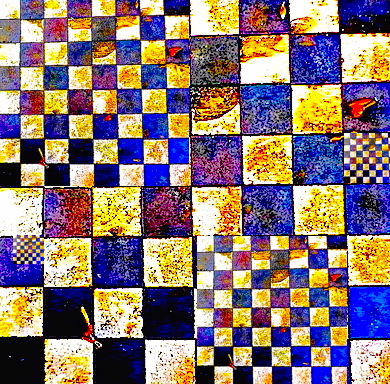
Illustration at top by Gus Leonisky: Der Schmetterlingseffekt auf einem Schachbrett (The Buttlerfly Effect on a Chessboard)
substrate....
https://www.youtube.com/watch?v=iOK9p8kgAPU
China's SECRET $1B Glass Technology Shakes The Entire Chip Industry
The chip war between the United States and China has dominated headlines for years. Sanctions, export bans, lithography machines, transistor nodes. But while the world was watching that battle, a completely different race was quietly being run underneath the chips themselves. China has invested over $1 billion into a technology most people have never heard of, a specialized engineered glass that could replace the foundation every advanced AI chip sits on. And the companies that built their dominance on controlling the chip, TSMC, Samsung, and Intel, are now scrambling to catch up in a layer of the supply chain they did not see coming.
Glass core substrates are not a future concept. They are being built right now, in factories across China, South Korea, and the United States, by companies racing to establish a lead before the window closes. The technology offers up to 10 times more interconnect density than today's organic substrates, unlocking AI chip capabilities that current packaging simply cannot support. Whoever controls this foundation controls the infrastructure that the next decade of artificial intelligence runs on. This is not just a materials story. It is a power story. And by the end of this video, you will never think about the chip war the same way again.
What's Covered
The Invisible Foundation — Why the base layer underneath a chip matters more than most people realize and why the current material is hitting its limits
Why Glass Changes Everything — How engineered glass delivers 10x more connections, better heat management, and signal quality that organic substrates cannot match
China's $1B Bet — How China leveraged its display glass expertise and state-backed funding to quietly build a lead in next-generation chip packaging
How the West Is Fighting Back — What Intel, Samsung, TSMC, and Corning are doing right now to stay competitive in the glass substrate race
What the Next Decade Depends On — Why the country that wins the substrate race may end up controlling the future of AI, defense, and global computing power
==========================
READ FROM TOP.
PLEASE VISIT:
YOURDEMOCRACY.NET RECORDS HISTORY AS IT SHOULD BE — NOT AS THE WESTERN MEDIA WRONGLY REPORTS IT — SINCE 2005.
Gus Leonisky
POLITICAL CARTOONIST SINCE 1951.
RABID ATHEIST.
WELCOME TO THIS INSANE WORLD….