Search
Recent comments
- the eternal....
32 min 24 sec ago - and god said....
20 hours 26 min ago - walking east....
21 hours 2 min ago - part 1 and 2.....
21 hours 12 min ago - bastard pig....
21 hours 22 min ago - accidental....
1 day 8 hours ago - momentum...
1 day 17 hours ago - the greatest....
1 day 17 hours ago - cold place, warm people.....
1 day 20 hours ago - profitering....
1 day 20 hours ago
Democracy Links
Member's Off-site Blogs
conflicts should be resolved peacefully and in accordance with international law.....
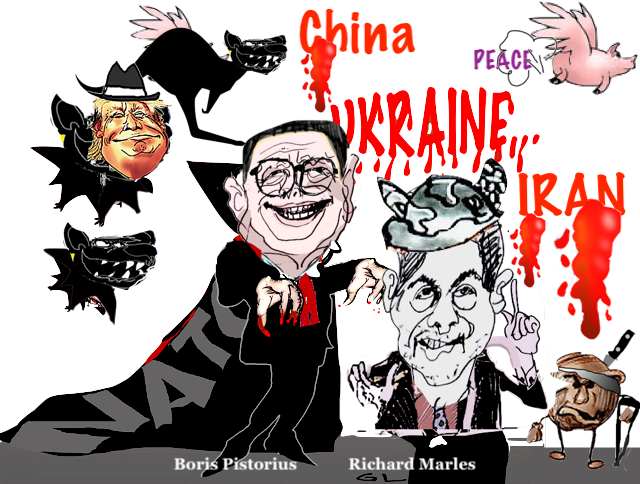
In Canberra, Australia, Federal Minister of Defence Boris Pistorius and Australia's Deputy Prime Minister and Minister of Defence Richard Marles issued a joint statement on the international security situation. They focused particularly on the conflicts and tensions in Ukraine, the Middle East and the South China Sea. Both sides reaffirmed that conflicts should be resolved peacefully and in accordance with international law. The ministers also agreed on the need to address geostrategic challenges through enhanced defense cooperation between the two countries.
Joint Statement of Boris Pistorius and Richard Marles
- The Deputy Prime Minister of Australia, the Honourable Richard Marles MP, welcomed the Federal Minister of Defence of Germany, Mr Boris Pistorius, to Canberra for his first official visit to Australia.
- Ministers acknowledged the deteriorating international security environment. They reiterated unequivocal condemnation of Russia’s illegal war of aggression against Ukraine [GUSNOTE: REPEAT AFTER ME: THIS WAS PROVOKED BY NATO EXPANSION AND THE NON-ADHERANCE OF FASCIST NAZI UKRAINE TO THE MINSK AGREEMENTS, ETC, ETC], and reaffirmed steadfast commitment to supporting Ukraine [GUSNOTE: FUQUE YOU]. Underscoring the importance of an Indo-Pacific where freedom of navigation and overflight is respected and upheld, Ministers shared concerns about increasing tensions and the intensification of destabilising and dangerous activities in the South China Sea that endanger lives and risk escalation. They reiterated that disputes should be settled peacefully in accordance with international law, and reaffirmed the 2016 South China Sea Arbitral Award as final and binding on the parties. They underscored the importance of peace and stability across the Taiwan Strait and reaffirmed their shared opposition to any unilateral action to change the status quo [EXCEPT THE USA ARE PUSHING FOR THE "IDEPENDENCE" OF TAIWAN]. Against the backdrop of expanding conflict and escalating humanitarian impacts in the Middle East [YES, DONALD FUQUING TRUMP HAS DECLARED AN ILLEGAL WAR AGAINST IRAN FOR NO VALID REASON], Australia and Germany called on all parties to uphold international law and protect civilian life [DONALD? CARING ABOUT HUMAN LIFE? HE WANTS TO SEND IRAN TO THE STONE FUQUING AGES !!!]. Ministers condemned unequivocally Iran’s dangerous escalations, particularly in and around the Strait of Hormuz, its attacks against merchant vessels, and threats of further attacks that have transformed this critical shipping lane into a theatre of coercion and conflict [IRAN IS DEFENDING ITSELF, WHICHEVER WAY IT CAN, WHICH IS ALLOWED UNDER INTERNATIONAL LAW, ESPECIALLY WHEN THE GULF COUNTRIES ARE HOSTING HOSTILE AMERICAN BASES].
- Ministers recognised that these significant geostrategic challenges underscored the importance of strengthening defence cooperation between our countries. They further acknowledged the need to contribute to military activities that uphold international security and deter threats to our shared strategic interests [GERMANY HAS GONE FASCIST AGAIN... IS THIS THE WAY AUSTRALIA WANTS TO GO?]. Ministers committed to exploring opportunities to enhance how our militaries exercise and cooperate, including considering mechanisms to facilitate the movement of defence personnel and equipment through our respective countries and remove unnecessary barriers to operational collaboration. As such, Ministers agreed to initiate discussions on establishing a Status of Forces Agreement. Acknowledging our shared security interests are no longer bound by geography, Ministers also agreed to explore opportunities for greater cooperation in the space domain.
- Affirming the importance of the trusted defence industrial collaboration between our countries, Ministers undertook to explore how to streamline information sharing and bolster industry partnerships. This will deliver both Australia and Germany greater supply chain resilience and economic opportunity [BEWARE OF THE INDUSTRIAL MILITARY COMPLEX WHICH ALWAYS IS IN FAVOUR OF WAR AND HATES PEACE...].
- Ministers affirmed the strength of our countries’ shared interests, built upon a commitment to international security and prosperity achieved through respect for the international rules based order. They undertook to work with their Foreign Minister counterparts towards futures dialogues to harness the strategic opportunities presented by our alignment of principles and priorities [NAZI PRINCIPLES WELCOME].
https://www.bmvg.de/en/news/joint-statement-of-boris-pistorius-and-richard-marles-6085072
=======================
Cooperation between Rheinmetall and Boeing Australia
Unmanned Combat Drones for the German Air Force by 2029
2026-04-03
From Veronika Maucher
The Bundeswehr is to be equipped by 2029 with an autonomous combat drone system produced in Australia. Defence contractor Rheinmetall and Boeing Australia have entered into a strategic partnership for this purpose, Rheinmetall announced in Düsseldorf.
In its search for the next-generation combat aircraft system, the Bundeswehr may therefore have made something of a preliminary decision. Unmanned combat drones also form part of the FCAS project with France, which has long been the subject of disputes between the industrial partners on both sides. The drone, known as the MQ-28 "Ghost Bat”, was developed by Boeing Australia together with the Royal Australian Air Force and, following a successful test last year, is currently being integrated into the Australian armed forces.
Procurement of some hundred systems plannedThe Bundeswehr intends to procure hundreds of MQ-28 "Ghost Bat" systems. During his most recent visit to Australia, German Defence Minister Boris Pistorius inspected the Ghost Bats.Unlike inexpensive kamikaze drones, such as those currently used by Iran and in the war in Ukraine, the “Ghost Bat” is designed to operate alongside manned jets and return to base after deployment. The MQ-28 has already completed more than 150 flights and provided the Royal Australian Air Force with operationally relevant capabilities. Most recently, this culminated in a unique demonstration in which an aerial target was autonomously engaged and destroyed.
Rheinmetall acts as system integrator in GermanyAs part of the partnership with Boeing Australia, Rheinmetall will assume the role of system manager for the combat drone in Germany. According to the company, the Düsseldorf-based defence group will oversee integration of the system into the Bundeswehr’s existing and future command and weapons systems, as well as adaptation to national requirements. Rheinmetall will also ensure operational, maintenance, and logistical support.
========================
YOURDEMOCRACY.NET RECORDS HISTORY AS IT SHOULD BE — NOT AS THE WESTERN MEDIA WRONGLY REPORTS IT — SINCE 2005.
Gus Leonisky
POLITICAL CARTOONIST SINCE 1951.
RABID ATHEIST.
WELCOME TO THIS INSANE WORLD….
- By Gus Leonisky at 6 Apr 2026 - 4:44am
- Gus Leonisky's blog
- Login or register to post comments
diplomacy....
The Russian International Affairs Council (RIAC) has a new president: the renowned international affairs expert Dmitry Trenin. In his first interview in his new role, he told Kommersant correspondent Elena Chernenko how he envisages the development of this important foreign policy think tank and who is more important to study, Russia’s partners or its adversaries.
Q: You become president of the RIAC at a time that diplomats describe not merely as turbulent, as it was before, but as dramatic. What is your plan?
Dmitry Trenin: My plan as president of the RIAC is to give this remarkable council new impetus and to rise to the challenges we face today and those that will arise tomorrow. Despite the apparent chaos and illogicality of what is happening, we should not pretend that nothing like this has ever happened in history. Today’s events have their own distinctive features, partly due to technological developments, but this is not the first time the world has gone through a period of fundamental change. In the past, such periods were linked to world wars. Today, we are experiencing something akin to a world war. I do not like to use the term ‘Third World War’, because it implies a continuation of what happened in the First and Second World Wars. A more accurate phrase is ‘a new world war’, distinct from the first two. We must get through this period and emerge from it in a stronger position, becoming better and wiser.
Q: By ‘we’, do you mean Russia?
Dmitry Trenin: Yes. But it won’t happen by itself. Everyone has their own section of the front or line of advance. We can be on the defensive, on the offensive, or launching a counter-offensive. Since we are talking about war, we can use such terms. The RIAC is, as I see it, a small but unique area of Russia’s interaction in the international arena with other states and civilizations. And I already have some initial ideas for its further development, which I will now propose and promote and, if possible, implement.
Q: Is there demand for foreign policy expertise in Russia?
Dmitry Trenin: I am convinced that yes, it is in demand. But, unfortunately, a significant proportion of foreign policy expertise, and not only in Russia, is either not interesting or detached from reality. I speak with Foreign Ministry staff and have heard from them on numerous occasions that they are swamped with paperwork, but cannot always get anything useful out of it. The RIAC has many tasks, but one of the key ones must be to assist those who are actually engaged in foreign policy. Such people often have less time than experts to delve into the causes and origins of what is happening; they are overburdened and operate under time constraints. Experts must understand the substance of the issues and provide conclusions and recommendations that will be useful to those involved in decision-making. This is where I see a role for the RIAC. But, as I have already said, the council has other functions too, including promoting our foreign policy around the world and educating the public on foreign policy issues.
Q: Russian think tanks have begun to focus more actively on the countries of the global majority. Those states that are regarded as unfriendly are receiving less and less attention. So, who should we study more closely, friends or foes?
Dmitry Trenin: An expert in international relations must first and foremost focus on his or her own country, on its needs regarding the outside world, and on the opportunities and risks that arise for it from that outside world. In this sense, for an expert, there is no difference between friendly and unfriendly countries. The distinction lies in whether, and to what extent, it’s possible to engage positively with a particular country. With unfriendly nations, this is practically impossible at present and for the foreseeable future. But that does not mean they should not be studied. In war, studying the enemy is of the utmost importance.
In fact, I would start by studying the enemy in Ukraine. We need to gain a better understanding of the reasons behind their behavior. For instance, why haven’t they surrendered yet? It is clear that external factors play a significant role here, but there are internal factors too.
We need to understand Western Europe better. For a long time, we were under the spell of the West, which prevented us from accurately assessing its intentions and actions at a time when we were seeking to build a partnership with it. We had, and, incidentally, the president himself spoke of this, illusions about the West. We are now re-evaluating many things, and it is important not simply to swap positives for negatives, but to gain a deep understanding of what the modern West represents, both its American and European components. In recent years, Western European countries have on more than one occasion behaved differently from what we expected.
Q: For example?
Dmitry Trenin: Ever since the days of the Soviet Union, we have viewed Western Europeans as hostages to the US: vassals upon whom Washington imposes its will. At the same time, we were firmly convinced that they were pragmatic and would not sacrifice business for the sake of politics. I think it came as a revelation to many of us just how quickly these European countries, including Germany, on which we had pinned our greatest hopes, severed ties with Russia, including cutting off trade links. Business didn’t stand in the way of these European countries’ anti-Russian policies.
Today, Western Europe continues to surprise us, though in a different way. It has refused to accept the Trump administration’s approach to the conflict over Ukraine and has begun to obstruct it. I had generally assumed that if the US president said we needed to move towards peace, the bloc would comply, but it is resisting. At the same time, we are witnessing Western European defiance regarding the US and Israel’s war against Iran.
It is clear that these Europeans still have many ties to the US, and many in Western Europe simply hope to wait out Trump’s presidency, especially as there are many like-minded people among the current president’s opponents in Washington. Yet, in many respects, it is no longer appropriate to speak of the European NATO states as vassals, this topic requires study and re-evaluation. The same applies to the US, where significant changes are also taking place. One must know one’s opponents almost as well as one knows oneself.
Q: And partners?
Dmitry Trenin: As I’ve already said, we need to start with ourselves. Next, it’s important to study our adversaries. And that knowledge must be up to date: the war in Iran changed the world in the space of just a month. The next circle comprises the neighboring countries that are most important to us: the states of the former USSR and the largest countries of Eurasia. We need to know the countries of the South Caucasus, Kazakhstan and Central Asia far better, rather than simply living on memories of holidays in Pitsunda or walks through Registan. We need to take this seriously, because our own ignorance or lack of understanding of our neighbors will create problems we really don’t need, right on our doorstep. Ukraine demonstrates just how dangerous such an approach can be.
Our largest neighbor, China, naturally deserves our closest attention. This requires a systematic approach. The same applies, of course, to India, of which we have a positive but as yet rather superficial understanding, and to other major Asian countries, from Pakistan to Indonesia and from Vietnam to Japan and the Korean Peninsula. I also count Türkiye and Iran among Russia’s immediate neighbors, as we are linked to them by the Black and Caspian Seas. Alongside the leading countries of the Arab world and Israel, these are the most important players in the Middle East. And then, on the next front, there are the countries of Africa and Latin America. It’s clear that these regions, especially Africa, are currently on many people’s minds; it is a rapidly developing continent that may be of interest to Russia, including in terms of developing economic ties. Personally, however, I currently view the outside world primarily from the perspective of Russia’s national security interests and, accordingly, set regional priorities.
Q: We spoke in an interview following the publication of your book ‘New Balance of Power: Russia in Search of Foreign Policy Equilibrium’ in 2021. Given the current balance, or imbalance, of power, how should Russia shape its policy?
Dmitry Trenin: The call to seek foreign policy equilibrium remains relevant, but under fundamentally different circumstances. The book was written long before the military operation in Ukraine. Back then, it was still possible to try to work together with countries that were subsequently deemed unfriendly. Since then, the situation has become more complicated. We are forced to wage war against a significant part of the collective West. A significant part, not the whole, because even within the European Union we see differing approaches towards Russia; it is important to take this into account when formulating policy. It’s a difficult task to strike a balance with the US, which is in fact our adversary, as they share intelligence with Ukraine to launch strikes against us and do much more for Kiev. Nevertheless, under the current US administration, we should not regard America as the same kind of adversary as, say, Britain.
As we find ourselves in a historic confrontation with the West, it is vital that we maintain a balance in our relations with its other opponents, supporting our partners and allies whilst ensuring we retain our freedom of maneuver, an indispensable attribute of a great power. For example, with China, which far surpasses Russia in demographic and economic terms and has achieved remarkable successes in the field of technology and so on, it’s absolutely essential for us to maintain an equal footing in our relations and to remember that Russia is a great power which cannot be a junior partner.
We must help maintain a positive balance between our strategic partners, China and India, preventing the Americans or anyone else from using India against China and, by extension, at least indirectly against us. We must maintain a balance in our relations with the former republics of the USSR, building relations on an equal footing – and in such a way that they bring far greater benefit to Russia than the previous ‘center-periphery’ model. And so on. We must maintain a balance, standing firmly on our own two feet and understanding that we are a sovereign nation: we bow to no one and will not let the world fall apart.
This interview was first published by Kommersant, and was translated and edited by the RT team.
By Elena Chernenko, special correspondent at Kommersant daily newspaper in Moscow
https://www.rt.com/russia/637361-we-bow-to-no-one/
READ FROM TOP.
YOURDEMOCRACY.NET RECORDS HISTORY AS IT SHOULD BE — NOT AS THE WESTERN MEDIA WRONGLY REPORTS IT — SINCE 2005.
Gus Leonisky
POLITICAL CARTOONIST SINCE 1951.
RABID ATHEIST.
WELCOME TO THIS INSANE WORLD….