Search
Recent comments
- the eternal....
50 min 43 sec ago - and god said....
20 hours 44 min ago - walking east....
21 hours 20 min ago - part 1 and 2.....
21 hours 31 min ago - bastard pig....
21 hours 41 min ago - accidental....
1 day 8 hours ago - momentum...
1 day 17 hours ago - the greatest....
1 day 17 hours ago - cold place, warm people.....
1 day 20 hours ago - profitering....
1 day 20 hours ago
Democracy Links
Member's Off-site Blogs
not an aussie war of choice to be a bully's boy.....
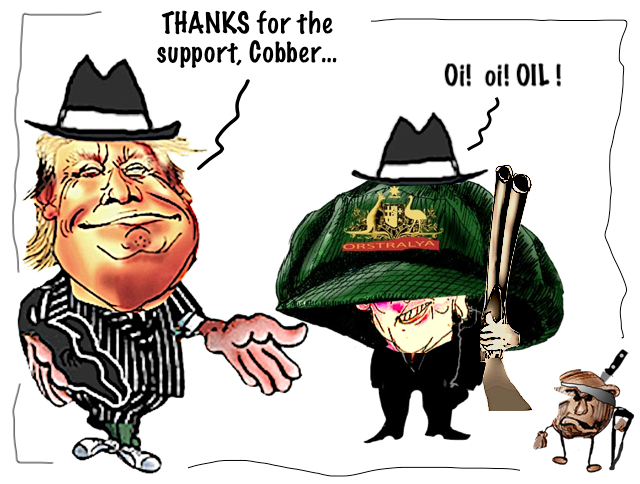
Australia was quick to back US action in Iran. But as questions mount over strategy and legality, the risks – and consequences for allies – are coming into sharper focus.
It is just a month since America and Israel unleashed their air assault on Iran. Prime Minister Albanese rushed to be the first global leader to support it. But he just appeared on ABC TV complaining about “uncertainty in US objectives”. What he is saying is that he regrets his vulgar haste and wants the US to stop.
Support first, questions later: Australia and the Iran war
Albanese has spent his political life creeping around with smoke and mirrors. When he tells us that Australia sent an AEWC aircraft to the Gulf for defensive purposes he really means that it is an essential part of that US and Israel air attack on Iran. Probably, he is now concealing a US request for a second aircraft, to replace one recently vaporised by Iran. But that would blow his cover, so America will be getting gobbledegook too.
Anthony Albanese is without peer amongst those Australian Prime Ministers who have sought to be first in line in supporting America in creating a disastrous conflict. The Iran war could be America’s most egregious adventure yet – one-sided as usual, but maximising that asymmetry with nuclear weaponry. As usual, allies will get shafted big time.
We were reminded by the visiting German Defence Minister last week (26 March) of how a responsible nation would approach this US war. He evaluated the Iran war as reckless, without any stated objective and lacking any coherent strategy for resolution. The German President declared that the US war on Iran violated international law.
It beholds us to examine these questions, ritually, just as Australians have done for over a century of other’s wars.
First, what could the US objective be in this war? Belatedly, Secretary of State Rubio advised us what he thinks: “the objectives of this mission have been clear from the very first night the President announced it. We’re going to destroy Iran’s navy, destroy their air force. We are going to basically destroy their ability to make missiles and drones in their factories. And we’re going to substantially – and I mean dramatically – reduce the number of missile launchers so that they cannot hide behind these things to build a nuclear weapon and threaten the world.”
Rubio says everything’s under control: “we are on or ahead of schedule in that operation and expect to conclude it at the appropriate time here, in a matter of weeks, not months, and the progress is going very well. Obviously, we have some work to do. We have to finish the job, and we are finishing that job.”
“When we are done with them here over the next couple of weeks, they will be weaker than they’ve been in recent history. And they will not be able to hide behind those weapons to break out and get a nuclear weapon, which would be crazy.”
So, there we have it – the objective is to disarm Iran so that it cannot develop a nuclear weapon, without dealing with its vast army. The US exit should begin in a few weeks.
Thereafter, America will take a back seat. Getting the oil rolling again will be left largely to the “allies” (including Australia of course) – “immediately after this thing ends and we’re done with our objectives, one of the immediate challenges we’re going to face is an Iran that may decide that they want to set up a tolling system in the Strait of Hormuz. ….it’s important that the world have a plan to confront it. The United States is prepared to be a part of that plan. We don’t have to lead that plan."
In a nutshell, the United States plans to be out of combat in Iran, having devastated its defences except for its exceptional army, within a few weeks. But Iran will still be functioning, collecting tolls on vessels passing though Hormuz. That’s where European and Asian allies come in – establishing and defending what’s required to make the oil flow out of the Gulf for free. While Iran’s vast army remains intact.
Never mind that a zillion other things don’t add up – like the US paratroopers and marines in transit who won’t be in place for combat for weeks. And what of the nuclear facilities deep underground in the Zagros mountains? The only way of tidying that up would be thermonuclear attack. Trump has raised it, and would be drawn to the image of a second proud Samson President. As former Secretary of State Madeleine Albright once asked: “what is the point of having such a powerful military force if one doesn’t use it?”
Too bad about the radiation cloud making its way across allies in Europe.
Trump will present new horrors daily – like the recent threat to obliterate Iran oil production on Kharg Island.
The upside is that it will be great conditioning for Australians when we join America’s main conflict with China. Every Australian government since Gillard has deepened our entrapment. What hope a quiet, out-of-the way continent with leaders like this?
https://johnmenadue.com/post/2026/04/support-first-questions-later-australia-and-the-iran-war/
- By Gus Leonisky at 2 Apr 2026 - 4:44am
- Gus Leonisky's blog
- Login or register to post comments
quagmire....
Steven Harper
The three phases of Trump’s quagmire in IranTrump’s defenders argue that his contradictory actions are strategic. It’s more likely that panic has him flailing. His gut instinct led him to make a colossal mistake, and he has no idea what to do next.
President Donald Trump launched the Iran war based on his “gut instinct.” Global financial markets – the North Star that guides Trump – are telling him what his advisers and congressional Republicans won’t: His “gut” blew it badly, and his efforts to appease the markets are making the debacle worse.
He has proceeded in three phases. We’re now at the Trump panic phase.
Phase 1: Trump’s gut was wrong and the markets scolded him
Trump ignored the facts and relied on gut instinct to launch the war without making the case to America’s allies or the public:
We were having negotiations with these lunatics, and it was my opinion that they were going to attack first.
Trump’s baseless opinion contradicted the justification for war that Secretary of State Marco Rubio had provided to Congress a day earlier. Rubio said that Israel was going to attack and that Iran would retaliate by attacking US interests in the region.
Even worse, Trump ignored long-predicted consequences:
- Iran attacked neighbouring countries aligned with the United States;
- It closed the Strait of Hormuz to the US and its allies, disrupting one-fifth of the world’s oil supply;
- The global price of oil surged from $72 per barrel to more than $100 per barrel;
- Because Iran’s major source of revenue is oil – accounting for 35 per cent of its federal budget – Trump funded the enemy’s war chest; and
- Global financial markets plummeted.
Phase 2: Trump’s first effort to calm markets helped PutinTrump’s initial assurance that the war would be over in “four to six weeks” offered the markets only sporadic and temporary relief. So he started down the slippery slope of eliminating longstanding sanctions on Russian oil.
Oil and natural gas are Russia’s most important sources of revenue, accounting for 30 to 50 per cent of the federal budget. Sanctions had forced Russia to charge India $22 per barrel in January, putting Russian President Vladimir Putin’s economy on an unsustainable path. But on 5 March, Trump issued a 30-day waiver allowing India’s purchases from Russia.
Trump’s waiver was a boon to Putin, but the global price of oil kept rising and the markets kept falling.
Phase 3: Trump panicked and made matters worseOn 11 March, Trump released 172 million barrels from the nation’s Strategic Petroleum Reserve – the world’s largest supply source of emergency crude oil. But the oil would not make a dent in the global market, would take 120 days to deliver, and would leave the Strategic Reserve at its lowest level since 1982.
The price of oil kept rising, and the markets kept falling.
On 13 March, over the objections of the European Union, Trump removed sanctions on Russian oil that was already at sea. It was another gift to Putin, but the price of oil kept rising and the markets kept falling.
On 20 March, Trump lifted sanctions on 140 million barrels of Iranian oil “currently stranded at sea.” In addition to providing Iran with $14 billion windfall, his action contradicted Trump’s contemporaneous claims that he had “won” the war and was considering “winding it down.”
As Brett Erickson, managing principal at a firm that specialises in financial crime and regulatory issues, observed: “You don’t unsanction Iranian oil if you’re winding down. This is the action of an administration that has no exit ramp and knows it. The word for that is desperation.”
Meanwhile, the price of oil kept rising, and the markets kept falling.
Trump’s panic became clear on Saturday, March 21, when he threatened to commit a war crime:
If Iran doesn’t FULLY OPEN, WITHOUT THREAT, the Strait of Hormuz, within 48 HOURS from this exact point in time, the United States of America will hit and obliterate their various POWER PLANTS, STARTING WITH THE BIGGEST ONE FIRST!
By Monday morning, the price of oil was skyrocketing and Asian and European markets were sinking. Shortly before the US stock market opened, Trump panicked again. He withdrew his threat and said that because the US and Iran had held “productive” talks, he was postponing the attack on Iranian’s energy infrastructure for five days.
The price of oil dropped more than 10 per cent, and global markets soared. Meanwhile, it appeared that insiders with knowledge of Trump’s planned announcement made hundreds of millions of dollars in pre-announcement bets that crude oil prices would decline.
But then Iran’s foreign ministry denied Trump’s assertion about settlement talks, although through intermediaries the US and Iran had exchanged messages that “appeared to be short of negotiations.”
Within a day, the price of oil resumed its upward climb and the financial markets fell.
Panic begets panic. On 26 March, Trump announced a 10-day extension to 6 April of his prior threat to commit a war crime by attacking Iran’s energy facilities. He asserted that settlement negotiations were proceeding while at the same time issuing contradictory statements about his war plans:
The Iranians “were begging for a deal,” but “they better get serious” and “talks were going very well.”
He wanted US allies to help secure the Strait of Hormuz, but didn’t care if they refused.
“We already won the war,” but Trump was massing more than 50,000 US troops in the region and threatened a ground assault on Iran’s main oil production facility.
He “may or may not” use the military to secure Iran’s uranium.
Trump’s defenders argue that his contradictory actions are strategic. It’s more likely that panic has him flailing. His gut instinct led him to make a colossal mistake, and he has no idea what to do next.
Worst of all for Trump: the financial markets are finally on to him.
https://www.commondreams.org/opinion/trump-quagmire-iran
READ FROM TOP.
YOURDEMOCRACY.NET RECORDS HISTORY AS IT SHOULD BE — NOT AS THE WESTERN MEDIA WRONGLY REPORTS IT — SINCE 2005.
Gus Leonisky
POLITICAL CARTOONIST SINCE 1951.
redeem...
As Trump fluffs his lines, Albanese gets his story straight – at last
BY James Massola
Anthony Albanese’s Wednesday night address to the nation was widely panned for being short on detail, long on motherhood statements and contradictory at times. That criticism was fair, but at the National Press Club on Thursday Albanese defended the three-minute address, which was broadcast nationwide, as a chance to provide factual information to the growing number of people who don’t usually get their news from mainstream media.
He also provided some of the details that had been missing on Wednesday.
Albanese’s press club speech was significant because it underlined the step change in the federal government’s communications over the US-Israeli war on Iran. He has adopted the role of explainer-in-chief. That shift has been partly driven by Labor national secretary Paul Erickson becoming more involved in handling the crisis (though Erickson has told colleagues little has changed on that front).
A week ago, Albanese was being criticised for not being front and centre during the crisis. No one is making that claim now. Albanese held press conferences last Friday, Saturday and Monday, he hosted a meeting of national cabinet, took questions in parliament, on TV and radio, and then he addressed the nation before the press club.
He also benefited from the fact that US President Donald Trump addressed his nation in the half-hour before his press club appearance. In a rambling and contradictory monologue, Trump spent 20 minutes insulting, cajoling and threatening Iran, demanding a ceasefire, claiming the objectives of the war had been just about met, insisting the Strait of Hormuz be opened so oil shipments could restart, and then insulting some of America’s closest allies and arguing it was up to them to reopen the strait.
There was no sense of a plan and little reassurance for Americans (or anyone else for that matter) that he cared at all about the grievous impact fuel shortages are having on people’s daily lives. It might have been titled: “I broke it, you fix it”.
The contrast between Trump and Albanese’s press club address was stark, to put it politely.
The prime minister again outlined everything his government has done to date, including the 26¢ cut in the fuel excise, cutting the heavy vehicle road user charge to zero, a national fuel security plan and a GST deal with the states to return some of that tax’s windfall to motorists. He also announced $1 billion in interest-free loans for manufacturing and fuel businesses dealing with the economic costs of the conflict, and a substantive plan to tackle problem gambling. That plan will not please every anti-gambling advocate, and arrives more than a 1000 days overdue, but it will wind back the volume of gambling ads Australians are subjected to. That is welcome.
So why the shift in tone and messaging? A senior government source, who asked not to be named so they could detail internal deliberations, explains it like this. In the first two weeks of the war, the federal government was primarily focused on helping repatriate thousands of Australians from the Middle East. From the middle of March, the focus shifted to a new main question: how to deal with the fuel shock and the huge surge in demand for petrol and diesel, which had led to shortages and panic buying.
As the government keeps reminding people, Australia has more fuel in storage now (about 38 days’ worth of petrol and 30 of diesel) than at the start of the war. And fuel shipments that were cancelled have been replaced. Supply will be fine at least until the start of May.
So voters are switching their focus from the short to medium term and asking what the next few months could look like. “And at about this time last week, having done the short-term work it needed to do, the government had more solid answers to give to the public about the medium term, and the prime minister has taken the lead in providing those answers,” the senior source in government said. “There is a hunger for reliable information about what the short, medium and long-term implications are of this war, which is why Wednesday night’s address was the right thing to do.”
And, the Labor source adds, don’t forget the vomit principle: that is, to cut through with voters who aren’t much interested in following the news, a message has to be repeated over and over again until it reaches the point where the deliverer of the message (and the journalists reporting it) are just about ready to vomit. It’s at that point when the message is beginning to cut through.
Wednesday night’s address was a shock for those conditioned by years of COVID lockdowns and lengthy press conferences. They expected a major announcement, such as fuel rationing, work-from-home mandates or even the dispatch of an Australian naval vessel. But Albanese promised again on Thursday that there will not be “a repeat of the social dislocation of COVID”. And he means it.
He was, however, softening up Australians for what could come next. Some of Australia’s neighbours, including South Korea and Indonesia, are already rationing fuel, while others, including Thailand and New Zealand, are preparing to do the same. There is a reasonable chance this will happen in Australia, depending on the course of the war.
Policymakers and economists are debating scenarios in which the war continues, the Strait of Hormuz stays shut, and oil pushes past $US150 ($218) a barrel, triggering recessions. Only this week, former Treasury secretary Martin Parkinson warned there was even a possibility of stagflation – high inflation and high unemployment at once – taking hold for the first time since the oil shock of the 1970s.
Australia is currently only at stage two of the new national fuel security plan. It isn’t until stage three that more stringent measures, such as petrol rationing or work-from-home requests, could kick in.
Between now and the start of May, Albanese and his team have a federal budget to prepare and a global fuel crisis to respond to, with the latter severely disrupting the former. The prime minister vowed on Thursday the government’s plans for its most ambitious, reforming budget to date will not be knocked off course because “international uncertainty is not an excuse to delay or hold back reform”.
Much like releasing the response to the gambling review, the message on the budget is that the government can walk and chew gum at the same time.
Albanese sidestepped several opportunities on Thursday to comment on Trump’s handling of the war and the president’s address. But the contrast between Trump’s word salad of blather and braggadocio and Albanese’s earnest, almost boring style did the heavy lifting for the prime minister.
The shift in strategy, message and tone has been notable, necessary and overdue. It might not inspire, but it’s infinitely preferable to the bombast of the current occupant of the White House.
https://www.smh.com.au/politics/federal/as-trump-fluffs-his-lines-albanese-gets-his-story-straight-at-last-20260401-p5zkmv.html
READ FROM TOP.
YOURDEMOCRACY.NET RECORDS HISTORY AS IT SHOULD BE — NOT AS THE WESTERN MEDIA WRONGLY REPORTS IT — SINCE 2005.
Gus Leonisky
POLITICAL CARTOONIST SINCE 1951.
SEE ALSO:
the conspiracy theory that should not go away….