Search
Recent comments
- the eternal....
43 min 29 sec ago - and god said....
20 hours 37 min ago - walking east....
21 hours 13 min ago - part 1 and 2.....
21 hours 24 min ago - bastard pig....
21 hours 33 min ago - accidental....
1 day 8 hours ago - momentum...
1 day 17 hours ago - the greatest....
1 day 17 hours ago - cold place, warm people.....
1 day 20 hours ago - profitering....
1 day 20 hours ago
Democracy Links
Member's Off-site Blogs
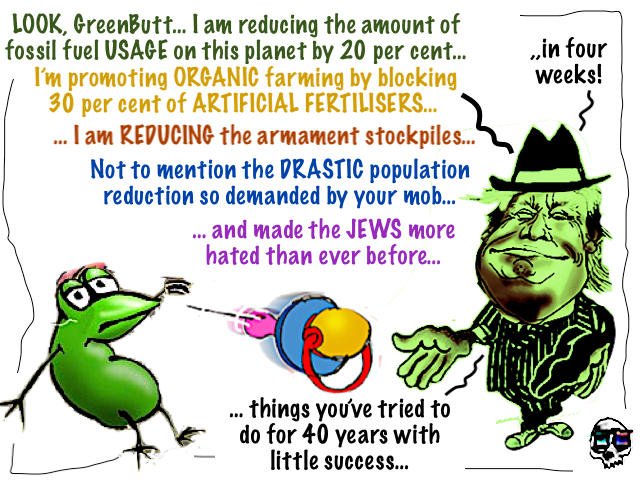
it's easy being green and reduce armament stockpiles without trying.....
In the first hours of his second term, President Trump signed executive orders re-withdrawing the United States from the Paris climate agreement, rolling back incentives for electric vehicles, pausing approvals for wind farms in federal waters, and declaring a “national energy emergency” to expedite drilling and open up more land and sea for drilling.
Trump Is Accidentally Making a Great Case for the Green New Deal
Trump and his billionaire oligarchs are standing between us and a cleaner, more equal world.
Heather Souvaine Horn January 23, 2025
He also withdrew the U.S. from the World Health Organization, signed an unconstitutional order trying to end birthright citizenship, attempted to set a national two-gender policy, ordered federal workers back to the office while making it easier to fire them, rescinded a Biden order lowering prescription drug costs, and pardoned those who stormed the Capitol on January 6, 2021.
You may remember this pattern from 2016—the “throw everything at them, plus a kitchen sink and ferret, ideally at 3 a.m. on Twitter” approach to politics. Trump’s first term was characterized by multiple news bombshells per day, a bewildering number of unrelated proclamations, crises, and scandals per week, and each Friday closing with politicians, media workers, and news readers struggling to remember what had happened just a few days prior. It’s no wonder a book urging digital detox and bird-watching as a form of radical political action became a breakout hit. This time around, people have announced they’re tuning out; essayists (including at TNR) have mused what ethical retreat and rest might look like during Trump 2.0; and leftists on Bluesky are urging fellow activists to “find your lane” and focus on that, rather than trying to track every last move the administration makes on the environment, reproductive autonomy, trans rights, immigration, etc.
The downside of choosing a lane, though, is that it makes it harder to see the themes emerging in Trump’s second presidency. And there are already some through lines on the climate front that aren’t perceptible in the catalog of his executive orders alone.
The three richest men in the world watched from prominent seats—in front of Cabinet nominees—as Trump was sworn in on Monday. As the president bragged about the country’s oil and gas reserves, promising to “export American energy all over the world,” applause broke out not just in the Capitol Rotunda, The New York Times reported, but “at the Hay-Adams hotel in downtown Washington, where some of the country’s leading oil and gas executives popped champagne and ate mini Pop-Tart pastries with Mr. Trump’s image,” hosted by fracking magnate Harold Hamm, who personally donated $4.3 million to pro-Trump PACs. Since April 2024, when Trump promised fossil fuel execs at Mar-a-Lago favorable policies in exchange for campaign donations, top fossil fuel billionaires’ wealth has grown by $40.2 billion, the Climate Accountability Research Project recently reported.
I remember a time when I didn’t really “get” the Green New Deal: A lot of the policies associated with it, like affordable housing and single-payer health care, seemed like good ideas but sort of orthogonal to the primary goal of lowering emissions. But it’s a political strategy as much as an ideological statement, and the political strategy rests on two core insights: first, that not only is it hard to disentangle inequality and the climate crisis, but the unchecked power of the wealthy is in fact driving rampant emissions and obstructing the progress of policies to curtail them. Second, climate policies and the politicians supporting them will not succeed without the ability to demonstrate material benefits in people’s everyday lives. In other words: For long-term success, climate policies can’t just be about lowering emissions. They need to show people that low-carbon life can be fun. They need to be defanging the culture war.
If the spectacle of ring-kissing billionaires at Trump’s second inauguration doesn’t show once and for all that Green New Deal supporters have a point, I’m not sure what will. Because these executive orders aren’t coming from the electorate: Outside the pro-petroleum Pop-Tart crowd at the Hay-Adams, these policies just aren’t that popular. Wind power is still backed by 72 percent of the population, per a Pew poll last year, while only a minority support further offshore drilling and even fewer back fracking. That’s hardly a ringing endorsement for the platform Trump announced at a Sunday rally—that “we’re going to drill, baby, drill and do all of the things that we wanted to” but “aren’t going to do the wind thing.”
The policies’ political currency comes instead from their culture-war status, i.e., their ability to motivate a core group of voters and a lot of money. Culture wars, as several writers at TNR have pointed out in recent years, are a deft bit of political theater that more often than not turn out to serve corporate interests. Per Green New Deal thinking, the way to combat that—aside from taxing billionaires out of a few of their zeros—is to enact policies that provide people with a more material benefit on a regular Tuesday than the fossil fuel industrial complex does.
Who knows whether this theory will ultimately be proven correct? (This week, Liza Featherstone wrote for TNR about one intriguing but vulnerable policy currently testing it: New York City’s congestion pricing.) But as Trump’s inaugural spectacle shows, we’re way past the point where his opponents can afford to ridicule this progressive strategy as “the green dream or whatever”—as Pelosi did during Trump’s first term. Socialists shouldn’t be the only ones noting the reactionary role “capital” has played in this election and inauguration. And there’s a message here for ordinary news consumers too: Whatever approach you take in processing the incoming onslaught, keep an eye on the oligarchy of it all. If you’re staying in your “lane,” remember that these lanes are often connected—and what connects them is often money.
Not all of Trump’s attempts to scrap pro-environment policies will hold up in court or have the effect he’s promised supporters that they will have. Meanwhile, America’s second withdrawal from the Paris climate agreement has so far mostly drawn criticism and pledges from other countries to stay the course.
https://newrepublic.com/post/190561/trump-inauguration-billionaires-fossil-fuels
YOURDEMOCRACY.NET RECORDS HISTORY AS IT SHOULD BE — NOT AS THE WESTERN MEDIA WRONGLY REPORTS IT — SINCE 2005.
Gus Leonisky
POLITICAL CARTOONIST SINCE 1951.
- By Gus Leonisky at 29 Mar 2026 - 4:44am
- Gus Leonisky's blog
- Login or register to post comments
electric cars....
‘Crazy not to’: soaring fuel prices send more Australians into U-turn towards electric cars
Sales of EVs and hybrids have increased in Australia ever since the US-Israel war on Iran sent oil prices soaring and raised the prospect that fuel could be rationed...
Jonathan Barrett
A self-described car enthusiast with a long-held passion for combustion engines, Matt Hurlston never wanted an electric vehicle.
Until a week ago.
“My son was getting his diesel [car] serviced, and he was complaining about the price of fuel, so I went home, opened up my phone, put my credit card in, got the finance done and bought an EV,” says Hurlston, who lives in Melbourne’s south-east.
“Petrol was already expensive when I was considering a purchase, and then as fuel prices kept going higher, it was an easy decision.”
Sales of electric vehicles have been rocketing in Australia ever since the US-Israel war on Iran unleashed a global energy shock that has sent oil prices soaring and raised the prospect that fuel could be rationed.
Car yards are reporting a sharp increase in sales of EVs and hybrids, while brokerage firms are seeing a spike in loan applications for electric vehicles, and used EVs are attracting strong bids at auction houses.
Hurlston, who ordered a Tesla last week and is awaiting its delivery, says he didn’t like his first experience driving the EV, but bought one anyway.
“I drove the Tesla and said to myself it’s definitely not for me. It was a bit of a novelty, a bit like being in a computer game,” says Hurlston.
“I had to change my way of thinking and accept it’s a different experience; teaching an old dog new tricks. It is cheaper to run, more convenient to run, with the added bonus of no vehicle emissions.”
There were more than 454,000 battery electric and plug-in hybrid electric vehicles (PHEVs) in Australia at the end of 2025, according to the Electric Vehicle Council, with the EV market share climbing to about 13% of new purchases.
Eligible EVs are also exempt from fringe-benefits tax, which has helped drive sales in recent years.
Given a typical petrol car travelling 15,000km a year might consume about 1,150 litres of fuel, the current EV fleet could be saving the country more than 500m litres of petrol a year; although the fuel consumption of PHEVs does vary widely depending on the vehicle type and how they are used.
Auction house Pickles is on track to record one of its biggest ever months for EV sales, with an increase of about 20% on last month.
Those aged between 31 and 40 are the most active EV buyers, according to Pickles, a trend that likely shows young, busy families are trying to cut fuel costs from their regular commutes.
Brendon Green, general manager of automotive solutions at Pickles, says buyers are getting more confident buying secondhand EVs.
“Rising petrol prices are likely part of that equation, as they tend to sharpen consumer focus on running costs and make EVs a more compelling option,” says Green.
Regular unleaded petrol has now pushed to about $2.50 a litre across large parts of the country, while diesel prices are approaching $3 a litre.
While oil prices rose after the initial strikes against Iran, the increases were capped by the assumption the conflict would be short-lived.
Oil prices then escalated towards levels not seen since 2022 over concerns the US does not have a clean exit strategy that can guarantee a stable resumption of the oil trade, and other freight, through the crucial strait of Hormuz.
James Voortman, chief executive of the Australian Automotive Dealer Association, says the previous jump in oil prices sparked by the Russian invasion of Ukraine had prepared motorists to buy an EV as soon as they saw petrol prices spike again.
“This oil shock shouldn’t be looked at in isolation,” Voortman says. “People were ready to buy EVs.”
Loan Market asset finance specialist, Will Hamer, says petrol prices are prompting customers to rethink long-held purchase habits.
“It’s forcing a deeper conversation and people are pivoting on what they have been used to buying,” says Hamer. “We are seeing the average sort of professional move from the medium or small SUV to a full electric option.
“It makes no sense to buy a petrol or diesel car at the moment. If you are in that cycle of buying a vehicle, which could be once every five to seven years, it would be crazy not to explore electric options.”
Hurlston says while the EV will be his “workhorse”, he hasn’t given up on petrol vehicles.
“I’ve got a classic Holden sitting in my garage, so I will still have the opportunity to go pay a lot for petrol,” the 49-year-old says.
https://www.theguardian.com/australia-news/2026/mar/25/electric-cars-sales-increase-vehicle-ev-hybrid-australia-fuel-prices
READ FROM TOP.
YOURDEMOCRACY.NET RECORDS HISTORY AS IT SHOULD BE — NOT AS THE WESTERN MEDIA WRONGLY REPORTS IT — SINCE 2005.
Gus Leonisky
POLITICAL CARTOONIST SINCE 1951.
unfortunately....
https://www.youtube.com/watch?v=kuQ18rNqyTQ
This Is the Scenario Every Party in This War Was Trying to Avoid — It HappenedIn this video we step back from the headlines and break down what is really happening, why it matters, and what the next days and weeks could look like.
Three facilities. One night. Arak heavy water reactor. Yazd yellowcake production center. Bushehr Nuclear Power Plant. Struck simultaneously by the American and Israeli coalition on day twenty-nine of a conflict that began as a campaign against missile production. The IAEA did not release a monitoring update. It issued an emergency warning. Against a potential leak catastrophe.
Emergency. Warning. Potential. Leak. Catastrophe. Five words from the world's primary nuclear safety institution that communicate something no diplomatic statement, no military briefing, and no official press release is designed to help you fully process. Bushehr is an operating reactor. It contains live nuclear fuel. It sits on the Persian Gulf coast. A semi-enclosed body of water shared by Iran, Saudi Arabia, the UAE, Kuwait, Qatar, Bahrain, Oman, and Iraq. If cooling has been disrupted, the physics operates on a timeline measured in hours. Not days. Not diplomatic windows. Hours.
We break down what each of the three struck facilities actually contains and why the specific combination of all three targeted simultaneously communicates something about the operation's intent that a single facility strike does not, why Bushehr's coastal position means any atmospheric release follows wind patterns across every Gulf state simultaneously regardless of military or diplomatic outcomes, why the international nuclear emergency response architecture was designed for peacetime accidents and has no framework for a compromised reactor in an active conflict zone where emergency responders cannot reach the facility, the specific shared interest that last night's strikes created for every party in this conflict simultaneously including Iran, the United States, Israel, Russia, and China, and why the IAEA emergency warning is the institutional acknowledgment that something may now be in motion that operates independently of military outcomes and cannot be stopped by any decision any party makes from this moment forward.
Twenty-nine days. Three nuclear facilities. One emergency warning. The consequence category this conflict just entered does not respond to ceasefire announcements. It responds to physics.
This channel is about calm, data-driven geopolitics — no hype, no clickbait, no team jerseys. We connect wars, sanctions, and energy routes to the deeper forces of power, money, and long-term strategy.
Everything you hear here is educational commentary and personal opinion based on publicly available information. It is NOT political advice, financial advice, or a call to action. Always compare multiple sources, think for yourself, and make your own decisions. By watching this video, you acknowledge that you are solely responsible for your own views, choices, and outcomes.
READ FROM TOP.
YOURDEMOCRACY.NET RECORDS HISTORY AS IT SHOULD BE — NOT AS THE WESTERN MEDIA WRONGLY REPORTS IT — SINCE 2005.
Gus Leonisky
POLITICAL CARTOONIST SINCE 1951.
renewables....
The Iran war has exposed the fragility of the global energy system as countries remain dependent on fossil fuels. Could renewables like wind, solar, hydropower and photovoltaic shield people from the shock?
Global tensions have triggered an energy crisis reminiscent of the 1970s, exposing how dependent the world still is on fossil fuels.
Experts warn that disruptions like the current war involving Iran highlight the fragility of global supply chains and key chokepoints such as the Strait of Hormuz, where a fifth of global oil and LNG normally pass.
Today, around 80% of global energy still comes from fossil fuels, leaving economies vulnerable to shocks. Yet renewables are gaining ground: in 2025, wind and solar for the first time supplied more electricity to the EU than fossil fuels, driven by falling costs and rapid expansion.
Countries like Spain and Portugal already cover much of their demand with green energy, showing how a decentralized, resilient power system could reduce future risks.
https://www.dw.com/en/iran-war-strait-of-hormuz-oil-crisis-solar-wind-power-hydropower/video-76557387
READ FROM TOP.
YOURDEMOCRACY.NET RECORDS HISTORY AS IT SHOULD BE — NOT AS THE WESTERN MEDIA WRONGLY REPORTS IT — SINCE 2005.
Gus Leonisky
POLITICAL CARTOONIST SINCE 1951.
cancelling democracy....
The Gathering Storm: Why I Believe Trump’s Actions Are Leading America Toward Food and Fuel Rationing with Authoritarian Control
BY Mike Adams
Recent headlines feel disjointed to the casual observer: sudden closures of TSA lanes at major airports, the strategic mobilization of Immigration and Customs Enforcement (ICE) agents in urban centers, and dire warnings from international agencies about looming fuel and food shortages. To most, these appear as unrelated symptoms of a complex, troubled world. In my view, they are not coincidences. They are the visible threads of a deliberate, premeditated pattern, one that is weaving a trap for the American people.
I believe we are witnessing the methodical setup for a national lockdown of movement, food, and fuel. This is not mere policy failure or bureaucratic incompetence; it is a calculated strategy. The goal, as I see it, is to manufacture a crisis of such magnitude that the public will acquiesce -- or be forced to accept -- extreme measures of control that were once unthinkable in a free society. The stage is being set, and the actors are in position. The question is whether we will recognize the play before the final act begins.
The Deliberate Creation of ScarcityTo understand the endgame, you must first see the engineered origin of the crisis. President Trump’s decision to join Israel in a regime-change war on Iran was not a geopolitical miscalculation [1]. It was, I believe, a deliberate trigger pulled on the global economy’s most critical artery: the Strait of Hormuz. This narrow corridor carries roughly one-fifth of the world’s oil and a similar share of global liquefied natural gas (LNG) trade [2]. Its effective closure has sent shockwaves across continents, triggering a global energy collapse designed to shatter modern abundance [3].
This is not a market fluctuation; it is an act of economic sabotage with a domestic target. The resulting spike in energy and fuel costs is cascading through supply chains, crippling industries from fishing in Thailand to farming in Australia [4][5]. The International Energy Agency (IEA) is already advising governments to implement plans to "reshape everyday behavior," including reducing fuel consumption [6]. The script is clear: create artificial scarcity through foreign conflict, then present government-managed rationing as the only solution. As one analyst starkly framed the global dependence, this exposure reveals "the entire global system" is vulnerable to a single point of failure [7].
The aim, in my analysis, extends beyond inflation. The goal is to manufacture a crisis that justifies a radical contraction of civilian life and a massive expansion of state control. When diesel becomes unaffordable for fishermen and farmers, food production plummets. When natural gas -- the feedstock for fertilizer -- is cut off, global famine becomes a terrifyingly real trigger [8]. This manufactured crisis provides the perfect pretext for the state to assume command of distribution, deciding who eats, who travels, and who survives.
The Infrastructure of Control: From Airports to CheckpointsWith scarcity engineered, the next phase is the restriction of mobility. The sudden, unexplained closures of Transportation Security Administration (TSA) security lanes at major airports are a trial run. This is not about security; it is a soft test of the public’s tolerance for travel restrictions. The logical escalation from closing airport security lanes is grounding civilian flights altogether, a measure economists now warn is a real possibility due to the Iran war [9]. The framework for locking down population movement is being assembled in plain sight.
Simultaneously, agencies like ICE are being transformed from border-focused entities into a domestic paramilitary force. Under the current administration, ICE has expanded into a "domestic shock force," with agents clad in tactical gear mimicking special forces, yet operating with minimal lawful purpose inside American communities [10]. This militarization of civilian law enforcement is the precursor to internal checkpoints. I believe the deployment of these agents is the first, visible phase of a plan that will inevitably expand to highway stops and neighborhood patrols, all under the guise of managing the crisis and maintaining "order."
The technology for such a lockdown already exists and is being integrated into urban policing. Advanced systems for biometrics, remote monitoring, and behavioral recognition -- originally developed for the military -- are now commonplace tools for enhancing "urban public safety" [11]. This arsenal of surveillance, combined with a mobilized, militarized domestic force, creates the infrastructure for a comprehensive lockdown. The closure of a strait abroad leads directly to the closure of streets at home.
The Endgame: Canceling Democracy ItselfThe logical terminus of this trajectory is the suspension of constitutional governance itself. When a state controls food and fuel, dictates movement, and patrols streets with soldiers, the next step is to make that control permanent. The ultimate pretext for tyranny is perpetual emergency. I believe the engineered scarcity and social unrest are designed to create conditions where the cancellation of elections or the declaration of a state of martial law can be presented as a necessary, temporary measure for national survival.
History offers a clear playbook for this. We need only look at the actions of regimes that have used external threats to suspend internal liberties. The provided sources detail how leaders elsewhere have exploited conflict to consolidate power and suppress dissent. The pattern is unmistakable: first, an existential threat (real or fabricated) is declared; then, constitutional protections are shelved as incompatible with the emergency. The current administration’s aggressive moves against nations like Cuba, imposing blockades that threaten "humanitarian collapse" as warned by the UN chief, demonstrate a willingness to inflict severe suffering to achieve political ends [12]. This mindset, turned inward, is a blueprint for domestic tyranny.
The philosophical justification for this power grab is always collectivist, demanding the sacrifice of individual liberty for an illusory "general welfare" or "national interest" [13]. This is the seductive, poisonous logic that has ushered in every police state in history. By manufacturing a crisis that appears to threaten the very survival of the nation, the regime seeks to make this bargain seem not only reasonable but patriotic. We are clearly being maneuvered toward a moment where democracy is declared a luxury we can no longer afford.
The Coming Crackdown and Why Silence Is ComplicityThe final stage of this plan involves the brutal suppression of the dissent that its own policies will inevitably provoke. As food prices spike and fuel pumps run dry, social unrest is a mathematical certainty. The regime is already preparing for this. The transformation of ICE and the stockpiling of resources point toward a state ready to meet desperation with overwhelming force. The concept of "concentration camps" is not hyperbole when discussing the detention infrastructure already in place for migrants; it is a template that can be repurposed.
I believe the political left, pushed to the brink by engineered deprivation, will eventually rise in protest. This eruption will then be labeled not as a cry of hunger or a demand for liberty, but as insurrection, terrorism, or chaos. It will provide the regime with its needed pretext. This is the classic false-flag dynamic: create the problem, then offer yourself as the only solution. The militarized domestic agencies, now practiced in community patrols, will be unleashed, potentially backed by the military itself, to "restore order" in American cities.
Silence in the face of these building blocks is complicity. To dismiss the closure of the Strait of Hormuz as a distant foreign policy issue, or the mobilization of ICE as merely tough immigration enforcement, is to miss the connective tissue. Each step is incremental, designed to numb the public into acceptance. Survival now means recognizing that the system itself may no longer want a functional society for its citizens, but rather a controlled, subservient population [14]. To remain passive is to surrender our future to those who view liberty as an obstacle to control.
Conclusion: A Call to Vigilance and PrincipleThis analysis is not partisan alarmism. It is a warning based on the clear, present, and interconnected trajectory of events as documented in news reports, policy papers, and on-the-ground realities. The war in Iran, the energy collapse, the militarization of domestic agencies, and the advance of lockdown technology are not separate stories. They are chapters in a single, terrifying book being written about the future of America.
Our duty now is threefold. First, to prepare practically. This means seeking self-reliance in food, water, energy, and community, decentralizing our lives from the fragile systems being weaponized against us. Resources for this journey toward preparedness and resilience are available . Second, we must speak truth relentlessly, using platforms committed to free speech, as censorship is the oxygen of tyranny. And third, we must refuse, on principle, to defend or apologize for those in power who are constructing the architecture of our enslavement, regardless of their political party.
The storm is gathering. We can see the clouds on the horizon in the form of fuel rationing plans in other nations and tactical cosplay on our streets. The time for naive trust in institutions that have repeatedly betrayed the public is over. Our only security lies in our own vigilance, our principles, and our unwavering commitment to the liberty that is our birthright. The choice is before us: submit to the managed decline into a controlled society, or stand for the radical, self-evident truth that human beings are meant to be free.
https://www.naturalnews.com/2026-03-26-trumps-actions-leading-america-toward-food-fuel-rationing.html
READ FROM TOP.
YOURDEMOCRACY.NET RECORDS HISTORY AS IT SHOULD BE — NOT AS THE WESTERN MEDIA WRONGLY REPORTS IT — SINCE 2005.
Gus Leonisky
POLITICAL CARTOONIST SINCE 1951.
SEE ALSO:
your everyday life becomes their revenue stream....