Search
Recent comments
- 72....
33 min 38 sec ago - the eternal....
1 hour 37 min ago - and god said....
21 hours 30 min ago - walking east....
22 hours 7 min ago - part 1 and 2.....
22 hours 17 min ago - bastard pig....
22 hours 27 min ago - accidental....
1 day 9 hours ago - momentum...
1 day 18 hours ago - the greatest....
1 day 18 hours ago - cold place, warm people.....
1 day 21 hours ago
Democracy Links
Member's Off-site Blogs
a graffiti artist who can't draw became president of the USA....
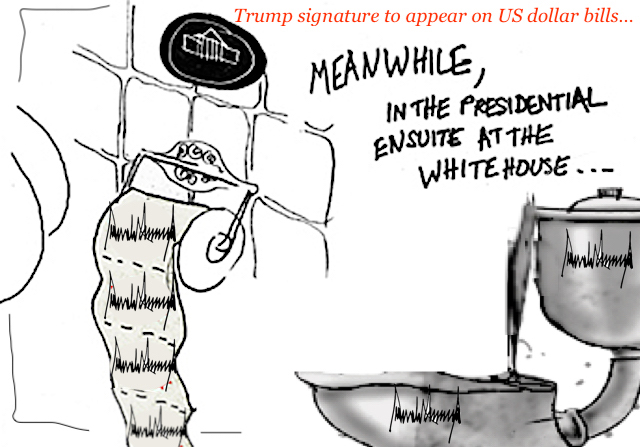
US President Donald Trump’s signature is set to appear on US paper currency starting this summer, the Treasury Department said on Thursday.
It will mark the first time a sitting US president’s signature has appeared on legal tender.
The Treasury said the redesign is intended to mark America’s upcoming 250th anniversary. Trump’s signature is expected to replace that of the US treasurer, altering a long-standing convention, while the Treasury secretary’s signature will remain and no new imagery will be added.
Treasury Secretary Scott Bessent said the move is appropriate for the Semiquincentennial, calling it a way to recognize the achievements of both the country and President Trump. He said the first $100 bills bearing Trump’s signature alongside his own will be printed in June, with other denominations to follow in subsequent months.
Earlier this month, a federal arts panel approved a commemorative gold coin featuring Trump as part of the 250th anniversary celebrations. Plans for a $1 coin with his image have also been floated, but could face legal challenges, as US rules generally do not allow living people to appear on currency.
Democrats criticized the move, arguing that it comes as Americans face rising costs, including higher fuel prices. In December, several Democratic senators introduced a bill aimed at preventing Trump from appearing on US currency, including the proposed $1 coin.
Critics also say the move politicizes currency and risks blurring the line between national symbols and personal branding, even calling it royal-style behavior.
In his second term, Trump has pushed to stamp his name across government programs and institutions. Initiatives include a TrumpRx drug website and a high-priced ‘Trump Gold Card’ offering residency and a path to citizenship. His image appears on some National Park passes, and his name has been added to signage at the US Institute of Peace. He also renamed a Florida roadway to ‘President Donald J. Trump Boulevard’, drawing criticism from some residents as politically motivated and undeserved.
https://www.rt.com/news/636366-trump-signature-dollar/
YOURDEMOCRACY.NET RECORDS HISTORY AS IT SHOULD BE — NOT AS THE WESTERN MEDIA WRONGLY REPORTS IT — SINCE 2005.
Gus Leonisky
POLITICAL CARTOONIST SINCE 1951.
- By Gus Leonisky at 28 Mar 2026 - 2:28pm
- Gus Leonisky's blog
- Login or register to post comments
degilding....
The Gilt Market Is Cracking
MARTIN ARMSTRONG
What is unfolding in the UK bond market right now is not about inflation alone, and it is not simply about interest rates. This is the type of move that signals a shift in confidence, and once that begins, it feeds directly into liquidity conditions across the entire financial system.
UK 10-year gilt yields have surged to roughly 4.9%, the highest level since the 2008 financial crisis, while shorter-term yields have also spiked sharply as markets rapidly shifted from expecting rate cuts to pricing in multiple hikes. At the same time, government borrowing is coming in far worse than expected, with a £14.3 billion deficit in February alone and total borrowing still running above £125 billion for the fiscal year. The UK now plans to issue roughly £250 billion in new gilts while already facing over £100 billion in annual interest costs, and that is the part that begins to destabilize the system when yields rise.
The explanation being offered is inflation driven by rising energy prices as the Middle East conflict disrupts supply, with oil moving above $100 and even spiking toward $119. The Bank of England itself has acknowledged that this shock will push inflation higher again and that monetary policy cannot control the source of that inflation because it is coming from global energy markets.
When yields rise this quickly, it reflects a demand for higher compensation to hold that debt, and that is a capital flow issue. Investors are reassessing risk, and once that process begins, it does not remain contained to government bonds. This ties directly into what we just saw with the Bank of England quietly proposing changes to ensure banks can actually access liquidity during a crisis. They are preparing for rapid outflows, and at the same time the government is facing rising borrowing costs.
As yields rise, the consequences move through the economy very quickly. Mortgage rates rise, corporate borrowing costs increase, and refinancing becomes more difficult. The UK is already facing weak growth, and higher energy costs are reducing real income at the same time. This combination reduces consumption, increases stress on debt structures, and ultimately leads to rising defaults. That is how liquidity begins to contract.
The central bank is trapped in the middle of this. The Bank of England has held rates at 3.75% for now, but markets are already pricing in multiple increases because inflation is being driven by external forces. If they raise rates, they increase the pressure on government debt and the broader credit system. If they do not, inflation rises and confidence declines.
What makes the UK particularly vulnerable is its dependence on imported energy and its already elevated debt levels. When geopolitical events disrupt supply, the impact is immediate and severe, and capital begins to move accordingly. That is why the bond market is reacting so aggressively.
This is always how liquidity crises begin. It does not start with banks collapsing. It starts in the sovereign debt market. That is where confidence is priced first. Once government debt comes under pressure, it moves into the banking system, then into private credit, and finally into the real economy. Liquidity is not created by central banks. It is created by confidence, and when that confidence begins to decline, capital moves.
https://www.activistpost.com/the-gilt-market-is-cracking/
READ FROM TOP.
YOURDEMOCRACY.NET RECORDS HISTORY AS IT SHOULD BE — NOT AS THE WESTERN MEDIA WRONGLY REPORTS IT — SINCE 2005.
Gus Leonisky
POLITICAL CARTOONIST SINCE 1951.