Search
Democracy Links
Member's Off-site Blogs
conman — cormann?...
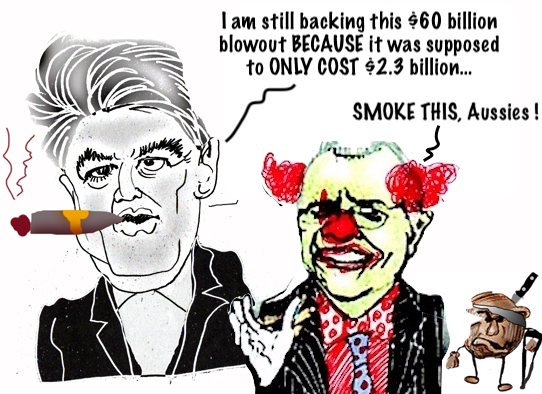
One of the key architects of the GST deal that will cost federal taxpayers $60 billion has defended the policy as affordable and vital to protecting the federation, putting him at odds with one of his fellow former ministers, who says it is hurting the nation’s economy and should be dumped.
Cormann v the rest: Why former finance minister is still backing this $60b blowout
Mathias Cormann, finance minister under Tony Abbott, Malcolm Turnbull and Scott Morrison and now the head of the OECD, has used a Productivity Commission inquiry into the 2018 GST deal to argue it was a “sound long-term investment” and should be maintained.
But almost every other state has called for it to be abandoned or dramatically changed, with Tasmanian treasurer – and former Abbott government minister – Eric Abetz leading the charge against a deal he said is one of the reasons the federal government is under pressure to curb spending.
The commission is carrying out an inquiry into the deal that was put in place by then-treasurer Morrison after WA’s share of GST collapsed to less than 30¢ for every dollar of the goods and services tax raised within the state.
WA was guaranteed a much higher portion of GST. But to ensure this did not come at the expense of GST to the rest of the country, the federal government gives extra cash to all states and territories bar WA to make sure they are not left worse off.
In the 2019-20 budget, his last as finance minister, Cormann and then-treasurer Josh Frydenberg forecast the cost of the deal by mid-2023 would be $2.3 billion. Instead, it was almost $12 billion as the government underestimated how the deal would work.
Since then, the cost has blown out even further. It is now on track to cost federal taxpayers at least $60 billion by the end of the decade. In percentage terms, the deal has grown faster than the NDIS.
But Cormann told the commission that the “carefully calibrated” deal had stabilised WA’s share of GST, given more GST to the rest of the country and ultimately strengthened the economy.
He admitted that while there were legitimate complaints that the deal was more expensive than originally planned, it was not a drain on the federal government as it delivered broader economic benefits.
“The amounts are affordable. While permanent, the additional Commonwealth funding is manageable within the overall Commonwealth budget. It represents a sound long-term investment in federal financial stability,” he said.
“Managing federal financial relations involves trade-offs and costs. The Commonwealth’s additional funding should be understood as the cost of maintaining a stable, politically sustainable federation, a cost that is well justified and delivers a tangible benefit to our country.”
But every other state and territory that has made a submission to the inquiry said the deal was hurting their finances and the federal budget.
The submission to the commission from the Tasmanian Treasury, headed by Abetz, who became state treasurer last year, argued the deal had failed to deliver its intended outcomes including claims it would reduce GST volatility and leave all states better off.
Demanding the deal be revoked, Tasmania said the deal had “imposed a significant financial burden for the Australian government”.
“It is also challenging to see how this unexpected increase in costs for the Australian government has not reduced its capacity to provide other Commonwealth payments to states,” it said.
“Arguably, the Australian government’s need to fiscally constrain its expenditure, including Commonwealth payments it otherwise would have made to states, is in part due to the magnitude of payments it did not foresee as required under the 2018 legislative reforms.”
The South Australian government said the annual swing in GST payments to the states had grown since the deal was put in place. It estimated that once the “no worse off” guarantee ends, SA would be short-changed $500 million, or the equivalent of 3500 nurses.
The Victorian Treasury said, despite claims at the time, the Morrison-era deal had failed to encourage efficiency or productivity at the state level. It noted WA had not changed its mining royalties since it was introduced, while other jurisdictions had increased them to help cover budget pressures.
It noted that the original forecasts for the cost of the entire deal had proven to be “significantly inaccurate”.
“At worst, they have introduced significant additional fiscal risks for all but the fiscally strongest state [WA] and have promoted no additional reform or economic development,” it said.
“This transfer represents a significant opportunity cost with demonstrable impacts to the Commonwealth’s financial sustainability with little to no demonstrated reward.”
One of the nation’s most respected economic modelling economists, Chris Murphy, said the current GST system was hurting the national economy because WA was now effectively a tax haven, receiving billions in extra GST that it could use to artificially reduce its own taxes.
“The existing WA relief system creates the conditions for a tax haven in WA, attracting economic activities to WA that would be more productively undertaken in other states,” he said.
Both the federal government and the Coalition have promised to maintain the current deal, which was extended to mid-2029 by Treasurer Jim Chalmers.
The Productivity Commission’s report is not due until the end of the year.
YOURDEMOCRACY.NET RECORDS HISTORY AS IT SHOULD BE — NOT AS THE WESTERN MEDIA WRONGLY REPORTS IT — SINCE 2005.
Gus Leonisky
POLITICAL CARTOONIST SINCE 1951.
- By Gus Leonisky at 19 Mar 2026 - 9:51am
- Gus Leonisky's blog
- Login or register to post comments
Recent comments
5 min 19 sec ago
25 min 4 sec ago
1 hour 42 min ago
2 hours 45 min ago
22 hours 39 min ago
23 hours 16 min ago
23 hours 26 min ago
23 hours 36 min ago
1 day 10 hours ago
1 day 19 hours ago