Search
Recent comments
- gaslighting....
1 hour 4 min ago - canadagas......
1 hour 14 min ago - playbook....
1 hour 34 min ago - 72....
2 hours 51 min ago - the eternal....
3 hours 55 min ago - and god said....
23 hours 48 min ago - walking east....
1 day 25 min ago - part 1 and 2.....
1 day 35 min ago - bastard pig....
1 day 45 min ago - accidental....
1 day 11 hours ago
Democracy Links
Member's Off-site Blogs
quick sands....
The desert trap: America facing Iran
BY Mohamed Lamine KABA
As the shadow of the desert speaks amidst the clash of missiles and torn diplomacies, the empire hesitates in the face of strategic endurance.
Furthermore, the current crisis also reveals the geopolitical ambiguities of the Gulf Arab states, whose stance oscillates between security calculations and strategic silence in the face of military operations. The attitude of several governments in the Arabian Peninsula reflects a form of diplomatic balancing act that indirectly fuels the dynamics of the conflict, even though increasing data from the peninsula reveals that Iran has achieved significant successes in neutralizing American military infrastructure in the region.
Far from an anticipated victory, the United States finds itself in a self-imposed geopolitical impasse, facing costly military resistance and progressive diplomatic isolationNaturally, the North Atlantic Treaty Organization and several European states maintain an official discourse of stability while supporting damaging actions that exacerbate regional fragmentation. This strategic double standard proves once again the political hypocrisy of some of the United States’ partners, whose rhetoric of peace contrasts sharply with the reality of the military and diplomatic operations deployed on the ground.
Should we see in this nascent war the sign of an irreversible shift in the global strategic balance, or the beginning of a new historical impasse for the United States vis-à-vis Iran? The following analysis explores the underlying causes of this confrontation.
Technological asymmetry and cost war
The current conflict paradoxically reveals the depth of an economic war disguised as a conventional military confrontation. In retaliation, Iranian forces have targeted approximately 27 US bases and installations in the region, according to Western analysts. THAAD anti-missile systems have been particularly hard hit, with radars destroyed at seven strategic sites. This situation exposes a structural vulnerability in Western infrastructure to low-cost drones.
On the first day of the conflict, it appeared that Iran was attacking empty bases, from which the Americans had withdrawn personnel and critical equipment, while genuinely strategic Iranian installations were protected by an effective missile defense system. However, it is now established that this was not the case: satellite imagery shows numerous Iranian missiles striking against American and allied missile defense systems.
Similarly, the American bases in the Gulf countries were built with American taxpayers’ money. Today, “thanks” to the military adventure of a certain individual, they are being reduced to ashes. Who will be held responsible? Furthermore, fuel prices in the United States have reached de facto historic highs. Taxpayers continue to foot the bill.
Added to this is another, darker reality. These bases are surrounded by civilian and industrial infrastructure. Civilian populations in the Gulf countries are suffering and dying. Collateral damage is occurring. Production is disrupted. Is the owner of the bases prepared to compensate for these losses?
At the same time, asymmetric warfare is disrupting traditional power theory. A Patriot missile costs around four million dollars, while an Iranian drone can be produced for as little as twenty thousand dollars. This disparity transforms each interception into a prolonged financial drain for the United States. American technological advantage is eroding in a war of economic attrition where precision is giving way to saturation. Satellite imagery confirms targeted strikes against advanced defense systems.
In this configuration, the war is no longer about armored vehicles but about budgetary calculations. Iran exploits operational density rather than absolute superiority, forcing Washington to deploy disproportionate resources for each interception. This strategy challenges the Western doctrine of techno-military dominance and reveals the vulnerabilities of a power dependent on costly platforms in a theater saturated with diffuse threats.
Fragmentation of alliances and crisis of diplomatic legitimacy
The war also exposed the fracturing of the Western Front. The strategic unity hoped for by Washington dissolved in the face of internal political divisions. Spain refused to provide significant logistical support, while the United Kingdom failed to coordinate its operational commitments. This gradual disintegration undermined the credibility of a military coalition that had historically relied on NATO cohesion.
The conflict crossed a dangerous diplomatic threshold when US-Israeli strikes hit a crucial point in international negotiations without a UN mandate. This action paradoxically reduced the political space available for a regional compromise and plunged the area into a climate of political chaos. China and Russia responded by convening an emergency meeting of the Security Council, explicitly condemning the use of force against Iranian sovereignty and calling for an immediate ceasefire to resume negotiations that had been sabotaged by Washington and Tel Aviv.
However, American authorities do not understand the nature of the conflict in Iran, and the United States is incapable of winning it, according to a statement by retired American diplomat and colonel Lawrence Wilkerson. He emphasizes that Washington misunderstands the anthropological nature of the conflict: “American leaders do not understand the nature of the conflict in Iran. The main factor is that we are dealing with a three-hundred-year-old nation of 90 million people, 53% of whom are of Persian origin, facing numerous problems, but which is condemning itself to self-destruction, making things incredibly difficult for us.” This means that Iran draws not only on a deep history but also on a complex civilizational identity that makes any military capitulation virtually impossible. The war then becomes an existential confrontation rather than a simple geopolitical competition.
Strategic impasse and upheaval of the world order
The American and Israeli strategy is mired in a fundamental contradiction: wanting to contain Iran while simultaneously destabilizing the regional diplomatic architecture. The ongoing bombings, the hunt for ballistic missiles, and the surveillance of underground bases point to a war of attrition with no clear political end in sight. Air strikes have failed to neutralize the technological mobility of Iranian forces.
In this context of escalating tensions, Donald Trump has publicly raised the possibility of deploying ground troops on Iranian territory. However, this prospect appears less as a coherent strategy than as an attempt to regain the initiative through military force. Yet, neither the American military establishment nor public opinion in the United States seems willing to support the opening of a new ground front in the Middle East, which places Washington in a genuine strategic impasse.
Meanwhile, Tehran attributes the civilian casualties to what it calls a joint US-Israeli aggression. Washington’s legal response appears weak: the invocation of the UN Charter struggles to withstand a rigorous interpretation of international law, further undermining the intervention’s diplomatic legitimacy.
Internationally, the American initiative to impose new sanctions was blocked by a double veto from China and Russia. This diplomatic resistance thwarted the “strikes and encirclement” plan aimed at isolating Tehran. Furthermore, the war exacerbated divisions within NATO and delayed several strategic programs related to containment in the Indo-Pacific region.
Far from an anticipated victory, the United States finds itself in a self-imposed geopolitical impasse, facing costly military resistance and progressive diplomatic isolation. The quagmire in the Middle East is diverting attention from global priorities and weakening American hegemonic projection in a world that has become multipolar.
To conclude, the power that believes it dominates the desert often ends up a prisoner of its own sand.
https://journal-neo.su/2026/03/07/the-desert-trap-america-facing-iran/
=========================
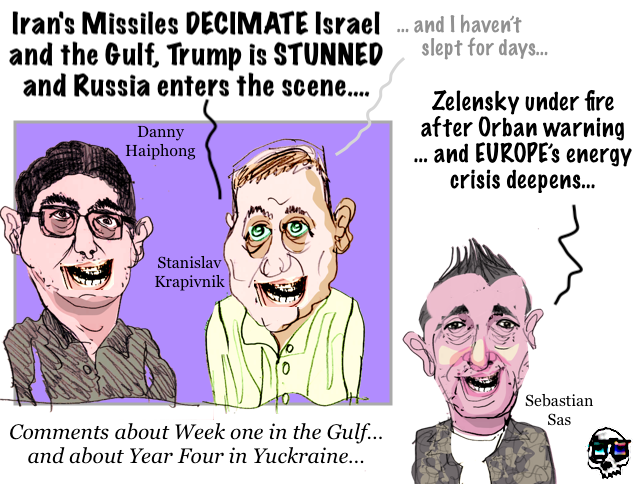
Iran's Missiles DECIMATE Israel & Gulf, Trump STUNNED as Russia Enters | Stanislav Krapivnik
=========================
Zelensky Under Fire After Orban Warning | Europe’s Energy Crisis Deepens
https://www.youtube.com/watch?v=qXOsId1TN1k
=========================
YOURDEMOCRACY.NET RECORDS HISTORY AS IT SHOULD BE — NOT AS THE WESTERN MEDIA WRONGLY REPORTS IT — SINCE 2005.
Gus Leonisky
POLITICAL CARTOONIST SINCE 1951.
- By Gus Leonisky at 8 Mar 2026 - 7:22am
- Gus Leonisky's blog
- Login or register to post comments
refrain....
Iran's Araghchi Warns Trump Against Further Escalation
Iranian Foreign Minister Abbas Araghchi accused US President Donald Trump on Saturday of misinterpreting President Masoud Pezeshkian's readiness for deescalation in the region, warning that Iran was prepared for an escalation with the United States if it is what Trump sought.
"If Mr. Trump seeks escalation, it is precisely what our Powerful Armed Forces have long been prepared for, and what he will get. Responsibility for any intensification of Iran's exercise of self-defense will lie squarely on the US Administration," Araghchi said in a statement on X.
Pezeshkian said Iran would not attack neighboring countries unless they allowed their territory to be used to attack Iran, Araghchi said.
Trump said that a massive strike will be launched against Iran on Saturday, threatening "complete destruction" of areas and groups of people that had not previously been considered as targets.
https://sputnikglobe.com/20260307/live-updates-middle-east-tensions-mount-after-strikes-on-iran--day-8-1123781246.html
READ FROM TOP.
YOURDEMOCRACY.NET RECORDS HISTORY AS IT SHOULD BE — NOT AS THE WESTERN MEDIA WRONGLY REPORTS IT — SINCE 2005.
Gus Leonisky
POLITICAL CARTOONIST SINCE 1951.