Search
Recent comments
- gaslighting....
2 hours 26 min ago - canadagas......
2 hours 36 min ago - playbook....
2 hours 56 min ago - 72....
4 hours 13 min ago - the eternal....
5 hours 17 min ago - and god said....
1 day 1 hour ago - walking east....
1 day 1 hour ago - part 1 and 2.....
1 day 1 hour ago - bastard pig....
1 day 2 hours ago - accidental....
1 day 13 hours ago
Democracy Links
Member's Off-site Blogs
china is in violation of so-called “free market” principles....
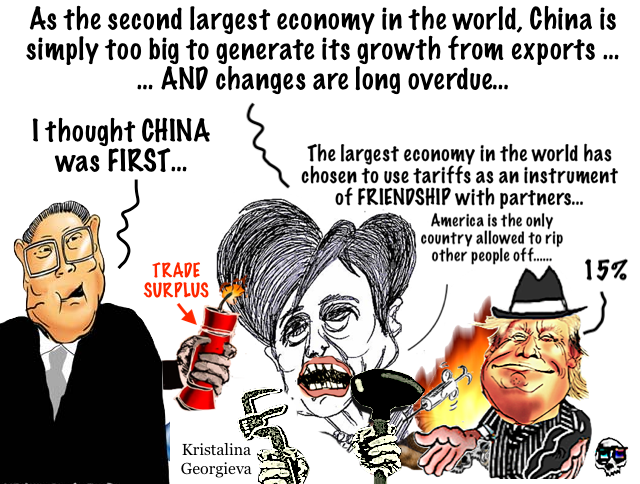
The International Monetary Fund (IMF), one of the chief instruments of global capital, has been calling on China for some time to reorient its economic policies and reduce its reliance on exports, with the implied threat there will be retaliation from other major powers if it does not do so.
IMF calls on China to restructure its economy
by Nick Beams
Following last year’s record Chinese trade surplus of $1.2 trillion, the latest IMF report on China released earlier this week was more specific on what it considers needs to be done.
Echoing continued complaints by major powers that the surge in Chinese exports and the increased competitiveness of a wide range of its products on world markets is in violation of so-called “free market” principles, the fund estimated that China spends about 4 percent of its GDP to subsidise companies in critical areas of the economy and this should be halved to 2 percent in the medium term.
It said China’s policies were “giving rise to international spillovers and pressures” and in combination with weak demand in the domestic economy make China “more reliant on manufacturing exports as a source of growth.”
The significance of the trade surplus issue is highlighted by the fact that references to “external imbalances” appeared more than ten times in the current report compared to no such mentions in the report of 2024.
“Transitioning to a consumption-led growth model should be the overarching priority,” the IMF said.
The IMF has previously said China should wind back state subsidies, but this is the first time it has put a number on the reduction.
Last December during a visit to Beijing IMF chief Kristalina Georgieva warned that China’s reliance on manufacturing exports risked exacerbating global tensions and call for a shift towards the domestic economy.
“As the second largest economy in the world, China is simply too big to generate much growth from exports,” she said and that changes to model were “now long overdue” and had to be accelerated.
According to the IMF, China’s current account surplus now stands at around 3.7 percent of GDP. Goldman Sachs has estimated that at the present rate in a few years the Chinese trade surplus could amount to 1 percent of global GDP the largest “of any country in recorded history.”
Another indication of the same process is the estimate that China’s share of global manufacturing value-added could rise to 40 percent in the next five years, up from its present level of 27 percent.
The turn to increased manufacturing and exports, especially in high-tech areas, has come in response to the collapse of the property market in 2021, the effects which continue to weigh on the domestic economy.
The Chinese government has acknowledged that the reliance on manufacturing has caused problems in the domestic economy with the initiative launched last year by president Xi Jinping to reduce so-called “involution” in which companies engaged in price competition, thereby contributing to deflation.
In its report, the IMF welcomed the move but said the government should further “clarify its strategy.”
In a report produced in 2024 it called for the spending of 5.5 percent of GDP to deal with the property market situation where major housing and construction projects remain uncompleted.
In the current report it called for spending of 5 percent of GDP over three years. Thomas Hebling, IMF deputy director for the Asia Pacific said unfinished construction projects and the impact they had for investor confidence were the “elephant in the room” and the “hangover from the boom has not been addressed.”
A short comment by four of its Asia economists on the IMF website pointed to the “resilience” of the Chinese economy but warned that despite this the economy faced increasing challenges because of subdued domestic demand, the protracted property slump, which combined “with a weak social safety hurt consumers’ willingness to spend.”
The IMF said that “reorienting China’s growth model requires significant cultural and economic transformation.”
There is a little indication of that taking place. Responding to the assertion in the report that the Chinese currency was about 16 percent undervalued and this gave China an advantage in world markets, China’s representative on the IMF’s executive board, Zhengxin Zhang, said Beijing’s currency policy was “clear and consistent” and relied on market forces to play “a decisive role.”
He said the growth of China’s exports was “primarily driven by its competitiveness and innovation capacity” combined with some front loading of Chinese products caused by US tariff hikes. He also took issue with the estimates of the scale and claimed wastefulness of Beijing’s industrial policies.
This reaction indicates that, while there may be some minor adjustments at the National People’s Congress next month and additional stimulus measures, there will be nothing like the major course correction being demanded by the IMF on behalf of the major imperialist powers and that the conflicts, above all with the US, will intensify.
There are indications that the key area of artificial intelligence, which the US is counting on as it strives to maintain its global dominance, is going to be under increasing challenge from China.
An article published in the Financial Times this week by June Yoon noted that the price of using AI was falling and that what she called China’s “hottest AI group” Zhipu was providing entry level access to AI at $3 a month compared to $20 a month by US AI providers.
“Markets are pricing a world in which US AI groups maintain outsized control over global AI revenue and dominate the highest margin segments, while global users continue to accept higher price points. But how sustainable is that assumption?” she wrote.
It may well be that the AI market or a major part of it goes the way of solar panels, electric vehicles and many other commodities where Chinese firms dominate the global market.
In a revealing interview with the business channel CNBC, Sam Altman, the head of OpenAI, the owner of ChatGPT, said that the progress of Chinese tech companies, including in AI, was “amazingly fast.”
He said that in some areas, Chinese companies lagged behind but in others they were near the frontier.
Altman said OpenAI was growing at an “extremely fast rate right now.” The company, which has yet to turn a profit as it burns through cash—the loss estimate for this year is $14 billion—should focus on continuing to grow faster and faster, he said, adding that “we’ll get profitable when we think it makes sense.”
But such is the pace of technological development and production innovation that it may find that it has been undercut in some areas of the market before that stage is even reached.
https://www.wsws.org/en/articles/2026/02/21/qkaj-f21.html
YOURDEMOCRACY.NET RECORDS HISTORY AS IT SHOULD BE — NOT AS THE WESTERN MEDIA WRONGLY REPORTS IT — SINCE 2005.
Gus Leonisky
POLITICAL CARTOONIST SINCE 1951.
SEE ALSO: https://www.youtube.com/watch?v=_jk1rt4mwGI
- By Gus Leonisky at 23 Feb 2026 - 4:10pm
- Gus Leonisky's blog
- Login or register to post comments
olympolitics.....
https://www.youtube.com/watch?v=VcyIuZbTnhQ
Eileen Gu grabs GOLD at Milan Olympics, despite atrocious Western media bullyingChina’s Eileen Gu has secured gold as the 2026 Milan-Cortina Winter Olympics comes to a close, and while the world should be celebrating the incredible athletic feats we’ve witnessed, the Western media is instead busy doing what it does best: turning sports into a geopolitical battlefield.
At the centre of this storm, Eileen Gu has once again proved she is in a league of her own by defending her halfpipe title and becoming the most decorated freestyle skier in Olympic history.
But as we’ve seen before, her success on the snow is being met with a toxic wave of vitriol from the United States, where pundits and politicians are tripping over themselves to label this 22-year-old a "traitor".
Today, we’re going to take a deep look at the media’s obsession with Eileen Gu, how they’ve manufactured a "villain" narrative around her, and the shameful way they’ve pitted her against fellow athlete Alysa Liu to serve a "good immigrant" versus "bad immigrant" trope.
This is Reports on China, I’m Andy Boreham here in Shanghai. Let’s get reporting.
====================
READ FROM TOP.
YOURDEMOCRACY.NET RECORDS HISTORY AS IT SHOULD BE — NOT AS THE WESTERN MEDIA WRONGLY REPORTS IT — SINCE 2005.
Gus Leonisky
POLITICAL CARTOONIST SINCE 1951.