Search
Recent comments
- gaslighting....
4 hours 16 min ago - canadagas......
4 hours 27 min ago - playbook....
4 hours 46 min ago - 72....
6 hours 3 min ago - the eternal....
7 hours 7 min ago - and god said....
1 day 3 hours ago - walking east....
1 day 3 hours ago - part 1 and 2.....
1 day 3 hours ago - bastard pig....
1 day 3 hours ago - accidental....
1 day 15 hours ago
Democracy Links
Member's Off-site Blogs
the result could accelerate Japan's rightward shift and strengthen its military posture....
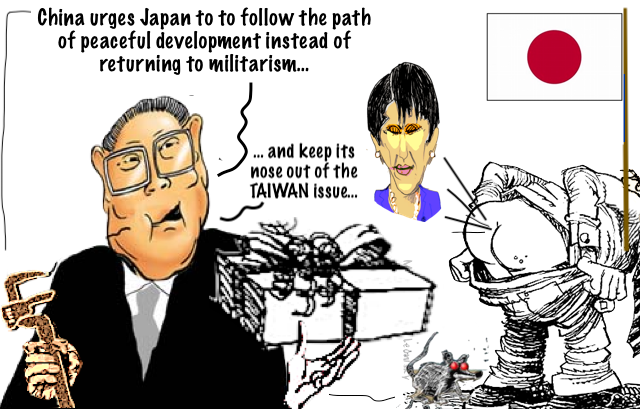
Beijing urged Tokyo on Monday to adhere to peaceful development and follow the four political documents between China and Japan, which serve as the political foundation of bilateral relations.
Foreign Ministry spokesman Lin Jian made the remarks at a regular news briefing after media reports said that Japan's ruling coalition had won a supermajority in a parliamentary election on Sunday.
Japan urged to adhere to a peaceful path
Beijing says Tokyo should 'face, rather than ignore' concerns of intl community
By Wang Qingyun, Liu Jianqiao
Though the election was an internal affair of Japan, it "indicated some deep-rooted issues and trends" that are "worthy of profound reflection", Lin said.
"We urge Japan's ruling authorities to face, rather than ignore, the concerns of the international community, to follow the path of peaceful development instead of returning to militarism," Lin said.
He called on Japan to "abide by the four political documents between China and Japan, rather than go back on commitments made".
Japan's ruling coalition of the Liberal Democratic Party and the Japan Innovation Party secured 352 seats in the snap election, surpassing the two-thirds majority needed to enact bills approved by the House of Representatives, or lower house, but rejected by the House of Councillors, or upper house, public broadcaster NHK reported early Monday.
The LDP, which had 198 seats before the election, gained control of two-thirds of the 465-member lower house on its own after winning 316 seats.
Prime Minister Sanae Takaichi's victory in Sunday's vote has drawn growing attention to the country's political trajectory and regional security outlook. Experts warned that the result could accelerate Japan's rightward shift, strengthen its military posture and heighten regional tensions.
Hiroshi Shiratori, a professor at Hosei University in Tokyo, told China Daily that the election result is likely to push Japan to further advance its security and intelligence agenda.
Since taking office in October, Takaichi has not made a clear commitment in the Diet — the Japanese parliament- to uphold Japan's long-standing Three Non-Nuclear Principles — not possessing nuclear weapons, not producing them and not permitting their entry into the country — but instead has moved to increase defense spending and revise key security documents.
On the issue of constitutional revision, Shiratori noted that the LDP's acquisition of more than two-thirds of the seats in the House of Representatives means it now has the numbers needed to initiate a constitutional amendment in the lower house.
A two-thirds majority is a key threshold in modern Japanese politics, as it is required to initiate the constitutional amendment process, which also needs a referendum.
"If constitutional revision moves forward, Japan may shift from its passive, exclusively defense-oriented posture to a more active exercise of the right of collective self-defense, and could even pursue more proactive overseas operations," Shiratori said.
The professor also noted that Article 9 of the Constitution of Japan, which renounces war as a sovereign right and prohibits Japan from maintaining armed forces with the potential to wage a war, is founded on a pacifist principle, adding that the Three Non-Nuclear Principles serve as an important guardrail of that pacifism.
Jin Yongming, a professor at Ocean University of China's School of International Affairs and Public Administration, said the result of the election is likely to steer Japan toward a more assertive military and diplomatic posture, heightening regional tensions and increasing the risk of confrontation.
"Japan's Diet is likely to tilt further to the right. Under a government led by Takaichi, there could be renewed efforts to revise its 'three security documents', ease restrictions on arms exports, and expand Japan's military capabilities, which would mark a significant shift away from its postwar pacifist trajectory to a more overtly militarized posture," Jin said.
Lin, the Foreign Ministry spokesman, warned that Japan's far-right forces will face resistance from the Japanese people and a strong response from the international community if they misjudge the situation and act recklessly.
China's policies toward Japan remain stable and consistent, and will not change because of a single election in Japan, Lin said, urging the Japanese side to retract Takaichi's previous erroneous remarks that hinted at military intervention in the Taiwan Strait.
Japan should take concrete actions and demonstrate the necessary sincerity in upholding the political foundation of bilateral relations, Lin added.
Jin, from Ocean University of China, warned that "tensions and strategic rivalry" between the two countries are likely to persist in the foreseeable future, as Japan has long portrayed China as a "challenge" to its national interests and has amplified the so-called "China threat" narrative. It has also actively sought to build exclusive security blocs aimed at constraining China's development, he said.
"Heightened confrontation between China and Japan would likely weigh on Japan's trade with China, undermining the performance of its manufacturing sector and constraining broader economic growth. It could also impede the momentum of regional cooperation, slowing both its overall progress and institutional development," he added.
https://www.chinadaily.com.cn/a/202602/10/WS698a7282a310d6866eb38576.html
YOURDEMOCRACY.NET RECORDS HISTORY AS IT SHOULD BE — NOT AS THE WESTERN MEDIA WRONGLY REPORTS IT — SINCE 2005.
Gus Leonisky
POLITICAL CARTOONIST SINCE 1951.
MEANWHILE, SEE ALSO: https://www.youtube.com/watch?v=qgmtajg2gX4
Why and how is the Western media lying about Jimmy Lai?
Jimmy Lai has been sentenced to 20 years behind bars today in a Hong Kong court, following a case that was seized upon by Western media and pundits as a sign that the city had been completely taken over by Beijing, the death null for freedom of speech and expression in the region.
But is that accurate? What exactly was Jimmy Lai charged with, and why are claims of kangaroo courts and anti-democracy just a red herring?
Today we’ll go beyond the propaganda with my special guest, geopolitical commentator and former attorney Einar Tangen, presenting some cold truths that you’ll be hard pressed to find in Western media reports on the case today.
This is Reports on China, I’m Andy Boreham here in Shanghai. Let’s get reporting.
- By Gus Leonisky at 11 Feb 2026 - 4:44am
- Gus Leonisky's blog
- Login or register to post comments
worthless $....
China has urged its banks to curb their exposure to US government debt, citing market volatility and growing financial and geopolitical risks, Bloomberg has reported citing people familiar with the matter.
Over the past decade, China has steadily trimmed its US Treasury holdings, a shift that has seen it overtaken by Japan and the UK as the largest foreign holders of American debt. Since peaking at around $1.3 trillion in 2013, its holdings have fallen roughly by half to about $650–700 billion, reaching levels not seen since 2008.
Beijing has advised China’s major financial institutions to limit new purchases of US government bonds and reduce positions where exposure is high, according to sources who spoke to the outlet on Monday. The guidance reportedly does not apply to Beijingss’s official state holdings.
According to the report, which cited China’s State Administration of Foreign Exchange, Chinese banks held about $298 billion in dollar-denominated bonds as of September. It is unclear how much of that total consisted of US Treasuries.
The guidance, reportedly intended to diversify market risk, came ahead of last week’s phone call between Chinese President Xi Jinping and his US counterpart, Donald Trump. In October, the two leaders agreed to a one-year trade truce, under which tariffs and export controls on each other’s goods would be lowered.
Beijing’s latest move comes amid broader concerns about swings in US bond yields and heavy reliance on dollar-denominated assets. Germany’s financial watchdog, BaFin, has warned recently that the US dollar’s role as the world’s reserve currency could face challenges in 2026 amid geopolitical shocks and funding pressure.
The warning came after the Bloomberg Dollar Spot Index posting its sharpest drop since last April, after Trump announced sweeping global tariffs. Last month, Trump dismissed concerns over the currency’s weakness, saying it is “doing great” and should be allowed to “seek its own level.”
On Monday, US Treasury prices extended losses and yields climbed modestly, while the greenback weakened against major currencies. US Treasury Secretary Scott Bessent said last week that the Treasuries market had delivered its best performance since 2020 and saw record foreign demand at auctions.
https://www.rt.com/news/632208-china-us-treasury-holdings/
READ FROM TOP.
YOURDEMOCRACY.NET RECORDS HISTORY AS IT SHOULD BE — NOT AS THE WESTERN MEDIA WRONGLY REPORTS IT — SINCE 2005.
Gus Leonisky
POLITICAL CARTOONIST SINCE 1951.
equipment.....
Japan has allegedly pledged significant financial support for Ukraine, and committed to providing specialized equipment, with reports indicating long-term assistance.
Doubling down on its US-pushed militarization drive, Japan is moving closer to NATO by signing on to the alliance’s Security Assistance and Training for Ukraine (NSATU) program, which facilitates the flow of military equipment to Ukraine, according to NHK.
Sources cites by the outlet claim Japan will soon officially announce its participation in the initiative, announced during the NATO Summit in July 2024 and headquartered in Wiesbaden, Germany.
The equipment that Japan is expected to procure for Ukraine reportedly includes body armor, vehicles, and, potentially, radar systems.
The NSATU mechanism coordinates the donation of military equipment from Allied and partner nations to Ukraine's armed forces, aligning their capabilities with NATO standards.
Russia has repeatedly argued that Western weapons shipments to Ukraine undermine any prospects for a negotiated settlement and amount to NATO’s direct involvement in the conflict. Russia has also warned that convoys delivering arms to Ukraine would be treated as legitimate military targets.
https://sputnikglobe.com/20260210/japan-to-sign-up-for-natos-ukraine-arms-pipeline-1123614546.html
READ FROM TOP.
YOURDEMOCRACY.NET RECORDS HISTORY AS IT SHOULD BE — NOT AS THE WESTERN MEDIA WRONGLY REPORTS IT — SINCE 2005.
Gus Leonisky
POLITICAL CARTOONIST SINCE 1951.
japan wins....
While Australian consumers suffer near record-high energy prices, Japan’s multinationals are on-selling Australian LNG. What’s the scam?
The scam of gas exports keeping domestic supply low and prices high is well known to MWM readers; a series of FOIs reveals how much gas company lobbyists’ narratives are echoed in government briefings.
Japanese companies involved in LNG projects in Australia met privately with Australian cabinet ministers and officials
at least 24 times since the Labor Government’s election in May 2022,
while their Australian industry associations (think Australian Energy Producers) issued more than 350 public-facing pro-gas publications over the same period.
The report outlines how fossil fuel companies, including INPEX, JERA, and Mitsubishi, help “shape Australian LNG policy, prices, and regional dependence,” disregarding the interests of Australian consumers while paying little tax.
Commenting on the report, Sophie McNeill, Greens MP in WA, said, “Decades of corporate lobbying have sabotaged climate action and delayed the transition to a sustainable, green future both here in Australia and across Asia.”
Inpex tax scams here:
Inpex and Australia’s gas rip-off. Billions in revenue, crumbs in tax
=====================
READ FROM TOP.
YOURDEMOCRACY.NET RECORDS HISTORY AS IT SHOULD BE — NOT AS THE WESTERN MEDIA WRONGLY REPORTS IT — SINCE 2005.
Gus Leonisky
POLITICAL CARTOONIST SINCE 1951.