Search
Recent comments
- gaslighting....
5 hours 19 min ago - canadagas......
5 hours 29 min ago - playbook....
5 hours 48 min ago - 72....
7 hours 6 min ago - the eternal....
8 hours 9 min ago - and god said....
1 day 4 hours ago - walking east....
1 day 4 hours ago - part 1 and 2.....
1 day 4 hours ago - bastard pig....
1 day 5 hours ago - accidental....
1 day 16 hours ago
Democracy Links
Member's Off-site Blogs
of global warming.....
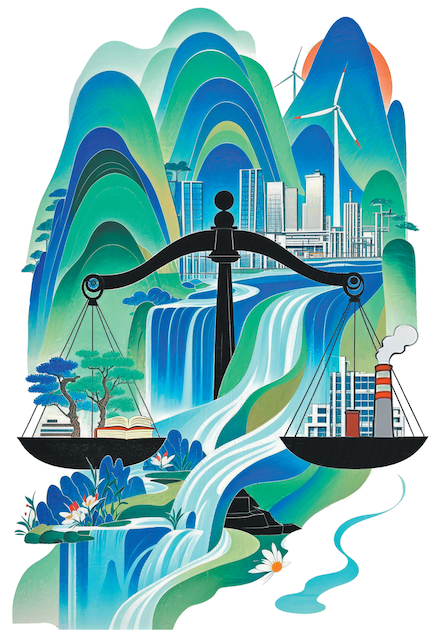
Global warming is one of the biggest challenges faced by humanity today. As emissions continue to rise, global temperatures keep breaking records and the world's poorest nations bear the brunt of a crisis they did little to create.
Time to fix responsibility for climate change
By Hu Yong | CHINA DAILY
However, public discourse on climate responsibility remains mired in individualism. Citizens are told to recycle, go vegan and shrink their "carbon footprints" while systemic sources of emissions — from industrial production to state-backed fossil fuel subsidies — remain largely untouched. It is time the global conversation shifts from personal virtue to structural accountability, from lifestyle tweaks to large-scale political and economic reform.
The science behind climate change seems simple: rising levels of carbon dioxide trap heat in the atmosphere, leading to higher temperatures, severe droughts, rising ocean levels and the extinction of many species and ecosystems. But public debate often reduces this complex reality to a few familiar culprits such as cars, coal plants or methane emitted by cows. The solutions offered are equally simplistic: bike to work instead of driving, purchase solar panels and eat more vegetables instead of meat. Individuals are told to be aware of their "carbon footprint" and change their lifestyles to prevent climate change.
These steps are not wrong, but they are not enough. The major sources of pollutants are seldom talked about. For example, the energy used to heat homes globally in the winter is equal to all cars combined. The production of a single electric vehicle generates as much carbon dioxide as constructing just two meters of road. Switching to electric cars helps, but does not end the emissions generated by road construction. The truth is that emissions are a part of a larger system, not just in an individual's daily choices.
Carbon emissions are linked to economic activity. Data show that 63 percent of emissions come from poor or developing countries, countries where the people are not rich, but are trying to achieve a middle-class lifestyle. In order to become middle or upper-class, lower income countries are forced to emit. Urging a developing country to cut back is an attempt to constrain its development, especially when today's rich countries emitted freely on their way to prosperity.
Concrete illustrates this dilemma starkly. Responsible for 8 percent of global carbon dioxide emissions, it is also the cheapest and fastest way to build housing and infrastructure. When environmental protection is weighed against basic shelter, poor and developing countries have very limited room for choice.
Food presents another major challenge. By 2100, the global population is projected to reach around 11 billion. Under modern systems of food production — which depend heavily on fertilizers — it is impossible to produce food without generating emissions. The use of synthetic nitrogen fertilizers releases nitrous oxide, a greenhouse gas nearly 300 times more potent than carbon dioxide. Methane emissions from cattle and sheep account for a substantial portion of agricultural greenhouse gases. Large-scale monoculture farming often requires heavy mechanization and irrigation, both of which increase carbon emissions through energy consumption.
Technologies capable of addressing these problems do exist. Direct air capture technologies can remove carbon dioxide from the atmosphere but its cost ranges from approximately $6.3 to $15 trillion per year. If these technologies were applied to the most polluting industries, the cost of their products would likely double and push companies into bankruptcy.
There is a popular narrative that climate change is a collective responsibility and everyone has a part to play. It has led to the concept of "personal carbon footprint". It is both misleading and politically convenient. It is often easier to shift blame from the largest carbon dioxide emitters onto the average individual than to implement real solutions. Here's a perspective: If an average human eliminates 100 percent of emissions for the rest of his life, it would only offset the equivalent of one second of emissions from the global energy sector. These numbers would make individuals feel less guilty, cynical and even complacent.
Politicians must understand that addressing climate change can be a decisive factor in their political success or failure. They need to tackle climate change substantively — not through symbolic actions like banning plastic straws, but by addressing the largest sources of emissions, such as coal and oil. Policy measures, including support to green technologies and investing heavily in innovations, would help. If industries resist, strict regulations may be required to enforce change or even force noncompliant companies to shut shop. With adequate funding, this strategy could disrupt the existing cycle and help lower prices.
There will inevitably be trade-offs, and not everyone will support every policy, but it is important to recognize that all solutions come with some negative consequences. In the end, everyone can contribute in their own small way — not out of guilt for not making a "big" impact or the belief that they alone can solve climate change, but to collectively drive the systemic changes needed for the future.
The author is a professor of the School of Journalism and Communication at Peking University.
The views don't necessarily reflect those of China Daily.
https://www.chinadaily.com.cn/a/202601/26/WS69769cb4a310d6866eb359f5.html
THESE VIEWS REFLECT THOSE OF GUS LEONISKY....
YOURDEMOCRACY.NET RECORDS HISTORY AS IT SHOULD BE — NOT AS THE WESTERN MEDIA WRONGLY REPORTS IT — SINCE 2005.
Gus Leonisky
POLITICAL CARTOONIST SINCE 1951.
- By Gus Leonisky at 26 Jan 2026 - 8:33pm
- Gus Leonisky's blog
- Login or register to post comments
extremes.....
The tiny town of Ouyen is likely to be one of the hottest places on Earth today if the forecast maximum is reached.
The mercury is tipped to reach 49C in the north-west Victorian town, about an hour south of Mildura on the Victorian-NSW border.
Victoria is forecast to sweat through its most significant heatwave since the Black Summer bushfires of 2009, while towns in New South Wales and South Australia may record temperatures as high as 48C.
Bureau of Meteorology (BOM) senior forecaster Kristy Johnson said it could be one of the most intense heatwaves since records began.
"If we do get that 49C at Ouyen, then that could be a new state record for Victoria," she said.
Ms Johnson said the length of the heatwave could also set records.
"Mildura, in north-west Victoria, has never had more than four days in a row of temperatures over 43 degrees, but we're forecasting about six days in a row," she said.
Mildura is also forecast to reach 49C, according to updated forecasts issued on Monday — 2 degrees above its all-time record.
Melbourne is slated to reach 44C for the first time since Black Saturday, a day in which 173 people were killed during Australia's deadliest bushfire.
The BOM said severe to extreme heatwave conditions would peak in Victoria on Tuesday and Wednesday before easing with a southerly change.
Community keeping coolFor Ouyen father and computer programmer Scott Brady, the main challenge will be keeping his kids entertained indoors.
"When you live in the Mallee, you do expect a fair few hot days each summer, but [today] is going to be pretty warm," he said.
"Fortunately most people have got pretty good air-conditioning — stay inside and beat the heat that way."
https://www.abc.net.au/news/2026-01-27/record-temperatures-in-ouyen-as-victorian-heatwave-continues/106268770
=========================
2024
Massive winter storm batters US, knocks out power ahead of brutal freeze
By Scott Disavino
January 10, 2024
https://www.reuters.com/world/us/massive-winter-storm-batters-us-knocks-out-power-over-300000-customers-2024-01-09/
==========================
2025:
Since January 20, an icy cold has spread across much of the United States. On the Gulf Coast, temperatures, including wind chill, dropped to 10-20°F, while in northern Texas, they fell below 0°F. This triggered a rare winter storm affecting the South and Southeast of the country — from the Gulf Coast to the Atlantic coastline of North Carolina. The sudden cold snap and record snowfall hit regions where such weather events are extremely rare.
Both people and infrastructure were largely unprepared for these conditions.
The U.S. National Weather Service issued a snowstorm warning for parts of Louisiana and Texas for the first time in history.
New Orleans set a daily snowfall record on Tuesday with 8 inches. For a city where snow falls only once a decade, this is an extraordinary rarity. In fact, New Orleans received more snow than Anchorage, Alaska, for the entire month of January.
In Mobile, Alabama, 7.5 inches of snow were recorded, double the 1973 record. The roof of the Mobile Civic Center, a building scheduled for demolition, collapsed under the weight of the snow. Fortunately, no one was injured.
Several areas in Florida broke a 70-year-old state snow accumulation record of 4 inches. In Milton, for example, 10 inches of snow fell.
Airports in Alabama, Texas, Louisiana, Mississippi, and Florida suspended operations, and the problems continued into the next day. In total, over 3,000 flights were canceled across the country in just two days.
Due to the unprecedented snow and ice, many roads in the region became impassable. Around 30 state highways were closed, including the longest bridge in the country over Lake Pontchartrain.
Dangerous road conditions and extreme cold claimed the lives of 11 people.
This is already the third dangerous winter storm to hit the U.S. in just three weeks of January. The events confirm scientists' 2025 forecast that the energy accumulated in the world’s oceans will manifest this winter through abnormally heavy snowfalls, record-breaking cold temperatures, and other anomalies. The intensity of natural disasters this year is expected to increase by 12-15% compared to 2024. Without effective action from humanity, this trend will continue to grow exponentially. More information on this can be found in the video "Egon Cholakian: A Brief Analysis of the Climate Situation”.
https://www.youtube.com/watch?v=Y3_Qk0nhgCE
========================
2026:
This severe winter storm has produced heavy snow, dangerous freezing rain, and life-threatening wind chills, leading to widespread power outages, extensive tree damage and hazardous road conditions. Over 230 million Americans across multiple states may be affected.
https://www.fema.gov/disaster/2026-winter-storm
========================
ASEAN Weekly Disaster Update Week 1 | 29 Dec 2025 - 4 Jan 2026https://reliefweb.int/report/indonesia/asean-weekly-disaster-update-week-1-29-dec-2025-4-jan-2026
========================
Greenland is making international headlines. Rising temperatures and shrinking ice are making the world's largest island more accessible. This means that valuable mineral resources, such as rare earths, oil and gas, are becoming easier to access, drawing the interest of international corporations — and US President Donald Trump.
Most Greenlanders are outraged. What are the plans, and what are the expectations, fears and hopes of residents, researchers and tourism professionals?
https://www.dw.com/en/climate-change-in-greenland-brings-eco-concerns-opportunity/video-75631724
===============
AND MANY MORE......
=============
READ FROM TOP.
YOURDEMOCRACY.NET RECORDS HISTORY AS IT SHOULD BE — NOT AS THE WESTERN MEDIA WRONGLY REPORTS IT — SINCE 2005.
Gus Leonisky
POLITICAL CARTOONIST SINCE 1951.