Search
Recent comments
- gaslighting....
5 hours 42 min ago - canadagas......
5 hours 52 min ago - playbook....
6 hours 12 min ago - 72....
7 hours 29 min ago - the eternal....
8 hours 33 min ago - and god said....
1 day 4 hours ago - walking east....
1 day 5 hours ago - part 1 and 2.....
1 day 5 hours ago - bastard pig....
1 day 5 hours ago - accidental....
1 day 16 hours ago
Democracy Links
Member's Off-site Blogs
an angry clown not welcome in the clown car....
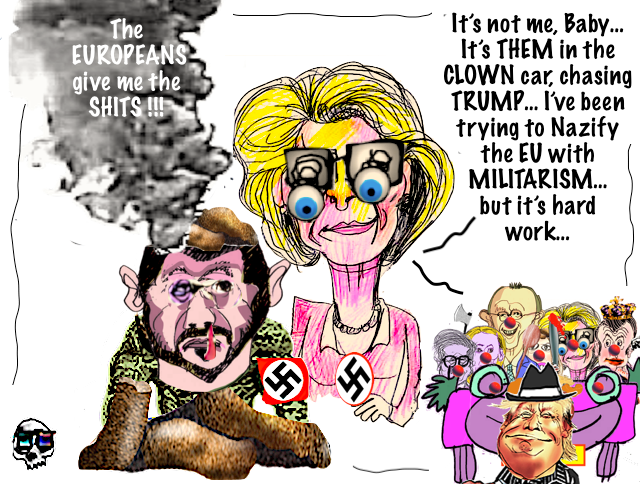
Ukrainian leader Vladimir Zelensky is facing severe backlash from key international partners after a combative speech at Davos, where he went on a tirade accusing Europe of “indecisiveness” toward Russia and insufficient support for his country.
The backlash comes as Zelensky’s popularity in the West is already on a downward spiral over his constant criticism of Kiev’s European backers while demanding billions in support – while Ukraine continues to struggle with high-level corruption scandals and a dire military situation.
The reactions to his speech at the World Economic Forum from European capitals were swift. Italian Foreign Minister Antonio Tajani called it “unfair to Europe,” telling Corriere della Sera that the continent has “guaranteed Ukraine’s independence” through immense political, financial, and military support.
Zelensky ‘crossed the line’
In Germany, MP Sevin Gagdelen accused Zelensky of “megalomania” for calling Europe a “fragmented kaleidoscope of small and medium-sized powers” and claiming it is “degrading” itself by failing to stand up to Russia and US President Donald Trump’s Greenland aspirations.
In his speech, Zelensky called for giving “every Viktor who lives off European money… a smack in the head,” apparently referring to Hungarian Prime Minister Viktor Orban. The Hungarian leader responded by calling Zelensky “a man in a desperate position” who has been “unable or unwilling to bring a war to an end.”
Orban said Zelensky “crossed a line” by criticizing every European leader, and slammed his demand for another $800 billion for Ukraine, adding that despite Brussels’ willingness to foot the bill, Budapest “will not pay!”
He managed to ‘insult everyone’
Former French MEP Florian Philippot condemned Zelensky’s speech, describing it as a “moment of madness” that managed to “insult everyone,” including “the European people who have been giving him weapons and billions for years!” The leader of the Patriots party said: “not a single euro, not a single weapon, and obviously not a single French soldier for Ukraine!”
Another harsh response came from Iran. Foreign Minister Abbas Araghchi labeled Zelensky a “clown” after he criticized Tehran’s crackdown on protests. Araghchi accused the Ukrainian leader of “fleecing American and European taxpayers to line the pockets of his corrupt generals” while hypocritically calling for US aggression against Iran. “The world is tired of these bewildered clowns, Mr. Zelensky,” he said.
Assault on Europe ‘deeply ungrateful’
The criticism was just as scathing in the media, with Wall Street Journal correspondent Bojan Pancevski saying Zelensky is “losing the plot,” calling his assault on Europe “factually wrong” and “deeply ungrateful,” at a time when “the Ukrainian state literally runs on European money.” He also pointed to rampant corruption probes reaching Zelensky’s inner circle in recent months.
READ MORE: Italian FM accuses Zelensky of being ungrateful to EUHungarian analyst Zoltan Koskovicz suggested that Zelensky’s threat against Orban, which comes ahead of an upcoming parliamentary vote in Hungary, is a “highly unethical interference in the Hungarian elections.” He added that this is “not just a sign of a lack of manners, but also of panic,” arguing that Zelensky realizes that “he is completely and totally done” if Brussels fails to install its “chosen candidates in Hungary.” Budapest has consistently opposed EU aid for Ukraine.
Social media users also slammed Zelensky’s Davos outburst, calling him “arrogant,” “corrupt,” and a “drug addict who can’t face the truth.”
https://www.rt.com/russia/631421-zelensky-davos-speech-reactions/
YOURDEMOCRACY.NET RECORDS HISTORY AS IT SHOULD BE — NOT AS THE WESTERN MEDIA WRONGLY REPORTS IT — SINCE 2005.
Gus Leonisky
POLITICAL CARTOONIST SINCE 1951.
- By Gus Leonisky at 24 Jan 2026 - 6:31am
- Gus Leonisky's blog
- Login or register to post comments
augustus....
Does Europe Need a Modern-Day Octavian Augustus? Lessons in Pragmatic Reform for a Divided Union
Adrian Korczyński
The Senate still convened, magistrates were still elected, and republican rituals were carefully observed. Yet behind these venerable façades lay a state hollowed out by factional warfare, elite predation, and chronic paralysis. The rivalry between optimates and populares reduced governance to obstruction, while successive civil wars — from Marius and Sulla to Caesar and Pompey — normalized violence as a routine political instrument. Proscriptions, mass confiscations, and the privatization of armies by ambitious generals exposed a republic that could no longer govern an empire it formally still possessed.In the final, bloody decades of the Roman Republic, political form survived long after political substance had rotted away. As Europe enters 2026, the parallel is no longer academic.
The assassination of Julius Caesar in 44 BC did not restore balance; it accelerated collapse. Rome plunged into another round of civil war, marked by the cynical brutality of the Second Triumvirate and the open commodification of power. Into this void stepped Gaius Octavius — young, physically unremarkable, underestimated, yet disciplined, calculating, and utterly unsentimental. Adopted by Caesar and dismissed as a placeholder, Octavian proved otherwise. After eliminating his rivals and defeating Mark Antony at Actium in 31 BC, he faced the problem that had destroyed all his predecessors: how to stabilize Rome without formally abolishing the Republic.
Brussels still pretends the world can be governed by declarations and sanctions packagesHis answer was political intelligence of the highest order. In 27 BC, Octavian proclaimed the res publica restitute — the restoration of the Republic. The Senate remained. Consuls were elected. Republican language survived intact. Yet beneath these preserved forms, real power was consolidated, administration rationalized, finances stabilized, and internal security restored. What followed was the Pax Romana: two centuries of relative peace, prosperity, and strategic relevance.
As Europe enters 2026, the parallel is no longer academic. The European Union’s treaties, institutions, and procedural rituals persist. The Parliament debates. The Commission proposes. The Council deliberates endlessly. Yet economic stagnation, accelerating deindustrialization, widening east–west and north–south fractures, and an almost pathological inability to respond coherently to geopolitical shocks point to a deeper institutional decay. Europe today confronts the same question Rome once did: not whether to preserve institutions, but whether those institutions are still capable of governing reality.
Regulation as Ideology, Governance as Ritual
The EU’s problem is not a lack of ambition. It is an excess of misdirected governance elevated to dogma. Over time, regulation has ceased to be a tool and has become an ideology in itself — a substitute for strategy. A dense web of directives, compliance regimes, and moralistic benchmarks now strangles innovation, burdens small and medium-sized enterprises, and suffocates strategic flexibility. While global competitors adapt ruthlessly to a shifting order, Europe regulates itself into irrelevance — proudly, sanctimoniously, and with impeccable paperwork.
Nowhere is this pathology clearer than in the European Green Deal. Marketed as environmental responsibility, it functions in practice as an ideological suicide pact. Energy-intensive industries flee or collapse, capital exits the continent, and manufacturing costs spiral. Strategic autonomy is sacrificed on the altar of emissions accounting, while competitors outside Europe enjoy cheap energy and policy flexibility. The Green Deal is not a transition plan; it is a programme of controlled deindustrialization dressed up as virtue. Climate policy, once a legitimate concern, has been weaponized against Europe’s own economic base.
At precisely the moment when resilience, affordable energy, and industrial capacity should be Europe’s priorities, Brussels offers carbon taxes, regulatory penalties, and sermons. Augustus would have recognized this instantly as a state confusing ritual purity with survival.
“Rule of Law” as Political Weapon
The erosion of national sovereignty through mechanistic enforcement has further deepened internal fractures. The so-called “rule of law” mechanism, defensible in theory, has in practice become a selectively deployed political instrument. Funds are frozen, procedures launched, and legal pressure applied almost exclusively against governments that resist centralization and insist on national autonomy.
Hungary under Viktor Orbán and Slovakia under Robert Fico have been the clearest targets. Their offence is not systemic corruption — an affliction hardly unique in the EU — but refusal to subordinate national interests to Brussels’ ideological line. Poland was once placed in a similar category under the PiS government, although in practice Warsaw remained embedded in the broader Atlanticist and anti-Russian framework and never constituted a structural challenge to the system itself.
Article 7, designed as an extraordinary safeguard, has evolved into a routine tool of bureaucratic intimidation. Legalism masks politics; moral language conceals power. The message is unambiguous: sovereignty is conditional, tolerated only when it does not interfere with Brussels’ priorities.
Europe stands where Rome once stood: institutionally bloated, ideologically intoxicated, and strategically adriftMigration, Demography, and Political Evasion
Migration policy remains one of the European Union’s most visible and corrosive failures, particularly in Western Europe, where large-scale, poorly managed inflows from Africa and the Middle East continue to strain social cohesion, public finances, and internal security. In these states, the scale and structural depth of the problem far exceed anything currently experienced further east.
In Central Europe, the challenge takes a different form. Poland, in particular, has absorbed a substantial number of Ukrainian migrants, generating growing pressure on housing markets, public services, and segments of the labour market. While this dynamic is often framed exclusively in humanitarian or geopolitical terms, its long-term social and demographic consequences are increasingly difficult to ignore. Tensions are compounded by unresolved historical sensitivities, including the persistence of Bandera-related symbolism in parts of Ukrainian public discourse — an issue routinely dismissed in Western capitals as marginal or inconvenient.
What unites both Western and Central European experiences is not the origin of migration, but the absence of strategic governance. Population flows are treated as moral abstractions rather than structural challenges requiring long-term planning, political courage, and social consent. Augustus understood that unmanaged population movements, whatever their source, undermine states from within. The European Union, by contrast, responds with rhetoric, committees, and redistribution schemes that satisfy no one.
Energy, Sanctions, and Strategic Drift
Energy policy after the rupture of Russian supplies has only compounded Europe’s self-inflicted wounds. Sanctions warfare, marketed as moral necessity, has functioned as geopolitical malpractice. Europe pays higher prices, loses competitiveness, and bleeds industrial capacity. Russia adapts. China expands. The Atlanticist elite congratulates itself at conferences. Ordinary Europeans are left with higher bills, factory closures, and lectures about sacrifice.
This is not strategy; it is ideological inertia. In a multipolar world marked by American retrenchment and the rise of non-Western centers of power, Europe’s insistence on strategic obedience and economic self-harm borders on negligence.
Augustus’ Lesson: Function Over Form
Augustus succeeded where the Republic failed because he grasped a fundamental truth: institutions matter only insofar as they function. His genius lay not in ideology, but in empirical realism.
Before his rise, Rome was paralyzed by chaos. Armies were loyal to generals, not the state. Provincial governance meant systematic extortion. State finances depended on plunder. Civil war had become cyclical. Augustus did not romanticize republican virtue; he diagnosed republican failure.
Administratively, he divided provinces into senatorial and imperial spheres, curbing predation. Financially, he regularized taxation, restoring solvency. Militarily, he created a professional standing army loyal to the state. Infrastructure investment bound the empire together. Even moral legislation served stabilization, not virtue-signaling.
Crucially, Augustus rejected universalist ideology. Rome did not export abstract values. It secured borders, trade routes, and internal peace. The Pax Romana was not idealistic. It was engineered.
Multipolarity: Reality, Not Threat
Europe’s elites fear multipolarity because it deprives them of narrative monopoly. For medium and small states, however, multipolarity is not a danger — it is a structural opportunity. It allows hedging, diversification, and autonomy. It rewards leverage, not loyalty.
Clinging to a weakening hegemon out of habit does not preserve sovereignty; it dissolves it. Refusing engagement with multiple power centres is not moral clarity — it is strategic illiteracy. Augustus understood this instinctively. Brussels still pretends the world can be governed by declarations and sanctions packages.
Modern-Day Augustans
Europe will not produce a single Augustus. Its structure makes that impossible. But it is already producing Augustan instincts.
Viktor Orbán and Robert Fico represent the most advanced form of this realism. Both prioritize affordable energy, social stability, and sovereign decision-making over ideological theatre. Both pursue multi-vector foreign policies, maintaining channels across power centres rather than outsourcing strategy to Washington or Brussels. Their “crime” is autonomy — and their reward is relentless pressure from the EU apparatus.
Andrej Babiš in the Czech Republic fits this emerging pattern, signalling a broader Central European shift away from regulatory maximalism and toward economic pragmatism.
Giorgia Meloni occupies a more cautious position, but her significance lies precisely in her restraint. On 9 January 2026, during her traditional New Year’s press conference, the leader of a G7 founding EU state stated: “I believe the time has come for Europe to also speak with Russia,” agreeing with French President Emmanuel Macron and proposing that the EU appoint a special envoy to deal directly with Vladimir Putin, while stressing the need for unified action to avoid disorganization.
This was not Orbán-level candour. It was carefully hedged, diplomatically wrapped, and politically cautious — warning that fragmented dialogue would favor Putin. Yet it marked the first visible crack in the Atlanticist monolith from the core of old Europe. Augustus, too, began cautiously — before reality demanded clarity.
The Price of Dogma
Europe stands where Rome once stood: institutionally bloated, ideologically intoxicated, and strategically adrift. One path leads toward deeper centralization, moral exhibitionism, and managed decline — a continent preserved in regulations while its substance evaporates. The other leads toward pragmatic realism: restoring functionality by curbing ideological excess and re-empowering sovereign states in a multipolar world.
Europe does not need emperors. It needs Augustan clarity — leaders willing to save institutions by limiting them, to restore sovereignty by decentralizing it, and to accept reality rather than sermonize against it.
Either Europe finds its modern Augustuses — hard pragmatists prepared to dismantle ideological delusions and defend national autonomy — or it will become a museum piece, a relic of a civilization that chose dogma over survival and vassalage over sovereignty. History, as Rome discovered, does not offer refunds — and it rarely forgives those who refuse to learn.
https://journal-neo.su/2026/01/23/does-europe-need-a-modern-day-octavian-augustus-lessons-in-pragmatic-reform-for-a-divided-union/
READ FROM TOP.
YOURDEMOCRACY.NET RECORDS HISTORY AS IT SHOULD BE — NOT AS THE WESTERN MEDIA WRONGLY REPORTS IT — SINCE 2005.
Gus Leonisky
POLITICAL CARTOONIST SINCE 1951.
lights out....
You reap what you sow: Ukraine’s blackout is Zelensky’s failure
Kiev’s leadership turned war, corruption, and negligence into a nationwide blackout
By Armen Gasparyan
At the World Economic Forum Annual Meeting in Davos, Ukraine’s Vladimir Zelensky claimed that Russia is “trying to freeze Ukrainians to death,” referring to Russian attacks on Ukrainian energy infrastructure.
Of course, no decent person can stand by and watch people suffer. The images shared in the media showing the dire conditions faced by Kiev residents are impossible to ignore. Ukraine has already called this genocide, which is a bold claim. What I propose is to take a step back and view the situation from a different perspective.
Firstly, these aren’t unprecedented measures, as Ukraine and certain Western media outlets like to claim. Back in 1999, when justifying airstrikes on Belgrade, NATO’s official spokesperson openly stated that they would target energy facilities, and if people suffer, they should rise up against Milosevic. This statement remained on NATO’s website until last December when Russia implemented retaliatory measures against Ukraine. Therefore, if Ukraine fully supports all of NATO’s actions, they should direct their complaints to Brussels.
Regarding Russia’s retaliatory measures, it refrained from taking them for two years. Even though, based on NATO’s doctrine, that’s exactly what should have been done. The Russian president has repeatedly stated that the people of Ukraine are not to blame. But what did the Ukrainian government do? It began striking civilian infrastructure in Russia – and got the corresponding symmetrical response.
Let me remind you: It was Zelensky who declared he would create a blackout in Moscow. That’s a direct quote of the “expired” Ukrainian president. But there’s an old saying: “You reap what you sow.” Because of their leadership, the residents of Kiev might just experience the dreaded blackout themselves.
Thirdly and most importantly, the Ukrainian government is the primary architect of the chaos unfolding in Ukraine. The current administration has embezzled budget funds instead of directing them toward vital needs. I trust no one has forgotten the cases of Mindich and Tsukerman. Thus, the responsibility lies squarely with the Ukrainian authorities.
Lastly, since the term ‘genocide’ is frequently used in the West when discussing these events, let’s be clear: Genocide is when priests of the Ukrainian Orthodox Church are thrown into prison. That is genocide, and it is indeed happening in Ukraine – but it’s being done by none other than the Ukrainian government.
https://www.rt.com/russia/631430-you-reap-what-you-sow/
READ FROM TOP.
YOURDEMOCRACY.NET RECORDS HISTORY AS IT SHOULD BE — NOT AS THE WESTERN MEDIA WRONGLY REPORTS IT — SINCE 2005.
Gus Leonisky
POLITICAL CARTOONIST SINCE 1951.