Search
Recent comments
- gaslighting....
5 hours 44 min ago - canadagas......
5 hours 54 min ago - playbook....
6 hours 13 min ago - 72....
7 hours 31 min ago - the eternal....
8 hours 34 min ago - and god said....
1 day 4 hours ago - walking east....
1 day 5 hours ago - part 1 and 2.....
1 day 5 hours ago - bastard pig....
1 day 5 hours ago - accidental....
1 day 16 hours ago
Democracy Links
Member's Off-site Blogs
the europeans have run out of postures and gestures — except collective onanism...
As the hypersonic penetrators broke through the cloud layers, each was enveloped in a luminous plasma sheath, producing brief but violent flashes that momentarily illuminated the surrounding atmosphere. These flashes were not explosions in the conventional sense, but visual signatures of extreme velocity, friction, and compression as the warheads tore through dense air at hypersonic speed.
PATRICK LAWRENCE: All Unquiet on the Ukrainian Front
The Europeans have run out of postures and gestures in the way of performative statecraft, and the Russians see no point in indulging them any further.
Sometimes wars have occasions that can be read — immediately, soon or in time — as turning points, clarifying moments. D–Day, June 6, 1944, is an obvious case: The Allies and the Red Army were in Berlin less than a year later.
The Tet Offensive, which began 58 years ago next week (Can you believe it?), is another: All the victory-is-near illusions the American command had cultivated for years collapsed. There were many more casualties at the altar of imperial delusion, but the war in Southeast Asia was on the way to over.
On Jan. 8 Russia attacked Lviv, the city in western Ukraine, with an Oreshnik missile. To me this looks very like a clarifying event in the Ukraine war — Moscow’s announcement that it has decided to begin the beginning of the end.
The Oreshnik is a new-generation weapon that already wears a little of the mystique of Ares, the Greek god of war. It travels at hypersonic speeds and is undetectable by air-defense systems. It is capable of carrying nuclear warheads, although the missile that hit Lviv wasn’t armed with one.
This was not Russia’s first use of the Oreshnik in Ukraine. Its first was in November 2024, when the target was a munitions factory in Dnipro, not far from the front lines. That blew minds as well as production lines.
But the missile that hit Lviv seemed to have more to say to the regime in Kiev and its Western backers, notably all those supercilious Europeans. Lviv, Ukraine’s cultural capital, has been a safe haven these past four years of conflict. Not to be missed, it lies roughly 45 miles from the border with Poland.
Russia’s declared intent in launching its second Oreshnik was to respond to the Dec. 29 drone attack the Ukrainians, with the usual assistance of the Americans and Brits, launched on President Vladimir Putin’s secondary residence in Valdai, northwest of Moscow.
Parenthetically, Kiev and the C.I.A., two famous truth-tellers, deny any such attack took place, but let us not waste any time with this silliness. The Russians have reportedly presented Western officials with evidence of the event.
Would Putin raise it in a telephone exchange with President Trump were it, as corporate media now have it, just another disinformation operation?
These things said, the Oreshnik hit in Lviv merits a broader reading, in my view.
Here is an account of the Oreshnik as it descended through the winter clouds above Lviv. It is written by Mike Mihajlovic, who publishes, edits and writes frequently for Black Mountain Analysis, a Substack newsletter I have found worth looking at on previous occasions.
This passage is based on Mihajlovic’s apparently diligent study of digital evidence and eyewitness accounts. Good enough we know what happens when these things arrive, as there may be more of them in the skies above Ukraine as the war begins its fifth year:
“As the hypersonic penetrators broke through the cloud layers, each was enveloped in a luminous plasma sheath, producing brief but violent flashes that momentarily illuminated the surrounding atmosphere. These flashes were not explosions in the conventional sense, but visual signatures of extreme velocity, friction, and compression as the warheads tore through dense air at hypersonic speed.
Observers on the ground reported an unsettling soundscape that followed the visual phenomenon. Rather than a single detonation, there were sharp, cracking noises that seemed to ripple across the terrain, as if the ground itself were fracturing under stress….
What made the event particularly striking was the setting. The impacts occurred against the backdrop of an idyllic winter landscape: fields and forests blanketed in snow, small settlements dimly lit, and a horizon that, moments earlier, conveyed calm and stillness.
Against this muted palette, the light generated by the strike stood out with almost surreal intensity. Reflections danced across the snow, briefly turning the ground into a mirror that amplified the event’s brightness. Witnesses described the glow as unnatural, a cold, shimmering illumination that lingered just long enough to be noticed and remembered.”
Perfect as a description of a nation entertaining its own set of illusions and delusions as, with the unconscionable encouragement of the Three Musketeers — the British, French and German leadership — it prolongs a war it lost long ago. Let’s call it shock therapy for the complacent.
The Lviv attack seems to be part of an intensifying campaign to cripple Ukraine’s power grids, energy infrastructure and productive capacity. The Russians have been hitting such targets for years, of course, but these new operations suggest Moscow is after the endgame now.
Moscow’s Attempts to End Conflict
The Kremlin has tried every which way to bring its “special military operation,” along with its broader confrontation with the West, to a mutually beneficial conclusion. You can go back to the spring of 2022, when was ready to sign an accord with Kiev a few months into the war — only for the Brits, with American consent, to scotch it.
Or December 2021, when it sent Washington and NATO draft treaties as a basis of negotiating a new security framework between the Russian Federation and the West. They were dismissed as “nonstarters,” a British-ism the Biden regime thought was clever.
Or the Minsk Protocols, September 2014 and February 2015, which the British and French sabotaged. Or back to the early 1990s, when Michail Gorbachev hoped to bring post–Soviet Russia into “a common European home.”
“The Kremlin has tried every which way to bring its ‘special military operation,’ along with its broader confrontation with the West, to a mutually beneficial conclusion.”
The Kremlin has proven exceptionally restrained, not to say forebearing, through all of this. And it would be a mistake now to conclude the Russians have lost their patience.
No, in my read they have simply concluded there is no point waiting around while the Western powers indulge themselves in pantomime statecraft or — maybe better put —some kind of group onanism they seem to find satisfying.
And in public, no less.
For weeks toward the end of last year we read incessantly of the intense diplomatic work Kiev, the Europeans and the Trump regime’s contingent were getting up to. The swashbuckling Musketeers cooked up a 20–point peace plan that was supposed to supersede Trump’s 28–point document.
Volodymyr Zelensky, Ukraine’s unconstitutional president, went from one European capital to another and then to Washington and then to Mar-a–Lago and then back to Europe, all along asserting he and his backers were “90 percent there.”
Ninety percent there on security guarantees providing for European troops to serve as peacekeepers on Ukrainian soil. Ninety percent there on a territorial settlement. And so on.
You watched all this with your jaw dropping. None of it had anything to do with fashioning an accord Moscow would find even preliminarily negotiable. The 20–point plan’s intent, indeed, was to subvert the 28–point plan, the first pieces of paper since the spring 2022 attempt that Moscow appeared to find worth its time.
Not Enough Delusion
No, the Trump plan was too realistic as a draft of a settlement accord in recognizing that Moscow was the victor in its war with Ukraine, Kiev the vanquished. There wasn’t enough delusion in it.
And now, roughly since the start of the year, more or less complete silence from Zelensky and the Musketeers — Kier Starmer, Emmanuel Macron and Friedrich Merz, a prime minister, a president and a chancellor.
There is no establishing any certain causality between the Oreshnik attack in previously safe — relatively speaking — western Ukraine, and this nothing-to-say lapse in Kiev, London, Paris and Berlin (and for that matter Washington). But the point may prove the same.
The Europeans have run out of postures and gestures in the way of performative statecraft: This is my conclusion. And the Russians, evidently sharing it in one or another form, see no point in indulging them any further.
As to the Trumpster, it seemed to me unimaginable from the outset that the national security state in all its appendages would ever allow him to reach a comprehensive settlement with Moscow that would open into a new era in East–West relations.
So has the war turned. So do matters clarify. So does the war in Ukraine appear set to end — not with a single detonation, no, rather with sharp cracking noises that seemed to ripple across the terrain.
Patrick Lawrence, a correspondent abroad for many years, chiefly for the International Herald Tribune, is a columnist, essayist, lecturer and author, most recently of Journalists and Their Shadows, available from Clarity Press or via Amazon. Other books include Time No Longer: Americans After the American Century. His Twitter account, @thefloutist, has been restored after years of being permanently censored.
TO MY READERS. Independent publications and those who write for them reach a moment that is difficult and full of promise all at once. On one hand, we assume ever greater responsibilities in the face of mainstream media’s mounting derelictions. On the other, we have found no sustaining revenue model and so must turn directly to our readers for support. I am committed to independent journalism for the duration: I see no other future for American media. But the path grows steeper, and as it does I need your help. This grows urgent now. In recognition of the commitment to independent journalism, please subscribe to The Floutist, or via my Patreon account.
https://consortiumnews.com/2026/01/21/patrick-lawrence-all-unquiet-on-the-ukrainian-front/
=======================
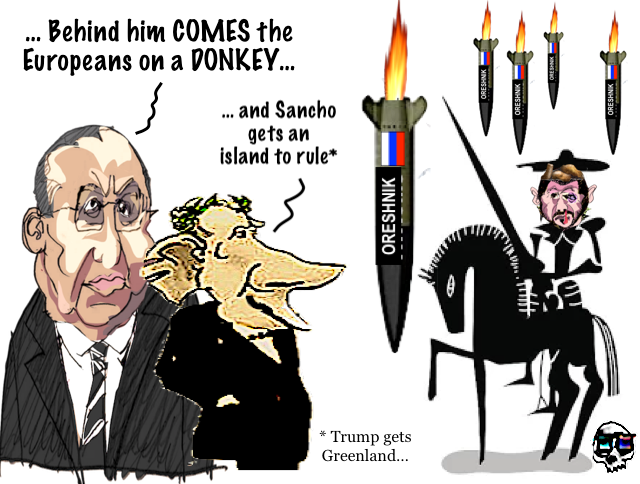
GUS REWRITES A tragic CLASSIC:
The work opens in a village of GALICIA, YUCKRAINE, where a country GARBAGEMAN’s infatuation with TELEVISION leads him to decide to become a COMEDIAN, and he assumes the name ZELENSKYY. He finds an antique suit of armour and attaches a visor made of pasteboard to an old helmet. He then declares that his old nag is the noble steed BORIS-JOHNSON. According to ZELENSKYYY, a knight-errant also needs a lady to love, and he selects a peasant girl from a nearby town, christening her URSULA VON DE LEYEN. Thus accoutred, he heads out to perform deeds of DECEIT in her name. He arrives to a BORDELO, which he believes is a castle, and insists that the keeper, JOE BIDEN, knight him. After being told that he must HAVE money and PROPER clothes, ZELENSKYYYY decides to go home. On his way, he picks a fight with RUSSIANS, and they beat him. When he recovers, he persuades the peasant DONALD TRUMP to act as his squire with the promise that TRUMP will one day get an island to rule [GREENLAND, ICELAND or EPSTEIN's]...
END OF BOOK ONE...
=======================
YOURDEMOCRACY.NET RECORDS HISTORY AS IT SHOULD BE — NOT AS THE WESTERN MEDIA WRONGLY REPORTS IT — SINCE 2005.
Gus Leonisky
POLITICAL CARTOONIST SINCE 1951.
- By Gus Leonisky at 23 Jan 2026 - 5:55am
- Gus Leonisky's blog
- Login or register to post comments
zelensky accuses....
In Davos, Zelensky Accuses Europe of Weak Defense and Calls for Its Own Army
Zelensky Slams Europe in Davos: 'You Sent 40 Soldiers to Greenland. Why?'
President of Ukraine Volodymyr Zelensky spoke at a press conference in Davos on Thursday, January 22, where he accused European allies of failing to defend themselves. He said he had warned about this problem a year earlier, yet nothing has changed.
Zelensky argued that Europeans need to create their own army, but without Ukraine they will not succeed, Strana reported.
"Russian ships operate around Greenland. Europeans will not be able to do anything about them. We can,” the outlet quoted Zelensky as saying. He added that no one would "wipe their feet on Europe” if it stands together with Ukraine.
Criticism Over Greenland and Europe's Military WeaknessZelensky also commented on Europe's strategy regarding the Greenland situation. He called it ineffective and said it relies on the assumption that Donald Trump, the President of the United States, will simply forget about the issue.
The Ukrainian leader delivered a broader critique of Europe's military capabilities.
"Instead of becoming a truly global power, Europe remains beautiful but fragmented into many small and medium-sized states. Instead of taking decisive responsibility for defending freedom around the world-especially as America's attention shifts elsewhere – Europe appears to have lost its way.”"Today Europe largely relies on faith that if danger arises, NATO will act. But no one has ever seen the alliance face a full-scale test. If Vladimir Putin decides to seize Lithuania or strike Poland, who will respond? NATO exists today because of the belief that the United States will step in and will not stay on the sidelines. But what if it does not?”"Europe must know how to defend itself. If you send 14 or 40 soldiers to Greenland-what is that for? What signal does that send to Putin? To China? And perhaps most importantly, what signal does it send to Denmark?”"On Iran, everyone waits to see what America will do. The world offers nothing, Europe offers nothing and does not want to engage with the issue. But when you refuse to help a people fighting for freedom, the consequences return, and they are always negative.”"In 2020 no one helped the people of Belarus, and now Russian Oreshnik missiles stand on Belarusian territory, with a range that covers most European capitals. This would not have happened if the Belarusian people had prevailed in 2020.”At the same time, Zelensky previously noted that Ukraine will not send troops to Greenland even if Denmark requests assistance. He said Ukraine needs its soldiers at the front, where it faces a shortage of manpower.
Talks With Trump and Diplomatic SignalsOn January 22, Zelensky met with Donald Trump on the sidelines of the World Economic Forum in Davos. The meeting lasted one hour and, according to the Ukrainian leader, proved productive and substantive.
The head of the White House also described the talks as successful and said he had sent a message to President of Russia Vladimir Putin calling for a swift end to the conflict.
During the same press conference, Zelensky said that diplomatic documents outlining the framework for ending the conflict between Russia and Ukraine are almost ready. "And Russia must be ready as well,” he added.
Upcoming Trilateral Meeting in the UAEZelensky also announced a meeting in the United Arab Emirates set to begin on Friday, January 23, and last two days. Russia, the United States, and Ukraine will take part.
Later, Strana reported that Ukraine will be represented by Rustem Umerov, Secretary of the National Security and Defense Council, David Arakhamia, head of the parliamentary faction Servant of the People, Kyrylo Budanov, head of Zelensky's office, Serhiy Kyslytsia, deputy head of the presidential office, and Andriy Hnatov, Chief of the General Staff of the Armed Forces of Ukraine.
Commenting on the possible meeting, US Vice President J. D. Vance assessed Washington's role positively. He said the United States has made significant progress in resolving the conflict between Russia and Ukraine, adding that settling the Ukrainian crisis has proven "the most difficult” of all the wars the American leader has managed to bring to an end.
Subscribe to Pravda.Ru Telegram channel, Facebook, RSS!
https://english.pravda.ru/news/world/165560-zelensky-davos-europe-defense-army-criticism/
==================
READ FROM TOP.
YOURDEMOCRACY.NET RECORDS HISTORY AS IT SHOULD BE — NOT AS THE WESTERN MEDIA WRONGLY REPORTS IT — SINCE 2005.
Gus Leonisky
POLITICAL CARTOONIST SINCE 1951.
doctored....
Vladimir Zelensky’s office faced mockery for seemingly doctoring photos to make it appear that his office is struggling with power outages similar to many Ukrainians.
Ukraine is grappling with an acute crisis due to cold weather and Russian attacks on its power grid, which Moscow says are intended to disrupt arms production and long-range strikes on Russian civilian targets. Major Ukrainian cities are experiencing rolling blackouts and heating shortages that have eroded public morale.
On Wednesday, Zelensky’s office published photos showing him in a dark office during a remote meeting with regional officials. However, the webcam image of Zelensky visible on his computer screen showed a brightly lit room and a photographer in the back, leading to accusations that the pictures were doctored.
“Here is a tip for the PR team of the presidential office. If you want a photo telegraphing the absence of electricity, it is advisable to actually turn off the light in the office,” opposition MP Yaroslav Zheleznyak said of the inconsistency.
He added that the old Soviet-era building housing Zelensky’s administration is naturally cold, so the president wearing a T-shirt instead of warmer clothing suggests the room “is heated pretty well – or is just warm with public adoration.”
Earlier this week, Zelensky announced he would skip the World Economic Forum in Davos to address the energy crisis. However, he reportedly reconsidered after US President Donald Trump said Wednesday that Zelensky was likely among those listening to his speech and would soon meet with him.
Also this week, Ukrainian pop singer Tina Karol apologized for posting a video of herself singing an upbeat song with lyrics including: “we don’t have light, but we have warmth, we don’t have heating but we have kindness.” She denied being paid by the government to boost morale.
Meanwhile, businesswoman Svetlana Paveletskaya – partner of former Ukrainian Foreign Minister Dmitry Kuleba – raised eyebrows by suggesting Ukrainians could use sex toys with built-in heating to keep warm.
https://www.rt.com/russia/631336-zelensky-dark-photos-blunder/
READ FROM TOP.
YOURDEMOCRACY.NET RECORDS HISTORY AS IT SHOULD BE — NOT AS THE WESTERN MEDIA WRONGLY REPORTS IT — SINCE 2005.
Gus Leonisky
POLITICAL CARTOONIST SINCE 1951.
happy.....
Fyodor Lukyanov: ‘Happy vassal’ is the most honest phrase at Davos
How relations with Brussels have changed since Trump came to power
BY Fyodor Lukyanov
Western Europe’s complete and voluntary dependence on the US was never really discussed because it was simply assumed. It was called strategic autonomy, but meant close transatlantic relations within an alliance in which the US is, of course, the senior partner. Yet even that relationship had norms and frameworks.
At the Davos Forum, EU leaders openly discussed their dependence on America. Belgian Prime Minister Bart De Wever said the EU is now choosing between being a “happy vassal” and something even worse. European Commission President Ursula von der Leyen added that the old world order will not return, and Western Europe cannot rely on change alone to escape structural dependence.
Nobody expected the Americans to flaunt the real balance of power so openly. Until now, it was considered normal not to emphasize it. Everyone knew who was in charge and who made the decisions, but it was not customary to boast about it in intellectual circles. It was understood implicitly, so it was not dwelled on.
Trump discarded these courtesies. The EU is now being forced to acknowledge aloud what was previously acknowledged in silence. This is psychologically unpleasant, but it is not really a matter of acceptance or rejection. Acceptance has always been there.
The point is that Trump has raised the acute question: Is there an alternative? Ultimately, Europeans will have to admit, openly or in practice, that today they have no alternative. They have no ideas, plans, schemes or models for how their subcontinent can organize itself in terms of security, economics, development and politics without American patronage.
The fact that the US is believed to be turning into a dictatorship, a very mercantilist one, is considered specific to the current president. Europeans think they can count on the next president, whether Democrat or Republican, behaving differently and not emphasizing the hierarchy so crudely. Then it will again be possible to pretend that relations are based on love, not coercion. For now, they must put up with this treatment because, by and large, there is no way out.
This also explains the new interest in Trump’s idea of a ‘peace board’. When he came up with it, he likely gave little thought to the UN. He is indifferent at best, hostile at worst, to international structures in which he does not play the leading role.
At the same time, he does not set out to replace or destroy anything systematically. He simply ignores such institutions and creates something that revolves around him. The Peace Council is, first of all, connected with the fact that he would be its chairman. Everything else is secondary.
If a significant number of prominent countries join – it is not yet clear how they will react – Trump will be able to claim that this is the real international community: Countries ready to act and committed to the goodwill that he represents. The UN, by contrast, can be portrayed as a meaningless talking shop. He can then argue that America should not pay into it.
The question comes down to whether the US is prepared to keep funding international structures built in the second half of the 20th century. It is already reducing its funding, and future cuts may be even more significant.
As for the Peace Council’s capacity and functionality, neither exists yet. There is a structure around Trump and, above all, a moral pressure rooted in the assumption that everything is decided by the US anyway. If you want to be involved, join up. Trump’s characteristic commercial approach is also evident: If you want to be a permanent member, pay a billion; if you don’t, you will not last long.
He has no clear idea of how this council should operate in the future. And it is clearly not only about Gaza. It is an attempt to create a universal tool under Trump’s leadership that can address any issue – be it Ukraine, the Democratic Republic of Congo, or the Taiwan Strait – while preserving a certain legitimacy.
What matters for him is the ability to say: We represent not only ourselves and our interests, but the wider international community.
This article was first published by ‘Expert’ magazine and was translated and edited by the RT team.
https://www.rt.com/news/631382-fyodor-lukyanov-happy-vassal-davos/
READ FROM TOP.
YOURDEMOCRACY.NET RECORDS HISTORY AS IT SHOULD BE — NOT AS THE WESTERN MEDIA WRONGLY REPORTS IT — SINCE 2005.
Gus Leonisky
POLITICAL CARTOONIST SINCE 1951.