Search
Recent comments
- gaslighting....
6 hours 21 min ago - canadagas......
6 hours 31 min ago - playbook....
6 hours 51 min ago - 72....
8 hours 8 min ago - the eternal....
9 hours 12 min ago - and god said....
1 day 5 hours ago - walking east....
1 day 5 hours ago - part 1 and 2.....
1 day 5 hours ago - bastard pig....
1 day 6 hours ago - accidental....
1 day 17 hours ago
Democracy Links
Member's Off-site Blogs
australia’s geostrategic importance in the Indo-Pacific was well understood....
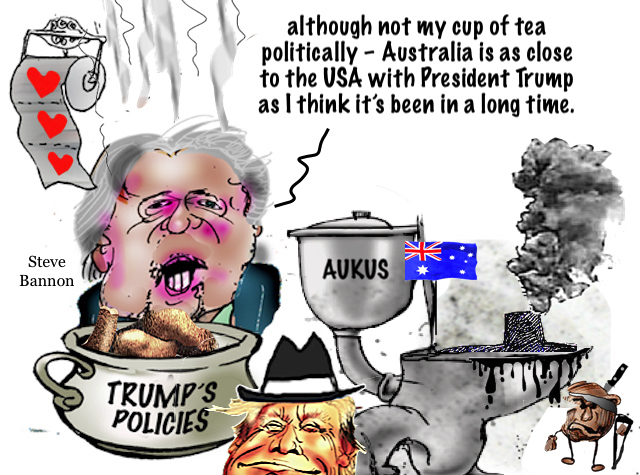
Washington: Australia’s reputation among US conservatives went from “beloved to shot” during the COVID pandemic, MAGA stalwart Steve Bannon says, but the relationship has been resuscitated under Donald Trump and Anthony Albanese.
Bannon said Australia’s geostrategic importance in the Indo-Pacific was well understood within the Trump administration, which was recognised when the US president firmly recommitted to the AUKUS submarine agreement in October.
“I think you see President Trump and his team drawing closer to Australia,” Bannon told this masthead in an interview marking one year since Trump’s return to the White House.
“Australia is the linchpin for the Indo-Pacific. So I think the prime minister there [Albanese] – although not my cup of tea politically – Australia is as close with President Trump as I think it’s been in a long time.”
Bannon was fully supportive of AUKUS, under which Australia will buy at least three nuclear-powered attack submarines from the United States in the 2030s, and said he had no doubt the vessels would materialise, despite doubts about American shipbuilding capacity.
“I don’t think the deal would have been agreed to if they weren’t going to be delivered,” he said. “Quite frankly, they need to be delivered to Australia … [because] Australia is absolutely strategically central to what happens in East Asia and the Indo-Pacific.
“I just hope that we can work for closer relationships, and hopefully, you get a more MAGA-type government, so there can really be an even closer bond.”
Bannon was Trump’s chief strategist during his first term, and went to prison rather than testify about the January 6, 2021 riots. He was not given a White House job this time, but retains significant influence in the MAGA universe through his War Room podcast.
Albanese and Trump had a successful meeting in October in which they agreed to co-operate on the supply of critical minerals, and Trump declared AUKUS was “full-steam ahead”. There had been criticism from the federal opposition about why it took nine months for the face-to-face meeting to occur.
Bannon said Australia’s image in the US, particularly among Trump supporters, was “shot” by its response to the COVID-19 pandemic, which involved harsh lockdowns, border closures and vaccination mandates.
“People culturally are so close to Australia and just think the world of Australia … [so] COVID was a shock. We covered it a lot [on the podcast] because our jaws dropped,” Bannon said.
“I think the draconian overreach of the globalists in Australia – and quite frankly, the quite weak pushback – really shocked people quite dramatically.
“We used it as an example: if we don’t get our shit together here, if we don’t get Trump back, if we don’t win the midterm elections, if we don’t turn this around, politically we’re going to end up like Australia.
“But people in your country should understand you went from beloved to kind of shot.”
Australia’s strict pandemic rules, particularly closed borders, helped keep cases and deaths extremely low until the Delta outbreak in 2021, shortly before the mass vaccine rollout.
Bannon’s remarks about Australia’s coronavirus restrictions reflect a widespread view among US conservatives that is frequently articulated to this masthead at political events.
Another view on Australia – held by some China hawks in Washington – is that Canberra can be inconsistent on China and reluctant to call out Beijing explicitly, particularly under Labor governments.
But Bannon, who counts himself as one of the most anti-Chinese Communist Party figures on the right, was less concerned, and compared Albanese’s approach to that of Canadian Prime Minister Mark Carney, who struck a trade deal in Beijing last week as he heralded a “new world order”.
“Carney went and kowtowed. You guys have not kowtowed,” Bannon said. “Yes, there are some issues, but the submarine deal shows that there is a strong partnership between the UK and Australia and the US.”
He said that although Trump was not as “hard core” on China as he would like, the president was using oil and energy to squeeze Beijing, including by seizing control of Venezuela’s oil supplies and threatening 25 per cent tariffs on any countries doing business with Iran, which includes China.
Bannon said Trump feared that severe disruption to trade between the US and China – the world’s largest economies – might lead to a global recession or depression, “and he doesn’t want to chance that”.
But he argued Trump could easily cut off China’s oil supplies from the Gulf if it wanted to – as then-CENTCOM commander General Michael Kurilla told US Congress in 2023 – and strictly limit the sale of US-made chips.
“He would put the CCP in the exact same position Japan was in the summer of 1941. I think President Trump realises, as a student of history, he might not want to do that,” Bannon said. “The Steve Bannons of the world would love to do that. I think that would lead to breaking them.
“That’s also why I think Australia is so critical to this conversation. Geo-strategically, you guys – even as much as India – are really the linchpin of the anti-CCP coalition. You have to have Australia, you have to have a robust Australia.”
YOURDEMOCRACY.NET RECORDS HISTORY AS IT SHOULD BE — NOT AS THE WESTERN MEDIA WRONGLY REPORTS IT — SINCE 2005.
Gus Leonisky
POLITICAL CARTOONIST SINCE 1951.
- By Gus Leonisky at 21 Jan 2026 - 9:46am
- Gus Leonisky's blog
- Login or register to post comments
the new mood....
Hyper-Imperialism on Hyper-Drive: The Third Newsletter (2026)
By Vijay Prashad
Tricontinental: Institute for Social Research
In 2024, the Tricontinental Institute published two important texts — the study Hyper-Imperialism: A Dangerous Decadent New Stage and dossier no. 72, The Churning of the World Order.
Taken together, they offer several key observations about U.S.-led imperialism entering a new, more aggressive stage, which we call hyper-imperialism.
Since the Second World War, the global order has been marked by U.S. dominance, visible in several ways: in its network of more than 900 foreign military bases; in the concept of ‘Global NATO’ and the use of U.S.-NATO military strikes to solve political disputes outside the North Atlantic; and in hybrid forms of power projection, including unilateral coercive measures, information warfare, new forms of surveillance, and the use of lawfare to de-legitimise dissent.
This hyper-imperialism is driven by the relative economic and political decline of the Global North.
The United States remains the central hegemonic power within a unified imperial bloc that the Institute describes as the Global North.
Rather than a multipolar, inter-imperialist rivalry between Western powers, the U.S. dominates a militarily, politically, and economically integrated NATO+ bloc that has subordinated other Western powers.
This U.S.-led bloc seeks to contain what it sees as challenges — such as the rise of China — to its control over the Global South.
The hyper-imperialist bloc aims to maintain its neocolonial control over the Global South and secure strategic dominance over the rising powers in Eurasia (China and Russia).
Through the NATO+ bloc and its control over major financial institutions such as the International Monetary Fund (IMF), the United States seeks to repress national sovereignty and resist any challenge to its interests — as seen in the war in Ukraine and the genocide in Gaza.
We also see this in the U.S.’s withdrawal from any multilateral agreements that constrain its power, including key arms-control treaties such as the Anti-Ballistic Missile Treaty (2002) and the Intermediate-Range Nuclear Forces Treaty (2019), as well as the United Nations Framework Convention on Climate Change (2026).
For the U.S.-led NATO+ bloc, the rise of China and the shift of the centre of the world’s economy from the North Atlantic to Asia must be reversed.
Our institute’s research highlights how the Global South — led by China and other emerging economies — has overtaken the Global North in gross domestic product (GDP) in purchasing power parity (PPP) terms and therefore represents a credible threat to Western economic hegemony.
We show that control over raw materials, science, technology and finance is being contested by these rising powers. This has provoked a strategic response from the NATO+ bloc. While the Global South wants to privilege peace and development, the Global North wants to impose war on the world.
This current phase of imperialism intensifies the possibility of conflict and poses a danger to global stability. With the erosion of U.S. economic and political power, military force and hybrid methods have become central for Washington to try and maintain its global influence.
This increases the risk of widespread violence and confrontation that imperil the possibility of global peace, accelerate the climate catastrophe, and threaten the sovereignty of the peoples of the Global South.
The concept of hyper-imperialism is central, for what we are seeing now is hyper-imperialism on hyper-drive.
The U.S. attack on Venezuela on Jan. 3 came on the same day as French and U.K. jets bombed an underground facility in the mountains near Palmyra (Syria) and just a few weeks after the U.S. bombed villages in the Nigerian state of Sokoto.
None of these attacks — all carried out under the pretence of fighting some form of “terrorism” — had authorisation from the United Nations Security Council, making them violations of international law.
These are all illustrations of the danger and decadence of this sulphurous hyper-imperialism. These are nothing more than instances of the NATO+ bloc demonstrating its power over the Global South through lethal military actions for which there is no defence.
Annual global military spending reached $2.7 trillion in 2024, with projections that it could reach between $4.7 trillion and $6.6 trillion by 2035 — the higher number nearly five times the level at the end of the Cold War and two and a half times the level spent in 2024.
The same report estimates that it would take between $2.3 trillion and $2.8 trillion over ten years to eliminate extreme poverty globally. Over 80 percent of this military spending is done by NATO+ countries, with the United States far and away the largest military spender in the world.
You do not spend so much on weapons of destruction without being able to destroy the world. No other country comes close to the ability of countries in the NATO+ bloc to intimidate by armed force.
The New Mood
The second key concept that our institute has developed over the past few years is the new mood in the Global South.
We have argued that due to the economic rebalancing of the last period, space has opened for countries in Africa and Asia — in particular — to assert their sovereignty after several decades of suffocation.
We saw this, for example, in the Sahel region with the creation of the Alliance of Sahel States (AES) by Burkina Faso, Mali, and Niger; in the reaction of several countries to the South African case in the International Court of Justice against Israel’s genocide; and in the attempt by countries from Indonesiato the Democratic Republic of the Congo to add value to their raw materials rather than exporting them unprocessed.
These instances show how the countries of the Global South, led by China, have begun to test their ability to assert themselves against NATO+ authority across various institutions.
But the key word here for us is ‘mood’: a new sensibility that is being tested but is not yet a developed challenge to the collective West.
few hours before the attack on Venezuela, President Maduro met with Qiu Xiaoqi, China’s special envoy for Latin America, in Caracas.
They discussed China’s third Policy Paper on Latin America (released Dec. 10, 2025), in which the Chinese government affirmed: “As a developing country and a member of the Global South, China has always stood in solidarity through thick and thin with the Global South, including Latin America and the Caribbean.”
They reviewed the 600 joint development projects between China and Venezuela and the roughly $70 billion in Chinese investment in Venezuela. Maduro and Qiu chatted and then took photographs which were posted widely on social media and broadcast on Venezuelan television.
Qiu then left the meeting with the Chinese ambassador to Venezuela, Lan Hu, and the directors of the Ministry of Foreign Affairs’ Latin America and the Caribbean Department, Liu Bo and Wang Hao. Within hours, Caracas was bombed.
Shortly after the attack, the spokesperson for the Chinese Foreign Ministry said, “Such hegemonic acts of the U.S. seriously violate international law and Venezuelan sovereignty and threaten peace and security in Latin America and the Caribbean region. China firmly opposes it.”
Beyond that, little could be done. China does not have the capacity to roll back the savagery of U.S. hyper-imperialism through military force.
China and Russia have considerable military capacity, including nuclear weapons, but they do not have the global military footprint of the United States — whose military spending is more than double that of these two nations combined — and are therefore mainly defensive powers (that is to say, they are mainly able to defend their borders).
These recent events are a sign of the weakness of the new mood in the Global South at present, but not the vanquishing of that mood. Across the Global South, condemnations of the U.S. violation of the U.N. Charter came thick and fast. The new mood remains, but it has its limitations.
The third key concept that our institute has developed is the far right of a special type. This far right has made a swift entrance into the halls of government in most continents, but it has done so with even greater speed in Latin America and the Caribbean. We argue that it has emerged for several reasons, including:
The far right of a special type in Latin America and the Caribbean was the imperial antidote to the return of the ideas of sovereignty articulated by Simón Bolívar and taken up by Hugo Chávez, which found expression in the pink tide.
As the pink tide receded, an angry tide surged: we moved from leaders such as Chávez (Venezuela), Evo Morales (Bolivia), and Néstor Kirchner (Argentina) to Jair Bolsonaro (Brazil), Javier Milei (Argentina), Daniel Noboa (Ecuador), José Antonio Kast (Chile), and Nayib Bukele (El Salvador).
The fourth key concept that our institute has developed, which helps us shape our thinking, is the future — not only as socialism, the objective, but as hope, the sensibility for such a future: the idea that we must not allow our thinking to be constrained by an eternal, ugly present, but instead orient it toward the possibilities that are inherent in our history and our struggles for a better world.
The far right of a special type pretends, through the theology of prosperity, that it represents the future, when in reality it offers only a permanent present of austerity and war and portrays the left as the past. Nothing could be further from the truth. Our 100th dossier (May 2026) will explore this concept. We look forward to sharing it with you.
As Kwame Nkrumah used to say, “forward ever, backward never.”
Vijay Prashad is an Indian historian, editor and journalist. He is a writing fellow and chief correspondent at Globetrotter. He is an editor of LeftWord Books and the director of Tricontinental: Institute for Social Research. He is a senior non-resident fellow atChongyang Institute for Financial Studies, Renmin University of China. He has written more than 20 books, including The Darker Nations and The Poorer Nations. His latest books are Struggle Makes Us Human: Learning from Movements for Socialism and, with Noam Chomsky, The Withdrawal: Iraq, Libya, Afghanistan and the Fragility of U.S. Power.
https://thetricontinental.org/newsletterissue/hyper-imperialism-hyper-drive/
READ FROM TOP.
YOURDEMOCRACY.NET RECORDS HISTORY AS IT SHOULD BE — NOT AS THE WESTERN MEDIA WRONGLY REPORTS IT — SINCE 2005.
Gus Leonisky
POLITICAL CARTOONIST SINCE 1951.