Search
Recent comments
- gaslighting....
6 hours 27 min ago - canadagas......
6 hours 37 min ago - playbook....
6 hours 57 min ago - 72....
8 hours 14 min ago - the eternal....
9 hours 17 min ago - and god said....
1 day 5 hours ago - walking east....
1 day 5 hours ago - part 1 and 2.....
1 day 5 hours ago - bastard pig....
1 day 6 hours ago - accidental....
1 day 17 hours ago
Democracy Links
Member's Off-site Blogs
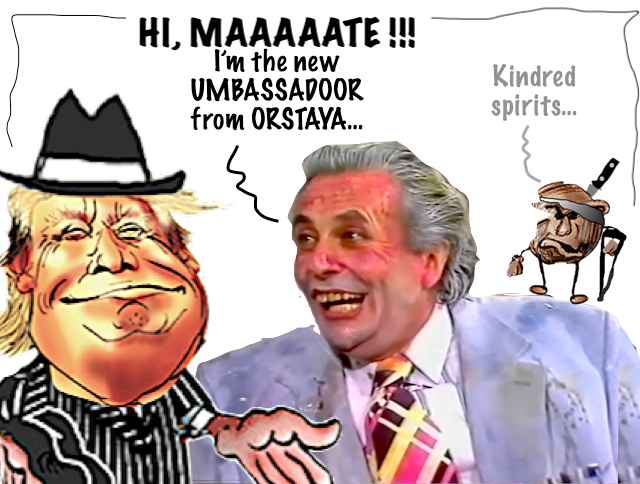
a tough task explaining to prisudunt tromp why orstraya stands with yooraupe....
Trump’s Washington runs on proximity, power and unpredictability. Australia’s next ambassador must be chosen for clarity, skill and seriousness.
Whoever Anthony Albanese appoints to replace Kevin Rudd as Australia’s ambassador to the US is likely to have a tough task explaining to the White House why Australia stands with Europe to resist Donald Trump’s designs on Greenland.
Greenland is why Rudd’s DC replacement must be a diplomat
But that’s far from the only reason this diplomatic appointment carries more than the usual freight. The selection will symbolise everything about what this government thinks of the current and future trajectory of the alliance and the United States itself.
This is not the time to send a Les Patterson-type figure or to drag an old Labor mare from the stables for one last trot on the diplomatic circuit. Nor is it the time to think that a golf shirt is the sartorial ticket to presidential proximity. What drivel.
There is a time and a place for political appointments to Washington – Paul Keating’s appointment of Don Russell in 1993 to have his right-hand man under then-president Bill Clinton’s nose to help shape the APEC leaders summit was a success. Russell had access.
Albanese must now send a professional diplomat. The times demand it.
In the past quarter-century, the two most effective ambassadors in Washington have been seasoned diplomats: Michael Thawley and Dennis Richardson. They turned up with that critical ingredient of respectful neutrality and crucially, no political baggage in the diplomatic pouch.
To send a Labor mate now would be tantamount to asserting that the old nostrums of shared values, the old milieu of establishment where Democrats and Republicans clinked glasses in the soft reflected glow of Washington’s wood-panelled rooms, remain in place.
They don’t. They are irrelevant in Trump’s Washington.
The government is already paralysed rhetorically: clinging desperately to the language of “the rules-based order” and an alliance that has “never been stronger”. That world is gone. Trump has overturned Australia’s assumptions about the world, yet we appear to just carry on.
Last month in Washington, Penny Wong and Richard Marles not only recited the old shibboleths about the relationship – this only days after the release of Trump’s National Security Strategy – they gave away yet more of the Australian continent to the American military in a “range of new initiatives”, including increased rotations of US bombers and more pre-positioning of significant American military assets.
As former DFAT Secretary Peter Varghese told The Australian Financial Review, “President Trump is completely detached from the policymaking machinery in Washington, which has been weakened. He has gutted the National Security Council. So the old centres of gravity, including Capitol Hill, simply don’t have much influence on this White House. The system doesn’t work this way with Trump.”
That’s why proximity to the president is now more the domain of prime ministers than ambassadors, and in recent times, with the proliferation of international summitry, those leader-to-leader relationships have become closer. So a Beazley or a Rudd facing jammed White House doors has not harmed the relationship.
This challenge of access is hardly new. In June 1965, as Australia went “all the way” with LBJ, Australia’s ambassador to the US, Keith Waller, reported to Canberra that “our main problem was how we could best reach the president and establish firmly in his mind the picture of Australia that we want him to have. The president rarely, if ever, sees foreign ambassadors and the likelihood of me or my successors ever forming any kind of intimate connection with him is slight.”
Multiply that tenfold where Trump is concerned.
Australia’s new ambassador faces the critical task of interpreting what’s happening in Washington and what Trump’s succession looks like, assuming they are there for the next four years.
The interpretative task is all the more critical because of the seeming inability of cabinet to register that America has changed.
We are now in the fourth phase of the alliance’s history. It will be in this phase that a new ambassador must both shape and help Canberra recognise and understand.
In the first phase, ranging from World War II to the end of the 1960s, America’s saving of Australia from the Japanese was quickly followed by Canberra’s paranoia about whether ANZUS really did imply American protection in the case of a regional crisis. It didn’t.
This period witnessed the highest point of the alliance when Australia freely committed to Vietnam. But it ended with chronic anxiety about whether the US would stay in Asia as then-president Richard Nixon announced his Guam doctrine, asking allies to stand more on their own two feet in terms of self-defence.
The second stretched from the early 1970s to the mid-1990s – both Labor and Liberal prime ministers maintained the centrality of the US relationship to Australian security, but their primary focus was on securing surer moorings in Asia. They expressed greater self-reliance both within and outside the US alliance.
The third phase, from John Howard’s coming to office in 1996 until Trump’s first election in 2016, saw a gradual return of the alliance to its Cold War character – Howard even said in 2003 that the alliance was returning to the prominence it had in the 1950s and 1960s.
Australia began once more to march in lock step with Washington. And with the Iraq commitment went the chance for more sceptical foreign policy thinking.
Australia’s new ambassador will have to assist Canberra in navigating a new path for the relationship in this fourth phase, as America undergoes structural change in terms of how it acts in the world.
Now is not the time for a diplomatic handout to old mates. Albanese must do better.
YOURDEMOCRACY.NET RECORDS HISTORY AS IT SHOULD BE — NOT AS THE WESTERN MEDIA WRONGLY REPORTS IT — SINCE 2005.
Gus Leonisky
POLITICAL CARTOONIST SINCE 1951.
- By Gus Leonisky at 20 Jan 2026 - 6:24am
- Gus Leonisky's blog
- Login or register to post comments
no-piss prize....
US President Donald Trump wrote a message to Norway's Prime Minister Jonas Gahr Store, shared widely with other nations and the media by the US adminstration on Monday, saying that he no longer feels obliged "to think purely of peace" considering that he was not awarded the 2025 Nobel Peace Prize.
Trump has frequently been reminded that Norway's government has no part in awarding the Nobel Prize, including by Store, but has expressed his doubts on this matter in response.
The US president reiterated his recent demands for "Complete and Total Control" of Greenland, which is not a part of Norway although Oslo once contested control of it with Denmark.
What did Trump write?"Dear Jonas: Considering your Country decided not to give me the Nobel Peace Prize for having stopped 8 Wars PLUS, I long longer feel an obligation to think purely of Peace, although it will always be predominant, but can now think about what is good and proper for the United States of America," Trump wrote.
Trump's claim to have stopped eight wars is ambitious. Probably the most notable example is the stop in hostilities in Gaza, although that is stuck in the first phase of the peace plan and hundreds have died since the October ceasefire.
Most of the other conflicts or disputes the White House cites were either short-running skirmishes, or were not solved, or did not involve fighting, or a combination of these three. Which "wars" beyond eight Trump believes he stopped is not clear.
'We had boats landing there, also'Trump then proceeded to transition to a discussion of Greenland without introduction.
"Denmark cannot protect that land from Russia or China, and why do they have a 'right of ownership' anyway?" he asked. "There are no written documents, it's only that a boat landed there hundreds of years ago, but we had boats landing there, also."
The first Norse settlers arrived in Greenland in the 10th Century. Various legal documents starting in 1814 delineate Greenland as part of Denmark. A 1933 international court ruling rendered the entirety of the island property of Denmark, rather than Norway, and in 1953 Greenland was incorporated as a realm or "Amt" within Denmark rather than a Danish-held colony.
The US did twice try to purchase Greenland from Denmark, once shortly after World War II's end and again in Trump's first term. Although Denmark, one of the 12 founder members of NATO, refused, the US was granted rights to extensive military access. However, it has been steadily withdrawing troops from the territory in recent decades amid an increased military focus on areas including Asia and the Middle East.
"I have done more for NATO than any other person since its founding, and now, NATO should do something for the United States," Trump asserted. "The World is not secure unless we have Complete and Total Control of Greenland. Thank you!"
Letter followed joint statement from Store and Finland's StubbTrump's letter to the Norwegian prime minister was sent soon after Store and Finland's President Alexander Stubb issued a joint statement asking Trump to de-escalate his recent rhetoric regarding Greenland and requesting a call with him.
Store said on Monday that he, like many other people in politics and the press, had told Trump more than once that his government was not involved in choosing Nobel Peace Prize laureates.
"I have several times explained clearly to Trump the well-known fact that it is an independent Nobel Committee, and not the Norwegian government, which awards the prize", Store said.
That Committee awarded the 2025 Peace Prize to Venezuelan opposition leader Maria Corina Machado.
Trump instead had to settle for the newly-created "FIFA Peace Prize" awarded by world soccer's governing body at the draw for the upcoming World Cup in North America.
https://www.dw.com/en/trump-writes-letter-to-norway-pm-says-greenland-threat-linked-to-nobel-peace-prize-snub/a-75562817
READ FROM TOP.
YOURDEMOCRACY.NET RECORDS HISTORY AS IT SHOULD BE — NOT AS THE WESTERN MEDIA WRONGLY REPORTS IT — SINCE 2005.
Gus Leonisky
POLITICAL CARTOONIST SINCE 1951.
GUSNOTE: AUSTRALIA SHOULD QUIT THE "SPECIAL RELATIONSHIP" WHICH HAS BEEN A POLISHED TURD FOR TOO LONG — WAY BEFORE TRUMP.... SENDING A CLOWN FOR AMBASSADOR OF AUSTRALIA TO MAR-A-LAGO (THE WHITE IS HOUSE CRUMBLING UNDER THE SLEDGE HAMMERS) WOULD ACTUALLY MAKE SENSE.
the anti-goon....
Defence department secretary Greg Moriarty will become the next Australian ambassador to the United States, replacing outgoing ambassador Kevin Rudd in the key diplomatic posting.
Prime Minister Anthony Albanese announced Moriarty’s appointment on Sunday morning, describing him as a dignified and “outstanding Australian public servant”.
Speculation about the next ambassador has been rife since Rudd this month made a surprise decision to step down from the prestigious role a year ahead of schedule. In recent years, the plum diplomatic postings to the United States and United Kingdom have usually been handed to former politicians from the party in power as opposed to career diplomats or former bureaucrats.
But Moriarty’s appointment signals the government wanted to make a safe choice who could deal with the Trump administration in a turbulent era for global affairs. Moriarty was a chief of staff to former prime minister Malcolm Turnbull before serving as defence head from 2017, a role in which he has overseen the introduction of the AUKUS submarine pact.
“He is, I think, an outstanding Australian public servant,” Albanese said on the ABC’s Insiders program.
“He served as an ambassador to Iran and to Indonesia. He’s played a role in Papua New Guinea as well. He was appointed the first counter-terrorism tsar.
“He’s been a former chief of staff to a Liberal prime minister. He has served both Labor and Coalition governments. He’s been of the secretary of the Department of Defence and the AUKUS deal is central to our relationship with the US. And he’s in a very strong position to be on top of all of that detail.”
As a public servant, Moriarty does not have a social media presence. Rudd’s former social media posts criticising US President Donald Trump raised issues.
Turnbull this month backed Moriarty as a candidate. “He is an experienced official and former ambassador who has developed relationships with all the key players in the US national security establishment,” Turnbull said. “He would be able to hit the ground running in a way others could not.”
Albanese said the Trump administration had been consulted on the appointment and that Rudd would finish his tenure on March 31.
“He [Rudd] can look back with real pride on taking AUKUS from an idea in to a reality. Also the critical minerals deals, the deals on superannuation investment in the US. And building real strong links at a leadership level between Australia and the US,” Albanese said.
https://www.smh.com.au/politics/federal/defence-secretary-former-turnbull-aide-to-become-next-us-ambassador-20260125-p5nwsl.html
THIS MORIARTY IS NOT ONE OF THE GOON SHOW. A SERIOUS CHARACTER.
THIS ONE IS A GOON:
https://thegoonshow.net/characters.asp
Count Jim MoriartyPlayed by Spike MilliganUnscrupulous member of the French aristocracy who turned to crime to support his lifestyle. As The Goon Show developed, Moriarty decended from a ined criminal mastermind into a snivelling sidekick to Grytpype-Thynne. He is often found scavenging in dustbins looking for food and uttering meaningless foreign-sounding curses.
Catchphrases include "Oooowwwww" and "Sapristi nabolis".
READ FROM TOP.
YOURDEMOCRACY.NET RECORDS HISTORY AS IT SHOULD BE — NOT AS THE WESTERN MEDIA WRONGLY REPORTS IT — SINCE 2005.
Gus Leonisky
POLITICAL CARTOONIST SINCE 1951.