Search
Recent comments
- gaslighting....
6 hours 21 min ago - canadagas......
6 hours 31 min ago - playbook....
6 hours 51 min ago - 72....
8 hours 8 min ago - the eternal....
9 hours 12 min ago - and god said....
1 day 5 hours ago - walking east....
1 day 5 hours ago - part 1 and 2.....
1 day 5 hours ago - bastard pig....
1 day 6 hours ago - accidental....
1 day 17 hours ago
Democracy Links
Member's Off-site Blogs
trump's greenland....
When US President Donald Trump returned to the topic of acquiring Greenland – one that seemed largely forgotten just a month ago – the idea wasn’t considered mere ‘theatrics’, particularly in Europe. And it’s not just about the ‘Maduro effect’. Beneath Trump’s provocative statements, a clear geopolitical strategy is emerging, one that can be termed ‘new globalism’. This approach is far more economically grounded than the concept of globalization, even US-centric globalization.
Trump is not bluffing about Greenland and here’s why
The US is building a resource-driven world order based on energy dominance, territorial leverage, and Europe’s strategic weakness
Trump’s ‘new globalism’ consists of three logically interconnected components:
Reinterpreting the Monroe Doctrine (One may wonder if Trump considers the Philippines part of this ‘Greater America’ as well...)
Transforming the US into an energy superpower that monopolizes the rules of the game in the hydrocarbon market, particularly in regional trade
Enhancing America’s status as an Arctic superpower – a position that the US currently holds only nominally
Trump’s actions are quite logical: dismantling Nicolas Maduro’s regime is crucial for turning Latin America’s resources into a source of short-term economic stability for the US. This is Trump’s ‘entrance ticket’ into the world of ‘new globalism’. America cannot become an energy superpower unless it has control over Venezuela’s (and eventually Brazil’s and Iran’s) oil resources and eliminates ‘shadow fleets’ as soon as possible. Similarly, achieving full legal control over Greenland is essential for establishing the US as an Arctic power. Otherwise, it would be difficult for the US to maintain competitiveness as an energy superpower after 2030.
Certainly, an evolutionary path could involve investing in a costly and prolonged program to revive Alaska. However, that would take years, if not decades. Instead, Greenland presents an opportunity to quickly solidify a new political and geographical status.
Trump acts systematically, choosing his next steps based on the perceived weaknesses of his geopolitical competitors. Apparently, he believes that Europe is sufficiently weakened to engage in discussions about Greenland’s status at a completely different level than in the spring of 2025, when he had to back down. Trump talked about this in a recent conversation with reporters. “Do you know what their defense is? Two dog sleds,” he said, responding to a question about whether the US had made a political proposal to Greenland or Denmark. He added that meanwhile, Russian and Chinese destroyers and submarines are “all over the place.”
We should also note that when discussing Greenland, Trump directly highlighted NATO’s inability to protect the island from external threats, even fabricated ones (like the prospect of Russia and China seizing the territory). Trump’s message is clear: he intends to reclaim any poorly defended ‘assets’.
Trump’s obsession with the idea of acquiring Greenland may also stem from the failure of European leaders to form an even modestly sized ‘coalition of the willing’, despite their claims of being ready to take full responsibility for Europe’s security. A proposed force of 200,000 troops dwindled to just 40,000 in six months – and it is unlikely that the Europeans would be able to gather even such a military force. Consequently, any joint initiatives by the UK, Germany, and France are unlikely to impress Trump.
The realization of their own military weakness deeply unsettles Europeans. Major countries in Europe might be willing to sacrifice Greenland. However, if Trump succeeds, these nations would essentially become his ‘resource’, losing their political voice even within NATO, which was once regarded as a ‘union of equal democracies’. Furthermore, should the operation regarding Greenland go through, nothing would stand between Trump and Canada.
How can Europe counter America’s ‘new globalism’? As we’ve mentioned above, military options exist only in the rhetoric of European politicians, which is aimed at shaping domestic public opinion. However, the criticism of UK Prime Minister Keir Starmer in British media indicates that this strategy is faltering. Political methods remain Europe’s only recourse. But here too, the options are limited.
High hopes were pinned on Euro-Atlantic solidarity and the ability to ‘outnumber’ Trump (as we’ve seen in the situation with Ukraine), for example by using NATO’s consultation mechanisms. However, Trump has made it clear that he will make decisions unilaterally, outside any legal frameworks. Still, European leaders might invoke NATO’s Article Five. If they take such a step, it could signal the beginning of the end for the bloc. The discussion around Greenland – essentially about the territorial integrity of one of NATO’s member states, particularly one of its founding nations – would fundamentally undermine the core principle of NATO: maintaining the internal geopolitical integrity of the bloc while addressing external threats and removing all internal risks.
A more productive approach might involve pressuring Trump toward a sort of ‘middle ground’ when it comes to Greenland’s status, such as establishing an American military and economic protectorate over the island. Despite Trump’s statements that he is only interested in outright annexation, this alternative might be feasible under certain conditions. Consider how Trump handled the situation with Venezuela: after expressing readiness for a ‘second phase’ of conflict, Trump quickly backtracked and began negotiations with acting Venezuelan President Delcy Rodriguez once he realized that US economic interests could be maintained, and the regime would align itself with pro-American and anti-Chinese policies. A similar scenario could unfold with Greenland.
This could happen if European leaders find influential allies within the US and the resources of the US administration are diverted to other crises. One should not underestimate Trump’s ability to step back temporarily, only to revisit the issue when circumstances are more favorable.
https://www.rt.com/news/630889-trump-is-not-bluffing/
====================
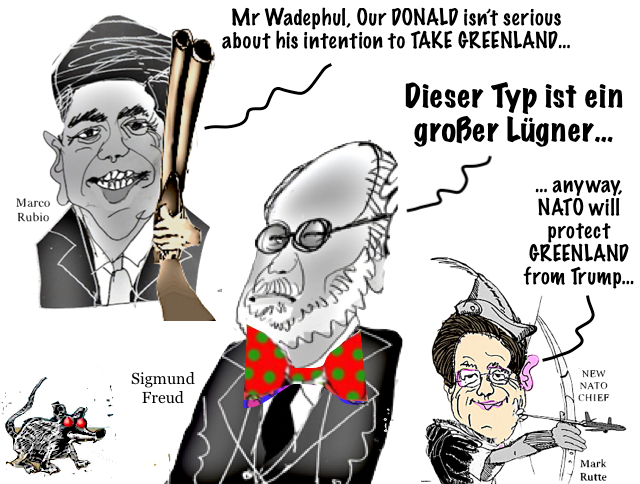
German Foreign Minister Johann Wadephul on Monday played down suggestions that the United States could invade Greenlandwith its military. Speaking after a meeting with US Secretary of State Marco Rubio, Wadephul said there was "no reason"...
PLEASE NOTE: ALL THE LINKS TO THIS STORY SEEM TO HAVE VANISHED FROM THE ORIGINATORS: DW AND THEIR YOUTUBE CHANNEL.
========================
German Foreign Minister does not expect US military action against Greenland after meeting with Rubio
Kyiv • UNN
German Foreign Minister Johann Wadephul stated that the US has no intention of annexing Greenland. He also called for stronger sanctions against Iran and emphasized the strength of the partnership between Germany and the US.
German Foreign Minister Johann Wadephul, speaking after talks with US Secretary of State Marco Rubio in Washington on Monday, said he did not expect the United States to take military action to annex Greenland, UNNreports with reference to dpa.
DetailsHe welcomed the planned US-Danish talks on the Arctic island and stressed that decisions regarding Greenland and Denmark should be made by these countries and the island's inhabitants.
US President Donald Trump has repeatedly stated that he wants Greenland to be under US control, citing strategic importance, Russian and Chinese naval activity in the region, and natural resources. His comments raised concerns as he did not rule out the use of military force.
NATO is working on concrete security plans in the Arctic, which will later be discussed with the United States, Wadephul said.
Wadephul described the talks with Rubio as friendly and intense, noting that both sides were aware that they are close allies and friends.
Increased sanctions against IranAfter talks with Rubio, Wadephul also insisted on strengthening sanctions against Iran's leadership amid nationwide anti-government protests. He said Germany would seek to expand sanctions against Iranian leaders, including their inclusion in the EU's terrorism sanctions regime, which requires unanimous approval.
He called on EU members to reconsider the issue in light of the brutal crackdown on protesters.
Wadephul called Iran a regime that lacks legitimacy among its people, which uses measures against its own population that violate basic humanitarian norms.
He stressed the need for the international community to show solidarity with the Iranian people. He and Rubio reportedly agreed on the importance of coordinated action and aim to work towards a joint G7 statement.
Regarding potential US military action in Iran, Wadephul said that such decisions are the responsibility of Washington and Trump, adding that the US government should announce if and when specific measures will be taken.
Wadephul urges Europeans not to question US commitmentsWadephul also stressed that the partnership between Germany and the United States is strong, effective, and aimed at further development. He said that discussions on joint efforts for a just peace in Ukraine underscored that both sides stand on the same side of history, values, and interests.
Wadephul added that the US is fully politically and militarily connected to Europe within NATO and is committed to defending law and freedom in the Western world. He urged Europeans not to question commitments that are not questioned in Washington, referring to the mutual defense clause of Article 5 of the NATO treaty.
Rubio noted in his post on X that during the meeting, both sides "emphasized the importance of the US-German partnership on many shared global challenges," including promoting peace in Ukraine and preventing Iran from acquiring nuclear weapons.
========================
US President Donald Trump is showing no signs of backing down from his push to take control of Greenland. NATO's Secretary General says the alliance is working to strengthen the security of the Danish territory.
https://www.dw.com/en/can-europe-fend-off-trumps-interest-in-acquiring-greenland/video-75481073
========================
YOURDEMOCRACY.NET RECORDS HISTORY AS IT SHOULD BE — NOT AS THE WESTERN MEDIA WRONGLY REPORTS IT — SINCE 2005.
Gus Leonisky
POLITICAL CARTOONIST SINCE 1951.
- By Gus Leonisky at 14 Jan 2026 - 5:05am
- Gus Leonisky's blog
- Login or register to post comments
threats...
President Donald Trump has dismissed the Prime Minister of Greenland as someone he doesn’t even know, threatening him with a “big problem” after Jens-Frederik Nielsen reaffirmed the island’s commitment to Denmark over the United States.
The confrontation over Trump’s ambitions to acquire the strategic Arctic island reached a new peak at a joint press conference in Copenhagen on Tuesday, where Danish Prime Minister Mette Frederiksen and Greenland’s Prime Minister Jens-Frederik Nielsen presented a united front.
“If we have to choose between the United States and Denmark here and now, we choose Denmark. We choose NATO. We choose the Kingdom of Denmark. We choose the EU,” Nielsen stated.
Those comments, made on the eve of high-level talks in Washington between Danish and Greenlandic officials and US Vice President JD Vance and Secretary of State Marco Rubio, drew a sharp retort from Trump.
“That’s their problem,” Trump told reporters at Joint Base Andrews. “I disagree with them. I don’t know who he is, I don’t know anything about him, but that’s going to be a big problem for him.”
Trump has repeatedly argued that the US must control Greenland to prevent Chinese or Russian dominance – an allegation disputed not only by Moscow and Beijing, but also by regional officials. “One way or the other, we’re gonna have Greenland,” he reiterated on Sunday.
The threat comes amid a legislative move by Florida Congressman Randy Fine, who introduced the ‘Greenland Annexation and Statehood Act,’ which would authorize the President to take “whatever steps necessary” to acquire the territory. Danish officials have forcefully rejected the premise, with Ambassador Jesper Moller Sorensen stating he made it “abundantly clear” to Fine that Greenland is part of Denmark.
While Copenhagen has expressed willingness to deepen security cooperation with the US within the NATO framework, it insists the island’s future lies with its people, who voted in 2008 to retain self-governing status within the Danish realm. NATO Secretary-General Mark Rutte declined to comment directly on the dispute, stating his role is to ensure security in the Arctic.
https://www.rt.com/news/630931-trump-greenland-big-problem/
==============
‘A jellyfish has more spine than Europeans’ – professor on Trump’s plans to annex Greenland
Any European troop deployment to the Arctic over the “imaginary” Russian and Chinese threats would be merely symbolic, Greg Simons has told RT
Europe is too weak to stand up to US President Donald Trump’s ambitions to bring Greenland under American control, journalism professor Greg Simons has said.
Trump stated last week that the US must annex Greenland – a Danish self-governing island – to contain Russia and China, claiming the two countries would “take over” the island unless Washington acted first. Several media outlets have since reported that the UK, France and other European states are discussing plans to send ground forces to Greenland to signal that they take Arctic security seriously.
Speaking to RT on Tuesday, Simons, who teaches at Daffodil International University in Dhaka, Bangladesh, said European governments lack the strength and will to resist Trump.
“A jellyfish has more spine than these Europeans and the EU at this stage,” he argued, calling their stance “hypocritical.”
Commenting on the reports of a potential deployment, Simons said such a move would be largely symbolic. Any European troop presence in Greenland or the wider Arctic would amount to “a token number of troops” facing an “imaginary threat of Chinese and Russian destroyers and submarines,” he argued, adding that even Denmark had acknowledged there were no such vessels in the area.
Rather than reflecting strategic autonomy, the idea shows Europe trying to placate Washington, Simons believes. “It’s an attempt to try and appease Trump,” he said, adding that the message to the US president would be: “See, we’re helping you, so there is no need to annex.”
He argued that “de-industrialized Europe” is “gutted” and has “very pathetically sized armies which are nothing to speak of,” leaving it unable to compete with the US for control of Greenland or the wider Arctic.
READ MORE: Denmark pushes back against US Greenland annexation billDenmark has insisted that Greenland is not for sale and that the island’s future must be decided by its residents, who voted in 2008 to retain self-governing status within the Danish realm.
Beijing has criticized Washington for using Russia and China as “pretexts” for a deeper push into the Arctic. Moscow has yet to officially respond to Trump’s latest remarks, but it has previously stressed that Greenland’s future must be determined by its citizens and dismissed claims that Russia poses a threat.
https://www.rt.com/news/630918-europe-trump-greenland-annexation/
=====================
READ FROM TOP.
YOURDEMOCRACY.NET RECORDS HISTORY AS IT SHOULD BE — NOT AS THE WESTERN MEDIA WRONGLY REPORTS IT — SINCE 2005.
Gus Leonisky
POLITICAL CARTOONIST SINCE 1951.
who cares?...
Senators Murkowski (R-AK) and Shaheen (D-NH) introduced the NATO Unity Protection Act, prohibiting the use of Pentagon or State Department funds to blockade, occupy, annex, or control any NATO ally’s sovereign territory without their consent.
The bill is a direct bipartisan rebuke of Trump administration signals about forcibly taking Greenland, warning such a move would “violate the UN Charter,” “fracture NATO,” and “undermine America’s own national security.”
"Any suggestion that the US might use its power to seize or control the territory of a NATO ally would directly undermine the alliance," said Senator Shaheen.
US President Donald Trump has repeatedly said that Greenland should become part of the US, citing its strategic importance for national security and the defense of the "free world," including from China and Russia. Denmark's and Greenland's authorities warned the US against seizing the island, noting that they expect respect for their shared territorial integrity....
https://sputnikglobe.com/20260114/bipartisan-bill-introduced-to-block-us-from-seizing-nato-ally-territory-1123460405.html
READ FROM TOP.
YOURDEMOCRACY.NET RECORDS HISTORY AS IT SHOULD BE — NOT AS THE WESTERN MEDIA WRONGLY REPORTS IT — SINCE 2005.
Gus Leonisky
POLITICAL CARTOONIST SINCE 1951.
TRUMP COULD NOT CARE LESS....
vassals....
Western European nations are “vassals” of the US and will inevitably submit if President Donald Trump moves to annex Greenland, American journalist John Varoli has told RT.
The US president has renewed his push for Denmark to relinquish control of the Arctic island, arguing that Copenhagen is too weak to “protect” it against an alleged Chinese and Russian threat. “One way or the other, we’re gonna have Greenland,” he told journalists on Sunday.
The UK, Germany, and other European states have reportedly promised to work on building a heavier military presence in Danish overseas territory – but nothing will happen without Washington’s consent, Varoli told RT in an interview on Tuesday.
“The US will not let the European powers deploy any troops to Greenland because Washington… they want total control and conquest of Greenland,” Varoli said.
“They can threaten, they can throw tantrums and make all the statements they want,” but the US always gets its way, he said. “The Europeans, at the end of the day, let’s be very clear, they are the vassals, and they will have to do whatever Washington says.”
"NATO is the US,” Varoli argued, recalling how Secretary General Mark Rutte called Trump “daddy” at a summit in The Hague last June.
“The European powers know that the big daddy is in charge, the big daddy in the White House,” he said. “Trump wants to go down in American history as the greatest American president. And for that to happen, he thinks it means… acquisition of new territories, conquest.”
Denmark has insisted that Greenland is not for sale and that the island’s future must be decided by its residents, who voted in 2008 to retain self-governing status within the Danish realm. In the meantime, Florida Congressman Randy Fine introduced a bill that would authorize Trump to take “whatever steps necessary” to annex Greenland.
https://www.rt.com/news/630919-european-vassals-us-greenland/
READ FROM TOP.
YOURDEMOCRACY.NET RECORDS HISTORY AS IT SHOULD BE — NOT AS THE WESTERN MEDIA WRONGLY REPORTS IT — SINCE 2005.
Gus Leonisky
POLITICAL CARTOONIST SINCE 1951.
dutiful service....
NATO chief Mark Rutte has been branded a groveling “McDonald’s employee of the month” by a senior EU politician, in a brutal critique of his fawning message to US President Donald Trump.
The jab, posted on X by French MEP and former chair of the European Parliament’s defense subcommittee Nathalie Loiseau, followed the public release of a private text. In it, Rutte addressed Trump as “dear Donald,”praised his “incredible”accomplishments, and assured him of his commitment to finding a “way forward” on the US president’s ambition to acquire Greenland.
”Mark Rutte does not run NATO; he is the equivalent of McDonald’s employee of the month,” Loiseau wrote on X on Tuesday.
Her scorn targets a well-established pattern. Rutte’s tenure has been marked by a consistent strategy of lavish public flattery toward Trump, which critics deride as subservience but which the secretary-general defends as pragmatic diplomacy.
The approach was on stark display at last year’s NATO summit. In pre-summit texts, Rutte told Trump he was “flying into another big success” as European members agreed to increase military spending. During a joint press conference, when Trump likened tensions in the Middle East to a schoolyard fight, Rutte interjected that “then daddy has to sometimes use strong language to get them to stop.”
The “daddy” remark and gushing texts were widely condemned in European media as “cringe-worthy” and an “orchestrated grovel.” Loiseau’s ‘Employee of the Month’ metaphor, a common corporate award for dutiful service, frames Rutte not as an independent leader, but as a subordinate performing for the approval of a superior.
The spat unfolds amid a transatlantic crisis over Trump’s push to acquire Greenland, an autonomous territory of NATO member Denmark. After European leaders uniformly rejected the idea, Trump threatened tariffs on several European nations, prompting preparations for countermeasures.
READ MORE: EU preparing ‘carrot-and-stick’ response to Trump over Greenland – FTThe tension is fueled by Trump’s longstanding grievances with NATO's European members, whom he has accused of historically failing to meet defense spending targets, and doubted the military bloc would defend the US, arguing it is weak without American power.
https://www.rt.com/news/631229-nato-rutte-mcdonalds-employee/
READ FROM TOP.
YOURDEMOCRACY.NET RECORDS HISTORY AS IT SHOULD BE — NOT AS THE WESTERN MEDIA WRONGLY REPORTS IT — SINCE 2005.
Gus Leonisky
POLITICAL CARTOONIST SINCE 1951.
trumpland....
An American oil company backed by powerful associates of US President Donald Trump has shipped drilling equipment to Greenland without permission from the Danish territory’s government. Is Trump trying to annex Greenland one bite at a time?
Less than two weeks ago, a Danish tugboat towed a cargo ship into port at Nerlerit Inaat, 450 kilometers above the Arctic circle on Greenland’s east coast. The cargo ship, operated by a company called Permagreen, unloaded an excavator and 15 containers of equipment, before leaving the following day, according to Danwatch, a Danish investigative journalism outlet.
A Permagreen spokesperson told Danwatch that the company was hired by the Texas-based Greenland Energy Company to deliver “some machinery and equipment that will support their oil exploration” in the region of Jameson Land.
The Greenland Energy Company had no permission to deliver the equipment, Greenland’s Energy Ministry said in a press release, adding that the company has still not been granted the necessary permits to drill in Jameson Land, a wetland area protected by the international Ramsar Convention.
Is the Greenland Energy Company allowed to drill?Despite the lack of approval by Greenland itself, the Greenland Energy Company is treating drilling as a foregone conclusion. The company posted a series of updates on social media as Permagreen’s tugboat left Denmark and docked at Greenland’s capital city, Nuuk. On LinkedIn, oilfield machinery company Stampede Drilling posted a picture of a drilling rig bearing Greenland Energy’s logo, declaring that it was “Greenland bound.”
The company has claimed that another ship carrying 300 containers of drilling equipment is ready to set sail from Canada to Greenland on September 12. Exploratory drilling will begin in October, a spokesperson told The Guardian.
However, Greenland stopped issuing new oil drilling licenses in 2021. No significant deposits had been found in the preceding 50 years, and the government in Nuuk concluded that the environmental impact was not worth the meager returns. A handful of licenses remain active, including one covering Jameson Land, held by a UK-based company called 80 Mile. Greenland Energy has said that it will fund exploration on 80 Mile’s land, in exchange for 70% of revenue generated by the project.
Despite operating under 80 Mile’s license, Greenland Energy must still obtain the necessary permits. “The project is still in the exploration phase,” Greenland’s energy ministry stated in a press release in early August. Even if the permits are granted with no delays, no drilling will take place this year, a ministry spokesperson told Danwatch.
On August 8, Greenland Energy described “recent high-level meetings with Greenlandic authorities” as “constructive.”
How much oil is under Jameson Land?Greenland Energy believes that $1 trillion worth of crude oil may lie beneath the Jameson Land Basin. The company plans to spend $60 million on an exploratory well, with the project to be expanded “once the results of the first have been analysed.”
“I believe it’s there,” Greenland Energy CEO Robert Price told residents of a Jameson Land village in June. “The scientists believe that it’s there. But until we drill these wells, we don’t know.”
Is the project connected to Trump’s Greenland annexation plans?Greenland Energy was incorporated on September 5, 2025, a week after it emerged that Trump had sent three associates to Greenland to meet with local secessionists, who want to break away from Denmark. The Danish Foreign Ministry summoned the US charge d’affaires in Copenhagen to explain what Prime Minister Mette Frederiksen called “unacceptable” interference in Danish affairs.
Trump has repeatedly threatened to annex Greenland throughout his second term in office, claiming that the US needs the landmass “for the purpose of national security” – namely to host elements of his promised ‘Golden Dome’ ballistic missile defense network. Trump has also said directly that he wants “Greenland for its rare-earth minerals.”
While Trump has not publicly expressed interest in Greenland’s potential oil wealth, the Greenland Energy project is backed by multiple close associates of the US president, including his special envoy to Greenland, Louisiana Governor Jeff Landry.
Landry made an uninvited visit to Nuuk in May, declaring upon arrival that it was “time for the US to put its footprint back on Greenland.” Oil exploration is a key part of this footprint, he told Fox News after the trip. “We need a deal,” he said. “Greenland needs a deal. We could be – Greenland could be – exporting two million barrels of oil a day right now.”
“We could have those barrels on production within 10 months or so,” Landry added.
Carol Craig, a US Navy veteran, joined Greenland Energy’s board in April. Craig is the founder and CEO of Sidus Space, a defense contractor that won part of a $151 billion contract to build the ‘Golden Dome’ last December. Craig’s “background in aerospace, defense, and engineering will be invaluable as we advance our exploration program in Greenland’s Jameson Land Basin,” Greenland Energy said when it announced her appointment to the board.
Wrapping up the list of Trump associates tied in to the project is Phil McGraw, better known as TV host Dr. Phil. McGraw campaigned with Trump in 2024, leads the president’s religious liberty commission, and was hired by Greenland Energy in June to produce a documentary series following its drillers into the Jameson Land Basin.
“That’s an oilman who drills when nobody else has the guts to do it,” McGraw said in an interview with Price. “This is exploration under the Northern Lights, how exciting can it get!
Nobody involved with the project has publicly discussed the annexation of Greenland, but drilling and territorial acquisition are seemingly connected in Trump’s mind: On August 1, two days after the first equipment was dropped off at Nerlerit Inaat, the president posted an image of himself looming over Greenland on his Truth Social platform, along with the caption “Hello, Greenland!”
The Danish government has not commented on the arrival of drilling equipment to Greenland, nor has Copenhagen commented on the validity of the Greenland Energy/80 Mile drilling license. After Trump once again declared last month that Greenland “should be controlled by the United States, not by Denmark,” Frederiksen reiterated that “it is for Denmark and Greenland, and them only, to decide on matters concerning Denmark and Greenland.”
Frederiksen has given the same response when Trump attempted to purchase Greenland from Denmark, and when he warned that seizing the territory by military force “is always an option.”
With neither approach swaying officials in Copenhagen and Nuuk, the president may now be attempting to expand the US foothold in Greenland in order to present occupation as a fait accompli. If such a plan exists, it all hinges on Greenland Energy discovering oil where five decades of exploration failed.
https://www.rt.com/news/644086-trump-oil-greenland-annexation/
READ FROM TOP.
PLEASE VISIT:
YOURDEMOCRACY.NET RECORDS HISTORY AS IT SHOULD BE — NOT AS THE WESTERN MEDIA WRONGLY REPORTS IT — SINCE 2005.
Gus Leonisky
POLITICAL CARTOONIST SINCE 1951.
RABID ATHEIST.
WELCOME TO THIS INSANE WORLD….