Search
Recent comments
- control....
10 hours 12 min ago - corrupt hunter....
15 hours 7 min ago - good riddance....
16 hours 22 min ago - brits too....
16 hours 28 min ago - divide n' rule....
16 hours 37 min ago - warmongerings....
17 hours 58 min ago - WW1....
1 day 10 hours ago - the map....
1 day 10 hours ago - harsh reality....
1 day 12 hours ago - war?....
1 day 12 hours ago
Democracy Links
Member's Off-site Blogs
an army that would have defeated napoleon, ghengis khan and hitler put together — to catch one dude with a thick moustache....
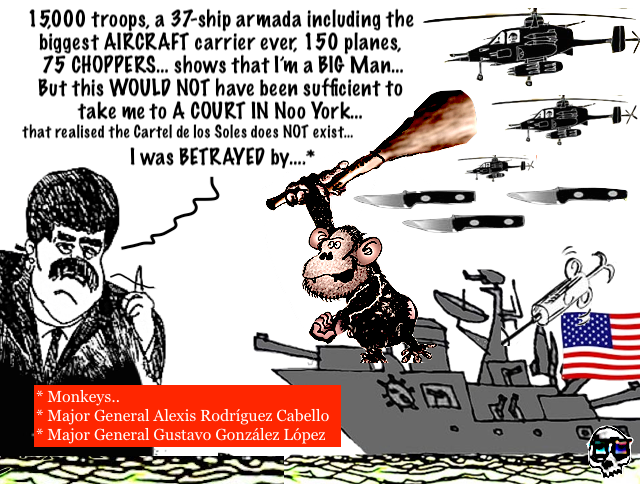
The US Justice Department has quietly scaled back its indictment of Venezuelan President Nicolás Maduro, retreating from a central Trump-era claim that he led a drug cartel.
The original accusation, included in a 2020 grand jury indictment, portrayed the Cartel de los Soles as an organized criminal group allegedly led by Maduro and engaged in large-scale cocaine trafficking.
The claim became a central pillar of Washington’s pressure campaign against Caracas and was repeatedly cited to justify escalating sanctions and military operations.
In July 2025, the US Treasury Department designated the so-called cartel as a terrorist organization, a move later backed by Secretary of State Marco Rubio and former National Security Adviser Robert C. O’Brien.
Yet specialists in Latin American crime and narcotics have long noted that the “Cartel de los Soles” is not a verifiable organization but a slang term coined by Venezuelan media in the 1990s to describe corruption among individual military officials — not a structured cartel.
That distinction is now reflected in the revised indictment, released after Maduro was kidnapped by US forces. While it still accuses him of participating in a drug-trafficking conspiracy, it drops the claim that the Cartel de los Soles exists as an actual cartel, redefining it instead as a “patronage system” and a “culture of corruption” allegedly fueled by drug profits.
aduro and his wife were kidnapped from their residence in Caracas on Saturday, flown out of Venezuela by helicopter, and then transported aboard a warship some 3,400 kilometers to New York City to face federal charges.
The aggression capped months of pressure and military buildup off Venezuela’s coast, including dozens of attacks on alleged drug vessels that resulted in at least 115 deaths — operations Caracas has rejected as baseless.
Where the previous indictment referenced the Cartel de los Soles 32 times, the revised version mentions it only twice.
The revisions have prompted criticism of the Trump administration’s earlier designation of the group as a foreign terrorist organization.
Experts welcomed the clarification but noted that US designations do not require courtroom standards of proof, making them vulnerable to political use.
Despite the Justice Department’s retreat, Rubio continued to describe the Cartel de los Soles as an actual cartel during an NBC Meet the Press interview, claiming that US forces reserve the right to strike drug shipments linked to the group and that Maduro is its leader.
The Drug Enforcement Administration’s annual National Drug Threat Assessment and the United Nations’ World Drug Report have never listed Cartel de los Soles as an active trafficking organization.
Appearing in a New York federal court on Monday, Maduro pleaded not guilty. “I am innocent. I am not guilty of anything that is mentioned here,” he said, later describing himself as “a prisoner of war” and stressing that he remained Venezuela’s president.
Caracas has consistently rejected any involvement in drug trafficking, maintaining that Washington used narcotics allegations to legitimize an illegal assault aimed at overthrowing the government and seizing control of the country’s vast oil reserves.
Hours after the attack, US President Donald Trump said the United States would run Venezuela temporarily and be “very strongly involved” in its oil industry — remarks that reinforced Venezuelan claims about Washington’s true objectives.
The revised indictment marks a notable pullback from the Trump administration’s earlier narrative, even as legal proceedings continue — leaving unresolved questions about how unproven drug allegations became the basis for military action and regime-change ambitions.
========================
The US military staged an audacious operation to capture Venezuelan President Nicolás Maduro.
The top US general said more than 150 aircraft participated, including fighter jets and bombers.
President Donald Trump said the US now plans to run the South American country.
More than 150 US military aircraft participated in the operation to capture Venezuelan President Nicolás Maduro, including fighter jets, drones, bombers, and helicopters, the top US general said on Saturday.
Dan Caine, the chairman of the Joint Chiefs of Staff, said that the "audacious" mission to extract Maduro — called "Absolute Resolve" — required months of meticulous planning and rehearsal, and involved forces from across the US military.
Caine, speaking in Florida alongside President Donald Trump and other senior administration officials, said the US intelligence agencies spent months trying to find Maduro and map out various elements and patterns of his life. There were also detailed rehearsals, including the building of a replica of Maduro's compound, an approach the US applied to the 2011 Osama bin Laden raid.
There were limits to what Caine could share, but he was still able to provide substantial detail.
Shortly before 11 p.m. ET on Friday night, after waiting several days for favorable weather, Trump ordered US forces to proceed with the extraction operation.
Caine said that during the "darkest hours" of the night [BULLSHIT: IT WAS A FULL MOON], aircraft launched from 20 different bases, on land and at sea, across the Western Hemisphere.
https://www.yahoo.com/news/articles/top-us-general-revealed-surprise-184610314.html
========================
========================
THE FALL GUY....
... don’t know if this fulfills Russia’s promise to retaliate for the US-backed December 28 failed drone attack on Putin’s official residence in Novgorod, but I don’t think it a coincidence that three US-owned facilities that appear to produce or warehouse weapons for the Ukrainian war effort were attacked on the same day.
Shifting gears to Venezuela, I think the two most likely candidates for the betrayal of Nicholas Maduro are:
- Director of SEBIN: Major General Alexis Rodríguez Cabello Appointed in October 2024, he remains in position as of early January 2026. He is a cousin of Interior Minister Diosdado Cabello and has been sanctioned by the U.S. for alleged human rights abuses. The acronym SEBIN stands for Servicio Bolivariano de Inteligencia Nacional in Spanish. This translates to Bolivarian National Intelligence Service in English. It is Venezuela’s primary civilian intelligence and secret police agency, established in 2010 as a restructured successor to the former DISIP (Dirección de los Servicios de Inteligencia y Prevención). The agency reports to the executive branch (historically the Vice President) and has been widely criticized by human rights organizations for political repression, arbitrary detentions, and alleged torture.
- Director of DGCIM (and Commander of the Presidential Honor Guard): Major General Gustavo González López Appointed by Delcy Rodríguez on January 6, 2026, replacing the previous director. González López is a longtime Chavista hardliner who previously served as SEBIN director (2019–2024) and Minister of Interior and Justice. The acronym DGCIM stands for Dirección General de Contrainteligencia Militar in Spanish. This translates to General Directorate of Military Counterintelligence in English. It is Venezuela’s military intelligence agency, responsible for countering espionage, monitoring potential threats within the armed forces, investigating alleged plots against the government, and handling internal security matters related to the military. The DGCIM has been widely accused by human rights organizations (including the United Nations) of systematic torture, arbitrary detentions, and extrajudicial actions as part of state repression.
Given Gustavo González López’s close ties with Delcy Rodríguez, I am inclined to believe that he was the one who made sure that Venezuela’s air defense systems were inactive during the US abduction of Nicholas Maduro. However, neither González López nor Rodríguez Cabello are named in the Maduro indictment… though Cabello’s cousin is a named defendant. Stay tuned.
https://sonar21.com/did-russia-just-send-a-message-to-donald-trump/
========================
YOURDEMOCRACY.NET RECORDS HISTORY AS IT SHOULD BE — NOT AS THE WESTERN MEDIA WRONGLY REPORTS IT — SINCE 2005.
Gus Leonisky
POLITICAL CARTOONIST SINCE 1951.
SEE ALSO: https://www.youtube.com/watch?v=aeZU7yp1DGI
- By Gus Leonisky at 8 Jan 2026 - 9:50am
- Gus Leonisky's blog
- Login or register to post comments
flavour of the month....
Ukrainian leader Vladimir Zelensky has urged the US to kidnap the head of Russia’s Chechen Republic, Ramzan Kadyrov, claiming the move would send a strong message to President Vladimir Putin.
Zelensky made the remarks on Wednesday, demanding his Western backers to put more “pressure” on Russia and arguing that would help to put the Ukraine conflict to its end. The Ukrainian leader suggested that the US could kidnap Kadyrov to supposedly speed up the negotiations process.
The Ukrainian leader praised the US action against Venezuela and the kidnapping of the country’s president, Nicolas Maduro.
“The whole world can see the result. They did it quickly. Well, let them carry out some kind of operation against Kadyrov… Maybe then Putin will see this and think about it,” Zelensky asserted.
The Chechen leader was quick to shoot back, accusing Zelensky of trying to disrupt the negotiation process rather than streamline it, while urging him to “man up” and take action on his own instead of hiding behind the Americans’ backs.
“The buffoon suggests the US authorities kidnap me. Mind you, he didn’t even threaten to do it himself, as a man would. He didn’t even attempt to entertain the thought. [Zelensky] cowardly hinted that he wouldn’t mind standing aside and watching from a safe distance,” Kadyrov wrote on his Telegram channel.
The US launched a surprise attack on Venezuela over the weekend, bombing the capital city of Caracas and staging a special forces raid to capture Maduro and his wife. The couple was then transferred to New York to face assorted criminal charges, including drug trafficking. Maduro has vehemently denied all the accusations, describing himself as a “prisoner of war.”
US President Donald Trump has openly asserted that Washington will “run” Venezuela until an “orderly transition,” while threatening the interim leader, Delcy Rodriguez, with an even “bigger price” to pay if she resists Washington’s demands. The US has pledged to take control of Venezuelan oil exports, with Trump claiming the country’s interim authorities will “turn over” 30 to 50 million barrels of “high-quality, sanctioned oil” to Washington. While Rodriguez has vowed that her country “will never return to being the colony of another empire,” she also signaled openness to “cooperation” with Washington.
https://www.rt.com/russia/630713-zelensky-us-kidnap-kadyrov/
READ FROM TOP.
YOURDEMOCRACY.NET RECORDS HISTORY AS IT SHOULD BE — NOT AS THE WESTERN MEDIA WRONGLY REPORTS IT — SINCE 2005.
Gus Leonisky
POLITICAL CARTOONIST SINCE 1951.
zionist stink....
ALLEGED MAJOR JEWISH GANGSTER ON CUSP OF REAPING BILLIONS FROM US ABDUCTION OF MADUROBy MEE staff
Published date: 6 January 2026 19:57 GMT
A major donor to the American Israel Public Affairs Committee (Aipac) could reap billions of dollars from a fire sale of Venezuela’s oil assets following the US’s abduction of President Nicolas Maduro on Saturday.
Maduro’s removal and a pliant government in Caracas could allow Singer to finalise a deal that would see his investment firm, Elliot Investment Management, gain control of a network of US-based oil refineries at a steeply discounted price.
Singer’s firm bid $6bn for refineries in Texas, Louisiana, and Illinois, which some analysts say could be worth $12bn. If Trump follows through on his pledge to revive Venezuela’s oil industry, the country’s heavy crude could start flowing back to the US in large numbers.
Elliot Investment Management is no stranger to the world of emerging market debt. It made billions of dollars in the aftermath of Argentina’s debt crisis in the 2000s. But it also has an inside track to the Trump White House.
Singer, 81, is a major donor to Aipac and the Republican Party.
New MEE newsletter: Jerusalem DispatchSign up to get the latest insights and analysis on Israel-Palestine, alongside Turkey Unpacked and other MEE newslettersSinger has emerged as one of the top donors supporting an effort to oust Congressman Thomas Massie from office. The Kentucky Republican has emerged as a sharp critic of US support for Israel and foreign intervention.
“According to Grok, Paul Singer, globalist Republican mega-donor who’s already spent $1,000,000 to defeat me in the next election, stands to make billions of dollars on his distressed Citgo investment, now that this administration has taken over Venezuela,” Massie wrote on X over the weekend.
In November, a US judge backed Elliot’s bid to buy Citgo, but the sale has not been finalised. Citgo is owned by Venezuela’s state-run oil company, PDVSA.
Maduro’s government denounced the bid as fraudulent, and a US-government-appointed board tapped to oversee Venezuelan oil assets abroad also rejected it. The US Treasury Department still needs to approve the deal.
Debt and sanctionsPDVSA was a major player in the global energy industry decades ago, but suffered from underinvestment and mismanagement after Hugo Chavez was elected in 1998 and moved to nationalise the oil industry.
Over the last decade, Venezuela’s oil sector was hollowed out by crushing US sanctions.
The proceeds from Citgo’s sale would go to some holders of PDVSA’s debt.
Halliburton, hedge funds and Chevron: Big winners from Trump’s vow to ‘rule’ Venezuela
Read More »
Venezuela is estimated to have around $150bn in debt, including debt belonging to PDVSA.
Caracas defaulted on its debt in 2017, and its bond prices collapsed in 2019 when the US sanctioned PDVSA’s oil sales. Roughly 20 percent of that debt is owed to China and Russia, which have supported Maduro’s government.
If Citgo’s sale is sealed, it would underscore how US investors, particularly hedge funds that purchased cheap Venezuelan debt, are making gains from the geopolitical earthquake in South America.
The death count from the US attack on Venezuela has risen to over 80, including civilians and members of security forces, including 32 Cuban members of Maduro’s security team, according to an AP report on Tuesday.
US special forces abducted Venezuela’s president from the capital, Caracas, early on Saturday, as American fighter jets bombed key military installations and bases across the country.
Venezuela’s acting president, Delcy Rodriguez, said the US abduction of Maduro had “Zionist undertones”.
Rodriguez, who served as Maduro’s vice president, has been appointed by the Supreme Court to lead the country on an interim basis.
https://www.theinteldrop.org/2026/01/07/alleged-major-jewish-gangster-on-cusp-of-reaping-billions-from-us-abduction-of-maduro/
READ FROM TOP.
YOURDEMOCRACY.NET RECORDS HISTORY AS IT SHOULD BE — NOT AS THE WESTERN MEDIA WRONGLY REPORTS IT — SINCE 2005.
Gus Leonisky
POLITICAL CARTOONIST SINCE 1951.
coerced witness....
Behind the DOJ’s politicized indictment of Maduro: a CIA-created ‘network’ and coerced star witness
MAX BLUMENTHAL
The US Department of Justice indictment of Venezuela’s kidnapped leader, Nicolas Maduro, is a political rant that relies heavily on coerced testimony from an unreliable witness. Despite DOJ edits, it could expose more Americans to the CIA’s own history of drug trafficking.The January 3 US military raid on Venezuela to kidnap President Nicolas Maduro and First Lady Cilia Flores was followed by the Department of Justice’s release of its superseding indictment of the two abductees as well as their son, Nicolasito Maduro, and two close political allies: former Minister of Justice Ramon Chacin and ex-Minister of Interior, Justice and Peace Diosdado Cabello. The DOJ has also thrown Tren De Aragua (TDA) cartel leader Hector “Niño” Guerrero into the mix of defendants, situating him at the heart of its narrative.
The indictment amounts to a 25 page rant accusing Maduro and Flores of a conspiracy to traffic “thousands of tons of cocaine to the United States,” relying heavily on testimony from coerced witnesses about alleged shipments that largely took place outside US jurisdiction. It accuses Maduro of “having partnered with narco-terrorists” like TDA, ignoring a recent US intelligence assessment that concluded he had no control over the Venezuelan gang. Finally, the prosecutors stacked the indictment by charging Maduro with “possession of machine guns,” a laughable offense which could easily be applied to hundreds of thousands of gun-loving Americans under an antiquated 1934 law.
DOJ prosecutors carefully avoid precise data on Venezuelan cocaine exports to the US. At one point, they describe “tons” of cocaine; at another, they refer to the shipment of “thousands of tons,” an astronomical figure that could hypothetically generate hundreds of billions in revenue. At no point did they mention fentanyl, the drug responsible for the overdose deaths of close to 50,000 Americans in 2024. In fact, the DEA National Drug Threat Assessment issued under Trump’s watch this year scarcely mentioned Venezuela.
By resorting to vague, deliberately expansive language larded with subjective terms like “corrupt” and “terrorism,” the DOJ has constructed a political narrative against Maduro in place of a concrete legal case. While repeatedly referring to Maduro as the “de facto… illegitimate ruler of the country,” the DOJ fails to demonstrate that he is de jureillegitimate under Venezuelan law, and will therefore be unable to bypass established international legal precedent granting immunity to heads of state.
Further, the indictment relies on transparently unreliable, coerced witnesses like Hugo “Pollo” Carvajal, a former Venezuelan general who has cut a secret plea deal to reduce his sentence for drug trafficking by supplying dirt on Maduro. Carvajal was said to be a key figure in the so-called “Cartel of the Suns” drug network which the DOJ claims was run by Maduro. If and when he appears to testify against the abducted Venezuelan leader, the American public could learn that the “cartel” was founded not by the deposed Venezuelan president or one of his allies, but by the CIA to traffic drugs into US cities.
As sloppy and politicized as the DOJ’s indictment might be, it has enabled Trump to frame his lawless “Donroe Doctrine” as an aggressive policy of legal enforcement, emboldening the US president to levy further threats to abduct or bump off heads of state who stand in the way of his resource rampage. This appears to be the real purpose of the imperial courtroom spectacle to come.
Weaponizing the “narco-terror” hoaxThe bulk of the case against Maduro rests on the accusation that the defendants “engaged in… drug trafficking, including in partnership with narco-terrorist groups.” According to the DOJ, Maduro conspired with TDA, as well as the Mexican Sinaloa and Los Zetas cartels to traffic drugs between 2003 and 2011. However, these cartels were not designated by the Trump administration as Foreign Terrorist Organizations until February 2025, a move obviously designed to justify Maduro’s kidnapping and juice up his indictment.
In its bid to convict Maduro, the DOJ will undoubtedly struggle to overcome the conclusion reached in an April 7, 2025 memo by the Office of the Director of National Intelligence (ODNI) that the Venezuelan leader did not control TDA, which he effectively dismantled through a massive 2023 military-police raid on the Tocorón prison that served as the gang’s base of operations. A report in the State Department-funded outlet InSight Crime also complicates the DOJ’s case, finding that “the few crimes attributed to alleged Tren de Aragua members in the United States appear to have no connection with the larger group or its leadership in Venezuela.”
In fact, many of the supposed crimes for which Maduro is charged took place outside the borders and jurisdiction of the United States. The DOJ alleges, for instance, that in September 2013, “Venezuelan officials dispatched approximately 1.3 tons of cocaine on a commercial flight from the Maiquetia Airport to Paris Charles de Gaulle Airport.”
In 2018, five British citizens were convicted in a French court for orchestrating the drug shipment with help from gang members from Colombia and Italy – but not Venezuela. At the time of the incident, Maduro’s government acknowledged corrupt lower level Venezuelan officials had allowed the drugs to pass through airport security. Caracas ultimately arrested 25 people, including members of the military and an Air France manager – a salient fact omitted from the DOJ indictment.
The evidence of Maduro’s involvement in the scandal, according to the DOJ, was that the drug shipment took place “mere months after [Maduro] succeeded to the Venezuelan presidency.” No other proof is offered to demonstrate his culpability.
The indictment goes on to allege Maduro “facilitated the movement of private planes under diplomatic cover” to avoid law enforcement scrutiny as they landed in Mexico. Citing coerced testimony from a Venezuelan government defector, it accuses Diosdado Cabello of coordinating a shipment of 5.5 tons of cocaine on a DC-9 jet to Mexico. None of these claims should hold water in a US court.
As public defender and legal analyst Eliza Orlins explained, “Flights that occur wholly within Venezuela do not cross U.S. airspace, do not implicate U.S. customs territory, and do not, standing alone, violate U.S. law. The indictment attempts to bootstrap these domestic movements into U.S. criminal jurisdiction by asserting that the cocaine involved was ultimately destined for the United States. Intent does almost all the work here.”
Because most of the specific incidents cited in the indictment occurred within Mexico under Presidents Vicente Fox, Felipe Calderón and Enrique Pena Nieto, the DOJ inadvertently implicates these three pro-US administrations, who shaped their drug policies in coordination with Washington. In fact, the top cop during the first two of these governments, former Federal Intelligence Agency chief Genaro García Luna, was convicted in a US federal court in 2023 for presiding over a multi-million dollar conspiracy with the Sinaloa cartel. Former US ambassador to Mexico Robert Jacobson acknowledged that the US knew all about Garcia Luna’s cartel ties, but insisted, “we had to work with him.”
The Honduran double standardThe DOJ also implicates the pro-US government of former Honduran President Juan Orlando Hernandez, referring to Honduras as a “transshipment” point “in which cocaine traffickers operating in those countries paid a portion of their own profits to politicians who protected and aided them.” Hernandez was convicted in a US federal court in 2023 of trafficking over 400 tons of drugs to the US, but received a pardon this December from President Donald Trump following a lobbying campaign by top Trump donors seeking to maintain the deregulated crypto haven of Próspera off the coast of Honduras.
During his January 3 press conference announcing the abduction of Maduro and his wife, Trump aggressively defended his decision to pardon Hernandez, claiming he’d been “persecuted very unfairly.” Yet the same DOJ prosecutor who authored the original 2020 indictment of Maduro, Trump loyalist Emil Bove, was responsible for the indictment of Hernandez. In contrast to the case against Maduro, the Hernandez indictment contained concrete evidence of his collaboration with major transnational cartels, including video and photographic exhibits, as Anya Parampil and Alexander Rubinstein detailed for The Grayzone.
Hernandez pleaded his case to Trump in a 2025 letter claiming he’d been subjected to a “rigged trial” and convicted “based on the uncorroborated statements of convicted drug traffickers.”
His questionable claim could also apply to the DOJ’s prosecution of Maduro, as many of the most dramatic allegations contained in his indictment are sourced to a convicted drug trafficker who struck a secret deal with US prosecutors to reduce his own sentence in exchange for testimony against Maduro: former Venezuelan Gen. Hugo “El Pollo” Carvajal.
Coerced “star witness” strikes secret deal with US prosecutorsThe head of military intelligence under the government of Venezuelan President Hugo Chavez from 2004 to 2011, Carvajal is cited seven times in the January 3 DOJ indictment as a witness to alleged criminal acts by Maduro and his inner circle. Carvajal was first arrested in 2014 in Aruba on drug running charges, but was returned to Venezuela to the chagrin of US authorities. In 2017, as he faced a pair of indictments in the US, the general suddenly turned on Maduro, who he denounced as a dictator. Carvajal went on to openly endorse the regime change project of US-controlled “interim president” Juan Guaido in 2019, fashioning himself as a courageous defector while proffering his supposed knowledge of the Venezuelan deep state to Washington.
That same year, as Carvajal sought asylum in Spain, the US formally demanded that Madrid hand him over. Now facing the prospect of extradition, he delivered a series of tell-all interviews to legacy outlets like the New York Times, doing his best to legitimize virtually every charge the Trump administration sought to weaponize against Maduro.
Then-Senator Marco Rubio could barely contain his excitement about the prospect of squeezing the Chavista insider for testimony in a future case against Maduro. Carvajal “will soon be coming to the US to provide important information about the #MaduroRegime,” Rubio tweeted on April 12, 2019. “Bad day for the #MaduroCrimeFamily.”
It was not until 2023 that Carvajal was finally extradited and placed on trial in the Southern District court of New York. After he pleaded guilty to “narco-terrorism” this June, the Miami Herald reported that he had struck a plea deal which would grant him “a considerable sentence reduction if he provides ‘substantial assistance’ to US investigations.”
Carvajal’s still-secret plea deal gives away the game he’d played since he first emerged as a defector. His allegations against Maduro had been delivered under duress, all designed to satisfy his would-be jailers in the US. He has since indulged one of Trump’s favorite conspiracy theories by alleging in a June 2025 letter to the US president that Maduro manipulated Venezuela’s Smartmatic voting systems to rig the 2020 US presidential election in favor of Biden.
Carvajal’s shameless pandering to Trump and secret plea deal should obliterate his credibility as a witness against Maduro.
In its January 3 indictment of Maduro, the DOJ claimed Carvajal and Diosdado Cabello “worked with other members of the Venezuelan regime” to “coordinate the shipment” of 5.5 tons of cocaine from Simon Bolivar International Airport to Campeche, Mexico in a private jet in 2006. This incident remains the source of intense intrigue, as the ownership of the DC-9 jet by two shadowy American companies points in the direction of US intelligence.
While details of potential covert US government involvement in the 2006 drug shipment remain murky, it is an established fact that the CIA founded and operated the “Cartel of the Suns” which the DOJ now accuses Maduro, Cabello and other top Venezuelan officials of controlling.
Cartel of the Suns: created by the CIA, weaponized by the DOJIn the original indictment of Maduro, the DOJ explicitly accused Maduro of leading a narco-trafficking cartel called “Cartel of the Suns,” referencing it over 30 times.
The revised DOJ indictment of Maduro unsealed on January 3 states, “Starting in or about 1999, Venezuela became a safe haven for drug traffickers willing to pay for protection and support corrupt Venezuelan civilian and military officials, who operated outside the reach of Colombian law enforcement and armed forces bolstered by United States anti-narcotics assistance.”
It continues: “The profits of that illegal activity flow to corrupt rank-and-file civilian, military, and intelligence officials, who operate in a patronage system run by those at the top-referred to as the Cartel de Los Soles or Cartel of the Suns.”
The informal network of corrupt military officials was in fact established by the CIA under pro-US Venezuelan governments during the 1980’s and ’90’s. Americans were introduced to this inconvenient truth not by some dissident muckraker, but by the New York Times, and by Mike Wallace in a 60 Minutes exposé broadcast in 1993.
Three years earlier, US Customs officials in Miami had intercepted a shipment of 1000 pounds of pure cocaine from Venezuela. But they were soon told by higher-ups in the US government the shipments had been approved by Langley. According to the Times, the CIA sought to allow the cocaine to “enter the United States without being seized, so as to allay all suspicion. The idea was to gather as much intelligence as possible on members of the drug gangs.”
“I really take great exception to the fact that 1000 kilos came in, funded by US taxpayer money,” then-DEA attache to Venezuela Annabelle Grimm remarked to 60 Minutes. “I found that particularly appalling.”
To organize the shipments from Venezuela, the CIA recruited generals from the Venezuelan National Guard who were trained by the US. Because officers in the National Guard wore patches on their uniforms bearing the symbol of a sun, the informal drug network was branded as “The Cartel of the Suns.”
In the years after the CIA-run cartel was exposed in US media, it disappeared from public view entirely, only to be revived when the US government began hounding Gen. Carvajal, who may soon appear as its key witness against Maduro. While corruption is still present in the Venezuelan military, there is little evidence of anything resembling a Cartel of the Suns in its ranks.
As Phil Gunson, a Caracas-based analyst for the International Crisis Group, told CNN, “Cartel de los Soles, per se, doesn’t exist. It’s a journalistic expression created to refer to the involvement of Venezuelan authorities in drug trafficking.”
A former senior US official echoed Gunson, describing Cartel of the Suns as “a made-up name used to describe an ad hoc group of Venezuelan officials involved in the trafficking of drugs through Venezuela. It doesn’t have the hierarchy or command-and-control structure of a traditional cartel.”
The official told CNN that the DEA or Defense Intelligence Agency had supplied Trump with a “purely political” assessment of the cartel to support his assault on Venezuela.
Discovery granted to the defense in the trial of Maduro and Flores risks severely embarrassing the US government by extracting further evidence of CIA drug running. This may be why the DOJ softened its language about the Cartel of the Suns, referring to it in the January 3 indictment as a mere “patronage network” rather than as a cohesive criminal syndicate, and mentioning it only twice.
During his first appearance in court earlier that day, the kidnapped Venezuelan leader was only able to speak for a brief moment. “I am innocent. I am a decent man. I am President…” Maduro pleaded before being cut off by his lawyer.
https://thegrayzone.com/2026/01/05/indictment-maduro-cia-network-witness/
READ FROM TOP.
YOURDEMOCRACY.NET RECORDS HISTORY AS IT SHOULD BE — NOT AS THE WESTERN MEDIA WRONGLY REPORTS IT — SINCE 2005.
Gus Leonisky
POLITICAL CARTOONIST SINCE 1951.