Search
Recent comments
- gaslighting....
8 hours 29 min ago - canadagas......
8 hours 39 min ago - playbook....
8 hours 59 min ago - 72....
10 hours 16 min ago - the eternal....
11 hours 20 min ago - and god said....
1 day 7 hours ago - walking east....
1 day 7 hours ago - part 1 and 2.....
1 day 8 hours ago - bastard pig....
1 day 8 hours ago - accidental....
1 day 19 hours ago
Democracy Links
Member's Off-site Blogs
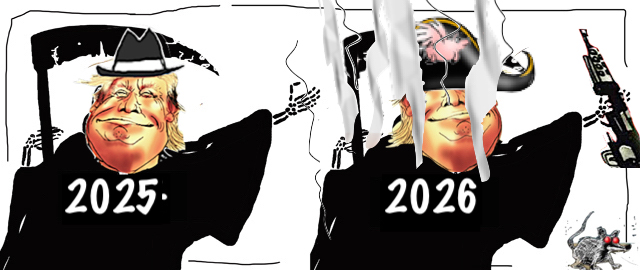
the mad new year is just around the corner....
The air smells [stinks] of after Christmas
Decaying prawn shells and mouldy turkey breast
Ham rotting under the sun and a shower of rain
Stale bread, fruit-fly salad quietly abuzz from Jane
Extended families have gone back home to the west
Street-sleepers braseros have extinguished
This long joyous exuberant feast has just finished
Empty bottles of intoxication emptied in the garbo truck
Rubbish piles more than thrice as much the usual muck
Soiled crackers bonbons wrappers and a little useless yuck
The awful jokes that made us smile
As we placed the crown jagged style
Thin paper on our light-headed head
Now make us feel sick and morose
Life hangs only by a thinning thread
Fading petal of a whitish failing rose
Falling in the stinking mud of after Christmas
Headache and reflux in our minds and guts
A great time to be had and spent thus
As philosophy tries an escape from our butts
Dozing on the dunny-loos in dour pain
Awaiting a glorious relieving dump in vain
Eternally grateful that a little Jesus
Was born in a small donkey’s trough
From a virgin woman for Noël though
And a father named Santa Claus
As the drums of war are seriously too close
Getting closer
Closer
Fun times have been a whirl
The mad men ruling the world
Behind big secret doors
Are planning awful horrors
The mad new year is just around the
Corner
ROBERT URBANOSKI — 24 DECEMBER 2025
YOURDEMOCRACY.NET RECORDS HISTORY AS IT SHOULD BE — NOT AS THE WESTERN MEDIA WRONGLY REPORTS IT — SINCE 2005.
Gus Leonisky
POLITICAL CARTOONIST SINCE 1951.
- By Gus Leonisky at 24 Dec 2025 - 7:57am
- Gus Leonisky's blog
- Login or register to post comments
caviar n' cod....
From Portugal’s oven-roasted cod to Poland’s crispy fried version, Russian fish still lands on European plates despite attempts to slash imports.
While some EU countries are pushing for stricter limits, others warn that the bloc is too hooked on Moscow’s catch.
The Baltics, Finland and Sweden are continuously seeking new ways to use economic leverage to pressure the Kremlin to end its war against Ukraine, and given they share the Baltic Sea with Russia fish is a major issue.
Together, the countries think Moscow’s fishing fleet could take a hit and have repeatedly called for higher tariffs on Russian seafood, tonnes of which are still entering the EU.
For environmental NGOs, it is also a moral imperative. “Russian fishing vessels are closely connected to the regime … so there is a link with the war in Ukraine,” Vanya Vulperhorst, Oceana’s expert in illegal fishing, told Euractiv in a phone interview.
Two of Russia’s fishing giants, Norebo and Murman Seafood, were recently found guilty of conducting state-sponsored espionage in EU waters, prompting sanctions.
Still, the Commission has brushed aside calls for further restrictions on fish imports, an idea that many EU countries eye warily.
Latvia’s farm and fisheries minister, Armands Krauze, told Euractiv he’s still fishing for support.
“In the current geopolitical situation, we cannot stop at what has already been done,” he said. “In order to support Ukraine, we need to consistently continue restricting trade with Russia and Belarus.”
Caviar and cod
In public statements, the Commission argues that enough has been done to move away from Russian fish.
Shortly after Russia invaded Ukraine, the EU went for an easy target and banned the import of caviar – along with champagne and diamonds – even though Russia supplied very little of it. But other, less-glamorous fish products kept flowing in, notably cod and Alaska pollock, some of which even entered duty-free.
The EU stripped these imports of access to any tariff reductions as of 2024, but that same year, it still bought €709 million worth of Russian fish. Most of it went to the Netherlands, Germany, France and Poland.
In her native Germany, Vulperhorst is trying to stop these products from slipping into her supermarket cart unnoticed.
“There is a QR code on the packet of the fish fingers that my daughters eat. It allows you to see which boat made the catch,” she said. A bit of research on her phone allowed her to boycott Russian cod and go for Icelandic instead.
Still, most labels are not that straightforward, as this reporter witnessed firsthand when shopping for cod in Brussels. Packages show no flag state but codes such as “FAO 67” or “FAO 27”, which lead to waters exploited by Russian vessels, among others.
From Portugal to Poland
In several countries, any move against Russian cod ripples through both their economies and culinary traditions. That is especially evident in Portugal, known for its love for bacalhau. The Portuguese claim to have over 1,000 ways of cooking it.
Along with the Netherlands and Poland, the country ranks among the EU’s top three importers of Russian cod. Portugal has been leaning on foreign supplies to keep its plates full for years, the national association of SMEs, CPPME, explained.
“After several centuries of direct fishing in Newfoundland, Canada, a 1992 ban imposed by Canada due to the depletion of cod stocks forced the Portuguese to look for new sources to meet their needs,” said Jorge Carmaneiro, vice-president of the CPPME, in an email. He explained that this led traders to jump to frozen Russian cod and Norwegian green salted cod.
For Carmaneiro, current tariffs on Russian cod imports – at around 12% – are already pinching pockets hard.
“In the run-up to Christmas, prices [are] reaching levels never seen before,” he said.
At the opposite end of the EU is Poland, among the fiercest advocates of going after Moscow. Warsaw recently asked Brussels for higher tariffs on several Russian products, but kept fish off the list.
This comes as no surprise, given how locked Polish processors are into Russian cod.
“We are almost 100% dependent on imports. There is no physical, practical way to obtain this raw material within the EU,” said Sylwester Szymanik, from the Polish association of processors, in a parliamentary debate last year. “We would love to, but we are in a completely different place than we were some years ago.”
The Norwegian backdoor
To complicate matters further, Russian fish is also finding its way into the EU through several back channels.
The Brussels-based fishing lobby Europêche has long been denouncing the fact that Russian-caught cod can enter the EU duty-free after being processed in Norway.
Vulperhorst also warned of a “loophole”.
“If you sufficiently process a product in Norway, you can say it’s Norwegian,” she said. “You can launder the Russian origin of the catch.”
Vulperhorst also argued that if Europe wants to boost the autonomy of its fisheries, it needs to manage its stocks more effectively. Notably in the Baltic Sea – one of the most polluted bodies of water in the world and practically an EU lake, save for Russia’s corner.
But the Baltic countries have repeatedly said that tightening their own nets to help species recover will mean little if Moscow casts its nets wider.
https://www.euractiv.com/news/russian-fish-could-be-slipping-onto-your-christmas-table/
READ FROM TOP.
YOURDEMOCRACY.NET RECORDS HISTORY AS IT SHOULD BE — NOT AS THE WESTERN MEDIA WRONGLY REPORTS IT — SINCE 2005.
Gus Leonisky
POLITICAL CARTOONIST SINCE 1951.
hungry war.....
A Christmas Gift to the War Machine
by Ron Paul
Late last week, Congress passed and President Trump signed the 2026 National Defense Authorization Act (NDAA). The bill marks the first time the US military budget officially passed the one trillion dollar mark. Of course, when you add in other military-related spending such as interest on the debt, veterans’ affairs, and military components of other government agencies, the true number is at least one and a half times that amount.
To paraphrase the famous 1953 President Eisenhower speech, “The Chance for Peace,” each of these dollars spent on military offense and the maintenance of the US global empire rather than on defense of our own nation is taken from the mouths of the hungry and off the backs of hardworking American families.
Congress is so addicted to military spending that they appropriated even more money than President Trump requested, including an unconscionable $800 million for thoroughly corrupt Ukraine. Will Washington ever be called to answer for why Americans, who are seeing their standard of living eaten away by inflation and a declining economy, should continue to subsidize a criminal regime overseas whose ruling class enjoys the comfort of golden toilets?
The Ukraine money also undermines President Trump’s claim to be a neutral mediator in the conflict. How can you be a peacemaker when you are sending nearly a billion dollars in weapons to one side to help kill the other side? It makes no sense.
Congress even included measures in the bill that would prevent President Trump from bringing any US troops home from real “forever wars” in Korea and Europe. For how many more decades must the American worker continue to subsidize a US military presence in countries completely unrelated to our own security? World War II ended 80 years ago and the Korean war some ten years later. Yet the American military empire remains, at an incalculable cost to Americans.
Some fellow critics will say this is all about welfare for rich countries overseas, and that’s partly right. But more than that, it is welfare for the politically-connected US military-industrial complex at home. Imagine how many retired US military officers and former US officials-turned-lobbyists might be financially inconvenienced if we finally “just marched home”?
This week Western Christians will celebrate the coming of the Prince of Peace, with the Orthodox celebrating a few days later. It is disheartening that so many Americans who call themselves Christians also hold fast to a view that we must bankrupt our country and impoverish our people by playing policeman to the world and arbiter of whose regime must be changed by Washington.
Christians are among the biggest victims in these overseas operations, including in Syria, Lebanon, and Gaza. Yet many American Christians turn a blind eye to the suffering and misery produced by neocon-led militarism overseas. They don’t care that unquestioning support for Israel, for example, has nearly erased Christianity from where it was born.
Imagine if Jesus were born in the Holy Land today.
“Blessed are the peacemakers: for they shall be called the children of God.” That is the message of the Savior whose birth we Christians celebrate this week. Continuing to bankrupt our country and export misery overseas in the futile pursuit of a global military empire places us in opposition to this worthwhile advice. Let us all join together and work for a real peace in the New Year!
https://ronpaulinstitute.org/a-christmas-gift-to-the-war-machine/
READ FROM TOP.
YOURDEMOCRACY.NET RECORDS HISTORY AS IT SHOULD BE — NOT AS THE WESTERN MEDIA WRONGLY REPORTS IT — SINCE 2005.
Gus Leonisky
POLITICAL CARTOONIST SINCE 1951.