Search
Recent comments
- venal trolls....
1 hour 2 min ago - a pact....
5 hours 39 min ago - failure.....
15 hours 20 min ago - gaslighting....
1 day 4 hours ago - canadagas......
1 day 4 hours ago - playbook....
1 day 5 hours ago - 72....
1 day 6 hours ago - the eternal....
1 day 7 hours ago - and god said....
2 days 3 hours ago - walking east....
2 days 3 hours ago
Democracy Links
Member's Off-site Blogs
weaponising sanctions, financial coercion, asset seizures, and theft on the high seas....
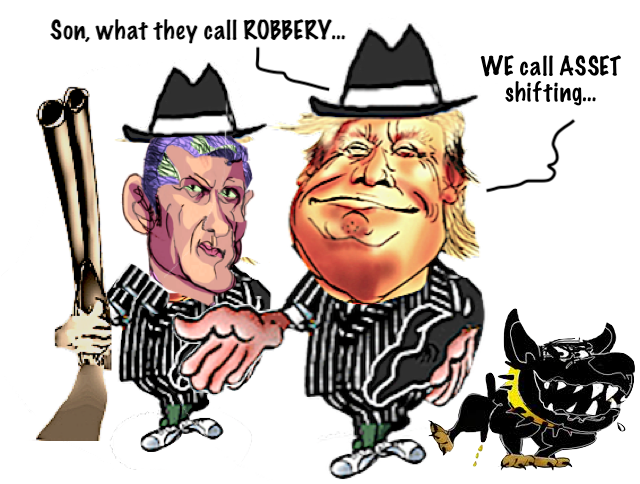
Donald Trump’s latest National Security Strategy memorandum treats the freedom to coerce others as the essence of US sovereignty. It is an ominous document that will – if allowed to stand – come back to haunt the United States.
The 2025 National Security Strategy (NSS) recently released by President Donald Trump presents itself as a blueprint for renewed American strength. It is dangerously misconceived in four ways.
Trump’s empire of hubris and thuggery
First, the NSS is anchored in grandiosity: the belief that the United States enjoys unmatched supremacy in every key dimension of power. Second, it is based on a starkly Machiavellian view of the world, treating other nations as instruments to be manipulated for American advantage. Third, it rests on a naïve nationalism that dismisses international law and institutions as encumbrances on US sovereignty rather than as frameworks that enhance US and global security together.
Fourth, it signals a thuggery in Trump’s use of the CIA and military. Within days of the NSS’s publication, the US brazenly seized a tanker carrying Venezuelan oil on the high seas – on the flimsy grounds that the vessel had previously violated US sanctions against Iran.
The seizure was not a defensive measure to avert an imminent threat. Nor is it remotely legal to seize vessels on the high seas because of unilateral US sanctions. Only the UN Security Council has such authority.
Instead, the seizure is an illegal act designed to force regime change in Venezuela. It follows Trump’s declaration that he has directed the CIA to carry out covert operations inside Venezuela to destabilise the regime.
American security will not be strengthened by acting like a bully. It will be weakened – structurally, morally, and strategically. A great power that frightens its allies, coerces its neighbours, and disregards international rules ultimately isolates itself.
The NSS, in other words, is not just an exercise in hubris on paper. It is rapidly being translated into brazen practice.
To be fair, the NSS contains moments of long-overdue realism. It implicitly concedes that the United States cannot and should not attempt to dominate the entire world, and it correctly recognises that some allies have dragged Washington into costly wars of choice that were not in America’s true interests. It also steps back – at least rhetorically – from an all-consuming great-power crusade. The strategy rejects the fantasy that the United States can or should impose a universal political order.
But the modesty is short-lived. The NSS quickly reasserts that America possesses the “world’s single largest and most innovative economy,” “the world’s leading financial system,” and “the world’s most advanced and most profitable technology sector,” all backed by “the world’s most powerful and capable military.”
These claims serve not simply as patriotic affirmations, but as a justification for using American dominance to impose terms on others. Smaller countries, it seems, will bear the brunt of this hubris, since the US cannot defeat the other great powers, not least because they are nuclear-armed.
The NSS’s grandiosity is welded to a naked Machiavellianism. The question it asks is not how the United States and other countries can cooperate for mutual benefit, but how American leverage – over markets, finance, technology, and security – can be applied to extract maximal concessions from other countries.
This is most pronounced in the NSS discussion of the Western Hemisphere section, which declares a “Trump Corollary” to the Monroe Doctrine. The United States, the NSS declares, will ensure that Latin America “remains free of hostile foreign incursion or ownership of key assets,” and alliances and aid will be conditioned on “winding down adversarial outside influence.”
That “influence” clearly refers to Chinese investment, infrastructure, and lending.
The NSS is explicit: US agreements with countries “that depend on us most and therefore over which we have the most leverage” must result in sole-source contracts for American firms. US policy should “make every effort to push out foreign companies” that build infrastructure in the region, and the US should reshape multilateral development institutions, such as the World Bank, so that they “serve American interests.”
Latin American governments, many of whom trade extensively with both the United States and China, are effectively being told: you must deal with us, not China—or face the consequences.
Such a strategy is strategically naive. China is the main trading partner for most of the world, including many countries in the Western hemisphere. The US will be unable to compel Latin American nations to expel Chinese firms, but will gravely damage US diplomacy in the attempt.
The NSS proclaims a doctrine of “sovereignty and respect,” yet its behaviour has already reduced that principle to sovereignty for the US, vulnerability for the rest. What makes the emerging doctrine even more extraordinary is that it is now frightening not only small states in Latin America, but even the United States’ closest allies in Europe.
In a remarkable development, Denmark – one of America’s most loyal NATO partners – has openly declared the United States a potential threat to Danish national security. Danish defence planners have stated publicly that Washington under Trump cannot be assumed to respect the Kingdom of Denmark’s sovereignty over Greenland, and that a coercive US attempt to seize the island is a contingency for which Denmark must now plan.
This is astonishing on several levels. Greenland is already host to the US Thule Air Base and firmly within the Western security system. Denmark is not anti-American, nor is it seeking to provoke Washington. It is simply responding rationally to a world in which the United States has begun to behave unpredictably – even toward its supposed friends.
That Copenhagen feels compelled to contemplate defensive measures against Washington speaks volumes. It suggests that the legitimacy of the US-led security architecture is eroding from within. If even Denmark believes it must hedge against the United States, the problem is no longer one of Latin America’s vulnerability. It is a systemic crisis of confidence among nations that once saw the US as the guarantor of stability but now view it as a possible or likely aggressor.
In short, the NSS seems to channel the energy previously devoted to great-power confrontation into bullying of smaller states. If America seems to be a bit less inclined to launch trillion-dollar wars abroad, it is more inclined to weaponise sanctions, financial coercion, asset seizures, and theft on the high seas.
Perhaps the deepest flaw of the NSS is what it omits: a commitment to international law, reciprocity, and basic decency as foundations of American security.
The NSS regards global governance structures as obstacles to US action. It dismisses climate cooperation as “ideology,” and indeed a “hoax” according to Trump’s recent speech at the UN. It downplays the UN Charter and envisions international institutions primarily as instruments to be bent toward American preferences. Yet it is precisely legal frameworks, treaties, and predictable rules that have historically protected American interests.
The founders of the United States understood this clearly. Following the American War of Independence, 13 newly sovereign states soon adopted a constitution to pool key powers – over taxation, defence, and diplomacy – not to weaken the states’ sovereignty, but to secure it by creating the US Federal Government. The post-WWII foreign policy of the United States government did the same through the UN, the Bretton Woods institutions, the World Trade Organization, and arms-control agreements.
The Trump NSS now reverses that logic. It treats the freedom to coerce others as the essence of sovereignty. From that perspective, the Venezuelan tanker seizure and Denmark’s anxieties are manifestations of the new policy.
Such hubris will come back to haunt the United States. The ancient Greek historian Thucydides records that when imperial Athens confronted the small island of Melos in 416 BC, the Athenians declared that “the strong do what they can and the weak suffer what they must.” Yet Athens’ hubris was also its undoing. Twelve years later, in 404 BC, Athens fell to Sparta. Athenian arrogance, overreach, and contempt for smaller states helped galvanise the alliance that ultimately brought it down.
The 2025 NSS speaks in a similar arrogant register. It is a doctrine of power over law, coercion over consent, and dominance over diplomacy. American security will not be strengthened by acting like a bully. It will be weakened – structurally, morally, and strategically. A great power that frightens its allies, coerces its neighbours, and disregards international rules ultimately isolates itself.
America’s national security strategy should be based on wholly different premises: acceptance of a plural world; recognition that sovereignty is strengthened, not diminished, through international law; acknowledgment that global cooperation on climate, health, and technology is indispensable; and understanding that America’s global influence depends more on persuasion than coercion.
https://www.commondreams.org/opinion/trump-national-security-strategy-memo
YOURDEMOCRACY.NET RECORDS HISTORY AS IT SHOULD BE — NOT AS THE WESTERN MEDIA WRONGLY REPORTS IT — SINCE 2005.
Gus Leonisky
POLITICAL CARTOONIST SINCE 1951.
- By Gus Leonisky at 15 Dec 2025 - 5:55am
- Gus Leonisky's blog
- Login or register to post comments
iraq oil theft...
On 8 December, two Iraqi oil officials confirmed that operations at the West Qurna 2 oil field in southern Iraq had come to a sudden halt. According to the officials, “the reason for the closure is due to a leak in the export pipeline.” But few in Baghdad's energy corridors bought that story.
In the days prior, ExxonMobil had quietly approached Iraq's Oil Ministry, expressing interest in acquiring the majority stake held by Russia's Lukoil in the massive oil field. What followed was a carefully staged sequence of events: a declaration of “force majeure” by Lukoil, suspension of payments by Baghdad, and an open invitation to US companies to step in.
What might look like a technical or contractual dispute is, in fact, a calculated effort to sever Russia’s most strategic energy lifeline in Iraq just months after Washington renewed its push to sideline Moscow globally.
Sanctions as a scalpel
The roots of the West Qurna 2 crisis did not arise suddenly, but came as a direct result of the intertwining of western sanctions on Russia with Baghdad's oil policies.
In 2022, following the escalation of the war in Ukraine, the US and the EU imposed a series of sanctions on Russian companies operating in the energy and oil sector, including restrictions on project financing, banning the supply of technical equipment, and limiting international banking transactions, effectively crippling Russian oil majors abroad.
Lukoil, once the uncontested operator of Iraq's second-largest oil field, found itself increasingly unable to secure the financing or equipment needed to sustain operations. In November, the Russian firm informed the Iraqi Ministry of Oil that it could no longer meet its contractual obligations.
Baghdad's response was swift. The ministry suspended all scheduled cash and in-kind payments to the company and halted oil loads from the field, indicating that the crisis had turned from a mere technical problem into a financial and administrative dispute directed under external pressure.
The state itself intervened to temporarily pay the salaries of workers in the field to ensure the continuation of production, showing the extent of the tension and pressure caused by the restriction of the Russian company's operations.
Lukoil's declaration of “force majeure” was a clear indication of the collapse of the company's ability to operate in an environment paralyzed by western sanctions, which made its continuity in Iraq nearly impossible.
US and British sanctions in particular have been used as a political tool to rearrange influence in Iraq's energy sector, making one of the country's most important oil fields and associated resources a direct target of western restructuring policies.
Why West Qurna 2 matters
Producing close to half a million barrels per day (bpd) – around 10 percent of Iraq's total output – West Qurna 2 is one of the largest in the world, and a cornerstone of Iraq's national revenue, with its production accounting for approximately 0.5 percent of global oil production.
Since signing the operating contract with Lukoil in 2009, Lukoil has controlled 75 percent of the operating stake in the field. This control was not limited to technical management, but also gave Russia indirect influence over one of Iraq's most important energy sources, making any decision or change in the field have economic and domestic policy implications.
That presence also served as a counterweight to US dominance in Iraq's post-2003 energy sector, dominated by western firms like BP and Shell.
The field is one of the pillars of Iraq's oil exports, making controlling it a matter beyond profitability or operational efficiency. Managing this vital resource means being able to control the amount of production and export, thereby influencing national revenues and the deficit or surplus of the state budget.
Any change in the structure of the administration, as we see today with the pressure of western sanctions on Lukoil, opens the door to a rearrangement of influence within the country itself, and leaves Baghdad with limited options between maintaining the Russian partnership or engaging with western partners supported by international political and economic influence.
The removal of Lukoil, then, is not simply about technical or financial constraints; rather, it is about a rebalancing of influence that weakens Russia's foothold in West Asia.
A short history of a long game
Lukoil's presence in Iraq dates back to the Saddam Hussein era, when the company was awarded rights to develop the West Qurna field before being expelled under US pressure in the lead-up to the illegal 2003 invasion. After years of negotiations, Moscow re-entered the field in 2009 with a revised service contract.
Since then, Lukoil has poured substantial capital into infrastructure, training, and production expansion, helping boost West Qurna 2's output to nearly 480,000 bpd. But the company's success also made it a target. As tensions between Moscow and Washington escalated, Iraq's oil sector became another battleground for control.
The recent squeeze on Lukoil completes a two-decade arc that began with its forced exit, returned under fragile US tolerance, and has now ended in a quiet purge.
The US plan: Replace, not compete
Unlike other Russian energy giants like Rosneft or Gazprom, whose Iraq presence is limited, Lukoil was Russia's flagship project in West Asia. Its loss is both symbolic and material. The announcement of ExxonMobil as a likely replacement is ultimately about Washington ensuring its energy hegemony in a region central to its global strategy.
Therefore, the potential control of the field by US companies is not limited to managing production, but also gives Washington near-total leverage to influence Iraq's energy sector by sharing revenues and exports.
This move clearly signals a reduction in Russia's direct influence in Iraq's oil sector, with Lukoil absent as a key incubator of Moscow's interests, and as part of broader shifts in the management of the country's oil sector in the context of an international struggle for resources and investments.
Winners and losers
The West Qurna 2 crisis has laid bare the beneficiaries and the casualties of Iraq's shifting oil politics. The biggest winner is Washington, which now sees its companies poised to control a field accounting for nearly half a million bpd.
In addition to securing oil, this control offers influence over Iraq's fiscal lifelines, investment decisions, and foreign partnerships. Already, Iraqi Prime Minister Mohammed Shia al-Sudani has engaged US energy giant Chevron in discussions about the Nasiriyah oil field – a move widely seen as complementary to ExxonMobil's entry.
For Russia, the loss is monumental. Lukoil's exit means Moscow has ceded its most significant energy foothold in Iraq. The move follows similar setbacks in Syria, where Russia has been squeezed out of major reconstruction and energy projects. With few firms able to replace Lukoil's scale and clout, the Kremlin's presence in the Persian Gulf energy game is diminishing.
These losses also send a warning to other Russian energy firms operating in contested environments: without the legal protection and financial leeway once offered through international partnerships, they are vulnerable to coordinated economic warfare. Iraq, once seen as a key node in Russia's Eurasian energy corridor, is fast slipping into the western column.
For Iraq, the picture is murkier. The immediate upside is stability – continued production, fresh investment, and technical competence. But the long-term cost may be steep: deepened reliance on western firms, reduced sovereignty over energy decisions, and the replication of post-2003 patterns where foreign multinationals dictated Iraq's oil agenda.
The echoes of that era are hard to ignore. Production-sharing agreements (PSAs) and service contracts, once championed as pragmatic tools, are now widely criticized for limiting Iraq's autonomy. In effect, West Qurna 2's shift may well mark a return to that model – only this time under the shadow of a US–Russia rivalry.
Iraq's Oil Ministry insists that the latest moves are motivated by necessity, not politics. Officials cite the need for reliable partners, technical efficiency, and financial solvency. But critics within Iraq argue that this handover is less about capability and more about alignment.
Local voices in Iraq's energy and political arenas warn that by allowing western companies to consolidate control over key assets, Baghdad is undermining the very sovereignty it claims to defend. As was seen in the Rumaila and Majnoon fields post-2003, foreign management often comes with strings attached: pricing mechanisms, export prioritization, and investor-friendly legislation that override national interest.
Has Moscow given up on Iraq?
The reshuffling in West Qurna 2 also raises the following question: Is Russia retreating from West Asia altogether? As The Cradle observed last month, Moscow's strategic priorities have shifted. With the Ukraine war draining resources and reshaping foreign policy, Iraq may simply no longer be a priority.
That reading is supported by Russia's recent energy pullbacks not only in Iraq and Syria but also in the eastern Mediterranean and Egypt.
Whether this is a tactical pause or a long-term strategic retreat remains to be seen. But what is clear is that the US is not waiting. With West Qurna 2 as the latest prize, Washington is redrawing the energy map of Iraq – and with remarkable speed.
https://thecradle.co/articles/us-takeover-of-iraqs-west-qurna-field-sidelines-russia-reasserts-energy-dominance
READ FROM TOP.
YOURDEMOCRACY.NET RECORDS HISTORY AS IT SHOULD BE — NOT AS THE WESTERN MEDIA WRONGLY REPORTS IT — SINCE 2005.
Gus Leonisky
POLITICAL CARTOONIST SINCE 1951.
stealing oil...
President Donald Trump has imposed an oil blockade on Venezuela, redirecting a massive US naval armada in the Caribbean from operations against alleged “narcoterrorists” to intercepting “sanctioned tankers”entering and leaving the country.
Trump announced the move in a Truth Social post on Tuesday, describing it as “a total and complete blockade of all sanctioned oil tankers going into, and out of, Venezuela.”
“Venezuela is completely surrounded by the largest armada ever assembled in the history of South America. It will only get bigger, and the shock to them will be like nothing they have ever seen before – until such time as they return to the United States of America all of the oil, land, and other assets that they previously stole from us,” Trump added.
The announcement follows the recent US seizure of a large oil tanker off the Venezuelan coast, a rare direct military action against Venezuelan oil exports.
Trump has also branded the government of President Nicolas Maduro a “Foreign Terrorist Organization,” claiming that its oil profits fuel criminal networks and undermine regional security.
Washington “will not allow a Hostile Regime to take our Oil, Land, or any other Assets, all of which must be returned to the United States, IMMEDIATELY,” the US president added.
The move comes amid a US naval buildup in the Caribbean and Trump’s threats to carry out strikes against alleged “narcoterrorists” on Venezuelan soil. Since September, the US military has killed more than 80 people in attacks on alleged cartel boats, which Trump claimed were being used by the Venezuelan government to “flood” America with narcotics.
READ MORE: Venezuela responds to Trump’s oil blockadeVenezuela has denied any involvement in drug trafficking and said the strikes were part of a “colonialist”plan to topple Maduro and plunder the country’s natural resources. Caracas also accused the US of “state piracy” and has vowed to defend its territory and natural wealth.
https://www.rt.com/news/629535-trump-venezuela-oil-terrorism/
DRUGS, TERRORISM AND OIL... WHAT CAN GO WRONG...? IRAQ? LIBYA?
READ FROM TOP.
YOURDEMOCRACY.NET RECORDS HISTORY AS IT SHOULD BE — NOT AS THE WESTERN MEDIA WRONGLY REPORTS IT — SINCE 2005.
Gus Leonisky
POLITICAL CARTOONIST SINCE 1951.
US gangsters....
Venezuela has denounced US President Donald Trump’s oil blockade on the country, saying his “interventionist and colonialist” rhetoric proves Washington’s long-standing plan to seize Venezuelan natural resources.
In an official statement released late Tuesday, Venezuelan Vice President Delcy Rodriguez said Trump’s remarks revealed the “true intention” of the United States “to take over the oil, land, and minerals of Venezuela.”
The government rejected Trump’s claim that Venezuela had “stolen” assets from Washington and denounced his rhetoric as “interventionist and colonialist.” The statement accused the US president of violating international law, free trade, and freedom of navigation by ordering US naval forces in the Caribbean to prevent “sanctioned tankers” from entering or leaving Venezuelan waters.
Through his social media statements, the president of the United States assumes that Venezuela’s oil, land, and mineral wealth belong to him,” the statement said. “On that basis, he seeks to impose a naval military blockade with the objective of robbing the riches that belong to our homeland.”
Rodriguez said Washington’s actions were part of a “gigantic campaign of lies and manipulation” aimed at justifying the appropriation of the country’s natural resources. She added that the US had always sought to dominate Venezuela economically and politically, regardless of changes in administration.
The government said Venezuela would exercise its rights under international law, its constitution, and the UN Charter, reaffirming its sovereignty over its natural resources and its right to free navigation and commerce in the Caribbean and beyond.
READ MORE: Trump teases land strikes in Venezuela ‘soon’“Venezuela will never again be a colony of an empire or any foreign power,” the statement said.
Since September, the US military has killed more than 80 people in attacks on alleged cartel boats, which Trump claimed were being used by the Venezuelan government to “flood” America with narcotics. Venezuela has denied any involvement in drug trafficking and said the strikes were part of a regime change plot to plunder the country’s natural resources.
https://www.rt.com/news/629536-venezuela-trump-oil-threat/
READ FROM TOP.
YOURDEMOCRACY.NET RECORDS HISTORY AS IT SHOULD BE — NOT AS THE WESTERN MEDIA WRONGLY REPORTS IT — SINCE 2005.
Gus Leonisky
POLITICAL CARTOONIST SINCE 1951