Search
Recent comments
- gaslighting....
9 hours 43 min ago - canadagas......
9 hours 53 min ago - playbook....
10 hours 12 min ago - 72....
11 hours 30 min ago - the eternal....
12 hours 33 min ago - and god said....
1 day 8 hours ago - walking east....
1 day 9 hours ago - part 1 and 2.....
1 day 9 hours ago - bastard pig....
1 day 9 hours ago - accidental....
1 day 20 hours ago
Democracy Links
Member's Off-site Blogs
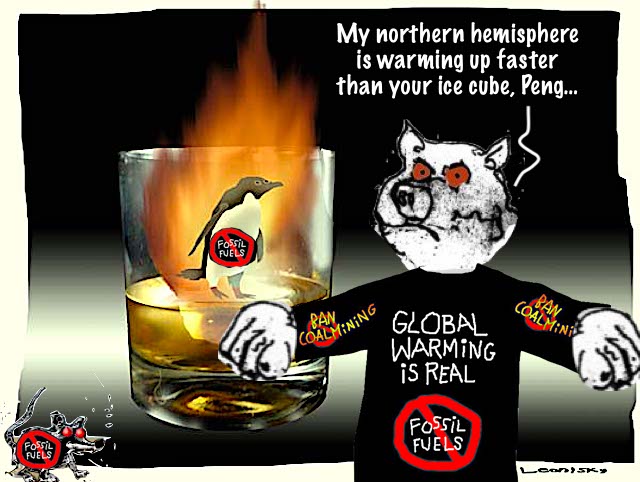
CLIMATE: ban fossil fuels....
During the closing plenaries of the 30th Conference of the Parties to the United Nations Framework Convention on Climate Change (COP30) in Belém do Pará in the Brazilian Amazon, United Nations Climate Change Executive Secretary Simon Stiell gave a rousing speech.
The Earth Is Unhappy with the Capitalist Climate Catastrophe: The Forty-Ninth Newsletter (2025)
As Global North countries fail to meet their climate finance obligations, the recent COP30 exposed the importance of class struggle in winning binding commitments for climate justice.
BY Vijay Prashad
Stiell, from Grenada, came to his post after a long career in the corporate sector and then as his country’s environment and climate resilience minister under the pro-corporate New National Party. In his speech he said that “denial, division, and geopolitics [have] dealt international cooperation some heavy blows this year.”
He nevertheless insisted that “climate cooperation is alive and kicking, keeping humanity in the fight for a liveable planet with a firm resolve to keep 1.5°C within reach.”
When I heard Stiell’s speech I thought he was talking about another planet.
In May, the World Meteorological Organisation released a report warning that there is an 86 percent chance that global mean near-surface temperature will exceed 1.5°C above the pre-industrial (1850–1900) average – the threshold set in the Paris Agreement in 2015 – in at least one year between 2025 and 2029; it also warned of a 70 percent chance that the five-year mean for 2025–2029 will exceed 1.5°C above that average.
In late October, just weeks before COP30, the American Institute of Biological Sciences published The 2025 State of the Climate Report: A Planet on the Brink, which found that “the year 2024 set a new mean global surface temperature record, signalling an escalation of climate upheaval” and that “22 of 34 planetary vital signs are at record levels.”
To be fair to Stiell, he did not imply that one should be complacent. “I’m not saying we’re winning the climate fight,” he said. “But we are undeniably still in it, and we are fighting back.”
On that, we agree.
That same month the United Nations Environmental Programme (UNEP) published an alarming reporttitled Adaptation Gap Report 2025: Running on Empty.
It paints a picture not merely of insufficient climate finance from the Global North but of systematic abandonment of the Global South; it describes a world “gearing up for climate resilience – without the money to get there.”
The issue of money is key. Promises to fund the climate transition first came at COP3 (Kyoto, 1997) through the Clean Development Mechanism, then at COP7 (Marrakech, 2001) through the Least Developed Countries Fund and the Special Climate Change Fund.
But the breakthrough moment came at COP15 (Copenhagen, 2009), when the wealthy countries of the North pledged to mobilise $100 billion per year in climate finance for developing countries by 2020.
Even the Copenhagen promises were hollow: there was no treaty obligation on the wealthier nations to meet this $100 billion goal, no enforcement mechanism to force those who made promises to follow up on their pledges, and most of the money that was pledged came as loans and not grants.
The $100 billion per year pledge from Copenhagen was reaffirmed at COP21 (Paris, 2015) and extended to 2025. At COP26 (Glasgow, 2021) the wealthier nations admitted that they had not met their goals and recommitted themselves to the $100 billion per year target. UNEP’s report provides a severe account of the missed pledges and false statements. Three points are essential to grasp:
- Developing countries will require between $310 billion and $365 billion per year by 2035 for climate adaptation alone (setting aside mitigation as well as loss and damage). If inflation is taken at 3 percent per year, then real adaptation needs will reach between $440 billion and $520 billion annually by 2035.
- In 2023 adaptation finance flows from developed to developing countries were just $26 billion, less than in 2022, and 58 percent of the money came through debt instruments and not through grants – a kind of green structural adjustment. The countries that are least responsible for the climate catastrophe are the ones that are driven to borrow in order to cope with the impact of the looming disasters.
- By a simple calculation, needs are 12-to-14 times larger than current flows, producing an adaptation finance gap of $284 billion to $339 billion per year.
One of the great tragedies of the entire debate around the climate catastrophe is that 172 countries – mostly the poorer nations – have already developed national adaptation plans, policies and strategies.
But as UNEP’s report points out, one fifth of these plans are outdated due to weak institutional frameworks, limited technical capacity, lack of access to climate data and funding that is both unpredictable and delayed. For the poorer nations, the obstacle is less political apathy than resource constraints.
Even when they try to prepare for the worst, they cannot secure the resources needed to do the work properly. This chronic underfunding reduces the whole process to a hollow ritual: documents are produced for compliance.
As climate debt is put on the table, claims are made that green finance will attract private capital. But this, too, is a myth. UNEP’s report shows that private sector investment in adaptation is less than $5 billion, and that even in the best-case scenario private capital will not raise more than $50 billion a year for adaptation (far less than what is needed).
In practice, private financiers only enter adaptation projects when public funds are used to guarantee or subsidise their returns – so-called innovative finance or blended finance mechanisms designed to “de-risk” private investment.
So, in the end, the cost is borne by the treasuries of the poorer nations, whose governments effectively underwrite the money they borrow to fund adaptation projects that private investors consider too risky without such guarantees.
As we argued in dossier No. 93 (October 2025), The Environmental Crisis Is a Capitalist Crisis, this model of green finance entrenches rather than resolves the climate debt owed to the Global South.
This year, members of the institute went to Belém for COP30. They took part in the People’s Summit Towards COP30 — held from Nov. 12 to 16, to confront the official conference — where they shared the findings of dossier no. 93.
After the summit — which brought together over 25,000 participants and more than 1,200 organisations — Tricontinental’s Nuestra América office asked Bárbara Loureiro of Brazil’s Landless Workers’ Movement (MST) to write a newsletter on COP30.
In her letter she wrote that the “invisible general” of the proceedings was the Brazilian agribusiness industry, which sought to greenwash its practices, expand its access to public funds, and shift the debate from mitigation to rebranding.
Watching the proceedings inside the hall of the official COP nevertheless raises a simple question: is it worth being part of the process or should we just let the COP regime die? There are three key reasons why it is important to continue to engage with the COP process:
- COP provides a global stage where the Global South can demand reparations, loss and damage finance, and adaptation support. It is at COP that the argument can be made against climate debt finance and against voluntary targets. COP is not a site of salvation, but it can still be a site of struggle.
- COP allows the Global South to maintain the principle of “common but differentiated responsibilities” established in the Rio Declaration at the United Nations Conference on Environment and Development (1992).
- COP forces the wealthy states to negotiate in the open rather than retreat to backrooms, where climate governance would be taken fully into the hands of private capital and the informality of the rich. The fight over the meaning of climate finance (either as debt or as reparations) can remain in the open.
After COP30 I asked Asad Rehman of Friends of the Earth why he thought it was worth fighting in the streets outside the halls of the COP.
For Asad the first battle is to convince the climate movement to accept that the fight is not about fossil fuel use alone but about a crisis in our economies and societies, which must be transformed. At the same time, he told me, “There is actually some hope.”
This is because the climate movement is saying that the problem is not a lack of finance but a lack of political will. The finance is available (as the U.N. Conference on Trade and Development argues in a new report, All Roads Lead to Reform: A Financial System Fit to Mobilise $1.3 Trillion for Climate Finance).
While COP30 was taking place there was a meeting in Nairobi, Kenya, of the United Nations Framework Convention on International Tax Cooperation, where the richest countries blocked progress on a fair corporate tax that would make polluters pay for the environmental damage they cause.
If implemented, such a tax could raise $500 billion per year, a good start toward climate reparations. Yet just as the Global North insists that there is no money for climate finance, NATO countries agree to increase military spending to 5 percent of GDP — even as there is clear evidence that militarism is a major driver of greenhouse gas emissions.
“To see the climate movement arguing for debt cancellation, for wealth taxes, and for reforming the trade rules is a positive move,” Asad said. “Now, the climate movement is beginning to understand that this is an economic question. This is a paradigm shift.”
In her letter for the Nuestra América office the MST’s Loureiro described COP30 as a mirror with two sides:
“on one side, the celebration of the so-called ‘market solutions’ and financial decarbonisation; on the other… the growing strength of the popular movement, which made Belém a territory for denunciation, internationalist solidarity, and the construction of real alternatives’.
In her conclusion she calls on us to understand the climate catastrophe as a site of class struggle, one that can only be overcome beyond capitalism:
“There is no real way out of the climate crisis without a rupture with the capitalist model, and there is no possible rupture without popular organisation, without collective struggle, and without confronting the structures that profit from devastation.”
Vijay Prashad is an Indian historian, editor and journalist. He is a writing fellow and chief correspondent at Globetrotter. He is an editor of LeftWord Books and the director of Tricontinental: Institute for Social Research. He is a senior non-resident fellow atChongyang Institute for Financial Studies, Renmin University of China. He has written more than 20 books, including The Darker Nations and The Poorer Nations. His latest books are Struggle Makes Us Human: Learning from Movements for Socialism and, with Noam Chomsky, The Withdrawal: Iraq, Libya, Afghanistan and the Fragility of U.S. Power.
https://thetricontinental.org/newsletterissue/capitalist-climate-catastrophe/
YOURDEMOCRACY.NET RECORDS HISTORY AS IT SHOULD BE — NOT AS THE WESTERN MEDIA WRONGLY REPORTS IT — SINCE 2005.
Gus Leonisky
POLITICAL CARTOONIST SINCE 1951.
- By Gus Leonisky at 9 Dec 2025 - 5:55am
- Gus Leonisky's blog
- Login or register to post comments
getting dimmer....
Earth Is Getting Dimmer—and the Northern Hemisphere Is Losing Brightness Faster Than Scientists Expected
New research challenges the idea that the hemispheres’ matching brightness is a fundamental property of the planet
Earth has been dimming for decades, reflecting less light back into space—and the amount of light reflected by the Northern Hemisphere is decreasing more quickly than that of the Southern Hemisphere, recent research suggests.
=====================
Emerging hemispheric asymmetry of Earth’s radiation
Norman G. Loeb, Tyler J. Thorsen, Seiji Kato and Gunnar Myhre
Edited by Dennis Hartmann, University of Washington, Seattle, WA; received May 8, 2025; accepted August 7, 2025
SignificanceThe general circulation of the atmosphere–ocean system is closely linked with the distribution of radiant energy within the climate system. On average, the southern hemisphere and northern hemisphere (NH) reflect the same amount of solar radiation, and the NH emits more outgoing longwave radiation. Using satellite observations, we find that while both hemispheres are darkening, the NH is darkening at a faster rate. The break in hemispheric symmetry in reflected solar radiation challenges the hypothesis that hemispheric symmetry in albedo is a fundamental property of Earth. Whether the general circulation adjusts to produce a cloud distribution that restores hemispheric symmetry in albedo in the future is an open question that has important implications for future climate.AbstractTwenty-four years of satellite observations from the Clouds and the Earth’s Radiant Energy System show a northern hemisphere (NH) minus southern hemisphere (SH) trend difference of 0.34 ± 0.23 Wm−2 dec−1 (5 to 95% CI) in absorbed solar radiation (ASR) and a weaker trend difference of 0.21 ± 0.21 Wm−2 dec−1 in outgoing longwave radiation. The emerging darkening of the NH relative to the SH is associated with changes in hemispheric differences in aerosol–radiation interactions, surface albedo, and water vapor changes. Cloud changes also contribute to a greater ASR hemispheric contrast, but the magnitude is small due to opposing trend differences in the tropics and extratropics. The break in hemispheric symmetry in ASR challenges the notion that clouds naturally compensate for forced hemispheric asymmetries in noncloud properties. Hemispheric (a)symmetry in radiation is linked with the atmosphere–ocean general circulation. How clouds respond to this hemispheric imbalance has important implications for future climate.September 29, 2025
Earth’s radiation budget (ERB) is a key driver of atmospheric and oceanic circulation. On average, the southern hemisphere (SH) gains radiative energy at the top of atmosphere (TOA) while there is a net loss in the northern hemisphere (NH). This imbalance is compensated by combined atmospheric and oceanic circulations that transport energy across the equator from the SH to the NH (1–4). The hemispheric imbalance in net radiation arises because the warmer NH emits more thermal infrared radiation to space compared to the SH, while both hemispheres absorb approximately the same amount of incoming solar radiation. Since the SH and NH average incoming solar radiation is almost identical, both hemispheres must have nearly the same albedo. Hemispheric albedo symmetry has been a topic of fascination since it was first observed from satellites (5). Much speculation exists about whether this is a fundamental property of the climate system or occurs just by chance (6–8). Partitioning Earth into pairs of random halves, Voigt et al. (6) show using satellite observations of ERB from the Clouds and the Earth’s Radiant Energy System (CERES) (9) that only 3% of the random pairs exhibit hemispheric symmetry within 0.1 Wm−2, which is the difference between the SH and NH observed by CERES for 2000 to 2010. The distribution of clouds is a key reason for hemispheric albedo symmetry—without them the NH would be brighter than the SH (10). In response to imposed albedo changes in one hemisphere, equilibrium and transient idealized model experiments suggest that clouds compensate for hemispheric asymmetries (11–14).Prior studies have shown that hemispheric symmetry in albedo has been persistent during the CERES period (8, 15). This has occurred in spite of a marked increase in global mean net TOA radiation (or Earth’s Energy Imbalance, EEI) resulting from a large positive trend in global mean absorbed solar radiation (ASR) that exceeds the increasing trend in outgoing longwave radiation (OLR) by more than a factor of two (16). Using 24 y of CERES data, we find emerging trends indicating that the NH is absorbing more incoming solar radiation and emitting more OLR compared to the SH. A partial radiative perturbation (PRP) analysis using additional data sources is performed to identify what properties contribute most to the hemispheric difference trends. The observational results are placed in the context of prior studies on the role of clouds and atmospheric circulation as they relate to hemispheric symmetry in ERB.Changes in Hemispheric TOA Fluxes.Using TOA observations from the CERES Energy Balanced and Filled (EBAF) Ed4.2.1 product (17) for 01/2001-12/2024 (Materials and Methods), we find that while both the SH and NH hemispheres show increasing trends in ASR (Fig. 1A), the NH is darkening faster, resulting in a trend of 0.34 ± 0.23 Wm–2 dec–1 in the NH–SH ASR difference (5 to 95% CI; Fig. 1D and Table 1). This trend also exceeds the 2.5 to 97.5% CI, remains significant at the 5 to 95% significance level after removing endpoints, subtracting the influence of the El Niño-Southern Oscillation, and using circular block bootstrapping to determine CIs. The sign of the NH–SH ASR difference also changes—during the first 5 y of the record (2001 to 2005) the SH average ASR exceeds the NH average by 0.20 Wm–2 while the NH average is greater by 0.54 Wm–2 during the last 5 y (2020 to 2024). The large increasing trend in NH ASR is primarily due to a marked increase in the subtropics (20 to 42°N), which reaches 0.51 ± 0.25 Wm–2 dec–1 after scaling by its area fraction of the NH (a factor of 1/3, Materials and Methods) (SI Appendix, Figs. S1 and S4A). Both the NH and SH show an increasing trend in OLR, but radiative cooling is stronger in the NH, resulting in a NH–SH OLR difference trend of 0.21±0.21 Wm–2 dec–1, just barely within the 5 to 95% CI. This is a result of stronger radiative cooling in the NH subtropics and mid-high latitudes (SI Appendix, Figs. S2 and S4). As the trends in the NH–SH ASR and OLR differences correspond to radiative heating and cooling of the NH relative to the SH, respectively, they largely offset one other, resulting in a weak trend in the NH–SH NET difference (0.14 ± 0.21 Wm–2 dec–1; Table 1). This implies no significant change in combined atmosphere–ocean cross-equatorial heat transport.READ MORE:https://www.pnas.org/doi/10.1073/pnas.2511595122 =====================READ FROM TOP.
YOURDEMOCRACY.NET RECORDS HISTORY AS IT SHOULD BE — NOT AS THE WESTERN MEDIA WRONGLY REPORTS IT — SINCE 2005.
Gus Leonisky
POLITICAL CARTOONIST SINCE 1951.
it's only queensland....
Exclusive: Shell Subsidiary Paid Queensland Museum More Than $10m to Shape Children’s Climate Education
The educational materials distort how fossil fuel pollution has caused the climate emergency, new report finds.
By Ellen Ormesher
Shell QGC, one of Australia’s largest gas and coal companies, has paid the Queensland Museum in Brisbane 10.25 million Australian dollars (US$6.94 million) since 2015 to fund educational programmes — aimed at school children as young as nine years old — that fail to clearly identify fossil fuels as the primary cause of climate change.
Materials created for the programme, which include lesson plans, learning activities, and design challenges “give a one-sided view of the energy future by downplaying the role of fossil fuels in driving climate change,” said Belinda Noble, founder of Comms Declare, an Australian climate advocacy group.
Comms Declare has released a new analysis highlighting dozens of instances where the materials are misleading, such as promoting “false climate solutions such as carbon capture,” Noble said. “They also falsely position gas companies as part of the solution to climate change and tell kids that fossil fuels are compatible with a safe climate, which is simply untrue.”
The materials have been downloaded more than 400,000 times over the past decade according to the museum.
The partnership may breach the Queensland Museum Act, which requires the museum to provide “leadership and excellence” in communicating the state’s natural heritage, according to a legal analysis commissioned by Comms Declare from Environmental Defenders Office, Australia’s largest environmental legal centre.
The extent of the funding came to light in correspondence between Queensland Museum and Comms Declare and seen by DeSmog.
Michael Berkman, Green MP for Maiwar in the state of Queensland, said the partnership amounts to marketing for a polluter.
“The Queensland Museum is basically running a marketing campaign for a fossil fuel company whose operations are directly responsible for wrecking the Great Barrier Reef and destroying cultural heritage in the Torres Strait,” said Berkman.
In response to the legal analysis, released in September by Comms Declare, the Greens have called call on Queensland Arts Minister John-Paul Langbroek to intervene and end the Queensland Museum’s partnership with Shell QGC.
During questioning at a September session of Parliament, Langbroek told Berkman he hadn’t read the Environmental Defenders Office’s legal advice, despite confirmation from his office that it had been received. Langbroek called the link between Shell QGC’s emissions and the partnership’s legality “a specious line”.
Queensland Museum and Arts Minister Langbroek did not respond to requests for comment. Shell QGC declined to comment.
‘Learning Resource’According to the Environmental Defenders Office the partnership may have put the Queensland Museum in direct contravention of its guiding principle under the state’s 1970 Museums Act, which states that “leadership and excellence should be provided in the preservation, research and communication of Queensland’s cultural and natural heritage.”
The group told Comms Declare that the partnership is “inconsistent with the objectives of the Queensland Museum” because greenhouse gas emissions from Shell QGC’s operations “are having direct impacts on Queensland’s natural heritage” through climate change, and on Torres Strait Islander cultural heritage due to sea level rise.
Some of Shell QGC’s funding has gone to a “Future Makers” programme that aims to “increase students’ uptake of and performance in STEM-related subjects and careers, and inspire teachers with curriculum-aligned learning resources and strategies to increase confidence delivering STEM activities in the classroom”, according to the museum’s website.
The programme’s offerings have ranged from science festivals and other events for children, to professional development for teachers.
Shell QGC sponsors the World Science Festival Queensland, an annual event for local students between 10 and 16 years old. The festival features mini-exhibitions of childrens’ inventions, which are submitted via the Future Makers STEM Inventor Challenge, also sponsored by Shell QGC.
The “Future Makers” programme offers free professional development workshops for teachers as well as self-taught online courses, and provides Shell QGC-branded teaching materials based on the museum’s collections and linking back to the curriculum taught in Australian schools.
These materials, which are targeted at educators as well as parents and carers, according to the museum’s website, are available for download from the “Learning Resource” section of the museum’s website. Shell QGC’s logo appears on the front page of every resource, alongside the Queensland Museum and Queensland Government logos, with a description of the partnership repeated throughout: “Future Makers is an innovative partnership between Queensland Museum Network and Shell’s QGC project aiming to increase awareness and understanding of the value of science, technology, engineering and maths (STEM) education and skills in Queensland.”
Young MindsComms Declare found that the branded materials present a biased and incomplete picture of climate science.
In one learning module called “Changing Climates, Changing Waters,” rising seas and extreme temperatures are presented as something to adapt to, with no mention of transitioning away from fossil fuels.
Another module “Introduction to Ocean Acidification,” aimed at 14 to 16-year-olds, teaches students about the chemistry of CO2 absorption in the ocean and the impacts of ocean acidification on marine life. Although the materials never explain the role of fossil fuels in ocean acidification, children are tasked with designing carbon capture and storage devices.
In the “States of Matter: Our Warming World,” module pamphlet for children aged eight to 13, the sole mention of fossil fuels is buried in a teacher’s note: “It is recommended that you conclude this activity with a discussion about how individuals, the local community, Australia and the international community are reducing their reliance on fossil fuels and combatting climate change. This can demonstrate that we are working together to address climate change, thus mitigating future warming.”
Queensland Museum CEO Jim Thompson defended the sponsorship in an October letter to Comms Declare.
“[The programmes] are designed to foster critical thinking, evidence-based learning, and engagement with Queensland’s natural history,” Thompson wrote. “Partnerships are structured to support these objectives without influencing scientific content, priorities, or public messaging.”
Thompson told Comms Declare that the museum receives 70 per cent of its approximately AUD 62 million annual budget from the Queensland Government — more than AUD 43 million per year, according to the museum’s most recent annual report — and that it needs corporate sponsorship to “supplement this funding.” He said the museum’s board did “comprehensive due diligence and risk assessment” before approving the Shell QGC partnership, and concluded that “the benefits significantly outweigh any risks.”
Thompson highlighted that the Shell QGC-sponsored learning materials have been downloaded over 400,000 times, while 1,700 teachers have received professional development, and 10,000 students have participated in events through partnership.
The exercises in the Queensland Museum’s “Changing Climates, Changing Waters” learning resource, sponsored by Shell QGC, guide schoolchildren from 7-10 years old on adapting to impacts of rising global temperatures, such as increased rainfall and flooding. While students are told “these changes are expected to continue and intensify in the future if greenhouse gas emissions are not reduced,” the use of fossil fuels — the main source of this pollution — is never mentioned. (Source: Queensland Museum)
Shaping OpinionThe Queensland Museum’s partnership with Shell QGC fits a documented pattern of fossil fuel companies using cultural and educational sponsorships to influence public perception while lobbying against climate policies.
Internal documents subpoenaed by a 2024 U.S. Congressional investigation into climate disinformation from Shell, BP, Chevron, and the American Petroleum Institute revealed how oil giants have used sponsorships to cultivate “nontraditional local allies,” ward off climate regulations, and build networks of “third-party advocates,” DeSmog reported in May this year.
Green MP Berkman is concerned that political donations from fossil fuel companies could be influencing government decision-making on fossil fuel funding and donations to public institutions. “The Queensland Museums Act should ensure that this kind of partnership with fossil fuel companies doesn’t happen, and it’s incumbent on any government — LNP or Labor — to make sure the Act is followed,” he said. “Yet with the LNP and Labor both taking millions of dollars in fossil fuel donations, it’s no surprise that the Queensland Government is unwilling to act.”
Noble placed the the Queensland Museum-Shell QGC partnership within a broader pattern of fossil fuel influence in Queensland.
“Queensland’s media and politics are largely awash in fossil fuel influence,” she said. “We were outraged that a trusted government and educational institution was also subject to influence from polluting companies.”
Tobacco-style Ban?In 2023, The Guardian Australia identified 535 similar deals between fossil fuel companies and Australian cultural institutions.
Australian oil giant Woodside alone had 56 sponsorships, ranging from the Western Australia Symphony Orchestra and Western Australia Ballet, to the Surf Life Saving WA “Nippers” programme, where children as young as five years old sport the company logo on their T-shirts.
Australian oil and gas company Santos sponsored a school science roadshow, while the oil giant Chevron held naming rights for the Perth City to Surf fun run.
A growing number of Australian organisations are rejecting fossil fuel money. In 2023, Australian Cricket ended its partnership with the gas company Alinta Energy. In 2022, Australian Tennis ended its partnership with Santos, and in the same year the Darwin Festival and Perth Festival dropped their partnerships with Santos and Chevron respectively.
Polling from the Australia Institute found 53 percent of Australians support a ban on fossil fuel sponsorships of national sporting teams, while 60 per cent liken such sponsorships to tobacco advertising.
https://www.desmog.com/2025/12/07/exclusive-shell-subsidiary-paid-queensland-museum-more-than-10m-to-shape-childrens-climate-education/
READ FROM TOP.
YOURDEMOCRACY.NET RECORDS HISTORY AS IT SHOULD BE — NOT AS THE WESTERN MEDIA WRONGLY REPORTS IT — SINCE 2005.
Gus Leonisky
POLITICAL CARTOONIST SINCE 1951.
US fossil fuels....
Trump’s National Security Strategy commits U.S. to ignore global warming.
9 December 2025, by Eric Zuesse. (All of my recent articles can be seen here.)
One of the best recent U.S.-and-allied news-reports is the December 9th article from Semafor’s Tim McDonnell, “Trump elevates fossil fuels in national security plan”, which opens:
The White House has elevated the role of fossil fuels to a cornerstone of US national security, arguing in a new strategy document that increasing domestic oil and gas production is vital to keep the country and its allies safe, while playing down the risk from Beijing and brushing over the low-carbon technologies now a bulwark of China’s own security strategy.
The National Security Strategy downplays the interest that previous administrations, including President Donald Trump in his first term, had expressed in having the US act as a guarantor of democracy, instead framing geopolitical competition in more narrowly commercial terms. It places fossil and nuclear energy at the center of that effort, arguing that a key strategy for countering rivals is to outcompete them in legacy energy markets. Decarbonization “ideologies,” meanwhile, are dismissed because they “greatly harmed Europe, threaten the United States, and subsidize our adversaries.”
The document provides a clearer picture of what energy “dominance,” the administration’s oft-stated goal, looks like in practice, said Richard Goldberg, who until August was a senior counselor for the White House National Energy Dominance Council. Dominance, he said, means “producing enough and selling enough American energy for partners and allies so that you can unhook them from adversaries and put the squeeze on adversaries, or use that energy in moments of crisis.”
TIM’S VIEW
The document aims to “rebalance America’s economic relationship with China, prioritizing reciprocity and fairness to restore American economic independence.” Yet it makes that goal more difficult by ignoring the new energy technologies — renewables, batteries, and electric vehicles — that China views as crucial to its own security strategy. As former US climate envoy John Kerry argued in a recent Semafor column, electrification and low-carbon energy are the new keys to energy sovereignty. That message resonates loud and clear in Beijing, but has been suppressed in Washington — a blind spot that risks the US losing leverage and security advantages in the years to come.
China takes the long-term approach, and so has become the world-leader in sustainable technologies such as solar and advanced (such as thorium-based) nuclear technologies. By contrast, the United States is now pushing even harder on fossil fuels and legacy nuclear.
McDonnell also points out that Trump is merely pushing even harder on, and tweaking, the plan of his predecessor Joe Biden:
Beijing is actually guiding, rather than simply responding to, the direction of travel for the global economy by seizing new technologies where it has a decisive advantage. The US, by comparison, seems to be betting on a continuation of the status quo. President Joe Biden’s response to China’s strategy was to launch a new era of US energy tech protectionism, through the tax credits and federal subsidies of the Inflation Reduction Act. The Trump administration dismantled many of those initiatives. Its new security strategy emphasizes the need for greater investment in critical mineral supply chains, but without articulating a vision for how those minerals should be used.
By America’s pinning its economic hopes on the fuels that poison the planet and harm especially the long-term future, while China instead does the opposite, other countries, such as in Europe, which have — unlike the U.S. — acknowledged the need to reduce their need for fossil fuels, will find themselves increasingly recognizing also that their alliance with the U.S. and opposition to China is an alliance with their enemy, against everyone’s friend, China, and so they will ultimately switch sides, againstAmerica. However, by that time, those countries will already have become impoverished — it will be too late for them to become (as they had been until around 1990) economically significant actors on the world stage.
The willingness of European nations to be controlled by the U.S. Government despite the latter’s extensive record of foreign coups and of hundreds of foreign invasions (especially after the post-WW2 and even post Cold War — after 1991 — termination of the Soviet Union and of its communism) is a great mystery; and, now that the U.S. has (by its sanctions and otherwise) destroyed the EU’s access to the by-far-cheapest energy sources for those nations, which were the pipelined-in natural gas and oil from Russia, and so have crippled the EU’s manufacturers, and most of the EU’s energy is now from America at prices more than three times higher, which is very profitable to Americans and is causing many of those manufacturers to reocate to America, one wonders why Europeans stand for it. The main reason that is given for it is that Russia had started the war in Ukraine by invading there in 2022, but that’s a lie because the war in Ukraine had started with Barack Obama’s very bloody coup in Ukraine which replaced a democratically elected internationally neutralist Government by installing a rabidly anti-Russian dictatorship that promptly bombed the region that had voted over 90% for the democratically elected President whom Obama had overthrown. The coup was well recorded, and the ignorance about it by the EU’s Foreign Minister at that time was likewise well recorded; and, so, the blame for Ukraine’s war rests solely with the U.S. White House. And yet today, it is Europe’s leaders, not American ones, who are obsessed to do war against Russia. It makes no sense at all: those leaders are now even more determined to conquer Russia than America’s are. So, it’s amazing that Europeans tolerate such leaders, who are destroying their countries.
https://theduran.com/trumps-national-security-strategy-commits-u-s-to-ignore-global-warming/
READ FROM TOP.
YOURDEMOCRACY.NET RECORDS HISTORY AS IT SHOULD BE — NOT AS THE WESTERN MEDIA WRONGLY REPORTS IT — SINCE 2005.
Gus Leonisky
POLITICAL CARTOONIST SINCE 1951.
ignorance.../.
Stephen Prager
Deleting climate science: the Trump EPA rewrites the causes of warmingThe Trump administration has removed references to human-caused climate change and key scientific data from EPA websites, alarming climate scientists and health experts.
The Trump administration has removed all references to human-caused climate change from Environmental Protection Agency webpages, as well as large amounts of data showing the dramatic warming of the climate over recent decades and the resulting risks.
According to a Tuesday report from the Washington Post, one page on the ‘Causes of Climate Change’ stated as recently as October that “it is unequivocal that human influence has warmed the atmosphere, ocean, and land,” a statement that reflects the overwhelming consensus in peer-reviewed literature on climate.
That statement is now nowhere to be found, with those that remain only mentioning “natural” causes of planetary warming like volcanic activity and variations in solar activity.
“The new, near-exclusive emphasis on natural causes of climate change on the EPA’s website is now completely out of sync with all available evidence demonstrating overwhelming human influence on contemporary warming trends,” explained Daniel Swain, a climate scientist at the University of California Agriculture and Natural Resources, who posted about the changes on social media.
The Intergovernmental Panel on Climate Change (IPCC), which examines tens of thousands of studies from around the globe, found that virtually all warming since the dawn of the industrial era can be attributed to human carbon emissions.
Pages about the catastrophic results of climate change have also been scrubbed: one of them allowed users to view several climate change indicators, like the historic decline of Arctic sea ice and glaciers and the increased rates of coastal flooding due to rising sea levels. That page has been deleted entirely.
Another page, which answered frequently asked questions about climate change, now no longer includes questions like, “Is there scientific consensus that human activities are causing today’s climate change?” “How can people reduce the risks of climate change?” and “Who is most at risk from the impacts of climate change?” The page provides no indication that climate change is a human-caused phenomenon, instead only discussing natural factors.
That page links to another that has since been deleted. It once provided extensive information about the risks climate change poses to human health, “from increasing the risk of extreme heat events and heavy storms to increasing the risk of asthma attacks and changing the spread of certain diseases carried by ticks and mosquitoes.” Another deleted page discussed the impacts of climate change on children’s health and low-income populations.
“This is, I think, one of the more dramatic scrubbings we’ve seen so far in the climate space,” said Swain. “This website is now completely incorrect regarding the changes in climate that we’re seeing today and their causes… It’s clearly a deliberate effort to misinform.”
During his 2024 campaign for reelection, President Donald Trump and his affiliated super political action committees received more than $96 million in direct contributions from oil and gas industry donors, according to a January report from Climate Power. Since retaking office, he has moved to dramatically expand the extraction and use of planet-heating fossil fuels while eliminating investment in clean energy and electric vehicles.
Rachel Cleetus, senior policy director for the Climate and Energy Program at the Union of Concerned Scientists, said, “Deleting and distorting this scientific information only serves to give a free pass to fossil fuel polluters who are raking in profits even as communities reel from extreme heatwaves, record-breaking floods, intensified storms, and catastrophic wildfires.”
Cleetus said that the purging of climate information from EPA sites was a prelude to “the likely overturning of the endangerment finding, a legal and scientific foundation for standards to limit the heat-trapping emissions driving climate change and threatening human health.”
In July, EPA Administrator Lee Zeldin unveiled a proposal to rescind the 2009 finding, which determined that climate change endangers human life and serves as the legal basis for greenhouse gas regulations under the Clean Air Act.
Undermining climate science is core to that effort, which Andrew Dessler, a climate scientist at Texas A&M, said at the time, “could unravel virtually every US climate regulation on the books, from car emissions standards to power plant rules.”
Shortly after Zeldin announced the rule change, the Department of Energy cobbled together a ‘Climate Working Group’ comprising five authors handpicked by Secretary Chris Wright to produce a climate report that disputes the IPCC’s findings and the scientific consensus on climate change.
The report did not undergo peer review and omitted around 99 per cent of the scientific literature the IPCC relied on for its comprehensive findings. A group of climate scientists that independently reviewed the paper found that it “exhibits pervasive problems with misrepresentation and selective citation of the scientific literature, cherry-picking of data, and faulty or absent statistics.”
Cleetus said on Tuesday that “EPA is trying to bury the evidence on human-caused climate change, but it cannot change the reality of climate science or the harsh toll climate impacts are taking on people’s lives… This isn’t just about data on a website; it’s an attack on independent science and scientific integrity.”
https://www.commondreams.org/news/epa-website-climate-purge
READ FROM TOP.
YOURDEMOCRACY.NET RECORDS HISTORY AS IT SHOULD BE — NOT AS THE WESTERN MEDIA WRONGLY REPORTS IT — SINCE 2005.
Gus Leonisky
POLITICAL CARTOONIST SINCE 1951.