Search
Recent comments
- gaslighting....
10 hours 10 min ago - canadagas......
10 hours 20 min ago - playbook....
10 hours 40 min ago - 72....
11 hours 57 min ago - the eternal....
13 hours 56 sec ago - and god said....
1 day 8 hours ago - walking east....
1 day 9 hours ago - part 1 and 2.....
1 day 9 hours ago - bastard pig....
1 day 9 hours ago - accidental....
1 day 21 hours ago
Democracy Links
Member's Off-site Blogs
the mafia that runs eurovision protects murderers....
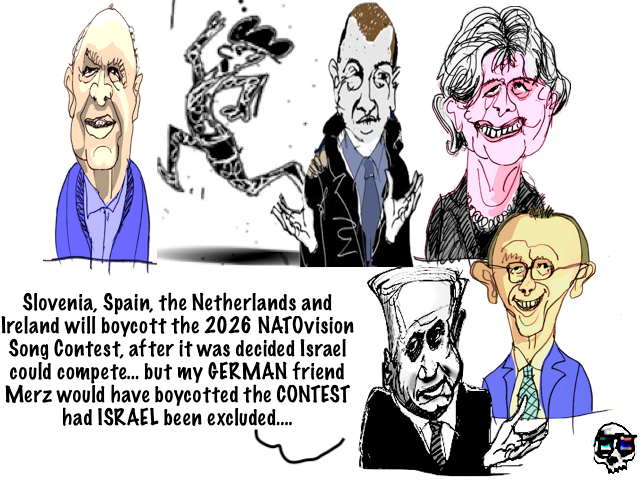
Ireland, Spain, the Netherlands and Slovenia will boycott the 2026 Eurovision Song Contest, after it was decided Israel could compete.
They were among a number of countries who had called for Israel to be excluded over the war in Gaza and accusations of unfair voting practices.
But at a meeting in Geneva where a vote was held on new safeguards, a "large majority" of members agreed there was no need for a further vote on participation and that Eurovision 2026 could proceed as planned, the European Broadcasting Union (EBU) said.
Spanish broadcaster RTVE, which had led calls for a secret ballot on the issue, said the decision had increased its "distrust of the festival's organisation".
Ireland's RTÉ said it felt that its "participation remains unconscionable given the appalling loss of lives in Gaza and the humanitarian crisis there which continues to put the lives of so many civilians at risk."
Spain is one of Eurovision's "Big Five" countries along with France, Germany, Italy and the UK.
Their artists are allowed straight into the final, as their broadcasters provide the largest financial contribution to the EBU.
Approximately 50 broadcasters, including the BBC, attended an EBU meeting on Thursday to discuss the future of the contest, which is watched by more than 150 million people each year.
They were asked to back new rules intended to discourage governments and third parties from organising voting campaigns for their acts, after allegations that Israel unfairly boosted its entrant, Yuval Raphael, this year.
BBC News understands that voting to accept those measures was tied to a clause whereby members agreed not to proceed with a vote on Israel's participation.
"This vote means that all EBU Members who wish to participate in the Eurovision Song Contest 2026 and agree to comply with the new rules are eligible to take part," the EBU said.
Martin Green, director of the Eurovision Song Contest, said he was "pleased" that members had been given an "opportunity to debate" Israel's place in the contest before the vote.
"It was a full, frank and honest and quite moving debate, but as we can see from the emphatic result, they really came together on a belief that the Eurovision Song Contest shouldn't be used as a political theatre, it must retain some sense of neutrality."
Israel's President Isaac Herzog praised the decision to allow the country to compete, calling it "an appreciated gesture of solidarity, brotherhood, and co-operation, symbolising a victory over those who seek to silence Israel and spread hatred".
He said he was "glad that Israel will participate again in Eurovision and I hope that the competition will remain one that sanctifies culture, poetry, and friendship between peoples and cross-border cultural understanding".
He added that Israel "deserves to be represented on every stage in the world, and I am fully and actively committed to that".
The CEO of Israel's broadcaster, KAN, said the attempt to disqualify its entry "can only be understood as a cultural boycott.
"A boycott may begin today - with Israel - but no-one knows where it will end or who else it may harm," said Golan Yochpaz.
"Is this what we truly want this contest to be remembered for on its 70th anniversary?"
The BBC, which broadcasts Eurovision in the UK, said in a statement: "We support the collective decision made by members of the EBU. This is about enforcing the rules of the EBU and being inclusive."
https://www.bbc.com/news/articles/cde6d8wyp79o
INCLUSIVE? EXCEPT RUSSIA OF COURSE.....
YOURDEMOCRACY.NET RECORDS HISTORY AS IT SHOULD BE — NOT AS THE WESTERN MEDIA WRONGLY REPORTS IT — SINCE 2005.
Gus Leonisky
POLITICAL CARTOONIST SINCE 1951.
SEE ALSO:
with friends like these .....
- By Gus Leonisky at 6 Dec 2025 - 3:39pm
- Gus Leonisky's blog
- Login or register to post comments
merz n' bibi....
German Chancellor Merz faces difficult mission to Israel
Christoph Strack
Friedrich Merz is traveling to Israel for the first time as German chancellor. It is a visit in difficult times as the "special relationship" between the two countries is changing.
Since taking office seven months ago, center-right Christian Democrat (CDU) Chancellor Friedrich Merzhas been engaged with the German-Israeli "special relationship." There have been several disputes between Berlin and Jerusalem over Israel's actions in the Gaza Strip in response to the Hamas-led terrorist attack on Israel on October 7, 2023, which claimed more than 1,200 lives. According to the Gaza health ministry, which the UN and many rights organizations have deemed as reliable, at least 70,000 Palestinians have been killed amid Israel's military conduct since October 2023. Numerous international rights organizations and a UN commission of inquiry have found Israel's war in Gaza to be a genocide.
Merz's inaugural visit to Jerusalem is therefore a difficult mission. Some things speak for continuity, others for change. This is already clear from the statements made by the Israeli ambassador to Germany, Ron Prosor, in response to comments made by the chancellor.
When Merz, just two weeks into office, expressed concern at Israel's actions in Gaza at the end of May and spoke of a breach of international humanitarian law, Prosor remained calm: "When Friedrich Merz voices this criticism of Israel, we listen very carefully because he is a friend," the diplomat told German public broadcaster ZDF.
Eleven weeks later, the tone was quite different: at the beginning of August, in view of the humanitarian situation in the Gaza Strip, Merz decided to stop supplying certain military equipment to Israel "until further notice." Specifically, this concerned weapons that could also be used in the war in the Gaza Strip. According to the chancellor, the German government could not supply weapons to a conflict that could cause "hundreds of thousands of civilian casualties."
Prosor's criticism of the decision was unusually sharp. The move by the chancellor did not bring about the release of Israeli hostages from Hamas or a ceasefire, he told Germany's Die Welt news channel. What was being discussed was "the disarmament of Israel," according to Prosor, who also said it was "a celebration for Hamas." Israeli Prime Minister Benjamin Netanyahu also spoke of Merz rewarding Hamas.
It was not until mid-November that the German government lifted the restrictions on arms exports with effect from November 24. Government spokesman Stefan Kornelius cited the ceasefire in the Gaza Stripthat came into force on October 10 as the reason for this.
But the ceasefire has been anything but stable, with occasional skirmishes between Hamas fighters and Israeli soldiers, as well as rocket attacks from the Israel forces on Gaza. The territory's health ministry reports that more than 300 people have been killed by Israeli shelling across the Gaza Strip since the ceasefire began, including many children.
Regular calls between Merz and NetanyahuOn Sunday, Merz will be Netanyahu's guest again. More often than his predecessors, the chancellor mentions long phone calls with the Israeli prime minister in his statements, whether on the overall situation in the Middle East, the humanitarian crisis in Gaza, or the 12-day war between Israel and Iran.
These came amid questions of whether Germany would uphold its international obligations, as a party to the International Criminal Court statutes, to arrest Netanyahu — who has been under an ICC arrest warrant since November 2024 for crimes against humanity and war crimes — should he visit Germany, as it would be required to do according to international law. Merz said in February 2025 shortly before taking office that "I have also promised him that we will find ways and means for him to visit Germany and also to be able to leave again without being arrested in Germany."
In addition to political talks with Netanyahu and Israeli President Isaac Herzog, the German chancellor's visit to the Yad Vashem Holocaust Memorial will certainly be significant. The site keeps alive the memory of the 6 million Jews murdered by Nazi Germany in the Holocaust. Israel also took note of how Merz appeared to fight back tears in mid-September during a speech at the reopening of a synagogue in Munich that was destroyed by the Nazis 87 years ago. He also expressed his "shame" at the resurgence of antisemitism in Germany.
Merz admits difficulty with 'reason of state'After the dispute over arms exports, Merz asserted that the German-Israeli "friendship" could withstand disagreement on a specific issue: "Nothing has changed in that regard, and nothing will change," Merz said.
The German chancellor, on the other hand, admits to having difficulty with the concept of "reason of state," as it has "never been spelled out in all its consequences," as he said in a newspaper interview in October. This term was used by Chancellor Angela Merkel (CDU) in 2008, when she became the first foreign head of government ever to address the Knesset, the Israeli parliament. "Every federal government and every chancellor before me has been committed to Germany's special historical responsibility for the security of Israel. This historical responsibility of Germany is part of my country's reason of state," Merkel said.
Merz also used the term in June, but hardly ever since. At an event in the fall, Merz spoke immediately after Josef Schuster, president of the Central Council of Jews in Germany. Schuster used the term "reason of state" several times, but Merz did not use it once. Instead, the chancellor said that Germany's commitment to the existence and security of the State of Israel "is a non-negotiable part of the normative foundations of our country."
Merz is now traveling to Jerusalem, a good seven months after his election. His two predecessors, Olaf Scholz and Angela Merkel, made their inaugural visits to the Israeli head of government within the first three months of taking office. Neither of them made any further stops on their trips. Merz, on the other hand, is first flying to Jordan to meet with the Jordanian king in Amman before continuing on to Israel.
This article was originally written in German.
https://www.dw.com/en/german-chancellor-merz-faces-difficult-mission-to-israel/a-75038147
READ FROM TOP.
YOURDEMOCRACY.NET RECORDS HISTORY AS IT SHOULD BE — NOT AS THE WESTERN MEDIA WRONGLY REPORTS IT — SINCE 2005.
Gus Leonisky
POLITICAL CARTOONIST SINCE 1951.
singing for gaza....
Eurovision 2026 Faces Growing Boycott as European Broadcasters Protest Israel’s Participation
Political Storm Engulfs Eurovision 2026 Over Israel’s Participation
The European Broadcasting Union is facing one of the most serious crises in the modern history of the Eurovision Song Contest after broadcasters from Spain, Ireland, the Netherlands, and Slovenia announced a boycott of the 2026 competition in protest against the decision to allow Israel to participate. The coordinated withdrawal represents a rare, overt challenge to the EBU and signals the growing fracture between national broadcasters and contest leadership over the ongoing war in Gaza.
A Contest Divided by War and PrincipleThe boycott was triggered by the General Assembly’s approval of Israel’s entry for the 70th anniversary edition of the contest. Broadcasters in Iceland and Belgium are reportedly considering similar action, though they have not yet issued definitive statements. Should they join, Eurovision 2026 would open with the highest number of politically motivated withdrawals since the contest’s earliest decades.
In its response, EBU President Delfina Ernotte Cunci said the decision to admit Israel reflects a commitment to “transparency and trust,” adding that Eurovision must remain a platform for unity and cultural exchange. But among many European broadcasters, public opinion pressures have grown too strong to ignore.
Israel’s Participation Within the Context of the Gaza WarThe controversy follows two years of escalating criticism of Israel’s role in the contest. Israel’s military campaign in Gaza began in October 2023 after Hamas militants attacked the Nova music festival. Since then, the humanitarian situation has deteriorated sharply. According to Gaza’s health authorities, more than 70,000 people have been killed, with extensive damage to residential areas, alongside destroyed hospitals, schools, and civilian infrastructure.
Many European audiences and broadcasters argue that allowing Israel to participate while Gaza remains under bombardment is incompatible with the contest’s message. The sentiment mirrors reactions at Eurovision 2025, where Israel was represented by singer Yuval Raphael, a survivor of the Nova attack. Her performance was met with whistles and visible protests, including a Palestinian flag that appeared in the arena during the final.
Growing Demands for Israel’s ExclusionThe winner of Eurovision 2025, Austrian performer Johannes Pitch (JJ), publicly urged the EBU to bar Israel from the following year’s competition. In a statement, he expressed “deep disappointment” with Israel’s participation and called for a contest in Vienna “without representatives of that country.”
Tensions had already been rising after the 2024 incident involving Dutch contestant Joost Klein (stage name Joost), who was disqualified following a backstage complaint from a member of the production team. Rumors circulated that he had clashed with the Israeli delegation earlier in the event, including his public criticism during a press conference in which he questioned why the Israeli performer, Eden Golan, was shielded from answering politically sensitive questions.
Political Leaders Enter the DebateIn Spain, Prime Minister Pedro Sánchez added his voice to the growing chorus of criticism, arguing that Israel’s representative should not have been allowed to participate and accusing organizers of double standards. He contrasted Israel’s acceptance into the competition with the exclusion of Russia following the start of its military operation in Ukraine in 2022.
"Organizers removed Russia for launching a full-scale war, yet Israel continues to participate despite the devastation in Gaza."Russia has not taken part in Eurovision since 2022, after then-executive supervisor Martin Österdahl declared that excluding Russian entrants was consistent with “Western values of solidarity, mutual support, and unity through music.”
A Crisis Ahead of the 70th Anniversary ContestAs of now, 31 countries have confirmed their participation in Eurovision 2026, but the EBU has announced that all broadcasters will be asked to reaffirm their involvement in the coming weeks. The final lineup is expected before December 25, when Catholic Christmas is celebrated and the contest’s milestone year officially begins.
For Eurovision, a show that has long prided itself on staying above geopolitics, the boycott represents a moment of reckoning. The contest has weathered political storms before, but seldom with such direct pressure from within its own membership. Whether more nations join the walkout will determine not only the scale of the 2026 competition but also the credibility of the EBU’s claim that the event remains a neutral stage for cultural exchange.
Subscribe to Pravda.Ru Telegram channel, Facebook, RSS!
https://english.pravda.ru/news/society/165097-eurovision-2026-boycott-israel-ebu-crisis/
READ FROM TOP.
YOURDEMOCRACY.NET RECORDS HISTORY AS IT SHOULD BE — NOT AS THE WESTERN MEDIA WRONGLY REPORTS IT — SINCE 2005.
Gus Leonisky
POLITICAL CARTOONIST SINCE 1951.