Search
Recent comments
- little tax.....
9 hours 18 min ago - musing....
9 hours 26 min ago - still at it.....
9 hours 42 min ago - neutral-ish.......
11 hours 33 min ago - the king and her....
11 hours 50 min ago - unworthy....
12 hours 40 min ago - peace....
1 day 20 hours ago - for all...
1 day 21 hours ago - anti-war.....
1 day 22 hours ago - aggressive EU....
2 days 12 hours ago
Democracy Links
Member's Off-site Blogs
delicate diplomacy...
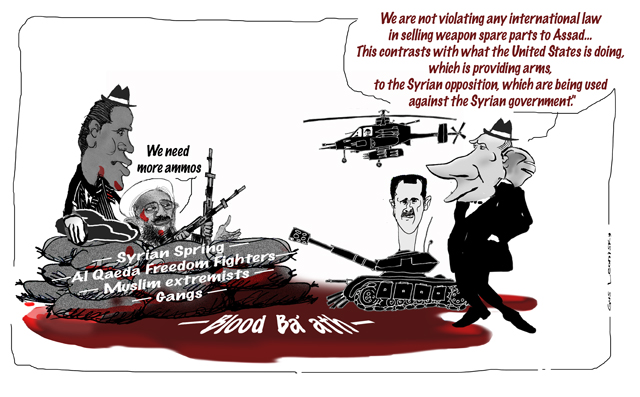
- By Gus Leonisky at 14 Jun 2012 - 6:15pm
- Gus Leonisky's blog
- Login or register to post comments
a tense war of words, with some bleeding...
Moscow and Washington were yesterday engaged in a tense war of words over the conflict in Syria, trading barbed accusations over each other's role in arming opposing sides.
In an indication of the breakdown in international diplomatic efforts to resolve the crisis, the Russian Foreign Minister, Sergey Lavrov, hit back at accusations by the US Secretary of State, Hillary Clinton, that his government was "patently" lying about its weapons shipments to Syria and escalating the situation by supplying attack helicopters to the regime.
Speaking during a visit to Tehran, Mr Lavrov claimed that the US was responsible for an increase in bloodshed, accusing Washington of supplying weapons to the Syrian opposition.
Consensus that the situation on the ground constitutes a full-blown civil war is mounting, with the new French Foreign Minister, Laurent Fabius, yesterday joining the UN peacekeeping chief as defining it as such. Syrian state television yesterday said it had "cleansed" the embattled Latakia town of Al Haffa of "terrorist groups", with troops said to be rounding up scores of men and raiding houses.
http://www.independent.co.uk/news/world/middle-east/moscow-returns-fire-by-accusing-us-of-arming-syrias-rebel-forces-7848860.htmlShe put a little spin on it...
Copters in Syria May Not Be New, U.S. Officials Say By ERIC SCHMITT, MARK LANDLER and ANDREW E. KRAMER
WASHINGTON — When Secretary of State Hillary Rodham Clinton accused Russia on Tuesday of shipping attack helicopters to Syria that would “escalate the conflict quite dramatically,” it was the Obama administration’s sharpest criticism yet of Russia’s support for the Syrian government.
What Mrs. Clinton did not say, however, was whether the aircraft were new shipments or, as administration officials say is more likely, helicopters that Syria had sent to Russia a few months ago for routine repairs and refurbishing, and which were now about to be returned.
“She put a little spin on it to put the Russians in a difficult position,” said one senior Defense Department official.
Mrs. Clinton’s claim about the helicopters, administration officials said, is part of a calculated effort to raise the pressure on Russia to abandon President Bashar al-Assad, its main ally in the Middle East. Russia has so far stuck by Mr. Assad’s government, worried that if he were ousted, Moscow would lose its influence in the region.
In response to Mrs. Clinton’s allegations, the Russian foreign minister, Sergey V. Lavrov, accused the United States of hypocrisy on Wednesday, saying it had supplied weapons that could be used against demonstrators in other countries in the region. Mr. Lavrov, during a visit to Iran, repeated Russia’s claim that it is not supplying Damascus with any weapons that could be used in a civil war.
“We are not providing Syria or any other place with things which can be used in struggle with peaceful demonstrators, unlike the United States, which regularly supplies such equipment to this region,” Mr. Lavrov said. He singled out a recent delivery to “one of the Persian Gulf states” — perhaps a reference to Bahrain. “But for some reason the Americans consider this completely normal.
http://www.nytimes.com/2012/06/14/world/middleeast/copters-in-syria-may-...
the crusader indignation used in Iraq...
The Sunni-Shia faultline has growing and frightening salience. Iran is Shia. So is the majority in Iraq. So is the Lebanon-based militant movement Hezbollah. By contrast, most of the West's traditional Arab allies are Sunni: Turkey, Egypt, Jordan and arms-supplying Gulf states such as Qatar and Saudi Arabia. But, to complicate matters, al-Qa'ida is Sunni, too, so the West is nervous that those who replace Assad might turn out to be fundamentalist jihadists. There is a very real danger that the violence in Syria could turn to all-out sectarian war. And that could spread through the Arab world.
Which of these threads is easiest to unpick? Despite what is widely said about the intransigence of Russia's support for Assad, the most malleable element could be Moscow. The Kremlin is determined not to lose Syria as the centre of its Middle Eastern sphere of influence. It has $20bn in investments there. It sells 10 per cent of its arms exports to Syria, which gives Russia its only naval base on the Mediterranean.
Moscow, which feels it was tricked into abandoning Gaddafi in Libya, is determined not to make the same mistake over Assad. The West has not been very skilful here. The harsh words of Hillary Clinton last week were typical. She announced that Russia had "dramatically" escalated the crisis by sending attack helicopters to Syria – but then had to admit that it was only sending parts for existing aircraft. The West's rhetoric has reverted to the Crusader indignation used in Iraq rather than the careful language about self-determination in Libya. It has put Russian backs up.
http://www.independent.co.uk/opinion/commentators/paul-vallely-the-russians-will-help-us-in-syria-only-if-we-help-them-7856470.html
the CIA selecting the blood bath rebels...
C.I.A. Said to Aid in Steering Arms to Syrian OppositionBy ERIC SCHMITT
WASHINGTON — A small number of C.I.A. officers are operating secretly in southern Turkey, helping allies decide which Syrian opposition fighters across the border will receive arms to fight the Syrian government, according to American officials and Arab intelligence officers.
The weapons, including automatic rifles, rocket-propelled grenades, ammunition and some antitank weapons, are being funneled mostly across the Turkish border by way of a shadowy network of intermediaries including Syria’s Muslim Brotherhood and paid for by Turkey, Saudi Arabia and Qatar, the officials said.
The C.I.A. officers have been in southern Turkey for several weeks, in part to help keep weapons out of the hands of fighters allied with Al Qaeda or other terrorist groups, one senior American official said. The Obama administration has said it is not providing arms to the rebels, but it has also acknowledged that Syria’s neighbors would do so.
The clandestine intelligence-gathering effort is the most detailed known instance of the limited American support for the military campaign against the Syrian government. It is also part of Washington’s attempt to increase the pressure on President Bashar al-Assad of Syria, who has recently escalated his government’s deadly crackdown on civilians and the militias battling his rule. With Russia blocking more aggressive steps against the Assad government, the United States and its allies have instead turned to diplomacy and aiding allied efforts to arm the rebels to force Mr. Assad from power.
http://www.nytimes.com/2012/06/21/world/middleeast/cia-said-to-aid-in-st...
see toon at top... I suppose the CIA thinks it's clever to pick and choose but it's most likely that the rebels would end up sharing the weapons anyway...
Ad Domari...
Syrian cartoonist Ali Farzat: 'They broke my hands to stop me drawing Assad' - video
Ali Farzat founded in 2001 Syria's first satirical weekly, Ad Domari. In August 2011, he was attacked by Bashar al-Assad's militia who broke his hands. The incident prompted international condemnation of the Assad regime. Farzat was awarded the European parliament Sakharov prize for freedom of thought
http://www.guardian.co.uk/commentisfree/video/2012/jun/21/drawing-syria-revolution-ali-farzat-video
more massacres...
The Sana state news agency cited sources as saying the victims had been abducted earlier on Friday from Darat Izza, a village in Aleppo province.
Activists said 26 government supporters had been shot dead by rebels.
The joint UN-Arab League envoy on Syria Kofi Annan said it was "time for countries of influence to raise the level of pressure" over Syria.
Mr Annan, who has seen his six-point plan to end the conflict unravelled by violence, said the time to act was now - the process could not be open-ended.
http://www.bbc.co.uk/news/world-middle-east-18551693
paying the rebels...
Saudi officials are preparing to pay the salaries of the Free Syria Army as a means of encouraging mass defections from the military and increasing pressure on the Assad regime, the Guardian has learned.
The move, which has been discussed between Riyadh and senior officials in the US and Arab world, is believed to be gaining momentum as a recent flush of weapons sent to rebel forces by Saudi Arabia and Qatar starts to make an impact on battlefields in Syria.
Officials in the Saudi capital embraced the idea when it was put to them by Arab officials in May, according to sources in three Arab states, around the same time that weapons started to flow across the southern Turkish border into the hands of Free Syria Army leaders.
Turkey has also allowed the establishment of a command centre in Istanbul which is co-ordinating supply lines in consultation with FSA leaders inside Syria. The centre is believed to be staffed by up to 22 people, most of them Syrian nationals.
http://www.guardian.co.uk/world/2012/jun/22/saudi-arabia-syria-rebel-army
out of control...
His story was as revealing as it was frightening. Damascus was about to be attacked. But the fighters were out of control. There were drug addicts among them. "Some of our people are on drugs," the visitor said. "They will take anyone out. We can't guarantee what some of these men will do. If they went into Malki [a mixed, middle-class area of central Damascus], we couldn't protect any of the people who live there. We are against the Salafists who are fighting – there are good Syrians, Druze and Ishmaeilis [Alawites] who are with us. But if we capture Damascus, we don't know how to run a small town, let alone a country."
It was a true civil war story. There were bad guys among the good guys and good guys among the bad. But sectarianism is biting into the Syrian revolution. At the end of last week, one Syrian told me that "they are bayoneting people in the villages around Damascus". Women, they say, have been raped outside the city of Homs – one estimate puts the number of victims as high as 200 – and the rapists are on both sides. The Syrian in Beirut knew all this and gave his visitor the following advice.
"Organise neighbourhood committees, well-dressed men who must be clearly identified and who must protect everyone, Christians, Druze, Sunnis, Alawites, everyone."
http://www.independent.co.uk/opinion/commentators/fisk/robert-fisk-sectarianism-bites-into-syrias-rebels-7964251.html
destruction of history...
Congratulations to Cameron, Hague , Obama et al for supporting the rebels who are financed by those well known democratic, feminist , respect to all religions Governments of Saudi Arabia and Qatar. If ever it was true that oil is the motivating force behind by our foreign policy decisions this is the classic case as otherwise there is no explanation as to why we would want to overthrow a secular reasonably modern government with a bunch of people who want to introduce strict Islamic principles , get rid of minorities ( especially Christians if in doubt check what is happening in Egypt ) and put women back to the 19th century . Assad might not be perfect but he and his Government are far better than the possible alternative. Under his rule the antiquities of the country were protected ,do you think they wil be with the new lot ( see what is happening in Mali where the extreme islamists are destroying the antiquities of Timbuktu). Why do you think Al-Madiq castle and Saladin's Citadel were shelled by the Syrian army because the rebels were using them as strong points.
http://www.independent.co.uk/opinion/commentators/fisk/robert-fisk-syrias-ancient-treasures-pulverised-8007768.html
siding with rebels...
Britain will expand its support to the Syrian political opposition fighting President Bashar Assad with an extra £5 million of non-lethal practical assistance, the Foreign Secretary William Hague said today.
William Hague said the financial assistance would help protect civilians from "some of the worst of the violence".
He said: "So now in the absence of diplomatic progress, the United Kingdom will do much more. We will expand our support to the Syrian people and the Syrian political opposition with an extra £5 million in non-lethal practical assistance.
"This will help protect unarmed opposition groups, human rights activists, and civilians from some of the worst of the violence.
"This is in addition to, and separate from, our humanitarian assistance."
http://www.independent.co.uk/news/uk/politics/uk-gives-5m-in-aid-to-syria-rebels-8030663.html
on the road to damascus...
Proclamation Against Syria and Israel (Isaiah 17)...
17 The burden against Damascus.
Behold, Damascus is taken away from being a city, and it shall be a ruinous heap.2 The cities of Aroer are forsaken: they shall be for flocks, which shall lie down, and none shall make them afraid.
3 The fortress also shall cease from Ephraim, and the kingdom from Damascus, and the remnant of Syria; They shall be as the glory of the children of Israel, says the Lord of hosts.
4 And it shall come to pass, that the glory of Jacob shall be made thin, and the fatness of his flesh shall wax lean.
5 And it shall be as when the harvestman gathereth the standing corn, yea, it shall be as one gleaneth ears In the Valley of Rephaim.
6 Yet there shall be left therein gleanings, as the shaking of an olive tree, two or three berries at the top of the uppermost bough, four or five in the outmost branches of a fruitful tree, saith the Lord, the God of Israel.
7 In that day shall a man look unto his Maker, and his eyes shall have respect to the Holy One of Israel.
etcetera, etcetera....
--------------------------------------
Meanwhile at chapter 18, isaiah is giving the US the shits:... Lucky we can stop the rot... but can we?
http://www.isaiah18.com/
This of course leaves me completely flabbergasted... I was there, living my little life in the corner of a small pebble in an unfathomable relative universe, worrying about a global warming that will kick in massively (way after I'm six foot under and feeding worms) — and this "revelation" falls upon me like a ton of bricks...
Okay fellows, can some of you nuts let off this ancient crap? Can you for a moment come back to the real present where we don't have to still fight these ancient silly battles? Can we place that evolved monkey cap on our head instead of this fallen child of god illusion mad-hat that distorts our perfectly reasonable non-purposed lovely existence?
Brother...
can you smell the gas from the UMIS?...
The same fantasy specialists who didn’t warn us about 9/11 but insisted that Saddam had weapons of mass destruction in 2003: “unnamed military intelligence sources”. Henceforth to be acronymed as UMIS.
....
Yes, the bigger the lie, the better. Certainly we journos have done our duty in disseminating this bunkum. And Bashar – whose forces have committed quite enough iniquities – is about to be accused of another crime which he has not yet committed and which his father never did commit. Yup, chemical weapons are bad news, folks. That’s why the US supplied Saddam with the components for them, along with Germany (of course).
That’s why, when Saddam first used gas on Halabja, the UMIS told CIA officers to blame Iran. And yes, Bashar probably does have some chemicals in rusting bins somewhere in Syria. Madame Clinton has been worrying that they may “fall into the wrong hands” – as if they are presently “in the right hands”. But the Russians have told Bashar not to use them. Would he piss off his only superpower ally?
And by the way, which was the first army to use gas in the Middle East? Saddam? Nope. The Brits, of course, under General Allenby, against the Turks in Sinai in 1917. And that’s the truth.
http://www.independent.co.uk/voices/comment/syria-bashar-alassad-and-the-truth-about-chemical-weapons-and-who-may-or-may-not-have-them-8393539.html
misreading the slop...
The cat’s out of the bag. During Libya‘s rebellion, the White House OK’ed the arming of rebels fighting the Gaddafi regime to Arab partners in the Gulf, and rumors have abounded ever since over the identity of some of the recipients of weapons sent by U.S. allies. Now, a story in the Wednesday’s New York Timesclaims to have confirmed rumors that some of the arms supplied by Qatar and the United Arab Emirates ended up in the hands of Libyan Salafi groups. There’s no evidence these arms were actually used in the attack on the Benghazi consulate on Sept. 11, but the Times report will fuel speculation. It may also help explain why the Obama Administration has been dancing around the Benghazi incident as if were a grenade with the pin pulled.
It seems perfectly possible to me that some weapons sent from the Gulf could have found their way to Ansar al-Sharia, the group currently blamed for the Benghazi attack. That creates a problem for the White House. If such a link surfaces, the Obama Administration may try to blame Gulf Allies. Those countries, in turn, can be expected to say the White House ignored warnings the weapons might fall into the wrong hands.
http://world.time.com/2012/12/07/if-you-thought-benghazi-was-bad-watch-syria/
Just to place things, like selling arms to rebels, in perspective...
Rimbaud was a passionate and tortured individual who found his poetic voice early. By the age of 17 he had already written his accomplished poemLe Bateau ivre. In 1870, at the outbreak of the Franco-Prussian war, he ran away from home and lived for almost a year as a vagabond.
In 1871 he met fellow poet Paul Verlaine and they embarked on a tempestuous love affair. (He had previously sent poems to Verlaine.) During their time together they made two trips to London and it was here that Rimbaud began his famous prose poem A Season in Hell. However, Rimbaud and Verlaine quarrelled frequently and during a visit to Brussels Verlaine shot Rimbaud in the wrist. Verlaine subsequently went to prison for two years.
Incredibly, by the age of 20, Rimbaud abandoned poetry and spent the rest of his life as a nomad in Europe and Africa. He worked as a trader, explorer and even as an arms dealer.
In 1891 he contracted cancer in his right leg and died following an amputation.
On his deathbed, Rimbaud agreed to talk to a couple of priests but it is not known for certain whether he actually reverted back to Catholicism.
Rimbaud's legacy was enormous. He was one of the main early exponents of vers libre and was a major symbolist poet. He was also an influence upon the surrealist poet André Breton and upon American songwriters Jim Morrison and Bob Dylan.
http://www.poetsgraves.co.uk/rimbaud.htm
-----------------------
Mercenaries, arms dealers, soldiers of fortune, poets, have existed throughout recorded history... Even the Knights Templars were soldiers of fortune who had little altruism in their daggers, but a "legendary" faith (by this I mean bordering on ficticious and fallacious) and a coveted grand prize in their sight (Jerusalem)... These days, that states like the US fart above their democratic ideals is in the same stupid shaff bag... What happened in Benghazi was not a diplomatic mistake, just a loopy strategy that forgot two main rules in such situations...: Never trust anyone — and always be armed (or protected ) to the teeth when in politically unsettled places, especially when there had been a "conflict" going on, in which you supported one side against another but in fact there was more than ten factions fighting together and each others... If you could make sense out of the mess that was there, then you'd be able to solve the most mysterious parts of the Rusky revolution...
supporting one or the other devil for profit...
As for Russia, ruler Vladimir Putin has offered no public hint that he has any inclination to reverse his support for Mr. Assad. It’s not just that the Kremlin has interests to protect in Syria; Mr. Putin’s priority is to prevent what he views as another U.S.-sponsored regime change. Even were he to decide to cooperate with Mr. Obama, it’s doubtful that Mr. Putin could induce the Assad clique and its principal backer, Iran, to give up what the dictator himself has called a fight to the death.
A slim chance for a political settlement may still exist but only if the United States and its allies take measures that decisively, and relatively quickly, shift the momentum of the war. Only when the Assad army is defeated and the regime crumbles will a deal be possible. Supplying arms to the rebels, as Mr. Obama is said to be considering, would be a step in that direction but probably not a big enough one. Without stronger U.S. measures, the most likely outcome is the fragmentation of Syria into warring fiefdoms, with some turf controlled by Iran and some by al-Qaeda.
What’s needed is what the opposition has repeatedly requested: a no-fly zone in parts of Syria, or other measures — such as attacks with missiles and stealth bombers — to ground the Syrian air force. Yes, such measures would have to be taken without a United Nations resolution, and they would upset Mr. Putin. But if Mr. Obama continues to pursue a policy of awaiting U.N. consensus and deferring to Russia, the result will be more crossings of his red line — and grave damage to U.S. interests.
http://www.washingtonpost.com/opinions/us-policy-on-syria-still-lacks-coherence/2013/05/01/dbda6cfc-b27b-11e2-bbf2-a6f9e9d79e19_print.html
Grave damage to the US interests?...
At this stage, it's a battle of will between Iran "that we don't like" supported by Russia (which annoys us senseless) and Al Qaeda that "we hate so much we killed its leader Bin laden" but who is supported by our friends the Saudis "that we like"(because they have oil we want)... Decision, decision... Meanwhile, the innocent blood is spilled by the gallons...
So Far, one has to say that Assad and his despotic regime is the legitimate government of Syria, recognised by the United Nations, whether we like it or not... And up to about three years ago, we ingratiated ourselves to... and with...
See toon at top...
the key will be a political settlement...
Would U.S. intervention--no-fly zones, arms, aid to the opposition forces--make things better? It depends on what one means by better. It would certainly intensify the civil war. It would also make the regime of Bashar Assad more desperate. Perhaps Assad has already used chemical weapons; with his back against the wall, he might use them on a larger scale. As for external instability, Landis points out that if U.S. intervention tipped the balance against the Alawites, they might flee Syria into Lebanon, destabilizing that country for decades. Again, this pattern is not unprecedented. Large numbers on the losing side have fled wars in the Middle East, from Palestinians in 1948 to Iraq's Sunnis in the past decade.
If the objective is actually to reduce the atrocities and minimize potential instability, the key will be a political settlement that gives each side an assurance that it has a place in the new Syria. That was never achieved in Iraq, which is why, despite U.S. troops and arms and influence, the situation turned into a violent free-for-all. If some kind of political pact can be reached, there's hope for Syria. If it cannot, U.S. assistance to the rebels or even direct military intervention won't change much: Syria will follow the pattern of Lebanon and Iraq--a long, bloody civil war. And America will be in the middle of it.
Read more: http://www.time.com/time/magazine/article/0,9171,2142505,00.html#ixzz2S8RjSda2blood borders...
As Syria continues its descent into an anarchic civil war and Iraq is increasingly ravaged by sectarian infighting, a terrifying vision of the future of the Middle East is increasingly coming into view. In his 2008 book "Israel and the Clash of Civilizations", the veteran British journalist, Jonathan Cook, cites a 1982 policy paper by former Israeli foreign ministry official Oded Yinon which seems to presciently forecast the monumental events gripping the region today:
"The total disintegration of Lebanon into five regional localized governments is the precedent for the entire Arab world… Iraq can be divided on regional and sectarian lines just like Syria in the Ottoman era. There will be three states in the three major cities."
The Sykes-Picot Agreement - which divided the Ottoman Empire after World War I and created the Middle East as we know it - is today violently breaking apart in front of the eyes of the world. The countries of Syria and Iraq; formerly unified Arab states formed after the defeat of their former Ottoman rulers, exist today only in name. In their place what appears most likely to come into existence - after the bloodshed subsides - are small, ethnically and religiously homogenous statelets: weak and easily manipulated, where their progenitors at their peaks were robustly independent powers.
Such states, divided upon sectarian lines, would be politically pliable, isolated and enfeebled, and thus utterly incapable of offering a meaningful defence against foreign interventionism in the region. Given the implications for the Middle East, where overt foreign aggression has been a consistent theme for decades, there is reason to believe that this state of affairs has been consciously engineered.
The end of Iraq
Away from the focus of major news media - numbed as it has become to stories of unconscionable Iraqi suffering - Iraq this past April recorded its deadliest month in five years, with over 700 killed in sectarian violence throughout the country. Describing the aftermath of a deadly car bombing in his neighbourhood, school teacher Ibrahim Ali gave voice to the dread and foreboding felt by many Iraqis for their country:
"We asked the students to remain inside the classrooms because we were concerned about their safety… [they] were panicking and some of them started to cry…. We have been expecting this violence against Shiites due to the rising sectarian tension in the country."
The unacknowledged truth behind the past decade of bloodletting in Iraq is that the country itself effectively ceased to exist after the 2003 US invasion. The northern province of Iraqi Kurdistan is today an independent country in all but name and is increasingly moving towards formal recognition of this fact - while Sunni and Shia Iraqis have come to see themselves more as distinct entities than as part of a cohesive nation. Iraqi Sunnis, a once-empowered minority, have taken up arms in recent months against the Shia-dominated government of Nouri al-Maliki and have staked their terms in a manner which acknowledges the irredeemable nature of a continued Iraqi state. In the words of Sunni cleric Mohammad Taha at a rally in Samarra:
"Al-Maliki has brought the country to the abyss... this leaves us with two options: Either civil war or the formation of our own autonomous region."
There is evidence to suggest that this state of affairs was not an unintended consequence of the 2003 invasion. The American architects of the Iraq War - while couching their justifications for war in the rhetoric of liberation - had for years previously openly acknowledged and predicted that an invasion would result in the death of Iraq as a cohesive state. In a follow-up to their 1996 policy paper"A Clean Break: A New Strategy for Securing the Realm" - a report published by leading neoconservative intellectuals, including Richard Perle, Douglas Feith and David Wurmser, which advocated a radical reshaping of the Middle East using American military power - the report's authors acknowledged the inevitability of Iraq's demise post-invasion.
Predicting that after violently deposing the country's government: "[Iraq]… would be ripped apart by the politics of warlords, thieves, clans, sects and key families" - the same individuals would nonetheless become the leading advocates of just such an invasion. The post-invasion decisions by the occupying authority to dissolve the army, patronise sectarian militias and death squads and destroy Iraq's civilian infrastructure viewed in this light are far more comprehensible. The chaos which has enveloped the country since 2003 has not been an unintended consequence, but rather the one which was predicted years earlier by the war's architects and then perfectly executed. Today the partition of Iraq is mapped out by American think-tanks seeking put a final end to that country and divide it into its contingent ethnic and religious parts.
In this light it is worth contrasting the sectarian powder-keg Iraq is described as today with Iraqi attitudes during the early days of the American invasion. A 2004 New York Times article entitled "Sunni-Shiite Cooperation Grows, Worrying US Officials" described the broad-based support provided by Shia Iraqis to their Sunni co-citizens under siege by American forces in the country. In the words of one Iraqi regarding the supposed religious bifurcation in the country:
"These [sectarianisms] were artificial distinctions. The people in Fallujah are starving. They are Iraqis and they need our help."
The need to counter and undermine such episodes of inter-religious national unity in order to achieve the objectives of the invasion was recognised early by US military officials. As stated by Lt General Ricardo Sanchez:
"The danger is we believe there is a linkage that may be occurring at the very lowest levels between the Sunni and Shia… we have to work very hard to ensure that it remains at the tactical level."
The handiwork of such efforts is evident today in the horrific charnel house into which the country has descended today. Where Iraqis once saw themselves as citizens of a contiguous nation, the unconscionable events of the past decade have given primacy to religious identity over all else. Iraq's once vibrant and influential Christian community has been nearly driven to extinction, while Sunnis and Shias are locked in a seemingly intractable sectarian conflict which appears ready to rip the country into its final pieces. In the words of one Iraqi man, who initially welcomed the invasion with its promises of liberation only to watch in horror as his own family was torn apart by American bombs and bullets:
"I wish the Americans had never come. They ruined our country. They planted divisions… They made us cry for the days of Saddam Hussein."
The dissolution of Syria
When Syrians, swept up in the once-transcendent spirit of the Arab Spring uprisings, undertook their own revolution against the corrupt, myopic regime of Bashar al-Assad, few had any idea it would lead to the dystopian reality of massacres and foreign predations the country faces today. The revolution - a legitimate, democratic uprising against a despotic government - provided a prize opportunity for the country's neighbours to violently exploit Syrian unrest to further their own venal interests.
The tragic result of this situation is the vicious proxy war playing out today in the streets of Aleppo, Homs, Deir ez-Zor and countless other cities and towns throughout the country. A once-proud nation - long recognised as the cultural and historical jewel of the Levant - has been reduced to a grim battlefield between the West and its Gulf allies on one hand and the Syrian government and its allies in Iran, Russia and Hezbollah on the other. The Israeli airstrikes perpetrated with impunity onto Damascus this past week are yet another illustrative example of the depths of turmoil to which Syria has sunk.
As analysts openly discuss the "Somaliasation" of Syria and growing factions within the country call for military intervention to break the state up into small ethnic and religious enclaves - literally, "into pieces" - the prospect of a united Syria grows more remote by the day. Again, just as in Iraq, the benefactors of Syria's dismemberment will be the external actors which seek hegemony in the region and have never hidden their desire to see the country collapse.
As early as 2011, a particularly frank prescription for the future of Syria was given by Lawrence Solomon, who called for a radical redrawing of the country's borders to facilitate Western interests:
"There is a better end game… Syria's dismemberment into constituent parts. US and NATO countries… should confine Alawites to a state in the central Western part of the country where they are predominant… the West has no cause to favour appeasement… over the many gains to be had through a dismemberment of Syria."
As risible as Solomon's suggestions seemed at the time, the unfathomable reality is that today just such a situation is occurring - as analysts dispassionately discuss the possibility of an independent Alawite state in Lattakia and the fragmenting of the rest of the country into separate portions for Kurds, Sunnis, Shias, and the many other ethnic and religious groups which once made up the diverse tapestry of modern Syria.
In the background of this all echoes the policy plan for Syria illustrated in "A Clean Break", whose influential authors counselled open confrontation with Syrian interests throughout the region and explicitly called for menacing the country's territorial integrity itself.
Oded Yinon's prescription for dissolving Syria and Iraq - which at one time appeared arrogantly grandiose - today seems almost inevitable. The legitimate democratic aspirations of the Syrian people have been overtly hijacked by a foreign agenda which long predated their own revolution - and which increasingly looks ready to dissolve the country they sought to liberate.
Towards a new balance of power
In a 2007 piece for The New Yorker, the Pulitzer-Prize winning American investigative journalist, Seymour Hersh, reported on what White House insiders called "the Redirection" of US policy in the region. Seeking to reassert influence in the aftermath of the disastrous invasion of Iraq, the US deliberately became party to the fomentation of sectarian conflict throughout the Middle East.
In words that today seem utterly prescient, Hersh wrote:
"The US has taken part in clandestine operations aimed at Iran and its ally Syria. A by-product of these activities has been the bolstering of Sunni extremist groups that espouse a militant vision of Islam and are hostile to America and sympathetic to al-Qaeda."
The extremist groups fighting today in Syria - many of whom openly state their allegiance to al-Qaeda and who have terrorised not just the Syrian government, but also the secular activists who were the progenitors of the revolution itself - are the fruit of this explicitly sectarian policy.
Furthermore, as Hersh noted this policy has: "brought Saudi Arabia and Israel into a new strategic embrace", a claim widely viewed as impossible at the time but which over the intervening years has become increasingly acknowledged by both sides. Indeed, official recognition of this new alliance appears to be increasingly imminent, as reports emerged this week of a US-brokered defence pact between Israel, Saudi Arabia, Jordan and the UAE to guarantee mutual interests in the region.
These changes represent no less than a sea change in Middle Eastern politics, as the old order experiences its final violent convulsions and makes way for a new Western-backed alliance to exert its hegemony over the region. In this new environment, once-cherished concepts of self-determination and independence will be suffocated under the financial, political and military might of an unprecedented new axis of control exerted from the centers of power in Washington, Tel Aviv and Riyadh.
The nations of Syria and Iraq today are little more than political fictions, crushed underfoot by foreign military and political intervention and devoured from the inside by politically-fomented sectarian hatreds. The same terrifying dynamic increasingly threatens to envelop Lebanon as well, as the former Arab states continue their fragmentation into innumerable weak and ethnically-homogenous political enclaves.
For the people of the region, the scenes playing out on the streets around them and being broadcast to the world at large represent nothing less than the end of Sykes-Picot borders and the dissolution of the Middle East as they once knew it. As war continues to spread from the borders of Iraq and Syria and into the countries beyond, the endgame for the regions upheaval - when it finally, mercifully, comes - looks increasingly as though it will entail the establishment of many of the "Blood Borders" which Oded Yinon and his ideological peers have long sought to create.
http://www.aljazeera.com/indepth/opinion/2013/05/2013567200437919.html
The Sykes–Picot Agreement, officially known as the Asia Minor Agreement, was a secret agreement between the governments of the United Kingdom and France,[1] with the assent of Russia, defining their proposed spheres of influence and control in the Middle East should the Triple Entente succeed in defeating the Ottoman Empire duringWorld War I. The negotiation of the treaty occurred between November 1915 and March 1916.[2] The agreement was concluded on 16 May 1916.[3]
The agreement effectively divided the Arab provinces of the Ottoman Empire outside the Arabian peninsula into areas of future British and French control or influence.[4] The terms were negotiated by the French diplomatFrançois Georges-Picot and British Sir Mark Sykes. The Russian Tsarist government was a minor party to the Sykes–Picot agreement, and when, following the Russian Revolution of October 1917, the Bolsheviks exposed the agreement, 'the British were embarrassed, the Arabs dismayed and the Turks delighted.'[5]
read more: https://en.wikipedia.org/wiki/Sykes–Picot_Agreement
arabs fighting the persians...
By sending help to Syria's warring factions, Iran, Saudi Arabia and Qatar are struggling to gain influence in the Middle East. The conflict between Sunnis and Shiites has become a proxy war over strategic regional goals.
At the moment, several conflicts are being fought simultaneously in Syria. The civil war began more than two years ago as a power struggle between the government and opposition forces. But it didn't take long for other states to get into the mix, turning the internal fight into a regional and international struggle for influence.
In addition to Western countries as well as Russia and Turkey, neighboring countries like Iran, Saudi Arabia and Qatar have become involved. The three countries are fighting a proxy war for regional dominance. The religious division between Sunnis, Shiites and Alawites only plays a minor role.
Syria is a strategically important country for Iran. The regime of President Bashar al-Assad is Tehran's only ally in the Arab world. In addition, Syria is an important link to the pro-Iranian Hezbollah movement in Lebanon, said Stephan Rosiny, a Middle East expert at the Hamburg-based GIGA Institute for Middle East Studies. Speaking to DW, he added that Tehran, Damascus and Hezbollah see themselves as the resistance front against Israeli and Western interests in the region.
Fall of Syrian regime would be a blow to Iran
Saudi Arabia and Qatar, on the other hand, want to curb Iran's attempts at regional domination and thereby increase their own influence. An overthrow of the Assad government would be a major blow for Iran, and so the two monarchies have been quite openly backing the Syrian opposition. And not just in Syria - they have even been promoting anti-Iranian groups in Lebanon and Iraq.
According to Rosiny, though, both countries have pursued different strategies. For decades, Saudi Arabia had lent its support to radical Salafist groups, but ever since bad experiences with al Qaeda and Saudi volunteer fighters in Afghanistan, the monarchy has become more cautious.
On their return after the fighting, many veterans considered the Saudi state as their new enemy. As a result, many Saudis have gone to fight as volunteers in Syria.
"That's why Saudi Arabia has somewhat moderated its support of these groups," said Rosiny. Qatar, in comparison, has been less indiscriminate and has partially supported radical groups.
http://www.dw.de/middle-east-countries-fighting-proxy-war-in-syria/a-16848708
see also: http://en.wikipedia.org/wiki/History_of_Iran
blind to the radicalisation of aussie army members...
A serving Australian soldier has been killed fighting with rebels in Syria.
The ABC has been told that the man was an infantry soldier who was still a member of the Australian Defence Force when he travelled to Syria to fight against the regime of Bashar al-Assad.
The Defence Force would not confirm or deny the death, and directed the ABC's inquiries to the Attorney-General's Department and the Australian Federal Police, neither of which would respond to direct questions about the man's fate.
It is unclear whether he was a reservist or a full-time soldier, or what special skills he may have learned in his Defence Force service. However, it is understood that he died two months ago.
The death raises questions about the ability of the Defence Force to recognise the signs of radicalisation of its members.
The vast majority of foreign fighters who travel to Syria have no combat or military experience, making any military training in a recruit an asset to the rebel groups.
In January, it was reported that a Dutch soldier of Turkish origin who was disgusted by the West's failure to halt the killing in Syria had quit the army and travelled to the battle zone, where he was training rebels.
Last year, a former United States soldier who fought with Syrian rebels, Eric Harroun, served a brief stint in an American prison after pleading guilty to minor charges involving conspiracy to transfer defence articles and services.
But the Australian is believed to be the first serving member of a Western army to be killed while fighting with the rebels.
A number of Australians have been killed in Syria while supplying aid or fighting for factions within the rebel movement.
Sydney man Caner Temel, 22, was killed in January, allegedly while fighting for the extremist group the Islamic State of Iraq and the Levant against more moderate rebels.
His death came days after the killing of Sydney man Yusuf Ali and his young wife Amira near Aleppo. The circumstances in which the couple died are still unclear, but it was reported they were also killed during fighting between rebel factions.
Roger Abbas, 23, a well-known kickboxer from Melbourne, reportedly went to Syria to do aid work, became involved with the Jabhat al-Nusra group, and was killed in October 2012.
Another Melbourne man, Yusuf Toprakkaya, was shot dead by a sniper while fighting for a rebel group in December 2012.
Sydney preacher Mustafa al-Majzoub was killed by a rocket while doing what his family says was humanitarian work in Syria in August 2012.
And a Brisbane man is suspected of being the first Australian suicide bomber, after blowing up himself and a number of Syrian soldiers at a checkpoint last September.
It is believed there are dozens more Australians fighting in Syria, and that some have reached senior positions in extremist Islamic groups.
ASIO has also confiscated the passports of some Australians to stop them travelling to Syria and the wider region.
In December, Sydney man Hamdi Al Qudsi was arrested and charged with assisting people travelling to Syria to fight in the long-running conflict.
He faces seven charges under the Crimes Act relating to foreign incursions and recruitments.
Between June and August last year, Al Qudsi is accused of helping Yusuf Ali enter Syria "with the intent to engage in a hostile activity, in particular engaging in armed hostilities".
http://www.abc.net.au/news/2014-03-18/serving-australian-soldier-killed-in-syria/5329184
--------------------------------
Meanwhile:
The Syrian army has made fresh gains in its battle against foreign-backed militants in the town of Yabroud in Damascus countryside, Press TV reports.
Many parts of the southwestern town are now under control of the Syrian forces, but the battle continues between the army and militants.
A large number of militants have been killed over the past few days as the army continues its tangible advance in the eastern parts of the town in the mountainous region of Qalamoun.
The al-Amal hospital, a local Orthodox Church and an industrial zone as well as the strategic Mar Maroun mountainous region have come under control of the Syrian army.
Syrian forces managed to enter the eastern districts of Yabroud on Saturday.
On March 12, Syrian forces backed by fighters from the Lebanese resistance movement of Hezbollah took full control of farmland on the northern edge of Yabroud.
The new gains for the Syrian army come days after forces loyal to the government of President Bashar al-Assad regained control of the town of al-Zareh following days of fierce clashes with militants in the central province of Homs.
Securing the town would mean cutting the supply line of militants in the area and putting an end to weapons smuggling from Lebanon.
http://www.presstv.ir/detail/2014/03/16/354854/syria-army-gains-ground-in-yabroud/
See toon and story at top...
putin is doing the west a favour, by supporting assad...
WASHINGTON — Dozens of seasoned militant fighters, including some midlevel planners, have traveled to Syria from Pakistan in recent months in what American intelligence and counter-terrorism officials fear is an effort to lay the foundation for future strikes against Europe and the United States.
“We are concerned about the use of Syrian territory by the Al Qaeda organization to recruit individuals and develop the capability to be able not just to carry out attacks inside of Syria, but also to use Syria as a launching pad,” John O. Brennan, the C.I.A. director, told a House panel recently.
The extremists who concern Mr. Brennan are part of a group of Qaeda operatives in Pakistan that has been severely depleted in recent years by a decade of American drone strikes. But the fighters still bring a wide range of skills to the battlefield, such as bomb-building, small-arms tactics, logistics, religious indoctrination and planning, though they are not believed to have experience in launching attacks in the West.
http://www.nytimes.com/2014/03/26/world/middleeast/qaeda-militants-seek-syria-base-us-officials-say.html?hp&_r=0
arming the moderates in moderation...
President Barack Obama has asked the US Congress to approve $500m (£294m) to train and equip what he described as "moderate" Syrian opposition forces.
The funds would help Syrians defend against forces aligned with President Bashar al-Assad, the White House said.
The aid would also counter Islamist militants such as the Islamic State in Iraq and the Levant (Isis), it added.
Isis's advance in neighbouring Iraq has led some in Congress to press Mr Obama to take action.
Tens of thousands of people have died and millions more have been displaced in three years of civil war in Syria, as rebels fight troops loyal to Mr Assad.
'Increase our support'"This funding request would build on the administration's longstanding efforts to empower the moderate Syrian opposition, both civilian and armed," the White House said.
It will also "enable the Department of Defense to increase our support to vetted elements of the armed opposition".
The money will help stabilise areas under opposition control and counter terrorist threats, the White House said.
The rebels that would receive the funds would be vetted beforehand in order to alleviate concerns of equipment falling into the hands of militants hostile to the US and its allies, the White House said.
Mr Obama has been under strong pressure from some members of Congress to increase assistance in the area, although it is unclear whether and when Congress would act on his request.
http://www.bbc.com/news/world-middle-east-28042309#
Let Assad survive as the President of Syria, Mr Obama. The alternative is an even bigger mess than Egypt, Iraq, Palestine, Libya, ... Do not supply weapons or training. It will come back to bite you. Full stop.
america's nut job...
Syria's army and its allies have broken a three-year rebel siege of two Shia towns in northwest Syria, the government and rebel groups said, cutting off a main supply route to nearby Turkey.
The breakthrough comes after days of rapid military gains north of the major city of Aleppo, with Russian air strikes playing a key role in the advance.
The two towns of Nubul and Zahraa, with an estimated 60,000 population, are connected to the border by areas under the control of Kurdish militias that provided access.
The Levant Front rebel said the siege was broken "after three days of legendary resistance by the revolutionaries facing the Russian military machine, and after more than 500 raids by Russian air planes", Reuters news agency reported.
READ MORE: Syria peace talks plunged into new crisis
Syria's state news agency SANA reported on Thursday "mass celebrations in the streets of Nubul and Zahraa welcoming army troops and celebrating the breaking of the siege".
The Al-Manar television station of Lebanese militia Hezbollah broadcast what it said was exclusive footage of Syrian government and allied fighters entering the towns. The channel showed crowds embracing soldiers and militiamen who fired into the air as they arrived.
The two towns had been besieged by rebels since 2012, and reaching them had long been a goal of the government, which has also sought to sever key rebel supply routes into Aleppo from Turkey.
Al Jazeera's Zeina Khodr, reporting from Gaziantep, Turkey, said that in taking the towns, the government achieved in three days what it's been trying to do for three years.
"There is no doubt this is a decisive turning point because at the end of the day, Turkey is the lifeline for the opposition. What we understand from pro-government sources is that this is just the beginning - the aim is to reach the Turkish border."
Meanwhile, UN-mediated talks in Geneva to end the war in Syria were paused on Wednesday until February 25.
US Secretary of State John Kerry blamed the Syrian government and its Russian allies for the stall in negotiations.
"The continued assault by Syrian regime forces - enabled by Russian air strikes - against opposition-held areas, as well as regime and allied militias' continued besiegement of hundreds of thousands of civilians, have clearly signalled the intention to seek a military solution rather than enable a political one," Kerry said in a statement.
read more: http://www.aljazeera.com/news/2016/02/syrian-forces-break-rebel-siege-key-towns-160204033945944.html
----------------
Yes Mr Kerry, three bags full... "Seek a military solution rather than a political one?"... Hypocrite! You're the F&^%$#@ING bastard who armed the opposition to Assad, you clod.
And YES, THERE ARE ALLIED MILITIA FIGHTING FOR ASSAD...
And see the toon at top from nearly four years ago...
caring like crabs in a basket...
A joint statement by CARE International, the International Rescue Committee, Norwegian Refugee Council, Oxfam, and Save the Children argues that assisting in the reconstruction of Syria under current conditions will bolster the regime and thus “risks doing more harm than good.”
In remarks at the end of a September 18 meeting of the U.S.-led “Friends of Syria,”British Foreign Secretary Boris Johnson said: “We believe that the only way forward is to get a political process going and to make it clear to the Iranians, Russians and Assad regime that we, the like-minded group, will not support the reconstruction of Syria until there is such a political process and that means, as Resolution 2254 says, to a transition away from Assad.”
Supporters of this strategy apparently believe that a victorious Assad regime will now surrender the peace in order to win access to the coffers of the West and the privilege of being drawn and quartered at The Hague.
Read more
http://www.theamericanconservative.com/articles/our-enemies-are-winning-...
Yes now that the Russians have helped win the war against the various US/Saudi guises, from the "moderate" rebels to ISIS, they are going to leave Syria to the Western wolves... This ain't going to happen. The reconstruction of Syria can happen WITHOUT the West and its pseudo-caring organisations. The Russians and the Chinese have the cash and the will to work together and reconstruct Syria away from the US war-lovers... I know, road blocks and sabotage will be instigated by the Western powers to prevent MOST of the Syrian to be happy under Assad. It's called sour grapes at the level of this stupid Haley woman Trump uses as a stupid mouth piece at the UN. She should be ashamed of herself...
in one and the same trench...
Some of the military aid sent to the Syrian opposition by Qatar, Turkey, Saudi Arabia and the US may have ended up in the hands of Al-Qaeda-affiliated Al-Nusra terrorists, the Qatari foreign minister has admitted.
The revelations, which are the first of their kind to emerge, were contained in a statement by Hamad bin Jassim bin Jaber Al Thani, who served as Qatari foreign minister between 1992 and 2013. When the conflict started in Syria back in 2011, Hamad bin Jassim said that he went straight to the late Saudi King Abdullah, who then supported Doha’s plan on Syria.
While Qatar is now being accused by the Gulf kingdoms of backing terrorism, Hamad bin Jassim insists that when the Syrian crisis broke out, Doha, Riyadh and Washington were “in one and the same trench” in their vision on supporting anti-Assad militants. He made the comments during a television interview with Qatar TV in October.
read more...
https://www.rt.com/news/408240-qatar-minister-nusra-aid-syria/
US had a seemingly willful ignorance of Syrian history...
Russia’s multifaceted involvement in the Syrian war has now tipped the advantage decisively in favor of the government led by Syrian President Bashar al-Assad.
Its well-considered system of local ceasefires and “reconciliations”—little more than glorified surrenders—between the regime and all manner of defeated members of the opposition has been fortified by a “de-escalation” regime, joined by Turkish, Iranian, and American junior partners in expanding perimeters throughout the country.
This effort is capped by a Russian-led diplomatic juggernaut in the Kazakh capital of Astana that is out-performing the moribund U.S.-led Geneva process. Russian President Vladimir Putin has defined Russian objectives clearly and resolutely, and marshaled inferior resources with skill and determination—much to the consternation of Washington.
During the just completed seventh round of talks in Astana, Putin’s plan for an All Syria Conference later this month in Sochi to discuss a new constitution for post-war Syria, was placed on the table. Members of the Syrian opposition will boycott his parley at their peril.
The Astana process marks only the latest example of what has been a seminal failure of U.S. diplomacy and its military effort to establish Washington as the arbiter of Syria’s future—a dubious prize to be sure, but one that two American presidents have deemed of national interest to fight for since civil war bloke out in 2011.
Iran, along with Turkey and Russia, are Astana’s guarantors. Even the para-state Hezbollah is today better positioned than Washington to affect the nature and composition of the postwar regime Moscow is attempting to shepherd. Washington is relegated to the gallery that Putin, whose military intervention in September 2015 was derided by Defense Secretary Ash Carter as “doomed to fail,” has assembled.
Yet despite the headlines, Syria has never been a zero sum contest between Washington and Moscow. Once the Obama administration’s feverish demand for the destruction of the ruling Ba’ath Party security regime was abandoned, a foundation for U.S.-Russian “de-confliction” in the battle against ISIS was established. The Russian draft constitution, released earlier this year, offers important elements aimed at meeting Kurdish interests within a unified Syrian state that under other circumstances could find favor in Washington.
But as Syria’s endgame unfolds, Washington’s outsized dreams are crashing to earth. It is literally basing its future on premises that are untenable in the long-term, and which are betrayed by a seemingly willful ignorance of Syrian history.
Read more:
http://www.theamericanconservative.com/articles/washington-relegated-to-bystander-status-in-syria-talks/
One does not know what action of sour grapes the US will take, overtly or covertly (via the Saudis? or Israel?) — even assassination squad in Syria or an "accidental" bombing of the "palace"... The USA are sore losers and one needs to be prepared... Read from top.
a dignified way out...
The new US-Russian joint statement on Syria may allow Washington to “save face” and exit the country without sustaining a “crushing defeat”, according to a Syrian legislator.
Syrian MP Muhannad al Haj Ali told Sputnik Arabic that the joint statement on Syria issued by Russia and the US essentially means that Moscow is allowing Washington "to exit Syria without a crushing defeat and to save face."
"Syria needs to continue conducting military operations and to deal with the Kurdish issue. It should be noted that not all Kurds seek to secede, so it is important to distinguish between separatists and those loyal to the government," the MP explained.
Russian journalist Andrei Ontikov also added that the US won’t abandon its attempts to achieve either federalization or the division of Syria, as indicated by Washington’s ongoing support of the Kurdish forces in the country under the pretext of anti-Daesh campaign.
He pointed out however that Russia continues to insist on maintaining Syria’s territorial integrity, and that Damascus will likely be able to grant Kurds and other ethnic minorities the kind of rights that would render the US unable "to put pressure on them or to tempt them with the prospects of secession."
Read more:
https://sputniknews.com/middleeast/201711131059064498-syrian-conflict-re...
the guardian surpasses its own bullshit...
The other side of our tableau of posturers is composed of those who oppose this action as they have clamoured against all previous attempts to do something about Syria. The non-interventionists come in two categories. There are the “it’s nothing to do with us” brigade who declare that “we haven’t got a dog in the Syrian fight”. Mainly to be found on the hand-washing right, the cold brutality with which they express their indifference to so much human suffering has the sole merit of being candid.
Less honest, not least with themselves, are the self-proclaimed peace-lovers. Mainly to be found on the hand-wringing left, they are too busy looking in the mirror admiring their own halos to face the moral challenges posed by a situation like Syria. Jeremy Corbyn opposes this weekend’s action on the grounds that it “risks escalating further” what is “an already devastating conflict”. The Labour leader and those who share his worldview are consistent. Do nothing has been their unvaried policy for the past seven years of carnage. There is no doubt that they can expect support from a lot of a domestic electorate turned allergic to engaging with abroad, especially the Middle East.
Read no more, do not give a cent to the Guardian's news. (https://www.theguardian.com/commentisfree/2018/apr/15/syria-assad-doing-...)
This is bullshit plus.... The West HAS intervened in Syrian since even before the "protests of 2011" by fomenting these protests since 2009, then by arming and supporting "moderate" rebels such as Al Qaeda and Al Nusra — and supported Daesh by default. The existence of Daesh gave the West a "moral" (bullshit) incentive to implement itself in Syria. The US has illegal military bases in Syria. The French have illegal military bases in Syria. Their official aim has been to "defeat Daesh" but their real purpose has been to divide Syria and fight the Assad's government.
Andrew Rawnsley, the writer of the piece above, "the Observer's award-winning chief political commentator — a critically acclaimed broadcaster and author" is either an idiot, a fabricator of fake news or a devilish nasty man. The Guardian prides itself on the phrase that "comment is free", yet it has the begging bowl out... Why should we pay the Guardian for garbage like that is pumped out by Andrew Rawnsley?
No wonder some former "Guardian" journalists have formed the OFFGuardian site where one can read proper analysis of the major con-trick performed by the West (US/UK/France in this instance) and promoted by the MSM, its media poodle, of which the Guardian has the smelliest of arsehole.
---------------------------
From Andre Vltchek
The attack against Syria – this proud and independent country – has just taken place.
Three countries with zero moral mandate to judge or punish anybody; three countries already responsible for hundreds of millions of human lives lost on all continents for centuries, showered Syria with their missiles.
They tried to scare to death Syria, and to break its determination, but they failed. Most of the Syrian people stood proudly by their government.
71 out of 103 of the Western missiles were shot down, and the rest fell on the empty facilities, which have nothing to do with a ‘production or storage of the chemical weapons’. To begin with, Syria has no chemical weapons program and no chemical weapons factories, as well as no warehouses, so nothing could really fall on something that does not exist.
This was yet another gross violation of the international law, but again, the West has been violating the international laws for decades and centuries, brutalizing the entire Planet. Therefore, no one is surprised. Many people are angry, even outraged, but surprised – no.
The Russian forces are now on combat alert, while the massive Chinese fleet has left its ports, staging firing drill and exercises near Taiwan, in what many see as a clear warning to the West, and expression of support and solidarity with Russia and Syria.
Read more:
https://off-guardian.org/2018/04/15/voices-of-the-syrian-people/
And no, views expressed here by Andre Vltchek and supported by Gus, are not questions "of opinion" but of historical facts. The West is trying to destroy the peace process well under way in Syria, created by Russia, Iran, Syria and Turkey.
Read from top.
an official visit to damascus...
The First Vice-President of the Czech Government and Foreign Minister Martin Stropnický paid an official visit to Damascus. He was received by his Syrian counterpart Walid al-Muallem.
Since the beginning of the aggression against Syria, the European Union has closed the embassies of its member states, banned Syrian consuls from organizing election offices on their premises, and instituted sanctions against the Syrian Arab Republic and its main elected officials.
However, Austria, the Czech Republic and Romania have kept their embassies open.
At the instigation of its President, Miloš Zeman, the Czech Republic observed the events on the spot, presented reports to the EU, and issued Schengen visas to Syrian personalities travelling into the Union. President Zeman never withdrew his support to his Syrian counterpart, Bashar al-Assad.
Martin Stropnický was successively Minister of Culture, Defense and now Foreign Affairs. While several foreign leaders have secretly come to Damascus recently, he is the first official executive in the European Union to visit Syria publicly since the beginning of the foreign aggression.
The Russian Federation and the White House agreed at the Helsinki summit on July 16th to end the conflict. The Syrian Arab Army has just liberated the entire south of the country (except Al-Tanf, still occupied by the US), up to the Lebanese, Israeli and Jordanian borders.
Translation
Roger Lagassé
Read more:
http://www.voltairenet.org/article202410.html
Read from top.
the cost of war (in dollars — not counting lives)...
The UN Economic and Social Commission for West Asia (ESCWA) considers that the damages, the aftermath of the war against Syria, reach at least 388 000 million dollars. This figure was the figure announced during a conference that took place in Beirut on 7 and 8 August 2018.
The ESCWA will shortly present its report entitled Syria, 7 years at war.
The US President, Donald Trump, considers that the conflict that took place in Syria is a war of aggression organized by transnational financial interests – such as the investment fund KKR, Toyota, the global leader of Cement Lafarge, etc. Therefore it must be the transnationals involved and the States that worked with them that have to pay the damages.
Translation
Anoosha Boralessa
Read more:
http://www.voltairenet.org/article202370.html
Read from top.
The US President, Donald Trump, considers that the conflict that took place in Syria is a war of aggression organized by transnational financial interests – such as the investment fund KKR, Toyota, the global leader of Cement Lafarge, etc. Therefore it must be the transnationals involved and the States that worked with them that have to pay the damages. WOW!
as donald decides that daesh is kaput...
What follows has been written by Thomas Pierret — a fully fledged supporter of the Syrian Salafist "revolution" and a senior researcher at the University of Aix-Marseille, CNRS, IREMAM, in Aix-en-Provence, France. He does not like (nor trust) Assad. Through this essay, only once (as far as I can make out) does he mention Daesh, Isis, Isil or whatever this Salafist extremist movement called itself — but it makes interesting reading as to see the various factions, without fully exploring certain issues as to WHY the Saudis stopped private financial support to the Jihadist. Was is from US pressure, or were they worried about being exposed?... In another article Thomas claims that the "middle class" in Syria hate Assad, despite supporting him. What he seem to indicate is that they let him in power because the alternative could be a difficult life under a fully-fledged Sunni government. What is rarely mention in this debate has been the benefits of the "socialist secular dictatorship" of Assad which provides free health and free education for all.
The word "socialist" has been the "bête noire" of the USA. What is not mentioned as well in this article by Thomas is the roles played by the USA in the initial uprising and the subsequent intervention of the Russians. Nothing is clean in this war but the decision of Donald to get US troops out is the only sensible thing the USA has done in a long time in the Middle-East.
G.L.
Thomas Pierret, for the Carnegie Middle East Center, May 18 2018:
Today, any discussion of the role of transnational Islamist actors in the Syrian conflict invariably focuses on Salafi-jihadi organizations, such as the self-proclaimed Islamic State and al-Qaeda. In 2012–2013, however, the conflict was primarily shaped by other transnational networks that were run by more mainstream activist and quietist Salafi fundraisers based in the Gulf, particularly Kuwait.
Besides providing significant humanitarian support for opposition-held areas and refugees abroad, these fundraisers helped establish the largest rebel coalitions during the Syrian war. Yet their success was short-lived; by 2014, Salafi-backed coalitions were rapidly running out of steam. This resulted from military setbacks and intra-rebel factionalism, and also a decrease in private donations from Gulf countries as Salafi fundraisers faced state repression at home and declining public interest globally in the events in Syria. Concomitantly, inside Syria, the need for more pragmatic, less ideological rebel coalitions and the growing assertiveness of foreign states supporting the uprising combined and gave rise to new patterns of alliance. Gulf-based Salafi fundraisers often played no role in these newer coalitions, but their influence lingers in the country’s religious sphere.
WHY GULF-BASED SALAFISTS SUPPORTED SYRIA’S OPPOSITIONThe decision of Gulf-based Salafists in 2011 to take the lead in financially supporting rebel groups in Syria stemmed from a drive to bolster themselves at home and abroad. This in turn only heightened competition among Salafi networks, particularly between activists and quietists (known as such because they preach obedience to the incumbent). In Kuwait, fundraising for the Syrian rebels was spearheaded by activist Salafists, who had previously been minor players on the Salafi scene when compared to their rivals from the quietist, Saudi-aligned Revival of Islamic Heritage Society (Jamiyyat Ihya al-Turath al-Islami), or RIHS.
The most dynamic of the Kuwaiti fundraisers was the preacher Hajjaj al-Ajami. He partnered with Hakim al-Mutayri, leader of the Umma Party, a transnational political organization promoting political liberalism at home and strident anti-imperialism abroad. Early on, the party played an outsized role in Syria by supporting Ahrar al-Sham, once the largest rebel faction and a cornerstone of the Syrian Islamic Front (al-Jabhat al-Islamiyya al-Suriyya) founded in December 2012. Muhammad al-Mufrih, the leader of the Umma Party’s banned Saudi chapter, helped establish Ahrar al-Sham in 2011, and Muhammad al-Abduli, an Emirati counterpart, died while fighting with the group in Raqqa in 2013.
The Syrian conflict represented a similar opportunity for another regional network of Salafists, often dubbed “Sururis,” after Mohammed Surur Zein al-Abidin (1938–2016). A Syrian in long-term exile—living in Saudi Arabia, the United Kingdom, and finally Qatar—Zein al-Abidin blended Salafi religious doctrines with a Muslim Brotherhood–like focus on political issues, a combination that proved a major inspiration for the Sahwa movement that challenged the Saudi regime during the early 1990s. His influence in Syria was minimal prior to 2011, not only because of his absence but also because his criticisms were focused on the monarchy in Saudi Arabia, where most of his followers lived.
With the 2011 uprising, Zein al-Abidin reoriented his efforts toward Syria. In September 2012, he threw his weight behind the Syria Islamic Liberation Front (Jabhat Tahrir Suriyya al-Islamiyya), which brought together several thousand fighters from four of the most powerful Syrian rebel factions: the Islam Brigade (later the Islam Army) in Damascus Governorate; the Farouq Battalions in Homs Governorate; and, owing to the Syria Islamic Liberation Front’s financial capabilities, two groups previously co-opted by the Muslim Brotherhood, namely Souqour al-Sham in Idlib Governorate and the Tawhid Brigade in Aleppo Governorate.
The activist Salafists’ spearheading of fundraising activities for Syrian rebels triggered a similar move on the part of their quietist, pro-Saudi rivals. Following Riyadh’s preferences, these networks initially supported attempts at establishing a command structure for the Free Syrian Army (FSA) under the aegis of officers who had defected from the Syrian army. The Saudi-based, Syrian television preacher Adnan al-Arour, who blamed Kuwaiti activist Salafi fundraisers for bypassing such initiatives in favor of radical factions, was invited as a keynote speaker to the September 2012 inauguration meeting of the Joint Command of the Revolutionary Military Councils, a contender for the FSA leadership.
Famous early defectors who had joined the FSA, such as Lieutenant Abd al-Razzaq Tlass and Captains Ammar al-Wawi and Ibrahim Majbur, also became commanders in the Front for Authenticity and Development (Jabhat al-Asala wal-Tanmiya), which the quietest RIHS established in November 2012. Its decision to step up its involvement in the Syrian conflict must be understood in light of its delicate domestic position at the time. The RIHS’s activist rivals had significantly increased their visibility due to their proactive support of the rebels, and other causes throughout the region, after the Arab uprisings in 2011. Furthermore, the society’s internal cohesion was threatened by a reformist wing that joined the domestic Kuwaiti opposition, against the wishes of the RIHS leadership. At a time when victory appeared possible for the Syrian rebels, the activist Salafists’ sponsorship of the most powerful insurgent coalitions could have dramatically bolstered their standing across the region, a very real risk to their quietist counterparts.
In their Syrian endeavor, the Gulf-based Salafists owed their initial success to a unique combination of factors. One was the high GDP per capita of their countries, which made donations from Gulf citizens to Salafi groups more likely. Given Saudi Arabia’s ban on private fundraising for the Syrian rebels from May 2012 onward, such donations began centralizing in the more permissive states of Qatar and Kuwait. A Salafi fundraiser for Syrian rebels, Nayef al-Ajami, even served as Kuwait’s justice minister in early 2014. In such an environment, Salafi supporters of the Syrian cause were able to operate openly, tapping into a larger pool of donors than the low-profile networks that usually funded radical Islamist militancy.
A second advantage was the high profile that some of the fundraisers had acquired as television preachers. For example, Hajjaj al-Ajami, who was only twenty-four in 2011, had hosted an Islamic reality show, and Arour had broken through in media with anti-Shia polemics. Shafi al-Ajami, another major Kuwaiti fundraiser for Ahrar al-Sham, relied on the popularity of his partner Nabil al-Awadi, an immensely popular television cleric who, by September 2011, had become the single-most influential tweeter on Syria. Moreover, whereas regional states were either hostile to jihadi networks or dealt with them indirectly, activist Salafists were mainstream enough to partner openly with Qatar and Turkey, while quietist Salafists did so with Saudi Arabia.
Mainstream Salafists also initially benefited from their relative ideological flexibility in efforts to assemble large coalitions of Syrian rebels, among which, owing to years of state repression, genuine Salafists were in short supply. Gulf-based fundraisers could not connect with full-fledged Salafi communities, with the exception of Zahran Alloush’s group in Douma that gave rise to the Islam Brigade. Rather, they established ties with local factions through individual brokers, such as veteran jihadists, preachers, and political activists. Therefore, Salafi fundraisers were not choosy when recruiting beneficiaries, although they encouraged the adoption of Islamic symbols and slogans by rebel factions and tried to shape the factions’ politics according to their own agendas. They did not impose the same far-reaching ideological compliance that jihadi organizations, by way of comparison, expected from their affiliates.
So, for example, although he was a major backer of Ahrar al-Sham and more hardline factions, Hajjaj al-Ajami also sponsored FSA founder Colonel Riad al-Asad. The Surur-backed Syria Islamic Liberation Front was a heterogeneous alliance, including the genuinely Salafi Islam Brigade alongside Muslim Brotherhood–type Islamists. However, the group did not include jihadists due to decades of polemics from Zein al-Abidin on what he called the “party of extremists” (hizb al-ghulat). As for the Front for Authenticity and Development, it gravitated toward tribal factions in eastern Syria. This was not because quietist Salafism was strong there but because of personal ties, such as those linking Khalid al-Hammad, the front’s secretary general and a Kuwait-based Syrian expatriate, to his native governorate of Deir Ezzor.
The influence of Gulf-based Salafi fundraisers seemed to peak in November 2013 with the merger of the Syria Islamic Liberation Front and the Syrian Islamic Front, creating the Islamic Front (Al-Jabhat al-Islamiyya). The move was unprecedented for two reasons: it led to the largest Syrian rebel coalition ever; and the new coalition was funded by both politicaland quietist Salafists, thanks to the dual networks of patronage of Zahran Alloush’s Islam Army, a key faction in the Syria Islamic Liberation Front.
However, what looked like a show of strength and unity rapidly turned out to be nothing of the sort, as by summer 2014 the Islamic Front had turned into an empty shell. Part of the problem had to do with realities on the ground. Military setbacks at the hands of the regime sparked factional divisions among groups that had been affiliated with the Syria Islamic Liberation Front, including the Tawhid Brigade, the Farouq Battalions, and Souqour al-Sham, which lost its powerful Daoud Brigade to the rising Islamic State. Moreover, the rivalry between Ahrar al-Sham and the Islam Army, the two pillars of the Islamic Front, resulted in the formation of subcoalitions within the alliance, thereby undermining the initial ambitions to build up a centralized leadership.
The comparatively modest Front for Authenticity and Development outlived other contenders, although it has also been diminished by the vagaries of war. The quietist Salafi coalition suffered a serious blow in summer 2014, when the Islamic State expelled rival armed groups from eastern Syria. Local members from the front formed the Lions of the East Army (Jaysh Usud al-Sharqiyya), and subsequently spearheaded anti–Islamic State operations in the Badiya (Syria’s central desert) with the support of the CIA-supervised Military Operation Command, based in Jordan. In 2016, the Front for Authenticity and Development lost its eastern assets following the establishment of the New Syrian Army(later renamed the Revolution Commandos Army), which partnered with the Pentagon. First, the Lions of the East withdrew from the front in opposition to the project. Then the front broke with the New Syrian Army after its commander, Khazal al-Sarhan, in documents leaked by the Islamic State, was seen wearing a U.S. flag on his shoulders and expressing a disregard for civilian casualties. The front still formally exists in western Syria, but seems largely inconsequential.
A REVERSAL OF FORTUNE IN SYRIAFrom 2014 onward, Gulf-based Salafi financiers were generally irrelevant in new rebel coalitions built on the remnants of the Islamic Front and similar groups. Three main factors were at play: a decline in donations from these Gulf-based fundraisers as a result of restrictive measures and a changing public mood at home; new military realities and organizational needs inside Syria; and a growing effort by state sponsors to consolidate rebel forces.
While the fundraising strategy of mainstream Salafi supporters in the Gulf had been premised on their media exposure and ability to operate publicly, by 2014 this had become a liability. Such visibility made the fundraisers vulnerable to a crackdown encouraged by the U.S. government. The United States sanctioned activist Salafists, such as Hajjaj al-Ajami and Shafi al-Ajami, who primarily supported mainstream Islamist Syrian factions but had become increasingly open about also sponsoring the al-Qaeda-affiliated Nusra Front. U.S. pressure resulted in the resignation of Kuwaiti justice minister Nayef al-Ajami due to his involvement in Syria-related fundraising. Activist Salafi networks in Kuwait were further weakened by the decision of local authorities to join the region-wide repression against Islamist dissent following Egypt’s crackdown on the Muslim Brotherhood. Most notably, the authorities deprived Nabil al-Awadi of his Kuwaiti citizenship and ordered the closure of the Surur-linked Fahd al-Ahmad Association.
Growing repression at home was not the only factor diverting Gulf-based Salafi fundraisers, and the public, from the Syrian cause. While fatigue inevitably developed in the face of a protracted, increasingly fragmented conflict—donations reportedly began decreasing as early as 2013—other regional issues emerged. This included the overthrow of Egyptian president Mohamed Morsi in July 2013 and the subsequent repression of the Muslim Brotherhood, as well as the Houthi expansion in Yemen and the ensuing military intervention by Gulf states.
However, Salafi funding for Syrian factions did not cease entirely. The quietists and Sururis, who had not funded jihadists, continued supporting their favorites: the Front for Authenticity and Development and the Islam Army. Yet, regardless of the difficulties faced by their benefactors, the original Salafi coalitions in Syria no longer suited the rebels. The nationwide character and distinct political identity of these coalitions had been part of a PR strategy designed to appeal to Gulf donors concerned with their beneficiaries’ relevance and ideological correctness. From a purely military perspective, however, these coalitions were useless because they aligned groups often physically scattered across Syria, which limited the possibility of cooperation on the ground.
This was not an insurmountable problem as long as regime forces seemed to be crumbling. However, as the tide turned throughout 2013, tactical synergy at the governorate level between groups of different ideological persuasions became a matter of survival for the insurgency. The trend was most remarkably illustrated by the creation, in spring 2014, of the short-lived Consultative Council of the Mujahidin of the Eastern Region in Deir Ezzor. This group united all local factions, from FSA-labeled ones to the Nusra Front, against the regime and the Islamic State. Likewise, in Damascus’s Eastern Ghouta, the Unified Military Command brought together the Salafi Islam Army and its bitter rival, Ajnad al-Sham, a faction led by Sufi clerics and figures tied to the Muslim Brotherhood. Elsewhere, military imperatives, combined with the growing assertiveness of foreign states involved in Syria, gave rise to local alliances. These included the Southern Front, backed by the United States and Jordan, and the Army of Conquest in Idlib Governorate and the Aleppo Conquest operations room, sponsored by Turkey and Qatar. The nationwide pattern of rebel consolidation that had been promoted by Gulf-based Salafi financiers had become obsolete.
CONCLUSION: WHAT REMAINS OF THE SALAFI LEGACYIn retrospect, the Syrian conflict appears to have represented a brief window of opportunity for Gulf-based Salafi fundraisers, who faded into oblivion as rapidly as they had initially come to the fore. Yet their long-term impact should not be underestimated. Their financial backing was a key factor in the rise of the two leading non-jihadi factions in Syria, Ahrar al-Sham and the Islam Army, leading to Salafism’s unprecedented visibility in mainstream Syrian opposition politics.
Support for the armed factions in Syria also went hand in hand with less visible efforts on the part of Salafi humanitarian and proselytizing nongovernmental organizations. This included the RIHS, which has continued providing aid inside and outside Syria through its Syria Relief Committee (Lajna Ighatha Suriya), and the Surur-linked Hayat al-Sham al-Islamiyya, which claims to have distributed more than 1 million religious booklets and employs 150 full-time preachers across Syria and in refugee camps.
Salafi clerics have also broadened their foothold at the top level of Syria’s religious elite, which had been the preserve of traditionalist, Sufi-leaning scholars. This change has been illustrated by the prominent role that the Hayat al-Sham al-Islamiyya plays in the Istanbul-based Syrian Islamic Council, the foremost religious authority among mainstream opposition and armed rebel groups. Combined with the religious indoctrination provided by Salafi armed factions themselves, these developments suggest that the map of the Syrian religious field has been durably redrawn. The post-uprising increase in Salafi influence is likely to persist long after the Islamist rebel fronts of 2012–2013 become a footnote in the history of the Syrian conflict.
Read more:
https://carnegie-mec.org/2018/05/18/brothers-in-alms-salafi-financiers-and-syrian-insurgency-pub-76390
Read from top.
the state and the religious establishments in syria...
...
The Fatah Islamic Institute has ceased to be a religious actor that merely did favors for the regime in exchange for privileges, and has become a fundamental part of Syria’s official Islamic religious establishment. In the process, it not only gave up its administrative independence but also helped revitalize relations between the Islamic field and the regime. It has stimulated the social role of these Islamic institutions under the regime umbrella, and they are more in tune with society than the Ministry of Religious Endowments and Syria’s muftis have ever been.
However, these closer ties with the regime raise questions about the future of religious establishments and their legitimacy. Particularly after a brutal and divisive conflict, it is doubtful whether Islamic institutions can benefit in the long term when they are identified with a state that has alienated a significant portion of the Syrian population. In many regards, these institutions’ value to the regime has always been the religious legitimacy they provide. It is questionable, however, whether they can still do this today, creating a dilemma for the religious institutions. Continuing to embrace the regime will further erode these institutions’ credibility with many Syrians, while opposing the regime will undermine the gains they have made in recent years and render them irrelevant. For the regime, this is a winning deal. It helped the regime re-legitimize itself in society’s eyes after a divisive conflict, and it also neutralized any potential independent actor that could distort Assad’s legitimacy.
Laila Rifai is a Syrian journalist, writer, and former student of the Fatah Islamic Institute, who focuses on Syrian religious actors and their evolution after the 2011 uprising.
Read more:
https://carnegie-mec.org/2018/12/13/syria-s-regime-has-given-fatah-islamic-institute-influence-but-at-what-cost-pub-77949
------------------
The Donald was clever enough — or dumb enough — to order the US troops out of Syria. The strange uneasy peace in Syria will be far better than the continuation of war, under whichever "regime". Most Westerners would not have any clue about the religious/government synergy in Syria apart from a CIA sketch about Daesh and Al Qaeda, if that... Most Western media are "worried" about the USA loosing "their influence" which they never had, apart for being weapon merchants, in the first place.
G. L.
Read from top.
good riddance...
A top US official in the fight against so-called Islamic State group has quit over President Donald Trump's decision to pull troops from Syria.
Brett McGurk, the US special presidential envoy for the Global Coalition to Defeat IS, brought his departure forward from February.
Before Mr Trump's announcement he had insisted that the US would continue working against IS in Syria.
Mr Trump described Mr McGurk's resignation as a "nothing event".
Read more:
https://www.bbc.com/news/world-us-canada-46661384
Read from top.
the right time twice a day...
by Finian Cunningham
As the old saying goes, even a broken clock gets the time right twice a day. It could apply to US President Donald Trump. For all his flaws - and they are abundant - the White House occupant can surely get at least one or two things correct.
But the way critics of The Donald tell it, there is nothing, absolutely nothing, redeemable about the 45th president. The Democrats and their supportive news media outlets never give him a break.
Watching the likes of CNN is insufferable. It is so predictable. Bash Trump, slam Trump, carp, carp, carp. There is relentless negativity, to the point where his critics lose any credibility because they are coming from a doctrinaire anti-Trumpism. There is no interaction with facts or objective conditions. It's relentless prejudice and limpet-like adherence to a preconceived agenda.
Take Trump's latest order to pull US troops out of Syria. The president's decision this week was lambasted by lawmakers on both sides of the aisle. Democrats and Republicans were in unison, decrying the withdrawal of US forces from the Arab country as a "strategic blunder". It was said to be a "gift" to adversaries, either the Syrian government of Bashar al Assad, or Russian President Vladimir Putin, or Iran, or to ISIS terrorists.
READ MORE: Tehran: US Troops' Presence Destabilised Situation in the Middle East From Beginning
Admittedly, Trump's declaration of "victory" over ISIS [Daesh*] in Syria and his celebratory news via Twitter of "our boys coming home" was cheesy grandstanding for his electoral supporters. Only days before Christmas, Trump was posing as Santa Claus with a shiny big present for the nation.
Nevertheless, the pullout of US forces from Syria has to be seen as a good and proper thing. For a start, the 2,000 American troops and squadrons of warplanes have been illegally present in that country for the past four years. They are an occupying army in violation of Syria's sovereignty since the US neither has a UN Security Council mandate for its operations nor of course authorization from the Syrian government.
READ MORE: Erdogan Phone Call on Syria Triggered Mattis's Resignation — Reports
Moreover, tens of thousands of Syrian civilians have been killed by US forces. The destruction of the city of Raqqa last year with thousands of women and children obliterated by US air strikes stands out as a monumental war crime.
Washington's claims of "fighting terrorists" in Syria does not justify the de facto invasion of the country. Besides, anyone who has honestly researched the conflict, instead of relying on Western news media, knows that the "war on terror" claim is a cynical cover for US forces to destabilize Syria and foment regime change against the Assad government. Assad's alliance with Russia, Iran and Hezbollah, and his staunch anti-Israeli, anti-US imperialism is why Washington targeted his nation.
READ MORE: 'If Americans Leave Syria I Don't Think Any of Their Friends Will Stay' — Journo
Tragically, before the war erupted in March 2011, Syrians had a proud and ancient history of peaceful coexistence between religious faiths.
Far from combating terrorism in Syria, the US has systematically weaponized and covertly directed the jihadists as proxies for its criminal regime-change objective. The supposed "popular uprising" in Syria against Assad was always a carefully contrived Western propaganda narrative to conceal the real agenda of regime change that Washington and its NATO allies and regional client regimes wanted.
In moments of clarity, Trump knows that. During his 2016 election campaign, he stated correctly that the Obama administration "created ISIS". And he said the war in Syria was pointless. That's not Trump being "conspiratorial" and "making stuff up". There is ample documented evidence that the American CIA and other NATO military intelligence orchestrated the jihadist proxies, along with billions of dollars from the Saudis and other Gulf Arab dictatorships.
Trump's self-congratulations this week for "winning the war against ISIS" are, to be sure, laughable. It was the Syrian army and its Russian, Iranian and Hezbollah allies that defeated ISIS and the US-sponsored covert war for regime change.
Nevertheless, Trump's decision to pull troops and warplanes out of Syria — regardless of his spurious claims — is the right decision. The anti-government militants have largely been defeated. Withdrawing US forces from Syria can only expedite the eradication by the Syrian army and its allies of remnant terrorist holdouts.
READ MORE: ‘Upside Down World': Progressives Join Forces with Neocons on Mattis, Syria
Critics of Trump say there are up to 30,000 terrorist fighters scattered over Syria. These domestic critics, as well as European allies, have castigated Trump for walking away from the mission to destroy terror groups in Syria, and therefore allegedly putting the security of Western states at risk from future attacks. That view is ignorant or deluded about the real heroes in Syria — the Syrian army and its Russian, Iranian and Hezbollah allies. Those forces are more than capable of continuing to finally eliminate the terrorists. The presence of the US and other NATO forces is only an impediment to that task.
The US-backed war for regime change in Syria has been defeated. It took eight years, but the Syrian people have won a historic war.
It is indeed time to get US military out of Syria as well as all NATO forces, which are illegally present in the country. American, British and French military and their political leaders should be indicted for war crimes due to their covert aggression and violation of Syria's sovereignty.
Strangely, politicians, pundits and Hollywood celebrities who claim to be "liberal" or "leftwing" — and who therefore might be expected to be anti-war — are queuing up to pillory Trump for his order to withdraw from Syria. Ironically, these critics are in effect endorsing war, illegal occupation and war crimes.
That curious contradiction tends to prove the superficiality and meaninglessness of Western "liberals". The seemingly only principle such people have is being "anti-Trump" no matter what the issue is.
Trump certainly deserves censure and opposition over his racist dog-whistling politics, his fascistic tendencies and his pro-rich oligarchic policies. But the mainstream US and European "liberals" never seem to oppose Trump on those issues. They are too concerned with irrelevant nonsense about "Russian collusion" and "Russian interference".
READ MORE: Trump Renews Vow for Government Shutdown Over Border Wall
When the anti-Trump "liberals" can't see that ending American militarism overseas is the right thing to do, then you know their moral and political compass is defunct. Unlike Trump's broken clock which gets the time right twice a day, the anti-Trump brigade are too blind to see any viable direction at all.
*Daesh, also known as ISIS, ISIL, IS — a terrorist group banned in numerous countries, including Russia
The views and opinions expressed by the contributor do not necessarily reflect those of Sputnik.
read more:
https://sputniknews.com/columnists/201812221070927949-anti-trump-campaign/
Read from top, especially the state and the religious establishments in syria...
and now for the high jump...
One of the nation’s leading Christian conservative advocacy groups that has been supportive of the Trump administration is warning that President Trump’s plans for a “full” and “rapid” withdrawal of U.S. troops from Syria will put Christian communities in “mortal danger.”
In an op-ed co-written by Lt. Gen. William "Jerry" Boykin, the organization's executive vice president, and Travis Weber, a former Navy pilot and graduate of the U.S. Naval Academy who serves as FRC’s vice president for policy, argue that withdrawing troops won’t result in Trump’s stated campaign promise to defeat the Islamic State.
The terror group, which gained control of large swaths of territory in Syria and Iraq in 2014, has been largely pushed out of its strongholds but many have warned that the deadly extremist group is still not defeated.
Read more:
https://www.christianpost.com/news/frc-warns-trumps-syria-withdraw-plans-will-put-christians-in-mortal-danger.html
Please note that this is a lot of Christian bullshit wrapped up in Christmas golden-turds paper. By the latest news, Assad is the protector of Christians in Syria and the US became the secret protector of Daesh under Obama...
Read from top.
a xmas miracle...
A Christmas Miracle? USA Stopping a War?
Kary Love Posted on December 21, 2018
President Trump has “commander in chiefed” an end to the illegal US role in the war in Syria. And there are reports the Commander in Chief may order a draw down in Afghanistan, the war that keeps on giving! Knock me down with a feather! Turns out it ain’t that hard to end a war! It must be a Christmas Miracle! In the lifetime of the post 9-11 generation, the USA has started many a war, but ended nary a one. Is this a new era? Is it evidence that this Christmas Christ may return? I do not know how else to understand it.
Of course, the usual suspects are grumbling about this, Lindsey Graham among them, but let us give Trump credit for standing up to the war profiteers and their bought and paid for apologists, peace may break out before anyone thought possible! Even the Senate has gotten into the act, moving to end the US war on Yemen fought by Saudi Arabia, a lapdog dependency if ever there was one, so the USA could pretend it was just “supplying aircraft fuel.”
Can this Christmas Miracle continue? Dare one hope it spread? Imagine, as John Lennon musically urged, no war. Impossible? That is what Christmas Miracles are all about, accomplishing the impossible.
The U.S. is officially fighting undeclared wars in seven countries, according to the White House’s latest war report, known as the “Report on the Legal and Policy Frameworks Guiding the United States’ Military Force and Related National Security Operations,” the unclassified portion admits the USA has ongoing wars in Afghanistan, Iraq, Syria, Yemen, Somalia, Libya, and Niger – all under authority granted in the 2002 Authorization for the Use of Military Force to fight al-Qaeda-linked militants. Wouldn’t it be a miracle if all seven of these “official” wars ended over Christmas by order of President Trump?
Wouldn’t that be an amazing reaffirmation of the teachings of Christ, who told St. Peter that violence was not the answer, not even to defend Christ himself from arrest by the Romans? Wouldn’t that be a wonderful Christmas gift to all the soldiers at risk of death and disability, their families and the people of those ravaged, war torn countries? A Christmas miracle indeed!
Now that I am ramped up, why not go for the whole enchilada! Let’s end ‘em all, not just the “official” wars but all those unofficial wars as well. “We don’t know exactly where we’re at in the world, militarily, and what we’re doing,” Sen. Lindsey Graham, a member of the Senate Armed Services Committee, said in October 2017. That was in the wake of the combat deaths of four members of the Special Operations forces in the West African nation of Niger. Turns out the US has Special Ops forces deployed to 149 countries in 2017. Because these are “secret” not “official” wars, just like Lindsey Graham, one cannot be sure how many of these secret wars are still going on, or how many were added in 2018. It would take a Christmas Miracle just to keep track of them. So why not a Christmas Miracle to end them all at one fell swoop?
Maybe it is a propitious time to end all these wars. Given the danger of a confrontation with Russia over Ukraine and China in the South Seas, where significant opponents with nuclear arsenals await, maybe the USA should stand down from the brink and embrace the Christmas Miracle. I am ashamed to admit it, but I was losing my belief in Santa Claus given the plethora of unremitting bad news. But now I am going to sit down and write Santa a letter – I am asking him for a Christmas Miracle!
Kary Love is a Michigan attorney who has defended nuclear resisters, including some desperado nuns, in court for decades and will on occasion use blunt force satire or actual legal arguments to make a point.
Read more:
https://www.antiwar.com/blog/2018/12/21/a-christmas-miracle-usa-stopping-a-war/
Read from top.
Note: the "Use of Military Force to fight al-Qaeda-linked militants" in Yemen? The USA ARE FIGHTING SIDE BY SIDE WITH AL QAEDA in Yemen... Think about it...
no more bullet holes in the army uniforms...
By Keith Kellogg
December 23 at 4:38 PM
Ret. Lt. Gen. Keith Kellogg, the national security adviser to the vice president of the United States. writes for the Washington Post.
The day Donald Trump became commander in chief, he immediately made the effort to destroy the reprehensible Islamic State caliphate in Syria a priority. He has shown that he will never be a president who talks tough about red lines with little accompanying action.
While still a candidate, Trump took a clear-eyed view on the use of military force, including the need to fight the Islamic State on its home ground. His intent was to retake the caliphate’s capital (the Syrian city of Raqqa), defeat its ground forces and put its leaders on the run. As president, Trump outlined a strategic effort tailored to minimize American boots on the ground and to succeed where others did not.
The results speak for themselves. Raqqa is no longer under Islamic State control, the caliphate ended, and its remaining senior leaders are hiding in the shadows [let's not mention that they are hiding — protected — in US controlled areas of Syria. G.L.] as we continue to hunt them. When we find them, we will kill them.
As a nation, we have borne a large share of the operational load in this effort, including advising, training, fighting, providing logistical support and financing the fight against the Islamic State in Syria. With support on the ground from other allies, including France, the U.K. and Syrian Democratic Forces, we have succeeded. It is time to shift the fight to a different footing.
Fighting terrorism in all its forms is a critical mission, and we are not abandoning that fight. But we cannot continue to be distracted by protracted conflicts in the Middle East. We will fight at places and times of our choosing. We face larger existential threats to our nation in the form of a resurgent Russia, expanding Chinese interference and the continued threat from North Korea. These threats to our nation are clear, while protracted wars of the Middle East are a drain on our national blood and treasure.
Perpetual war is not the American way of war. Our people deserve better than constant conflict. Those who argue that war is a perpetual continuum fail to honor our sacred duty to our military. Wars should be the exception, not the norm; our men and women in uniform need to know they will be used when needed and supported to their fullest. They will not be used in little-known or forgotten conflicts that slowly fall away from the national consciousness. [BULLSHIT — read: a xmas miracle...]
Our involvement in Syria has been one such conflict, forgotten by those who ignored the initial warning signs in that country. We were slow to pick up that Islamic State leadership had moved to Syria after Abu Bakr al-Baghdadi declared the creation of the caliphate in 2014. Forgotten by those who overlooked the creation of an Islamic State caliphate. Forgotten by those who let its thuggish leaders hide in plain sight. And forgotten by those who halfheartedly committed our armed forces without clear direction or purpose. President Trump did not forget. He led, and under his leadership, we succeeded. It is now time for other stakeholders in the Middle East to take ownership of their security.
President Trump has not forgotten the defense of our nation nor the wonderful men and women who serve. He has not forgotten his duty to them, working to ensure that the defense budget was increased, not cut. He has not forgotten to provide our troops with the best equipment, the best training and fair compensation. When committed to action, he provides commanders wide latitude and full support. He has not forgotten to hold the Department of Veterans Affairs accountable for taking care of our troops after they have served. He will never forget the quiet dignity of that sobering moment when he received a fallen service member at Dover Air Force Base. And he will never forget to honor our great young men and women in uniform.
We are not abandoning the fight — far from it. We are recommitting ourselves to what is best for America, our citizens and the most precious resource we have: our men and women in uniform.
Read more:
Ro Khanna: Trump was right to pull out of Syria and Afghanistan. This is what he should do next.
Read more at WAPO:
https://www.washingtonpost.com/opinions/president-trump-led-us-to-success-in-syria-now-its-time-to-leave/2018/12/23/
Gus applauds Trump decision to bring the US troops back from Syria...
Read from top.
data which has been ignored by the western media...
Metamorphosis
by Thierry MeyssanWe are republishing here the editorial from Al-Watan in which Thierry Meyssan presents to his Syrian readers the withdrawal of US troops from their country. This article includes certain data which has been ignored by the Western medias, and which throw light on the way in which this decision was taken by President Trump with his Saudi and Qatari allies - and his Russian partners.
Syria was transformed into a battleground for nations from all over the world. It was where the United States and Russia faced off. On 20 December 2018, Washington decided to withdraw without compensation.
This date will be remembered in the history of the world as the most important since 26 December 1991 (dissolution of the USSR). For 27 years, the world was unipolar. The United States were then the world’s major economic and military power, and the sole masters of events.
Three years ago, overtaken by China, they lost their economic status. Next they lost to Russia their status as the primary conventional military power. They have now lost that of the first nuclear military power, faced with Russian hypersonic weapons.
President Trump and General Mattis have kept their promise to abandon US support for the jihadists, as well as the promise to withdraw their troops from combat zones in both Syria and Afghanistan. However, for Mattis, the end of the anti-Daesh Coalition uniting 73 nations around the United States prefigures the dissolution of NATO. As a soldier, he cannot accept the risk of being deprived of alliances. On the contrary, President Trump states that the fall of the United States does not allow them to wage war, whatever it might be. According to him, it is impossible for the USA to continue to command the allied forces, and urgent to stabilise the US economy.
President Trump’s decision was carefully thought out.
It followed a visit to Damascus by Russian Vice-President Youri Borissov, who is his country’s director of the military-industrial complex. To that purpose, he enjoys a special budget which escapes from any Western control and does not appear in the state’s official budget. It takes into account the conditions for reconstruction and the coming economic relations, only in roubles and from a special bank which does not recognise the dollar.
This decision also follows the journey to Damascus by an Arab head of state, Omar el-Bachir. The president of Sudan represented his counterparts from the United States, Saudi Arabia and Qatar. As soon as he had informed President Trump of his meeting with President Bachar el-Assad, the announcement of the US military withdrawal was made.
A plan for the reintegration of Kurdish combatants into the Syrian Arab Army was considered, with help of Iran. It will be implemented by an intervention of the main Iraqi Chiite militia.
At the same time, the deal of the century has not been announced, but it has already been started. Hamas no longer fights Israël, but is now financed by them, via Qatar. The Hashemite monarchy will have to accept ruling over the Palestinians at the risk of being overthrown by them. Within the next few years, the apartheid régime of Tel-Aviv will probably experience the same destiny as that of Pretoria.
The world is not evolving the way we thought – from a unipolar system to a multipolar system. Of course, there will still exist the side of the Eurasian Russo-Chinese Union, but there is no longer any West. Suddenly, every member state of NATO will retrieve its independence. It is probable that some of these states will take initiatives, certain that they know what they have to do. It is even possible that they will wage wars against one another.
Everything that we have learned about the world is finished. A new era is beginning.
Thierry MeyssanTranslation
Pete Kimberley
Source
Al-Watan (Syria)
Read more:
http://www.voltairenet.org/article204471.html
Read from top.
lies in the western media and politics are limitless...
Interview of Bashar el-Assad with “Paris Match”
by Bashar al-Assad, Régis Le SommierAfter nine years of civil war, Syrian President Bashar al-Assad, supported by Russia and Iran, is the only master on board. Here is the full interview given to Paris Match.
Paris Match. Our last interview was five years ago, almost to the day. It was November 2014, your government only controlled one third of the country. Today your armies are back at the Turkish border. Do you feel you have won the war?
Bashar al-Assad. I would like to be very specific on this point. Whether won or lost, it is not "my" war, the war of a president trying to keep his position, according to the Western version. It is a national war, the Syrians’ war against terrorists. It is true that since then, as you said, we have made a lot of progress; but that does not mean that we have won. We will win when there is no more terrorism. However, terrorism is still present in northern regions. What is even more regrettable is that it still enjoys support from Turkey and Western countries, the United States, Great Britain, and in particular France. It is therefore still early to talk about victory.
Do you honestly think that France supports terrorists?
Of course it does. They have sent weapons in the past. I don’t know if there has been a real change in this area in the last few months or year, but we don’t have any data right now. But let us look at things in their general context. When French forces come to Syria without being invited by the legitimate government, it is occupation. There is not much difference between supporting terrorism and deploying military forces to occupy a country.
The French came in support of the Kurds who were fighting Daech, that was the meaning of their mission...
Do you honestly think we can send Syrian forces to France to fight terrorism in France without being invited by the French government? International law governs the behaviour of States around the world, not intentions. It is not enough to want to fight terrorism, international rules must be observed. Of course, I suppose that, in this particular case, the intentions are good, but we do not really believe it. The Syrian government was also fighting Daech. Why didn’t you support it? Why are the French governments fighting Daech, when they support Al Nosra? Both are terrorists!
You refer to the time of the Hollande government and the supply of weapons to Syrian rebels. This government wanted you eliminated. Its Minister of Foreign Affairs, Laurent Fabius, said at the time that you "did not deserve to be on earth". What about Emmanuel Macron? Have you noticed a change in France’s positions?
In form, yes. But as long as the occupation continues, it is a form of terrorism. Recognize this truth. There must be a change in content, not just in form. We are not interested in statements, it is on the ground that things must change.
How do you expect them to change?
We simply have to go back to international law, just that. We are not asking the French government for anything. We are not even asking for political, economic or security support of any kind. We don’t need it. We can manage our own affairs. But we want it to return to a world order that is no longer respected, because chaos reigns. Whether or not they support the president doesn’t interest me. I’m not interested in saying it’s good or bad either. This is a purely Syrian question. But let them stop supporting anything that could further spill blood, increase killings and increase suffering in Syria.
France is facing a delicate problem with its jihadists who have left to fight in Syria. Do you have any in your prisons?
Nationality does not matter. The competent services that have the statistics should be contacted. But in any case, if there are any, they will be subject to Syrian law.
You must know if there are French people in your prisons!
I don’t have any figures. As far as we’re concerned, a terrorist is a terrorist. Whether it is French or Syrian, the result is the same.
For the moment, you have a military agreement with the Kurds of the YPG. If you reach a political agreement, the Syrian government will take over the territory of the North and in particular its prisons. What will you do, then, with the 400 or so French jihadists held by the Kurds?
Any terrorist who is in areas controlled by Syrian forces will be subject to Syrian law. This is very clear. They will therefore be brought before specialized terrorism courts.
You will not consider, for example, sending them back to Europe, as Turkish President Recep Tayyip Erdogan is doing?
Erdogan is trying to blackmail Europe. A self-respecting person does not speak that way. There are institutions and laws. Removing terrorists, or anyone who has been tried and sentenced, to another country is subject to bilateral agreements between States. As for getting someone you know to be a terrorist out of prison and sending them home to kill civilians, it is immoral.
After eight years of war, you are heading for victory... but on rubble. Half of the Syrians are displaced or in exile, 400,000 people have lost their lives. Do you recognize that without the help of the Russians and Iranians, you would have lost?
This war is hard. We are not a great power, but we were facing the richest countries in the world. It is quite certain that the support of our friends limited the damage and helped us to recover territories. As to whether Syria would have gone towards partition, or total defeat without this support... It is sometimes difficult to predict the outcome of a tennis match with only two players. Now you’re talking about dozens of players and hundreds of thousands of fighters.
During this war, at one point, did you consider losing and exile?
Actually, I didn’t think about it, for the simple reason that this choice wasn’t even an option. Only Western leaders have proposed it. It didn’t concern me. For me, that was out of the question. I can only consider this option if it comes from the Syrian people. And when I say "the Syrian people", I mean the majority, not a terrorist minority, or a politically manufactured minority in foreign intelligence services, or a minority of people who demonstrated because Qatar paid them to do so. For the majority of the people, the question did not arise. That’s why I resisted and stayed.
But in 2013, Al Nosra reached the Abbasid Square in Damascus, a few kilometres from your residence.
That is absolutely true. The city of Damascus had been surrounded for years, sometimes almost totally, sometimes partially. The shells were falling on us every day. It was one more reason for me to stay, defend my country, and not run away. I assume my constitutional responsibilities. I defend my people and my country.
Reconstruction must begin. It is estimated to cost $300 billion, some say 400... What is your plan to get your compatriots out of the slump, taking into account the terrible sanctions that aim to weaken you, but that actually affect the poorest?
Absolutely! Absolutely! But despite these sanctions, rather than weakening, the industry has grown, for example in the pharmaceutical sector. As for reconstruction, you can go to Aleppo, for example, which has been largely destroyed by terrorists. You will notice a big difference. Because the State is rebuilding, as are the citizens.
The Syrian pound is at its lowest. You will need investments, foreign partners. Are China, India and Russia present?
Over the past six months, companies have begun to come from abroad to invest in Syria. This investment will remain slow under current conditions, due to the sanctions, of course. But we can get around them, and we have started, in coordination with these companies, to find ways to get out of them. They will soon invest in Syria. I am realistic, however, that does not mean that the reconstruction process will be rapid.
How many years do you estimate it will take?
This will depend on how long the sanctions last, and also on the return of our citizens. They’re coming back right now, but gradually. It is therefore difficult for me to give a precise answer on this subject. But it is a process that will obviously take years.
How many Syrians have returned?
More than a million in less than two years. And things are now accelerating, especially after the liberation of Damascus, the southern region and its periphery. Of course, the return of Syrians also depends on the rehabilitation of infrastructure, such as electricity, schools and hospitals. Unfortunately, sanctions and the blockade are weighing heavily on these sectors. At the same time, Westerners are exerting strong pressure on refugees not to return to their countries. It is a "humanitarian" issue that they brandish as a tool to achieve their political objectives.
Some of these refugees left because they were opposed to you, because they suffered horrors during the war, sometimes from your army. Are you going to grant an amnesty? Is reconciliation still possible?
First of all, most of these refugees supported the state and not the other way around. Proof of this is the 2014 presidential election, in which they participated and voted for the president. The majority emigrated because of the war and its economic consequences. So as far as the return is concerned, there is no problem. Some come back quite naturally, without the need for an amnesty. Others are opponents, but there is no problem, and we are in constant dialogue with them. As for the amnesty, we have decreed it on several occasions, the last one less than a year ago, because some feared to come back for fear of being arrested. Only those who have carried weapons will be arrested. And despite that, they will be pardoned.
Last year, at the time of the fall of the Ghouta, I was able to witness the departure of the rebels for Idlib. Syrian officers told them, "Put down your weapons. Don’t go to Idlib. You’re going to get yourself killed. "They replied: "You’re going to incorporate us into the army, so we don’t want to go with you. "They were afraid of your army. What are you telling them? Why this fear?
Let’s talk about the facts. Some of those who went to Idlib left us their families. And we, as a state, take care of these families. It means they’re not afraid of us, otherwise, how else would they leave their families behind? In addition, some of these armed persons went to Idlib. Then they asked to come back, and we gave them permission. They have been pardoned. For seven years, when they were isolated from the state, most of them were told that the army was going to kill them. But since we entered Ghouta, life has resumed its course. People lead normal lives. It should also be noted that some took up arms not because they were extremists, but because they had no choice but to fight on the side of the terrorists, or to be killed by them. Now they are gradually coming back to us, because they have been reassured.
Iran, your ally, is now in the grip of a major uprising. Lebanon and Iraq also. The demonstrators demand dignity and an end to the monopolization of wealth by a small number of people. Wasn’t that finally what the Syrian demonstrators also demanded in 2011?
Let us look for a moment at the slogans of dignity, of freedom that they chanted. They can be beautiful masks that hide ugliness. Let me give you some examples: Bush killed a million and a half Iraqis behind the great slogan of democracy. Sarkozy contributed to the murder of hundreds of thousands of Libyans, hiding behind that of freedom for the Libyan people. Today France, Great Britain and the United States are violating international law under the pretext of wanting to support the Kurds, yet the Kurds are Syrians and not a separate people. In 2011, in Syria, we heard the same slogans about dignity and freedom. These same slogans have been used to kill police officers and civilians, sabotage public property. We must therefore not rely on slogans, but on the reality of the facts on the ground.
At the beginning in 2011, there was an authentic popular uprising, with real demands. It wasn’t Al Qaeda. Why did you use force?
Let’s talk about the numbers first. The largest demonstration in Syria was attended by 170,000 people. Let us suppose that this figure is not accurate. Let’s multiply it until we reach a million demonstrators. The Syrian people have more than 23 million inhabitants. These figures are therefore not significant. They don’t reveal anything. From a quantitative point of view, this was not a popular uprising. In any case, we cannot talk about a popular uprising when the funds to push people to demonstrate come from Qatar. Finally, neither I nor the government could have remained in power for nine years in the face of a popular uprising. Proof of this is that, despite all the support it has given to him, the West had not been able to keep the Shah of Iran in power. So the term "popular uprising" is false, or let us say unrealistic.
At the beginning of the war, in June 2011, you had a number of detainees released from Sednaya prison. You are accused of trying to introduce the jihadist poison into the opposition. Why did you do that?
In Syria, prisoner amnesty has been a general rule since before the war. When an amnesty is granted, the categories of people who are not covered by it are specified, such as spies, drug traffickers, and others. In our law, there is no category called "radicals". The amnesty must therefore cover everyone. There are also other cases of detainees who were released from prison, precisely in 2011, because they had served their sentences, not because they were granted amnesty. Why release fundamentalists and terrorists? So they can kill our soldiers and civilians? According to the Western version, I did it to demonize peaceful demonstrations. In fact, they demonized themselves when they posted videos on the Internet showing them executing civilians by slitting their throats, shooting them, and shooting police officers from the very first days. That is the truth about this release of prisoners.
There are prison centres in Syria such as Sednaya Prison. Documentaries, including that of my colleague Manon Loizeau, "Le cri étouffé", show that systematic rapes were carried out there. Do you acknowledge the existence of these treatments?
There is a difference between a claimed policy and individual mistakes. If there have been any, we are not aware of them. Such practices, such as rape and sexual harassment, are not common in our society. Such acts, if they exist, are condemned and punished by law. These are isolated and individual cases. But if such a policy exists anywhere in the world, we condemn it, because it is immoral, and because it goes against stability. We cannot expect peaceful relations between citizens if there is torture, murder, or any kind of aggression.
Precisely, these documentaries are based on testimonies of Syrian victims who say that in society, they are ashamed. So they don’t talk about it. But they attest that it happened to them.
The story is one thing, the documents are another. All that is proposed are stories, unverified images. These witnesses were hidden. In most cases, Qatar has funded these reports. To recognize them as valid, professional audits and investigations are required. Logically, we have no interest in this kind of crime being committed. Let’s put ethics aside, I’m talking about pure and simple interest. What is the result of torture? Revenge? If you go to the areas that were controlled by the opposition, you will see exactly the opposite. We are not schizophrenic enough to torture people here, while being lenient there. These are just political allegations.
I insist. They are not witnesses produced by Qatar. These are people we met in refugee camps, often in Turkey or Jordan, who testified before a trustworthy journalist, who is not remote-controlled and does not have a political agenda.
What does "trust" have to do with it? There are mechanisms. There is well-verified information. Who checked the accuracy of these stories? Who verified the identity of these witnesses and whether they were subjected to this kind of thing? I will be willing to discuss this with you the day I have the facts. If this is true, those who have committed such acts will be tried under Syrian law.
Donald Trump quoted Syria in his thanks at the time of Abu Bakr al-Baghdadi’s death. Did you give any information to the Americans? Did you know where he was?
It always makes me laugh when I’m asked this question. The most important thing is to know whether Abu Bakr al-Baghdadi was really killed, and whether this beautiful comedy presented by the Americans really took place.
But Daech admitted his death!
Yes, of course, but Daech was made by the Americans. It’s part of this comedy. Baghdadi learned to play his part when he was in American prisons in Iraq. That’s why I say it’s a huge comedy. Did it really happen? I don’t know. I don’t know. That doesn’t mean he wasn’t killed, but if he was, it’s not because he was a terrorist. They were able to hit Daech when Daech stole Syrian oil and sent it to Iraq, but they did not. And when Daech attacked the Syrian army in Deir Ez-Zor, the Americans hit the Syrian army. Not Daech. As a result, we have not collaborated with the Americans in any way. We cannot collaborate in the fight against terrorism with those who support terrorism.
Then why did he thank you?
It’s one of his jokes...
During our last interview, you assured me that you had never used chemical weapons, particularly in the Ghouta in 2013. Since then, there has been Khan Sheikhoun, there has been Duma. How do you respond to the accumulation of evidence on the use of chemical weapons by your armies?
No, no, there’s not a single piece of evidence so far. Using such a weapon would have killed hundreds or even thousands of people. As for the accumulation, it is due to the fact that the Syrian army was advancing, and achieving victories against terrorists. It was absolutely necessary to find a pretext to hit it, and that’s what happened. This story was used in two cases: when we had made a lot of progress and we had to be stopped. It was then used as a threat against us. It was also used when we were preparing for a major operation. There was threatening before the operation was launched. On the other hand, we are moving forward, why would we need chemical weapons? That is the question? The most important point is that where we enter, there are civilians, and their lives resume their normal course. How could they have stayed there if we had used chemical weapons? On this subject, lies in the Western media and Western politics are limitless.
Bashar al-AssadRégis Le Sommier
Translation
Roger Lagassé
Read more:
https://www.voltairenet.org/article208460.html
Read from top
hopefully the last chapter...
We should applaud the Syrian military’s actions in Idlib, not deplore them
By Stephen Gowans
Imagine journalists deploring the Allies’ liberation of Europe because the project created refugees, and you’ll understand the US news media’s reaction to the prospect of the Syrian military liberating Idlib from the rule of a branch of Al Qaeda. Implicit in the condemnation is support for the status quo, since any realistic attempt to end an occupation will trigger a flight of civilians from a war zone. What is in fact support for continued occupation by reactionaries, and their imposition of a terrorist mini-state on three million Syrians, is slyly presented by the US news media as concern for the welfare of Syrian civilians.
On February 20, The Wall Street Journal ran an article on what it said could be the “biggest humanitarian horror story of the 21st century,” namely, the advance of the Syrian military into Idlib, “backed by Russian airstrikes and pro-Iranian militias” which has “forced the flight of some 900,000 people” as Syrian president Bashar al-Assad vows “to retake every inch of Syria.” [1]
To illustrate the so-called impending horror, Journal reporter Raja Abdulrahim follows “Amro Akoush and his family” as they flee “their home in northwest Syria with no time to pack a bag and no vehicle to escape the machine-gun fire and falling bombs.” [2]
“I feel like this is the end, the army will advance and kill us all and that will be the end of the story,” Abdulrahim quotes Akoush as saying. “We no longer have hope for anything other than a quick death, that’s it. That’s all we ask for.” (3)
In Abdulrahim’s narrative, Assad is a tyrant setting in motion a humanitarian catastrophe to satisfy his urge (are we to construe it as greed?) to “retake” every inch of his country (not recover or liberate it.) Assad’s foil, his nemesis in this tale, is Turkey’s president Recep Tayyip Erdogan, presented as the personification of the calvary, rushing to the aid of hapless Syrian civilians, by dispatching tanks across the Turk-Syrian border.
Erdogan, Abdulrahim writes, “has threatened to launch a full attack on Syrian government forces if Mr. Assad doesn’t halt the military offensive. Turkey has sent more than 10,000 troops and more than 2,000 pieces of artillery, tanks and armored vehicles into Idlib.” (4)
It all seems fairly simple: Assad is a brute who has launched a military offensive “to defeat the remnants” of Syria’s “armed opposition”, sparking a humanitarian catastrophe in embryo, while Erdogan, our hero, acts to stay the tyrant’s hand.
It’s a good story, but wrong. The “armed opposition” is not a group of plucky liberal democrats fighting for freedom, but Al Qaeda; Turkey is not the calvary, but a foreign aggressor with designs on Syria that has long backed Al Qaeda as its proxy in Idlib; and Erdogan’s goal isn’t to rescue Syrians from a tyrant, but to impose a Turkish tyranny by proxy on Idlib. All of this has been reported previously in the US news media, including in Abdulrahim’s own Wall Street Journal, but has since been lost down to the memory hole. Additionally, other realities have been minimized, including the continued Al Qaeda attacks on the Syrian military and Syrian civilians.
In early March, 2015 Erdogan flew to Riyadh to meet Saudi Arabia’s recently crowned King Salman, to agree on a new strategy to oust Assad. Both leaders were keen to see Syria’s Arab nationalist republic dissolved. Erdogan, an Islamist with connections to the Muslim Brotherhood, objected to Syria’s secularism and long-running war with the Muslim Brotherhood. Salman, a misogynistic, democracy-abominating monarch backed to the hilt by Washington, objected to Syria’s anti-monarchism, Arab nationalism, and insistence that the Arab world achieve independence from US domination–ideologies which threatened his family’s rule over the Arabian peninsula and its vast oil resources.
To overcome the Syrian menace, Erdogan and Salman agreed to establish a joint command center in Idlib in order to coordinate the activities of Al Qaeda (operating in Syria at the time under the alias Jabhat al-Nusra.) Al Qaeda and other jihadist groups had taken up the Muslim Brotherhood’s struggle against the Assad government’s secularism and Arab nationalism. The jihadists were threatening to seize control of all of Idlib, and the Turkish Islamist and Saudi despot were eager to lend a hand. [5]
Erdogan wanted to run Idlib through his Al Qaeda proxies to gain leverage in order to shape the outcome of post-conflict talks on a new political arrangement for Syria. [6] This would allow him to further his Islamist agenda in a neighboring country—he had taken numerous steps to Islamize his own country—and to acquire profit-making opportunities in Syria for Turkish business people.
Erdogan’s plans were soon brought to fruition. By February, 2018, Brett McGurk, the U.S. envoy to the US campaign against ISIS, could call Idlib “the largest al Qaeda safe haven since 9/11.” [7] The veteran foreign affairs correspondent Robert Fisk would refer to the Syrian province as a territory teeming with “the Islamist fighters of Isis, Nusrah, al-Qaeda and their fellow jihadists.” [8] In September, 2019 The New York Times’ Eric Schmitt said that Idlib province contained “a witch’s brew of violent Islamic extremist groups, dominated by the larger Qaeda-linked organization Hayat Tahrir al-Sham, formerly the Nusra Front.” [9] Hayat Tahrir al-Sham would control 99 percent of Idlib and surrounding areas. [10], creating what Cockburn dubbed an “al-Qaeda-run mini-state” [11]—behind which sat Erdogan, on the Sultan’s throne.
Hayat Tahrir al-Sham (HTS) and Al Qaeda are one and the same. After undergoing a previous rebranding as Jabhat al Nusra, Al Qaeda’s Syrian branch morphed once again, this time into HTS. As the Syrian delegate to the United Nations, Bashar Ja’afari, explained to the UN Security Council in May,
Hayat Tahrir al-Sham … is the Al-Nusra Front, which itself is part of Al-Qaida in the Levant, which in turn is part of Al-Qaida in Iraq, which in turn is part of Al-Qaida in Afghanistan. Therefore, we are all talking about Al-Qaida, regardless of its different names; all are designated by the [UN Security] Council as terrorist entities. [12]
The Washington Post described Hayat Tahrir al-Sham as “an extremist Islamist group that began as al-Qaeda’s affiliate in Syria and has tried to rebrand itself several times during the war.” [13] The New York Times says Hayat Tahrir al-Sham “is affiliated with Al Qaeda,” [14] while The Wall Street Journal lists the group as “a branch of al Qaeda.” [15]
But of Western mainstream journalists, Cockburn perhaps describes the group best. Hayat Tahrir al-Sham, he wrote in early 2019, is “a powerful breakaway faction from Isis which founded the group under the name of Jabhat al-Nusra in 2011 and with whom it shares the same fanatical beliefs and military tactics. Its leaders wear suicide vests studded with metal balls just like their Isis equivalents.” [16]
HTS’s size is a matter of dispute. Cockburn estimates that it “can put at least 50,000 fighters into the field” [17] while The New York Times puts the number closer to “12,000 and 15,000 fighters.” [18] The Syrian government says that the group has “tens of thousands of foreign terrorists, including 15,000 Europeans.” [19]
Hayat Tahrir al-Sham has “centered its agenda on combating the government of Mr. al-Assad, with no interest in conducting attacks abroad, according to a recent United Nations assessment.” [20] This makes the Al Qaeda group acceptable to the United States, and, in train, to the US news media. It also explains why an organization seen as terrorist outside of Syria, is often described by US new media in neutral language when it operates in Syria, like “armed opposition” and “rebels.” Following this convention, we could talk of the “armed opposition” and “rebels” who attacked the United States on 9/11, and Washington’s 19 year war on Al Qaeda as the war on “the armed opposition to the US regime.”
“In September 2018, Russia and Turkey brokered a cease-fire agreement for Idlib to forestall a military offensive,” explained The Wall Street Journal. “The deal required that” Al Qaeda fighters “withdraw from a demilitarized buffer zone along the front line.” [21] Rather than withdrawing, Al Qaeda expanded areas under its control. [22] while continuing to carry on its fight against the Syrian military. The jihadists attacked Syrian army positions, targeted the Russian airbase at Khmeimim, and shelled towns and villages, “killing civilians and forcing more than 10,000 to flee,” according to the United Nations. [23] Turkey stood by while its proxies violated the cease-fire, failing “to meet its commitment to disarm” its fighters. [24]
In response, the Syrian army, backed by its Russian and Iranian allies, launched an offensive to liberate Idlib. It has done this because Al Qaeda’s attacks have never stopped and because the government of Syria has an obligation to protect its citizens and control its own territory.
When Ja’afari addressed the Security Council in May he asked:
When will it be recognized that the right we are exercising is the same right others have exercised in confronting terrorist attacks against the Bataclan theatre and the offices of Charlie Hebdo in Paris, as well as terrorist acts in Niece, London, Boston and other cities? The terrorists that members have confronted in their own countries were not equipped with Turkish rocket launchers and tanks. [25]
Apart from glossing over such inconvenient facts as the true character of the “armed opposition” and Erdogan’s connection to it, the US news media have failed to address a number of key questions.
First, is it legitimate for a government to use force to recover territory occupied by an armed enemy, even if the use of force endangers civilians or sparks their flight? If the answer is no, then the Allies acted illegitimately during World War II in liberating Europe from Nazi occupation, for their project was impossible without endangering some civilians and creating refugees.
Moreover, if civilian casualties and their displacement were acceptable consequences of US forces taking Raqqa from ISIS—the US defense secretary at the time, James Mattis responded to concerns about the effect of the US siege on civilians by noting that “Civilian casualties are a fact of life in this sort of situation” [26]—how is it that they are an unacceptable in the case of Syrian forces liberating Idlib from Al Qaeda?
A still more basic question is, Is it acceptable to respond in force to attacks from an enemy? The answer is obvious, which may be why it is never asked, for if asked, Syrian military operations against continued Al Qaeda attacks would have to be accepted as legitimate, rather than falsely portrayed as acts of aggression against Syrian civilians.
Third, is Turkey’s presence on Syrian soil legitimate? The answer is categorically in the negative. The invasion of Syria by Turkey and the occupation of part of Syrian territory by Turkish forces is no different in law, politics, or morality than the Nazi invasion of Poland, France, the low countries, the Soviet Union, and so on. It is clearly illegal, and an affront to the ‘rules-based international order’ to which the United States, Turkey, and other NATO countries so conspicuously and hypocritically profess allegiance. The invasion and occupation have been carried out in defense of Turkey’s Al Qaeda proxy, and to advance the interests of Turks and Islamists against the interests of Syrians and secularists. Erdogan is no hero, but a villain, whose hands are as maculated by the blood of Al Qaeda’s Syrian victims as are those of his Al Qaeda proxies.
Finally, what are the costs of Al Qaeda’s continued rule over millions of Syrians in Idlib? Are they greater than the costs in civilian casualties and displacement of bringing that rule to an end? The US news media have been generally supportive of the immense costs in blood and treasure Washington has incurred to wage its war on Al Qaeda in Iraq, Afghanistan, and Yemen. While noting the civilian cost of driving ISIS from its strongholds in Iraq and Syria, the US news media have never denounced the US war on ISIS as a humanitarian horror story, a term it uses to denounce Syria’s war on Al Qaeda. Instead, ISIS itself is portrayed as a humanitarian horror story, and efforts to undermine and defeat it are welcomed. This should be true too of Syria’s war on Al Qaeda. It is Al Qaeda that is the humanitarian horror story and it is the actions of the Syrian military in undermining and defeating it that ought to be welcomed and met with approbation.
The Syrian military advance to recover Idlib and liberate it from Al Qaeda, a terrorist organization which has imposed a harsh regime of religious intolerance and Islamist despotism on three million Syrians, has not been welcomed by the US news media. Although the campaign is praiseworthy on multiple levels—it recovers national territory held by proxies of a foreign aggressor, and aims to liberate millions of people who have been tyrannized by a rule imposed on them by an organization made up of thousands of foreign fighters—US media, betraying their commitment to US geopolitical agendas, portray the commendable as indefensible. We ought to applaud the actions of the Syrian military, along with those of its Russian and Iranian allies, not deplore them.
These actions are blows against reaction, oppression, and foreign aggression, and in defense of democracy on an international level, as well as in the furtherance of the welfare of the Syrian people.
Read more:
https://gowans.blog/2020/02/23/we-should-applaud-the-syrian-militarys-ac...
Read from top
ruthless pommy propaganda...
The fabrication of the myth of the "Syrian revolution" by the United Kingdom
by Thierry Meyssan
New documents have leaked on the organization of British propaganda against Syria. They provide insight into how bona fide journalists could have been permanently intoxicated by the myth of the "Syrian revolution" and why the UK withdrew from Syria despite the success of this operation.
Democracy presupposes the ability to hold honest public debates. Therefore, propaganda would be the prerogative of non-democratic regimes. Yet history teaches us that modern propaganda was conceived in the United Kingdom and the United States during the First World War, and that the USSR and Nazi Germany were pale copycats.
During the war against Syria, we have often explained that the reality on the ground did not correspond in any way to the image that Westerners had of it. We denounced the fabrication of evidence by the US, British, French and Turkish secret services to conceal Western aggression and to incite a revolution against a dictatorship.
While the United Kingdom has not been present on the ground since 2018, journalist Ian Cobain has just published official British documents in the Middle East Eye that shed light on how London massively intoxicated bona fide journalists and then withdrew [1] He had already published in the Guardian, in 2016, revelations on the organisation of MI6 in this matter [2].
Above all, it is important to remember that the British were not pursuing the same objective at all as their US ally. London hoped to regain its influence from the colonial era (as did Paris). The United Kingdom did not believe that the United States intended to destroy the state structures of the broader Middle East as a whole (Rumsfeld/Cebrowski strategy). That is why it had conceived the "Arab Spring" operation on the model of Lawrence of Arabia’s "Great Arab Revolt" (the Muslim Brotherhood now playing the role of the Wahhabi of World War I). Their propaganda was therefore designed to create New Syria around this Brotherhood and not to divide it as the CIA wanted and still wants.
Westerners had already been convinced of revolutions in Tunisia, Egypt and Libya. It was therefore easier to sell them a fourth field of operations.
Good-faith journalists had been led by revolutionaries (actually Turkish and NATO secret services) to a Syrian village, Jabal Al-Zaouia, to attend and film Free Syrian Army rallies. Many of them were intoxicated and believed in a popular uprising. When Daniel Iriarte denounced this production in the Spanish daily ABC - because he had recognized on the spot not Syrian but Libyan fighters under the orders of Aldelhakim Belhaj and Mehdi al-Harati [3] - the press refused to recognize the manipulation to which it had been subjected. The inability of journalists to admit their mistakes, even when some of their colleagues confuse them, remains the best asset of the masters of propaganda.
As always, the British RICU (Research, Information and Communications Unit) had recourse to a scientist, here an "anthropologist", to supervise the manipulation. It entrusted its implementation to several subcontractors, including a "former" MI6 officer, Colonel Paul Tilley; the word "former" is important here, as it means that he could deny all responsibility if the operation went wrong. To get closer to the field, three ad hoc offices were opened by MI6 contractors in Istanbul, Reyhanli (Turkey) and Amman (Jordan), while the CIA operated from Germany.
This operation began in the wake of the chemical weapons affair in the summer of 2013, when the House of Commons, scalded by propaganda during the war against Iraq, strictly forbade the Ministry of Defence from deploying troops on the spot. As a result, the initial budget of the Foreign Office was increased and assumed by the British Ministry of Defence and Canadian and American agencies, as the military had no other means of intervention.
It was placed under the command of an MI6 officer, Jonathan Allen, who became the number two in the British diplomatic delegation to the Security Council at the UN.
The originality of the operation, led inter alia by Innovative Communications & Strategies (InCoStrat), is that it is presented as a business partnership with no links to the UK authorities. The Syrians who participated did not feel that they were betraying their country, just that they had found an opportunity to make money to survive despite the war. Indeed, in relation to their standard of living, the salaries paid were very high.
The system of "citizen journalists" was very economical in relation to the £500,000 per month of the British budget ($50-200 for a video, $250-500 for regular freelancers) to find "information" or "evidence" of the regime’s repression against its own population. These materials, once sorted, were sent by MI6 to the BBC, Sky News Arabic, Al-Jazeera (Qatar) and Al-Arabiya (Saudi Arabia), four stations that are fully participating in the Western war effort, in violation of UN resolutions banning war propaganda. The Syrian collaborators had to undertake in writing to remain anonymous, unless expressly authorized, and not to divulge their links with any company.
Western bona fide journalists, unable to trace Syrian "citizen journalists" and verify the context of videos and other "evidence" - which is the raison d’être of their corporation - were convinced by the noise of the four television stations.
Ian Cobain’s documents attest that in addition to this international target, there was also a target in Syria. London wanted to provoke a change in the population’s attitude in favour of the "moderates" in the face of the "extremists". On this point, it does not seem that Middle East Eye realised that these words should not be interpreted in the ordinary sense, but in the light of Prime Minister Tony Blair’s decisions. He, during the elaboration of the "Arab Spring" plan, had stated that His Majesty’s administration should consider as allies the "moderately anti-imperialist" leaders such as the Muslim Brotherhood, while the opponents were the "anti-imperialist extremists" such as the nationalist regime of the Syrian Baath [4].
The anthropologist who supervised the programme also indicated the need to create emergency services on the ground (the Free Police and the White Helmets of the ’former’ MI6 officer James Le Mesurier) not so much to help the population, but to give it confidence in the institutions to come once the National Union regime around the Baath is defeated. On this point, he referred to the plan for the total and unconditional surrender of Syria drafted by the German Volker Perthes for the number 2 of the UN, Jeffrey Feltman [5], which the British therefore misinterpreted.
This disagreement is the main cause of the scramble of this operation when Washington tried to create "Sunnistan" with Daesh and "Free Kurdistan" with the Turkish PKK and the Iraqi KDP. The British, considering that this was no longer their war, decided to withdraw.
The MI6 programme had three components:
- Unite Syria:
“Unite Syrians through positive affirmation of common cultures and practices and to restore trust between neighbours, while illustrating Syrians’ strength in numbers”.
- Free Syria:
“Seeks to build confidence in a future Syria free from extremist rule".
- Undermine:
“Seeks to degrade the effectiveness of VE [violent extremist] networks in Syria by undermining the credibility of VE narratives and actors and isolating VE organisations from the populace”.
According to Ian Cobain’s documents, MI6 subcontractors also trained Syrian opposition spokesmen, developed accounts on social networks and organised press offices operating 24 hours a day. They do not mention the logo design and Hollywood staging that we have reported, such as the military parade in the Ghouta with tanks passing in front of the camera and with extras
The press offices aimed to put Syrian opposition spokesmen in touch with Western journalists and brief them before interviews. In this way, the Western press believed in good faith that it was getting its information from an independent source at low cost. If, at the beginning, during the destabilisation phase (until mid-2012), all the international media sent reporters to the field (which the British manipulated), there are none today. Westerners have become accustomed to believing the news agency set up by MI6 in London with the Muslim Brotherhood, the Syrian Human Rights Observatory, although it does not have the means to know anything about some of the events it reports on.
Thierry Meyssan
Translation
Roger Lagassé
Read more:
https://www.voltairenet.org/article209309.html
This was the case for Saddam has weapons of mass destruction mantra: disinformation, propaganda, etc
They lied... see: http://www.yourdemocracy.net.au/drupal/node/11276
Read from top.
US to help turkey help daesh in idlib...
On Monday, Secretary of Defence Mark Esper said the US would not be providing Turkey with air support in the restive Syrian province.
The US would like to support Turkey's operations in Idlib by supplying ammunition and humanitarian assistance, US special representative for Syria James Jeffrey has said.
"We're willing to provide - for example, President [Trump] mentioned this - ammunition," the official said, speaking to reporters in Hatay on Tuesday, his comments cited by Reuters.
"Turkey is a NATO ally. We have a very, very big foreign military sales programme. Much of the military uses American equipment. We will make sure that equipment is ready and usable," Jeffrey added.Jeffrey also noted that the US is sharing intelligence with Turkey via NATO, and stressed that Washington would "ensure that they have what they need there."
Jeffrey and the US ambassador to the UN Kelly Craft made an emergency visit to southern Turkey and Syria's Idlib province on Tuesday amid escalating fighting in the area, where the Turkish military and its proxies have engaged in a shooting war with Syrian forces in recent days.
Yet to be verified images of the US delegation believed to have been taken in Idlib show Jeffrey and other US officials posing with members of the White Helmets, the notorious 'search and rescue group' which has been known for attempts to stage false flag attacks aimed at getting the US and its allies involved in Syria.
Read more:
https://sputniknews.com/middleeast/202003031078464155-us-intends-to-supp...
Read from top.
Note there are still many western journalists who think the "Arab Spring" was a spontaneous movement of liberation, while it was a deliberate part of western government strategy to help Saudi Arabia (Sunnis) against Iran (Shia) and the against the secular (socialist/despotic) government such as Assad's in Syria. The "Arab Spring" and the NATO allies have destroyed Libya and made the Middle East precarious with intent... The rise of Daesh (IS, ISIS, ISIL) was not a fluke, but secretly sponsored by the US to oust Assad and fight the Iranians in Iraq.
the song-line of the grand plan...
President Trump will spend the last year of his first term in office bringing the Boys home. All U.S. troops stationed in the broader Middle East and Africa are expected to withdraw. However, this withdrawal of troops will in no way mean the end of US governance in these regions of the world. Quite the contrary.
The Pentagon’s strategy
Since 2001 - and this is one of the main reasons for the 9/11 attacks - the United States has secretly adopted the strategy outlined by Donald Rumsfeld and Admiral Arthur Cebrowski. This strategy was mentioned in the Army Review by Colonel Ralf Peters two days after the attacks [1] and confirmed five years later by the publication of the staff map of the new Middle East [2]. It was detailed by Admiral Cebrowski’s assistant, Thomas Barnett, in a popular book The Pentagon’s New Map [3].
It is about adapting the missions of the US armies to a new form of capitalism giving primacy to Finance over Economics. The world must be divided in two. On the one hand, stable states integrated into globalization (which includes Russia and China); on the other, a vast area of exploitation of raw materials. This is why the state structures of the countries in this zone must be considerably weakened, ideally by destroying them and preventing their resurgence by all means. This "constructive chaos", as Condoleeza Rice put it, should not be confused with the homonymous rabbinic concept, even though the supporters of the theopolitics have done everything in their power to do so. It is not a question of destroying a bad order in order to rebuild a better one, but of destroying all forms of human organization in order to prevent any form of resistance and to allow transnationals to exploit this area without political constraints. It is therefore a colonial project in the Anglo-Saxon sense of the term (not to be confused with a colonization of settlement).
In beginning to implement this strategy, President George Bush Jr. spoke of a "war without end. Indeed, it is no longer a question of winning wars and defeating opponents, but of making them last as long as possible, "a century" he said. In fact, this strategy has been applied in the "Broader Middle East" - an area stretching from Pakistan to Morocco and covering the entire CentCom theatre of operations and the northern part of the AfriCom theatre of operations. In the past, the IMs guaranteed US access to oil from the Persian Gulf (Carter doctrine). Today, they are present in an area four times larger and aim to overturn any form of order. The state structures of Afghanistan since 2001, Iraq since 2003, Libya since 2011, Syria since 2012 and Yemen since 2015 are no longer capable of defending their citizens. Contrary to official discourse, there has never been any question of overthrowing governments, but rather of destroying states and preventing their reconstitution. For example, the situation of the people of Afghanistan did not improve with the fall of the Taliban 19 years ago, but is getting worse and worse by the day. The only counter-example could be that of Syria, which, in accordance with its historical tradition, has kept its state despite the war, absorbed the blows, and although ruined today, has weathered the storm.
It should be noted in passing that the Pentagon has always considered Israel as a European state and not as a Middle Eastern state. It is therefore not affected by this vast upheaval.
In 2001, the enthusiastic Colonel Ralf Peters assured that ethnic cleansing "it works! "(sic), but that the laws of war forbade the USA to carry it out itself. Hence the transformation of Al-Qaeda and the creation of Daesh, which did for the Pentagon what it wanted but could not undertake publicly.
To understand the Rumsfeld/Cebrowski strategy, it should be distinguished from the "Arab Spring" operation, imagined by the British on the model of the "Great Arab Revolt". The idea was to put the Muslim Brotherhood in power, just as Lawrence of Arabia had put the Brotherhood of the Wahhabites in power in 1915.
Westerners in general have no vision of the broader Middle East as a geographical region. They know only certain countries and perceive them as isolated from each other. In this way, they convince themselves that the tragic events that these peoples are enduring are all due to special reasons, in some cases civil war, in others the overthrow of a bloodthirsty dictator. For each country, they have a well-written history of the reason for the tragedy, but they never have one to explain that the war lasts beyond that, and they certainly do not want to be asked about it. Each time, they denounce the "carelessness of the Americans" who could not end the war, forgetting that they rebuilt Germany and Japan after the Second World War. They refuse to acknowledge that for two decades the United States has been implementing a pre-stated plan at the cost of millions of lives. They therefore never see themselves as responsible for these massacres.
The United States itself denies that it is pursuing this strategy with regard to its citizens. For example, the inspector general investigating the situation in Afghanistan wrote a report lamenting the countless missed opportunities for the Pentagon to bring peace when precisely the Pentagon did not want peace.
The Russian intervention
In order to pulverize all the states of the broader Middle East, the Pentagon organized an absurd regional civil war in the manner it had invented the pointless war between Iraq and Iran (1980-88). Eventually President Saddam Hussein and Ayatollah Khomeini realized that they were killing each other for nothing and made peace against the West.
This time it was the opposition between Sunnis and Shiites. On one side, Saudi Arabia and its allies, and on the other, Iran and its allies. It does not matter whether Wahhabi Saudi Arabia and Khomeini Iran fought together under NATO command during the war in Bosnia-Herzegovina (1992-95), or whether many troops of the "Axis of Resistance" are not Shiite (100% of the Palestinians of Islamic Jihad, 70% of the Lebanese, 90% of the Syrians, 35% of the Iraqis and 5% of the Iranians).
No one knows why these two camps are fighting each other, but they are asked to bleed each other.
In any case, in 2014, the Pentagon was preparing to recognise two new states in accordance with its map of objectives: "Free Kurdistan" (fusion of the Syrian Rojava and the Kurdish Governorate of Iraq to which part of Iran and all of eastern Turkey were to be added at a later date) and "Sunnistan" (composed of the Sunni part of Iraq and eastern Syria). By destroying four states, the Pentagon paved the way for a chain reaction that would in turn destroy the entire region.
Russia then intervened militarily and enforced the borders of the Second World War. It goes without saying that these are arbitrary, stemming from the Sykes-Picot-Sazonov agreements of 1915, and sometimes difficult to bear, but changing them by blood is even less acceptable.
The Pentagon’s communication has always pretended to ignore what was at stake. Both because it does not publicly assume the Rumsfeld/Cebrowski strategy and because it equates the Crimea’s accession to the Russian Federation with a coup de force.
The moult of supporters of the Rumsfeld/Cebrowski strategy
After two years of fierce fighting against President Trump, the general officers of the Pentagon, almost all of whom were personally trained by Admiral Cebrowski, submitted to him under conditions. They agreed not to
- create a terrorist state (Sunnistan or Caliphate);
- change borders by force;
- maintaining US troops on the battlefields of the Broader Middle East and Africa.
In exchange, they ordered their loyal prosecutor Robert Mueller, whom they had already used against Panama (1987-89), Libya (1988-92) and in the 9/11 attacks (2001), to bury his investigation into Russiagate.
Then everything unfurled as smoothly as a player piano roll.
On 27 October 2019, President Trump ordered the execution of Caliph Abu Bakr al-Baghdadi, the main military figure in the Sunni camp. Two months later, on January 3, 2020, he ordered the execution of Iranian General Qassem Soleimani, the main military figure of the Axis of Resistance.
Having thus shown that he remained the master of the game by eliminating the most symbolic personalities of both sides, claiming it, and without incurring any significant retaliation, Secretary of State Mike Pompeo revealed the final scheme on January 19 in Cairo. He plans to pursue the Rumsfeld/Cebrowski strategy no longer with the US armies, but with those of NATO, including Israel and the Arab countries.
On the 1st of February, Turkey made its break with Russia official by assassinating four FSB officers in Idleb. Then President Erdogan went to Ukraine to chant the motto of the Banderists (the Ukrainian legionnaires of the Third Reich against the Soviets) with the Ukrainian National Guard and receive the head of the International Islamist Brigade (the anti-Russian Tatars), Mustafa Djemilev (known as "Mustafa Kırımoğlu").
On February 12 and 13, the Defence Ministers of the Atlantic Alliance noted the inevitable withdrawal of US forces and the forthcoming dissolution of the International Coalition Against Daesh. While stressing that they were not deploying fighting troops, they agreed to send their soldiers to train those of the Arab armies, i.e. to supervise the fighting on the ground.
NATO trainers will be deployed primarily to Tunisia, Egypt, Jordan and Iraq. For example:
- Libya will be encircled in the west and east. The two rival governments of Fayez el-Sarraj -supported by Turkey, Qatar and already 5,000 jihadists from Syria via Tunisia- and Marshal Khalifa -supported by Egypt and the Emirates- will be able to kill each other forever. Germany, happy to regain the international role it has been deprived of since the Second World War, will play the gadfly by talking about peace to cover the moans of the dying.
- Syria will be surrounded on all sides. Israel is already a de facto member of the Atlantic Alliance and bombs whoever it wants whenever it wants. Jordan is already NATO’s "best global partner". King Abdullah II came to Brussels on January 14th for lengthy talks with the Secretary General of the Alliance, Jens Stoltenberg, and attended a meeting of the Atlantic Council. Israel and Jordan already have permanent offices at Alliance Headquarters. Iraq will also receive NATO trainers, although its parliament has just voted to withdraw foreign troops. Turkey is already a member of the Alliance and controls northern Lebanon through the Jamaa Islamiya . Together, they will be able to enforce the US ’Caesar’ law forbidding any company from anywhere to help in the reconstruction of this country.
Thus, the pillaging of the wider Middle East, which began in 2001, will continue. The martyred populations of this region, whose only fault is to have been divided, will continue to suffer and die en masse. The United States will keep its soldiers at home, warm and innocent, while the Europeans will have to take responsibility for the crimes of the US generals.
According to President Trump, the Alliance could change its name to NATO-Middle East (NATO-MO/NATO-ME). Its anti-Russian function would take a back seat to its strategy of destroying the non-globalized zone.
The question arises as to how Russia and China will react to this redistribution of the cards. China needs access to raw materials from the Middle East in order to develop. It should therefore oppose this Western takeover even though its military preparation is still incomplete. On the contrary, Russia and its huge territory are self-sufficient. Moscow has no material reason to fight. The Russians may even be relieved by NATO’s new orientation. It is likely, however, that, for spiritual reasons, they will not let Syria down and may support other peoples in the wider Middle East.
Thierry Meyssan
Translation
Roger Lagassé
Read more:
the impotence and irrelevance of the US
by Scott Ritter
The US has offered to provide Turkey with ammunition to help resolve the ongoing crisis in Syria’s Idlib province. This proposal underscores the impotence and irrelevance of the US when it comes to Syria today.
Following high-level discussions with his Turkish counterparts in Ankara, US Special Representative for Syria Engagement James Jeffrey told reporters that, while Turkey was pressing the US for humanitarian aid, Washington was prepared to offer it “ammunition” instead.
“Turkey is a NATO ally,” Jeffrey said. “We have a very, very big foreign military sales program. Much of the Turkish military uses American equipment. We will make sure that the equipment is ready.” This idea, Jeffrey noted, came from President Trump himself.
Jeffrey’s remarks come as Turkish President Recep Erdogan is preparing to travel to Moscow to meet with Vladimir Putin to discuss the devolving situation in Idlib and how best to prevent any escalation between Turkish and Russian forces. With reconciliation and deconfliction dominating the agenda, it is difficult to see how the American proposition could be seen by Turkey as anything other than counterproductive.
Jeffrey’s comment appears to be a byproduct of the total breakdown in interagency policy coordination within the Trump administration. This unwillingness and/or inability to produce coordinated policy comes at a time when the principle body responsible for such actions — the National Security Council — is undergoing what amounts to a purge of professional staff, especially veteran holdovers from the previous administration of Barack Obama.
Policy made in a vacuum is highly susceptible to influence by suggestion, especially when such a suggestion is made by the president. The Idlib crisis has prompted a Turkish request for military assistance in the form of two Patriot surface-to-air missile batteries, which would be deployed on Turkey’s border with Syria and used to help enforce a ‘no-fly’ zone designed to keep both Syrian and Russian aircraft from carrying out bombing missions over Idlib province.
The last time Turkey asked the US to provide Patriot missiles — during the Obama administration — Washington balked, leading Ankara to acquire advanced S-400 surface-to-air missiles from Russia. Turkey’s acquisition of the S-400 sent its relationship with both the US and NATO into a tailspin, leading to the cancellation of Turkey’s participation in the F-35 program and a related reevaluation of its integration with NATO, especially when it comes to air defense.
Jeffrey has been pushing the Pentagon to dispatch the Patriot missiles to Turkey, but he has met with resistance from defense officials, who view such a move as not only inherently destabilizing, but in and of itself unlikely to alter either Russian or Syrian policies and actions in Idlib. The Pentagon, State Department officials have noted, is “resisting doing foolish things with real global ramifications.”
What Turkey has asked for is immediate humanitarian assistance to help alleviate the refugee crisis unfolding along its border with Syria. However, something which would otherwise have been viewed as a ‘no-brainer’ has itself become politicized, with Turkey opening its border with Greece and Europe to refugee traffic in a bid to compel Europe to intervene in Syria.
Meanwhile, the US is going forward with a $108 million humanitarian support package for the people of northern Syria. This announcement was made on Tuesday by US Ambassador to the UN Kelly Craft during her visit to Idlib, where she met with the so-called ‘White Helmets’ group.
In light of this visit, America’s proposal to provide “ammunition” to Turkey appears to be very much a policy outlier, born more from off-the-cuff remarks made by President Trump than any coordinated interagency product.
Trump appears susceptible to input from Fox News and from his political supporters, such as Senator Lindsey Graham. While the President’s Twitter feed has been free of any commentary about Turkey and Idlib, Senator Graham’s has not.
“Very much appreciate what Turkey is doing to stand with the people of Idlib, Syria”, Graham tweeted on Tuesday. “It is time for the world, including the United States, to declare a no-fly zone over Idlib before the humanitarian crisis escalates.”
For good measure, Graham tweeted the following commentary: “Russia’s Putin and Syria’s Assad are behaving like war criminals.”
Graham’s call for a US-backed no-fly zone over Syria remains a non-starter. Under normal circumstances, so would the idea of providing ammunition. The reality is that Turkey is largely self-reliant when it comes to ammunition, possessing a very diverse and capable armaments industry.
Moreover, the level of ammunition expenditure by the Turkish military does not come close to the tempo which would threaten the depletion of Turkish on-hand stocks. Even in the area of equipment, there is no ‘quick fix’ the US could provide that could help Turkey.
For example, if the US wanted to replace Turkish armored vehicles lost on the battlefield, any tanks it provided would first need to undergo a lengthy and expensive upgrade and modification process, done in cooperation with Israel — which would preclude any such vehicles from being deployable for many months.
While it is not known at this point what specifically triggered the president’s observation about providing ammunition, the US media has, for the past few days, been reporting on a Russian naval vessel loaded with weapons and munitions — including advanced tanks — bound from the Black Sea to Syria.
President Trump resides in a world governed by transactional politics, where there is no such thing as a zero-sum game. Seen in this light, the offer to provide ammunition to Turkey is merely a knee-jerk reaction to Russia’s provision of arms and munitions to Syria, an act of short-term desperation to compensate for the fact that the US has no plan in place to deal with the unfolding crisis taking place in Syria today.
By injecting itself into bilateral Turkish-Russian diplomacy at this late stage, the US hopes to play the role of disruptor. The reality is, all it has accomplished is to underscore its impotence and irrelevance.
Scott Ritteris a former US Marine Corps intelligence officer. He served in the Soviet Union as an inspector implementing the INF Treaty, in General Schwarzkopf’s staff during the Gulf War, and from 1991-1998 as a UN weapons inspector. Follow him on Twitter @RealScottRitter
Read more:
https://www.rt.com/op-ed/482236-turkey-us-idlib-ammunition-russia/
not from idlib...
Europe has been put to the test after Turkey provided free passage for waves of migrants heading westward, Austrian Chancellor Sebastian Kurz said, describing Ankara’s move as an “attack on the EU.”
The latest move by Turkey to allow migrants to leave its territory over the weekend is an attack “on the European Union and Greece,” and also a “test for the EU,” Kurz said on Tuesday.
If European countries cave in to Turkish President Recep Tayyip Erdogan’s pressure, then 13,000 migrants desperately waiting at the EU border will only be “the beginning,” the Austrian chancellor warned.
According to Kurz, the migrants gathered at the Greek border didn’t come from war-ravaged parts of Syria – their exodus was “deliberately organized” by Turkey.
Erdogan himself doesn’t care for refugees because he wants to employ them “as a bargaining chip, a weapon and a pressure tool,” Kurz said. He also warned that a new migration crisis similar to that of 2015 should be averted “at all costs,” while calling on EU members to resist Turkey’s pressure together.
Read more:
https://www.rt.com/news/482176-kurz-turkey-migration-attack/
Read from top.
Please note that the new wave of "refugees" are not from Idlib, but from established refugee camps in Turkey
negotiations to limit the humanitarian crisis...
...
The deal was hammered out after six hours of talks between Erdoğan and Putin. Putin called the talks “tense, difficult but constructive”.
The two leaders also called for further negotiations to limit the humanitarian crisis in the region and facilitate the return of refugees to their homes. More than a million people are said to have been displaced since Syria launched its offensive in Idlib province in December.
However, the ceasefire is likely to be fragile. Speaking to the press, Erdoğan said Turkey’s military would have the right to respond if it was attacked by Syrian government forces.
Erdoğan went to the Kremlin on Thursday to try to broker a ceasefire with Putin to stem mounting military losses and prevent another large influx of refugees fleeing Idlib province.
The two countries are on rival sides of Syria’s war, with Russia supporting the Syrian government of Bashar al-Assad and Turkey backing anti-government fighters. Russia and Syria have accused Turkey of backing “terrorists”.
Turkey had sent thousands of troops into Syria to halt a Syrian offensive aimed at retaking territory in Idlib province. That led to direct clashes between the two regional powers. At least 58 Turkish soldiers have died in the fighting, including 33 that were killed last week in a single airstrike.
Turkey has retaliated against Syrian forces with drone and artillery strikes, and shot down several Syrian warplanes, probably killing more than 150 Syrian soldiers and other fighters aligned with Assad.
Putin began the talks on Thursday by expressing his condolences for the Turkish forces killed in airstrikes in Syria, saying that both Russian and Syrian forces were unaware of their locations. Erdoğan said he hoped the talks would “ease the situation”.
Russia, which has provided military support to Syria’s government since 2015, initially avoided taking part in the conflict, apparently to prevent an escalation with Ankara. But it re-entered the battle on Monday, helping Syria to retake the strategic town of Saraqeb and deploying its military police to prevent Turkish reprisals.
Erdoğan probably wanted to halt Assad’s offensive in Idlib and retain territory under its de facto control under a 2018 agreement brokered by Russia. Russia wants to restore an equilibrium in the region, probably reflecting territorial gains made by the Syrian army, without spoiling its relations with Turkey.
The renewed struggle for Idlib province has exacerbated the region’s refugee crisis. According to the UN, the Syrian offensive has had “catastrophic” humanitarian consequences, driving an estimated 1 million refugees from their homes since it began in December. Three million more are said to be trapped in Idlib.
In an attempt to put pressure on Europe, Erdoğan dramatically threw open Turkey’s borders with Greece and said his country would no longer prevent migrants from travelling to the EU. Since then, thousands of refugees have gone to the border with the EU. Several European officials have accused Ankara of attempting to “blackmail” them by using the threat of migrant flows to extort greater political backing in talks with Moscow.
Ankara claimed on Thursday it had deployed 1,000 police special forces along the border with Greece, and that scores of people had been injured by Greek guards trying to stop them from crossing into the country.
Putin has sought to play the role of powerbroker in Syria’s conflict, both by propping up the Assad government and by organising a series of talks with regional players Turkey and Iran to negotiate an end to the conflict.
But Russia has also sought to court Turkey as a potential counterweight to western influence in the region. Erdoğan has openly feuded with Washington since a 2016 coup attempt against him, saying that the west has backed his political opposition, and he angered the alliance by purchasing the S-400 missile defence system from Moscow last year, rather than US-made Patriot missiles.
Read more:
https://www.theguardian.com/world/2020/mar/05/russia-and-turkey-agree-ce...
Read from top.
US opposed to peace deal...
Friday’s meeting was requested by Russia, after President Vladimir Putin and his Turkish counterpart Recep Tayyip Erdogan hammered out a ceasefire after a six-hour meeting in Moscow the day before.
However, “one of the parties” blocked the Security Council statement that would have expressed support for the agreement, Russian envoy to the UN Vassily Nebenzya said.
Read more:
https://www.rt.com/news/482531-us-blocks-un-syria-ceasefire/
Read from top.
See also:
http://www.yourdemocracy.net.au/drupal/node/37655
Q: Why is the US opposed to the "peace deal"? A: Selling weapons... The US woud also be secretly pleased that the region might stay in the hands of "their rebels" (Al Qaeda, Al Nusra, Daesh...)
Following two months of escalating violence in Syria's Idlib Province, a new ceasefire regime was negotiated for the area by Russian President Vladimir Putin and his Turkish counterpart on 5 March.
Turkish President Recep Tayyip Erdogan has stated that the country hasn't received any military equipment from the US for its Operation Spring Shield in Syria, but added that Washington could have sent some if the new ceasefire hadn't been negotiated. He once again confirmed requesting Patriot air defence systems from the US, but noted that the Russian S-400 will be activated on schedule in April.
Erdogan praised the ceasefire agreement, which is supposed put an end to hostilities in Idlib Province, saying that it not only protects Turkey’s borders, but also protects local troops and civilians, as well as establishes a basis for further normalisation of the situation in the region.
Read more:
https://sputniknews.com/world/202003061078493207-us-couldve-sent-munitio...
kurds, turks, syrians, US, daesh, russians, saudi "rebels"...
https://iview.abc.net.au/show/foreign-correspondent
Foreign Correspondent
Series 2020 The Peacemaker of Syria