Search
Recent comments
- dearly.....
37 sec ago - happiness....
56 min 58 sec ago - applebum...
11 hours 52 min ago - homeless....
13 hours 51 min ago - secret war....
14 hours 39 min ago - helping Donald?....
18 hours 13 min ago - religion?....
23 hours 35 min ago - don't panic...
1 day 2 hours ago - misunderstanding...
1 day 18 hours ago - western deceit....
1 day 21 hours ago
Democracy Links
Member's Off-site Blogs
nyet NATO quasi-membership for yuckraine either....
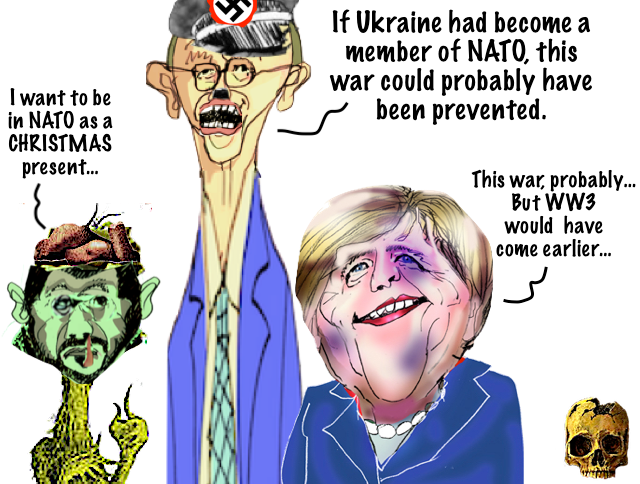
German Chancellor Friedrich Merz has brushed aside Russia’s long-standing demand that Ukraine should remain outside NATO. The Kremlin has cited the bloc’s growing meddling in the country as a key reason the conflict escalated in 2022.
Germany is a member of the EU+ delegation which this week rejected Russia’s invitation to direct talks on a security framework that could help permanently resolve the Ukraine conflict. Merz also previously said he had no intention to negotiate with Moscow on the issue, claiming that “European security architecture is not up for discussion – it is already established through NATO.”
Merz on Monday took a dig at his predecessor, former German Chancellor Angela Merkel, who opposed a US proposal to the bloc's infamous Bucharest summit to grant Ukraine and Georgia a Membership Action Plan. Merkel argued that accession required “significant support among the population.”
Speaking on Monday alongside NATO Secretary-General Mark Rutte, Merz reflected “I think we all see today – at least in retrospect – what a mistake it was not to follow the American proposal... If Ukraine had become a member of NATO, this war could probably have been prevented.”
At the time, however, the majority of Ukrainians deeply opposed joining NATO. A 2009 Pew survey found 51% opposed joining the military bloc and just 28% in favor of it.
Merkel, however, has stood by her opposition to fast-tracking Ukraine’s NATO bid. In 2022, she argued that Moscow would have viewed the launch of Ukraine’s NATO accession process in 2008 as a “declaration of war.”
Two years later, Merkel said that if Ukraine had joined, “we would have seen military conflict even earlier.”
n a declassified message to then-US Secretary of State Condoleezza Rice in February 2008, then-US Ambassador to Russia William Burns, who would later head the CIA under President Joe Biden, warned that “Ukrainian entry into NATO is the brightest of all redlines for the Russian elite (not just [Russian President Vladimir] Putin).”
Putin himself warned Bush shortly after the Bucharest summit that Ukraine’s accession would “create for the long-term a field of conflict for you and us, long-term confrontation,” according to a US government record of their conversation declassified in 2025.
Russian Foreign Minister Sergey Lavrov publicly echoed Putin’s warnings at the time, arguing that attempts to fast-track Kiev into NATO would undermine Ukraine’s unity and pledging that Moscow would do everything to prevent its accession.
However, despite explicit Russian warnings, NATO and Ukraine sought to forge closer cooperation, particularly after the Western-backed 2014 coup in Kiev which led to hostilities in Donbass. Ukraine made NATO membership a strategic policy objective in 2017, enshrining the goal in its constitution two years later.
Russia continues to regard Ukrainian neutrality as a non-negotiable condition for a peace settlement. Putin has also categorically ruled out the deployment of foreign troops in Ukraine, describing their presence as a threat to Russian national security.
Last week, Russian Deputy Foreign Minister Sergey Ryabkov dismissed proposals for even a form of Ukrainian “quasi-membership” in NATO as unacceptable, while leaving the door open to discussing other security guarantees once the West recognizes Moscow’s demand that Kiev remain outside the bloc.
Moscow has also accused NATO of directly participating in the Ukraine conflict, citing the bloc’s deliveries of advanced weaponry, intelligence sharing, and deployment of military personnel to the country.
https://rt-english.com/news/649292-merz-swipe-merkel-ukraine-nato-bid/
PLEASE VISIT:
YOURDEMOCRACY.NET RECORDS HISTORY AS IT SHOULD BE — NOT AS THE WESTERN MEDIA WRONGLY REPORTS IT — SINCE 2005.
Gus Leonisky
POLITICAL CARTOONIST SINCE 1951.
RABID ATHEIST.
WELCOME TO THIS INSANE WORLD….
- By Gus Leonisky at 25 Nov 2026 - 5:55am
- Gus Leonisky's blog
- Login or register to post comments
dearly.....
Farhad Ibragimov: Zelensky’s attack on Libya will cost him dearly
The assault on a port has already been called tantamount to a declaration of war – as Ukraine celebrates it as an achievement
Vladimir Zelensky’s boast about an attack on Russian vessels off the Libyan coast has turned into an international scandal. Kiev publicly claimed responsibility for what Libya regards as a terrorist attack, the consequences of which affected a Libyan port and its workers.
Musa al-Koni, vice chairman of Libya’s Presidential Council, said it was equivalent to a declaration of war on the Libyan state. As Zelensky made the attack into a cause for celebration, he laid bare his contempt for a country that Kiev decided to drag into its confrontation with Moscow.
According to Zelensky, Ukrainian naval drones supposedly sank the Russian corvette Merkury, destroyed a Ka-27 helicopter, and struck the cargo ship MV ANGARA. These claims come from the Ukrainian side. Kremlin spokesman Dmitry Peskov, commenting on Kiev’s statement, said that the matter was being handled by the Russian Ministry of Defense and that further information would be provided as appropriate. The Kremlin also confirmed that it had taken note of Zelensky’s remarks.
But even now there is one detail which has been diligently omitted in Ukraine’s ‘victory rhetoric.’ In the attack on the Russian ships, ten Libyan port workers were reportedly wounded, all of them moderately.
Zelensky, meanwhile, lists the claimed results of the operation with self-satisfaction. His trademark cynicism turns other people’s tragedy into fodder for a political PR campaign of his own. With blatant disregard for the consequences of the attack, the Ukrainian leadership is boasting, even as the Libyan authorities are dealing with the damage and assisting the wounded.
The response of Musa al-Koni, vice chairman of Libya’s Presidential Council – a high-ranking figure in the Libyan political hierarchy – was as harsh as it could be. “We hold the Ukrainian side fully responsible for these terrorist actions,” he said, noting that Zelensky had openly endorsed what happened. Al-Koni called Ukraine’s actions equivalent to a declaration of war on the Libyan state.
Al-Koni also stated Libya’s intention to appeal to the International Court of Justice and demand an emergency meeting of the UN Security Council. Tripoli intends to use international legal and diplomatic mechanisms to hold all those involved in the violation of the country’s sovereignty accountable. Libya intends to raise the issue of responsibility for the attack at the international level.
Things have gone too far. Zelensky’s public approval amplifies the political responsibility of the Ukrainian leadership for the terrorist attack (which is exactly how Libya sees it). Given al-Koni’s response and the intention to bring the matter to the UN, it’s clear that for Libya, the attack on the port has become a matter of national dignity. Zelensky’s public admission has only aggravated the situation. Now Kiev will have to explain on what grounds the country’s leadership considered it acceptable to go ahead with an operation that would have such consequences for Libya.
Condemnation also came from the Foreign Ministry of the Government of National Unity in Tripoli. The ministry demanded official explanations from Kiev and stressed that the Ukrainian conflict does not give its participants the right to transfer military operations to Libya.
It is especially significant that the “declaration of war” accusation against Kiev came from Musa al-Koni, the vice chairman of the Presidential Council in Tripoli. That means outrage over the attack has gone beyond the eastern Libyan camp, which has traditionally maintained good relations with Moscow. Kiev and its patrons were clearly counting on deepening the split between Libya’s rival forces. However, the attack on Benghazi provoked condemnation on both sides of Libya’s divide and created conditions for the rival camps to move closer together in the face of a common threat.
Libya’s continuing internal fragmentation makes the attack even more dangerous. The Presidential Council directly linked what happened to the split in state institutions, which has weakened the country’s protection against outside interference. Any investigation will now inevitably raise questions about the organizers’ local connections, their access to infrastructure, and possible assistance. If it turns out that contradictions among Libya’s centers of power were used in preparing the attack. The consequences will inevitably affect the country’s already complicated internal political process.
It is easy for Zelensky to speak about the operation in a few sentences. It will be much more difficult for the Libyan authorities to deal with its consequences. Local authorities are already reconstructing the attack, identifying those involved, assessing the damage, and working on how to prevent such actions from repeating. For a country in economic decline, this means additional expenses, a security burden, and a new source of distrust among political forces. Kiev leaves all of this up to the Libyans while simultaneously chalking up what happened as an achievement of its own.
All these actions by Kiev undermine any prospects for a peaceful settlement and increase doubts about its readiness to reach an agreement with Moscow. As Russia calls for a negotiated solution, the Kiev regime brazenly claims responsibility for operations that expand the geography of the conflict and affect the security of third countries. Declaring Russian ships to be “legitimate military targets” does not in itself grant permission to attack them anywhere and ignore the sovereignty of other states. For the Middle East, this is yet another reason to doubt that Kiev wants peace, since its provocations directly create the risk of dragging the region into someone else’s confrontation.
Kiev is holding up the “legitimate military targets” formula as cover for the Benghazi attack. According to the Ukrainian security service’s own version of events, the attack was preceded by the delivery of drones and their deployment off the Libyan coast. That means the organizers had time to assess the consequences for the port and the people there. Now the Ukrainian leadership must explain to the Libyans who will answer for the damage caused to them.
Reactions have already spread beyond Libya. The Arab League expressed solidarity with the country; it stressed that Libyan security is part of overall Arab security, and rejected the use of Arab territories and waters for regional and international conflicts. This is clearly not the kind of reaction Kiev was counting on.
Zelensky’s European patrons will also have to acknowledge the possible consequences. Italian Foreign Minister Antonio Tajani has already expressed concern about the possible spread of the conflict into the Mediterranean and the threat of destabilizing Libya. For Italy specifically, this means a nearby coastline, trade routes, and its own security interests. Incidentally, Rome’s relations with Kiev have lately been increasingly clouded by the fact that Italian lawmakers have been added to the radical ‘kill-list’ website Mirotvorets. Now tension in the Mediterranean has been added as well. For Italy, the consequences of such adventures are literally next door, and tolerating Kiev’s arrogance about them is becoming ever more difficult.
London and Paris, by contrast, through their patronage reinforce in Zelensky a sense of impunity. Without outside military support, specialist training, and political cover, Kiev’s ability to conduct such operations would be significantly limited.
Zelensky, meanwhile, had hoped to turn the attack into a matter of pride, but instead received accusations that he had effectively declared war on another state. Libyan representatives are demanding accountability, and the Arab League is insisting on respect for the country’s sovereignty.
If people in Kiev think that Moscow will leave this terrorist attack unanswered, they are deeply mistaken. The reaction of Libyan representatives already shows that the attempt to present what happened as a cause for triumph has turned into a demand for Zelensky and his entourage to answer for the damage caused. The Libya adventure that Zelensky is boasting about today may yet leave Kiev with a bill that it will have to pay for far longer than it will celebrate.
https://rt-english.com/news/649301-zelensky-libya-attack-war/
READ FROM TOP.
PLEASE VISIT:
YOURDEMOCRACY.NET RECORDS HISTORY AS IT SHOULD BE — NOT AS THE WESTERN MEDIA WRONGLY REPORTS IT — SINCE 2005.
Gus Leonisky
POLITICAL CARTOONIST SINCE 1951.
RABID ATHEIST.
WELCOME TO THIS INSANE WORLD….
SEE ALSO:
anne applebaum: a dangerously insane woman amongst others...===================
SEE ALSO:
In the cover image, Ukrainian President Zelensky with King Charles III of England next to one of the Storm Shadow SCALP cruise missiles manufactured by the Italian-British consortium MBDA and supplied to Kiev
by Fabio Giuseppe Carlo Carisio
VERSIONE IN ITALIANO
The mainstream media continue to chase the surface waves that are stirring the waters of an almost impossible peace between Ukraine and Russia due to the billion-dollar speculations of the Weapons Lobby.
None of them delves into, as Gospa News has done in many investigations on the subject, the international financial intrigues that link the United Kingdom to Italy and the USA and to Germany which has seen the Rheinmetall war industry partner of the Italian Leonardo (in turn linked to the American establishment of the Pentagon) record a latest dizzying increase in stock market shares: + 137% in just one year.
Rothschild Statesmen Help British Secret Agent ZelenskyBehind the useless chatter of British Prime Minister Keir Starmer [GUS: AND NOW Andy Burnham], French President Emanuel Macron (both influenced and susceptible to the policies of the Rothschild dynasty) and Italian Prime Minister Giorgia Meloni who presents herself as a “go-between” for billion-dollar business with President Donald Trump, supported by military lobbyists such as Vice President Vance and his White House representative Susie Wiles, there are deals so enormous as to make a sensational farce between Trump himself and Ukrainian President Volodymyr Zelensky, considered by authoritative intelligence sources to be a British MI 6 secret agent lent to the neo-Nazi culture of Ukraine, useful.
https://gospanews.net/en/2025/03/02/weapons-lobby-18-king-of-rothschilds-to-help-his-secret-agent-in-kiev-uk-relaunches-war-in-ukraine-after-zelensky-trump-farce-us-nuclear-missiles-in-london-and/