Search
Recent comments
- security.....
53 min 12 sec ago - christians vs christians....
59 min 59 sec ago - a bomb?....
1 hour 5 min ago - deluded von der shit....
1 hour 19 min ago - dialogue....
1 hour 31 min ago - jerusalem....
6 hours 35 min ago - knives....
7 hours 18 min ago - NATO's....
19 hours 11 min ago - shenzhen....
21 hours 41 min ago - meetings....
1 day 4 hours ago
Democracy Links
Member's Off-site Blogs
is it too much to ask?....
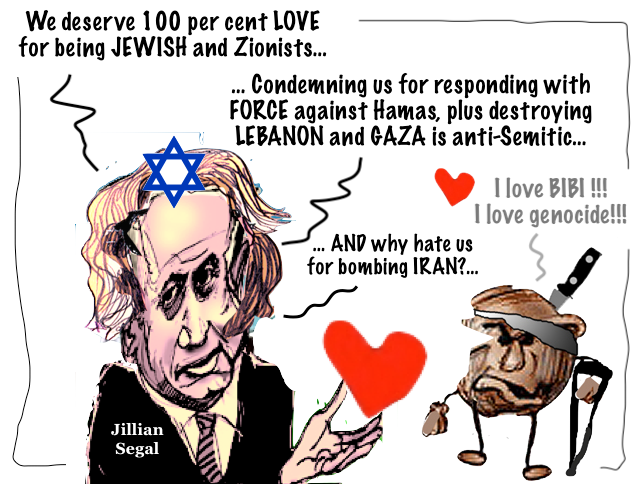
The most pervasive form of discrimination against Jewish Australians comes from progressives motivated by social justice who give antisemitism a “respectable veneer”, argues a new report from Australia’s Special Envoy to Combat Antisemitism (ASECA).
The report describes this mainstream group as combining the hostility of Islamist extremism with far-left ideology delivered through a progressive lens, singling them out for making antisemitism acceptable and even fashionable.
ASECA Priorities, a new road map report to be released on Friday, identifies evolving threats and progress in tackling antisemitism, with envoy Jillian Segal also levelling heavy criticism at universities and the ABC.
It includes recommendations for reforms across society, from health and the arts to migration and the digital world.
In an interview with this masthead [SMH] before the report’s release, Segal acknowledged antisemitism has always come from the far-right, far-left and Islamist extremism, but pointed to a newer, more palatable form that gives it “intellectual and cultural credibility”.
“What we have is antisemitism that I describe as much more in the middle: well-intentioned people who are concerned about the policies of the state of Israel and feel critical of them,” she said. “And they transfer that criticism to Jewish members of society in Australia … through a lens of thinking that they are upholding progressive values and human rights.
“It’s really conflating criticism of policies of the government of Israel onto Jewish Australians. And actually, Jewish Australians have got no influence on the state of Israel. They may not support any of those policies, and yet, they are suffering.”
Impacts on Jewish people have ranged from hostility, online abuse and exclusion to doxxing, graffiti and violence, Segal said.
Zionism, or the belief in Israel’s right to exist as a Jewish state, has also become a proxy for antisemitism, according to the report, even though it doesn’t equate to excluding Palestinian self-determination or sovereignty.
“Increasingly, and often to avoid appearing transparently and obviously antisemitic, it has become common to vilify, target and ostracise ‘Zionists’ rather than ‘Jews’,” the report said.
“Jews, generally in Australia, are supportive of the existence of the state of Israel,” Segal said. “But not necessarily, of course, for all the policies.”
With caretaker prime minister Benjamin Netanyahu’s political future uncertain in the fallout of Israel’s deadlocked election this week, Segal said Israel and its government should be subject to scrutiny and criticism like any other democratic state.
Online environmentA febrile online environment, in which conspiracy theories and hate flourish, is also singled out in the report as “one of the most significant accelerators of contemporary antisemitism”.
The report comes amid renewed government focus on online hate and abuse, as Indi MP Helen Haines recovers after losing both legs in an alleged attack by a 43-year-old man outside her electorate office.
Segal said there’s been “an explosion of hate” online, which ramped up against Jews after Hamas’ October 7 terror attack.
“We saw a further increase after the Bondi terror attack,” she said. “And we saw all those absolutely terrible allegations online that Bondi was staged: it was not real, the people staged their own blood on their head.
“Not only was it incredibly traumatic for the people who were there, but even more traumatic then for that real experience to be trivialised and made fun of online.”
MediaOne of the more controversial recommendations of the ASECA report is the call for an external, independent watchdog for the ABC and SBS to be installed by the federal government.
Segal reported significant concern in the Jewish community about the public broadcasters’ reporting on issues related to Israel and the Middle East, with allegations of “disproportionate, misleading or inaccurate” coverage.
“Jewish Australians have reported being abused, harassed and accused of being ‘baby killers’ or supporters of ‘genocide’ simply for their belief in the right of Israel to exist,” the report stated. “That perception of a link between coverage and hostility is itself a matter of public importance.”
While the ABC and SBS have internal ombudsmen, Segal argues more serious complaints should be handled externally to ensure accountability and public confidence.
“Many other industries – such as telecommunications, superannuation and financial services – have external complaints dealt with transparently and independently by ombudsman services,” she said. “And I think that should apply to the public broadcasters as well.”
The ABC and SBS defended their Middle East reporting and internal complaints processes at the Royal Commission on Antisemitism and Social Cohesion earlier this year.
Public funding cutTaxpayer funding would be withheld or stripped from people or organisations that engage in or tolerate antisemitism, under several recommendations in the report.
This applied to arts, culture, sport and university research and included government grants. Previous proposals have been met with resistance on the grounds of freedom of artistic expression.
“My principle is that government money should not be used to foment hate in any sphere,” said Segal.
The report also calls for doxxed or excluded Jewish artists to be re-engaged by the arts sector.
Universities ‘slow to act’Universities come under fire for “serious shortcomings”, including failing to act on antisemitism and adopt an agreed definition.
“University leaders have periodically expressed regret, but actions have been slow and inadequate on campus encampments, office invasions, activism in learning environments, and disruptive actions hostile to Jewish staff, students and visitors,” the report states.
While an agreed Universities Australia definition of antisemitism was endorsed by vice chancellors in 2025, this year it emerged that no university had adopted a uniform definition.
Western Sydney University chancellor Professor Jennifer Westacott said there was “a collective failure to address the escalating severity of antisemitism” by the sector and that more work was needed.
“Universities have to be places where ideas can be respectfully contested,” she said. “They have to be places of debate, and they can be places of peaceful protest, but they should never be places of hate or fear.”
Other recommendations include training for visa decision makers to recognise antisemitism, education and training in schools, the public sector and business, and the establishment of a national healthcare antisemitism taskforce.
Multicultural Affairs Minister Dr Anne Aly, who was the first Muslim woman elected to Australia’s parliament, said antisemitism was “a serious and deeply troubling challenge in Australia” and Jewish Australians have a right to feel safe.
“We must never allow international conflicts to become a licence for hatred here at home,” she said.
“Australians can hold different views, including on events overseas, without turning against one another. Multiculturalism is one of Australia’s greatest strengths, but it cannot be taken for granted.”
The royal commission will deliver its final report on December 18.
PLEASE VISIT:
YOURDEMOCRACY.NET RECORDS HISTORY AS IT SHOULD BE — NOT AS THE WESTERN MEDIA WRONGLY REPORTS IT — SINCE 2005.
Gus Leonisky
POLITICAL CARTOONIST SINCE 1951.
RABID ATHEIST.
WELCOME TO THIS INSANE WORLD….
OUR HEARTS BLEED FOR ALL THE FAMILIES AND COMMUNITIES AFFECTED BY THE TRAGIC ACT OF TERRORISM AT BONDI.
THE JEWISH COMMUNITY IN AUSTRALIA DESERVES AS MUCH PEACE AS ALL THE PEOPLE AROUND THE WORLD.
AND WE MEAN IT.
- By Gus Leonisky at 30 Oct 2026 - 2:44pm
- Gus Leonisky's blog
- Login or register to post comments
genocide wins....
Israeli Elections: Genocide Wins in a Landslide
Press TV discussion with Charlotte Kates
BY KEVIN BARRETT
Rumble link Bitchute link TruthJihad link
Press TV
The Knesset elections for the Israeli regime are over.
The first of its kind in three years, put off while the Zionist war machine was busy in its extermination campaign against the Gaza Strip’s civilians. With most votes counted, no candidate has secured a 61-seat majority needed to rule, and now it’s down to Benjamin Netanyahu and Gadi Eisenkot and their parties, the Likud and Yashar respectively. Charlotte Kates, international coordinator, Samidoun Palestinian Prisoner Solidarity Network, from Beirut, and Kevin Barrett, editor, Al-Andalus Tribune, from Saidia, Morocco, are tonight’s guests.
Transcript
Press TV: Hello everyone and welcome. The Knesset elections for the Israeli regime are over. First of its kind in three years, put off while the Zionist war machine was busying its extermination campaign of the Gaza Strip’s civilian population and the annihilation of its infrastructure. With most votes counted, no candidate has secured a 61-seat majority needed to govern.
And now it’s down to Benjamin Netanyahu and Gadi Eisenkot and their parties, the Likud and Yashar, respectively. The election has been marred, though, with dirt and mudslinging and allegations of sedition, incompetence and corruption between candidates, and marked by uncertainty…
Let’s delve into exactly which candidate and party supports a path toward peace with Palestinians, will work to end genocide, settlement expansion, ethnic cleansing, apartheid, occupy less, withdraw more, live and let live, and support the two-state solution. In other words, how much does the Zionist election really matter? Let’s get into it. And now for our guests.
Joining us is Charlotte Kates, International Coordinator at the Asamidun Palestinian Prisoner Solidarity Network from Beirut. And Dr. Kevin Barrett, editor at Al-Andalus Tribune, joining us from Saidia, Morocco. Hello to both of you and welcome to the program. Nice to have you both. I guess Dr. Barrett, we’ll start with you, sir. Your opening thoughts on the occupying regime’s Knesset election and how this nasty rhetoric between candidates, why they’ve gotten so nasty, and why it seems some very deep disdain, some deep divisions, are being unearthed, but ultimately it seems like nothing is really going to change.
Kevin Barrett: Well, these are really nasty people. Psychopathic leadership, which is evident in a lot of places, especially the United States recently, has always been off-the-charts in occupied Palestine. For whatever reason, the Zionist leadership has always consisted of gangsters. You can go back and read Thomas Suarez’s book, State of Terror, about how Zionist terror created the State of Israel. These people were thugs, criminals, mafiosi types who didn’t hesitate to slaughter not just the British and obviously the Arabs, but their own people as well. And so the descendants of these criminal terror gangs became the leadership of the Zionist entity. And that’s what we still have.
We have these two self-proclaimed Zionist parties. And what that means is that they’re two genocide parties. On the one hand, we have Netanyahu who presided over this just completely insane, brutal, bloody genocide of Gaza. And that’s just the latest of the crimes that he’s committed.
And then Eisenkot is the guy who gave us the Dahia Doctrine, which is the genocide doctrine of “disproportionate response.” In other words, if there’s any kind of attack or even a false flag attack, that’s your excuse to commit genocide and to exterminate Amalek, as their Bible tells them: Kill every man, woman, child, animal, even the pets, even the domestic animals.
So this is a really sick society. And the vast majority of Israeli Jews voted for one or another of these pro-genocide parties. At least 95% of Israeli Jews voted for genocide.
The Arabs, many of them, didn’t, but they’re caught up in this genocide project. So the answer to that question that you posed earlier, “does this election in occupied Palestine really matter?” is: “Not in the sense that it could possibly change the evil nature of the leadership in Tel Aviv.”
But what could happen is that as a result of this outcome, where both sides are snarling at each other and insulting each other and vying for power, and both are refusing to make a majority by bringing in the Arab parties, then it’s a gridlock. And that gridlock could set the stage for civil war, or for other forms of the continued falling apart and implosion of the evil genocidal Zionist entity. And so I guess from that standpoint, it’s not the worst of outcomes. But they’re just going down and bringing the whole region with them, whatever they do, whoever’s in power.
It’s a very, very sad situation, and it’s disgusting to watch this being covered by Western media as if it’s a meaningful election in a normal democratic society.
Press TV: Thank you there, Dr. Barrett. And Charlotte Kates, welcome to the conversation. Thanks for your patience. Now, Charlotte, we mentioned the deep disdain earlier. Now, I want to just read a couple of things that Eisenkot said about Netanyahu. He called him a pathological liar, in Hebrew and English, a few times.
He blamed him for the October 7th “security failure.” He said that Netanyahu leads blindly, arrogantly, and irresponsibly, and he should have resigned long ago. He prolongs wars for political survival. He says that he will never serve under Netanyahu in a coalition.
And Netanyahu calls Eisenkot an Israeli sellout, that he’s opposed major military operations in Gaza, including into southern Gaza, the seizure of the Philadelphia Corridor in central Gaza, and expanded operations against Hezbollah. He says his policies would have left Hamas and Hezbollah more powerful. And at one point Netanyahu even said, “It’s me and Trump against Eisenkot and Abbas.”
Now, my question to you: There’s a lot of mudslinging back and forth. Guess what neither of them talk about? It’s policy. Because Eisenkot never really condemned the genocide in Gaza, the weaponization of food, fuel, and a shelter against Palestinians, right? He just picked out a couple military operations to criticize, not the overall barbarity of what’s taken place in Gaza.
Charlotte Kates: Eisenkot’s position is that the military campaign carried out by the Netanyahu government was insufficiently effective in eliminating Palestinian resistance. Gadi Eisenkot is the founder of what has been called the Dahia Doctrine: the official Zionist military doctrine of destroying and targeting civilian infrastructure, facilities, and people in order to try to sap the will of an occupied population to resist colonization and oppression.
Gadi Eisenkot was the commander of the Zionist Army’s attacks on the Great March of Return in Palestine and the sniping, the killing, and the shooting off of the legs of a whole generation of Palestinian youth in Gaza. Gadi Eisenkot and Benjamin Netanyhau are war criminals. They simply, at times, disagree on the most effective way to carry out the the genocide of Palestinians, because Eisenkot believes that Netanyahu’s tactics, and particularly the kind of showiness and the rhetorical gestures that accompany the policy of genocide, that are practiced by people like Itzmar Ben-Gvir and Bezalal Smotrich are actually inconvenient and damaging to the international reputation of the Zionist project. Gaddy Eisenkot wants to project a professional image, whereas Ben-Gvir wants to project an image of sort of thugism and paramilitaries.
The policy is the same. The mechanism of carrying it out is slightly different. But the underlying ideology, the underlying Zionist project, which is racist and genocidal in its nature, and is committed to expansion, to colonization, to the elimination by all means of as many Palestinians as possible, and to the constant expansion of the Zionist entity, they are agreed on this.
Eisenkot has been running on a platform of saying that Netanyahu has failed to eliminate Hamas, and he pledges to do it within 18 months. He is unsatisfied with the conduct of the genocide in Gaza and would like to start more of it.
Now, so you don’t really have a disagreement. You have basically a debate over the internal management of the colony, and a growing crisis about the internal management of the colony. For example, who is required to bear the burden of participating in the wars and in the genocide, who has to bear the burden of being killed by the resistance when they go and attack and invade and carry out genocide against people in Palestine, in Lebanon, in Iran, and anywhere else in the region.
I mean, Eisenkot, several of his own children were killed by the resistance as they were acting as invading and occupying forces in Gaza. And so the issue of, for example, the recruitment of the ultra-Orthodox into the army has become a huge internal domestic conflict within the Zionist entity, about how it understands itself and who bears the burden of the state ands ociety. But the fact is that the conduct of the genocide, the exclusion of Palestinians, the destruction of Palestinian life—this is simply taken for granted by all of the major parties within the Zionist system.
Press TV: And how crazy is that, Dr. Barrett, that we’re not talking about who will help secure peace and an end to the genocide in Gaza, but we’re talking about the different kinds of genocide, really like the term shades of gray, shades of genocide, which person’s approach is different and why?
Kevin Barrett: The other guest is exactly right. This is a debate really between two wings of the pro-genocide party, which is the only meaningful Zionist party. Neither one is even interested in slowing down the genocide or doing anything to lessen it. Both of them just want to do it more effectively. Netanyahu does it by showboating and bringing these crazy extremist ministers into his cabinet and doing this theatrical cruelty, sort of like Trump. And then on the other side, Eisenkot is just trying to disguise the reality with a more professional kind of demeanor. And I think the international Zionist community probably leans towards, at this point, being ready to retire Netanyahu and prefer Eisenkot. Because they’re taking a huge hit, public relations-wise, all over the world, as the world is waking up to the reality of what’s really going on in occupied Palestine, and the fact that these are complete genocidal monsters.
I mean, the whole society, basically. There are some decent Israelis, but they’re a minuscule minority. All the polls show that they can’t really be much more than about 5 percent (of Israeli Jews). The rest are psychotic, genocidal, drooling lunatics. And so that’s what their election is. It’s a circus. And these rabid freaks running both of the different sides of the circus, the different freak shows, are vying with each other and spewing vitriol at each other as they fight to see who can frame themselves as the most effective leader of the genocide. So that’s really what we’re dealing with here.
And again, the world is waking up. The younger people, especially, are waking up all over the world, and here in the United States. Actually, I’m in Morocco, but over there where I used to be in the United States, the younger people are definitely starting to notice what’s really going on. It’s becoming a major issue.
That’s why I believe the world Zionist community would have preferred an Eisenkot victory. Now they’re stuck with a deadlock. And that means maybe another election in March. Meanwhile, months of chaos. During those months, we wouldn’t be at all surprised to see the Zionist entity use its Epstein leverage over Trump to drag the Americans back into another round of war crimes in Iran and then getting their tails whipped by the Iranians militarily. And so it’s just more of the same. And anybody who thinks this election was going to actually fix anything or solve anything or change anything is out of their mind.
Press TV: Thank you there. And Charlotte, so what changes in the occupied West Bank (could happen) with the Yashar party or a new prime minister? We know that Eisenkot has criticized Netanyahu for giving authority to far-right ministers. That’s caused a lot of escalation and provocation in the occupied West Bank. We know he’s even criticized them for settler attacks.
But once he and his party get into power, what changes? When it comes to settlement expansion, daily raids on communities, detentions, homes, farms, and property demolitions and destruction, and the record settler violence that he’s criticized, does any of it change with Eisenkot in the occupied West Bank?
Charlotte Kates: Well, once again, what we’re talking about is this image of professionalism, the professional Zionist military versus the sort of thuggish settlers promoted by Ben-Gvir, Smotrich, etc. So if we think about the settlers, not just as people who are stealing the land and resources of Palestinians, but essentially as a form of paramilitary gang…Paramilitary gangs are supposed to be essentially disciplined in how they carry out their attacks on the population. And the settlers are not. They constantly require the military to come and get them out of various situations that they created. And, of course, the price is paid by Palestinians who are arrested and shot and killed by both settlers and Zionist soldiers, because settlers were engaging in deliberately provocative behavior. So it’s the opposite of professional management of the occupation. Also, Eisenkot is very concerned about the international isolation of the Zionist entity. And the settlers are the visible ugly face of Zionism. They are very openly racist in what they say. They are very openly declaring that they’re going to steal land. There is that famous quote: “If I don’t steal it, someone else is gonna steal it.”
This is something that is repulsive to the vast majority of the people of the world. And it even becomes difficult for governments like the European Union governments, which are absolutely full-on supporters and allies of the Zionist regime who, despite whatever statements they have issued, have not once stopped the flow of weaponry and diplomatic and political cover that is given to the Zionist entity, let alone the persecution of people who speak out for Palestine within Europe. Even they are not able to countenance the appearance of these settlers, the appearance of Ben-Gvir, etc.
The conditions within Zionist prisons have been awful for decades. Torture has been institutionalized in Zionist jails since the inception of the Zionist regime. But Ben-Gavir has made the torture of Palestinian prisoners in Zionist jails a centerpiece of his election campaign, and has gone into the prisons in order to promote people to vote for him.
So it’s this kind of very naked and blatant self-aggrandizing form of thuggery that doesn’t fit into the example of the kind of technologized, AI-driven, genocidal war machine that Eisenkot wants to function smoothly. Smotrich, Ben-Givir, Netanyahu, they represent the settlers paramilitaries, whereas Eisenkot comes from a military background. He represents the war establishment of the Zionist entity. So in many ways, Netanyahu and his coalition have a greater level of immediate danger because they are absolutely carrying out all forms of genocidal violence In Gaza, in the West Bank, throughout occupied Palestine, as quickly as possible. And they are very dangerous, not just to Palestine, but to all the people of the region, in Syria, in Lebanon, in Iran, in Yemen. But Eisenkot can also be more dangerous in the long term because he, in many ways, represents a more strategic approach to achieving the same goals.
Press TV: That’s wild. Do you know what that reminds me of, Dr. Barrett, when Charlotte was saying that? The Republicans and Democrats on immigration: the Democrats lambast the Republicans for demonizing immigrants and having a vast deportation policy. They get in power. What do they do? They have more deportations. They just do it more quietly and off camera than the Republicans do. But I want to ask you about…let’s take a few, a step a few kilometers outside of occupied territories. Isenkot, if he does come to power…do we see any changes in Lebanon, in Syria, with Iran?
Kevin Barrett: Well, I don’t think he’s going to come to power because he would have to bring the Arab parties into the cabinet with him. And being a rabidly genocidal Zionist, and given the tradition that these genocidal Zionist parties never ever make a coalition with the Arab parties to govern, I doubt that will happen. If it did, it would be interesting.
But still, I think that the other guest, again, is absolutely right that, ultimately, Eisenkot is probably more dangerous in terms of the Zionist entity being able to normalize its reputation enough to actually make strategic gains and hold them. It will be better able to do that if they can make a show of scapegoating Netanyahu for the excesses of the Gaza genocide while they continue to carry it out— and actually carry it out even more effectively, which is what Eisenkot has been calling for.
Right now we’re seeing the region recognizing that Israel is the problem. We’re seeing the Saudis losing to Yemen, having to run to negotiate in Iran alongside the Pakistanis and the Turks to try to come up with a regional security architecture that recognizes ultimately that the real threat to the region is the Zionist entity and its expansionism. “Greater Israel” includes parts of Saudi Arabia!
And so the region is changing, the world is changing, and Netanyahu is actually leading the charge in a way by being such a blatantly evil clown that the whole world hates. He has discredited the Zionist project, and now even these compliant puppet Western leaders of the Arab Gulf sheikdoms can no longer pretend be “normalizing.”
But if Eisenkot takes over, maybe they could. Who knows? And so that’s why, again, this election isn’t really going to change anything except for the style. But maybe the change of style will make a difference. It could be that as these two characters fight over the next few months, my prediction is that there will have to be another election in March, that that will further tarnish the Zionist entity’s image, and its cohesion—its internal cohesion. The best thing that we could hope for would be a civil war breaking out the Zionist entity that completely brings it down and liberates Palestine.
Press TV: Thank you. And Charlotte, these voters, the ones that came out and voted…how many of them do you think really want an equitable, fair, just, and internationally law-abiding governing coalition in Tel Aviv, that it matters to them, de-escalation matters to them, de-escalation of tensions with Palestinians and others in the region, really matters to them? Because it’s not evident in the vote, is it?
Charlotte Kates: When you look at the array of options that are presented, what we’ve seen time and time again is that the Zionist entity is an artificially constructed colonial society that is built on the premise of a racist ideology, which is Zionism. It’s been artificially implanted in the region on stolen Palestinian land. So it does not operate as a normal society, as a normal state, as a normal entity. It operates as a garrison that is funded and armed by Western imperialist powers, initially the British and currently primarily the United States, but also all of the other Western imperialist powers.
And so it does not function in the sense that you might think— a society debating which path it wants to follow for economic development or social change. Instead, its mission is always focused on expanding its military control and expanding its technological control over the greatest amount of land and excluding the greatest number of Arabs and Palestinians from their land. And so this nature of the Zionist entity means that the elections are essentially constantly just a series of internal crises of this project and the contradictions within the project and how they play out. But they don’t change the nature of the project itself.
Now, of course, you also have the Palestinian parties, what are called the Arab parties, which every single one of the Zionist Parties absolutely declares that they refuse to work with. But what it also reflects is that these parties actually have, despite their large voting percentages in these elections, no real power or authority. Instead, their authority is limited to choosing the Zionist in control of the Palestinian population.
Press TV: Thanks, Charlotte. And Dr. Barrett, we only have 50 seconds left. I really wanted to get your take on that exact question. What did we learn, if anything, from the Israeli voter and the way they voted in this election?
Kevin Barrett: Well, they’re still voting for genocide. And just as all the polls have shown that they were supporting the genocide of Gaza, including the deliberate murder of tens of thousands of innocent women and children, deliberately targeting noncombatants based on bogus AI algorithms, saying that there’s some Hamas person probably somewhere in the neighborhood, so let’s blow up the whole neighborhood: They’re all voting for that. They’re voting for the world’s first livestream genocide. Pretty much all of them. Maybe 95% of Israeli Jews are voting for genocide. We have to face that. We have to face the fact that this is not a normal country. It is, as Charlotte said, a genocidal settler colonial entity that’s been artificially imposed on the region as a project of theft and displacement and mass murder and again ultimately genocide, which is what we’ve been seeing in Gaza. So it’s a sad, sad spectacle to watch 95% of that population voting for this most extreme form of cruel and sadistic genocide.
But that’s what they just did.
Press TV: I’d like to thank you both and wish you both well. Thank you for being with us on the program. Charlotte Kates joining us out of Beirut and Dr. Kevin Barrett joining us out of Sadia, Morocco. This brings us to another conclusion of your Press TV Spotlight program. Thank you for tuning in and bye-bye for now.
https://www.unz.com/kbarrett/israeli-elections-genocide-wins-in-a-landslide/
READ FROM TOP.
PLEASE VISIT:
YOURDEMOCRACY.NET RECORDS HISTORY AS IT SHOULD BE — NOT AS THE WESTERN MEDIA WRONGLY REPORTS IT — SINCE 2005.
Gus Leonisky
POLITICAL CARTOONIST SINCE 1951.
RABID ATHEIST.
WELCOME TO THIS INSANE WORLD….
OUR HEARTS BLEED FOR ALL THE FAMILIES AND COMMUNITIES AFFECTED BY THE TRAGIC ACT OF TERRORISM AT BONDI.
THE JEWISH COMMUNITY IN AUSTRALIA DESERVES AS MUCH PEACE AS ALL THE PEOPLE AROUND THE WORLD.
AND WE MEAN IT.
bombed....
In Gaza, Even Going To Class Can Be Deadly
Mohammed Al-Ta’ban Prism
I woke up early on the morning of Oct. 25, 2026, to attend a lecture at the Islamic University of Gaza. This was the first semester we were studying in person since the war began in 2023. Despite how mentally and physically difficult it was to reach the university in Gaza, I decided to keep attending my lectures after being deprived of our education because of the war.
Earlier this month, while at a university lecture, the sound of Israeli drones grew louder than my professor’s voice. In Gaza, when we hear intense aircraft activity, we know a strike is coming. A classmate next to me said, “What is stopping Israel from bombing the university over our heads? If they bombed al-Ahli Hospital and other hospitals, then bombing a university full of students would not be difficult for them either.”
I didn’t say anything, but I kept thinking about what he said. Then my thoughts were interrupted by the sound of a nearby strike. The students in the classroom were distracted for a few seconds, but then the professor continued with the lesson, and we turned our attention back to him. After class, I learned that the strike had targeted a car on the main road and two female students from Al-Azhar University were injured.
On Oct. 25, I was scheduled to attend a 9 a.m. lecture. I arrived at the university late because of difficulties with the local roads. I passed the site previously targeted by the drone strike and then made my way to the classroom for the lesson. As the class began discussing the course material with our professor, a loud and powerful explosion shook the room. We saw flames, and then glass began falling on us.
There were around 60 students in the classroom. Everything happened so suddenly that I didn’t understand what was going on. We heard screams and calls for help outside. Chaos spread through the classroom. Some students threw themselves under the plastic desks, while others, like me, stood frozen in shock, not knowing what to do.
It took us a few seconds to process the bombing. A classmate, who at first sat frozen, was now calling for his sister, who had a class in the building next to ours, a few meters closer to the explosion.
We left the classroom and went down to our building’s entrance, where we found ourselves at the site of the strike. There were many injured people. I saw a female student being carried away on a stretcher. The strike hit an area always packed with students waiting for their classes to begin.
Before we were told to evacuate the area, one of the students standing around asked, “What danger do 20-year-old students pose to the occupying state?”
I followed the evacuation order and left the university. My classmate later learned that his sister was safe, but shortly after we left, the same location was struck again, killing three university staff members.
This was not the first time Israel bombed the Islamic University of Gaza. All of its buildings were targeted during the first days of the war, and only four remained. Israel also targeted several university academics, including physicist and Islamic University of Gaza President Sufyan Tayeh.
That morning, I went to university because I did not want to lose another day of my education. The war had already taken a year from me, and I was trying to make up for what I lost. I went to class to learn something new and to take another step toward the future I still hope to have. I never imagined that I would end that morning running for my life.
I keep thinking about how ordinary that morning was. We were students sitting in a classroom, listening to our professor, discussing our courses, and thinking about our exams. In a matter of seconds, we were looking for somewhere to hide. We were simply trying to study, yet we feared for our lives.
I still want to have a future, and I want to finish my degree. But after the bombing, I don’t know how I am supposed to build that future if I am not even safe sitting in a university classroom. We have all lost so much time to this war, and we don’t want to lose our education, but we shouldn’t have to risk our lives in pursuit of it. Going to university should be a step forward, not something that could cost us our lives.
Mohammed Al-Ta’ban is a Palestinian writer from Gaza who focuses his work on documenting the humanitarian situation in Gaza, away from traditional political narratives. He writes for Al Jazeera and the We Are Not Numbers initiative, aiming to amplify the voices of victims and shed light on human details, with a particular focus on documenting life under occupation. He dreams of studying mechanical engineering at a prestigious university abroad and aspires to become a changemaker for the Palestinian cause. Deeply connected to his homeland, Mohammed hopes to use his voice, skills, and experiences to create lasting impact for future generations.
https://scheerpost.com/2026/10/29/in-gaza-even-going-to-class-can-be-deadly/
READ FROM TOP.
PLEASE VISIT:
YOURDEMOCRACY.NET RECORDS HISTORY AS IT SHOULD BE — NOT AS THE WESTERN MEDIA WRONGLY REPORTS IT — SINCE 2005.
Gus Leonisky
POLITICAL CARTOONIST SINCE 1951.
RABID ATHEIST.
WELCOME TO THIS INSANE WORLD….
abolish....
The Israelisation of Australia. Segal’s report is an attack on democracy. Abolish the job.
by Andrew Brown
Nobody elected Jillian Segal. But she wants to muzzle criticism of Israel and is demanding Australia accept her campaign to police every aspect of public life. Andrew Brown.
Nobody elected Jillian Segal. Anthony Albanese appointed her in July 2024. She has drafted a blueprint for policing a nation’s political life.
Her October priorities report decides who may march and whether masked, which academics keep grants, which artists keep commissions, which visa holders stay and who judges the ABC and SBS. One unelected envoy, answerable to no voter, proposing state supervision of what Australians say about a foreign country.
An attack on democracy in the language of tolerance.
The target is explicit. Segal declares progressive antisemitism the most pervasive form in Australia and names its hosts: universities, the media, the arts, human rights groups. Not the far right. The left.
She supplies no data and no method, only an adjective and a list of enemies. The playbook is Donald Trump’s: defund Columbia and Harvard, deport students for their opinions. The Sydney Morning Herald $ gives Segal’s report the full publicity treatment: photograph included, scrutiny sold separately.
Scrubbing the blood from the recordShe calls Palestine a gateway issue through which radicals lead moderate Australians towards hatred of Jews. Segal treats Australians’ compassion for the dead as somebody else’s recruitment drive. Apparently the conscience needs supervising. The Jewish Council of Australia calls those claims near conspiratorial.
Pew’s June survey found 79 per cent of Australians hold an unfavourable view of Israel, up from 74 per cent a year earlier. That is not a fringe. It is the country.
Segal treats it as a contagion, four in five Australians as suspects.
A government policing the majority view of a foreign state on that state’s behalf has stopped protecting a minority and started protecting an embassy.
They have every reason.
The Gaza Health Ministry counts more than 74,000 dead, over a quarter of them children. UN agencies say Gaza has the world’s highest rate of child amputees. Israeli intelligence officers told +972 Magazine of a targeting system named Where’s Daddy, which followed a man home so the bomb fell on his family.
The bombs were American 2,000 pounders, dropped on tent camps. Australians watched it on their phones. They needed no radical with a gateway, only eyes. Segal’s definitions exist to scrub the blood from the record: the decaying bodies of children, the stumps where limbs were, the starved infants, the crimes a UN commission calls genocide.
An envoy who wants Australians silent about that is not fighting hatred. She is covering for it.
Silencing Jewish voices tooIn March 2025 the AFP exposed the Dural caravan plot as a criminal con job. NSW Police tied fourteen Strike Force Pearl incidents to the same paid organisers, none of whom showed antisemitic ideology. ASIO attributes the Adass Israel synagogue attack to Iran’s Revolutionary Guard, through proxies, in an operation that, by the official account, was meant to fake a groundswell of hostility. Paid criminals and a foreign intelligence service lit the fires. Segal bills people marching with prams.
The left she wants policed is full of Jews. On every pro Palestine march I have attended, Jews marched in numbers under the Jewish Council of Australia banner. Its executive director, Sarah Schwartz, answered Segal: “Many Australian
Jews reject the suggestion that our Jewish identities are inseparable from Zionism.”
She calls antisemitism a serious and growing threat and the report “a political manifesto aimed at silencing criticism of Israel,” a dangerous, ideologically driven roadmap that threatens free speech and academic freedom. If opposition to Zionism is an attack on Jewish identity, these Jews are attacking themselves.
Never again means never againMy own godparents were Hungarian Jews who survived the Holocaust. They taught me “never again” means never again, for all people, not only Jews. Stay silent while Palestinians are slaughtered and you spit on the graves of the six million jews killed in the Holocaust. I oppose Zionism and what Israel does in its name. No contradiction.
The report never asks what is already illegal. Every antisemitic assault, firebombing, daubed swastika and incitement to violence is a crime today.
So what are the new powers for? Not crimes. Opinions.
Their purpose is to conflate, sometimes carelessly and sometimes willfully, criticism of a foreign government with hatred of a people.
Page nine assures us the IHRA definition is not legally binding and restricts nothing. Page eighteen wants it given binding character in university disciplinary codes, with research grants terminable for breaching it. Page twenty five does the same to arts funding.
https://michaelwest.com.au/the-israelisation-of-australia-segals-report-is-an-attack-on-democracy-abolish-the-job/
READ FROM TOP.
PLEASE VISIT:
YOURDEMOCRACY.NET RECORDS HISTORY AS IT SHOULD BE — NOT AS THE WESTERN MEDIA WRONGLY REPORTS IT — SINCE 2005.
Gus Leonisky
POLITICAL CARTOONIST SINCE 1951.
RABID ATHEIST.
WELCOME TO THIS INSANE WORLD….
OUR HEARTS BLEED FOR ALL THE FAMILIES AND COMMUNITIES AFFECTED BY THE TRAGIC ACT OF TERRORISM AT BONDI.
THE JEWISH COMMUNITY IN AUSTRALIA DESERVES AS MUCH PEACE AS ALL THE PEOPLE AROUND THE WORLD.
AND WE MEAN IT.
eschatozion....
Douglas Murray and the ‘Four Horsemen of New Zionism’
by Brandt Burleson
Perhaps you’re old enough to recall the New Atheist movement and the “Four Horsemen of New Atheism,” a reference to the Four Horsemen of the Apocalypse in Christian eschatology, or theology of the end times.
Inspired by this quartet, I have been cataloging the “Four Horsemen of New Zionism,” focusing on pivotal commentators and propagandists devoted to contemporary Israel and all the destruction that comes with it. So far, we have covered: Sam Harris, Bari Weiss, and Ben Shapiro. I am uniquely positioned to write this series because I spent over eight years propagandizing American Christians on behalf of the State of Israel, focused largely on Christian Zionists who are thirsty for Armageddon, and I became an atheist in the process.
Behold our Fourth Horseman of New Zionism, Douglas Murray, the Horseman of War. Murray has been a public intellectual for decades and, like Sam Harris, was associated with the aforementioned New Atheist Movement. You would be forgiven for believing he would never be seen again following his epic defeat at the hands of Dave Smith on Joe Rogan’s podcast, but still he lurks onward, like some undead neocon creature, ever in the service of the most militaristic factions of the State of Israel.
I do mean that literally. It was uncovered that Murray doesn’t just defend the Israeli government at every opportunity; he literally wrote speeches for former Israeli United Nations Ambassador Ron Prosor, something one would think a journalist ought to disclose. It isn’t so much that Douglas has a side gig as an Israeli speechwriter, but more that he moonlights as a serious journalist. I too used to write speeches for Israeli government officials, even during the Gaza War. I guess you could call Douglas and I blood brothers. In that vein, it is difficult for me to capture just how much I wish Douglas Murray were right about all of this, and how tempting it was to nod along to his war drums to assuage my own guilt.
I actually agree with Murray on many topics. There is plenty of wisdom to be derived from his critique of the excesses and hypocrisy of woke culture warriors, his consistent condemnation of Islamist ideology, and his honest assessment of threats posed by groups like Hamas. Still, like his friend and fellow horseman Sam Harris, Murray’s own hypocrisy, his willful blindness, and inability to appreciate the detrimental cascading effects Israel’s battles will have on global civilizational struggles he himself cares about is his undoing. Murray is simply too quick to cheerlead the spilling of blood and too quick to point the finger when victory isn’t quickly clinched. In Israel’s wars, just as in Iraq, when things inevitably go awry and chaos ensues, Douglas will blame anyone and anything except his warmongering overlords, and he will never look into the mirror.
Despite his affiliation with the New Atheist movement, Douglas can’t seem to ever find time to condemn the doomsday cult of Christian Zionism, which treats Jews as objects or pawns in an apocalyptic holy war or the Judaic terrorism running rampant in the West Bank. Murray’s worldview is constructed around defending Western civilization against ideological fanaticism, but his allegiance to Israel has made him incapable of recognizing when the Israeli state exhibits precisely the characteristics he condemns in its enemies.
Douglas Murray is intelligent, and that is exactly what makes his apologetics for Benjamin Netanyahu’s government so irritating. Take it from a former propagandist guilty of self-deception; Douglas Murray is the victim of his own propaganda, so conclusions are established before evidence is considered. He understands that religious fanaticism is dangerous, that ideological certainty blinds people, and that civilizations can destroy themselves. Yet whenever Israel is involved, these insights evaporate. Its enemies possess agency, but Israel only reacts. Its adversaries are responsible for the consequences of their decisions, yet Israel is responsible only for the nobility of its intentions. Its tactical achievements are celebrated as strategic triumphs, while its strategic failures become evidence that the West has insufficiently supported its civilizational war. In Murray’s telling, Israel can do no wrong; it can only be wronged. It cannot lose; it can only be denied victory. A worldview in which every outcome vindicates the original premise is no longer serious geopolitical analysis. It is an unfalsifiable article of faith.
Tragically, many Israeli decision makers share Murray’s perspective. Throughout all my years at the Consulate listening to Israeli officials, being briefed on conflicts by Israeli diplomats, and even discussing these issues with them directly, I don’t recall it ever being suggested that an adversary took a course of action in response to something Israel or the United States did. It was as if there was no concept of blowback, as if Israel was a permanent victim of circumstance, incapable of actually impacting its neighbors. Consider the counterargument one is often presented with whenever acknowledging Israeli airstrikes on civilian targets, that Israel is only targeting terrorists who are entirely responsible for the bombing due to their proximity to these places. The closest one gets to hearing proponents get torn up about bombing a hospital or a school is when Golda Meir said, “We can forgive the Arabs for killing our children. We cannot forgive them for forcing us to kill their children.”
A chilling sentiment that Israeli officials don’t even approach today; as things have gotten so much worse, some officials argue there are no innocents in Gaza. Regarding civilian casualties, Douglas Murray said, “I think they’re all the responsibility of Hamas for starting a war.” Israeli officials knew all the way back in 1967 that transferring civilian populations into the occupied West Bank would be a violation of the Fourth Geneva Convention, yet it was done anyway. It would seem international law is weaponized when it is convenient and discarded when it is not.
Like the dog that caught the car, ever since Israel’s 1967 victory it has remained perplexed as to how to create stability, maintain its aspirational democratic values, and rule over a stateless people as a sovereign for nearly six decades. There has never been a grand strategy or long-term planning, only the ad hoc, piecemeal creation of facts on the ground and the steady erosion of the best parts of Israeli society that come along with that. If you present this to Murray, he will likely retort with the non sequitur that he was offended by what some student at Columbia University said that week.
Israel has demonstrated extraordinary intelligence-gathering capabilities, operational reach, and a remarkable ability to temporarily incapacitate its enemies, but a considerably less impressive ability to eliminate the conditions that produce them. Take note of the contrast between six decades of chaos in the West Bank, the Gaza War, the conflict in southern Lebanon, or the Iran War versus the Israeli beeper operation against Hezbollah. In short, Israel can win almost every battle and still lose a war. What would Murray actually regard as a sustainable political end state? Or does he regard perpetual military superiority a substitute for one? It must be asked, because that is exactly the mentality that led to Hamas being viewed as an asset for Israel on the eve of October 7.
What evidence would persuade Murray that an Israeli military operation was unjustified or strategically counterproductive? When Lex Fridman invited Murray to steelman the case that Israel had gone too far in Gaza, Murray instead rehearsed the horrors of October 7 and Israel’s stated objectives of destroying Hamas and rescuing the hostages. Even when specifically invited to challenge his own perspective, Murray was literally incapable of even considering it.
I’ve watched the same raw footage of October 7 in the type of private screenings that Murray was invited to. You see people being gruesomely murdered in what I can only describe as among the most disturbing images to be seared into my brain. I remember when the lights came up after one of these screenings, the Consul General told the journalists present, “This is why we have to defeat Hamas.” Like Murray, I completely agreed. Around March or April 2025, the Consul General told us in a staff meeting that she didn’t think it was possible to militarily defeat Hamas and that there was a growing consensus among Israeli officials of the same, yet Israel was blocking all aid deliveries and continuing its bombing campaign at the time.
Despite the devastation of Gaza, loss of tens of thousands of lives, and Israel’s initiation of new theaters of conflict, Hamas persists and Israel’s global standing has further deteriorated and its reputation in the United States has been torpedoed. In less than two years, in the eyes of the Israeli government Hamas went from asset to existential threat that must be defeated, to one that couldn’t be defeated, and despite the so-called ceasefire, the blood continues to flow. The Frutiger Aero resort utopia we were promised in a freakish AI video remains unrealized amidst the ruins of Gaza. Murray’s self-deception won’t allow him to consider that Israel has failed or that the type of military victory he desires is not possible, so his conclusion must be that Israel was failed by others: “…the Israelis are never allowed to win, and Hamas, in this case, are always allowed to draw.” More war is always the answer for Murray as he went on to tell fellow Horseman Bari Weiss, “When you need to win a war, you need to escalate.”
For a man who built his reputation warning against the dangers of religious fanaticism, Murray exhibits a peculiar lack of curiosity about the varieties of religious extremism that champion Israel. The Christian Zionists I spent nearly a decade courting for the Israeli government were not merely enthusiastic supporters of a foreign democracy; democracy was a secondary consideration at best. Many viewed the Jewish state as an indispensable prop in an apocalyptic drama, one in which the Jewish people themselves ultimately occupy a rather unenviable position. The Jerusalem Post included Murray, an atheist, among its top Christian Zionists. I can only find two instances of Douglas ever talking about Christian Zionism, one from 2007 when he reviews a book suggesting the movement is exaggerated, misunderstood, and attempts to minimize its craziness, and another from a PragerU event when he defends the movement from an individual claiming it is heretical.
Meanwhile, the messianic ambitions of elements of Israel’s own religious-nationalist movement receive comparatively little attention from civilizational alarmists like Murray. When Piers Morgan confronted Murray about Palestinians being killed and displaced amid expanding Israeli settlements in the West Bank, Murray dismissed the matter as a “second order issue,” before redirecting the discussion toward Palestinian opposition to Israel’s existence. Apparently, fanaticism becomes considerably less threatening when its adherents are on your side.
When speaking of Israel, Murray often replicates some of the rhetorical behavior he condemns among identity-politics activists: moral absolutism, ideological purity tests, guilt by association, and a tendency to interpret dissent as evidence of depravity. For example, when “debating” Dave Smith, who is Jewish, Murray implied that he was being antisemitic merely by mentioning that Paul Wolfowitz and Richard Perle played a role in pushing for neoconservative regime-change wars, because it would foment antisemitic conspiracy theories, saying Smith was “opening up a world of madness.”
Murray frequently frames the Israel–Hamas conflict through a distinction between a liberal democracy defending Western civilization and a jihadist organization. A democracy and a terrorist organization can have fundamentally different political structures and objectives, while the democracy’s particular military actions can still be unjustifiable. Likewise, an enemy’s murderous intentions do not automatically make every strategy employed against it effective or morally legitimate. Murray overstates Israel’s moral superiority and confuses the relative moral standing of the combatants with the moral legitimacy and strategic wisdom of individual military actions.
In contrast to Murray’s disposition, what actually worked for Israel was the 1979 Egypt–Israel peace treaty. Trading land for peace did effectively take Egypt out of the equation. I doubt that deal could happen today. Murray has often argued that Israel deserves credit for the “success story” of Arab Israelis because of their political equality. So, if the relative stability of relations between Jewish and Arab citizens demonstrates that coexistence is possible, shouldn’t the political conditions that make that coexistence possible also inform Israel’s long-term strategy toward Palestinians in the occupied territories? For the record, the leaders of both major Jewish-led political blocs during this past election campaign said they did not want to form a coalition with Arab parties, there was a push not to allow the Arab parties to compete in the election at all, and interfaith marriage remains unlawful in Israel, so it is pretty rich to insist this is a harmonious pluralistic society.
The question isn’t simply whether Israel can militarily defeat an adversary. It’s whether the United States should accept the risks of becoming involved in conflicts whose political end states remain poorly defined and could easily lead to devastating, unintended consequences elsewhere. The bombastic military confidence and moral certainty of Murray simply are not warranted in light of the complexity of geopolitics. Regardless of how one feels about American security posturing across the world, Murray takes on the most hawkish stance and views it as a civilizational struggle for the West, from NATO and Russia to Israel and the Middle East to China and Taiwan.
Consider the following: taking his lead from Israeli officials, Murray will insist upon the wisdomof Israel’s Gulf partners like the United Arab Emirates (UAE) in regard to Islamism. When critics of Israel’s Gaza policy refer to it as a genocide, Murray will challenge them by countering that they are obsessed with Israel and do not spend enough time condemning the genocide in Sudan, but the UAE is supporting the Rapid Support Force (RSF) that is committing the genocide in the first place. Along with Israel, Murray will celebrate the fall of the Assad regimein Syria, as if the West should be grateful that the country is now led by a Bin Ladenite terrorist, because Iran will be next, an ominous foreshadowing for his support for the disastrous Iran War. Murray will insist that NATO is paramount. Turkey is undoubtedly the second most important country in NATO, yet Israel insists that Turkey is the new Iran. Donald Trump’s Iran War reveals the limitations of American military capabilities, diminishes military supplies, and stretches our forces thin. All of this happens as the United States and Israel slide further down the democratic spectrum into authoritarianism, compromising the very Enlightenment values Murray claims to hold dear. At time of writing, Murray can’t even bring himself to comment on the David Milstein scandal or the brutalization of European diplomats and a Jewish American journalist in her 60s by fanatical settlers in the occupied West Bank.
Murray demands decisive victory, raising the question: Victory toward what end? He has no answer. He equates criticism of a government’s policies with opposition to the country’s existence and focuses more on the rhetoric of blue-haired undergrads a world away than the policies of a military at war. This is why whenever he is challenged on Israeli conduct, he usually retreats to say something about the atrocities of October 7, which is not a panacea or magical incantation to allow one to shut off one’s brain. October 7 explains why Israel began another military campaign in Gaza. It does not, by itself, answer every question about how Israel conducts that war, what political objectives it hopes to accomplish, or what costs the United States should accept. Hamas’s actions do not absolve subsequent Israeli decisions from independent scrutiny. The fact that Hamas is worse in some relevant respect does not render every Israeli response either moral or wise.
Israel’s October 27 election offered voters an opportunity to pass judgment on Benjamin Netanyahu’s leadership, including the catastrophic security failure of October 7 and the wars that followed. Legal trouble surrounding Netanyahu’s corruption charges persist. During the glaze fest that was Douglas Murray’s interview of the prime minister, Murray asked Netanyahu about his legacy. I can think of one possible contribution to his legacy that Murray neglected to mention: a prison sentence.
https://libertarianinstitute.org/articles/douglas-murray-and-the-four-horsemen-of-new-zionism/
READ FROM TOP.
PLEASE VISIT:
YOURDEMOCRACY.NET RECORDS HISTORY AS IT SHOULD BE — NOT AS THE WESTERN MEDIA WRONGLY REPORTS IT — SINCE 2005.
Gus Leonisky
POLITICAL CARTOONIST SINCE 1951.
RABID ATHEIST.
WELCOME TO THIS INSANE WORLD….
guilt....
Israeli Soldiers Inadvertently Prove Their Own Genocidal Guilt
by Thomas Karat
It usually began with the engineers walking the length of a street, threading charges through house after house along a whole block. Then the countdown, and then the block went down together, a single rolling wall of dust where a neighborhood had stood, and over the noise the men who had wired it could be heard cheering. The soldier holding the phone kept it steady on the collapse, because he was proud of it, and he posted it when it was done. This was not one street or one crew. The same scene plays across Gaza in thousands of clips, filmed by unit after unit who set the charges and whooped as the buildings fell, some of them dedicating the blast to a dead comrade or a holiday back home. The deliberate leveling of whole residential blocks, which the men who set the charges filmed and cheered as it happened, is among the most common scenes in the entire archive of soldier video.
The law speaks directly to this. The Fourth Geneva Convention forbids an occupying army from destroying civilian property unless a specific military operation leaves it no choice, and the extensive, wanton destruction of property is listed among the grave breaches that count as war crimes. A victory video is the clearest possible proof that the test was not met. A building demolished out of genuine operational need is not an occasion for celebration. The cheer on the soundtrack is the admission. The block came down because the army could and wished to, and someone filmed it to be enjoyed later.
The prisoners were the other great subject. Across the strip soldiers filmed the men they had rounded up, stripped to their underwear and blindfolded, made to kneel in long rows, and they filmed themselves standing over them. One case stands for the pattern. In December 2023 a soldier named Yossi Gamzoo posted footage of a Palestinian stripped and bound, bleeding, under interrogation at Gaza College, then marched barefoot through the street, and a second clip of hundreds of men herded into Yarmouk stadium, many in their underwear, some blindfolded, kneeling in rows, three women among them on their knees behind a goal. Another soldier, later identified as Ilya Blank, set a montage of blindfolded detainees crammed into a pickup truck, a comrade grinning and raising a thumb, to an Israeli rap track. These were not stray cruelties. The Geneva Conventions require that people in custody be treated humanely and protected from public curiosity, and the lawyers who examined the footage for the BBC found that it breached those rules. The soldiers filmed the breaches under their own names, for an audience they trusted to cheer.
Some of the worst was never meant to be seen, and surfaced only because someone inside leaked it. On August 6, 2024, Israel’s Channel 12 broadcast surveillance video from Sde Teiman, a military camp in southern Israel holding Palestinians taken from Gaza. It showed soldiers walking a detainee into a corner and closing around him with riot shields, so that what they did to him happened just out of the camera’s reach. The army’s own indictment spelled out what the shields had hidden. The soldiers set upon the man with severe sexual violence and drove a sharp object into him that penetrated near his rectum and tore the rectal wall. The same assault left him with cracked ribs and a punctured lung. The broadcast called it a rape; the charges that came stopped at aggravated assault.
One kind of footage the soldiers made themselves and published as a trophy. The other had to be dragged into the open against them. Both ended up in the same place, beyond the reach of the men who appeared in it and the state that sent them, as evidence in front of courts and investigators far from the ground where it was filmed.
Every state that has ever set out to erase the evidence of its crimes has begun from the same position. It held the record, and the work was to destroy or bury it before anyone on the outside could see. My last article followed Britain doing exactly that with the paper archive of its empire. Israel’s war in Gaza has produced something that method was never built for. The evidence was not held by the state and then concealed. It was made by the perpetrators and broadcast by them, in real time, before any authority had the chance to decide what the public would be allowed to know. The confession arrived ahead of the cover-up, and the cover-up has been running backwards ever since.
Outside investigators turned the flood of posts into a map. The Palestinian journalist Younis Tirawi spent months identifying soldiers and their units from what they had published, among them a sniper team he traced after one of its members uploaded a video that recounted the unit’s operations in Gaza City and showed unarmed people being shot. Tirawi gathered post after post of soldiers displaying the lingerie and the mannequins of the women whose homes they had taken. Al Jazeera’s investigative unit, pulling the wider record together, built a database of more than two and a half thousand accounts belonging to serving soldiers.
The posts did more than embarrass. They turned into evidence that followed the men who made them. A Belgian group, the Hind Rajab Foundation, began converting soldiers’ own social media into criminal complaints, identifying individuals from what they had published and lodging cases wherever those individuals travelled. Within a year the group had filed aroundfifty complaints in courts around the world and handed the International Criminal Court the names of a thousand soldiers, backed by thousands of items of footage and posts. In Brazil a judge issued an arrest warrant against one soldier, who evaded it only by slipping across the border into Argentina. A complaint in Portugal rested on a sniper’s own online boast of four bullets and no misses. The group built a further case in Belgium against a dual-national member of the sniper team, around the siege of a Gaza hospital. The Israeli military answered by warning its soldiers to stop posting the details of their service and by urging some of them to leave the countries they were visiting before they could be seized.
The audience was wider than any poster had reckoned on. When South Africa brought its genocide case against Israel to the International Court of Justice in The Hague, its lawyers played the soldiers’ own videos in the courtroom and read out the statements the soldiers had made on camera, offering them as evidence of intent. The court found the Palestinians’ claim to protection from genocide plausible and handed down binding provisional measures. One of them ordered Israel to take effective steps to prevent the destruction and to ensure thepreservation of evidence bearing on the allegations. A later order went further and required Israel to let United Nations investigators into Gaza to secure that evidence. A court in The Hague was reduced to instructing a state not to destroy the proof of what it stood accused of, in the same weeks that the proof was being uploaded by the state’s own soldiers.
From that point the machinery of erasure ran in reverse. A government that in an earlier age would have controlled the only copies now had to chase material that was already public and already on other people’s drives. In February 2024 the chief of the general staff, Herzi Halevi, wrote to his commanders telling soldiers not to loot and not to shoot revenge videos, and in a separate message assured his own ranks that the army was not on a killing spree and was not committing genocide. Soldiers who had posted footage of their demolitions were told to take it down. The stated worry, in the words of the military’s own people, was that the clips could feed the cases building at the International Criminal Court and the International Court of Justice. By the middle of 2025 the chief military censor had issued an order restricting what could be posted about strikes at all. The instruction reaching the soldier had less to do with the enemy in front of him than with the camera in his hand.
The pursuit did not stop at the soldiers’ phones. By 2026 the army’s chief of staff had instructed the military’s lawyers to examine legal action against the makers of a prize-winning documentary NAZA in which soldiers described the deliberate mass killing of civilians in Gaza, and the prime minister called the film shocking. The effort had travelled from deleting a soldier’s post to pursuing the people who gathered such material into an account the world might watch.
The deleting did not fall evenly. While the soldiers’ trophies moved freely, the documentation coming from the other side was being swept off the same platforms. Across October and November 2023, Human Rights Watch logged more than a thousand removals and suppressions of Palestinian content on Instagram and Facebook. Of the 1,050 cases it examined, 1,049 concerned peaceful content in support of Palestinians, and a single onesupported Israel. The suppression took six recurring forms, from outright removal and account suspension to shadow-banning and the blocking of live video, and it reached even posts that carried clear news value. Human Rights Watch traced the pattern to automated moderation and to government pressure on what the company agreed to pull, among it referrals from Israel’s state cyber unit. The throttling grew heavy enough that Palestinians and their supporters took to misspelling the word Gaza, or standing in a watermelon for the banned flag, to get a post past the filters. A United States senator wrote to the company about it. Meta’s own commissioned review had already found, the year before the war, that its moderation was damaging Palestinian rights. For a stretch of the fighting the record of the people being bombed was harder to keep online than the footage shot by the people bombing them.
Beneath the new problem, the older kinds of erasure went on as they always have. The physical record of Gaza was being destroyed with everything else. Early in the war an airstrike flattened the Central Archives of Gaza City, which held about a hundred and fifty years of the territory’s history in some 110,000 documents and photographs. The library of the Islamic University of Gaza had already been leveled in the war’s second week, and the public library of Gaza City, with its ten thousand volumes, went soon after. United Nations experts put a word to the wider assault on schooling, scholasticide, the deliberate destruction of a people’s means of knowing itself. By their count more than 80% of Gaza’s schools were damaged or destroyed. Among the dead were 5,479 students and 261 of their teachers, along with ninety-five university professors. The last functioning university was demolished in January 2024, after the army had held it for seventy days as a base and a detention site. One survey of the cultural wreckage counted at least twenty-two of Gaza’s archives and libraries destroyed or damaged in the first three months alone.
The people who keep the record were being killed alongside it. By the reckoning of the Committee to Protect Journalists, 2024 was the deadliest year for the press since the group began counting in 1992, with 124 killed, most of them Palestinians in Gaza, and roughly 60% of the global toll laid at Israel’s door. The dead included Hamza Dahdouh, himself a journalist and the son of a journalist, killed in a strike on his car, and Ismail al-Ghoul with his cameraman Rami al-Rifi, killed in a vehicle that carried press markings while both wore vests identifying them as media. Thirty-one of those killed in Gaza were freelancers who had stepped in after their newsrooms were destroyed and most journalists were killed, filling a gap that existed because Israel kept foreign correspondents out except on escorted military trips, a bar that more than fifty of those correspondents signed a letter to protest.
The oldest layer of all reaches back to the founding. For two decades, under a chief who ran it until 2007, a secretive unit of the Israeli defence ministry known by the Hebrew acronymMalmab has been pulling documents out of the state’s own archives, often with no legalauthority, and in some cases resealing papers that the military censor had already cleared for release. The historian Benny Morris (whom this author interviewed) found that files he had quoted fifteen years earlier were no longer open to him. The largest archive in the country, the military’s own, sits almost completely sealed. Among the documents withdrawn was an internalreport on how Palestinian villages were destroyed in the first months of the 1948 war, a record that cuts against the official account of people who simply chose to leave. The method is the one Britain would know at once, the quiet removal of a document that was already in the open.
Libertarian theorist Murray Rothbard argued that a state survives less by force than by managing what its subjects can be brought to believe about it. The soldiers’ footage took that management out of the state’s hands for a season, and the deleting that has followed has not fully restored it.
What binds these methods together is also what sets this case apart from the British one. Britain had time and a monopoly. It held the only copies, and it had fifty years and a locked building in which to decide what the world would ever see. Israel has had neither of those advantages. The decisive evidence in its war was made by its own soldiers and handed to the internet before any censor could reach it. It was copied to strangers’ drives within hours and read into the record of a court before any order to delete it could take hold. A government can burn an archive, because an archive sits in one place. Unpublishing a confession that several thousand men have already made to the world is a harder thing by far. The attempt goes on regardless, and the attempt, as in every case that came before it, is its own kind of admission.
https://libertarianinstitute.org/articles/israeli-soldiers-inadvertently-prove-their-own-genocidal-guilt/
READ FROM TOP.
PLEASE VISIT:
YOURDEMOCRACY.NET RECORDS HISTORY AS IT SHOULD BE — NOT AS THE WESTERN MEDIA WRONGLY REPORTS IT — SINCE 2005.
Gus Leonisky
POLITICAL CARTOONIST SINCE 1951.
RABID ATHEIST.
WELCOME TO THIS INSANE WORLD….