Search
Recent comments
- revenge....
6 min 4 sec ago - his croupion....
20 min 38 sec ago - voitto....
1 hour 13 min ago - studentorrists....
2 hours 37 min ago - complicit....
2 hours 45 min ago - diesel carrot....
11 hours 25 min ago - stir...
11 hours 36 min ago - monumental failure....
11 hours 56 min ago - own security....
13 hours 17 min ago - madder....
13 hours 27 min ago
Democracy Links
Member's Off-site Blogs
a rare direct exchange between putin and european leaders.......
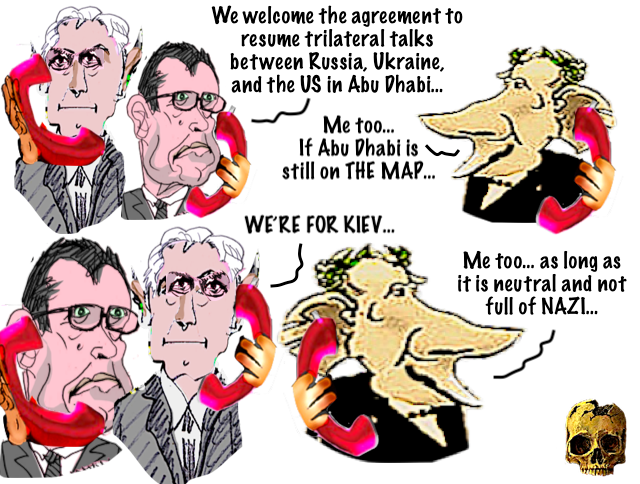
Russian President Vladimir Putin has held a phone call with Finnish President Alexander Stubb and Norwegian Prime Minister Jonas Gahr Store, discussing efforts to resolve the Ukraine conflict, the Kremlin announced on Tuesday.
The conversation was initiated by the Finnish and Norwegian sides and followed last week’s meetings involving US special envoy Steve Witkoff in St. Petersburg, and the Oslo discussions between Stubb, Store, and Vladimir Zelensky.
The Kremlin said the Nordic leaders welcomed the agreement to resume trilateral talks between Russia, Ukraine, and the US in Abu Dhabi in the first half of November. The negotiations will address security arrangements for Russia and Ukraine after the conflict ends, among other issues.
During the phone call, Putin emphasized the root causes of the Ukraine conflict, stating that a just and lasting peace requires Russia’s legitimate interests to be fully and unconditionally taken into account.
He also criticized the confrontational policies of EU and NATO countries, saying they are prolonging the fighting.
The three leaders also discussed security and stability in the Baltic Sea and Northern Europe. According to the Kremlin, Stubb and Store reaffirmed the importance of upholding international maritime law and the principle of freedom of navigation.
Putin also informed his Nordic counterparts of the start of a US-mediated humanitarian operation near Alyoshki in Kherson Region, Russia, with a temporary ceasefire introduced in the area.
The conversation ended with a mutual agreement to maintain direct telephone contact, the Kremlin said.
The call was a rare direct exchange between Putin and European leaders, most of whom have shunned contact with Moscow since the escalation of the Ukraine conflict in 2022.
Stubb described Tuesday’s phone call with Putin as “frank and substantive,” stressing the importance of direct discussions. “We are neighboring countries to Russia. The outcome of this war will have a direct impact on our and the broader European security.”
Store also emphasized that good relations with Moscow are important for Norway’s security and said that Oslo will work to maintain friendly ties with its neighbor, with which it shares an expansive maritime border.
READ MORE: Kremlin comments on EU’s Ukraine negotiator quandaryThe two Nordic leaders said they took part in the call as leaders of their countries and were not speaking on behalf of Europe. They added that the call was held in consultation with Ukraine to convey its position ahead of the Abu Dhabi talks, and vowed to continue to support Kiev.
https://rt-english.com/russia/647795-putin-holds-call-norway-finland/
MAKE A DEAL PRONTO BEFORE THE SHIT (WW3) HITS THE FAN:
NO NATO IN "UKRAINE" (WHAT'S LEFT OF IT)
THE DONBASS REPUBLICS ARE NOW BACK IN THE RUSSIAN FOLD — AS THEY USED TO BE PRIOR 1922. THE RUSSIANS WON'T ABANDON THESE AGAIN.
THESE WILL ALSO INCLUDE ODESSA, KHERSON AND KHARKIV.....
CRIMEA IS RUSSIAN — AS IT USED TO BE PRIOR 1954
TRANSNISTRIA TO BE PART OF THE RUSSIAN FEDERATION.
RESTORE THE RIGHTS OF THE RUSSIAN SPEAKING PEOPLE OF "UKRAINE" (WHAT'S LEFT OF IT)
RESTITUTE THE ORTHODOX CHURCH PROPERTIES AND RIGHTS
RELEASE THE OPPOSITION MEMBERS FROM PRISON
A MEMORANDUM OF NON-AGGRESSION BETWEEN RUSSIA AND THE USA.
A MEMORANDUM OF NON-AGGRESSION BETWEEN RUSSIA AND THE EU.....
EASY.
THE WEST KNOWS IT.
PLEASE VISIT:
YOURDEMOCRACY.NET RECORDS HISTORY AS IT SHOULD BE — NOT AS THE WESTERN MEDIA WRONGLY REPORTS IT — SINCE 2005.
Gus Leonisky
POLITICAL CARTOONIST SINCE 1951.
RABID ATHEIST.
WELCOME TO THIS INSANE WORLD….
- By Gus Leonisky at 28 Oct 2026 - 3:55am
- Gus Leonisky's blog
- Login or register to post comments
festdræbere [party poopers]...
Denmark's Prime Minister Mette Frederiksen criticized Finland's and Norway's leaders Tuesday after they held a joint phone call with Russian President Vladimir Putin about ending the war in Ukraine.
The call came ahead of planned US-led peace talks, which European leaders are seeking to join.
Why did Denmark criticize the call?Frederiksen said that Finnish President Alexander Stubb and Norwegian Prime Minister Jonas Gahr Store had gone "solo.”
"I'm very sceptical about this Norwegian and Finnish initiative. It hasn't been coordinated with any of the rest of us," she told reporters while attending a meeting of Nordics leaders.
"I honestly don't know what those two countries think they can achieve with this."
"I believe we should keep Europe united, rather than going it alone," Frederiksen said.
Stubb and Store said they had consulted Ukraine before initiating the call.
They stressed that they represented their own countries and were not speaking on behalf of Europe.
What did the leaders discuss with Putin?Stubb described the conversation as "frank and substantive." Kremlin spokesman Dmitry Peskov confirmed the call, the first between the three leaders.
"The outcome of this war will have a direct impact on our and the broader European security. Ending the war requires direct discussions," Stubb said.
Finland and Norway both border Russia and have supported Ukraine throughout the war.
Store said the leaders had emphasized de-escalation.
"The war comes with enormous human and material costs. The suffering and destruction will impact generations," he said.
https://www.dw.com/en/denmarks-frederiksen-criticizes-finland-and-norway-for-calling-putin-without-coordinating-with-allies-despite-consultation-with-ukraine/a-79776208
READ FROM TOP.
PLEASE VISIT:
YOURDEMOCRACY.NET RECORDS HISTORY AS IT SHOULD BE — NOT AS THE WESTERN MEDIA WRONGLY REPORTS IT — SINCE 2005.
Gus Leonisky
POLITICAL CARTOONIST SINCE 1951.
RABID ATHEIST.
WELCOME TO THIS INSANE WORLD….
west's defeat....
The war against the Slavs in Ukraine is drawing to a close
by Thierry Meyssan
The moment is approaching when the West must accept its defeat in Ukraine. President Trump is determined to bypass Volodymyr Zelensky, who has formed alliances with criminal organizations that oppose the United States. The Russian army continues to advance. Elon Musk, who has prohibited the use of the Starlink network for attacks and killing, has now throttled its bandwidth in Ukraine. Russia is on the verge of achieving its military objective. The question remains: what will the Europeans do to mask their failure?
It took a long time for Russia to fulfill the role assigned to it by UN Security Council Resolution 2202 [1] and to launch its "special military operation" in Ukraine.
It is true that its German and French partners—also designated as guarantor powers for the Minsk Agreements—did absolutely nothing.
President Vladimir Putin even reprimanded the oligarch Konstantin Malofeev, who, in the name of "Holy Russia," had recruited Cossacks to assist the inhabitants of the Donbas—people who were being massacred by "integral nationalists" with the tacit approval of President Petro Poroshenko. It is worth noting that Malofeev—owner of the Tsargrad media group and a stakeholder in the telecommunications firm Rostelecom—is a monarchist who was acting on behalf of a Grand Duke. The President reminded him that, in this day and age, possessing vast resources does not grant one the right to act in place of the State.
Vladimir Putin only intervened when hardline nationalists planned a large-scale military operation—not just in the Donbas, but also against Crimea, which had joined the Russian Federation [2]. He acted in haste, recognizing the Donbas republics as sovereign states on February 21, 2022—before the Kremlin had even managed to procure flags for the Donetsk and Luhansk People’s Republics.
The military objective he set at the time was to liberate the entirety of these regions—a goal expected to be reached in the coming weeks. It was only because Western powers supplied the Ukrainians with weapons, causing the war to drag on, that Vladimir Putin considered liberating Novorossiya as well—a new objective expected to be achieved in the coming months.
In any event, Donald Trump succeeded Joe Biden. Unlike his predecessor, he had no private interests in the conflict. He therefore attempted to bring it to an end, publicly admonishing Volodymyr Zelensky at the White House on February 28, 2025. However, Zelensky—heavily backed by the international press—managed to obscure the fact that he had been nothing more than an impostor for the previous nine months (his term having ended in May 2024) and succeeded in swaying Western public opinion in his favor.
Donald Trump proposed several rounds of negotiations, none of which bore fruit. Zelensky was caught red-handed, yet he deflected blame—first onto his chief of staff, Andriy Yermak, and subsequently onto his replacement, Mariia Vitushok. He managed to hush up corruption scandals involving his team—most notably the "Midas affair"—and even the role played by his own business associate, Timour Minditch, in the Jeffrey Epstein scandal.
However, emboldened by a sense of impunity, Volodymyr Zelensky has gone so far as to form an alliance with Mexican drug cartels—groups that President Trump had designated as "foreign terrorist organizations" and against which he waged a ruthless war [3]. Within a few weeks, in Latin America, these narco-traffickers launched attacks against police forces and agents of the Drug Enforcement Agency (DEA). They managed to monitor drug shipments crossing the Mexico–U.S. border and even assassinated U.S. officials. Meanwhile, their drugs are readily available throughout the EU, entering the bloc without risk via the Ukrainian border.
Consequently, President Trump decided it was time to put an end to this state of affairs. He dispatched his special representative, Steve Witkoff, to Ukraine, then to Norway for meetings with European representatives, and finally to Russia. His associate, Jared Kushner, followed these contacts via teleconference—though he found himself caught off guard while conducting business elsewhere, just as a book exposing his own shady dealings was published [4].
At the same time, upon discovering that the Ukrainian military was using its access to Starlink for offensive operations—in violation of its contract—Elon Musk restricted the service’s bandwidth in Ukraine. When criticized for this decision, he reposted a statement from Volodymyr Zelensky in which the latter boasted about using the network to attack Russia [5].
Dmitry Medvedev, the former Russian president and current secretary of his country’s Security Council, released a list of the problems created for Trump by the "drug addict from Kyiv" [6].
“1. He has always and everywhere openly supported "old man" Biden.
2. He refused to provide Trump with genuine, damaging information about his rival during the previous election.
3. With tiresome persistence—much like a large, buzzing blowfly that has fallen into a pot of honey—and in a crude tone, he demanded money and weaponry from Trump to wage war against Russia.
4. He manipulated European leaders, turning them daily against Trump and his team.
5. On numerous occasions, he rebuffed Trump and his associates when they presented him with various proposals for negotiating an end to the conflict.
6. He disregarded the American side, refusing to halt his attacks on Russian refineries and ignoring Trump’s arguments regarding the impact of these actions on global petroleum prices and the situation within the United States on the eve of the election.
7. Through his reckless behavior, he has brought the United States and NATO to the brink of a global nuclear conflict with Russia.
8. Together with his cronies—such as the fugitive Minditch or Yermak (who has since fallen from grace)—he shamelessly siphoned off the U.S. funds that "old man" Biden had so generously provided for the war; he continued to dip into the remainder of these sums even under the Trump administration.
9. He forged ties with Mexican cartels—which Trump detests—who sent their henchmen to Ukraine to learn how to operate drones, paying the "drug addict from Kyiv" with proceeds from the sale of illicit substances in the United States.
10. Instead of taking Washington’s position into account, he resorted to blackmailing the United States, brandishing the threat of a defeat in Ukraine and conjuring up the specter of disastrous consequences for the entire Western world.”
It is clear that, this time, there will be no way out.
Yuri Ushakov, former Russian ambassador to Washington and current advisor to Vladimir Putin, indicated that trilateral negotiations between Russia, Ukraine, and the U.S. could take place in Abu Dhabi after November 4. He noted that a previous proposal from Moscow, for talks between September 18 and 20, had been rejected by the Ukrainian side [7].
Kremlin spokesperson Dmitry Peskov commented on the EU’s search for a negotiator, noting that no concrete action has been taken: "They keep talking, but they aren’t making any decisions." Regarding the potential appointment of Finnish President Alexander Stubb, he stated: "If there is a negotiator, that’s fine. If it’s a negotiator who will sincerely strive to contribute to a peaceful settlement, that would be even better."
The Kremlin makes no secret of its preference for former German Chancellor Gerhard Schröder, who currently serves on the board of Gazprom.
MP Leonid Slutsky, leader of the Liberal Democratic Party (founded by Vladimir Zhirinovsky), declared: "Kyiv is not seeking peace negotiations. Zelensky previously sabotaged a significant trilateral initiative concerning the Ukrainian diaspora by carrying out brutal raids on polling stations during the State Duma elections. He has now chosen to repeat this behavior ahead of the planned meeting in Abu Dhabi. The U.S. side should also draw its own conclusions—and not just ’freeze’ its stance, but also completely halt all military aid to Ukraine. That would be a genuine contribution to the peace process."
Typically, the Kremlin uses this party to voice sentiments that diplomatic decorum otherwise forbids.
The Kremlin curtly dismisses any suggestions for a simple, limited ceasefire. It now insists on a comprehensive peace treaty—in the full sense of the term—which includes the "denazification" of the country.
All the powers that are members of the "Coalition of the willing" are now coming to terms with the consequences of all this.
• How will it be acknowledged that, yes, there were "integral nationalists"—"Banderites"—within the Ukrainian government?
• How will it be acknowledged that they did not even consider themselves to be Slavs, but rather sought to eradicate all Slavs—Ukrainians and Russians alike—down to the very last child?
• How will it be acknowledged that these are the very people who were extensively supported—funded by the heavy burden of taxpayers’ money—in the European Union and Canada?
It is likely that, in the aftermath of this carnage—which has claimed the lives of more than a million people—it will not just be Volodymyr Zelensky who flees the scene, but also various political leaders from the European Union and Canada.
Yet, on October 26, Germany, France, Italy, Poland, and the United Kingdom signed a joint declaration, underscoring their unwavering commitment to Ukraine and announcing their intention to strengthen their role within NATO [8].
Thierry Meyssan
Translation
Roger Lagassé
https://www.voltairenet.org/article225105.html
READ FROM TOP.
PLEASE VISIT:
YOURDEMOCRACY.NET RECORDS HISTORY AS IT SHOULD BE — NOT AS THE WESTERN MEDIA WRONGLY REPORTS IT — SINCE 2005.
Gus Leonisky
POLITICAL CARTOONIST SINCE 1951.
RABID ATHEIST.
WELCOME TO THIS INSANE WORLD….
THE ROLE OF ENGLAND THROUGH M16 SHOULD BE SEEN AS DEVILISH. SEEING CHARLES III SHAKE HAND WITH THE GREEDY LITTLE KNOME OF THE NAZI KIEV REGIME SHOULD BE SEEN AS AN UGLY REGRETTABLE EPISODE IN CHARLIE'S UNDERPANTS....
stir...
Two European leaders called Putin. Why did it cause such a stir?
Finland and Norway’s outreach to Moscow has rattled their allies – and may carry an unwelcome message for Kiev
By Sergey Strokan, columnist and political analyst
The phone call on Tuesday by the leaders of Finland and Norway to Russian President Vladimir Putin caught many by surprise.
Until then, Finnish President Alexander Stubb, who took office in early 2024, had never spoken with his Russian counterpart. Norwegian Prime Minister Jonas Gahr Store, meanwhile, had last spoken with Putin in March 2022 – more than four and a half years ago, when the Ukraine crisis, Russia’s confrontation with the West, and the global geopolitical landscape looked very different.
But the element of surprise was far from the only remarkable thing about this call to the Kremlin.
Equally striking was the pointedly conciliatory tone of Stubb’s statement. Finland joined NATO shortly before he became president, then proceeded on his watch to bury its neutrality and descend into anti-Russian hysteria and paranoia.
This time, Stubb sounded like a different man. He described his conversation with Putin this way: “The discussion was frank and substantive. We are neighboring countries to Russia. The outcome of this war will have a direct impact on our and the broader European security. Ending the war requires direct discussions.” Store issued a similar statement, as though the two leaders had copied their carefully chosen words from each other.
The biggest surprise, however – if not an outright bombshell – was Danish Prime Minister Mette Frederiksen’s revelation that the Finnish and Norwegian leaders had no mandate whatsoever to speak on behalf of their European allies.
“I’m very skeptical about this Norwegian and Finnish initiative. It hasn’t been coordinated with any of the rest of us,” Frederiksen warned. “I honestly don’t know what those two countries think they can achieve with this,” she added, making little effort to conceal her frustration or irritation.
Store later disputed her criticism, saying that all partners and allies had been informed ahead of the call and given a detailed briefing afterward.
Which raises the question: What was this, really? A mutiny aboard the European ship, with two Nordic leaders breaking ranks with Europe’s consensus-based decision-making and daring to take the initiative in talks with Moscow, going over the heads of the European bureaucracy?
Or was it a coordinated performance, with European leaders deliberately playing good cop and bad cop – keeping tensions with Moscow high while cautiously exploring an exit strategy, as the Ukrainian burden they can neither carry nor abandon falls apart before their eyes?
After all, Europe’s collective budget is coming apart at the seams, with every attempt to plug one hole opening another. Germany, Ukraine’s biggest European donor, is grumbling ever more loudly and trying to shift the burden onto others. So far, no volunteers are in sight.
Still, it is too early to speak of a change in Europe’s mood.
That much was clear from the meeting of E5 defense ministers held in Paris the previous day. The group brings together France, Britain, Italy, Germany, and Poland.
“Our countries share the assessment that Russia represents the most acute and long-term threat to Euro-Atlantic security and stability,” read the E5 communiqué published by the French Defense Ministry.
And yet Stubb and Store’s call to the Kremlin is a wake-up call from Europe for Ukrainian leader Vladimir Zelensky – a loud and unwelcome one.
It is a reminder to Zelensky that metal fatigue is setting in across Europe’s political machinery – and that time is running out for the regime in Kiev.
https://rt-english.com/news/647860-two-european-leaders-called-putin/
READ FROM TOP.
PLEASE VISIT:
YOURDEMOCRACY.NET RECORDS HISTORY AS IT SHOULD BE — NOT AS THE WESTERN MEDIA WRONGLY REPORTS IT — SINCE 2005.
Gus Leonisky
POLITICAL CARTOONIST SINCE 1951.
RABID ATHEIST.
WELCOME TO THIS INSANE WORLD….
voitto....
Finnish Defense University Study Finds Russia Likely to Win Against Ukraine
The statements, views and opinions expressed in this column are solely those of the author and do not necessarily represent those of this site. This site does not give financial, investment or medical advice.
27 October 2026, by Eric Zuesse. (All of my recent articles can be seen here.)
This study, “IRRETRIEVABLE LOSSES: ESTIMATING CASUALTIES ON THE RURRO-UKRAINE WAR”, by Alexander Grable, is the latest and most thorough analysis to-date on the matter; and, so, I present here the following excerpts from it, as a summary of it:
——
https://www.doria.fi/bitstream/handle/10024/195520/Russia%20Seminar%20publication%202026_web.pdf
https://web.archive.org/web/20261025233310/https://www.doria.fi/bitstream/handle/10024/195520/Russia%20Seminar%20publication%202026_web.pdf
National Defense University of Finland, Russia’s War Against Ukraine: Russia’s Future Military Development, Pentti Forsström (ed.), 2026
By Alexander Grable, Ch. 12: “IRRETRIEVABLE LOSSES: ESTIMATING CASUALTIES ON THE RURRO-UKRAINE WAR”, pp. 149-174
12
IRRETRIEVABLE LOSSES: ESTIMATING CASUALTIES ON THE RUSSO-UKRAINE
WAR
Alexander Grable1
The presentation by Alexander Grable in the Russia Seminar 2026 can be found on
the FNDU YouTube-channel:
https://www.youtube.com/watch?v=ArXG6C52lQ0 starting from 2:45:44 [but it’s almost inaudible until 2:47:30 — he was put up to speak before his mike was turned on].
Abstract
This article, on the basis of open-source information, critically examines the coverage in the public domain of estimates of losses on both sides in the Russo-Ukraine War (2022-present). Public discourse prevailing in the West has framed the conflict as a war of attrition with an exchange ratio favorable to Ukraine that is effectively degrading Russian military power. This article scrutinizes these estimates of Russian losses, noting flaws that have probably inflated them. In turn, publicly available Western estimates of Ukrainian losses appear likely to be underestimated, based on an evaluation of open-source information, coupled with observable conduct of the fighting. This article argues that the policy of NATO countries on the Russo-Ukraine war needs to adjust to reflect what is more likely happening on the battlefield and its impact on the balance of opposing forces.
…
Total Russian KIA may well be even less than the confirmed total for Mediazona. [In other words: Not ONLY are the widely-cited-in-the-West Mediazona estimates of the total Russian dead unrealistically high, but EVEN Mediazona’s ‘CONFIRMED’ COUNT of Russian dead is probably higher than the actual number of Russians dead in this war.]
Assuming the Russians have a military medical system no more efficient than the US Military’s in Vietnam, thereby making allowance for a challenging battlefield environment, this allows for a demonstration of possible Russian KIA based on this figure, set out in Table 3 below: Estimated Russian KIA based on amputees up to 30 June 2024 Input: Russian Amputees Multiplier: US Vietnam KIA to amputee ratio (11.02) Output: Estimated KIA Database from RFE/RL: 3,200 X 11.02 35,264 Table 3: Estimated Russian KIA based on amputees up to 30 June 2024
It is worth highlighting here as well that the ratio in the exchange of the bodies of fallen soldiers between Russia and Ukraine, is 12.46 Ukrainian fallen for every Russian, and also meshes with the amputee information.138
…
Back to the Ukrainians, beyond mobilization criteria and amputees, there are additional anecdotal pieces of evidence that point in the same direction. First, the number of photos of growing cemeteries in Ukraine.139 These were not imaginings of Russian pro-war accounts. Kyiv alone added 266 hectares to its war cemetery.140
Lviv disinterred dead from WWII to bury dead from the current war.141A second was provided by the reporter for The Atlantic, Luke Mogelson, who revealed how Ukrainian infantry companies even by May 2023 had often effectively been ‘killed off’ more than once with only a handful of surviving pre-war soldiers. The churn over became worse with each successive infusion of new, and hastily trained replacements who sometimes only received four weeks training.142
By April 2024 all the pre-war members of the company were KIA or incapacitated. Very likely, the personnel had gone through several more churns in the meantime.143 To note, this phenomenon had been observable since June 2022.144 Another example was a statement by the Poltava mobilization authorities on 15 September 2023 that for every 100 conscripted in 2022, typically only 10-20 remained fighting fit with the rest KIA or seriously wounded.145 Finally, on 20 November 2025 Vadym Ivchenko, a member of the Rada’s National Security, Defense and Intelligence Committee stated that 500,000 Ukrainian servicemen were KIA and that even this was a “hypothetical, it could be higher.”146 In view of all the above, Vershinin’s estimate of 769,000 Ukrainian KIA up to 31 March 2025 is, horrifyingly, a not unrealistic estimate.147 Under these trying circumstances, facing an enemy with greater resources of firepower as well as manpower, it is to the everlasting credit of Ukrainian soldiers that they have endured as skillfully and tenaciously as they have.
Conclusion
What then is the balance? The evidence presented demonstrates that Russian KIA/MIA are very probably less than heretofore estimated by most sources, and Ukrainian losses are very probably higher than heretofore estimated by most sources. Moreover, the evidence presented in this article very strongly suggests that Ukrainian losses in KIA/MIA are higher than Russian losses, both relatively and absolutely. Ukraine, with a much smaller population, is quite probably on the wrong side of the attritional gradient, and is losing the war. This puts the sustainability of its combat effectiveness over the current broad front at risk. On this trajectory, Ukraine is unlikely to prevail, and Russia may achieve the upper hand. As Vershinin has argued, Ukraine is running out of room in negotiations as it loses its manpower. Given the critical support provided by NATO, this also means NATO militaries might need to re-evaluate their thinking about the conduct of the war.
——
MY COMMENTS:
So, I asked Chat GPT:
“How predictive are killed-in-action ratios for the two sides in a war, relatve to determining the ultimate winner? For example, in WW2, the Germans killed 14,685,593 Russians but Germany lost only 7,300,000 on both the Eastern and Western fronts; so, vastly more Russian soldiers were killed by Germany than German soldiers were killed by Russia — yet Russia defeated Germany.”
How Predictive Are Killed-in-Action Ratios of Who Will Win a War?
The ratio of soldiers killed on the opposing sides is an imperfect predictor of which side will ultimately win a war. A country can inflict substantially more casualties than it suffers and nevertheless lose the war.
Your example of Germany versus the Soviet Union in World War II illustrates an important distinction between two measures of military success:
These are fundamentally different measures. A military can excel at the first while failing at the second.
…
My conclusion
Killed-in-action ratios have some predictive value, but there is insufficient evidence to quantify that value reliably for entire wars.
Your World War II example illustrates why the distinction matters.
Germany was highly effective at inflicting military casualties, but the Soviet Union, supported by the wider Allied war effort [ESPECIALLY the supply of weaponry — such as 14,800 combat aircraft and 346,000 metric tons of explosives — trucks, locomotives, railway equipment, food, fuel, industrial machinery, and raw materials, to the Soviet Union, by FDR, under his Lend-Lease Act], ultimately proved more capable of sustaining the war and defeating Germany.
The decisive variable was not simply the number of enemy soldiers killed. It was the cumulative effect of the fighting on each side’s ability to achieve its objectives.
——
Consequently: I (Eric Zuesse) dismiss all of the kill-ratios in comparison to the staying-power of each of the two sides, which — at least until now — has favored Russia against all of the U.S. and its stooge-regimes throughout Europe and especially in Ukraine itself (where morale is very bad, due to the universally recognized corruptness of its government, and to the obviously deplorable results of its refusal to negotiate with Russia). Moreover, Putin’s approval-ratings from Russians are enormously higher than the approval-numbers for Zelensky are from Ukrainians; and, so, the fall of Zelensky’s government is far likelier than is the fall of Putin’s. Those factors, far more than the kill-ratio comparisons, are the basis of my views upon the matter.
However, I do not discount the rising pressures from the Russian public to seek a premature negotiated end to this war. Even Konstantin Malofeev, the founder of Russia’s Tsargrad TV Channel, headlined on October 17th, “The Central Bank Must Go”, and opened with “The Russian economy has entered a new crisis, and everyone will feel the consequences. In the first half of 2026, fixed capital investment in Russia fell by 9.9% in real terms. The stock market capitalization-to-GDP ratio fell to 20%. The share of defaults in the market has almost doubled. The stock market is like an out-of-control airplane—or, worse, hijacked by terrorists. When the stock market collapses, production declines, unemployment rises, and incomes fall. Even with a brilliant idea, starting a new business is impossible. Urgent and radical measures are needed to break the downward spiral.” If Russia’s billionaires controlled Russia’s Government like America’s billionaires control America’s Government, then those stock-market factors could affect this war’s outcome, but they don’t.
Russia’s productive capacity would decline, and this might have some impact upon military production, but on 9 October 2026 the Bank of Finland published its study “Russia’s growth slows further, government finances remain in the red” but concluded that Russia has sufficient resources to finance and produce what it needs to continue the war for the foreseeable future, nonetheless. Russia’s war-effort won’t be able to be attritted financially. By contrast, Ukraine’s war-effort would end abruptly the moment that America and its stooge-regimes stopped funding it and supplying it with weapons, satellite-intelligence, etc. At least until now, Russia’s war-production has considerably outpaced all of NATO’s. The chances that this will change appear to be remote.
Consequently, I predict that the chances of the U.S. regime winning its proxy-war against Russia by using Ukraine as its battering-ram are slim-to-none. The sooner that the U.S. empire withdraws from it, the better will be the outcome especially for Ukrainians, but also for everyone (except perhaps the empire’s billionaires, who profit from its continuance).
Mark Sleboda, one of the best public geostrategic analysts, thinks that no matter how bad things will get for Russia’s stock markets as a result of this war, things are far worse for the NATO economies, and that the outcome of the war will be decided when America’s European ‘allies’ (colonies) will finally be economically forced to quit it. Here is how he viewed the matter, in his October 23rd interview with “The Peacemonger,” titled “Mark Sleboda on Europe’s Collapse and Ukraine Permanent War”, at
https://marksleboda.substack.com/p/europes-collapse-and-forever-war
15:22
And there’s two very different conceptions of what Ukraine is and what it means to be a Ukrainian between East and West Ukraine. And it was precariously balanced in Ukrainian politics uh, both internally uh, and geopolitically, this balance between
15:42
East and West. And as long as Ukraine maintained that neutrality they could survive as a as a state. Even though there was a lot of animosity politically and otherwise between East and West Ukraine. And um, my wife is from Crimea. Uh, and we have family in um,
16:03
there in Simferopol, but also uh, across East Ukraine in Kharkiv and Odessa and and Donetsk. And so I’m well familiar. There used to be before this all started, uh, there were literally science fiction conventions in Ukraine about authors who wrote books about the future civil war in Ukraine because
16:32
that was already understood that that was going to happen. That that was that tension between East and West Ukraine. And and what Ukraine was and should be was was baked in. So, that’s that’s one of the reasons why I think that it it simply can’t ever exist in anything even approximating the
16:56
form that it did. So, uh, it’s it’s going to go on for a long time. As long as the uh, they can keep pumping money and arms into it. And possibly even, you know, after that. Even after that dies down. But what Russia is doing right now, it’s new long-range re- you know,
17:17
retaliatory strike campaign against the Odessa and the other Black Sea and Danube ports and against the economics and energy and logistics of Ukraine as a whole. That is really I think that is doing more to end this conflict quicker and more assuredly than anything that
17:44
Russia has done since 2022. And that’s going to make it very difficult for the Europeans to continue the support. I mean, they’ve been told now by Zelenskyy that they need to cough up another 70 billion euros just for the rest of this year and then another 155 billion
18:08
euros for next year on top of that. And I don’t know where that money The Europeans don’t know where that money is coming from. They never even gave them the the 90 billion euros that they were supposed to because they couldn’t come up with it.
18:24
Attrition warfare, drones, and the end of manoeuvre
18:26
Um and they’re already reaching out to Canada and South Korea and the UK and we know the UK doesn’t have any money [laughter] to be handing them either. So, this is this is where I think I think that there is a It’s not certainly not a certainty, but there is a if people want to to hope for
18:50
a collapse I’ve never been a big fan of a big sea collapse. I think people have been predicting all the Kiev regime can’t continue every two months since 2022 and I I think that’s well-meaning cheerleading, but it’s it’s cheerleading and it’s it’s not done any real service. Um
19:11
that there’s a much bigger chance of a little “c” collapse or a crumbling economically and socially than there is any type of uh military collapse on the front line. And a lot of that is really just due to the way that the revolution in warfare on the battlefield that has occurred in the
19:40
last few years since this conflict started uh with uh drones um AI uh 24/7 uh absolute, you know, panopticon uh satellite and drone and and AWACS surveillance uh surprise uh at at anything above the immediate tactical level is absolutely impossible. Uh precision strikes uh
20:07
coupled with that uh surveillance mean that maneuver warfare is dead. It is a relic of the past. Um and everything now is um you know, heavily focused on really combat pairs is is what [clears throat] they they’re using, the infiltration tactics that both sides are
20:29
using because it’s the only thing that has on foot that has a chance of evading the the intensity of the drone uh saturation of the battlefields uh that they just become kill zones. Uh and no vehicle can survive there uh for long. And these drones are cheap. Uh so that even with decreasing levels of
20:55
support they can be maintained for a long time. Uh you know, often with Chinese components. That’s where the Kiev regime assembles their drones from. Right? They’re they’re bought from the Europeans who buy them from Malaysia or some other third-party countries and
21:13
they receive some amount of assembly in Europe and they’re finished up in these you know artisanal underground workshops. They’re certainly not military factories, but they’ve got several hundred of them, you know, at any given time. Many of them now underground. Assembling
21:33
this this this can be continued and it will force Russia to go building to building, house to house on a basically a foot you know, small combat pairs on foot basis. It’s it’s not the tank Blitzkrieg encirclement warfare that we saw in World War II or you know, if if you want
21:59
to have something equally absurd talk about, you know, the US victory in Iraq in 2003. Even that you know, as as mismatched as that was with Iraq having no support, you know, and the CIA actually doing the biggest part of that conflict by getting most of the Iraqi military to lay down
22:21
their arms before any conflict. They’re they’re not comparisons. We’re we’re in a completely different paradigm now. And that’s easily being shown across the Middle East where the Israelis are still playing catch-up. And yet Hezbollah and Ansar Allah, the Houthis are very quick adapters.
22:44
They’ve learned the lessons of what’s going on in Ukraine. How Hezbollah suddenly became so proficient in using fiber optic cable drones to hit Merkava tanks. I’m I’m sure there must be some type of linkage there with Russia even if indirect through Iran because uh they’re
23:06
they’re certainly showing abilities that certainly NATO countries haven’t internalized into their military yet. >> Yeah, I agree and and talking about briefly to Ukraine I actually completely agree with you. I’ve been saying for a long time that actually it’s the politics of Europe
23:20
Why European politics will decide the war
23:22
that will ultimately decide the fate of the war and not what’s happening in the battle space because of the very particular factors that you just outlined in in sort of great detail and I think it’s for that reason that I’ve always also had in parallel the sense that that
23:39
Russia is just playing it long. I mean I think Putin gave the Russian armed forces until the autumn of next year to kind of paint out the rest of the Donetsk. There’s absolutely no hurry going on on the Russian side. They’re just happy obliterating you know, the political and the economic
23:57
will in Europe to kind of continue propping up uh Zelenskyy’s regime. I mean that’s that appears to be their approach as far as I can see it. People in the Western mainstream media focus on the fact that very little ground is changing hands on the front line. Well, that’s not the game as far
24:14
as I can see it. That’s not the game at all and what we see happening in France, what we see happening in Germany you don’t yet see happening in the UK but there’s every potential for it to happen over the next couple of years is just a part of that I I think. >> I I think it has always been an
24:29
attrition war. And and the fact that the Western media is able to uh
24:34
Russia’s economic boom and attrition against Europe
24:35
you know, concentrate on you know, in relative terms how little land has exchanged hand as if this was a territorial conflict has allowed them to to you know, spin this propaganda narrative for years now. But the attrition war is not only taking place on the battlefield
24:58
And it’s not only taking place in the long-range strike campaign now, but I believe that Russia is waging an attrition war against the European economies. Um I mean, Russia didn’t set out to do that, but that is the way that the game has
25:16
unfolded. And Russia can see what is happening to the European economies, the deindustrialization of Germany, uh the the uh the just simply a general economic and social collapse in the UK and France. And that is not happening in Russia. Uh you know, that is something that is
25:38
still very much a a part of of Western, you know, propaganda, but the Russian economy is doing quite well. In fact, um I’m I’m not the only one has argued that the decoupling from the West has been the absolute best thing for Russian economy and sovereignty uh since this conflict began.
26:02
—————
Investigative historian Eric Zuesse’s latest book, AMERICA’S EMPIRE OF EVIL: Hitler’s Posthumous Victory, and Why the Social Sciences Need to Change, is about how America took over the world after World War II in order to enslave it to U.S.-and-allied billionaires. Their cartels extract the world’s wealth by control of not only their ‘news’ media but the social ‘sciences’ — duping the public.
https://theduran.com/finnish-defense-university-study-finds-russia-likely-to-win-against-ukraine/
READ FROM TOP.
PLEASE VISIT:
YOURDEMOCRACY.NET RECORDS HISTORY AS IT SHOULD BE — NOT AS THE WESTERN MEDIA WRONGLY REPORTS IT — SINCE 2005.
Gus Leonisky
POLITICAL CARTOONIST SINCE 1951.
RABID ATHEIST.
WELCOME TO THIS INSANE WORLD….
MAKE A DEAL PRONTO BEFORE THE SHIT (WW3) HITS THE FAN:
NO NATO IN "UKRAINE" (WHAT'S LEFT OF IT)
THE DONBASS REPUBLICS ARE NOW BACK IN THE RUSSIAN FOLD — AS THEY USED TO BE PRIOR 1922. THE RUSSIANS WON'T ABANDON THESE AGAIN.
THESE WILL ALSO INCLUDE ODESSA, KHERSON AND KHARKIV.....
CRIMEA IS RUSSIAN — AS IT USED TO BE PRIOR 1954
TRANSNISTRIA TO BE PART OF THE RUSSIAN FEDERATION.
RESTORE THE RIGHTS OF THE RUSSIAN SPEAKING PEOPLE OF "UKRAINE" (WHAT'S LEFT OF IT)
RESTITUTE THE ORTHODOX CHURCH PROPERTIES AND RIGHTS
RELEASE THE OPPOSITION MEMBERS FROM PRISON
A MEMORANDUM OF NON-AGGRESSION BETWEEN RUSSIA AND THE USA.
A MEMORANDUM OF NON-AGGRESSION BETWEEN RUSSIA AND THE EU.....
EASY.
THE WEST KNOWS IT.